Covid-19 will soon be declared endemic in Thailand, leading virologist Dr Yong Poovorawan announced on Tuesday.
In a Facebook post, he pointed out that the number of Covid-19 infections in the country is declining and very soon this virus will become endemic like influenza.
For instance, he said, influenza spread widely in 2009 before becoming endemic in 2010. Influenza still exists and there is a regular outbreak, especially during the rainy season from May to September, he said.
Hence, Dr Yong said students should be given their flu shots now that schools have reopened and the rains have started.
He also said that if it becomes necessary to administer Covid-19 vaccines every year, jabs should be given before schools open.
Thailand has been advised to consider quarantining travellers from South Africa and Portugal after recent reports show that the more infectious BA.4 and BA.5 Omicron subvariants are fast spreading there.
The European Centre for Disease Prevention and Control (ECDC) recently named BA.4 and BA.5 as variants of concern.
Public Health Commission vice-chairman Chalermchai Boonyaleephan said on Monday that the Omicron BA.2 subvariant is the dominant strain in many countries, including Thailand.
However, both BA.4 and BA.5 that have been found in South Africa spread faster than the BA.1 subvariant and can infect people despite them being vaccinated or being infected with Covid-19 earlier.
He also predicted that the BA.5 subvariant will become the dominant strain in Portugal by Sunday (May 22) as 37 per cent of the population is already infected with the BA.5 subvariant.
“Thailand should consider quarantining tourists from Portugal and South Africa or at least having them undergo RT-PCR tests to prevent these subvariants from entering the country,” he said.
He added that ECDC has warned European countries to beware of these subvariants and has advised both countries to give the elderly and people with chronic diseases a fourth jab.
“The World Health Organisation, however, has not named BA.4 and BA.5 as variants of concern yet,” he added.
Separately, leading virologist Dr Yong Poovorawan said an mRNA booster for people whose first two jabs are inactivated vaccines helps boost immunity against Covid-19 effectively.
“The immunity provided by a Pfizer booster after receiving two Sinovac or Sinopharm jabs is similar to three Pfizer jabs,” he said, citing a study conducted by Chulalongkorn University’s Centre of Excellence in Clinical Virology, which he heads. He added that this combination should also provide high immunity to children.
The national drug system development committee included antiviral drugs for hepatitis B and C, both of which could trigger liver cancer, on the National List of Essential Medicines on Wednesday.
Food and Drug Administration deputy secretary-general Surachoke Tangwiwat said 916 drugs are mentioned on the list.
He said the move aimed to enable more people to access hepatitis B and C antiviral drugs as both diseases could trigger liver cancer.
The price of hepatitis C antiviral drugs will become cheaper as the Government Pharmaceutical Organisation is now able to produce them, he noted.
“Patients who have hepatitis B will receive new drugs which can treat the virus effectively,” he said.
Surachoke added that the rising median price of some drugs has been “improved” to facilitate procurement and enable more people to access the drugs, such as granulocyte colony-stimulating factor, a glycoprotein that stimulates bone marrow.
On Wednesday, the National Communicable Disease Committee approved a strategy to eliminate hepatitis B and C between 2022 and 2030 as these diseases are considered a global public health problem.
Separately, expert virologist Dr Yong Poovorawan pointed out on his Facebook page on Thursday that the number of children with chronic hepatitis has increased in more than 20 countries.
Administering a Covid-19 vaccine booster dose to elders via an intradermal injection (ID) provided lower immunity but also fewer side effects, the Siriraj Institute of Clinical Research (SICRES) said.
SICRES announced the study result on the necessity for elders to receive a Moderna or Pfizer booster dose.
The institute said elders face the risk of suffering from severe Covid-19 symptoms so they need the booster dose for protection.
However, some of them are worried about side effects so they might not go in for vaccination.
The institute explained that ID used only one-fifth of a vaccine dose when compared to the intramuscular injection (IM) while also reducing side effects.
According to the study of 210 elders aged over 65 who received two doses of AstraZeneca, all of them gained immunity after a booster dose against the Omicron variant.
The study also confirmed that the immunity and side effects of ID is lower than IM, with the Moderna vaccine providing a higher immunity response than Pfizer.
SICRES concluded that elders need a booster dose to protect themselves from Covid-19.
Almost one out of every five young children in Thailand has already been infected with Covid-19, a leading virologist said on Monday.
Dr Yong Poovorawan said about 8 per cent of children aged 5-6 were infected during the Delta outbreak, citing an infection survey conducted by Chulalongkorn University’s Centre of Excellence in Clinical Virology, which he heads.
“The infection among this group of children increased to 17 per cent during the Omicron outbreak,” he said in a Facebook post on Monday.
“More than half of them were asymptomatic,” Yong added, explaining that their previous infection was shown by the presence of Covid-19 virus antibodies in their blood.
He said that 8 per cent of children aged 6-11 years who participated in the centre’s research study had also shown previous infection with asymptomatic Covid-19.
“This proves that small children may have already been infected with Covid-19 and these infections are likely to increase.”
However, most of them were asymptomatic and will have generated immunity against the virus in future, Yong added.
He believes many teenagers and adults have already been infected with Covid-19 unknowingly after experiencing no or only mild symptoms.
However, this should help create herd immunity and reduce the virus’s severity in the future.
Meanwhile, the Chula centre’s Covid-19 infection survey was a useful tool for making disease-control plans, he said.
It is advisable for people considered in the Covid-19 high risk group to take a fourth vaccine dose, a leading virologist said on Tuesday.
Dr Yong Poovorawan was responding on Facebook to a question on whether a fourth vaccine dose is necessary.
He said the first two doses of vaccines are fundamental vaccines while the third dose is the booster dose.
In his opinion, all people must receive two doses of fundamental vaccines and a booster dose.
He explained that an additional booster dose — the fourth dose — is necessary for people aged over 50, or people with congenital diseases.
He added that it is necessary for people with chronic diseases such as kidney ailments, cancer, or diseases related to the immunity system, to receive the fourth jab.
Also, people in high-risk situations such as medical personnel should also receive the fourth vaccine dose, he said.
Amid concern over the low rate of Covid-19 vaccination among Thailand’s elderly, a lung specialist has revealed stark evidence of the dangers for unvaccinated old people.
Dr Manoon Leechawengwongs posted a comparison on Facebook of two cases of Covid-19 in elderly patients.
The first patient had received two doses of AstraZeneca vaccine, while the second patient was unvaccinated.
The fully vaccinated patient is 74 years old and has hypertension as well as an enlarged prostate gland. He suffered fever, coughing, and a sore throat for three days and tested positive for Covid-19 on April 3. However, his oxygen saturation and lung X-ray were normal.
He took four capsules of Molnupiravir every 12 hours and had recovered well enough to return home after five days.
After two weeks of monitoring at home, he was given another lung X-ray and the result was normal.
The unvaccinated patient is 77 years old and was healthy and strong with no congenital diseases. He suffered coughing and phlegm for four days and tested positive for Covid-19 on April 11.
His oxygen saturation and lung X-ray were normal. His erythrocyte sedimentation rate (ESR) and high-sensitivity C-reactive protein (hs-CRP) were also normal.
He started taking Molnupiravir on April 12 and his symptoms improved after five days, with no side effects from the drug.
However, when he stopped taking Molnupiravir on April 18, he developed a fever and a cough on the same day. His ESR and hs-CRP level increased but his oxygen saturation and lung X-ray were normal. He finally recovered after another five days of treatment with steroids.
Manoon cited the comparison as evidence that receiving only two doses of vaccine is far safer than being unvaccinated.
Vaccination helped protect elderly patients against severe symptoms and pneumonia, he added.
He also said that Thai doctors should stop prescribing Favipiravir for severely ill Covid-19 patients as there are better medicines available.
According to government data, about one in six elderly people remain unvaccinated despite being among the group at highest risk of severe symptoms and death from Covid-19.
Booster shots provide 1.7 times less immunity against the Omicron BA.2 subvariant compared to the BA.1 subvariant, top virologist Dr Yong Poovorawan said on Friday.
In a Facebook post, Dr Yong said a recently conducted study shows that nearly all current Covid-19 patients in Thailand had been infected by the BA.2 subvariant.
The study, “Omicron BA.1, BA.2 and Covid-19 booster vaccination”, was published on Wednesday in the peer-reviewed Journal of Infectious Diseases.
His report also concludes that the mutation of the virus causes the immunity to drop slightly.
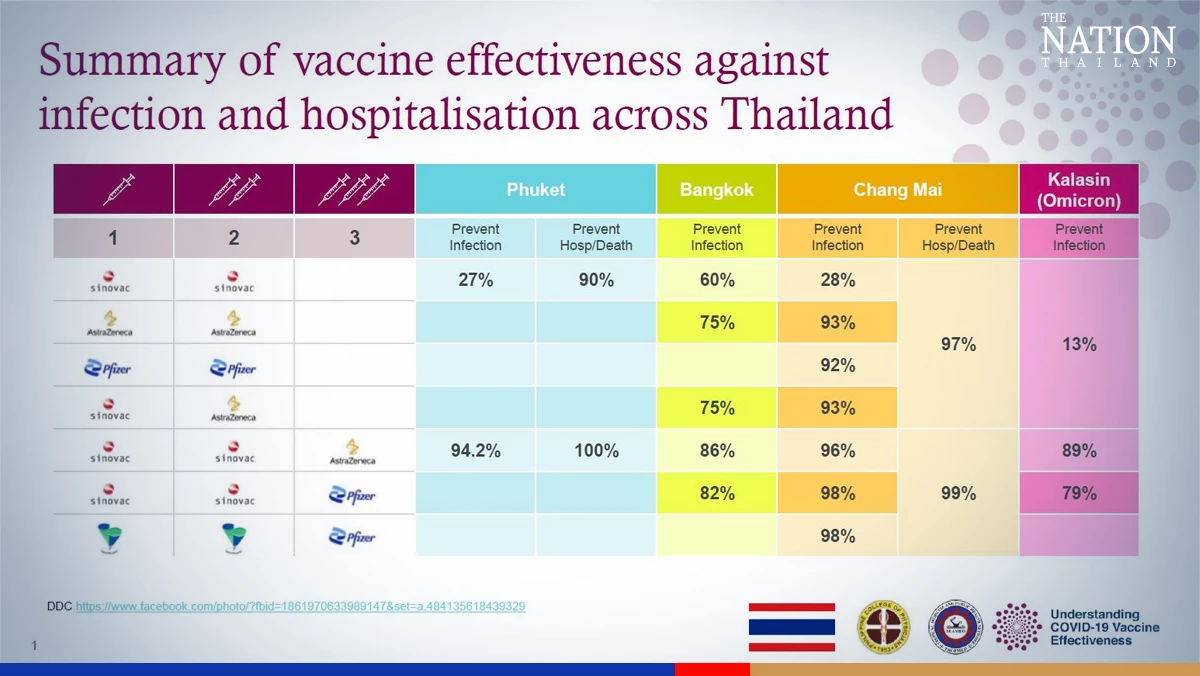
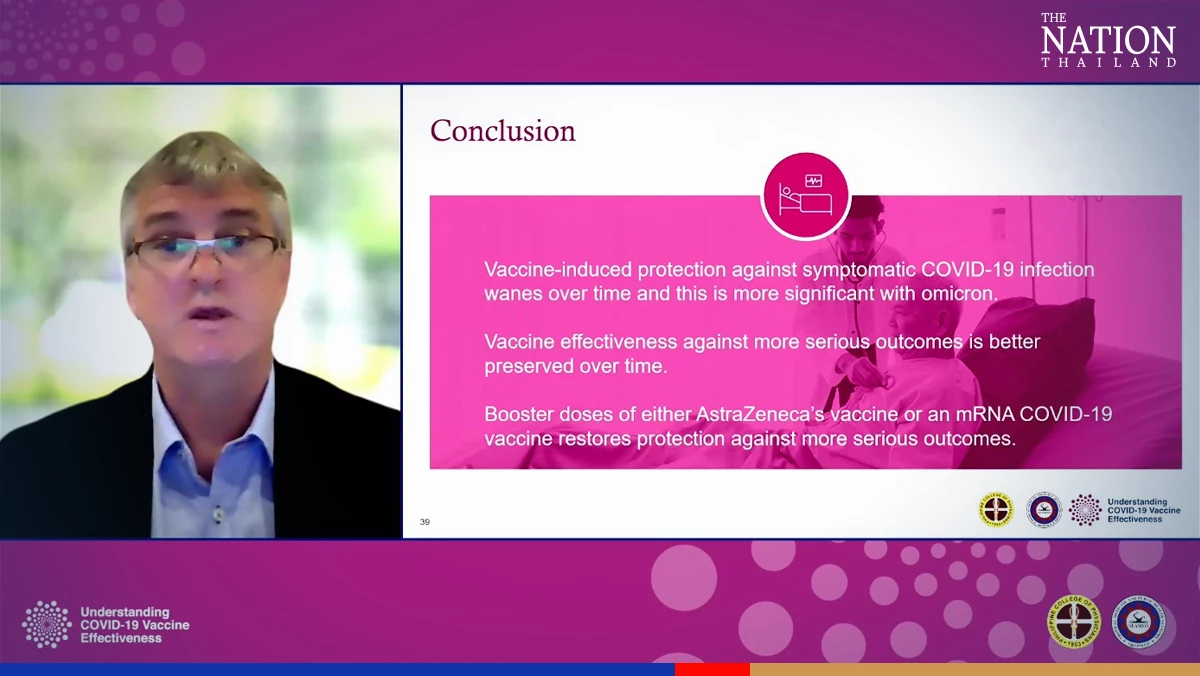
Data from 79 real-world studies show that AstraZeneca and mRNA Covid-19 vaccines provide equal protection against hospitalisation and death after two doses, several experts said on Wednesday.
The data indicated that both viral vector and mRNA vaccines, specifically Pfizer and Moderna, offer the same protection against hospitalisation (91.3-92.5 per cent) and death (91.4-93.3 per cent), regardless of age.
While data available at the time of review relates to Delta and earlier variants, emerging data indicate similar findings on serious Covid-19 outcomes resulting from Omicron.
“Covid-19 vaccines have been critical in saving lives and helping Southeast Asian countries return to some normalcy over the past year,” said Guy Thwaites, director of Oxford Clinical Research Unit in Vietnam.
“This is important information for the region’s policymakers as they consider the optimal deployment of Covid-19 vaccines in their populations over the next 12 months,” he added.
Meanwhile, National Vaccine Institute of Thailand deputy director Sunate Chuenkitmongkol said experts have to focus on all evidence, including antibody levels and effectiveness in real-world settings, to prove that a vaccine can effectively protect people from serious outcomes.
“We have reviewed 79 relevant real-world publications and proved that the most widely used viral vector vaccine and the available mRNA vaccines demonstrate high and equal protection against severe outcomes of Covid-19,” she said.
She also urged the Thai government to accelerate the third jab in order to create herd immunity.
AstraZeneca and its global partners have released over 2.9 billion vaccine doses to more than 180 countries, and approximately two-thirds of these doses have been delivered to low- and lower-middle income countries.
The vaccine is estimated to have helped prevent 50 million Covid-19 cases, five million hospitalisations, and to have saved more than one million lives.
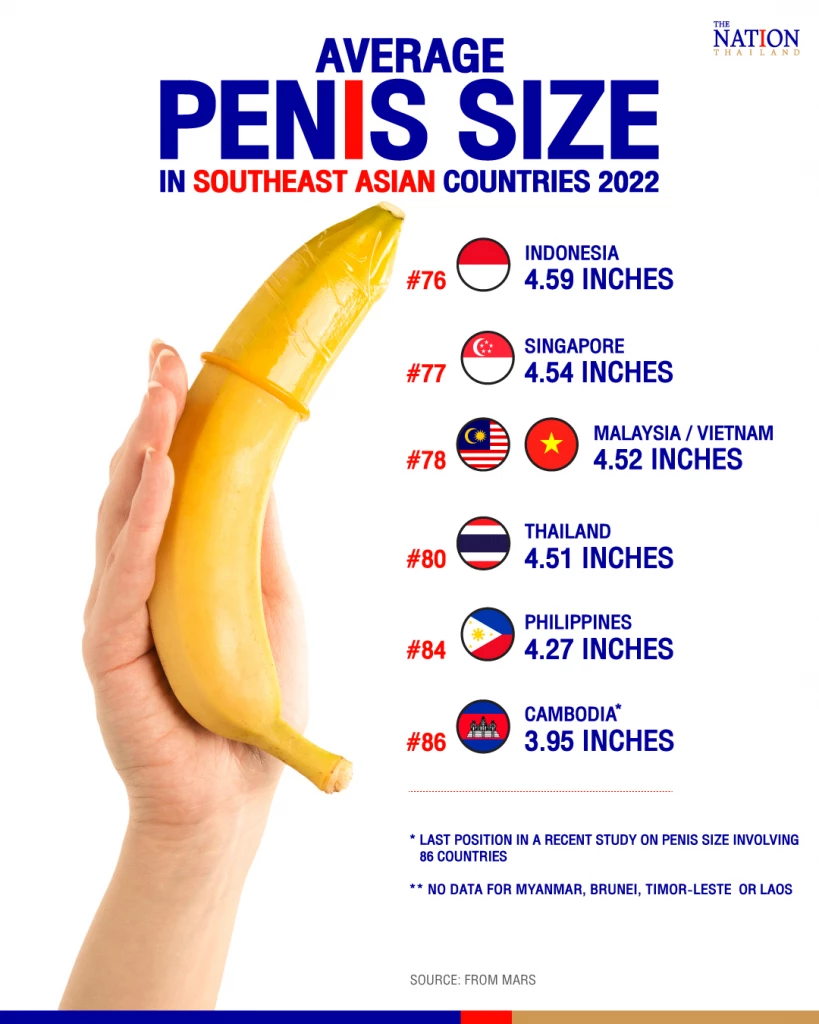
The average penis size in Thailand is the seventh-smallest in the world, according to a survey conducted by British online clinic From Mars.
Cambodia tops the ranking for smallest erect penises with an average of just 3.95 inches (10 centimetres). Thai penises measure up as the fifth-longest in Southeast Asia, behind Indonesia, Singapore, Malaysia and Vietnam but ahead of Philippines and Cambodia.
Heading the list of countries with the biggest penises is Ecuador, at 6.93 inches.
The clinic collected data from the World Population Review to come up with figures for average erect penis size from 86 countries. It also used Google search data from 2021.
Pharmacist Navin Khosla, who conducted the study, said the survey relied on self-reported data so some respondents might be generous with measurements. However, it still gives a basic idea of average sizes around the world.
The study lists the top 10 countries with the biggest penis as:
1 Ecuador 6.93 inches
2 Cameroon 6.56 inches
3 Bolivia 6.50 inches
4 Sudan 6.48 inches
5 Haiti 6.30 inches
6 Senegal 6.26 inches
7 Gambia 6.25 inches
7 Cuba 6.25 inches
7 Netherlands 6.25 inches
10 Zambia 6.21 inches
Meanwhile, the top 10 countries with the smallest penis size are:
1 Cambodia 3.95 inches
2 Taiwan 4.24 inches
3 Philippines 4.27 inches
4 Sri Lanka 4.29 inches
5 Hong Kong 4.41 inches
5 Bangladesh 4.41 inches
7 Thailand 4.51 inches
8 Vietnam 4.52 inches
8 Malaysia 4.52 inches
10 Singapore 4.54 inches
Khosla said, “Whether people are concerned about the size or the shape, or any other aspect for that matter, most of us have wondered at some point or another whether ours is big enough.”
Penis size can have a massive impact on men’s confidence and self-image, he added.
However, “[t]he truth is, that the owner of the penis is far more likely to be worried about the size of their penis than their sexual partners are!”










 SootinClaimon.Com