Centara opens Doha hotel

ศาสตร์เกษตรดินปุ๋ย : ขอบคุณแหล่งข้อมูล : หนังสือพิมพ์ The Nation

http://www.nationmultimedia.com/detail/Tourism/30365386

Centara opens Doha hotel

Tourism March 07, 2019 17:52

By The Nation

4,114 Viewed

Centara Hotels and Resorts, a Thai hotel operator, has celebrated the grand opening of its new waterfront hotel in Doha, introducing the company’s Thai hospitality to Qatar for the first time.

The 265-key Centara West Bay Residences and Suites Doha is in the city’s West Bay district, which is home to many of Doha’s skyscrapers. Overlooking the Arabian Gulf, the hotel is near the lively Doha Corniche and 25 minutes’ drive from Qatar’s Hamad International Airport.

The launch marks a milestone for Centara, as the company continues to expand its international footprint.

The opening event traditional Thai and Qatari performances, including a falconry show, and a ribbon-cutting ceremony and VIP dinner by Michelin starred chef Alfred Prasad.

“Doha is one of the most dynamic destinations in the world today, and we are delighted to enter this important market with such a spectacular new hotel. Centara West Bay Residences and Suites Doha is an iconic addition to the city’s skyline. With spacious accommodation, luxurious facilities and gracious Thai service, this hotel will cater to all types of guest, from leisure visitors and large family groups to long-stay business travellers. We look forward to welcoming all guests to Doha in the future, as the city embarks on an exciting new era of international prominence and prosperity,” said Thirayuth Chirathivat, CEO of Centara.

It opens ahead of the annual season-opening Qatar Open tennis tournament, the 2019 IAAF World Athletics Championships and the 2022 FIFA World Cup.

Italy rolls out welcome mat for region’s tourists

ศาสตร์เกษตรดินปุ๋ย : ขอบคุณแหล่งข้อมูล : หนังสือพิมพ์ The Nation

http://www.nationmultimedia.com/detail/Tourism/30365319

Bastianelli: Tourism from Asia is increasing faster than that of the total tourism demand, because of the major increase in long-haul tourism markets in Italy with respect to its neighbours.

Italy rolls out welcome mat for region’s tourists

Tourism March 07, 2019 01:00

By JINTANA PANYAARVUDH
THE NATION

5,489 Viewed

THAILAND is emerging as a potential high-growth market for tourism to Italy, underpinned by that country’s opening of promotional office in Bangkok that has activated a new antenna for luring Thai visitors as well as those from elsewhere in Southeast Asia.

The office, which was opened late last year, is operated by the Italian National Tourist Board (ENIT), which is responsible for the promoting tourism to Italy from around the world.

“The new Bangkok office plays a very important role, as the first the Italian hub in Southeast Asia with the task of promoting Italy and its destinations throughout this portion of the tourism market in this part of the world,” Giovanni Bastianelli, Enit executive director, told The Nation in an interview.

As Southeast Asia’s tourism demand for destinations worldwide is growing, it is a fundamental task for Italian regions to have a point of reference in such a growing market, said Bastianelli, who pointed to Italy’s status as a world-renowned top tourist destination.

Apart from Thailand, the Bangkok office is responsible for promoting tourism in the newer source markets of Vietnam and Myanmar, along with Malaysia, as visitors from these countries are increasingly heading to Europe, said Bastianelli.

“Since countries in this region make up an emerging market for the Italian tourism sector, it is still necessary to develop a correct and stronger brand positioning in order to reach the best target for Italian destinations, and namely the more affluent segment, as well as millennials and multi-generational family groups,” he added.

Enit’s marketing strategy is based on global campaigns to promote knowledge of Italy and its locations among travellers while providing information on tourism offerings and products.

Tourism promotion for Italy would be oriented towards “some strategic cross-cutting musts: sustainability, accessibility for all and digital implementation”, he said.

According to Bastianelli, tourism from Asia is increasing faster than that of the total tourism demand, because of the major increase in long-haul tourism markets in Italy with respect to its neighbours, he said.

Italy experienced a boom in tourism from Asian travellers in 2017, especially from Thailand.

The number of Thai arrivals in Italy increased almost 90 per cent over the past three years, from 18,000 in 2014 to 33,700 in 2017, according to Bastianelli.

In 2017, there were more than 254,400 nights spent in Italy by tourists from Thailand, he said.

Compared with 2016, these flows depict a growing trend regarding every variable of tourism. The number of nights spent increased 47.6 per cent, with a 7.4 per cent increase in expenditure that reached 21.7 million euros, Bastianelli said.

Alongside the increase in the number of Thai visitors to Italy, inflows from the rest of Asia also rose in 2017.

China is the biggest source market when it comes to Italian accommodation figures, with over 3 million arrivals for growth of 15 per cent; nights spent in accommodation touched 5 million, increasing 12.4 per cent.

Reaching 996,000, arrivals from South Korea increased by 14 per cent, and the nights spent totalled 1.8 million, up by 14.6 per cent.

The 933,000 tourist arrivals from Japan generated almost 2 per cent more nights than in 2016.

The other Asian countries totalled over 1 million arrivals and 2.4 million nights spent, an increase of 1.1 per cent.

As for this year, Enit expects the number of tourists from Asia to be relatively flat compared with last year, Bastianelli said.

“It means we are still growing from 2016 in international arrivals. Overall, there has been a 5 per cent increase in airport arrivals from foreign airports over the last two years (2018 and 2017),” he said.

Here’s what you do in Fiji

ศาสตร์เกษตรดินปุ๋ย : ขอบคุณแหล่งข้อมูล : หนังสือพิมพ์ The Nation

http://www.nationmultimedia.com/detail/sleep/30365281

Here’s what you do in Fiji

sleep March 07, 2019 01:00

By THE NATION

Six Senses Fiji is hosting “Early Bird and Bonus Nights” all this month for vacationers reserving more than 60 days in advance.

Room rates start at US$680 (Bt21,600) per night, but if you’re planning on more than just a weekend break, sign up for Bonus Nights. You get one extra night at no extra charge when booking a stag of five consecutive days and two bonus nights over seven days.

Daytime activities include aerial yoga, singing-bowl classes and “alchemy bar sessions”, plus cooking classes that cover Fijian cuisine, pizza and desserts.

At 5pm daily, guests can attend a Mixology Starter Class in which the bartenders share their cocktail secrets.

The weekly Bulatin schedule includes performaces of Meke (traditional Fiji-style) song and dance, costume making, trips to nearby villages and markets and even some coaching in the Fijian language.

For fans of watersports, Hauraki Adventures will take you snorkelling, scuba diving, jet skiing or fishing and the Tropicsurf gang will get you up on a surfboard.

Find out more at http://www.SixSenses.com/resorts/fiji/offers.

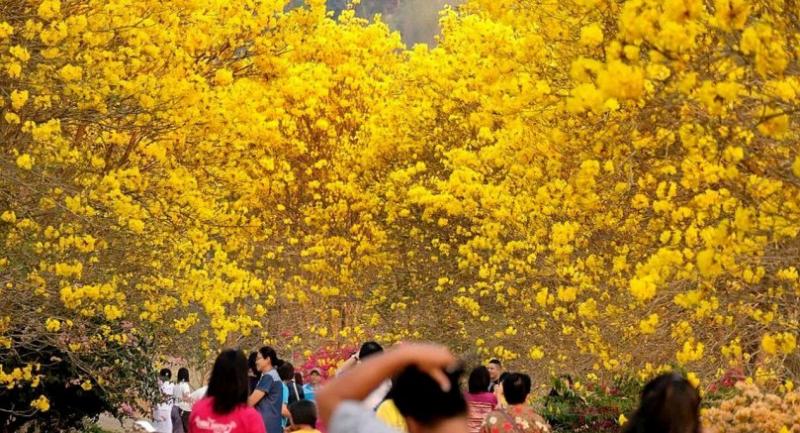
Tourists treated to stunning view of yellow flowers

ศาสตร์เกษตรดินปุ๋ย : ขอบคุณแหล่งข้อมูล : หนังสือพิมพ์ The Nation

http://www.nationmultimedia.com/detail/Tourism/30365249

Photo Courtesy of Tourism Authority of Thailand's Nan branch office
Photo Courtesy of Tourism Authority of Thailand’s Nan branch office

Tourists treated to stunning view of yellow flowers

Tourism March 06, 2019 08:00

By The Nation

2,069 Viewed

Tourists enjoy the sight of the yellow flowers of the Tabebuia Chrysantha, more commonly known in English as the Golden Trumpet Tree, in full bloom in Nan’s Thung Chang district.

Photo Courtesy of Tourism Authority of Thailand’s Nan branch office

A local group this week invited people to take photos of the beautiful scene along a 150-metre path on a private property just off Highway 101’s 98th kilometre marker.

Be quick, though – the flowers only remain in full bloom until the middle of March. Admission costs Bt20.

Photo Courtesy of Tourism Authority of Thailand’s Nan branch office

THAI resumes flights on Bangkok-Karachi route, via Omani airspace

ศาสตร์เกษตรดินปุ๋ย : ขอบคุณแหล่งข้อมูล : หนังสือพิมพ์ The Nation

http://www.nationmultimedia.com/detail/Tourism/30365192

A Thai Airways employee sticks flight information on a screen as stranded tourists whose Thai Airways flights have been canceled wait for news at the Suvarnabhumi International Airport in Bangkok, Thailand, 28 February 2019. / EPA-EFE

THAI resumes flights on Bangkok-Karachi route, via Omani airspace

Tourism March 04, 2019 21:02

By The Nation

5,834 Viewed

Thai Airways International (THAI) has resumed normal flights to and from Karachi via Omani airspace, after flights were cancelled due to the closure of Pakistani airspace last Wednesday.

However, THAI’s round-trip flights on the Bangkok-Lahore and Bangkok-Islamabad routes remain cancelled, the national carrier said in a statement on Monday.

Pakistani airspace is currently open, but with limitations to routes into both Lahore and Islamabad, said THAI president Sumeth Damrongchaitham.

THAI will operate round-trip flights on the Bangkok-Karachi route via a mix of regularly scheduled flights and special flights, as follows:

1. Regular flights operate on March 4, using Airbus A330-300 aircraft, with the capacity to carry 598 passengers per round trip.

– Flight TG341 from Bangkok-Karachi departed from Bangkok at 6.50pm and is expected to arrive in Karachi at midnight (local time).

– Return flight TG342 from Karachi-Bangkok departs from Karachi on March 5 at 1.10am (local time) and is expected to arrive in Bangkok at 9.30am.

2. An additional two special flights will be operated today and tomorrow, using Boeing 777-200 ER aircraft, with the capacity to carry 1,168 passengers per round trip:

On March 4:

– Flight TG3419 from Bangkok-Karachi departs at 8pm and is expected to arrive in Karachi at 1.10am (local time).

– Return flight TG3429 from Karachi-Bangkok departs at 2.20am (local time, Tuesday) and is expected to arrive in Bangkok at 10.40am.

On March 5:

– Flight TG3419 from Bangkok-Karachi departs at 10am and is expected to arrive in Karachi at 2.55pm (local time).

– Return flight TG3429 from Karachi-Bangkok departs at 4.20pm (local time) and is expected to arrive in Bangkok at 12.30am (next day).

Chinese can’t resist Thailand’s ‘Teflon’ tourism

ศาสตร์เกษตรดินปุ๋ย : ขอบคุณแหล่งข้อมูล : หนังสือพิมพ์ The Nation

http://www.nationmultimedia.com/detail/Tourism/30365098

Chinese can’t resist Thailand’s ‘Teflon’ tourism

Tourism March 03, 2019 12:25

By The Thaiger

12,762 Viewed

After Thailand temporarily faded in popularity with Chinese holidaymakers, they returned in huge numbers again in January – 3.7 million tourists in all.

This was a nearly 5-per-cent rise from the same month last year.

Mainland China continues to be the main source of foreigners visiting Thailand, with just over a million arrivals in January, a 9.3-per-cent increase year-on-year and an astonishing 20-per-cent hike from December.

The Ministry of Tourism and Sports says the Kingdom is “firming up of the new normal”, in which the distinction between what used to be the high and low seasons has mostly vanished as the visitor mix diversifies and Thailand evolves into a year-round tourism destination.

The turnaround, following last July’s boating accident in Phuket in which 47 Chinese vacationers drowned, is significant, making the Thai tourist industry seem like Teflon – invulnerable to serious damage.

After that summer tragedy, negative social media and ill-conceived comments from Thai leaders caused a significant drop in Chinese arrivals, particularly in Phuket, where bookings fell between 20 and 50 per cent in various hotel sectors.

Six Chinese airlines cancelled flights to Phuket for lack of demand.

Among non-Asian arrivals, Russia retains its place as Thailand’s largest source market, with 229,518 arrivals in January, a small rise year-on-year.

German, French, Finnish and Swedish arrivals declined between 3.5 and 14.6 per cent.

Arrivals from Britain and Norway increased by better than 3 per cent in the same month.

Three Eastern European countries – Poland, Kazakhstan and Ukraine – also registered arrivals over 100,000 visitors and increases in numbers compared to 12 months ago.

Arrivals from the United States and Canada also rose.

Australian visitors dropped 1.5 per cent and New Zealand visitors 5.7 per cent. The number of Australian visitors to Thailand has been consistent for almost 20 years, never rising or falling much despite the changes in fortune for the Australian dollar versus the baht.

One of the big improvers, and increasingly important feeder market, is Indian tourism.

January saw a rise of nearly 25 per cent compared to the year before. It is projected that Indian tourism will continue to rise throughout this year.

The ministry forecasts 41.1 million foreign tourists for 2019, with China, other Southeast Asian countries and Europe contributing rises this year.

Avani brings its footprint to Siem Reap

ศาสตร์เกษตรดินปุ๋ย : ขอบคุณแหล่งข้อมูล : หนังสือพิมพ์ The Nation

http://www.nationmultimedia.com/detail/sleep/30365215

Avani brings its footprint to Siem Reap

sleep March 05, 2019 12:00

By The Nation

Avani Hotels & Resorts makes its way to Cambodia with the FCC Angkor managed by Avani, which is scheduled to open in the second quarter of this year.

The property has recently undergone a US$7 million (Bt222.6 million) facelift adding 60 new luxury rooms in the timeless French colonial architecture that is intrinsic to the historic and cultural fabric of Siem Reap.

“Avani Hotels & Resorts’ first entry into Cambodia signals our ongoing commitment to offering an upscale experience to all intrepid travellers. We believe FCC Angkor will be home to the intrepid traveller seeking an authentic experience in the social hub of Siem Reap,” said Dillip Rajakarier, chief executive officer of Minor Hotels, the parent company of Avani Hotels & Resorts.

Located across from the Royal Independence Gardens and Royal Residence, it stands on the land that was once home to the elegant mansion of the French colonial governor, and the renowned Foreign Correspondents Club and a popular meeting place for local and international journalists, celebrities, and travellers from around the world.

Surrounded by several day and night markets, eclectic restaurants, and the popular Pub Street in walking distance, the hotel also provides easy access to such historical sites as Angkor Wat and the Preah Ang Chek Prea Ang Chorm shrine.

“We are excited to be working with Avani Hotels & Resorts as they are exceptional operators of lifestyle hotels, and well aligned to promote and position the FCC Angkor and FCC Collection brand. The new FCC will also be a member of Preferred Hotels & Resorts, joining us in the commitment to deliver extraordinary, engaging and unique experiences to our global guests,” said Susan Devine, owner’s representative, FCC Angkor – managed by Avani.

The enhancements have perfectly blended the colonial structures with contemporary designs inspired by Cambodia’s natural beauty and Khmer culture, which extend across the pedestrian bridge to the newly built extension.

Throughout the property, the exotic environment of verdant gardens, Khmer contemporary art, and exclusive European design accents create a sophisticated, residential feel, a signature concept for the heritage property.

Along with the new and refurbished rooms and suites, FCC Angkor has updated and expanded its facilities. A brand-new bar called Scribe now complements the Mansion’s renovated restaurant, where guests can experience relaxed, personalised service whether sipping a refreshing signature cocktail or dining on authentic Cambodian cuisine featuring fresh, local ingredients. Other additions include a spa, pool, and lounge – spacious and breezy, surrounded by colourful, fragrant greenery, where guests can enjoy a drink, mingle, and chat.

Online booking can be made at http://www.AvaniHotels.com.

Living the high life in Hua Hin

ศาสตร์เกษตรดินปุ๋ย : ขอบคุณแหล่งข้อมูล : หนังสือพิมพ์ The Nation

http://www.nationmultimedia.com/detail/sleep/30365060

Living the high life in Hua Hin

sleep March 02, 2019 01:00

By Pattarawadee Saengmanee
The Nation Weekend

2,170 Viewed

The partially renovated Hilton is perfectly located for nights out on the town

LOCATED RIGHT in the centre of one of Thailand’s best-loved resort towns and ideal for accessing both the local nightlife and culinary scene, the five-star Hilton Hua Hin Resort & Spa is undergoing a massive makeover to provide a superior holiday experience for leisure and business travellers.

Fronting on to the tranquil, pristine beach, this 295-room property was opened in 2001 and has earned accolades for its iconic design that allows all guests to admire the sparkling waters of the Gulf of Thailand from their private deck.

Accommodation can be divided into four main types – Classic, Deluxe, Premium and Executive – ranging in floor area from 42 to 450 square metres. The six newly refurbished floors are home to Premium Ocean View rooms, Executive Junior Suites and Executive Ocean Suites.

Elegant with a modern minimal look, all the renovated rooms and suites boast contemporary Thai-inspired interior decor and soft neutral colours that create a warm ambience. The lobby is dominated by a prominent water feature that flows into the adjacent landscaped garden.

During the day, gym rats can enjoy their workouts at the fully equipped fitness centre while sportsmen can burn off excess energy on the tennis and squash courts, play table tennis or get some laps in at the pool.

Overlooking the beach and turquoise sea, the heart of the resort is home to the large lagoon-style swimming pool with water slides surrounded by comfortable sun loungers.

Part of the next phase of the facelift, the 200-square-metre Sukhothai Suite is still a popular option for families. It has two bedrooms and a large living room with a dining area and pantry corner, and the private sun deck is a great place for a small party. The marble-finished bathroom has a whirlpool bathtub and separate rain shower and toilet.

Guests staying in Suites and Executive rooms receive access to the Resort Lounge and can take advantage of complimentary Wi-Fi, equipment business support, continental breakfast, pre-dinner cocktails and canapes and refreshments throughout the day.

I spend two nights in a 42sqm Premium Ocean View room that is cosy and spacious with a high ceiling and dark wood parquet floor. Everything is controlled with advanced in-room technology like motion sensors and it also boasts a smart charging station with several plugs and USB hubs. The decor is very Thai down to the miniature khon mask and handcrafted headboard depicting scenes from the Ramakien epic.

There’s a king-size bed but I prefer to lounge on the comfy sofa bed surfing the complimentary Wi-Fi Internet and international channels on a 40-inch HDTV. There’s also a work desk with ergonomic chair, eco-friendly features and extra power outlets.

The fully stocked minibar corner provides tea and coffee making facilities and alongside is a wardrobe packed with an ironing board set, hairdryer, safety box, bathrobes and slippers. The bathroom is luxurious with the premium fittings, a double-washbasin counter, a walk-in hydrotherapy rain shower and separate toilet.

I wake early and flop down on my balcony’s sofa bed watching the emerald waters wash over the white sand as I sip hot tea.

The Market restaurant starts the day with a full international buffet line of Thai delicacies, Chinese dim sum, Japanese dishes, salad bar and a fresh juice corner.

After roaming around the town to check out some new chic cafes, I’m back to the hotel for my 60-minute Thai massage treatment at Eforea Spa, and visibly relax as the therapist uses traditional techniques to release my tight muscles. It has nine treatment rooms with panoramic windows overlooking the ocean and lush garden as well as Japanese bath and Jacuzzis.

I book a table for the Barefoot BBQ Night that’s available on every first Saturday of the month. The buffet is set up on the beach and serves a variety of grilled seafood dishes and other western delicacies.

Among the dining options, Hua Hin’s tallest roof-top Sky Bar is the best spot to watch sunset and have specially tailored cocktails, while the Hua Hin Brewing Company serves a variety of craft beers, live music and DJ tunes until late night. The rooftop White Lotus restaurant is the only place in Hua Hin where diners can enjoy a dim sum buffet and a la carte dishes prepared to Szechuan and Cantonese recipes.


IF YOU GO

High point: Guestrooms are airy and clean.

Low point: More than 50 per cent of guestrooms and public spaces look old and are still waiting for their facelift.

Pay for it: The resort is offering guests up to 35- per-cent discounts when booking a room by March 19 for any stay between March 20 and February 2020.

Find it: 33 Naresdamri Road, Hua Hin, Prachup Kriri Khan

Call it: (032) 538 999

Browse it: https://www3.hilton.com/en/hotels/thailand/hilton-hua-hin-resort-and-spa-HHQHIHI/index.html

The race to save a legend

ศาสตร์เกษตรดินปุ๋ย : ขอบคุณแหล่งข้อมูล : หนังสือพิมพ์ The Nation

http://www.nationmultimedia.com/detail/world/30364599

  • Hot-air balloons are a popular way to take in the beauty of the lake, with its vegetable plantations and traditional houses on stilts./AFP
    Hot-air balloons are a popular way to take in the beauty of the lake, with its vegetable plantations and traditional houses on stilts./AFP

The race to save a legend

World February 23, 2019 01:00

By Agence France-Presse
Nyaung Shwe, Myanmar

2,705 Viewed

Inle Lake in Myanmar’s Shan state is a diamond in danger of disappearing

MYANMAR’S FAMED Inle Lake has enchanted tourists for decades with its floating gardens and the graceful leg-rowing style of its fisherman, but experts warn the lake is drying up and urgent action is needed to avoid disaster.

Each year around 200,000 foreigners and one million locals visit Inle – a vast, serene body of water surrounded by verdant hills.

Many criss-cross the lake on small wooden boats to visit stilted villages of the Intha ethnic minority.

A balloon glides gracefully over the lake./AFP

Others glide soundlessly overhead in hot-air balloons as farmers tend to drifting fields of tomatoes below, grown on the water on layers of decomposing vegetation.

Fishermen elegantly propel their boats with their leg curled round a large oar.

But there is a “darker side” to this seemingly bucolic idyll, says Martin Michalon, a researcher into the impact of development on the lake.

As farmers race to produce higher yields, pesticides and fertilisers are slowly poisoning the water.

Inle is also shrinking at an alarming rate.

Traditional houses rise on stilts amid vegetable plantations./AFP

“One century ago, it was six metres deep in rainy season. Now it is never more than three metres deep,” explains Michalon.

Deforestation to clear land for development and slash-and-burn farming is thought to be largely to blame, with silt flowing into the lake from surrounding hillsides.

But water extraction for irrigation and increased numbers of tourists could also be putting undue strain on the water table.

If conditions at the lake deteriorate, then tourism – the area’s most powerful economic driver – will also likely be affected.

The lake has enchanted tourists for decades, but experts warn it’s drying up and urgent action is needed to avoid disaster. /AFP

Urgent action is needed to avoid Inle experiencing this “double disaster” in the next few years, warns Michalon.

Political will to help save Inle Lake has so far not been translated into action.

“There is very loud commitment, but on the ground very little changes,” he adds.

Welcome to drone town

ศาสตร์เกษตรดินปุ๋ย : ขอบคุณแหล่งข้อมูล : หนังสือพิมพ์ The Nation

http://www.nationmultimedia.com/detail/world/30364598

Surrounded by forests, Naka appears to drone enthusiasts who admire the views transmitted to their display screens./Japan NewsYomiuri 
Surrounded by forests, Naka appears to drone enthusiasts who admire the views transmitted to their display screens./Japan NewsYomiuri

Welcome to drone town

World February 23, 2019 01:00

By Wataru Yukita
Japan News Yomiuri

3,174 Viewed

A sparsely populated Japanese locale is catching a buzz as the country’s drone-flying capital

IN A QUIET mountainous area where rushing creeks and chirping birds used to provide the only usual sounds, there is now a mechanical buzz in the air. The source of the sounds is drones – small unmanned aerial vehicles flying over a town in Tokushima Prefecture.

The town, Naka, where the population has steadily been decreasing, is now being promoted as the place “where the largest number of drones fly in Japan” by seeking to turn its very lack of uniqueness to its advantage.

In late November at the B&G Yagai Katsudo Centre, a facility for outdoor activities surrounded by forests and streams within the town, three drones were gracefully flying in the bright blue sky.

They slowly made circles, rapidly ascended and showed off moves as if they were living creatures. Controlling the drones were officials of the municipal government’s drone-promotion office.

Hayato Tawa, 23, deputy chief of the promotion office, made an appeal, saying, “You can fly drones here in unlimited ways without worrying that they will hit buildings or people.”

In April 2016 the town became Japan’s first municipality to establish a section exclusively for drones.

Surrounded by forests, Naka appears to drone enthusiasts who admire the views transmitted to their display screens./Japan NewsYomiuri 


In 2017 the local government made a “drone map” that identified 25 spots suitable for flying drones, including a place that is good for seeing autumn leaves.

After it was released online, the map gained popularity via social media, and about 100 drone fans visited from all over the nation in the course of a year.

Hitomi Adachi, a 47-year-old company employee from Naniwa Ward, Osaka, who visited the town for the first time in September, said it was “different from Osaka. I can freely fly my drone in this great natural setting, and I never get tired of it, even when I fly it for many hours.”

Naka was created in 2005 as a result of a merger of five towns and villages. The population then was 11,596, but it has fallen year by year. The current population is 8,444, with residents age 65 or older making up 48.5 per cent. There are only two convenience stores in the town, which has no famous tourist spots.

Why did a town in such a condition decide to focus on drones?

Naka has a map showing all the coolest places to send a drone aloft. /Japan NewsYomiuri 

Drones attracted public attention in Japan in the wake of an incident in April 2015 in which a drone was found on the rooftop of the Prime Minister’s Office.

At the time, a man who had moved to and was living in the town as a member of local vitalisation cooperators happened to remark, “If it were in this town, a falling drone wouldn’t bother anybody.”

The Civil Aeronautics Law revised in the wake of the incident prohibits drone flights in “densely inhabited districts”.

However, Naka is a town where the population has been decreasing and forests account for 95 per cent of its acreage. Thus, there are few places in the town that are subject to the law’s regulation.

A plan to vitalise the local communities by using drones has proceeded smoothly. The central and prefectural governments have taken note of the efforts.

Naka was then designated a “special drone zone” by the prefectural government. In February 2016 Japan’s first experiment with using drones to deliver parcels to houses, which was organised by the Land, Infrastructure, Transport and Tourism Ministry and other entities, was implemented in the town as a measure to help people facing difficulties shopping.

The town government also invited drone-race events and has held events for residents to experience flying drones.

Initially many of the residents were sceptical about the plan, voicing doubt about how useful drones would be. But now many of the residents have purchased drones and fly them.

Kunishige Takezaki, 79, who has been in the forestry business for many years, became interested in drones in the wake of hands-on events, and purchased one for about 150,000 yen in the summer of 2016.

“I feel as if I myself am flying while I watch the screen of the controller. This town where I have lived for many decades looks different when I see it from the sky.”

Drones are also utilised for the forestry business, the town’s main industry.

Usually, trees cut down in the mountains are transported to nearby roads using wires and ropes. It had been a heavy burden for workers to attach ropes to the trees while climbing up and down mountain slopes.

Now the ropes are attached to drones, which carry the ropes to the working sites, so work can be completed within several minutes.

Hirohito Kamei, 41, president of Kamei Ringyo, a Tokushima-based forestry company, expressed hope, saying, “Drones can wipe away the image that forestry work is too hard and can contribute to securing workers.”

The town has attempted to vitalise its local communities for four years. Although its depopulation problem cannot be solved quickly or easily, the sight of drones hovering in its skies gives the impression that the future holds unlimited possibilities.