Thai Airways International is to operate four weekly flights between Bangkok and the Iranian capital Tehran with effect from October 1
Thai Airways International is to operate four weekly flights between Bangkok and the Iranian capital Tehran with effect from October 1.
Flying high to Tehran
Thai Airways International is to operate four weekly flights between Bangkok and the Iranian capital Tehran with effect from October 1. Flight TG527 will depart Suvarnabhumi Airport at 3.30pm on Wednesday, Thursday, Saturday and Sunday and land at Tehran Imam Khomeini International Airport at 7.30pm local time. The return flight leaves Tehran at 9pm and arrives in Bangkok at 6.55am. Tehran boasts great museums, parks, restaurants and friendly people and is the gateway to the ancient Persian Empire.
Castles of wax
Sakon Nakhon celebrates the end of the three-month Buddhist lent with its much-loved Wax Castle Festival from October 11 to 16. The annual event draws more than 10,000 visitors to admire the spectacular procession of miniature Buddhist temples and shrines moulded out of beeswax that are paraded past Wat Phra That Choeng Chum. Boat races and other festivities also mark the end of the long retreat.
Emirates re-routes to Auckland
Emirates responds to the growing demand for travel between Thailand and New Zealand with a new daily service from Bangkok to Auckland via Sydney. From October 30, flight EK418 will depart Bangkok at 7.30pm and land in Auckland at 3.55pm local time. The return flight, EK419, departs Auckland at 4.30pm and arrives in Bangkok at 1.10am. The service, which will operate on the A380, is part of a planned reroute of the EK418/419 service, currently flying between Dubai and Christchurch, via Bangkok and Sydney. The new route goes from Dubai to Auckland, via Bangkok and Sydney.
On your marks
Amari Watergate’s Charity Midnight Run returns to Bangkok on October 15 to raise funds for education in rural Thailand. Participants can experience the city by night while running through downtown Bangkok and return home with the coveted championship trophies and commemorative medal as well sharing in the spirit of helping and giving.
Iqbal Ahmed
Special To The Statesman
September 17, 2016 2:02 pm
Acclaimed writer Iqbal Ahmed travelled recently to Kashmir and sent us this postcard.
Acclaimed writer Iqbal Ahmed travelled recently to Kashmir and sent us this postcard.
I had waited all summer in 2010 for the clashes between the security forces and the people to end so I could go to Kashmir for a little while, but when the protests finally subsided it was the middle of autumn. As Srinagar is a summer capital, it comes to life only from April to September each year. I arrived there in November and the town looked gloomy. I travelled to Gulmarg on a day trip with a few friends but the hill station wore a deserted look. Most of the hotels there had already closed for business until the next summer.
We considered ourselves lucky to find a restaurant in a hotel open for lunch. However there were no diners inside. One of my friends asked the solitary waiter if it was possible to order some food. He said they had only plain rice and a dish of meat that is dry and isn’t usually served with rice. I thought it was courageous of the owners to keep their restaurant open when there were no tourists around.
The situation in Kashmir was relatively peaceful towards the end of 2012 and many foreign governments relaxed the advice for their citizens about travelling to Srinagar, and Gulmarg was heralded by the BBC as a new Chamonix. A Polish colleague brought a newspaper from Katowice with him to show me a feature published in its travel pages on Kashmir. I visited Srinagar again in September 2013 when the then German Ambassador to India, Michael Steiner, hosted a concert by the Bavarian State Orchestra in the Shalimar garden on the outskirts of the city. Zubin Mehta performed at this concert. It created a controversy, resulting in a shutdown of shops and businesses in Srinagar and I decided to go to Gulmarg that day.
We drove through a ghost town to reach Gulmarg in a little over an hour. A friend had arranged for us to stay in a cottage owned by the Jammu & Kashmir government. We dropped our bags at the cottage and walked to the far end of Gulmarg, found a newly opened hotel there and stopped by to have dinner in its restaurant. A receptionist at the hotel told me that they had about 20 rooms out of 80 occupied that night. We were having dinner when I received a phone call from the friend who had arranged the cottage for us, informing us that the caretaker was worried because we hadn’t returned yet. It was 10 p.m.
When I returned to Srinagar on 17 August this year, the authorities had imposed a curfew for a continuous 72 hours. An acquaintance of mine in London thought curfew in Srinagar meant that I couldn’t move around during the night but it was other way round – people in the town could venture out of their homes only in the evening.
I wasn’t sure if I had boarded the right flight from Delhi to Srinagar when I saw just a handful of Kashmiri people in the aircraft. The rest of the passengers were mostly moustachioed men in plain clothes who belonged to the security forces. A lone woman accompanying them had an Indian flag pinned to the lapel of her jacket.
A porter came rushing toward me with a trolley as soon as he saw me standing near the luggage carousel. I usually like to carry my own bags but I couldn’t bring myself to say no on this occasion. The main exit of the airport was closed and there was a row of uniformed military men who were perhaps waiting to receive one of their high-ranking officers outside a side door. When one of my relatives drove me to his home near the airport, I heard the crackle of gunfire again after a gap of two decades
I had no access to the Internet or a phone line, which is ideal if you’re on holiday. But I couldn’t call my parents to let them know that I’d reached Srinagar safely. The state government had cut off the Internet and most of the phone lines for more than a month to quell protest. I tried to make a call using a local SIM-card but the message that appeared on my phone screen read as ‘Congestion’.
A few hours later, my relative’s neighbour, who subscribed to a government-run mobile service provider and was able to make calls on his phone, appeared with his handset for me to talk to my parents. They had tried in vain to reach the airport to pick me up. It is such small acts of kindness that have kept the people going since the curfew was imposed in mid-July.
Knowing that shops in the town had been shut for many weeks, my friends and acquaintances in London were worried that I might starve in Srinagar if I travelled there. But a thoughtful relative had stocked up groceries for my visit. Visitors to Kashmir find that hospitality is usually elevated to a high moral principle in the Valley. Perhaps that is why an American head teacher in London suggested to me, when I was looking for a job, that I should work in the hospitality industry. I found that most of the people in the town bore their hardships with dignity and I felt guilty that my hosts had gone out of their way to arrange everything for my visit.
I borrowed a transistor radio from a neighbour of theirs to listen to Kashmiri folk music in the evening since the cable TV channels were scrambled. And I borrowed a book, The Veiled Suite by Agha Shahid Ali, from the bookshelf of my relative to while away my time in Kashmir. It had been some time since I’d picked up the collected works of any poet – the last such book I had read was that of Czesław Miłosz.
As soon as I started reading Shahid Ali’s book I began to relive the years I had spent in Srinagar in the early 1990s. He receives a neat postcard from Kashmir at his home in America and while holding the four-by-six inch card in his hand he gazes at the half-inch Himalayas. He has a premonition that perhaps this is the closest he can now get to his ancestral home in Srinagar and the waters of the River Jhelum won’t be ultramarine by the time he returns to Kashmir. But he doesn’t mind if the idea he has of his birthplace is out of date because he knows that he can develop it into a fine portrait, like developing the negative of a photograph.
The current situation in Kashmir reminded me of Borges’ favourite theme of circular time in which things return to where they once were, as many things in Srinagar seem to have come full circle. Telecommunications were disrupted in the early 90s and sometimes people had to travel from Srinagar to Delhi to make an international phone call. I had to phone someone in Delhi to top-up a local SIM I was using. I could receive calls on it but couldn’t dial out. Shahid Ali witnesses the devastation in Kashmir during that time leading people first to despair and rage, then only rage, then only despair.
‘Srinagar hunches like a wild cat,’ he writes, ‘lonely sentries, wretched in bunkers at the city’s bridges, far from their homes in the plains, licensed to kill’. Shahid has been dead for 15 years now and the scene he describes precedes his death by 10 years but it is a true description of the town right now. He quotes the Roman historian, Tacitus, reporting a British chieftain’s speech which includes the line ‘Solitudinum faciunt et pacem appellant’ – they make a desolation and call it peace.
The mood in Kashmir is one of resignation. However, having gone through the turmoil of the last quarter of a century, the people in the valley have become resilient. I found that socially it’s business as usual in Srinagar. I attended the funerals of an elderly relative and a neighbour and received an invitation to attend a wedding. Businessmen have become oblivious of their losses whereas those who are hard up are suffering in silence.
The groups of young men lurking in the back roads of Srinagar could easily get into trouble by throwing stones at the security forces to overcome their boredom. But it is very difficult for someone who is born and brought up in Kashmir not be troubled by the troubles in the Valley, no matter if the person is living in a faraway country. Shahid describes his émigré life as being like an Adam of two Edens, one who has lost paradise twice, and he has a nightmarish vision of being rowed through paradise on a river of hell.
I could get around in Srinagar on my pushbike. Rumour had it in the town that petrol supplies have been stopped. The petrol stations indeed remained shut and I saw children selling the tawny liquid in small water bottles by the roadside. I left my parents’ home early one morning to cycle to the house of a friend who lives on the slope of a mountain at the edge of Lake Dal and he showed me a stream which I had heard of but never seen before. We took a walk along it to reach Shalimar garden, accompanied by a chorus of cicadas. It offered me a panoramic view of the valley with Lake Dal in the foreground and Koh-e-Maran hill in its middle. The fort built on top of this hill in 1808 was opened to the public again recently after more than twenty years and many people said that Srinagar was going to be the next big tourist destination in Asia.
The peace is always fragile in Kashmir. Before I booked my tickets I’d asked a friend if August was the right time to visit Srinagar. He said it was never the right time to visit the Valley and I could only hope for a peaceful visit. I would have liked to stay in a guesthouse called Dar-es-Salam (which means House of Peace) overlooking Lake Nagin but I stayed at my parents’ home and, while there, Agha Shahid’s The Veiled Suite transported me to a House of Sorrow.
The poet accompanies the coffin of his mother, who died of brain cancer, in a Lufthansa flight from America for burial in his ancestral graveyard in Kashmir. Shahid’s grief for his dead mother turns into grief for his lost homeland in the elegies he writes on this journey. He has imagined that he is the only passenger on a flight from Delhi to Srinagar. I was awoken from a similar dream when I flew from London to New Delhi to catch a connecting flight to Srinagar.
While cycling in Srinagar, I passed the high-school I attended and came across a private house at its rear occupied by security forces personnel, one of whom was watching the residents of this neighbourhood from a bunker built on the front lawn. The gates of Badamwari, where almond trees blossom in the spring, were closed and a plastic tarpaulin hung over them so that no one could have a peek.
The nearby temple of Amar Koul was padlocked. It reminded me of a long-haired Englishman who worshipped at this temple from morning till evening during my childhood. The road leading to the top of the Koh-e-Maran hill, once the route of my morning run, was barricaded and an alert paramilitary man armed with a machine gun stood behind a bullet-proof van. I walked down the road and saw a signboard pitched by the Jammu & Kashmir Tourism Development Corporation pointing toward a boat club. I thought perhaps this road would lead me to a Ghat on Lake Nagin but I saw the watchtowers of the Central Jail along it. The road was desolate. There was a small house at the bottom of the road but I wasn’t sure if it was occupied by the paramilitary troops and didn’t want to trespass and end up in hospital in my beloved Kashmir.
(Iqbal Ahmed is the author of “Sorrows of the Moon”, chosen by “The Guardian” newspaper as a Book of the Year, and Empire of the Mind, picked similarly by The Independent on Sunday. He lives in London.)
Ha Nguyen
Viet Nam News
Vietnam September 16, 2016 11:06 am
Mi Quang has been served in Quang Nam since the 14th century. It is a harmonious combination of materials, delicious for locals but also carrying a resonant aftertaste among visitors. Photo/Hoai Nam
Mi Quang is a delicious noodle dish and features a distinctive aftertaste.
Every region in Vietnam features unique culinary specialties. Pho hails from Hanoi. Bun bo comes from the central city of Hue.
And the wide, yellow noodles of mi Quang can be traced back to the central province of Quang Nam.
Mi Quang has been served in Quang Nam since the 14th century. The noodle dish is a harmonious combination of fresh ingredients.
It is eaten with toasted Vietnamese sesame rice crackers, fried shallots and herbs, such as rau ram (fragrant knotweed), coriander, perilla and lettuce. The Mi Quang dish is delicious and features a distinctive aftertaste.
Culinary expert Nguyen Thi Kim Chi, of the Quan An Ngon chain of restaurants, says mi Quang’s simple roots stem from a dish originally meant for labourers.
Ancient settlers in the region used locally sourced fresh ingredients — including whatever seasonal plants, meats and fish they had on hand — to create their culinary traditions.
“Over time, mi Quang became the pride of locals. We cherish its original, aromatic flavour and the way it represents the solid cultural values of our native village,” says Chi.
Mi Quang chefs often customise the style, flavor and ingredients of the dish to individual taste, using whatever ingredients they have on hand.
The art of the sauce and dumplings also varies with each chef. Some use chicken or pig bones. Either way, the sauce should have a sweet flavour quite different from pho broth cooked with oxen bone.
The late poet Bui Giang dreamed of enjoying a bowl of mi Quang before passing away. Similarly, the late writer Nguyen Van Xuan was obsessed with eating the dish under bamboo shade in his native village.
Home Village
Huynh Van Toi, from Quang Nam, says Phu Chiem is the Quang noodle’s native village.
Part of Phu Chiem’s fame stems from a broth of simmering shrimp and salty side pork. The resulting broth is a very thick, bright and cheerful red, which is considered part of the dish’s allure. Phu Chiem’s Quang noodles should be eaten with green or red chili to accentuate their peppery, warm salty flavour in the broth and dumpling.
“This expresses the real culinary style of the central people,” Toi says.
Toi’s grandfather Huynh Huy, 90, tells this story of the dish’s origins:
“After the sudden death of King Che Man, or Jaya Simhavarman III — the 34th king of the Cham-Pa kingdom (1288-1307) — Queen Huyen Tran ought to have been burned with the king’s other imperial maids, in accordance with the kingdom’s law. But her brother, the King of Dai Viet sent his men to bring the queen back to her native country. Here in Quang Nam’s Danh Village she was granted 32 mau (each mau is about 3,600sq.m) of good land. She taught locals weaving and then granted them 28 mau of land to grow rice and produce Quang noodles. Now Quang noodles are essential at every party and gathering of Quang Nam people.”
These days Quang noodles are available everywhere in the country’s major metropolitan areas, including Hanoi, HCM City and Da Nang. Each location cooks the dish in its own style — be it chicken, beef or pork noodle — says culinary expert Chi.
Khonesavanh Latsaphao
Vientiane Times
Laos September 15, 2016 5:03 pm
Nong Fa, a lake in the hills of Attapeu Province, is a next stop in Central Laos. Photo/Vientiane Times
Nong Fa, a lake in the hills of Attapeu Province, is a next stop in Central Laos.
The popular tourist attraction is currently receiving even more attention at the 13th China-Asean Expo and China-Asean Business and Investment Summit being held here on September 9-14, in which Laos is featuring Attapeu as its City of Charm in a bid to promote tourism and city-to-city exchanges.
Deputy Director of the Attapeu provincial Information, Culture and Tourism Department, Kongchak Sisavad told Vientiane Times lately that the province’s governor had approved a proposal to develop a water route to the lake.
The province’s Administration Office is now planning to sign an agreement with a local company to survey a water route via the Xekhaman River.
“The proposed route is about 50 kilometres long, and it would take a one-hour boat ride to travel from Sammakhixay District to the lake,” Kongchak said.
The road route to the lake is about 170 kilometers long, but one section of about 70 kilometers is difficult to negotiate in the wet season.
Kongchak said Laos’ City of Charm pavilion at the Osmanthus Hall of the Nanning International Convention and Exhibition Centre featured several of Attapeu’s attractions, but many visitors were particularly showing interest in the Nong Fa Lake and the Brao ethnic group.
The lake is located high on a hilltop and has crystal clear waters that reflect the blue sky and resemble the sea in colour. It is believed that the lake was formed after a meteor crashed at the site hundreds of years ago.
The Brao ethnic group is one of the 11 distinct groups in Attapeu Province. They typically build their houses on hilltops and wear elaborate bracelets on their arms and legs. They also cut their teeth, pierce ears and use animal tusks as earrings.
The Cities of Charm pavilion at the expo aims to enrich cooperation between China and the Aseanmember states and boost country-to-country ties.
China and the 10 Asean countries feature one of their cities at the expo every year to showcase development and business opportunities in trade, investment, science and technology, culture and tourism.
The other cities of charm featured at this year’s expo are Fuzhou in China, Bandar Seri Begawan in Brunei, Koh Kong Province in Cambodia, Indonesia’s Archipelago, Terengganu in Malaysia, Mawlamyine in Myanmar, General Santos City in the Philippines, Singapore, Bangkok in Thailand and Buon Ma Thuot in Vietnam.
PHOOWADON DUANGMEE
THE NATION September 14, 2016 1:00 am
Sun-dried salted threadfins hang upside down in the sun in Tak Bai, Narathiwat province. The Nation/Phoowadon Duangmee
A package of salted threadfin is a great gift to take back home. The Nation/Phoowadon Duangmee
The sun-dried threadfin is sealed with piece of paper in order to keep the fish safe and free from the flies. The Nation/Phoowadon Duangmee
A package of salted threadfin is a great gift to take back home. The Nation/Phoowadon Duangmee
Despite the violence in the deep South, Tak Bai in Narathiwat is well worth a visit if only to taste its threadfin
But then the threadfin is way more delicate than the seer fish.
Known as pla ku lao among fishmongers in Thailand, the threadfin can only be found in the Gulf of Thailand. The Andaman Sea side is out of luck. The fish is silvery grey and lives in brackish water. It was once found just south of Bangkok where Chao Phraya River flows into the Gulf but pollution in the estuary chased it away. Today you can find the threadfin along the East coast from Phetchaburi down to Songkhla and Narathiwat.
The threadfin has a firm flesh and a mild flavour. Westerners would almost certainly halve the fish and fillet it before pan-frying in olive oil and butter. The Chinese, on the other hand, leave the fish to dry in the sun.
Like Pattani, Yala and other parts of Narathiwat provinces, Tak Bai is home to a sizeable Chinese community, who made their home among the local and aboriginal Muslim people several hundred years ago. When the Hakka Chinese left their ancestral “circular houses” in Southern China in the 16th Century, and braved the South China Sea to start new lives in Southern Thailand, they brought their recipes along with them.
Tak Bai’s salted threadfins, though, are more of the Cantonese school of cooking. The fish is kept whole and the guts and entrails are removed delicately through the mouth using hooks. The fish is then stuffed with a handful of salt and left hanging upside down to dry in the sun for a week or two. And they look surprisingly beautiful.
“It’s not every threadfin that can be made into a salted fish as aesthetics play a part too,” says Manthana Phoothararak, director of the Tourism Authority of Thailand’s Narathiwat Office. “The locals sort out the fish and select only threadfins whose skin has been neither cut nor broken. Makes sense as otherwise the flies would find their ways into the fish.”
Families in Tak Bai have their own recipes and many of them are well-kept secrets.
“Usually they give threadfins a “massage” by rolling the fish with a bottle and sprinkling them with a condiment made of honey and other ingredients,” adds the director. “That makes Tak Bai’s salted threadfin more special than those found in other parts of Thailand.”
Nat Phop Yung Thong restaurant is the best place to enjoy the authentic sun-dried salted threadfins.
The restaurant is famous for Southern cuisine, boasting dishes like hot-and-sour “yellow curry”, pan-fried liang leaves with egg and young coconut shoots and shrimp in salty coconut soup. For the sun-dried salted threadfins, the cooks cut the fish into thin perpendicular strips before deep-frying. The brownish deep-fried threadfin is served with sliced shallot, bird’s eye chilli and half a lime. The fish is flavourful with a unique combination of salt, sweet and fermented insanely good! And as the fans of Southern food will know, fresh vegetables, fried egg and “boo doo” paste are the perfect accompaniment to the deep-fried salted threadfins.
“Threadfin is Tak Bai’s real delicacy,” says Manthana.
Buyers of salted threadfins don’t usually eat the fish themselves, say the folks in Tak Bai, and eaters of salted threadfins don’t usually pay for themselves. The salted threadfins are too delicate – and much too expensive.
IF YOU GO
< Thai Smile and AirAsia operate flights between Bangkok and Narathiwat. The southern province is noted for 300-year-old Taloh Manoh Mosque, Wat Cholthara Singhe, Chao Mae Tomo Chinese Shrine and the |pristine beach of Ao Manao.
CHULARAT SAENGPASSA
THE NATION September 14, 2016 1:00 am
Japanese folklore and legend are told through the Namahage cultural show in Akita Prefecture.
Tourists relax in the Kuroyu Onsen facility near a hot spring in Oyasu Valley.
A path leads through a hot spring in the lush mountains surrounding Oyasu Valley.
Tourists can join an udon-making workshop at a famous restaurant in Akita town.
The golden Tatsuko statue next to Lake Tazawa was created by Tokyo National University of Fine Arts and Yasutake Funakoshi in 1968. It is dedicated to the legend who once lived on these shores.
Namahage, a demon-like creature in Japanese folklore, is portrayed by men wearing hefty ogre masks and traditional straw capes during a New Year’s ritual in the Oga Peninsula area of Akita Prefecture.
Home to hot springs, crater and caldera lakes and wooden samurai mansions, Akita Prefecture is the perfect place to spend a holiday
An hour’s flight north of Tokyo, Akita Prefecture in Japan’s Tohoku region is a quiet mountainous area that’s full of charm.
Famous for rice farming and sake breweries, its impressive landscape and rich history more than compensate for the lack of bustling shopping areas and nightlife, making it an ideal destination for anyone wanting to escape the madding crowd.
The prefecture is home to the ancient town of Kakunodate. Dating back to 1620, Kakunodate is famous for its samurai architecture and weeping cherry trees. Although the castle is long gone, today’s Kakunodate has retained many of the old samurai manses and visitors feel like they have travelled back in time as they stroll past the old buildings that line Samurai village.
Some of these samurai houses have been converted into souvenir shops and restaurants, with one of the largest, Aoyagi House, transformed into an open-air samurai museum. Now known as the Aoyagi Samurai Manor Museum, it displays samurai tools and household utensils as well as toys from the Edo Period.
Exhibits here have their roots in the original Aoyagi House and many of them were collected and used by members of the Aoyagi family during their lifetime.
The grand estate is also home to a shady garden boasting hundreds of rare plants. Among them is the aoyagi Yae Beni Shidare Zakura, an eight-petal red weeping cherry that’s magnificent when it’s in full bloom.
Not all the old samurai houses are open to the public though it is possible to admire them up close from the comparative comfort of a rickshaw.
From Kakunodate, tourists can take a train to other beauty spots in the prefecture. Many visitors, and particularly fans of the South Korean TV series “Iris”, opt to travel by road to the crater lake of Tazawa, where Choi Seunghee and Kim Hyuenjun embraced by the golden statue of a local girl called Tatsuko.
But even without its connection to the popular series, Tazawa is worth a visit. The deepest lake in Japan at 423 metres, it cannot freeze over even when the temperatures drop well below zero. According to legend, Tatsuko was a beautiful girl who prayed to retain her beauty forever but was instead cursed and turned into a dragon and eventually sunk to the bottom of Lake Tazawa. She now stands with her back to the clear blue waters, a figure of purity and beauty.
A short drive away is Oyasu Valley, its hot spring evident to the nose the moment we step down from the bus. But while the sulphur odour is less than pleasant, the landscape is amazing and it is easy to understand why even emperors once frequented the valley.
The beautiful landscape continues all the way to Oga city, which lies within the boundaries of the Oga Quasi-National Park, and is a popular destination for both birdwatchers and paragliders. Surrounded by steep cliffs and volcanic crater lakes, the Oga region is best known for its Namahage shows. Taking their name from the strange deity resembling a demon, these powerful drum performances were traditionally staged over the New Year period to offer blessings and dispel bad luck but are today regularly put on for tourists and performed by young locals who have refused to move to big cities in search of better-paying jobs.
Akita, which is believed to have given its name to the popular breed of dog, is also justifiably famous for its udon noodles and udon-making classes are available for those who would like to learn the technique.
Held at Sato Yosuke restaurant in Akita town, which can trace its origins back more than 150 years, the workshop teaches participants how to produce Japan’s famous Nihon Sandai Udon through the fermentation of the flour to drying, stretching and boiling.
The best part comes right at the end of the class when participants sit down to tuck into the tasty udon at this famous restaurant.
IF YOU GO
< Akita is about three hours by trains from Sendai Station and an hour’s flight from Haneda Airport.
< Visitors coming from Osaka should expect to spend six hours on the train.
< Thai tourists are allowed to enter the country without a visa for stays not exceeding 15 days.
CHUSRI NGAMPRASERT
THE NATION
September 14, 2016 1:00 am
MONGOLIA: Nomad’s Day is, as the name suggests, the most important day in the lives of the Mongolian nomads.
From wrestling in Mongolia through performance art in Malaysia and tennis in China, there’s plenty to do in the region this month and next
NOMAD’S DAY
September 17 to 18, Gun Galuut Reserve, Mongolia
Nomad’s Day is, as the name suggests, the most important day in the lives of the Mongolian nomads. The major customs of nomadic life including horsemanship, wrestling and folkloric music and dance are demonstrated on these special days, groups then competing with visitors to load gers, the Mongolian tent, on yak carts, assemble the gers in the shortest time, make milk-tea, catch and tame horses and much more. The best of nomadic traditional cuisine is served on the evening of September 18.
DIVERSECITY
Until October 2, Kuala Lumpur, Malaysia
DiverseCity is also known as the Kuala Lumpur International Arts Festival. An ambitious programme of performing and visual arts, it showcases the rich and nuanced diversity of Malaysia and also explores the close ties and deep relationships with the other counries in the Asean bloc. Visit http://www.Diversecity.my.
FESTIVAL OF THE DEAD (BOUN KHAO SALAK)
September 16, Nationwide, Laos
During the festival of the dead, offerings are presented to Buddhist monks. On the last day, which is always the full moon, every family goes to the temple to make offerings to the deceased, especially to those who have passed away over the last year. It is believed that if the spirits do not receive offerings, the living will suffer from bad luck. In Luang Prabang during the festival, the Mekong is jammed with beautifully carved boats with snake-heads for prows. The serpent, or naga, appears in Buddhist literature as the protector of Lord Buddha and that’s the reason why the boats are sacred and kept inside the temple precincts. Every year, 40 men from each temple parish volunteer to race in their temple’s boats.
SEOUL PERFORMING ARTS FESTIVAL
September 30 to October 30, Seoul, South Korea
Contemporary drama, dance, musical theatre and interdisciplinary arts are at leading cultural spaces throughout Seoul next month. The festival features some 40 breathtaking performances from Korean and international companies, which highlight the fundamental elements of performing arts from the past as well as draw attention to the possibilities of the present and the future. Visit Spaf.or.kr.
CHINA OPEN TENNIS TOURNAMENT
September 25 to October 9, Beijing, China
The China Open was launched in 2004, and is held in Beijing over the National Day holidays. Hosted by the Beijing Olympic Green Tennis Centre, this elite ATP tour event attracts many of the world’s best tennis players.
NATIONAL DAY RACE DAY
October 1, Hong Kong
The National Day Race on October 1 has long been one of the highlights of Hong Kong’s horse racing calendar. Every year, the Hong Kong Jockey Club presents various spectacular cultural performances at Sha Tin racecourse to commemorate the founding of the People’s Republic of China, attracting thousands of racing fans and visitors.
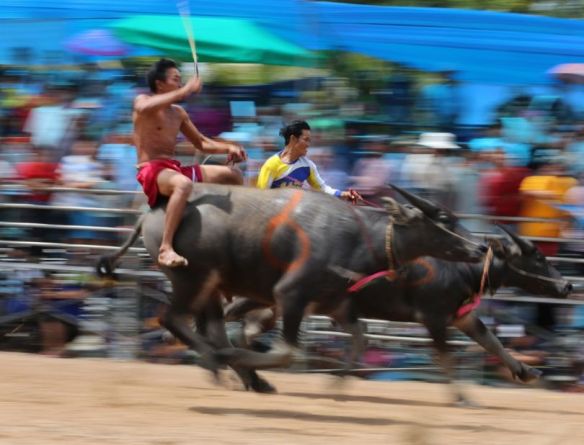
RAGING BULLS: Chon Buri province, about an hour’s drive east of Bangkok, is hosting Buffalo Racing on October 15.
Chon Buri province, about an hour’s drive east of Bangkok, is hosting Buffalo Racing on October 15.
Raging bulls
Thai water buffaloes might not be as aggressive as Spanish bulls but they can certainly give the bulls a good run for their money and they’re a lot more fun. Chon Buri province, about an hour’s drive east of Bangkok, is hosting Buffalo Racing on October 15. Beefy buffaloes, skinny buffaloes and white buffaloes will race against each other over a 100-metre-long grassy strip, leaving a huge cloud of dust in the air. You’ll be surprised – and terrified – at the beasts’ terrific speed but poor sense of direction.
Bangkok Airways joins up with the Tourism Authority of Thailand, Samui Municipality and theSamui Travel Association for the “Samui Discovery Travel Fair”, which runs from Friday through Sunday at Siam Paragon’s Fashion Hall. As part of the activities to promote tourism on the island during the so-called green season, the airline is offering all-inclusive fares on its Bangkok-Samui,Chiang Mai–Samui, Phuket-Samui, Krabi-Samui and Pattaya–Samui routes starting at Bt3,310 round trip. Tickets must be purchased and issued during the event and are valid for travel from Friday until the end of November.
Khao Yai for “U”
Surrounded by the rolling hills and lush valleys of Khao Yai National Park, the new U Khao Yai will be opening its doors to travellers on November 15. Located in Pak Chong’s Moosi subdistrict, the resort draws on the traditional architecture of the French countryside and boasts a modern and eclectic interior design providing both comfort and relaxation with landscaped gardens, ponds and a large free form swimming pool. Find out more at http://www.UKhaoYai.com or Facebook.com/ukhaoyai.
The sky’s the limit
VietJet Air, a budget airline from Vietnam, spread its wings across Thailand, offering three new routes – Bangkok-Chiang Mai, Bangkok-Phuket and Phuket-Chiang Rai – as well as flights between Bangkok and Haiphong in Vietnam. The airline, which owns a fast-growing fleet of Airbus A320s, is based in Ho Chi Minh City. For tickets and booking, visit http://www.VietJetAir.com.
Dawn
Asia News Network September 10, 2016 10:01 am
In the heart of the Karakoram mountains lies the fabled Lukpe Lawo
Hopping on the large boulders of Biafo glacier, I was drenched in sweat and panting.
As I paused to catch my breath, my eyes moved towards the path that led to Baltoro glacier, reminding me of the ordeals I faced a few years ago after stepping on the glacial moraine and the boulders of Baltoro glacier.
It was my first encounter with glaciers and that too with Baltoro, [often termed ‘Bal-Toro’ in Urdu, meaning bone breaker].
googletag.display(‘div-gpt-ad-1458203125906-0’);
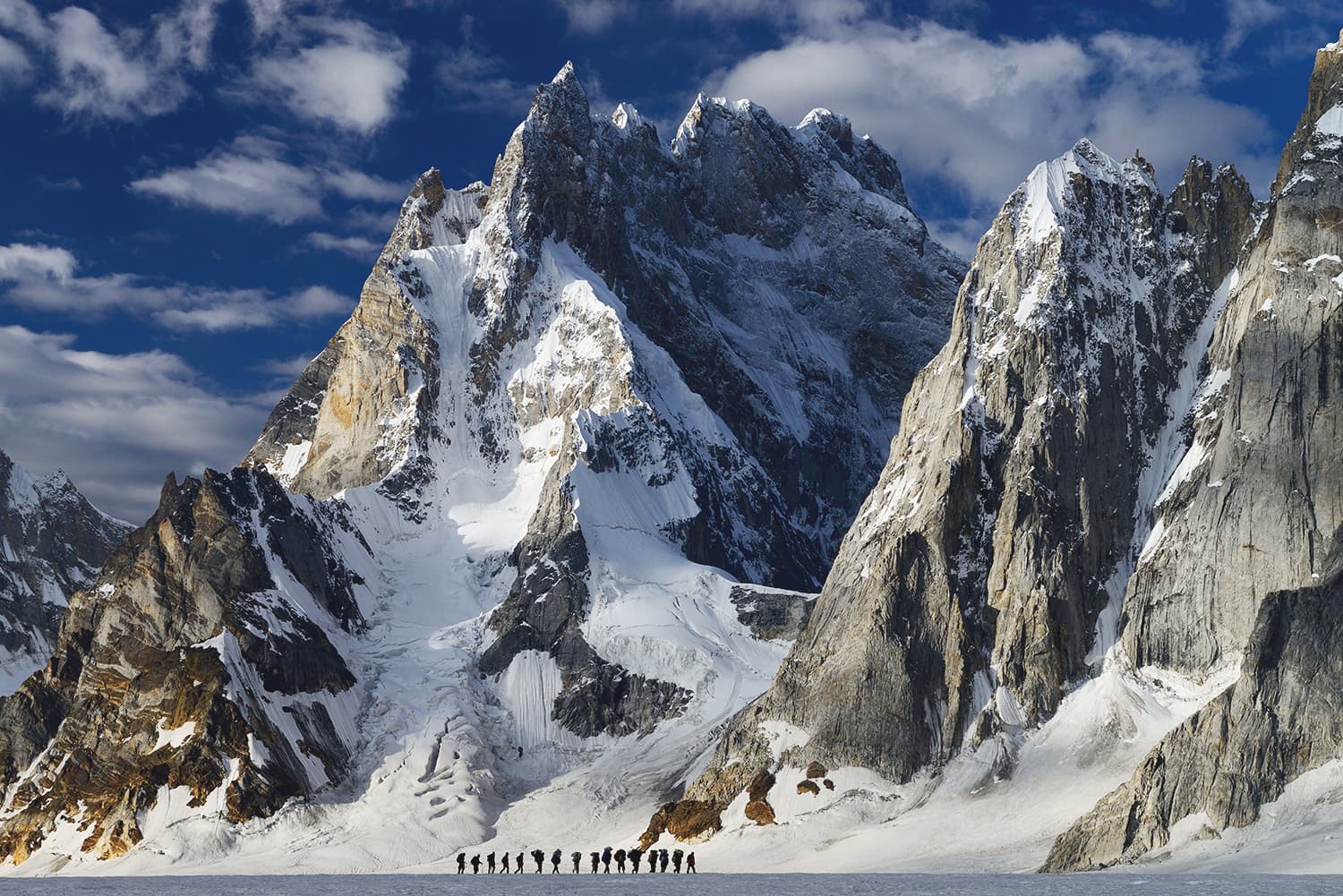
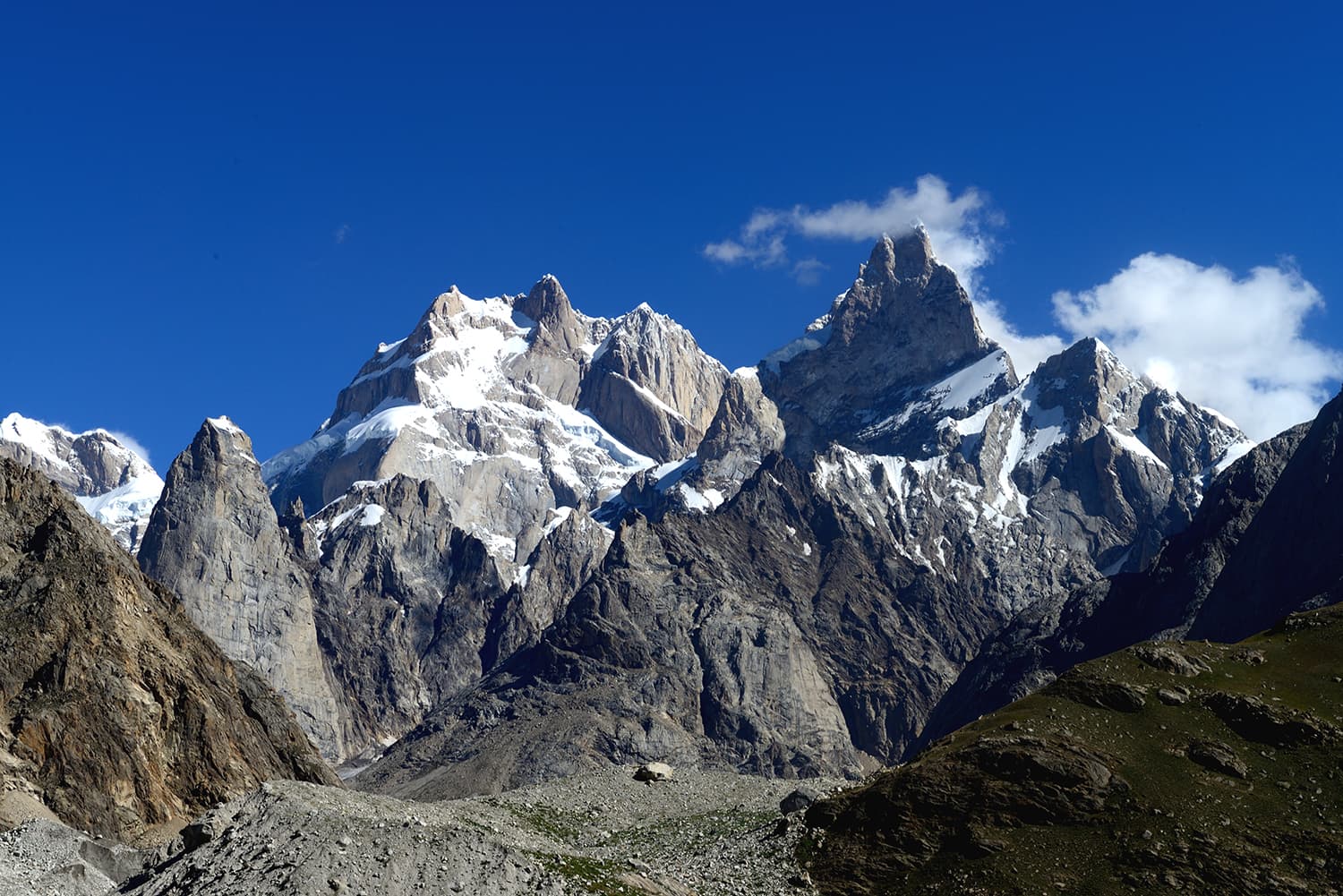
Solu Towers (5947m) in the vicinity of Snow Lake and Hispar La. ─ Photo by author
I remembered all the group members, including myself, using all sorts of nasty names from our personal vocabularies to describe the terrain and varied moraines of Baltoro.
Having left Askole and stepping on Biafo’s boulders, Baltoro’s brutalities seemed like silly little pranks of a mischievous child.
All those words that I had given to Baltoro in 2010, were passed on to ‘honour’ the ‘glory’ of Biafo’s crusts and turfs; most of them starting with B [whether in English, Urdu or Punjabi!].
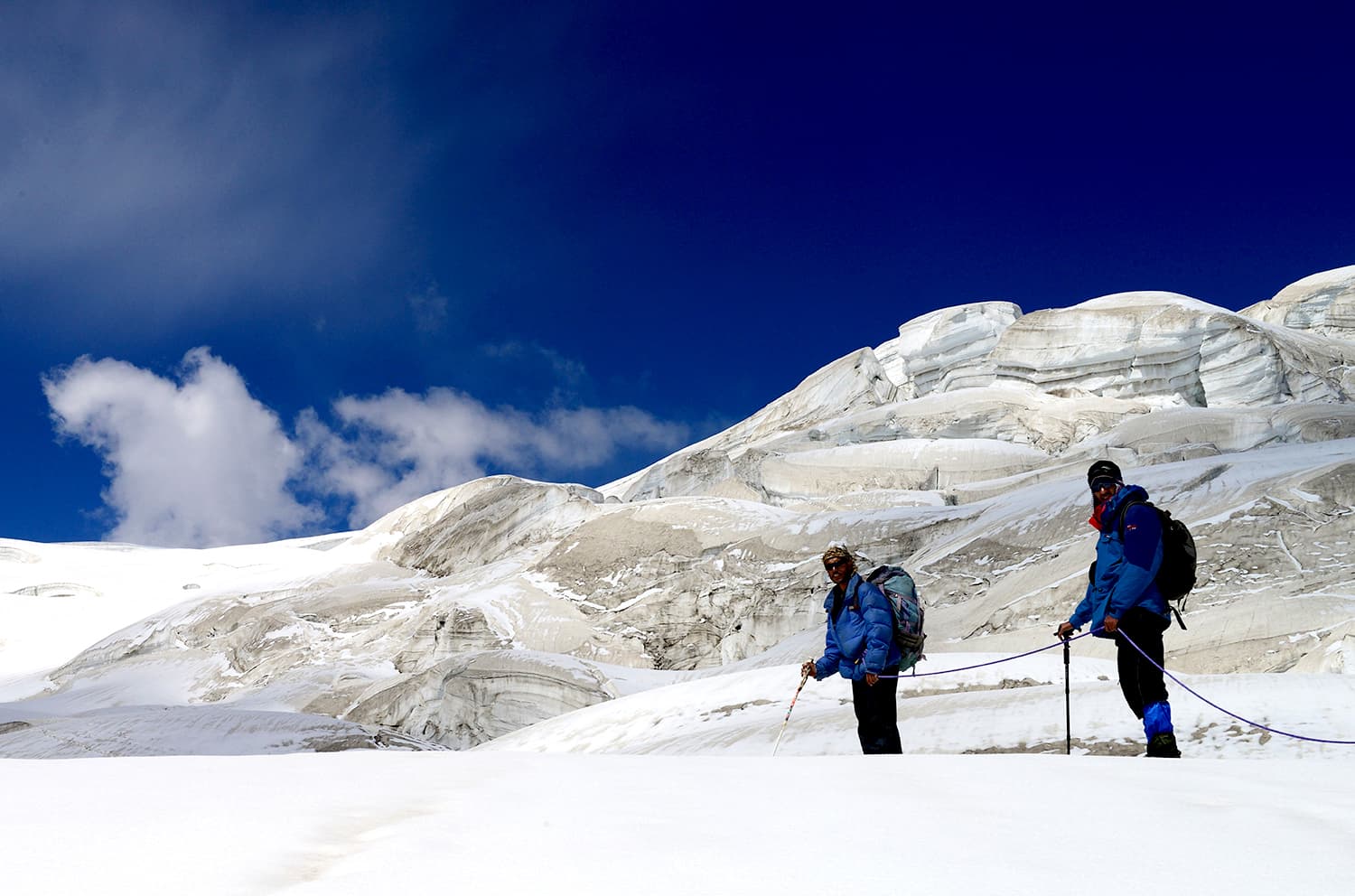
An Australian expedition lead by porters is moving towards snowlake while crossing Sosbun Brakk (6413m). ─ Photo by author
My mind was set before embarking on this journey, termed as the most difficult trek of Pakistan’s north.
Where I was going had a reputation well above that of word of mouth. The terrain was the most terrifying and tormenting ‘mettle tester’ in every way. But then the destination too was not ordinary.
In the heart of the Karakoram mountains lies the fabled and fabulous Snow Lake
Lakes are often called the mirrors of mountains, but a lake exists that does not reflect anything because its water is frozen.
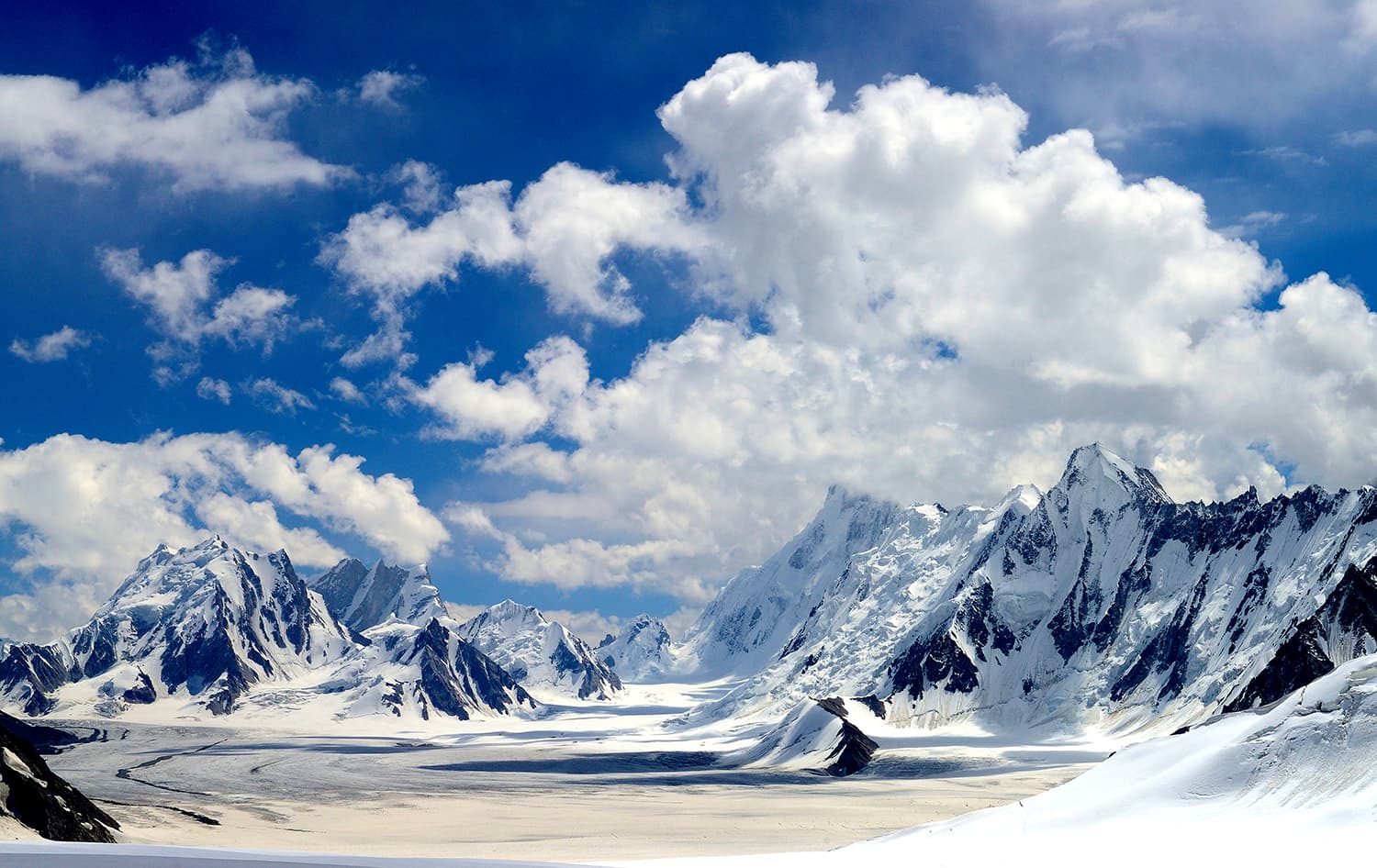
Lukpe Lawo, famously known as Snow Lake, lies in the heart of Panmah Muztagh range which is a sub-range of the Karakoram mountains. Actually it’s a high altitude glacial basin which was discovered by a British mountaineer, Martin Conway, in 1892.
View of Snow Lake from Hispar Pass’s summit. ─ Photo by author
Only a few lucky souls have seen this 16 km-wide frozen lake located 4,877 metres above sea level on the convergence point of the Hispar and Biafo glaciers.
Both glaciers together form the world’s longest glacial system (100 km) outside the polar regions — 67 km long Biafo alone is the world’s third longest glacier, whereas the Hispar glacier is 49 km long. The Snow Lake traverse uses all of Hispar glacier’s length and 51 km of Biafo glacier’s length.
The ancient kingdoms of Baltistan and Nagar are located in the opposite direction of Snow Lake. We started our journey from Skardu which falls in Baltistan, and after crossing Biafo glacier and scaling the Hispar Pass (5,128m) and its glacier, we would have reached Hunza.
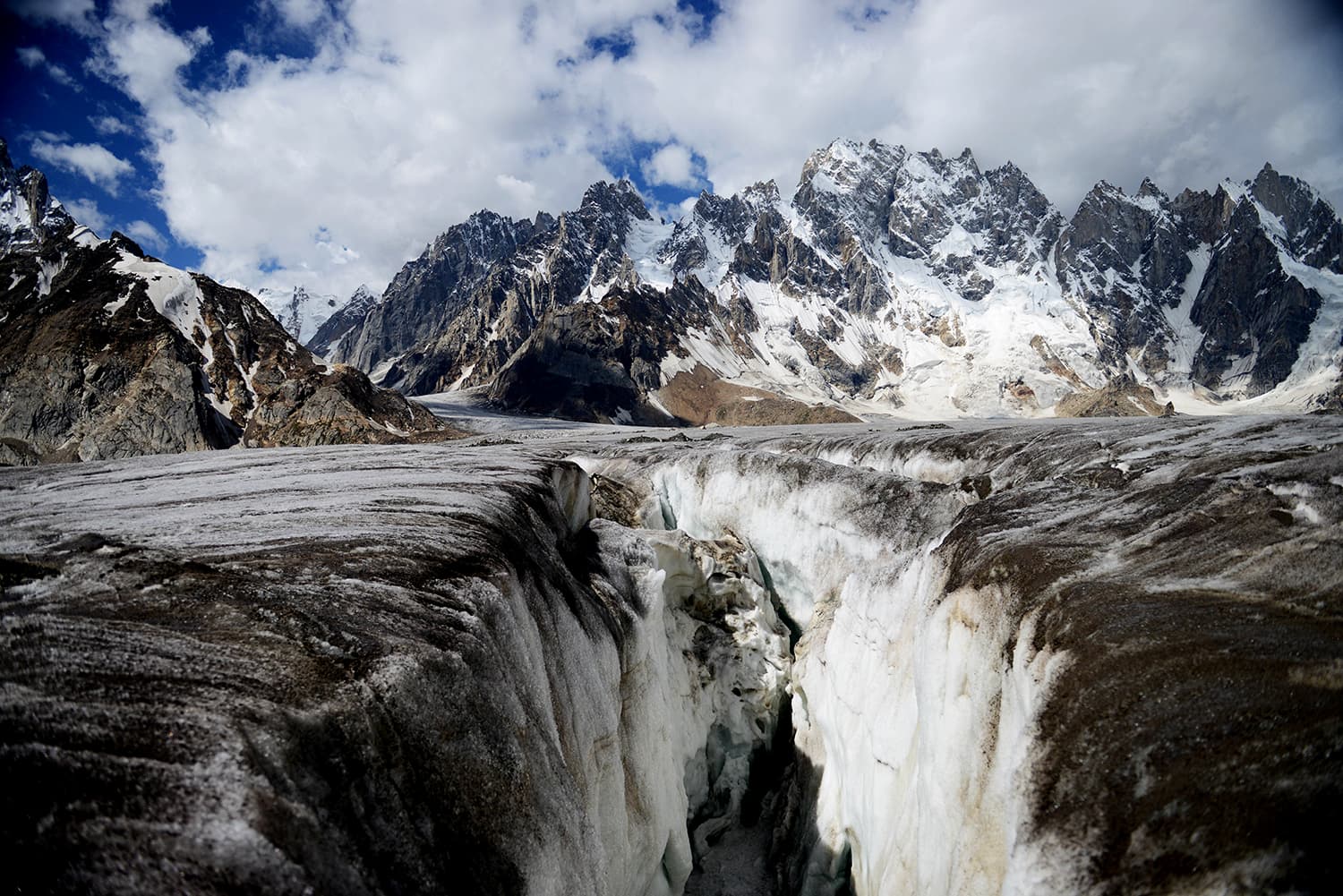
Crevasses of Biafo Glacier. ─ Photo by author
Being a sub-range of the Karakoram mountains the Panmah Muztagh too has some prominent peaks for climbing, such as Baintha Brakk or The Ogre (7,285m), Latok Group (7,145m), Sosbun Brakk (6,413m) and Solu Towers (5,947m). Different features distinguish them from the rest of the Karakoram — Panmah Muztagh range is much rockier and steeper with complex granite formations.
Scaling the height of Hispar Pass. ─ Photo by author
At Namla, the first campsite on the Biafo glacier, a sign board describing Namla as a sighting place for snow-leopards greeted us. Our porters and a very talkative guide told us that markhor too can be seen on the surrounding cliffs.
We were further informed that various hunters come to Biafo to try their luck, and the presence of hunter posts on the way to the Biantha campsite confirmed this.
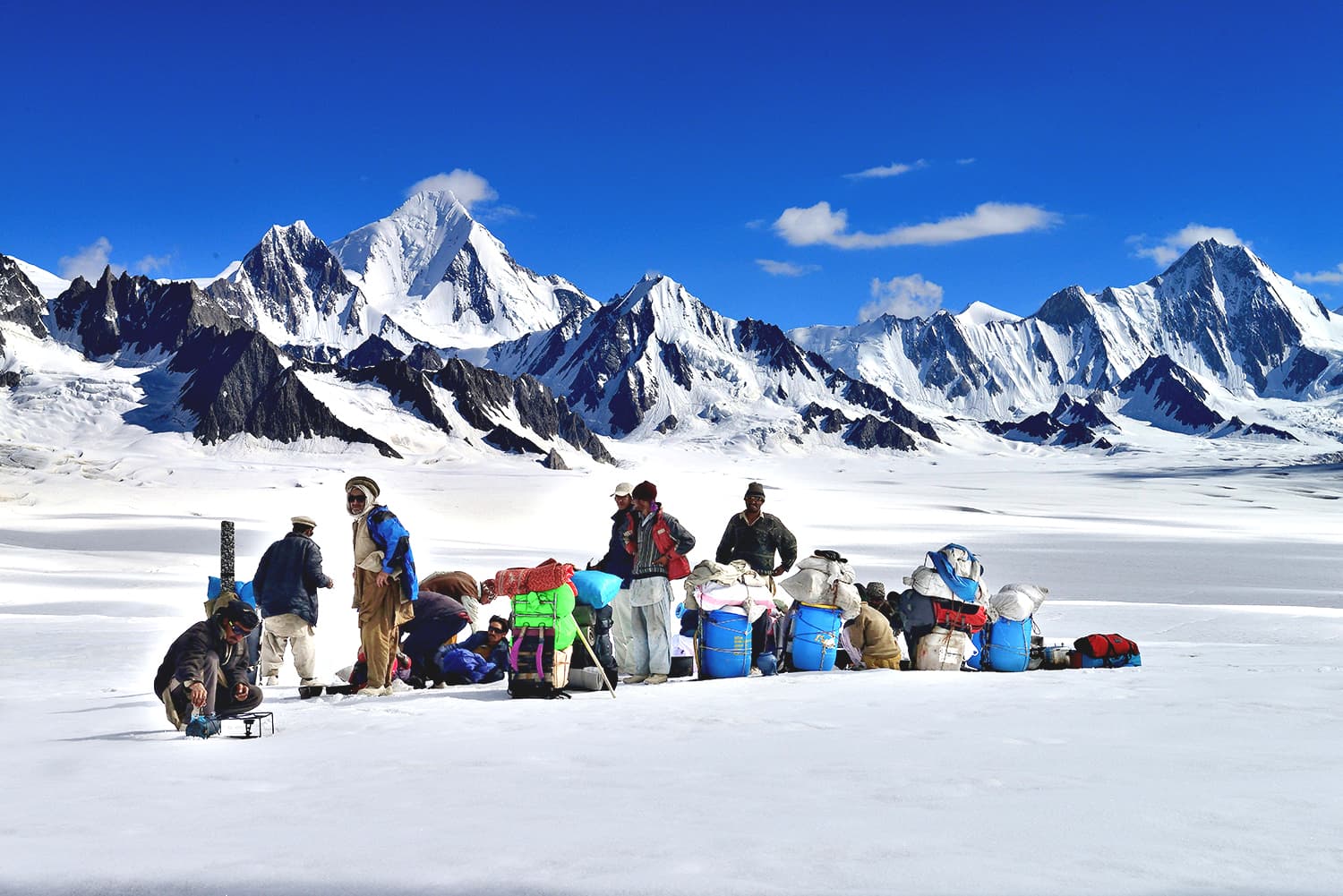
A pause for soup at Snow Lake. ─ Photo by author
Hunters come to the posts in summer and stay for several days in quest of their bounty. A few hunt for hobby while the rest hunt for selling and often sell markhor meat for 7,000 rupees per kilo.
We had a rest day at the Baintha campsite to relax our stiff and cramped muscles. Around noon we heard gunshots; somebody whispered “Markhors are being hunted.”
After some time a hunter came and offered markhor meat to us. He had sold almost all the meat and was left with just 5kg which he did not want to carry the entire length of the Biafo.
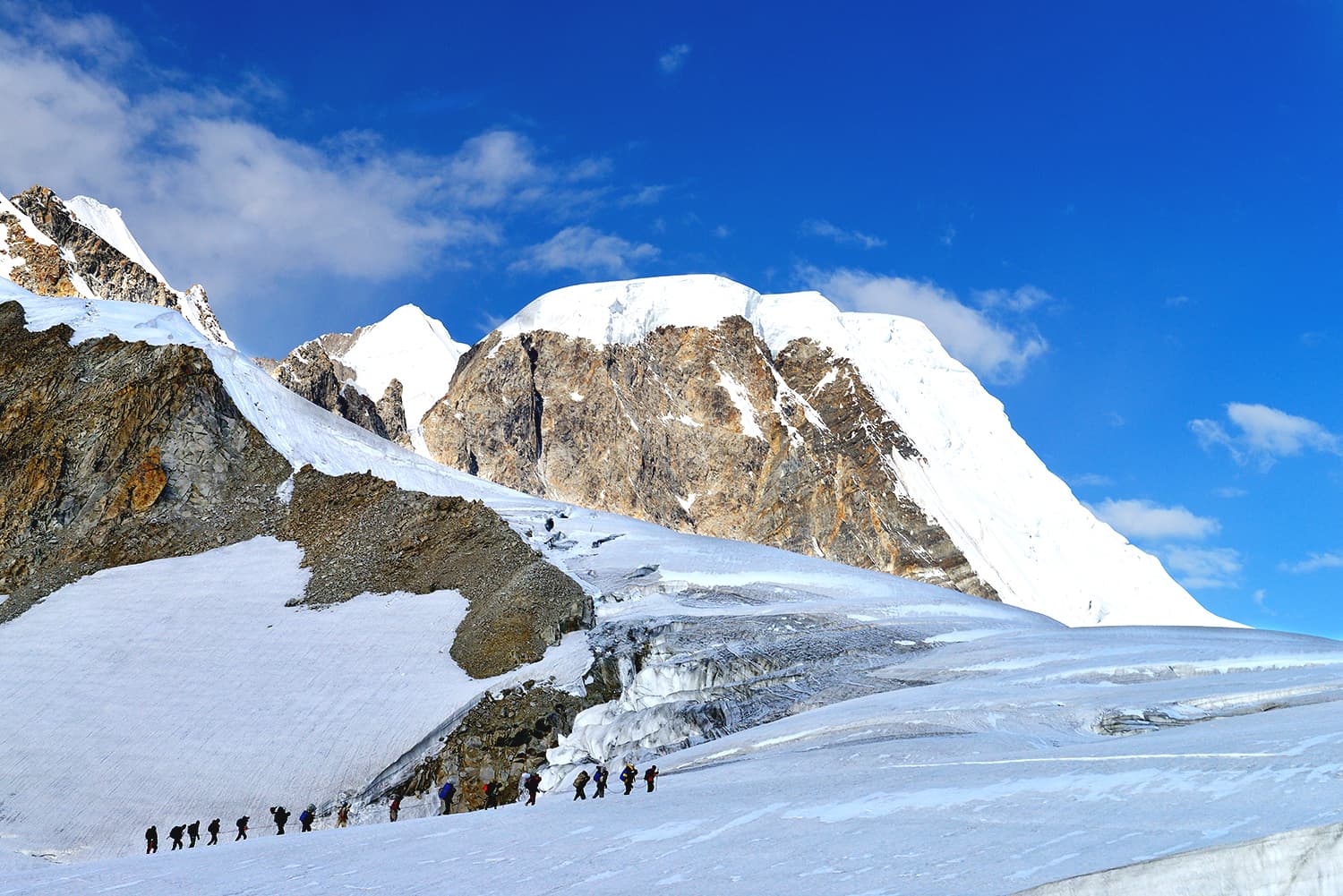
Almost there – among the crevasses of Hispar pass. ─ Photo by author
All of us knew that markhor is one of the ‘near threatened’ species so nobody was interested but the hunter knew all the tricks of marketing and managed to convince most of the expedition members to ‘taste’ the most expensive meat of our lives.
The markhor had been killed and we had no involvement in his cold-blooded murder, so the top management decided to enjoy the ‘God sent’ opportunity.
The meat was handed over to our expert cook who told us that, since we were in the wilderness of mountains with no proper kitchen facility, we should not expect the feast to be ready before two hours.
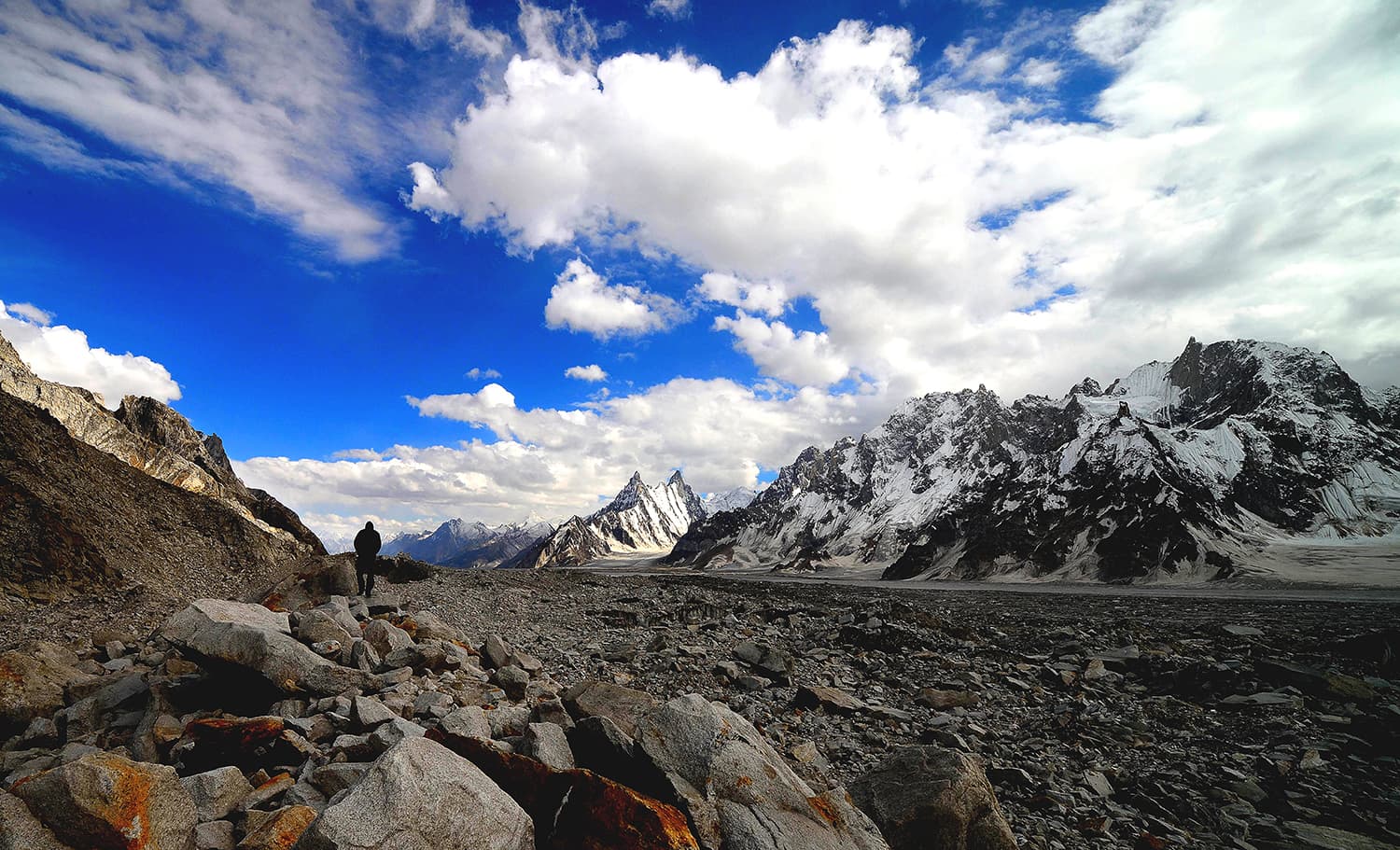
A wanderer enjoying the solitude of Biafo. ─ Photo by author
We spent the long wait relaxing and inhaling the aroma of the food being cooked.
After battling with the kerosene stove for more than two hours, our cook served lunch.
It took me quite some time to chew the first bite; even after being cooked for over two hours the meat was still like rubber.
It tasted good (thanks to the chef’s culinary skills) but climbing on cliffs gave the markhor tough meat. I left the rest in my plate and finished the rice as did a few others.
A night spent at the brink of Hispar glacier. ─ Photo by author
After coming back from this expedition, I learnt that the Gilgit Baltistan government auctioned off the markhor hunting license for 6.2 million rupees.
The next campsite that we reached was on the upper surface of the glacier which was cluttered with stones of all sizes eroded from the mountain cliffs.
Biafo is notorious for being cluttered with time and energy consuming lethal crevasses and to avoid these we took the longer route.
Almost there – among the crevasses of Hispar pass. ─ Photo by author
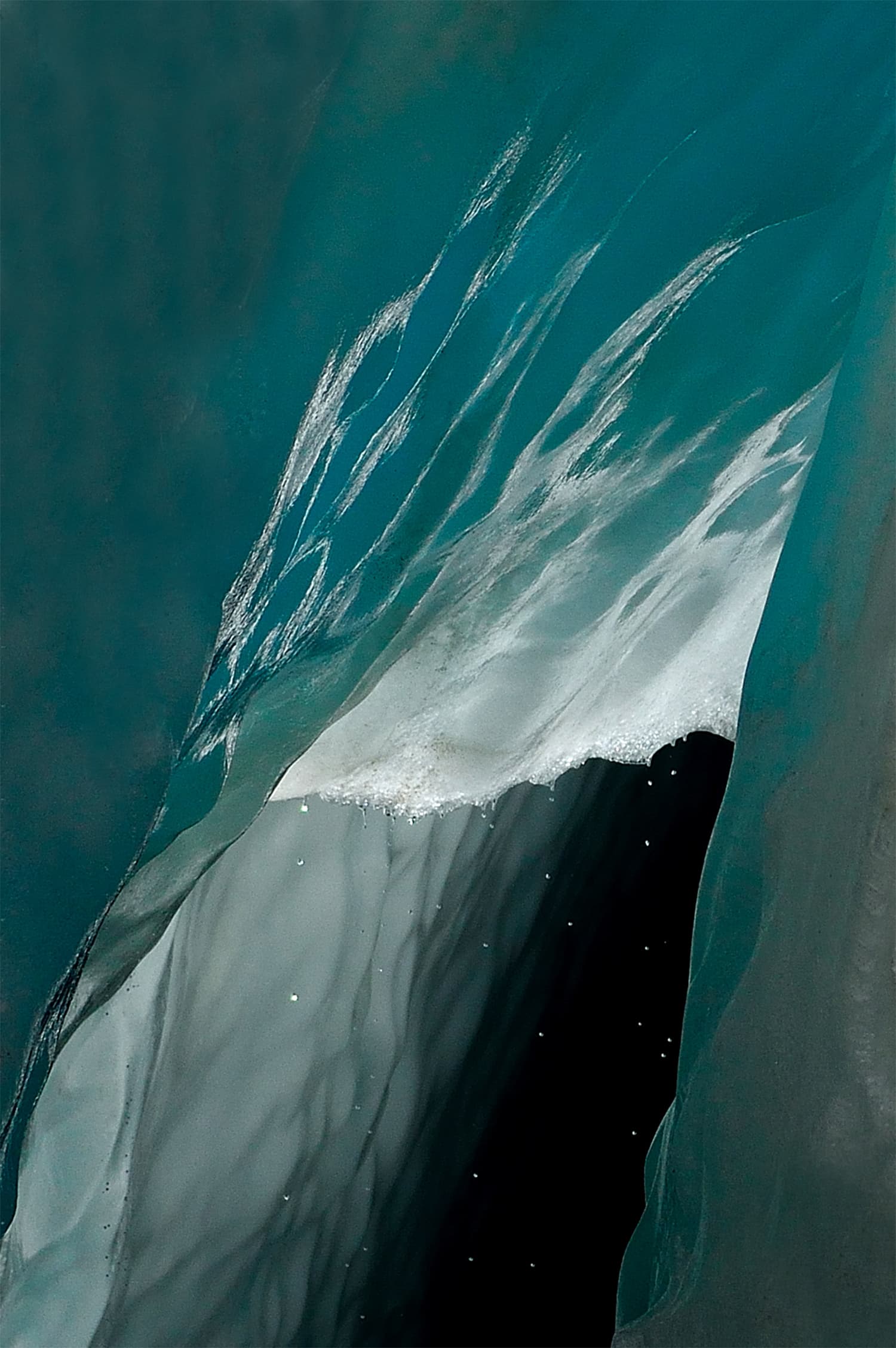
A melting green glacier. ─ Photo by author
Fresh snowfall covers crevasses and makes them deadlier. Since it was summer, the centuries-old glacial ice and snow was melting and the water was going deep into the maze of hidden and deep crevasses.
It seemed as though this entire orchestra of nature was perhaps crooning the last couplet of Rumi’s poem,
‘Be melting snow. Wash yourself of yourself.’
Dancing around crevasses and jumping on the boulders, somehow we crossed two more stages and reached the mouth of Snow Lake.
Here we rested for a while, while the porters served us soup in the majestic span of Snow Lake.
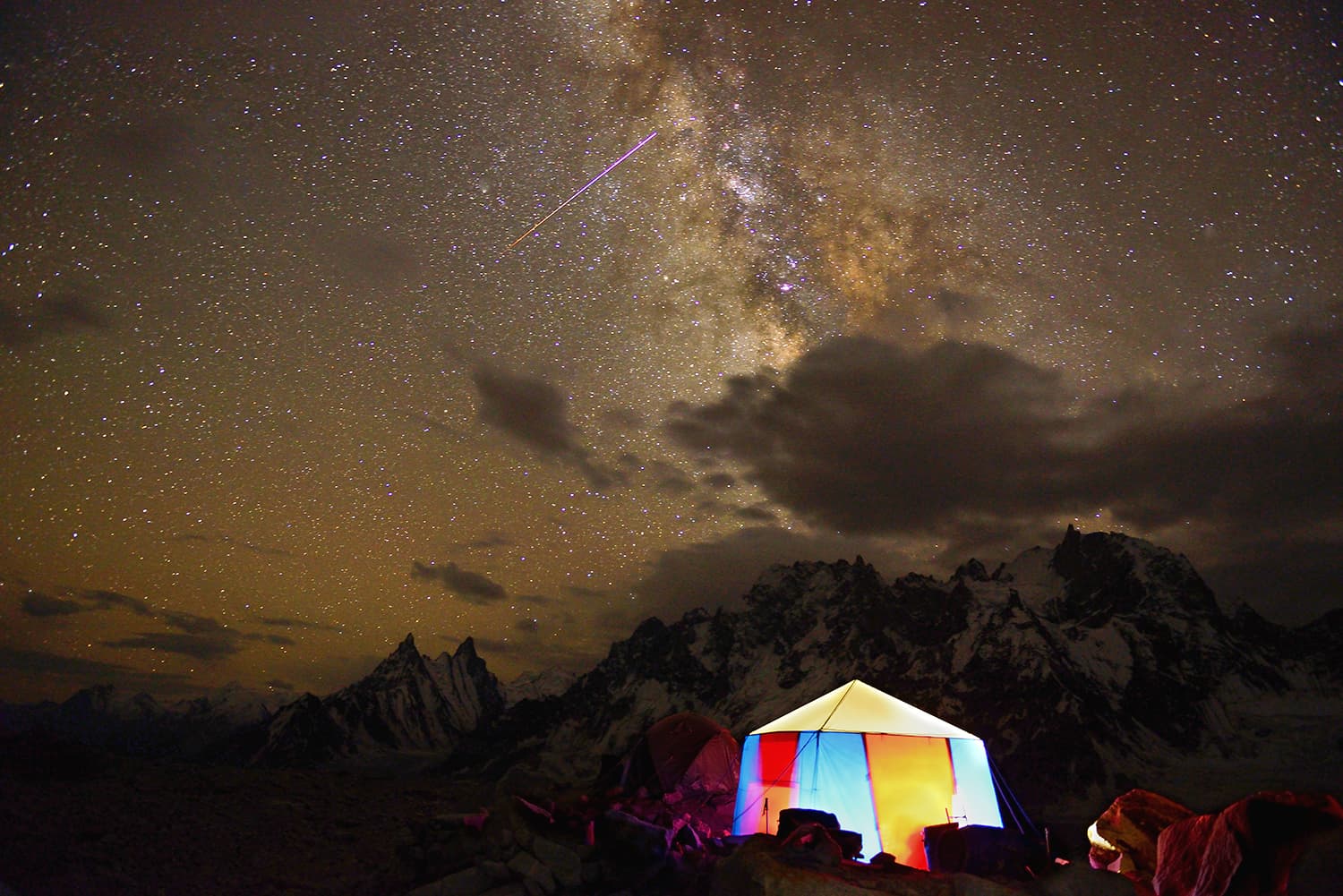
A long exposure shot of milky way and a shooting star near Snow Lake. ─ Photo by author
Then we started to ascend the Hispar La; the climb was way more toilsome than it appeared, a couple of times the ice cracked beneath the feet and one or the other group member came close to falling down the bottomless deep crevasses but thankfully we were prepared — tied up with rope and group formation, and the expertise of the guides came to our rescue.
By afternoon we were on top of the Hispar La. The view from 5,128m above sea level was spectacular.
The famous Italian climber and mountain guide Hervé Barmasse has won nine international awards for climbing and opening new routes on various unclimbed peaks. He has climbed more than 30 peaks, most of which were ‘first ascents’.
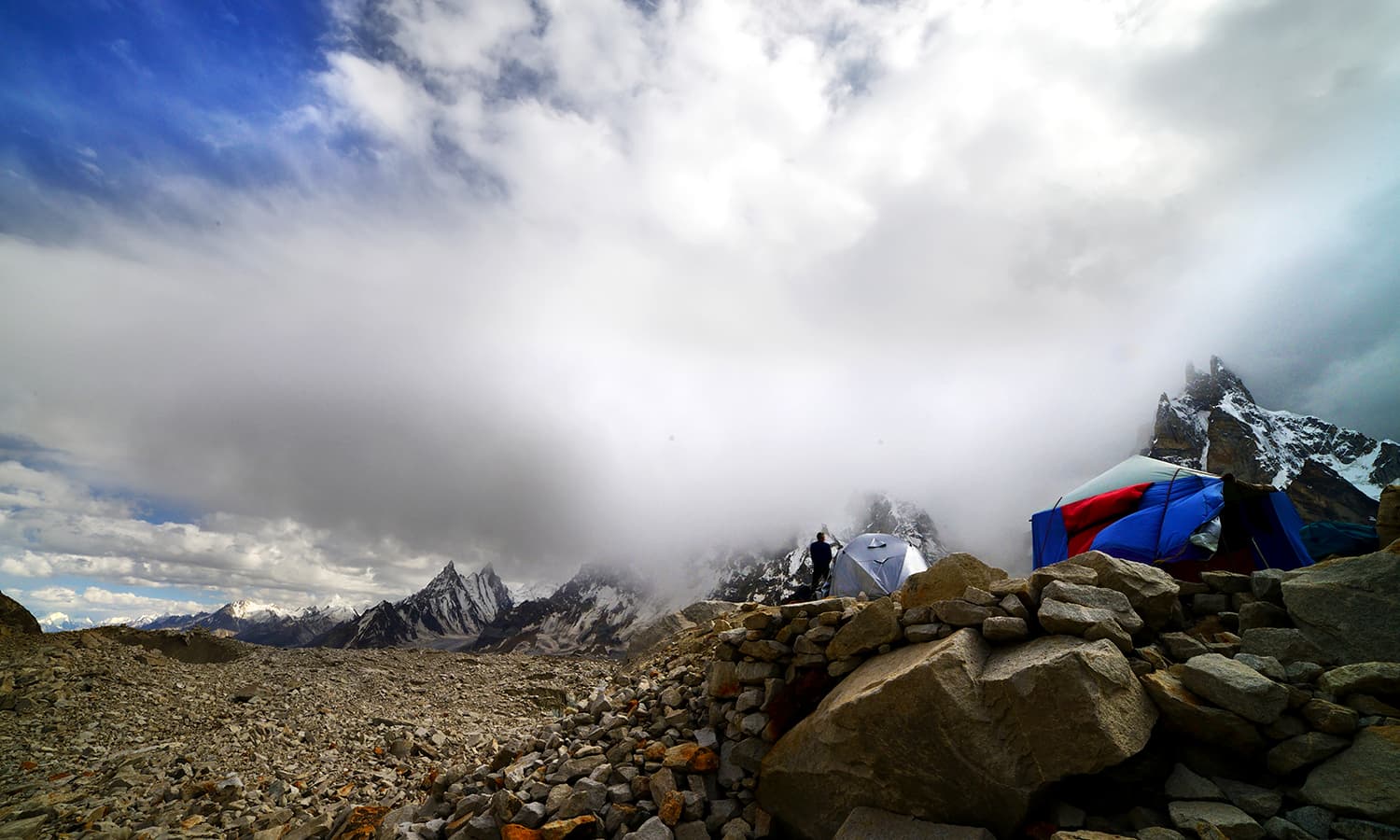
An Australian trekker gazing the approaching storm. ─ Photo by author
In an article about peaks around Biafo glacier and Snow Lake, published in 2013 in American Alpine Journal, a prestigious publication of the world of climbing, he states, “In five expeditions to different areas of the Karakoram, I’ve climbed virgin peaks and new routes up to 7,000m, but never seen a place like Snow Lake, its particular features making it so aptly named.”
The panoramic view from the top of Hispar La substantiated his words.
Stones and frozen snow: An abstract composition of nature at the canvas of Biafo. ─ Photo by author
This corner of Karakoram is almost unexplored; unlike the Baltoro or main Karakoram, very few climbers turn to this side.
Peaks around Snow Lake are more challenging, but yet to be explored and ascended.
Some of them are not even touched and named; in the language of climbing such peaks are called ‘Virgin Peaks’. Aspiring climbers can try their luck and give their names to unnamed peaks, and enrich the history of climbing.