SP Automotive เผยว่านี่ไม่ใช่แค่ Super car หรือ Hyper Car แต่คือ Ultra car คันแรกของโลก ด้วยแรงม้าสูงชนิดที่ไม่เคยมีมาก่อน และคุณสมบัติที่ล้ำหน้าอื่นๆ มันจะเป็นตัวเปลี่ยนเกมสำหรับวงการยานยนต์ระดับสากล ซึ่งเหนือไปกว่า Hyper Car
Chaos มีความเร็วสูงสุด 500 กิโลเมตรต่อชั่วโมง ซึ่งเร็วกว่า Bugatti Chiron Super Sport 300+ และ Hyper Car ไฟฟ้าอย่าง Rimac Nevera
ท่ามกลางความสำเร็จและยอดขายมหาศาล Sixth Tone เผยข้อมูลอีกด้านหนึ่งว่า Shein เน้นการผลิตเสื้อผ้าที่รวดเร็วและราคาถูกกว่าคู่แข่ง จึงเกิดประเด็นถกเถียงเกี่ยวกับสวัสดิการแรงงานซึ่งมีข้อมูลเปิดเผยว่าพนักงานในโรงงานที่ประเทศจีนมีสภาพการทำงานที่ไม่ดีนัก และต้องทำงานหนักโดยมีเวลาพักน้อย
Huang Yan ศาสตราจารย์จากมหาวิทยาลัยเทคโนโลยี South China ในกวางโจวซึ่งทำงานวิจัยเกี่ยวกับความเป็นอยู่ของแรงงานในประเทศจีน กล่าวว่า ความเป็นอยู่ของแรงงานในอุตสาหกรรมฟาสต์แฟชั่นของจีนเป็นการก้าวถอยหลังในแง่ของการคุ้มครองสิทธิแรงงาน และผลประโยชน์ของคนงานมักจะถูกละเลย
โดย Lauren Bravo ผู้เขียนหนังสือ How To Break Up With Fast Fashion กล่าวว่าเสื้อผ้าราคาถูกสนับสนุนให้ผู้บริโภคมองว่าเป็นเสื้อผ้าที่ใช้แล้วทิ้ง ทำให้หลายคนกังวลเกี่ยวกับความยั่งยืน
LONDON – Regulators in Britain granted approval to the experimental drug molnupiravir from U.S. pharmaceutical giant Merck on Thursday, marking the first authorization from a public health body for an oral antiviral treatment for covid-19 in adults.
Experts have said that if widely authorized, the medicine could have huge potential to help fight the coronavirus pandemic: Pills are easier to take, manufacture and store, making them particularly useful in lower-to-middle-income countries with weaker infrastructure and limited vaccine supplies.
“We will continue to move with both rigor and urgency to bring molnupiravir to patients around the world as quickly as possible,” Merck President Robert Davis said in a statement.
The company, which added that it would submit applications to other regulatory agencies, has applied to the U.S. Food and Drug Administration for emergency use authorization, while the European Medicines Agency has launched a rolling review of the drug.
“Today is a historic day for our country,” British Health Secretary Sajid Javid said in Thursday’s announcement. “This will be a game changer for the most vulnerable … who will soon be able to receive the ground-breaking treatment.”
In a global clinical trial, the pill reduced hospitalizations and deaths by nearly half among higher-risk adult coronavirus patients diagnosed with mild to moderate illness, according to Merck, which developed the drug with Ridgeback Biotherapeutics after a discovery at Emory University. The first dose given to a volunteer in the trial was in the United Kingdom.
The U.K. medicines regulator approved the use of the treatment in people who are older than 60 or have at least one other factor that puts them at risk of covid-19 developing into severe illness, such as obesity and heart disease. The agency found it “safe and effective” at curbing the risk after “a rigorous review.”
Britain became known during the pandemic for its speed in authorizing vaccines. It was the first country in the world to approve a coronavirus vaccine tested in a large clinical trial when it granted emergency use authorization to the Pfizer-BioNTech shot last December.
Suerie Moon, co-director of the Global Health Center in Geneva, said the first approval of molnupiravir is “very significant in terms of giving patients and the public at large confidence that this treatment can be widely used.”
William Fischer, a pulmonary and critical-care physician and professor at the University of North Carolina at Chapel Hill, said the pill presents a chance to help overcome the inequities in access to treatment and prevention of the virus that have marked the pandemic. The pill is notably easy to use compared with monoclonal antibodies, a costly treatment that is infused or injected.
“Supply and the ability to provide these monoclonal antibodies is extraordinarily limited to really resource-rich countries,” said Fischer, who helped lead the Phase 2 clinical trial of molnupiravir.
He added, “This pill does play a really important role in terms of making sure that people have equal access to care.”
Virologists have said they are hopeful that as well as limiting the risk of developing severe illness, the treatment could help reduce transmission of the virus, too. And, since the pill can be picked up from a pharmacy and taken at home, Fischer said it will help prevent hospitals from becoming overwhelmed by covid-19 patients and having to put off other types of care.
The United States has made an advance purchase of 1.7 million courses of molnupiravir at a cost of about $1.2 billion, or roughly $700 per treatment course. Other countries have also reached agreements with Merck to buy the pills, including Australia, Singapore and South Korea.
The U.S. drugmaker said that it expects to produce 10 million courses of the treatment by the end of this year, along with at least 20 million in 2022, and that it plans to adopt a “tiered pricing approach” taking into account each country’s ability to pay.
The firm has also agreed to share its license for the pill with several Indian manufacturers and with the Medicines Patent Pool, a U.N.-backed nonprofit organization, to allow production around the world and help boost access to more than 100 low- and middle-income countries. The move stood out in a pandemic that has seen pharmaceutical companies lobbying to keep rights to vaccines. More than 50 pharmaceutical companies from around the world have inquired about the molnupiravir license agreement, the Medicines Patent Pool said Thursday.
The U.K. approval marks “an important step,” Hervé Verhoosel, spokesman for Unitaid, a global health agency hosted by the World Health Organization, said in a statement.
“One of the most pressing challenges is now to guarantee a quality-assured generic market at lowest possible price and as rapidly as possible after relevant authorizations for all low- and middle-income countries,” Verhoosel said, adding that Unitaid and its partners are working to address potential market challenges in developing countries.
Advocacy organizations, however, have criticized Merck for leaving out upper-middle-income countries hit hard by the pandemic. Some are calling for the company to give up its patent for the drug.
“Pills are easier to manufacture and distribute in countries with insecure infrastructure so it’s vital that Merck releases the patent and trade secrets for this drug,” Tim Bierly, pharma campaigner at the U.K.-based organization Global Justice Now, said in a statement Thursday.
The drug – which received a type of conditional marketing authorization for products that fulfill an unmet medical need – will go by the name Lagevrio in Britain. It works by introducing errors that garble the genetic code of the virus and prevent it from making copies of itself. The window in which it can be administered and still work may be narrow, though, and the British regulator recommended taking it “as soon as possible” after a positive coronavirus test and within five days of symptoms onset.
The U.K. health secretary, Javid, called it “an excellent addition to our armory,” while urging people to keep getting their coronavirus shots. Doctors maintain the vaccines remain the principal tool against the coronavirus, as they seek to help prevent people from catching it rather than treating the disease after infection.
GLASGOW, Scotland – The United States and 20 other countries announced Thursday that starting next year they would stop spending tax dollars to support international fossil fuel projects, a move the group said would divert $18 billion a year toward clean energy.
The pledge comes just a day after even more nations agreed to restrict public financing for coal power.
The decision to curb public spending on fossil fuels – which came as negotiations were underway at a major U.N. climate conference in Glasgow – will further restrict investments in drilling, power plants and other projects by international development banks and other publicly funded institutions.
“The presumption has to be that direct finance and public finance towards energy in developing countries around the world has to be in the clean and green area,” John Morton, climate counselor for the U.S. Treasury Department, said at the announcement of the initiative on Thursday.
The new measures are the latest of several new targets that the International Energy Agency said could meaningfully alter the trajectory of global warming. The IEA’s executive director Fatih Birol said Thursday that if the new targets “are met in full and on time, they would be enough to hold the rise in global temperatures to 1.8 degrees Celsius [2.7 degrees Fahrenheit] by the end of the century.”
That marks an improvement in the agency’s normally glum assessments, and Birol called it a “landmark moment.” The IEA director credited measures taken since mid-October, including Indian Prime Minister Narendra Modi strengthening of the country’s 2030 targets, its pledge to hit net zero emissions by 2070, and the pledge by several other large economies to reach net zero emissions. Birol also said that another key factor was that more than 100 countries had promised to cut emissions of methane 30% by 2030.
The forecast, however, remains dire, something not lost on the youth. More than a dozen young climate activists staged a small protest on Thursday inside the U.N. climate summit building. They stood in a crowded hallway and chanted: “Whose planet? Our planet! Whose future? Our future! Whose water? Our water! Whose air? Our air!”
Much larger protests are planned for Friday and Saturday at a park in Glasgow outside the conference venue. Swedish activist Greta Thunberg is expected to headline the events.
Leaders of multilateral institutions, philanthropies and advocacy groups have urged the rapid phaseout of coal, oil and gas operations, arguing that if it is done right, consumers worldwide would be able to make the transition from the carbon-emitting present to a decarbonized future.
“Ending international finance for all unabated fossil fuels is the next critical frontier we must deliver on,” British Energy Minister Greg Hands said. “We must put public finance on the right side of history.”
The move to restrict public money for all foreign fossil fuel projects doesn’t affect what countries do at home, nor does it include every major international funder of such efforts.
China, Japan and South Korea, which together comprise nearly half of international public funding for fossil fuel projects, did not join the pledge. And there appeared to be some loopholes. But proponents still said that it could send a positive message.
“We hope this will lead to the same domino effect that we’ve seen with coal finance,” said Laurie van der Burg, a global public finance campaign manager at the nonprofit Oil Change International.
Stopping the flow of money to new fossil fuel development is essential to meeting the world’s climate goals, activists say. In May, the International Energy Agency published a “road map” to zeroing out carbon emissions by 2050; according to that plan, there should be no new development of fossil fuel supplies after that year.
“That kind of systemic change is what drives exponential change,” Nigel Topping, the UN’s high-level climate action champion, said of the public and private commitments to shift funds away from fossil fuels.
But even as the promises for greater action pile up, cracks are starting to emerge in some countries’ commitments to curbing planet-warming emissions.
Two days after signing on to a pledge to halt deforestation over the next decade, Indonesia’s Environment and Forestry minister, Siti Nurbaya Bakar, condemned the agreement in a Facebook post.
“Forcing Indonesia to zero deforestation in 2030,” she wrote, is “obviously inappropriate and unfair.”
Indonesian officials said they believed their commitment was only to ensure that the country’s forestry sector absorbs as much carbon as it emits.
Asked about the apparent reversal, COP26 President Alok Sharma projected assurance.
“All of those who have signed up to these have done so in full understanding of what they are signing up to,” he said.
Officials also deflected concerns that the United States did not join a coalition of countries promising to eliminate coal from their power sectors.
Topping noted that President Joe Biden has pledged to generate all U.S. electricity from clean sources by 2035 – a goal that necessarily involves phasing out coal. And economic forces have already curbed use of the world’s dirtiest fuel in the United States by more than half.
Another factor is the European Union’s plan for a carbon border adjustment mechanism, which would effectively tax products with high carbon contents and make access to the European market difficult. South African President Cyril Ramaphosa said this week that one reason for reaching a landmark deal this week to close coal plants and install renewables was that goods produced in South Africa’s coal-intensive economy could soon face trade barriers as a result of the new E.U. tax.
As negotiators at the climate summit in Glasgow looked for more ways to cut emissions, U.N. experts on Thursday said the world must spend five to 10 times more helping vulnerable people adapt to inevitable environmental upheaval.
Already, millions are suffering amid prolonged droughts, catastrophic wildfires, chronic flooding and worsening storms brought about by rising temperatures, according to a sobering new “Adaptation Report” released at COP26.
The threats will only intensify if emissions continue along their current trajectory, heating up the Earth by an estimated 2.7 degrees Celsius (4.9 degrees Fahrenheit) by the end of the century.
“Climate change is happening, impacts are increasing now and today, and we’re going to be committed to these growing impacts for the foreseeable future, as long as we can actually imagine,” said Henry Neufeldt, chief editor of the U.N. Environment Program’s report.
“Adaptation is necessary,” he said, “even if we stopped emissions today.”
After the World Bank announced it would stop funding coal projects in 2013, there has been a growing wave of similar commitments from countries and financial institutions. This year, the world’s 20 biggest economies agreed to end public finance for overseas coal projects. Restricting public funds for fossil fuels can also make them less attractive to private investors, who may see the projects as riskier without a backstop of government support. It also communicates that producers of polluting fuels have “lost their social license,” van der Burg said.
But van der Burg cautioned that the details of the international finance pledge still need to be fleshed out. Loopholes that permit indirect funding or that allow countries to continue supporting fossil fuel projects that use small amounts of carbon capture to reduce their emissions, for example, would diminish the pledge’s significance, she said.
The separate commitment to phase out coal power and not invest further in it, announced late Wednesday, attracted 18 new countries, including Poland, Vietnam and Chile, all major coal consumers. They committed to phase out coal by the end of the 2030s for richer countries and a decade later for less-developed ones, though oil and gas was not covered, limiting the pledge’s ambition.
“Coal has no part to play in our future power generation,” British Business Secretary Kwasi Kwarteng said in a statement. “The end of coal is in sight. The world is moving in the right direction, standing ready to seal coal’s fate.”
Coal isn’t dead yet, though. GHGSat, which can use satellites to detect facility-level data about greenhouse gas emissions, said Thursday that methane emissions from oil, gas and coal facilities had grown rapidly so far in 2021. It said emissions from coal mining activity in 2021 were larger than those measured from 2017 through 2020 combined.
In the United States, Ashley Burke, spokeswoman for the National Mining Association, defended coal mines and power plants as “the building blocks of electric vehicles, solar panels and wind turbines.”
She said that global emissions reductions couldn’t be achieved “without vastly more momentum around carbon capture development and deployment.” Burke pointed to the recent run-up in energy prices, saying that “targeting the fuels that are still keeping the lights on in much of the world, with no plan for what happens when the wind stops blowing, the sun stops shining and natural gas prices are sky high, is a road map for exorbitant energy prices.”
The efforts to curtail coal use come as rich nations are being pressed to do more to help their poorer, less energy-intensive neighbors.
Rajiv Shah, president of the Rockefeller Foundation, said this week that there is tremendous inequality in the energy sector. He said 3.6 billion people consume less than 1,000 kilowatt hours of energy per person annually. That compares with 8,000 kilowatt hours per person for countries in the Organization of Economic Cooperation and Development and 12,000 in the United States.
“You cannot have this grand transformation of the global economy take place if it does not capture the hopes and aspirations of billions of people throughout the planet,” said Shah, who along with Ikea Foundation and the Bezos Earth Fund this week launched an alliance to retire coal plants while accelerating renewable energy. (Jeff Bezos owns The Washington Post.)
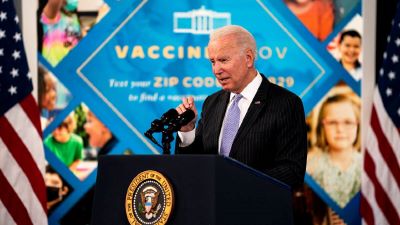
Companies with more than 100 employees will be mandated to require coronavirus vaccinations for their workers or do regular testing by Jan. 4 under the terms of a new federal rule released Thursday by the Biden administration.
The hotly anticipated rule, which is being implemented on an emergency basis by the Department of Labor, is one of the White House’s most strenuous attempts to increase vaccination rates across the country.
The policy is already being contested by a number of Republicans, and Texas Attorney General Ken Paxton said on Twitter he planned to sue the federal government to block the policy, calling it an “illegal, unconstitutional regulation.”
The new policy would require weekly testing and mandatory face-masking for workers who choose not to get vaccinated. It also specifies that employers must provide paid time off for workers to get vaccinated or recover from any side effects. But companies are able to require un-vaccinated employees to foot the bill for tests.
“Low-wage, hourly, and frontline workers have been particularly hard hit by the pandemic,” said Rep. Robert Scott, D-Va., the chairman of the House Committee on Education and Labor, who has pushed for the Department of Labor to act more aggressively on workplace safety throughout the pandemic. “Workplace vaccination policies will save lives, protect our economic recovery, and help us finally get things back to normal.”
So far, 222 million Americans have received at least one dose of the vaccine, but the numbers vary widely in different parts of the country. During a surge of the virus’s delta variant in the late summer, White House officials escalated efforts to vaccinate more Americans, leading to the new emergency rule.
Coronavirus vaccines have proved successful at preventing infection and have in many cases minimized the symptoms of those who do become sick, offering what public health experts say is the best chance to lead the country out of the pandemic.
But many Republicans have asserted that having the federal government become involved in vaccine rules amounts to an unfair government edict. A number of GOP governors and attorneys general have promised to challenge the policy in court.
“I don’t think they properly weighed all the risks and benefits of doing this, and are using a shotgun approach and not a scalpel when infections are dropping and vaccinations are already continuing to rise,” said Roger Severino, a former Trump administration official and fellow at the socially conservative Ethics and Public Policy Center. “All the indicators are that the grave danger has passed.”
Labor and White House officials spent weeks hammering out the text, keeping an eye on the high likelihood of legal challenges it would face and the complexity of issues raised by a rule that will apply to hundreds of thousands of businesses. The White House estimates the policy will apply to 84 million workers across the country.
More than 70 business groups, individuals and other interested parties met with officials in the final days before the rule was released to ask questions and express concerns about things like how the requirement would effect staffing with labor shortages if people refused to comply and quit their jobs. A number of industries are already struggling to find employees, particularly in sectors like construction and trucking.
The new policy “is likely to increase compliance costs and cause regulatory burdens that will exacerbate several headwinds facing the construction industry,” Ben Brubeck, a vice president at Associated Builders and Contractors, said in a statement.
The rule tracks very closely to the plan announced by the White House in September, though it could be modified going forward. For example, written into the text of the 490 page rule is a hint that the Occupational Safety and Health Administration (OSHA) may explore expanding the rule in the future to cover all businesses, not just those with more than 100 employees.
“OSHA is confident that employers with 100 or more employees have the administrative capacity to implement the standard’s requirements promptly, but is less confident that smaller employers can do so without undue disruption,” it said, saying it would seek public comment on the matter.
Because of the testing option, the new White House ruling does not constitute a strict vaccine mandate. In fact, it is softer than many of the policies instituted by many private companies as well as state governments that have required vaccinations for employees. Still, the new federal ruling is expected to give companies that had hoped to institute more stringent mandates, but backed off for fear of employee opposition, more political cover to do so.
Companies that don’t comply could face the potential of $13,000 fines per violation, or $136,000 per willful violation, potentially adding hundreds of thousands of dollars or more in fines for companies that are found to be well outside of the rules.
The release of the rule was paired with the release of a vaccine mandate for workers at facilities that participate in Medicaid or Medicare.
Those employees will be required to be fully vaccinated by Jan. 4, adding an additional 17 million workers to the requirements, at 76,000 medical facilities. Medical or religious exemptions will apply in these cases. All told, the federal government’s various vaccine requirements will apply to more than two-thirds of the workforce, officials said.
The Department of Labor estimates the rule will prevent more than 250,000 hospitalizations from workplace Covid-19 exposure and save thousands of lives. Even before the rule’s implementation, more than a third of U.S. workers now say their employer is requiring them to get vaccinated.
“Covid-19 has had a devastating impact on workers, and we continue to see dangerous levels of cases,” Labor Secretary Marty Walsh said Thursday.
Opposition has been marshaling in advance of the OSHA rule’s release at the political level. Republican attorneys general in at least 24 states have vowed to fight the rule in court, and one, Arizona Attorney General Mark Brnovich, R, has already filed a lawsuit against the federal government over it. Some state governments, including Missouri’s, are pledging to explore legislation that could exempt their state from the requirement.
But officials from OSHA and the Centers for Medicare and Medicaid Services told reporters that the new rules “preempt” any state or local laws that seek to ban or limit employer authority for vaccination, masks and testing, like one that Republicans in Texas passed recently. They said they plan to take action if states that have their own occupational health plans, which are required to be at least as stringent as the federal rules, do not comply with the federal plan.
The mandates appear to enjoy support by many Americans: A September Gallup poll found that 58% of people said they supported the coming OSHA requirement and 63% said they supported the mandate at Medicaid and Medicare facilities. Labor unions, like the American Federation of Teachers and the Retail, Wholesale and Department Store Union, cheered the new rule, citing the health threats workers have faced throughout the pandemic.
The GOP efforts to continue to contest the rule come in addition to legal battles in states including Minnesota, New York, Texas, Michigan, Kentucky, Ohio and others over other coronavirus vaccine mandates. More than 10 Republican-controlled states have also filed a lawsuit against the federal government for its vaccination requirements for federal contractors. But those mandates have mostly withstood legal challenges, as have private mandates imposed by big companies and hospital systems.
Mandates do appear to have led to an increase in vaccinations. United Airlines, which had one of the strictest mandates for a major air carrier, said its employee vaccination rate increased to more than 99%. Delta, which used financial penalties and testing requirements, saw the employee vaccination rate go to 90% from 75%. Tyson Foods said recently that at least 96% of its employees were vaccinated in advance of its Nov. 1 deadline – up from under 50% before it announced the mandate in August.
Many hospitals in New York saw vaccination rates increase to more than 95% by the deadline of the state’s mandate for health-care workers, up from the 70 to 80% range before the rule was announced. In California, major hospitals saw vaccination rates increase to about 90% after a similar, albeit slightly less stringent mandate.
The White House said these type of vaccination mandates have been increasing rates by more than 20 percentage points among their target populations, and it cited other studies showing that increased vaccination would help smooth the way for the economic recovery.
In New York, which instituted a mandate for municipal workers, about 91% of the city’s workforce had at least one shot by the deadline earlier this week, which officials hailed as a significant success. Those numbers rose steadily as the deadline approached – increasing five percentage points in the final days.
About 9,000 workers – less than 2.5% of the city’s 378,000-person workforce – were placed on unpaid leave because they didn’t get vaccinated, despite protests and threats from anti-vaccine contingents in the police, fire and sanitation departments that the mandate would lead to massive labor shortages. Another 12,000 workers have pending medical or religious exemptions, officials said.
There, and in other cities like Los Angeles, firefighter and police unions have sought to challenge the mandates in court. In Chicago on Monday, a judge blocked the city’s Dec. 31 deadline for enforcing a vaccination mandate for the police department in a lawsuit brought by the police union, saying the two sides needed more time to resolve the dispute. The judge left intact the city’s current rules, which require municipal workers to report their vaccination status and pay for twice-weekly testing if they are not vaccinated. Another judge in the city recently dismissed a motion to halt the city’s requirement.
Overall, 32 out of 34 city departments in Chicago say that at least 92% of their employees are in compliance with the city’s rules. But those numbers have lagged among police and fire departments, with only 72% of police and 87% of the fire department in compliance, according to WBEZ.
Some other labor unions, advocates and workers have hailed the effort.
“The covid-19 pandemic was a whole other story. It showed how much we needed strong OSHA standards,” Anne Barden, a dietary aide, cook and union member at Trinity Hill Care Center in Connecticut, said during a recent news conference organized by the National Council for Occupational Safety and Health about the coming rule.
Barden spoke about the toll the pandemic took on workers, saying that at one point half of the staff members were out sick or in quarantine.
“We welcome OSHA’s more aggressive approach,” Barden said.
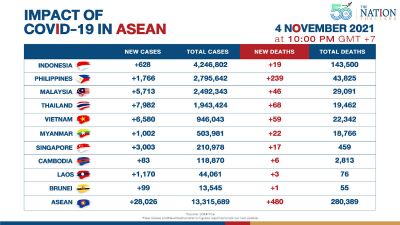
The number of Covid-19 cases crossed 13.31 million across Southeast Asia, with 28,026 new cases reported on Thursday (November 4), higher than Wednesday’s tally at 27,416. New deaths are at 480, increasing from Wednesday’s number of 452. Total Covid-19 deaths in Asean are now at 280,389.
Managing Director of COVAX Facility said during a meeting with Vietnam’s Prime Minister on Wednesday that it has decided to allocate additional over 9 million doses of Pfizer and Moderna Covid-19 vaccine to Vietnam and will deliver them to Vietnam as soon as possible. Meanwhile, Vietnamese PM thanked COVAX for providing Vietnam with 38.9 million doses of vaccines free of charge in 2021, including nearly 23 million doses delivered to the country.
Meanwhile, Cambodia’s Health Minister has authorized the use of Covid-19 drug Molnupiravir for emergency conditions. In addition, Prime Minister Hun Sen has revealed that the government has prepared $2.5 million budget to buy Molnupiravir tables for Covid-19 patients in the country. The drug will be manufactured by Mylan Laboratories Limited, based in India.

 พระมหาเทวีแห่งเมืองยองห้วยที่ลุกขึ้นมากอบกู้แผ่นดินชาวไทใหญ่ หลังการก่อรัฐประหารในเมียนมาที่คร่าชีวิตและอิสรภาพของเจ้าฟ้าไทใหญ่เป็นจำนวนมาก
 SP Automotive เปิดตัวรถยนต์ระดับ Ultra car คันแรกของโลก กำลังสูงถึง 3,065 แรงม้า ความเร็วสูงสุด 500 กม./ชม.


 แบรนด์แฟชั่นจากจีนเจ้านี้ก้าวขึ้นเป็นแพลตฟอร์มช้อปปิ้งที่มียอดดาวน์โหลดมากที่สุดในสหรัฐอเมริกา มูลค่าแซงหน้ายักษ์ใหญ่หลายราย
 จีนสกัดโควิดเข้มไม่ให้เข้ากรุงปักกิ่งเตรียมเปิดโอลิมปิกฤดูหนาวในอีกไม่ถึง 100 วัน
 อาการเสพติดคริปโต วิกฤตด้านสุขภาพจิตที่กำลังระบาดหนักจนต้องมีนักบำบัด
 เอเจนซี่ของหนุ่มๆ วง BTS จากแดนกิมจิเตรียมขายโฟโต้การ์ดในรูปแบบสินทรัพย์ดิจิทัลและพัฒนาวิดีโอเกมร่วมกับวง