Asean crosses 4 million Covid-19 cases but Singapore to soon start easing lockdown measures
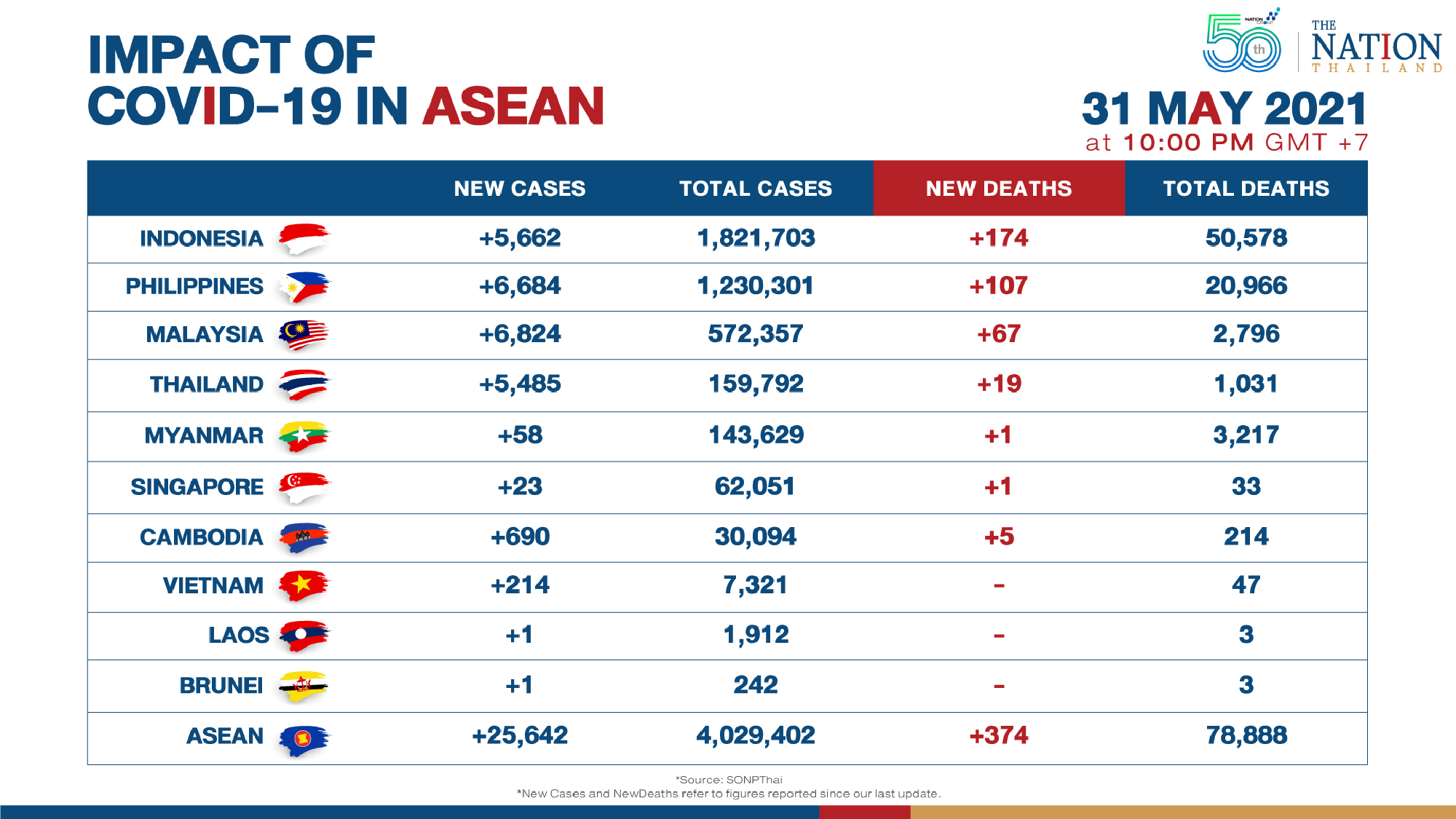
The number of Covid-19 cases across Southeast Asia crossed 4.02 million, with 25,642 people testing positive on Monday.
The number was slightly higher than Sunday’s 25,603.
With 374 deaths, down from Sunday’s 390, total fatalities in Asean rose to 78,888.
Singapore Prime Minister Lee Hsien Loong on Monday said they expected to secure total control over the pandemic in the next two weeks and start easing lockdown measures in the country.
From June 13 onwards, Singapore will start vaccinating students aged over 12 years, after public health officers warned that new strains of the virus could increase the infection rate among children and adolescents.
Malaysia’s public health minister said that so far 82,341 cases had been found among children and teenagers. Of these, 19,851 patients were under four years old while 27,402 patients were between 13 to 17 years old. No underage patients have developed severe symptoms that require treatment in ICU. The ministry urged parents to take extra care of their children to keep them safe from the virus, such as refraining from taking them to crowded areas.
China three-child policy and the new age of demographic anxiety
On Monday, China announced what seemed to many analysts as an inevitability – a further unwinding of its once-draconian regime of population control.
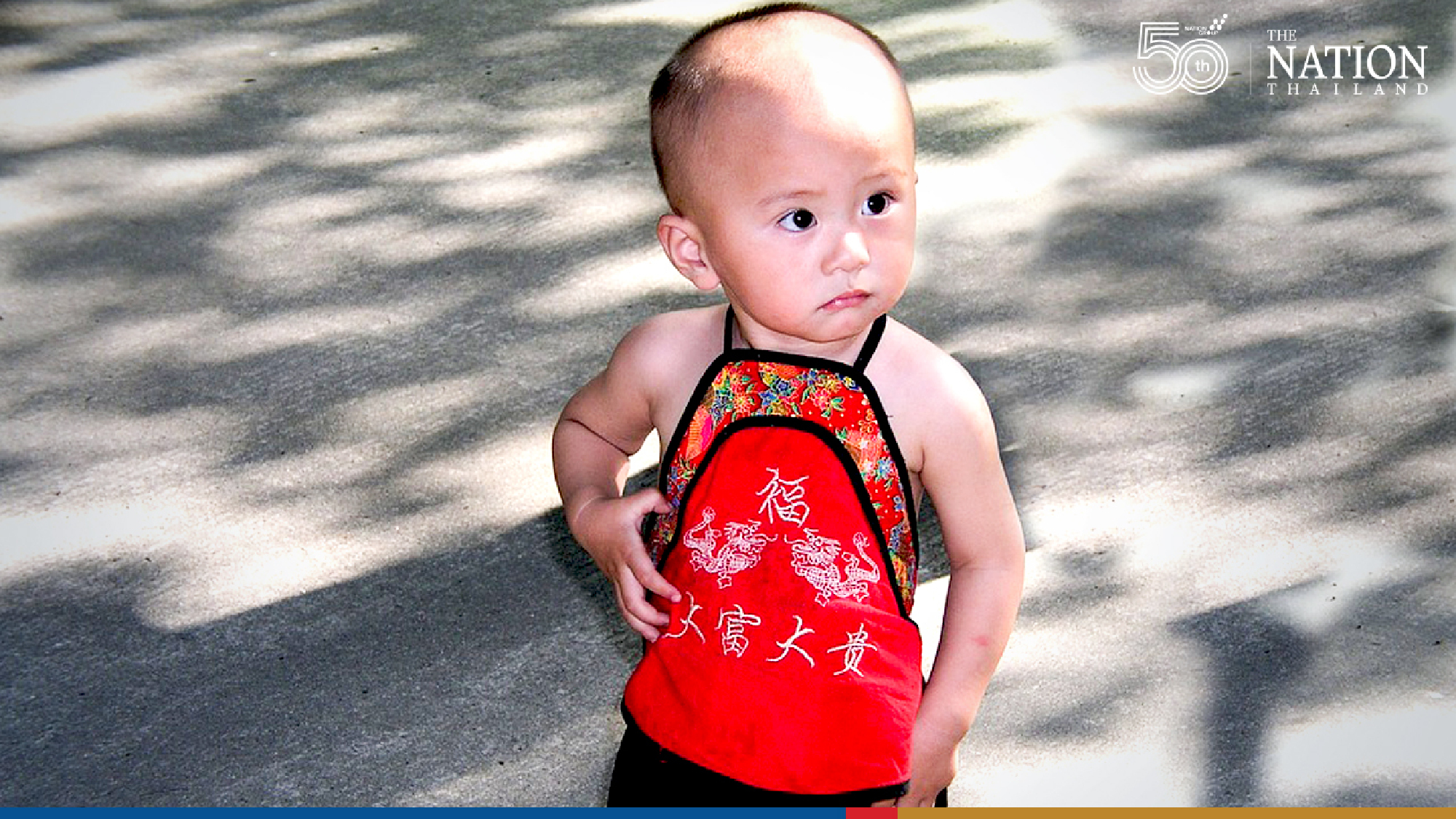
According to a new policy unveiled at a meeting of the Politburo chaired by Chinese President Xi Jinping, married couples are now allowed to have up to three children. The move comes on the heels of China’s once-in-a-decade census, which found that the country’s population grew at its slowest rate since the 1950s.
The narrative of China’s success often hinges on its particular 20th-century demographic advantage: The country’s Communist rulers were able to mobilize a huge pool of impoverished workers to fuel an unprecedented transformation that made the world’s most populous nation into a global manufacturing powerhouse. But after years of rapid industrialization and urbanization, China is experiencing a demographic slump on par with countries in the developed world, with declining birthrates, an aging population and a growing gender gap.
China’s birthrate dropped 15 percent last year – a reflection of the intense toll of the pandemic, but also broader trends of rising costs of housing and education in China’s teeming cities. Nearly 20 percent of the Chinese population is now aged 60 or above, according to the latest census data. By the start of the next decade, according to research by Morgan Stanley, close to 124 million more people will have entered the age category of 55 and above, the largest demographic increase among age categories and a sign of a rapidly graying population.
This is all largely thanks to the legacy of Beijing’s heavy-handed “one-child” policy, which was brought into effect four decades ago to tamp down a surging population. For years, authorities implemented the policy unevenly and often brutally, with millions of forced abortions and sterilizations likely carried out. In 2016, in a tacit recognition of the damage done, China relaxed its protocols to allow married couples to have two children. But the country’s birthrate still dropped the next four consecutive years.
The latest edict smacks of a mounting sense of panic within the halls of power. “As new data exposed the vulnerabilities in China’s growth model, calls among the public – from demographers to central bank officials and entrepreneurs – for scrapping restrictions on family size have gained urgency,” wrote my colleague Lily Kuo. “Yet China’s leaders stopped short of completely dropping the deeply unpopular family-planning regime in place since 1980 – often brutally enforced, through forced abortions, sterilizations and steep fines. Keeping the limits in place, researchers say, is a way to maintain control.”
That control took various forms in the preceding decades. Human rights activists and journalists documented myriad cases of forced sterilizations, as well as an opaque and often cruel system of punishments and fines for those found to be violating the one-child rule.
“Local officials had wide discretion in determining how much to fine violators. Sums could range from a multiple of two to 10 times annual household income,” wrote Mei Fong in “One Child: The Story of China’s Most Radical Experiment.” “People had no way of figuring out ahead of time what they were liable for, and two sets of violators, under similar circumstances, might pay vastly different penalties. In 2010, a family-planning official apparently imposed a fine of 5 million yuan, or over $800,000, on a violator.”
“What can be said is that China’s policy produced a lot of one-child families – today the country has about 150 million of them – and perhaps tens of millions of abortions and sterilizations, many of them involuntary,” noted the Economist in 2019. “Corrupt and brutal family-planning officials demolished the homes of some who resisted. Women had their menstrual cycles recorded on blackboards, for all to see. As birth quotas bit, gender ratios became more skewed by infanticide and sex-selective abortions of girls.”
Few experts believe the new rules will be able to redress the harm inflicted over multiple generations. “The three-child policy is a step forward, but the question is: If the two-child policy did not mean people had more children, will that happen under a three-child policy?” Sun Xiaomei, a professor at China Women’s University, told Kuo.
“A comprehensive policy package ranging from tax incentives, education and housing subsidies, more generous maternity leave, universal provision of child care” is needed for the three-child policy to be effective, Liu Li-Gang, managing director and chief China economist at Citigroup, told Bloomberg News.
China’s Politburo indicated it will prioritize addressing some of these mounting social needs, though it offered few specifics on its plans. As Kuo reported, myriad commenters on Chinese social media speculated over the shift in official policy and whether the central government would move toward punishing those not procreating. One Weibo user wrote on the microblog site, “Whether you change the policy to five children or eight children, housing prices are still the best sterilization tool.”
China’s demographic turn is perhaps the most acute illustration of a global trend. The world’s population surged in the 20th century, growing from 1.6 billion in 1900 to around 6 billion in 2000. Now, forecasters predict that the majority of the world’s countries with the exception of some nations in sub-Saharan Africa will see a population decline by the end of the century. The United States, like China, also experienced its slowest population growth in almost a century over the last decade. According to research published last year in the Lancet, a British medical journal, 23 nations, including Japan and Italy, will have their populations halved by 2100.
This has radical implications for the future of global politics. “The strain of longer lives and low fertility, leading to fewer workers and more retirees, threatens to upend how societies are organized – around the notion that a surplus of young people will drive economies and help pay for the old,” noted the New York Times in May.
“It may also require a reconceptualization of family and nation. Imagine entire regions where everyone is 70 or older,” the Times wrote. “Imagine governments laying out huge bonuses for immigrants and mothers with lots of children. Imagine a gig economy filled with grandparents and Super Bowl ads promoting procreation.”
Police searching for gunmen in Miami area shooting that left at least 2 dead, 21 injured
Authorities are searching for the gunmen who opened fire shortly after midnight on Sunday outside of a music event in the Miami area, leaving two dead and more than 20 injured in what police are calling a targeted act that resulted from group rivalries.
Three men approached the El Mula Banquet Hall near Hialeah in a white Nissan Pathfinder, police said. They got out of the vehicle armed with assault rifles and handguns and opened fire on the crowd that had gathered outside the space, before getting back in the car and fleeing, police said. Twenty-three people were shot, and two were declared dead on the scene.
Three people were still hospitalized Monday with critical injuries and “clinging to life,” Miami-Dade police Maj. Jorge Aguiar said during a Monday news conference. Three others who were hospitalized have been released, including a 17-year-old who was shot in the leg.
Authorities are searching for the vehicle and the gunmen, and seeking information from the public, officials said in a Monday news conference. Police also released surveillance footage they said they hope will spur more information from the public.
“This is a day that we should be with our loved ones, we should be remembering those who were lost who served our country” Miami-Dade County Mayor Daniella Levine Cava said during the Memorial Day update. “Instead, here we are standing once again for a terrible tragedy.”
Aguiar said the violence stemmed from “an ongoing rivalry” between two groups, and police believe the intended target may have been in front of the venue.
When the gunmen started shooting, several people in the parking lot returned fire, police said.
During the news conference, a man authorities later identified as a father of one of the victims interrupted the briefing, turning to the cameras to say, “You all killed my kid,” before officials pulled him away.
“That is the pain that affects our community, right there, right before you,” said Alfredo “Freddy” Ramirez III, director of the Miami-Dade Police Department.
Police have not officially released the names of any of the victims.
Angelic Green told the Miami Herald that her son and nephew, both 24, were among those shot early Sunday.
She said her son was shot in the abdomen and underwent surgery, and is in stable condition. Her nephew was shot one time in the abdomen and three times in the leg, but also seems to be stable.
Green said her son called her and her husband “frantic” to tell them he had been shot. “He was telling us, if something happens to him, that he loves us. We said, ‘We love you, too, but you’re gonna survive this.'”
Green called it the “worst phone call of my life.”
The Miami-Dade police department released video footage that shows three people leaving a Pathfinder wearing hoods and masks. They run off screen and leave the car doors ajar. Less than 10 seconds later, the individuals run back to the car and drive off.
Levine Cava made an emphatic call for the community’s cooperation to “get these killers off the streets,” asking residents to come forward. “We need your help. We need information.”
A litany of law enforcement and county officials condemned the gun violence that shook the area in recent days.
On Friday night, seven people were shot and one person died after a gunman opened fire near the Wynwood area. Police said they don’t believe the two shootings are connected.
“We must break the cycle of violence – there is a cycle,” Levine Cava said during the news conference. “Gun violence is an epidemic, and the pandemic has intensified it.”
Miami-Dade county commissioner Keon Hardemon called the recent gun violence “acts of domestic terrorism.”
“Anytime a shooter strikes 20 people, most of whom have nothing to do with whatever their issue is – anytime they strike them down and they die in our community, it is meant to keep us from having a regular life here in Miami-Dade County,” he said. “It is to keep us from going out and enjoying ourselves.”
“It is to put a chill in our communities,” Hardemon said.
Miami Police Chief Art Acevedo also decried gun violence over the weekend.
“Mass shootings continue to occur on a regular basis across our country & yet elected officials only talk about the militarization of the police on the left and gun rights on the right. Gun violence is a public health epidemic our Nation needs to address,” he wrote on Twitter.
Marcus Lemonis, of the CNBC show “The Profit,” is offering a $100,000 reward to help authorities find the attackers in Sunday’s incident. Miami-Dade police tweeted that the U.S. Bureau of Alcohol, Tobacco and Firearms’ Miami Division added $25,000 to the reward.
Published : June 01, 2021
By : The Washington Post · Paulina Firozi, Paulina Villegas


 OECD ปรับแนวโน้มการเติบโตทั่วโลกปี 2021 ให้ดีขึ้น พร้อมกับปรับลดคาดการณ์ของญี่ปุ่น
 จีนผ่อนปรนนโยบายเพื่อเพิ่มจำนวนประชากรโดยอนุญาตให้คู่รักมีลูกได้ 3 คน
 ผู้เชี่ยวชาญเตือนถึงความอันตรายหากยังไม่เร่งหาที่มาของไวรัสโคโรนา พร้อมเรียกร้องกดดันจีนเพื่อเข้าถึงข้อมูลอย่างอิสระ
 สำนักข่าว Bloomberg รายงานว่าจีนกำลังเพิ่มการปราบปรามภาคการศึกษาออนไลน์โดยบังคับให้บริษัทสตาร์ทอัพด้านการศึกษายอดนิยมต้องชะลอแผนเปิดขายหุ้นครั้งแรกในปีนี้
 นักเศรษฐศาสตร์ที่มีชื่อเสียงจากมหาวิทยาลัยเหรินหมินในกรุงปักกิ่งแสดงความเห้นที่น่าประหลาดใจเกี่ยวกับ Bitcoin แต่ก็น่าจะสะท้อนว่าจีนคิดอย่างไรกับเงินคริปโต
 มาเลเซียยอมรับว่าผู้ป่วยหนักบางรายอาจไม่สามารถรักษาในไอซียูเนื่องจากขาดแคลนเตียงรองรับท่ามกลางจำนวนผู้ป่วยโควิดที่สูงเป็นประวัติการณ์
 ประเทศเซเชลส์มีสูตรการใช้วัคซีนที่คล้ายไทยคือใช้วัคซีนจากจีน (Sinopharm) และวัคซีนสัญชาติบริติช-สวีดิช (AstraZeneca) แต่ยังเอาโควิดไม่อยู่ทั้งๆ ที่มีอัตราฉีดระดับโลก

