By Maria Sacchetti, Nick Miroff, Silvia Foster-Frau The Washington Post
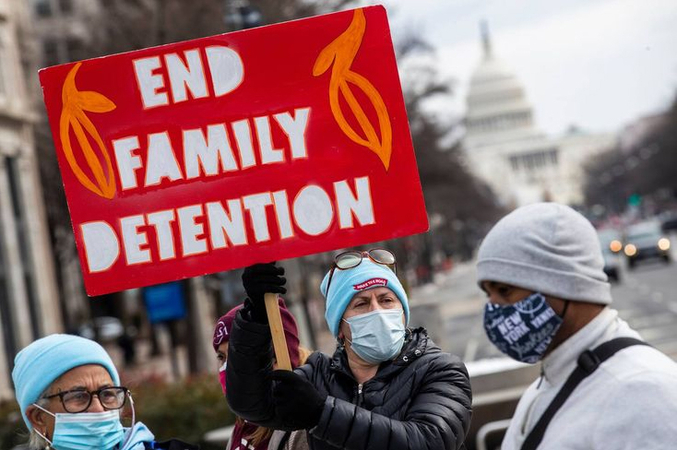
WASHINGTON – The Biden administration is preparing to convert its immigrant family detention centers in South Texas into Ellis Island-style rapid-processing hubs that will screen migrant parents and children with a goal of releasing them into the United States within 72 hours, according to Department of Homeland Security draft plans obtained by The Washington Post.
The plans show the Biden administration is racing to absorb a growing number of migrants crossing the U.S.-Mexico border amid shortages of bed space and personnel. Republicans and some Democrats fear that relaxing detention policies will exacerbate a surge that is already straining the Biden administration.
Russell Hott, a senior official with Immigration and Customs Enforcement, notified staff of the rapid-processing plan in an email Thursday that said arrivals by unaccompanied minors and families this year “are expected to be the highest numbers observed in over 20 years.”
If U.S. border officials continue to take in more than 500 family members per day, the change in use to the family detention centers “may not be sufficient to keep pace with apprehensions,” Hott warned in his email, which was reviewed by The Post.
Individuals who cannot be housed in one of the rapid-processing centers may need to be placed in hotels, Hott wrote. MVM, an ICE contractor, will help transport the families to hotels if there is no longer capacity at the rapid-processing centers, he said, adding that the company plans to use hotels in McAllen and El Paso, Texas, and Phoenix.
“We welcome the change, because the detention of families – we never thought that was a good system or a good policy at all,” said Edna Yang, co-executive director of American Gateways, an immigration legal aid organization in Texas. “They shouldn’t be detained, and they should be given the opportunity to go before the immigration judge and be released in the community and not held like prisoners.”
The plans come as Republicans are criticizing President Joe Biden for relaxing immigration policies, saying he could encourage more migrants to travel to the border.
“There is no question there’s a crisis at the border,” Rep. James Comer, R-Ky., said Thursday on Fox News. “It’s Joe Biden’s fault. Joe Biden has signaled to the world that he’s not going to take border security seriously.”
Transforming family detention amounts to a wholesale repudiation of not only Donald Trump’s policies but also Barack Obama’s and presents a significantly different vision of how to handle the fast-changing character of mass migration at the southern border.
For decades, single adults – particularly men – dominated the flows northward into the United States, but the number of families and minors traveling without their parents has increased substantially in recent years. Before the coronavirus pandemic, migrant families and unaccompanied minors were a majority of those taken into custody at the southwest border, a trend that more closely resembles refugee streams worldwide.
During the Obama and Trump administrations, most families were quickly released or deported. But some were held in dormitory-style facilities for weeks or months, if not longer, for immigration proceedings. Advocates for these families have long said they are fleeing violence and poverty and shouldn’t be detained at all – a sentiment Biden echoed on the campaign trail last year.
“Children should be released from ICE detention with their parents immediately,” Biden wrote on Twitter in June. “This is pretty simple, and I can’t believe I have to say it: Families belong together.”
Six weeks into Biden’s presidency, advocates are frustrated that his administration has continued to detain families and expel them from the border under a public-health order. The number of detained family members more than doubled, from 228 adults and children before Biden took office to 476 last week, federal records show.
Although the tally is a fraction of the combined capacity of 3,300 people at three family residential centers, the uptick baffled child-welfare advocates who hoped that the detention centers would finally close. They noted that Biden and Alejandro Mayorkas, now the homeland security secretary, helped to expand use of these detention centers during the Obama administration.
“There needs to be open expression of what they’re going to do with these facilities,” said Bridget Cambria, a lawyer representing migrant families in Pennsylvania. “They shouldn’t detain families or children even for one second.”
ICE oversees three family residential centers for immigrants facing deportation: the 96-bed Berks Family Residential Center in Leesport, Pa., and a pair of larger facilities outside San Antonio, a 2,400-bed center in Dilley and an 839-bed center in Karnes City.
The Biden administration has said it is reviewing the way it uses family detention facilities and told a federal judge last week in a lawsuit over the detentions that the policies had not changed.
“A detention center is not where a family belongs,” Mayorkas told NBC News in an interview this week, hinting at the plans.
DHS officials, speaking on the condition of anonymity to describe the unpublicized plans, said the transition to rapid-release centers is already underway.
ICE emptied out the Berks center Feb. 26, releasing all 21 people there. ICE confirmed that the facility is empty but would not say why.
Officials are considering turning Berks into a women-only center, a DHS official said, while Dilley and Karnes would serve as quick-release intake facilities that would screen migrant families, check their backgrounds and release them pending an immigration court hearing. Some would enroll in “alternatives to detention,” such as ankle-monitoring programs. Families would undergo coronavirus testing, and nonprofits would then help them secure airplane or bus tickets to their final destinations in the United States, typically with relatives or friends.
The goal is to process and release 100 families per day, the plans show. Migrants who test positive for the coronavirus would be quarantined for 10 days.
Advocates for immigrants have cheered the preliminary plans in recent days – albeit cautiously because DHS has not made a formal announcement.
In Texas, advocates said the region’s top immigration officials held an emergency conference call with them on Feb. 20 to discuss plans to transform the centers into shorter-term facilities. Officials told them to prepare for more migrants to be released from Dilley and Karnes.
“It’s incredibly encouraging to hear a completely different philosophy and attitude for people coming into this country,” said Daniel Klein, board chairman for the Interfaith Welcome Coalition, who was on the call, which was first reported by the San Antonio Express-News.
Klein said that the nonprofit has added more volunteers at the bus station in downtown San Antonio to help migrants find shelter or make travel plans and that it has sometimes spent $1,000 a night on food, water and bus tickets.
Biden has pledged to create a more humane immigration system and restore the asylum process, but he is also eager to skirt a border crisis that could imperil his legislative agenda, including an effort to legalize 11 million longtime undocumented immigrants.
Some Democrats from southern border communities worried that rising migration would burden communities reeling from the coronavirus and a winter storm that cut power to millions and killed more than 30 in Texas.
“Our country is currently unprepared to handle a surge in migrants in the middle of this pandemic,” Rep. Henry Cuellar, D-Texas, tweeted Thursday. “I urge the Biden administration to listen and work with the communities on the southern border who are dealing with this influx. Inaction is not an option.”
The Biden administration has not detailed how it would handle another influx.
In 2014 – when Biden was vice president and Mayorkas was deputy DHS secretary – the United States received an influx of 68,000 families, up from 14,800 the year before. At the time, Biden said the “crisis” was “untenable and unsustainable,” and he and Mayorkas worked to stem flows from Central America and expanded family detention by opening the facilities in Dilley and Karnes. Mayorkas said then that he would ensure that “the detention of adults with children is done as humanely as possible.”
After the centers expanded, the number of migrant families apprehended at the border dropped below 40,000, but detention did not stop the flows. After a judge ruled that officials could not detain children in unlicensed facilities for more than 20 days, the numbers began to rise again.
Advocates for immigrants said detention had little impact because of the severe conditions in Central America and the Caribbean that are driving migrants north, such as violence, climate change, poverty and government corruption.
The numbers have only continued to grow.
More than 470,000 migrant families and 76,000 unaccompanied minors arrived in fiscal 2019, a record on both counts, and most were released into the United States pending a court hearing.
Dora Schriro, who led ICE’s office of detention policy and planning, said ICE’s experience with family detention shows that it is harmful to children and their parents by placing them in conditions where they are afraid. She said she reduced the capacity in Pennsylvania to 84 beds before leaving in 2009.
After the Obama administration expanded the detention centers to more than 3,300 beds, she said, DHS asked her and others to issue recommendations in a report published in late 2016. Their first recommendation: “Detention is never in the best interest of children.”
“DHS should discontinue the general use of family detention, reserving it for rare cases when necessary,” such as because someone is a flight risk or a danger to the community, the report said.
Soon after, Trump took office. He sought to detain families and separated parents from their children in a failed attempt to stem the rising flows of migrants.
Schriro said the Biden administration faces dual challenges at the border: keeping its international obligations to offer refuge to people feeling harm, and making sure Americans are safe.
“You’ve got two really critical commitments, and this administration is finding a path to honor both of those obligations,” she said. “The trick is not sacrificing one for the other.”
By The Washington Post · Mustafa Salim, Louisa Loveluck
BAGHDAD – A U.S. contractor died during rocket attacks on an Iraqi military base Wednesday, the Pentagon said, posing a fresh challenge to the Biden administration days after it launched military action in retaliation for an earlier attack.
Iraq’s military said that 10 Grad rockets had landed on the Ain al-Asad air base in the western province of Anbar, and that the vehicle they were launched from had also been located. Around half of the rockets were intercepted by a U.S. aerial defense system, American and Iraqi officials said.
“A U.S. civilian contractor suffered a cardiac episode while sheltering and sadly passed away shortly after,” said Pentagon spokesman John Kirby, sharing no further information about the person’s identity. “There are no current reports of U.S. service member injuries, and all are accounted for.”
The attack came during an acutely sensitive period for the President Joe Biden and the Iraqi government. While similar rocket attacks have routinely been claimed by or blamed on Iran-backed militia groups, Washington is trying to blunt the tensions that soared between Washington and Tehran during President Donald Trump’s years in office.
Biden said Wednesday: “We are following that through right now. Thank God no one was killed by the rocket. One individual, a contractor, died of a heart attack. But we’re identifying who’s responsible, and we’ll make judgments from that point.”
Western officials point to Biden’s response to rocket attacks on U.S. service personnel in Iraq last week as a case in point. Although the strikes resulted in the first unilateral military action of Biden’s presidency, the Iran-backed militants it targeted were across the border in Syria, not Iraq, a move that seemed consciously calibrated to avoid further escalation.
In Baghdad, meanwhile, officials have all hands on deck for the arrival of Pope Francis on Friday, with the pontif’s visit representing an opportunity for the embattled government here to showcase Iraq’s relative stability in the wake of the Islamic State’s military defeat.
“Iraqi security forces are on scene and investigating. We cannot attribute responsibility at this time, and we do not have a complete picture of the extent of the damage,” Kirby said in a statement. “We stand by as needed to assist our Iraqi partners as they investigate.”
Rocket attacks on U.S. diplomatic and military targets have escalated in the year since Trump ordered the killing of Iran’s most influential military strategist, Maj. Gen. Qasem Soleimani, and the Iraqi militia leader, Abu Mahdi al-Muhandis, responsible for maintaining cohesion among the country’s disparate network of militia groups.
Recent attacks on U.S.-linked bases have been claimed by splinter groups that have announced themselves since the deaths of Soleimani and Muhandis. Although U.S. officials say that those groups are backed by Iran, the extent of Tehran’s control over individual attacks remains unclear.
As night fell Wednesday, there was no claim of responsibility for the latest rocket attacks.
Asia rebuffs U.S. sanctions on Myanmar, giving generals lifeline
InternationalMar 04. 2021A demonstrator wears a National League for Democracy (NLD) party themed protective mask during a protest outside the Embassy of Myanmar in Bangkok, Thailand, on Feb. 1 2021. MUST CREDIT: Bloomberg photo by Andre Malerba.
By Syndication Washington Post, Bloomberg · Philip J. Heijmans
As the U.S. looks to build a coalition to further punish Myanmar’s generals, it is not having much success convincing governments in Asia to follow suit.
The standing of army chief Min Aung Hlaing’s regime has slipped even further in the West after his envoy to the United Nations denounced the military takeover and Myanmar authorities killed at least 18 protesters on Sunday, the deadliest day since the Feb. 1 coup. While the junta has since told security forces to avoid using live bullets, reports emerged that protesters were still being shot with them. At least two more were killed on Wednesday in the city of Mandalay.
The U.S. has led the international pushback, with National Security Advisor Jake Sullivan saying the country was “coordinating closely with allies and partners in the Indo-Pacific region” and would take additional actions after imposing targeted sanctions on the coup makers. The U.K. also sanctioned the generals and the European Union has said its working on punitive measures.
Asian countries, by contrast, haven’t taken any concrete action. While Indonesia has conducted shuttle diplomacy and Singapore has said its “appalled by the violence,” no countries in the region so far have indicated they would support sanctions or any other measures that would hit the military’s finances.
On Tuesday, foreign ministers of the 10-member Association of Southeast Asian Nations, which includes Myanmar, called “on all parties to refrain from instigating further violence” and for “a peaceful solution through constructive dialogue.” While some individual ministers called for the release of Aung San Suu Kyi and a return to democracy, the statement didn’t mention her by name and refrained from using the word “coup.” It also said Asean, which is based on the principle of nonintervention, was ready “to assist Myanmar in a positive, peaceful and constructive manner.”
Singapore Prime Minister Lee Hsien Loong separately said sanctions would only hurt the population at large and push Myanmar closer to those willing to talk to them like China.
“You can ostracize them, condemn them, and pass resolutions or not, but it really has very little influence,” Lee told the BBC, according to comments distributed by his office. “We have to express disapproval for what is done, which is against the values of many other countries, and in fact a large part of humanity. But to say that I will take action against them, where does this lead?”
For Myanmar’s generals, Asia’s reluctance to join in U.S.-led sanctions or even cut them out of meetings effectively offers a diplomatic lifeline as they struggle to gain control of the country. Prior to Myanmar’s opening about a decade ago, business ties with Asia allowed the junta to survive for years despite much broader Western sanctions than are currently in place.
“Asean has an unmatched track record of indifference to authoritarian rule in Myanmar,” said Lee Morgenbesser, a lecturer at Australia’s Griffith University whose researches Southeast Asian politics.
Among Southeast Asia’s 10 countries, two are run by military men who staged coups, two are Communist regimes with no elections, two have had ruling parties in power for more than two decades and one is an absolute monarchy. Malaysia, Indonesia and the Philippines are the only democracies that have seen peaceful transfers of power from one party to another in recent years.
Countries in Asia also avoided sanctioning Myanmar’s generals over allegations of genocide against the Muslim Rohingya minority that forced more than 700,000 people to flee across the border into Bangladesh. An independent UN fact-finding mission found in 2019 that at least 59 foreign firms — most from Asia — had either joint ventures or commercial ties with the military, producing revenue that “substantially enhances its ability to carry out gross violations of human rights with impunity.”
“In some ways, Asean allowed the military to get away with what happened with the Rohingya crisis and I think that they are faced with something more dangerous,” said Bridget Welsh, honorary research associate at the Asia Research Institute, University of Nottingham Malaysia. “This is going to be much more difficult for them to wrestle with.”
Myanmar’s generals have made clear they have no intention of returning the nation to isolation, vowing to hold elections after a yearlong state of emergency. The junta has appointed Aung Naing Oo — a familiar face to foreign investors — as investment minister.
China and Thailand alone accounted for about half of Myanmar’s trade in 2019, the latest year for which data is available, with the U.S. and Europe comprising roughly 13%. Asian economies represented seven of Myanmar’s top 10 foreign investors as of January, led by China and Singapore, according to data from the Directorate of Investment and Company Administration.
Vietnam’s Viettel Group, a state-owned enterprise operated by the Ministry of Defense, announced in 2018 that it was investing $1.5 billion to set up the mobile operator Mytel. Thailand’s state-owned PTT, meanwhile, has imported natural gas from Myanmar for years via the Gulf of Martaban, and its exploration arm said last month it didn’t expect the political situation to impact its operations or plans in the country.
Asean should take a clear stand particularly on avoiding more civilian casualties, according to Ong Keng Yong, a former secretary-general of the bloc. He likened Myanmar to a neighbor who infringes on the rights of nearby home owners.
“You can rearrange the furniture and setup in your home,” he said. “But if that involves more use of scarce electricity and water resources, the others in the gated compound can have a say.”
Samsung details plans for $17 billion chip facility in U.S.
InternationalMar 04. 2021The Samsung Electronics logo is displayed in a window at the company’s D’light flagship store in Seoul, South Korea, on Oct. 6, 2020. MUST CREDIT: Bloomberg photo by SeongJoon Cho.
By Syndication Washington Post, Bloomberg · Sohee Kim
Samsung Electronics Co. revealed additional details about its plans to build a cutting-edge semiconductor facility in the U.S. in a filing with the state of Texas, making the disclosure as the Biden administration vows to make the security of the U.S. chip supply a national priority.
The South Korean company plans to invest about $17 billion in its Project Silicon Silver and create about 1,800 jobs over the first ten years, according to an economic impact study prepared by a local consultant. Some $5.1 billion would go into buildings and property improvements, while $9.9 billion would be spent on machinery and equipment.
The filing with the Texas comptroller warned the chips project is “highly competitive.” Samsung is evaluating alternatives sites in Arizona and New York, as well as in Korea.
“Because of its strong ties to the local community and the successful past 25 years of manufacturing in Texas, Samsung Austin Semiconductor would like to continue to invest in the city and the state,” the study said.
In their first weeks in office, the Biden administration has emphasized the importance of advanced technologies, including semiconductors, artificial intelligence and next-generation networks. The president has ordered a global supply chain review for microchips as well as large-capacity batteries, pharmaceuticals and critical minerals and strategic materials such as rare earths.
Bloomberg News first reported in January that Samsung was considering building an advanced chipmaking plant in the U.S., in hopes of winning more American clients and narrowing the gap with industry leader Taiwan Semiconductor Manufacturing Co. The company was in discussions to locate a facility in Austin, Texas, capable of fabricating chips as advanced as 3 nanometers, people familiar with the matter said at the time.
Details of Samsung’s discussions with local governments have since leaked out in filings and other revelations. The economic impact study was prepared by Impact DataSource, an Austin, Texas-based economic consulting, research and analysis firm.
The report shows Samsung’s Project Silicon Silver would add approximately 7 million square feet of new space to the Austin campus, where the company has had operations for decades. It estimates that 542 new workers would move to the city, contributing to an addition of 1,626 new residents.
Property tax abatements would total about $1.5 billion over 20 years at the city and county levels, while direct and indirect economic output would be about $8.6 billion and salaries would total $7.3 billion.
A January filing detailed the likely timeline for the project. If Samsung chooses Austin, it would break ground in the second quarter of 2021 with the expectation that production would be up and running by the fourth quarter of 2023, it said.
Separately, Samsung’s current foundry plant in Austin hasn’t resumed operations since Feb. 16 after it was ordered to halt operations by Austin Energy due to blackouts in the region. Power and water are back but it will take more time to fully restart operations, officials said.
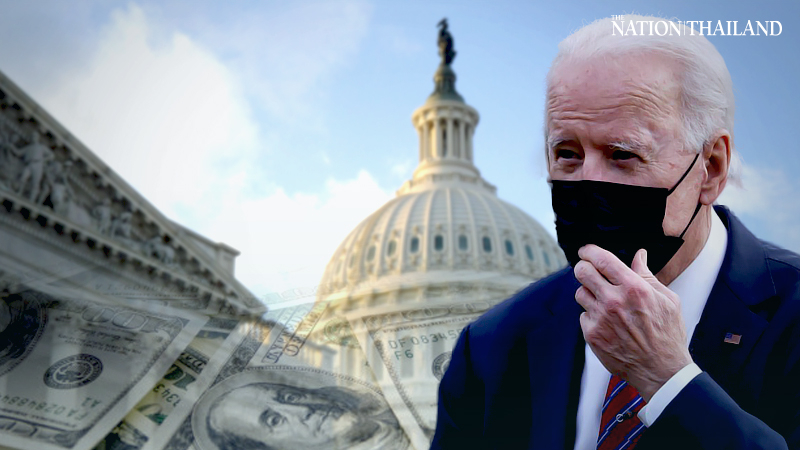
WASHINGTON – President Biden has agreed to narrow eligibility for a new round of $1,400 stimulus payments in his $1.9 trillion coronavirus relief bill, a concession to moderate Senate Democrats as party leaders moved Wednesday to lock down support and finalize the sweeping legislation.
Under the new structure, the checks would phase out faster for those at higher income levels, compared to the way the direct payments were structured in Biden’s initial proposal and the version of the bill passed by the House on Saturday.
The change came as the Senate prepared to take an initial procedural vote to move forward on the bill as early as Thursday. Biden and Senate Democratic leaders were scrambling to keep their caucus united since they cannot lose a single Democrat in the 50-50 Senate if Republicans unite against the legislation.
In addition to the stimulus checks, the sweeping economic package would also extend unemployment benefits through August, as well as set aside $350 billion for state and local aide; $130 billion for schools; $160 billion for vaccinations, testing and other health care system support; increased the child tax credit; and spend billions more on a variety of other provisions including rental aid and food assistance.
Biden made a closing pitch for the package to House Democrats on Wednesday evening, citing public polling in favor of the measure and telling them: “I know parts of this and everything else we seek to do are not easy, but people are going to remember how we showed up in this moment, how we listened to them . . . and how we took action.”
At least one Senate Republican, Lisa Murkowksi of Alaska, appeared open to considering a vote in favor of the legislation, telling reporters, “My state needs relief.” Elsewhere, though, GOP opposition was hardening, as Sen. Ron Johnson, R-Wis., announced plans to force Senate officials to read the entire 600-page-plus bill aloud before debate could even begin — a process he predicted would take around 10 hours.
“I don’t want to sound like a leftist, but I’m gonna resist,” Johnson told a talk radio host in Wisconsin.
The action in the Senate was unfolding against a backdrop of tightened security around the Capitol complex, as the sergeant-at-arms and the Capitol Police warned of potential violent unrest over the coming days. The House moved up votes to allow members to avoid the Capitol on Thursday, the day some conspiracy theorists have identified as when former president Donald Trump should rightfully be inaugurated. The Senate is scheduled to remain at work.
Under the plan for stimulus checks passed by the House, individuals earning up to $75,000 per year and couples making up to $150,000 per year would qualify for the full $1,400 payment. The size of the payments would then begin to scale down before zeroing out for individuals making $100,000 per year and couples making $200,000.
Under the changes agreed to by Biden and Senate Democratic leadership, individuals earning $75,000 per year and couples earning $150,000 would still receive the full $1,400-per-person benefit. However, the benefit would disappear for individuals earning more than $80,000 annually and couples earning more than $160,000.
That means singles making between $80,000 and $100,000 and couples earning between $160,000 and $200,000 would be newly excluded from seeing any benefit under the revised structure Biden agreed to.
The changes were confirmed by a Democratic aide who spoke on the condition of anonymity to describe internal deliberations.
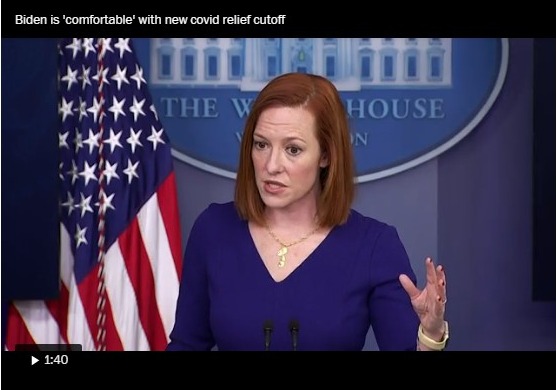
White House press secretary Jen Psaki said Biden has always been open to a faster phaseout for higher-earning individuals and “he is comfortable with where the negotiations stand.”
“He is comfortable and knows there will be tweaks on the margin,” Psaki said Wednesday’s White House briefing. “What his firm viewpoint is, is that it needs to meet the scope of the challenge, it needs to be the size he’s proposed, it needs to have the core components in order to have the impact on the American people.”
Sen. Jeanne Shaheen, D-N.H., was among those who had called for changing the eligibility levels for checks, telling reporters this week, “I think we could drop it below the $200,000 and still get households that really need it.”
She said she would hope to redirect the savings from that change toward other needs, such as hospitals.
Narrowing eligibility for the stimulus checks was just one change moderates like Sens. Shaheen and Joe Manchin, W.Va., had been seeking. Several were also eyeing better targeting money for state and local governments, and changing the structure of weekly federal unemployment benefits in the bill, to keep them at the current level of $300 rather than raise them to $400 as proposed by Biden and passed by the House.
Senate Democrats do not intend to adopt the suggested change to unemployment benefits, and they will stay at $400-per-week, the aide said. The unemployment benefits currently are set to expire March 14; the Biden bill would extend them through August. Democrats are aiming for final passage of the bill ahead of the March 14 deadline.
About 12 million fewer adults and 5 million fewer children would get the stimulus payments under the new Biden-Senate compromise, according to preliminary estimates from the Institute on Taxation and Economic Policy, a left-leaning think tank. About 280 million Americans in total – 200 million adults and 80 million children – would be eligible for the checks under the new structure.
Centrist Senate Democrats initially had pushed for even more aggressive restrictions on the stimulus payments. Senior Democratic officials had at one point considered dropping the full benefit for those making more than $50,000 per year, a change they ultimately abandoned after a backlash led by Senate Finance Chair Ron Wyden, D-Ore., and Senate Budget Chair Bernie Sanders, I-Vt.
Still, liberal lawmakers bristled at the new changes. House liberals have suggested it could be difficult for them to approve the package if it’s watered down significantly in the Senate. Presuming the Senate passes the package this week, it would still have to go back to the House for final approval.
“I don’t understand the political or economic wisdom in allowing Trump to give more people relief checks than a Democratic administration,” Rep. Alexandria Ocasio-Cortez, D-N.Y., said in a statement. “People went far too long without relief last year – if anything we should be more generous, not more stingy. It’s also an insensitive compromise for the roughly 80 percent of Americans that live in urban areas, which are known for higher costs of living.”
Biden acknowledged in his comments to House Democrats that “I know we’re all making some small compromises,” but he said staying united to pass the relief bill, his first major piece of legislation, would help restore the public’s faith in government and open the door to further successes.
“It’s a show of strength,” Biden said. “We know how much we have to do, but it all starts here, it starts by bringing this home.”
On a portion of his call with House Democrats that was not public, Biden told Rep. Suzan DelBene, D-Wash., that he supports legislation that would permanently increase the child tax credit to $3,000 per child, according to two people on the call who spoke on the condition of anonymity to share details of the conversation. The legislation as currently written would do so for one year.
Senate moderates were discussing further changes and GOP senators also were preparing amendments aimed at further targeting the legislation, which could peel off Democratic votes as the legislation moves through the Senate.
Democrats are advancing the package under a process called “budget reconciliation” that allows it to pass with a simple majority instead of the 60 votes normally required. With only 50 votes in the Senate and GOP support uncertain, Democrats must ensure they remain united to pass the legislation with Vice President Kamala Harris breaking the tie.
Attention has focused on Senate moderates who have voiced skepticism about various elements of the bill. Psaki expressed optimism Wednesday that Democratic moderates such as Manchin would support the bill.
ECB downplays yield concerns, signaling no drastic action needed
InternationalMar 04. 2021Flags of the European Union (EU) fly outside the European Central Bank (ECB) headquarters in Frankfurt, Germany, on July 16, 2020. MUST CREDIT: Bloomberg photo by Alex Kraus.
By Syndication Washington Post, Bloomberg · Carolynn Look, Alexander Weber, Jana Randow
European Central Bank policymakers are downplaying concerns over rising bond yields, suggesting they can manage the risk to the euro-area economy with verbal interventions including a pledge to accelerate bond-buying if needed.
ECB Governing Council members, who meet next week to set policy, see no need for drastic action such as expanding the overall size of their 1.85 trillion-euro ($2.24 trillion) emergency asset-purchase program, according to officials familiar with internal discussions.
The officials didn’t say whether the pace of purchases has been stepped up in recent days, for which data isn’t yet available. One person noted that yields fell on Monday after some policy makers said the institution would react against unwarranted increases. An ECB spokesman declined to comment.
The relatively sanguine mood was backed up on Wednesday by Governing Council members including ECB Vice President Luis De Guindos and Bundesbank President Jens Weidmann, who said in public remarks that they’re not too worried.
European yields rose, led by the longest-dated debt. The rate on German 10-year bonds climbed as much as seven basis points to minus 0.28%. The euro was down 0.2% at $1.2073 at 5:20 p.m. Frankfurt time.
The global sell-off of government bonds originates from the U.S., where prospects of massive fiscal stimulus are bolstering the economy and lifting inflation expectations.
In Europe, Greek and Italian 10-year yields led the charge, climbing about 20 basis points in the past two weeks. Benchmark German yields touched levels last seen in March 2020, and those for their French equivalents briefly turned positive for the first time since June.
That’s a problem for the euro area because sovereign yields are used by banks as a reference point for lending. The region’s recovery is already expected to be slower than that of many other advanced economies, in part due to its slow vaccine roll-out, and higher borrowing costs could further damp momentum.
Policymakers have been rolling out public appearances before their weeklong quiet period starts this Thursday. Guindos said yields have risen from very low levels and “the situation is very calm” when looking at spreads between different nations. Weidmann told Bloomberg Television that “the size of the movements is not such that this is a particularly worrisome development.”
The Bundesbank head added that the ECB is ready to adjust the pace of asset purchases if needed though, saying that “we want to preserve favorable financing conditions for the non-financial sector — that’s not just looking at financing costs for governments, it’s a much broader picture.”
Bank of Spain Governor Pablo Hernandez de Cos said at a separate event that rising yields may reflect market expectations of an earlier start to unwinding monetary stimulus, and that “avoiding premature increases in nominal interest rates” is essential.
Earlier in the week, Executive Board member Fabio Panetta said the jump in yields “is unwelcome and must be resisted.” He also said it is “not too late” to act. French Governing Council member Francois Villeroy de Galhau said the ECB “can and must react” to any unwarranted moves.
The latest purchasing data surprised investors though by showing that the central bank actually slowed buying last week, despite President Christine Lagarde saying policy makers are “closely monitoring” the rise in nominal bond yields.
Those figures don’t reflect orders made Thursday and Friday, as transactions take a couple of days to settle and show up in the central bank’s accounts. This week’s purchasing data will be published next Monday and Tuesday.
Investors have been closely watching for any signs of market intervention by the ECB. Vincent Juvyns, a strategist at JPMorgan Asset Management, said on Bloomberg radio that in contrast to the U.S., where the economy is being boosted by massive stimulus, “it is probably too early to allow rates to rise in Europe.”
“I would hope and expect that the ECB would be a bit fire-fighting with additional buying in the coming weeks and months,” he said.

 การขุดบิตคอยน์ต้องใช้พลังงานไฟฟ้าปริมาณมหาศาลทะลุร้อยเทระวัตต์-ชั่วโมงต่อปี
 ผู้นำทหารเบอร์ 2 ของเมียนมาบอกไม่กลัวถ้าถูกคว่ำบาตร
 องค์กรเพื่อประชาธิปไตยเผยผลการจัดอันดับเสรีภาพไทยลดลง ชี้ประชาชนไม่ถึง 20% ของโลกอยู่ในประเทศเสรีภาพ
 เฟซบุ๊กประกาศระงับ 185 บัญชีหลังพบปฏิบัติการข้อมูลข่าวสารเชื่อมโยงกองทัพไทย

 A demonstrator wears a National League for Democracy (NLD) party themed protective mask during a protest outside the Embassy of Myanmar in Bangkok, Thailand, on Feb. 1 2021. MUST CREDIT: Bloomberg photo by Andre Malerba.
 The Samsung Electronics logo is displayed in a window at the company’s D’light flagship store in Seoul, South Korea, on Oct. 6, 2020. MUST CREDIT: Bloomberg photo by SeongJoon Cho.

 Flags of the European Union (EU) fly outside the European Central Bank (ECB) headquarters in Frankfurt, Germany, on July 16, 2020. MUST CREDIT: Bloomberg photo by Alex Kraus.

