PlayStations are hot with consoles drawing rare shopping crowds
InternationalNov 28. 2020A GameStop store in Tampa, Fla., on Nov. 27, 2020. MUST CREDIT: Bloomberg photo by Eve Edelheit
By Syndication Washington Post, Bloomberg · Carolina Gonzalez, Richard Clough · BUSINESS
Good luck finding a PlayStation 5.
The newest video-game console from Sony Corp., alongside rival Microsoft Corp.’s updated Xbox, are arguably the hottest items this Black Friday as shoppers line up in person or swarm retailers’ websites hoping to snag one. GameStop Corp., one of the few retailers to do a brick-and-mortar release, saw shoppers line up as early as Thursday — some even set up tents — at locations from Norfolk, Va., to Salinas, Calif.
“There’s always an item, or a few items, people can’t find. The big hot item this year is Sony PlayStation 5 and Xbox from Microsoft,” Joseph Feldman, senior managing director and assistant director of research at Telsey Advisory Group, said in a Friday morning interview. “Those are the two new items that I keep hearing people ask for, especially at Best Buy and GameStop, and you just can’t find them right now.”
A highly coveted product is just what retailers need this holiday season. After a brutal year of economic lockdowns and retail distress, stores are hoping that pent-up demand can rejuvenate the industry even as new waves of Covid-19 sweep across the country. Health concerns notwithstanding, a big-selling item can draw shoppers who may end up buying other gifts, too, while browsing in-store or online.
To limit crowds, Best Buy chose to release the newest consoles only on its website, a decision that retail analyst Neil Saunders called “a miss,” given soaring demand.
“Best Buy could have done something creative with outside collection to manage the crowds,” he said.
Still, the shares are outpacing the market this year as Best Buy benefits from the remote-working and home-schooling trends during the pandemic.
“Best Buy is trading so well right now that they can afford to be picky,” Saunders said. The company’s shares are up about 29% year to date.
Google searches for gaming products were up again this week, according to a note from Baird Equity Research. Interest for “World of Warcraft” was up 96% after the launch of its latest expansion pack, while “FIFA Ultimate Team” was up 43% this week. The term “gaming headset” also saw a consistent increase in internet searches, up 24% week over week.
With all the interest in gaming, the new consoles are sure to draw crowds wherever they release. But there’s one reliable way to get your hands on them without lining up — pay resale. The consoles, which retail around $400 to $500 apiece, are selling for more than $1,000 on eBay.
Black Friday is here – and it’s completely different
InternationalNov 28. 2020Black Friday shoppers come and go from a Target store in Falls Church, Va., on Friday. MUST CREDIT: Photo for The Washington Post by Amanda Andrade-Rhoades
By The Washington Post · Abha Bhattarai · BUSINESS, RETAIL
Black Friday sales are in full swing, but Trisha Stuart is unimpressed. The 55-year-old finished her shopping weeks ago – and did it all online.
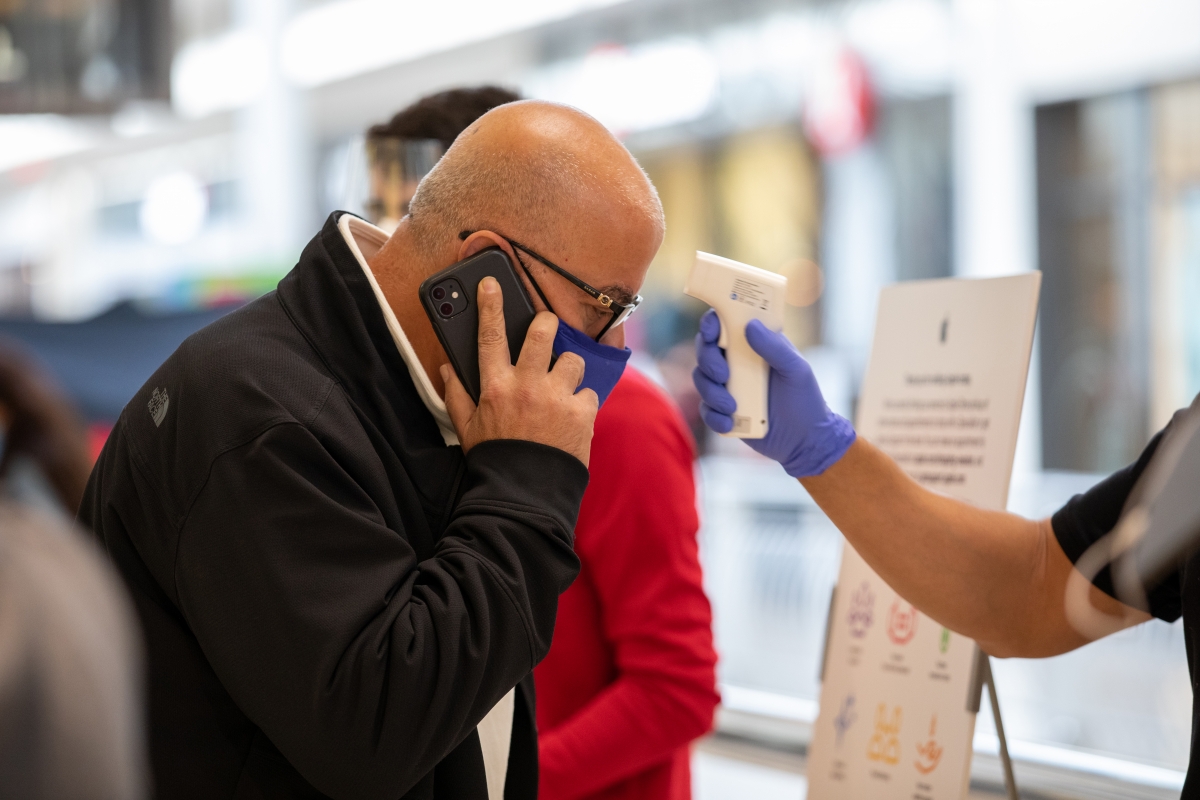
A man has his temperature checked before entering an Apple store at Tysons Corner Center in Tysons, Va., on Friday. MUST CREDIT: Photo for The Washington Post by Amanda Andrade-Rhoades
She spent far less than usual – about $200 on an air fryer for her husband and gift cards for their four adult children – because, she said, “covid has put us on edge.” The retired nurse from Green Valley, Ariz., isn’t traveling this year. And when she does leave the house, she says, it’s mostly to pick up groceries; buying new clothes or housewares feels extravagant during these grim times.
Stuart is like millions of Americans who have tempered their spending since the coronavirus pandemic swept the country and set off a recession: More than 20 million Americans are collecting some form of unemployment benefits. Retailers, in turn, have had to reimagine the most important shopping season of the year with public health in mind. The Black Friday “doorbusters” they once dangled to draw crowds have largely shifted online, and in-store offers are being staggered to allow for social distancing.
Americans spent a record $5.1 billion online on Thanksgiving Day, which is 22% higher than last year but lower than projected, according to Adobe Analytics. Because so many consumers started their holiday shopping in October and early November, Black Friday week just doesn’t hold the same frenetic appeal, analysts say. Adobe expects overall online sales to grow 33%, to $189 billion, this holiday season.
It is unclear, they said, exactly how the holiday season will play out, especially at a time when coronavirus cases are rising at an alarming rate.
“There are so many unknowns – the economy, covid, unemployment – that could impact how willing customers are to spend this year,” said Scott Stuart, no relation to Trisha Stuart and chief executive of the Chicago-based Turnaround Management Association, a group that represents restructuring professionals. “We can’t lose sight of the fact that, fundamentally, everything has changed. Will there be more stimulus money? Will people be shy about spending? We just don’t know.”
Analysts and shoppers across the country reported lines to get into some stores, such as Best Buy, Lululemon and Bath & Body Works. But department stores and apparel chains, they said, remained largely empty on Friday.
“It’s definitely not as busy as last year,” said Todd Putt, a spokesman for Tysons Corner Center in Virginia, one of the country’s busiest shopping malls. “A lot of sales have already been going on for a while so people don’t feel the same pressure to come out and shop on Black Friday,”
At a Walmart Supercenter in Northwest Washington, the mood early Friday morning was decidedly calm. Signs at the entrance promised “Black Friday Deals for Days” and, indeed, the country’s largest retailer has been rolling out seasonal discounts online and in stores for weeks. Inside, there appeared to be little urgency among the shoppers as they browsed $7 children’s jeans and $49 cookware sets, which were also being offered online. An employee in a neon vest twirled a large plastic candy cane to direct the occasional customer down the store’s one-way aisles.
“No crowds,” said a worker taking a cigarette break outside the store. “A lot of people are shopping online.”
It was a similar story a few miles away at the Macy’s in downtown Washington, where a side lane had been blocked off for curbside pickups. Employees far outnumbered shoppers inside the store.
Beatrice Mintah stopped in for a $30 comforter set around 7 a.m. after finishing her shift as a health-care aide. “I just picked it up and now I’m leaving,” the 39-year-old said, adding that she typically shops online. “This is it for today because of the pandemic.”
The National Retail Federation this week projected healthy gains in holiday spending – 3.6 to 5.2% compared with the 3.5% average recorded the past five years – driven in part by grocery sales. The estimate suggests Americans will spend $755 billion to $767 billion.
But despite the rosy outlook, the trade group acknowledges there could be some bumps for an industry that was hurting even before the pandemic. Dozens of major brands have filed for bankruptcy this year, and many more have announced sweeping store closures and layoffs. Apparel stores and mall chains, which typically rely on holiday sales for a major chunk of their profits, have been among the hardest hit.
“It’s hard to quantify such uncertainty,” chief economist Jack Kleinhenz said on a call with reporters this week. The latest forecast, he said, is “part science, part judgment and, of course, part luck.”
Still, retailers are pinning their hopes on an early online shopping season that they hope will help make up for months of lost sales. Walmart and Target kicked off holiday sales earlier than ever, in October. Others, such as Best Buy, Amazon and Nordstrom, started offering Black Friday deals online on Sunday. (Jeff Bezos, the founder and chief executive of Amazon, owns The Washington Post.)
The shopping event looks different in-store, too. Store layouts have been reconfigured – wider walkways, one-way aisles – to discourage browsing. Target is allowing shoppers to circumvent front-door lines by reservation. There are new rules regarding masks, maximum occupancies and temperature checks.
It’s all added up to a subdued Black Friday at malls and strip centers across the country. In Sunrise, Fla., Renee Sainten arrived an hour early for her 10 a.m. shift at the mall, expecting large crowds and an overflowing parking lot. After a decade of working the busy holiday season at Sawgrass Mills outlet mall, she thought she knew what to expect.
She was shocked when she saw how empty it was.
“It’s usually so crowded, even on a regular weekend, that cars are parked on the grass,” said Sainten, 37, who works at the watch chain Tourneau. “Today I found a spot right in the front of the mall and thought, ‘Wow, is it really Black Friday?’ “
But long-held traditions can be hard to give up. In Clermont, Fla., Jacob Burlingame got in line outside GameStop on Wednesday evening, hoping to snag a PlayStation 5 when the store opened at 7 a.m. on Black Friday. The console, which sells for $499, has been sold out for weeks.
He put Thanksgiving plans with his girlfriend on hold, and spent two nights on the pavement, reading “Kingdom Keepers” and eating cheeseburgers from the McDonald’s Dollar Menu.
It’s been a tough year for Burlingame: His grandmother died of covid-19, and he lost his job at Disney World during the pandemic. He works remotely now, handling customer service for a local bank, and said he hoped a PlayStation 5 would help liven up his time at home.
“I wore a mask and staked out my spot for 33 hours,” said Burlingame, 25. “It was the one thing I was really looking forward to.”
But in the end, he didn’t get a PlayStation 5. Although the company’s flier had promised at least two PlayStation 5 consoles per store, workers told him they only had one.
Burlingame went home empty-handed on Friday morning. He put his Thanksgiving turkey in the oven and said it was time for Plan B: Shopping online.
Lia Dangelico has spent the past several months working from home – and buying online.
She plans to spend about $1,250 on holiday gifts this year, about $200 more than she did a year ago, because she won’t be traveling to see family.
“We always try to make it really special, but this year, since we won’t be together, I want everyone to feel extra special and loved,” said Dangelico, a communications director for a trade association in Springfield, Va. “We’re also super lucky to have secure jobs, so with so much staying in and no travel, we haven’t spent as much this year.”
The 33-year-old says she buys from small businesses, Black-owned shops and secondhand retailers when she can. She’s spent much of the pandemic stocking up on comfort items like incense, candles and a meditation cushion, and is considering buying a treadmill because she canceled her gym membership in the spring. Mostly, though, she’s been buying gifts for her eight siblings.
“It doesn’t make up for not being together,” she said. “But it just feels better.”
In El Paso, Dominique Olsson, 32, says she’s keeping things simple this Christmas: She’s already ordered T-shirts for her parents, a framed map for her husband and necessities like clothing and a step stool for her 2-year-old son.
“Our financial situation hasn’t changed much – my husband is military, I’m prior military – so there hasn’t been a fear of where our next check will come from,” Olsson said. “But still, I’m not trying to spend very much this year. We just never know what might happen.”
Early in the pandemic, she and her husband canceled family trips to Sweden and St. Louis. But even as they’ve adjusted to the pandemic, she says, she’s choosing more practical gifts this year. Olsson is helping her sister with a car payment and got her three nieces and nephews a six-month subscription to Little Passports, which offers educational activities they can do at home.
“We still want to do something for our family, but we want to make it more personal than just buying things,” she said. “I’m usually conservative with money anyway, but this year that feels even more important.”
Prominent Iranian nuclear scientist killed in ambush attack, bringing threats of revenge
InternationalNov 28. 2020A U.S. soldier walks past a wall burned in the Iranian airstrike at the Ain Al-Asad base near Anbar, Iraq, on January 13, 2019. MUST CREDIT: Photo for The Washington Post by Emilienne Malfatto
By The Washington Post · Kareem Fahim, Joby Warrick, Miriam Berger · WORLD, MIDDLE-EAST
ISTANBUL – One of Iran’s most prominent and well-guarded nuclear scientists was killed Friday in a daytime ambush on a rural road outside Tehran, an attack Iran’s foreign minister blamed on Israel and that sharply raised regional tensions in the closing weeks of the Trump administration.
The scientist, Mohsen Fakhrizadeh, was seen as a driving force behind Tehran’s disbanded effort to build a nuclear weapon nearly two decades ago. His role in Iran’s current programs – reactors and uranium enrichment – was less direct and analysts said the killing would likely have a limited impact on Tehran’s nuclear capabilities.
It also underscored one of the many challenges ahead for the Biden administration as it looks to reset U.S. policies toward Iran after President Donald Trump’s “maximum pressure” campaign.
Iran’s foreign minister, Mohammad Javad Zarif, described the attack the work of “state terror” and implicated Israel as having a possible role. Officials in Israel had no comment.
The attack – which Iranian news agencies said involved a car bomb and gunmen – recalled the shadowy killingsof Iranian nuclear scientists a decade ago and exposed holes in Iran’s security and intelligence agencies.
Just this year, it was the third high-profile attack to shake Tehran’s leadership.
In January, a U.S. drone strike in Baghdad killed Maj. Gen. Qasem Soleimani, Iran’s most powerful military commander and head of its special-operations forces abroad. And in August, Israeli agents acting on behalf of American officials assassinated a senior al-Qaida official in Tehran, according to a U.S. official.
Fakhrizadeh was once at the pinnacle of Iran’s nuclear program, including an effort to develop nuclear arms that U.S. intelligence says was scrapped in 2003. But his latest role was less directly involved in Iran’s nuclear sites, which include extensive centrifuge labs to enrich uranium.
While Fakhrizadeh had been a key figure in Iran’s bomb program, “that work is all in the past, and there is no reason to expect that if Fakhrizadeh is gone it would have any effect on Iran’s current nuclear program,” said Paul Pillar, a 28-year veteran of the CIA and a senior fellow at Georgetown University’s Center for Security Studies.
Analysts said the timing of the attack appeared linked to the impending change of U.S. administrations.
Trump – who withdrew the United States from a nuclear pact that Iran struck with world powers five years ago – has ramped up sanctions and other pressures on Tehran since walking away from a deal with world powers aimed at reining in Tehran’s nuclear program. Biden has pledged to work more closely with allies on Iran policies and work to rejoin the nuclear agreement.
Iran has recently increased its stockpile of enriched uranium since the Trump administration pulled out of the 2015 nuclear deal. Iran has insisted that the enriched uranium is intended only to power its nuclear energy plants and a research reactor. Iran’s foes counter that it puts the nation closer to producing warhead-grade material.
The Biden team also did not have an immediate comment. U.S. officials had no immediate comment, but Trump retweeted veteran Israeli journalist Yossi Melman, who described the attack as a “major psychological and professional blow for Iran.”
“The operation reflects thinking of those in the Netanyahu government – and/or the Trump administration – who see these next few weeks as their last chance to make relations with Iran as bad as possible, in an effort to spoil the Biden administration’s efforts to return to diplomacy with Tehran,” said Pillar, referring to Israeli Prime Minister Benjamin Netanyahu.
A Middle Eastern intelligence official said Israel was behind the attack. “There was an opportunity and it was taken,” the official said.
Former CIA director John Brennan, a strong Trump critic, tweeted that the attack was “a criminal act & highly reckless.”
“It risks lethal retaliation & a new round of regional conflict,” he wrote. “Iranian leaders would be wise to wait for the return of responsible American leadership on the global stage & to resist the urge to respond against perceived culprits.”
Accounts of Fahkrizadeh’s killing indicated his movements were being tracked and the attack was coordinated.
The semiofficial Tasnim news agency said that the attack began with a car bomb that detonated in the path of Fakhrizadeh’s vehicle. Then “terrorists started shooting,” it reported.
But Brig. Gen. Amir Hatami, Iran’s defense minister, described a different chain of events in an interview with Iranian state television, saying the attack started with gunmen opening fire on Fakhrizadeh’s car. A pickup truck about 50 feet away exploded a short time later, he said. The gunfire continued, wounding the scientist and two of his bodyguards.
Fakhrizadeh later died at the hospital, the minister said.
A gray sedan, its windshield riddled by bullet holes, was shown in photos taken by Iranian news agencies at the scene of the attack.
The killing spurred calls from Iranian officials for accountability, or revenge.
“Terrorists murdered an eminent Iranian scientist today,” Zarif, Iran’s foreign minister, wrote on Twitter.
Iran has accused Israel and the United States of carrying out similar deadly attacks on nuclear experts in the past.
“This cowardice – with serious indications of Israeli role – shows desperate warmongering of perpetrators,” Zarif tweeted about the death of Fakhrizadeh. He said Iran calls on the international community, especially the European Union, “to end their shameful double standards & condemn this act of state terror.”
Hossein Dehghan, a former member of Iran’s paramilitary Revolutionary Guard and adviser to Iran’s supreme leader, wrote on Twitter: “We will descend like lightening on the killers.”
Fahkrizadeh “was one of the key individuals behind Iran’s nuclear program in the post-revolution era” and was deeply involved in shaping “the weapons phase of the program,” said Ariane Tabatabai, a Middle East fellow at the German Marshall Fund.
“This is very significant politically and symbolically. It again exposes the deep flaws in Iran’s internal security. This is one of many incidents involving Iran’s nuclear program this year and one of several targeted killings on Iranian soil or affecting high level Iranians,” she said.
Fakhrizadeh was widely regarded as the brains behind Iran’s nuclear program, including Tehran’s clandestine efforts to develop a nuclear bomb in the early 2000s. The physics professor, believed to be about 60 years old, has been identified by intelligence officials as the head of the Amad Plan, the secret nuclear weapons research program that sought to develop as many as six nuclear bombs before Iranian leaders ordered a halt to the program in 2003.
After the weapons program ended, he continued to supervise successor organizations that continued to employ many, if not most, of the Amad project’s scientists in conducting nuclear-related research, U.S. and Israeli analysts believe.
The current program is “now more focused on maintaining and developing nuclear weaponization capabilities rather than building the weapons themselves, said David Albright, president of the Institute for Science and International Security, a Washington nonprofit that tracks nuclear-weapons proliferation.
He called the attack on Fakhrizadeh a “shocking and disturbing development.”
Formerly a reclusive figure rarely seen in public, Fakhrizadeh has more recently allowed himself to appear on official Iranian websites, including during events held by Iran’s supreme leader, Ayatollah Ali Khamenei. Albright said the increased visibility “may have made him more vulnerable, making his movements easier to track.”
Targeted attacks between 2010 and 2012 killed at least four researchers and others with links to Iran’s nuclear program. Tehran accused Israel and the United States of masterminding the attacks as part of a covert war. U.S. officials have denied any role, and Israel has not commented.
In 2011, Darioush Rezaeinejad, an electrical engineer doctoral student whose work involved nuclear applications, was gunned down outside his Tehran apartment.
In 2012, motorcycle riders attached a magnetic bomb that tore apart a car carrying Mostafa Ahmadi Roshan, a nuclear scientist working at Iran’s main uranium-enrichment facility in Natanz. Roshan, 32, had planned to attend a memorial for another nuclear researcher, Tehran University professor Masoud Ali Mohammadi, who was killed in a similar pinpoint blast in 2010.
An Iranian man convicted in the Mohammadi attack, who Iran claimed was trained by Israel’s Mossad spy agency, was hanged in 2012.

 A GameStop store in Tampa, Fla., on Nov. 27, 2020. MUST CREDIT: Bloomberg photo by Eve Edelheit
 Black Friday shoppers come and go from a Target store in Falls Church, Va., on Friday. MUST CREDIT: Photo for The Washington Post by Amanda Andrade-Rhoades
 A U.S. soldier walks past a wall burned in the Iranian airstrike at the Ain Al-Asad base near Anbar, Iraq, on January 13, 2019. MUST CREDIT: Photo for The Washington Post by Emilienne Malfatto
 เปิดไทม์ไลน์ตำนานลูกหนังชื่อดังเจ้าของฉายา “หัตถ์พระเจ้า”


 ไต้หวันและสหรัฐเดินหน้าแผนการจัดหาเงินทุนเพื่อพัฒนาโครงสร้างพื้นฐานผ่านบริษัทเงินทุนเพื่อการพัฒนาระหว่างประเทศ
 เกิดเหตุชุลมุนในรัฐสภาไต้หวันหลังพรรคก๊กมินตั๋งไม่พอใจที่รัฐบาลอนุมัตินำเข้าเนื้อหมูจากสหรัฐ


 จีนแข่งสหรัฐ เร่งสร้างความสัมพันธ์กับภูมิภาคอาเซียน พร้อมเสนอความร่วมมือเส้นทางสายไหมดิจิทัล
 เกาหลีใต้เผชิญโควิดระลอก 3 ติดเชื้อรายวันเกิน 500 ราย หวั่นเตียงผู้ป่วยขาดแคลน
 แอสตราเซเนกาเตรียมทดลองวัคซีนเพิ่มเติมหลังพบว่าวัคซีนเพียงครึ่งโดสอาจได้ผลดีกว่าเต็มโดส
 รัฐสภาสวีเดนเผยจดหมายเปิดผนึกจี้ไทยทำตามหลักสิทธิมนุษยชนสากล ย้ำยุโรปจับตาอย่างใกล้ชิด

