มีผู้กล่าวว่า “เป้าหมายที่แท้จริงควรเป็นการลดความยากจน แทนที่จะลดความเหลื่อมล้ำ” (real goal should be reducing poverty rather than reducing inequality.)
InternationalNov 27. 2020Karen James embraces her daughter Olivia James, 7, during a break from school and work at their home in Alexandria, Va. MUST CREDIT: Photo for The Washington Post by Amanda Andrade-Rhoades
By The Washington Post · Hannah Natanson, Laura Meckler · NATIONAL, HEALTH, EDUCATION, HEALTH-FEATURES
Sophia Sanchez, age 9 and stuck in perpetual Zoom school, is crying a lot lately.
Hannah Hopkins, 9, who attends fourth-grade in Lexington, Ky., drew this picture to capture how she thinks the coronavirus has affected life in the United States. MUST CREDIT: Courtesy of Hannah Hopkins
Her mother and sister rush in and ask what went wrong. Did the Internet go out again? Is her computer plugged in? Is the math too confusing? Sophia can’t really answer. She’s too upset, wondering whether she’ll ever learn new things again, fearing she’ll fail the fourth grade and, more than anything, missing her friends. She hasn’t seen a single friend since March, when she was in third grade.
“So I just get really angry and frustrated,” she said. “I cry.”
Some children are doing fine with remote school; some even prefer it. But many others are like Sophia: They are suffering emotionally, mentally and even physically from so many hours, often alone, in front of a computer screen.
To gauge the struggle, The Washington Post asked parents nationwide to share stories and artwork produced by youths participating in the mandatory home-school experiment, garnering more than 60 responses from families living in 18 states.
School-age children are losing interest in food. They are complaining of back pain and burning eyes. They are developing feelings of depression.
It is unsurprising, even predictable, experts say, and likely to get worse the longer school campuses throughout the country remain shut down.
“The strain on kids is enormous,” said Matthew Biel, chief of the child and adolescent psychiatry division at Georgetown University School of Medicine. “Your 7-year-old wants to be recognized when they raise their hand. Oftentimes doesn’t happen on Zoom. They want to be able to make a comment, make a joke with a peer – can’t do that, no chatting allowed. Wants to be able to get up and walk around the classroom and move – can’t do that, we need to see your face on screen.”
He said it can be particularly hard for children with special needs, developmental delays or social struggles, but it can also be challenging for youths who simply crave friendship and the comfort of school rituals.
Especially for younger children, Biel said, the only way to express shock, sadness and displeasure is through emotional, sometimes violent outbursts and tantrums. And, although parents across the United States are rushing to reassure their children, they cannot provide the one answer that would help most – telling children when the pandemic will be over.
“This is just how life is now,” Biel said. “None of us can really share with our kids when it is going to end. We don’t know.”
Toby Weissbratten, who attends second-grade in Ashburn, Va., drew this picture of a globe wearing a mask to show how the novel coronavirus pandemic has reshaped the world. MUST CREDIT: Courtesy of Toby Weissbratten
For Creedence Peterson, the school day has become a lesson in discomfort.
It starts when the 12-year-old pulls on his uniform: white button-down shirt, gray slacks, blazer and tie, as mandated by his New York City private school. Then he sits down on his bed, where he will spend the next six hours attending an almost unbroken string of Zoom classes.
Immediately, the waistband cuts into his stomach. The blazer feels hot.
Two hours in, his neck starts to bother him. His muscles feel strained, stretched. Holding his head in the same position for so long is unnatural, just plain wrong.
But the worst is when his eyes start to water and itch, which they almost always do. Creedence rubs them, and that helps, but within seconds they hurt worse. Soon they’re bloodshot, so ghastly looking that his parents at one point tested him for pinkeye – but no, it was just from staring at a screen for so long.
One room over, his 8-year-old sister, Piper, who attends Zoom classes while in her bedroom, usually starts feeling lightheaded at Hour 3. Her eyes begin burning around then, too. She takes every one of the “stretch breaks” her school offers, but what she would really like to do is run out to the playground for a game of tag.
That, Piper is sure, would make her feel better – or at least closer to how she used to feel before the pandemic, back when she woke up every morning feeling happy. There wasn’t a particular reason, she said. She just remembers being excited for the day.
That almost never happens now. Instead, “you get frustrated and furious,” Piper said. “Like, you don’t want to look at a screen. You don’t want to be at online school. You start crying.”
Creedence said he is just as frustrated as his sister. He would like to complain about school to his friends – in online chats, because he can’t see them in person – but so many of his friends have moved away. There was the family that left for Florida, and the twins, once his best friends, who now live in the Hamptons. Their parents decided they didn’t like New York anymore, Creedence said.
Piper misses her soccer team. Creedence misses the doughnut shop across the street, which recently shut down because of a lack of customers.
When things get too sad or weird, the siblings like to lose themselves in video games. The nice thing about a video game, Creedence said, is that it lets you shape the world the way you want it to look – or, he clarified, the way you need it to look.
But as soon as he closes the console, the same fear surges back.
“We might never be able to go back to some of our favorite restaurants, because they closed down, and we might never really see our friends again, because they moved away,” Creedence said. “This may never get back to normal.”
Karen James works in late October while her daughter Olivia attends virtual school at their home in Alexandria, Va. MUST CREDIT: Photo for The Washington Post by Amanda Andrade-Rhoades
At the start of the school year, Karen James tried to make things as normal as she could for her 7-year-old daughter, Olivia Gabriela James. She took first-day-of-school photos and dressed her up in nice school clothes. Olivia was right on time to her at-home workstation, in the dining room of the family’s home in Alexandria, Va.
But as time went by, James found there were holes she could not fill. Sometimes the mother felt helpless.
“Hands tied, I can’t change anything myself,” she thought. “And I’m doing the best that I can. Right? Which on some days doesn’t seem good enough.”
A single mom, James had to balance helping her daughter with her own demanding work-from-home responsibilities.
Olivia complained about technology (“It’s glitchy”) and missing her friends (“It’s really hard”). She longed to be in the same room with her teacher. The death of George Floyd added a layer of pain that Olivia, who is Black, is barely able to process. The second-grader glimpsed some of the news footage, and her mother felt forced to talk with her about injustices years before she would have liked.
“George Floyd died, and it just made me really sad, upset,” Olivia said. She knows exactly what happened. “The officer put his knee in his neck so he couldn’t breathe.”
The hardest blow came just before Olivia’s birthday, on Aug. 2, when James had to tell Olivia that her grandfather would not be coming to the house for her party. He comes every year, so when James told her daughter that he wouldn’t be showing up this year, she feared Olivia would think it was a trick, setting up some kind of super-special surprise.
“No, baby, really, this time Grandpa can’t come from Florida,” she told her. “It’s real.”
Olivia was in tears. So was her grandfather, leaving Jones forced to comfort both her father and daughter.
“I just think about the long term and how it will affect her academically as well as emotionally, and I try to give as many hugs and kisses and support as I can,” James said. “And I tell her, you know, we’re all doing this, like everyone in America this is happening to right now. But I wonder sometimes, you know – am I just talking over her head? So [I] just try to love on her, the best I can.”
Luke Pages, 12, who attends sixth-grade in Gaithersburg, Md., drew this picture to show how he thinks the novel coronavirus pandemic has reshaped his life. MUST CREDIT: Courtesy of Luke Pages
Luke Pages, 12, has a lot of trouble guessing how his days are going to go.
Not because of online school – that’s predictable. He knows how many 15-minute screen breaks to expect. He knows he will be taught by seven teachers over the course of the week. And he knows exactly how tired he will be – and how much his head will hurt – by the third Zoom class.
The uncertainty is due to his constantly shifting emotions.
“Emotions” is not a word Luke used a lot pre-coronavirus. The sixth-grader, who lives in Gaithersburg, Md., with his parents and little brother, Ethan, never spent time thinking about how he was feeling before. The answer was almost always “good.”
He is still happy, sometimes. But that sense of well-being has an expiration date now, and he never knows how long it will last. On good days, an hour. On not-so-good days, 10 minutes.
On the most stressful days, he just starts crying and can’t stop.
Ethan Pages, 10, who attends fifth-grade in Gaithersburg, Md., drew this picture to capture how he feels most of the time since the pandemic began. MUST CREDIT: Courtesy of Ethan Pages
“I don’t know why,” Luke said. “It’s like a roller coaster of emotions.”
Ethan, who is in fifth grade, has come up with his own words to describe what is happening inside his head. “Big feelings,” he calls it.
“I am feeling very sad and angry,” Ethan said. “Sad because I can’t see my friends and the people I miss. Angry because I have to see the same people, including my annoying brother.”
He also wishes he could see his teachers in person. Watching them on Zoom is “fine,” but the 10-year-old sometimes feels as if his teachers are not really his teachers – and he’s not a real fifth-grader – because he has never actually set foot in a classroom.
Ethan has questions about his lessons, and he doesn’t know how to put them into words that will make sense in an online chat or an email, which is the only way to win private time with the teacher. He would like to walk up to his teacher and explain his confusion with his hands. Sometimes, especially when school is hard, he closes his eyes and imagines doing that.
Luke, meanwhile, daydreams about something he always took for granted – the several-minute slices between every lesson. Back in real school, that is when he walked the hallways with his friends, headed for the next classroom. He can’t remember what they talked about – just random stuff, probably. Now, he can’t even see his friends’ faces, because not everybody likes to turn their cameras on for Zoom class.
Although the rest of his emotions have gone haywire, the 12-year-old said there is one feeling he can always count on: The end of every school day brings the same exhaustion and disappointment. If Luke could just go play football with his best friend after school, the way he used to, that might make him feel better. Instead, he’s developed a mantra.
“We’re all in this together,” he tells himself. “We will get through it.”
Annabelle Lisberg, 5, who attends kindergarten in Montclair, N.J., drew this picture to represent her feelings about online learning. MUST CREDIT: Courtesy of Annabelle Lisberg
Sophia Sanchez in Los Angeles knows who she would like to tell about everything going wrong with her life – her best friend, Sofia, who shares her name and whom she has known since first grade. Before the pandemic, she and Sofia were working on an illustrated book about a spy. They drew side by side at recess, unfolding new details of the plot with every picture. And they talked – about school, what was happening that day, how it made them feel.
Sofia is the only friend Sophia has spoken to since school shut down. But her mother doesn’t have Sofia’s mother’s number, so Sophia messages Sofia through the chat function of an online game they both play. It’s OK, Sophia said, but it doesn’t really feel like she’s talking to her best friend.
If the coronavirus were somehow gone tomorrow, that’s who Sophia would want to see first. She would march straight back to normal school. She would head for the monkey bars, where she would race Sofia, just like before.
By The Washington Post · No Author · ENTERTAINMENT, SPORTS, VIDEO-GAMES
Odds are that any video game fan would appreciate the new PlayStation 5 or Xbox Series X, if you can find one. The next-gen systems make an obvious-but-expensive gift for anyone who loves video games, but aside from tracking down the latest, greatest and priciest consoles, finding a good gift for a gamer can be tricky if you’re not familiar with gaming.
Yeah, sure, you could hedge and buy a gift card to let the recipient pick out whatever they want, but purchasing a specific gift for the game enthusiast in your life better shows you understand and care for their passion. And that can be a gift as valuable as the present itself.
So, Step 1: Engage with your gamer. Find out what platform they use (is it a PC or a console like a PlayStation? Or do they mainly play on their smartphones?) and what types of games they like to play. Once you know those key factors, you can start figuring out how your gift can make their experience better based on how they like to interact with games.
Identifying age-appropriate options is easy, but understanding how the player approaches their passion is a little more nuanced. The gifts they may enjoy most likely hinge on how they like to spend their time gaming. Below are some broad types and some specific characteristics to define different types of gamers, as well as some gift ideas that may fit well for those in that category. And if you do opt for the PS5/Series X/S route, the video below can help you decide which is the best fit.
– – –
Are they competitive?
If they approach gaming like they would a sport, you may want to look into adopting a similar take on gifting. Look into ways you can help them improve their skills and win through better equipment.
Suggestions:
– A customizable controller
There’s nothing bad about the standard controllers that ship with consoles – heck, the PS5′s DualSense is revolutionary – but truly competitive players may like a chance to shape their handset to best suit their play, whether in the form of a modified, re-mappable controller or an amped-up keyboard and mouse.
The first aspect to consider is the number of inputs. Modern games can be complex with more commands than there are buttons on standard controllers. A gaming mouse with buttons on side (in addition to the standard scroll wheel and left/right top buttons) puts more commands at your finger tips. Likewise, adding some back buttons to a console controller not only adds more moves to a player’s menu, it can put actions in an easier-to-reach position. Many of these options are also made with materials that tend to be more durable than stock hardware.
Be sure to check out the individual features for each controller, as they are not universal and your gamer may have a preference in how the buttons are laid out.
Xbox Elite Controller Series 2: Adjustable thumb-stick tension, hair-trigger locks and a snug-and-comfy rubber grip offer a serious upgrade on the standard Xbox controller you can use on the Xbox One, Series X/S or on PCs using Windows 7 or later. ($179.99 through Microsoft Store)
Scuf Impact/Prestige: Super customizable, the Impact lets you tinker with pretty much every major feature to get the most out of a controller compatible with PS4 and PC. They’ll also work with PS4 games played on a PS5, but not PS5-specific games. (Starting at $149.99 through Scuf) Playing on an Xbox? The Prestige provides the same benefits for Series X/S as well. (Starting at $159.99 through Scuf)
Dualshock 4 Back Button Attachment: Even adding two extra buttons can go a long way and clip-on accessory delivers that help at a super-affordable price for PS4 users. Alas, it does not work with the new PS5 controllers as well. ($29.99 through PlayStation)
Hori Real Arcade Pro.V Kai: Some fighting game competitors prefer the feel of an arcade-like setup that uses a joystick and buttons instead of a controller (where buttons tend to be smaller and closer together), this one, recommended by Wired, provides all you need to get that arcade cabinet feel at home. Note, there are specific models for Xbox and PlayStation, be sure to get the right one. ($169.99 through Amazon)
Razer Deathadder V2 mouse: There are plenty of options for any budget when it comes to good gaming mice, but PC Gamer tops its list with a model that feels good, adds buttons and doesn’t break the bank. You may also want to check out their full list in case another option better aligns with your gamer’s preferences. ($69.99 through Lenovo)
Satisfye ZenGrip for Nintendo Switch and Switch Lite: The Switch consoles can be a pain to hold for long periods of time. The Satisfye grips may seem odd because of the asymmetrical design, but that’s to replicate the movement of extended thumbs on a real controller. There are two versions available for the regular Switch and Switch Lite. You won’t want to go handheld with the Switch without these again. ($28.99 for Switch, $26.99 for Switch Lite through Amazon)
– A better headset
When it comes to cooperative, team-based games, communication is essential. And as games become more immersive, sounds and audio cues have never been more important to fully comprehending an in-game situation. If your teammates can’t hear you, that’s a problem. If you can’t hear an enemy’s footsteps approaching your position, that’s a problem too.
Like anything, headset prices span the spectrum and some budget options (like those found in the series below) yield a great result, even if they don’t have a premium feel or lack some high-end features. If you want to make the most of the next-gen consoles though, be sure to snag a set with 3-D audio abilities.
JBL Quantum series: There are plenty of impressive headsets out there, but the Quantum line delivers a lot of features at a lot of different price points, making for a simple recommendation.
All of the Quantum models from the 300 series ($39.95) and higher offer surround sound and PC software for personalization. While they work with all platforms via a 3.5mm cord, they deliver the best experience when playing on a PC. The higher-end models include active noise cancellation and the top-of-the-line Quantum One ($249.99) even has a head-tracking feature, so if there’s a sound originating in front of you and you turn your head to the right, you’ll hear if in your left ear and quieter or not at all in your right. A directional mic with echo-cancelling features keeps you loud and clear, even if you’re playing in a noisy environment. The best aspect of these sets though is the snug and supple feel when you put one on your head. (Starting at $39.95 through JBL)
– – –
Are they into immersive games that demand a time investment?
If your gamer prefers a lean-back approach with lengthy, story-driven games that emphasize immersive entertainment, you could consider some accessories to improve their overall experience with their games, or even introduce them to new ones.
Suggestions:
Sony Pulse 3-D Wireless Headset: Games can be cinematic experiences, so why not put the audio on par with the stunning visuals? For those that want to experience the PlayStation 5’s 3-D audio at its best, we recommend Sony’s Pulse 3-D wireless headset.
The headset offers clean, bass-y audio, and a similar experience to surround sound – making audio feel as though it’s happening all around you. You may hear an arrow zoom past your ear or an enemy approaching from behind, which further embellishes the realism of the digital worlds you inhabit. It also has excellent dual, noise-cancelling microphones to pick up your voice clearly during party chat. (Starting at $99.99 through PlayStation)
A soundbar: If you want to fill the room with the sounds of the world surrounding your character, enhancing a sound system is a great way to take advantage of the native 3-D sound and Dolby Vision technology in the Xbox Series X/S, or the PS5′s 3-D Tempest AudioTech. The difference between 3-D sound and surround sound is that the former can produce a mass of audio sources that envelop the listener from a number of directions, not just wherever the speakers are located.
The options here aren’t particularly cheap, particularly if you’re trying to please an audiophile/snob, but a pair of more moderately priced soundbar/subwoofer packages (one from Sony priced at $398.99 through Crutchfield and one from Samsung at $397.99) can still unlock the audio potential of the new consoles. If you’re looking for other options, just remember to look for models that utilize Dolby Atmos.
“The Last of Us Part II”: Full of rich storytelling, meaningful combat and a world ripe with both wonder and danger, “The Last of Us Part II” does not disappoint – especially if you enjoyed the first installment. In this new chapter, you play as Ellie, who is older and angrier than the wide-eyed young girl she used to be. Witnessing her evolution is fascinating and heartbreaking, but it’s also a game that surprises in how it handles its wide cast of characters. Be sure the person your buying for can stomach violent content, however. There is no shortage of it. (On sale at $29.99 via Target)
“Spiritfarer”: In “Spiritfarer,” death is not the end – it’s the beginning. This management sim casts you as Stella, a young girl who becomes a ferrymaster for the dead, guiding them to the afterlife. You visit islands to convince spirits to hop aboard, and bring them comfort in their final moments by building them homes on the boat, feeding them their favorite meals, completing their final demands and sometime simply giving them a hug. This heartwarming tale is elevated by gorgeous visuals, as well as excellent platforming and a consistent feeling of discovery during exploration. ($29.99 through Steam, free with a Game Pass subscription through Xbox)
“Assassin’s Creed Valhalla”: Vikings. Need we say more? The newest chapter to the open-world “Assassin’s Creed” franchise puts you in the shoes of Eivor, a Viking leader who forms alliances across England to help their clan settle in the new land. Ubisoft marries old and new concepts, bridging the gap between stealth, combat, role-playing mechanics and lore in the most meaningful way for the series in years. (Starting at $59.99 for the standard edition through Ubisoft)
The Scuf Exo: You’re probably going to think of this as a gaming pillow, and you’re not wrong. And don’t buy this unless your intended recipient is the practical sort that doesn’t care what they look like while playing, because you’ll win no coolness points with this thing. What you do get is support for your wrists, allowing you to lay your hands and the controller on the pillow, which sits on your lap and supports your elbows as well. It eases tension in your shoulders, too, but the biggest aid is in allowing longer use of the PS5 controller, which is as weighty as it is awesome and can cause some strain during long gaming sessions. ($39.99 through Scuf)
– – –
Are they casual or extroverted players?
For a lot of people during the pandemic, and for school kids even before that, gaming has become a go-to way to socialize. Here’s how you can help them get a little more from their casual game sessions.
Suggestions:
“Among Us” (on PC): “Among Us” is a fun and sometimes broken social deduction game about rooting out killers on a spaceship. Its popularity partially stems from the boost it got from content creators playing the game together – not to mention the nearly record-breaking stream of Alexandria Ocasio-Cortez (D-N.Y.) – but another likely factor is that the game is free on mobile devices. That’s a fine way to play, but the optimal experience is on PC, where the game costs $5. It’s a minor upgrade, mostly sparing players of accidentally pressing the wrong button or steering their avatar in the wrong direction on a smaller screen, but it’s well worth the cost of admission. ($5 through itch.io)
Jackbox Party Pack: The Jackbox Party Packs are the easiest way to get a group of people with little to no game experience together for a session – bar none. The only requirement is for one person in the group to own a party pack, and for everyone else to own a phone or computer. Each party pack includes a sampling of minigames, though our recommendation would be to choose a pack with “Quiplash,” which is likely the most intuitive and fun of the bunch. The latest entry is Party Pack 7, though 3 is generally viewed as the gold standard of the bunch (and 4 is great too). (Starting at $12.49 through Jackbox Games)
Discord Nitro subscription: It’s likely that the social player in your life is already spending tons of time on Discord, the voice and chat service primarily geared toward gamers. It’s a great place to organize game sessions, host chats and private streams, and just goof off with friends. It’s a versatile free service by default, but a Discord Nitro subscription ($9.99 per month) – or even the cheaper Discord Nitro Classic package ($4.99 per month) – will open up some new features for power-users, including a higher upload cap and the ability to use custom emotes across servers. (Starting at $4.99 per month through Discord)
– – –
Are they experiential?
Some people enjoy gaming for its ability to approximate an experience they can’t replicate in everyday life. In the current pandemic, that can include things like getting outside, finding safe ways to socialize or seeing parts of the world you can’t currently access.
Suggestions:
Oculus Quest 2: Between an affordable price and the simplicity of just pairing your headset with a modern smartphone, the barrier to entry for virtual reality has never been lower. And while super-deep games aren’t yet the norm for VR (though that’s changing) there are a plethora of apps already on the market that allow users to sink into immersive 3-D experiences. If you want to dive into higher-powered games that require a PC connection, you can also snag the Link cable for an additional $79.99. ($299.99 through Oculus)
“Microsoft Flight Simulator”: The latest entry in Microsoft’s long-running flight simulator series flew under the radar for the wider industry when it was released, but that’s because the game can be tough to run, even on the most beastly PC setups today. But if you know someone who has a hankering for travel and has a decent PC rig, “Microsoft Flight Simulator” is a groundbreaking new project that recreates the entire Earth and all of its airports for travel. It’s a one-of-a-kind title, and the most impressive tech showcase of the year. ($59.99 through Xbox)
– – –
Are they streaming?
The pandemic has further boosted a growing trend of gamers streaming themselves and their gameplay on outlets like Twitch, YouTube and Facebook. If they’re trying to put themselves out there and grow their audience, you can help them put their best foot forward.
Suggestions:
Maono AU-04 USB Microphone Kit: As streamers acquire more and more technical capabilities with their streams, a higher expectation on quality is expected, one that the easy-to-use Maono USB Microphone Kit meets with style. The mic plugs in directly using USB, comes with an adjustable stand and offers industry-level audio capabilities like cardioid recording and high sampling rates. A great entry-level mic if you’re serious about streaming. (Starting at $49.71 per month through Amazon)
Aduro U-Stream Ring Light: The aforementioned heightened expectations of game streams also extend to the picture-in-picture quality of the streamer cams themselves. While several laptops and computers come with cameras capable of streaming at high quality, lighting on your face is the key ingredient to making your face pop. The Aduro U-Stream Ring Light, which comes with an adjustable stand and brightness controller, is one of the less expensive models out there but gets the job done. (Starting at $39.99 per month through Amazon)
Streamlabs: The final step to your streaming success is software that can tie everything together, and Streamlabs more than answers the call. It not only provides standard streaming capabilities like picture-in-picture and direct linking with sites like Twitch, but it also provides search engine optimization services to help your channel acquire more views. The best part? It’s free! (Starting at no cost through Streamlabs)
– – –
Are they nostalgic?
If they like to indulge on classic consoles or play vintage games, there may be a number of ways to recapture that “the time I got an NES for Christmas” feeling with throwback games and platforms.
Suggestions:
Turbo Grafx Mini: The mini-retro-console trend is overshadowed by the big box releases this holiday, but don’t sleep on Konami’s packaging of 16-bit-era classics. Anyone who grew up on gaming in the late last century would at least remember hearing about these games, even if you didn’t play them. With 57 titles, some of them impossible to find on the free market, it’s an incredible value for the retro gamer. You may need some luck to find one, however, as it is largely out of stock. (Normally $99.99 through Amazon)
“Streets of Rage 4”: Remakes and rehashes were huge in 2020, but none of them captured early 1990s arcade nostalgia quite like indie developers Dotemu and LizardCube did with their update to the Sega Genesis series. The core gameplay of “walk right, punch bad guys” is mercifully left alone, peppered with a few tweaks to tighten up the experience. “Streets of Rage 4” offers one of the purest brawling experiences today, a pixel-perfect present for purists. ($34.99 through Best Buy)
“Super Mario 3-D All-Stars”: Nintendo has finally collected three of the most memorable 3-D Mario games into a single package for the Switch: “Super Mario 64,” “Super Mario Sunshine” and “Super Mario Galaxy.” Beyond an HD update, Nintendo did little to update these games, so with all of their original blemishes intact, they’re exactly how you remember them. ($59.99 through Amazon)
“Sonic Mania”: This celebration of the Genesis-era Sonic games combines remixed versions of the original zones with brand new areas like Mirage Saloon and Titanic Monarch Zone. Clever tweaks have been made to the gameplay and level design, done with an incredible attention to detail. With the sleeker, modern sheen that Sega gave to “Mania,” it’s not a stretch to say that this is the best Sonic game ever made. ($19.99 through Best Buy)
Mega Man Legacy collections: It has been more than 30 years since the original “Mega Man” was released on the NES, but these platformers still hold up as a master class in gameplay and level design. Capcom has published several of these comprehensive collections, spanning decades of “Mega Man,” “Mega Man X” and “Mega Man Zero” games. In addition to extra game modes, the cherry on top of these archival compilations are the “museums,” which are packed with sketches, art and other visual materials from the original games. (Prices vary but normally $14.99 through Nintendo)
22 feel-good movies and TV shows you can watch with the whole family
InternationalNov 27. 2020Madison Reyes as Julie in Netflix’s “Julie and the Phantoms.” MUST CREDIT: Eike Schroter/Netflix
By The Washington Post · Bethonie Butler · ENTERTAINMENT, FILM, TV
The holidays will feel a bit different this year, but some traditions cannot be thwarted – like our annual viewing of “It’s a Wonderful Life.” Though your gatherings might be smaller than usual, there are a ton of family-friendly viewing options on streaming and a growing number of ways to make them a virtual group experience. We’ve rounded up some of our favorite kid-friendly TV and film picks below.
– “A Christmas Story” (1983)
Consider this a triple dog dare. (Streams on Hulu Plus Live TV/TBS)
– “Jingle Jangle: A Christmas Journey” (2020)
A toymaker who lost everything when his apprentice betrayed him is inspired by his granddaughter to return to the trade in this fantastical musical. It boasts an all-star cast – Forest Whitaker, Keegan-Michael Key, Anika Noni Rose, Hugh Bonneville and Phylicia Rashad – to boot. (Streams on Netflix)
– “Hair Love” (2019)
Matthew A. Cherry’s Oscar-winning short, about a little girl who helps her dad figure out how to do her hair, clocks in at just under seven minutes but will stay with you for much longer than that – especially if you’ve ever struggled to love your own hair. (Streams on YouTube)
– “Ratatouille” (2007)
We wouldn’t let Remy, the rat chef at the center of this Oscar-winning animated film, cook our Thanksgiving dinner, but we’ll gladly take his culinary tips while we wait for the musical conceived by TikTok users to materialize. (Streams on Disney Plus)
– “Coco” (2017)
This tender and vivid Pixar/Disney film is rooted in the Mexican tradition of Día de los Muertos, the annual time when families honor their departed loved ones, so it’s a great preamble to discussing grief with younger kids (or processing it at any age). The story revolves around a young aspiring musician who – in a quest to reverse his family’s long-standing rule against music – finds himself among his ancestors in the Land of the Dead. (Streams on Disney Plus)
– “Star Wars: The Clone Wars” (2008)
Force-sensitive families will enjoy this animated “Star Wars” series, which takes place between Episodes II and III of the Star Wars prequel saga and lets an intriguing heroine shine. (Streams on Disney Plus)
– “The NeverEnding Story” (1984)
This is familiar territory for ’80s kids, but why not let the younger generations see what movie magic looked like in the pre-CGI days? (Streams on HBO Max)
– “Paddington 2” (2017)
The marmalade-loving bear has a run-in with the law in this fun sequel, which features one of Hugh Grant’s finest performances as villain Phoenix Buchanan. The first film isn’t bad either. (Streams on Hulu Plus Live TV/TBS)
– “The Not-Too-Late Show with Elmo” (2020)
The lovable Sesame Street resident interviews celebrities and hosts musical guests in a typical but truncated late-night format: Each episode is just 15 minutes. (Streams on HBO Max)
– “Molly of Denali” (2019)
This animated PBS Kids show revolves around a young Alaska Native girl. The series won a Peabody Award this year for “helping to shift the ways that the next generation will think about Indigenous people and for giving native media-makers a central role in shaping their own representation.” (Streams on PBS Kids)
– “PBS Kids Talk About: Race & Racism” (2020)
This PBS special tackles a tough and timely subject through conversations with real kids and their parents, along with some good example-setting from fan-favorite characters including Arthur and Daniel Tiger. The broadcaster also offers some helpful resources for starting your own conversations at home. (Streams on PBS and YouTube)
– “Izzy’s Koala World” (2020)
Animal lovers of all ages will get into this docuseries following tween “Koala Whisperer” Izzy Bee, who takes care of cuddly marsupials with some help from her mother, a wildlife veterinarian, on Australia’s Magnetic Island. (Streams on Netflix)
– “Spider-Man: Into the Spider-Verse” (2018)
Miles Morales goes from Brooklyn teenager to superhero in this Oscar-winning animated film featuring an ensemble cast of voices (Shameik Moore, Hailee Steinfeld and Mahershala Ali among them) and, for what it’s worth, a song that toddlers seem to love. (Streams on Netflix)
– “Home Alone” (1990)
Is it even the holiday season if you don’t watch Macaulay Culkin (and Catherine O’Hara!) in this blockbuster and its 1992 sequel? (Streams on Disney Plus)
– “A Charlie Brown Thanksgiving” (1973)
The Peanuts gang has an eventful Thanksgiving feast in this holiday classic. (Streams on Apple TV Plus)
– “Julie and the Phantoms” (2020)
A teenager grieving the loss of her mom starts a band with three ghosts in this Netflix dramedy, which is far less morbid than it sounds – and perfect for musically inclined tweens/teens. (Streams on Netflix)
– “The Baby-Sitters Club” (2020)
Ann M. Martin’s treasured teen series gets a decidedly Gen Z update, featuring several charismatic new talents. (Streams on Netflix)
– “Toy Story 4” (2019)
Andy’s toys are back for another beautiful and emotional adventure in this Oscar winner. (Streams on Disney Plus)
– “Hamilton” (2020)
Lin-Manuel Miranda cut some coarse language out of his Tony-winning musical so even the kids could learn about the ill-fated Founding Father and his American Dream. (Streams on Disney Plus)
– “Anne with an E” (2017)
This Canadian series, an adaptation of Lucy Maud Montgomery’s famed children’s novel, finds Anne of Green Gables at her pluckiest – and has a passionate fan base that bristled over the show’s cancellation earlier this year. (Streams on Netflix)
– “Black Panther” (2018)
The late Chadwick Boseman is the heart of this breathtaking and culturally significant Marvel film. (Streams on Disney Plus)
– “It’s a Wonderful Life” (1946)
Every year – but especially this one – we can benefit from the life lessons in Frank Capra’s beloved Christmas classic. (Streams on Hulu Plus Live TV/USA)
By Syndication Washington Post, Bloomberg · Martha Beck · BUSINESS, WORLD, US-GLOBAL-MARKETS, THE-AMERICAS
Brazil surprised analysts with stronger-than-expected employment and budget numbers for October, a sign that the economic recovery seen in the past few months is gaining speed in the beginning of the fourth quarter.
The country created a record 394,989 formal job positions last month, nearly twice as much as expected by economists in a Bloomberg survey. Economy Minister Paulo Guedes celebrated the result, saying the country could finish 2020 with no job losses despite the coronavirus pandemic.
“This only shows that the economy is bouncing back in V shape,” Guedes told reporters after the numbers were released.
Meanwhile, the Treasury reported a primary deficit of only 3.6 billion reais ($680 million) for October, way lower than the 20 billion reais expected by analysts and following a large gap of 76.2 billion reais in September.
The budget surprise came on the heels of an economic recovery that has boosted tax collection at the same time as the government reduced cash handouts given during the pandemic. Companies that benefited from tax exemptions in the past few months also resumed paying them in October.
“The economic recovery played an important role in October’s result,” Treasury Secretary Bruno Funchal said at a news conference following the release of the data.
Latin America’s largest economy has started recovering in the third quarter, with the central bank’s economic activity index, considered a proxy for GDP, rising 9.47% from the previous three months. Yet the government is far from achieving a comfortable fiscal position — its 2020 budget deficit is estimated at 844 billion reais, or 11.7% of gross domestic product.
Mexico’s feminists continue occupation in calling for an end to violence
InternationalNov 27. 2020Feminist activists and artists dance outside the Mexican human rights office, which for two months has been run as a shelter for women and children. MUST CREDIT: Washington Post photo by Marissa Lang
By The Washington Post · Marissa J. Lang · WORLD, THE-AMERICAS
MEXICO CITY – They’re groped on the train and abused at home. Girls are assaulted at school, women at work. They’re killed in big cities and small villages.
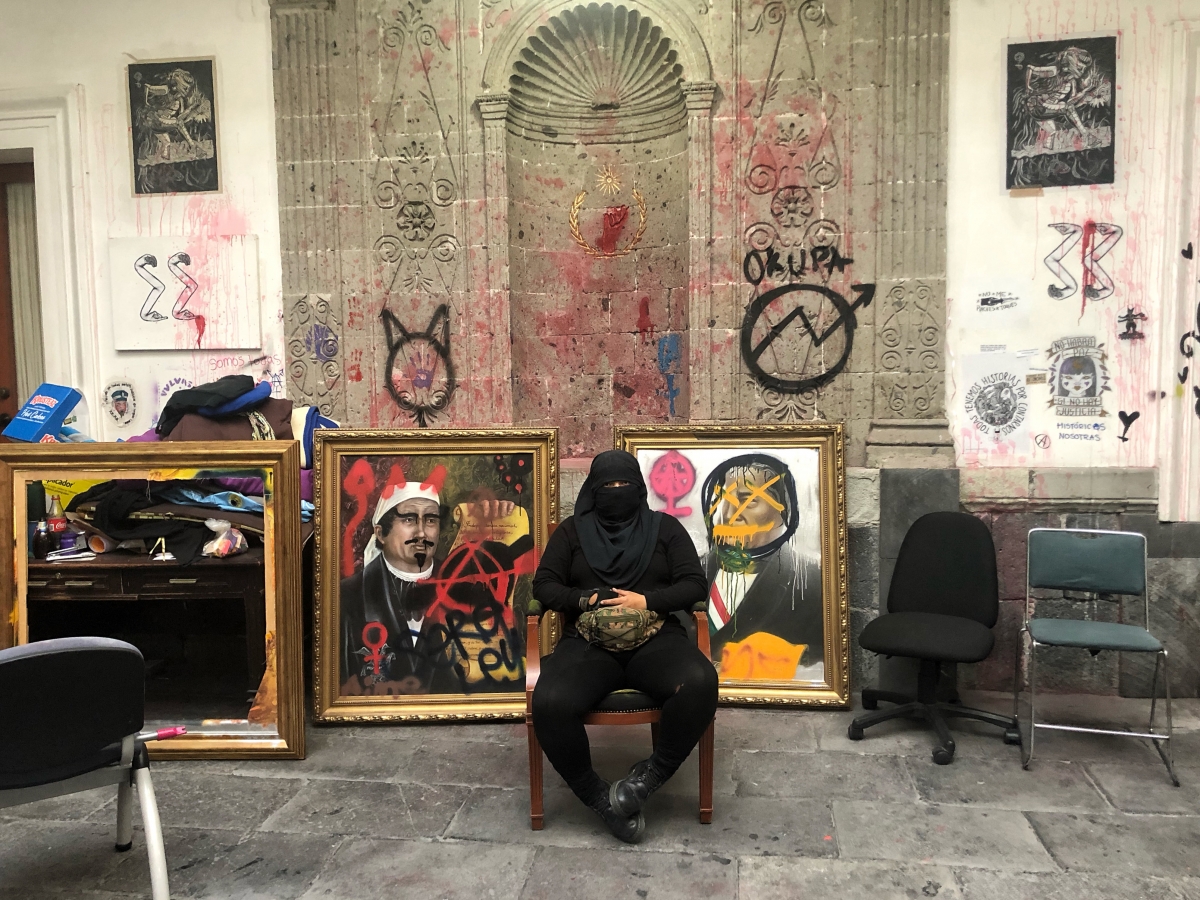
Doc, a member of feminist group Bloque Negro, is among the activists who have occupied the human rights office. She is seen in the courtyard of the Spanish colonial building in front of historic paintings the activists have defaced. MUST CREDIT: Washington Post photo by Marissa Lang
In 2020, on pace to become the deadliest year for women in Mexico on record, activists say there is no safe place left for women here.
So they have made one. They kicked the government workers out of the federal Human Rights Commission building in Mexico City. They covered the walls with the names of rape victims and hung posters with the faces of the dead. Then they invited women and children to shelter.
“In here, you realize that you’re not really alone, that we have all suffered some kind of gender violence and nobody has taken care of us – not the state, not the police,” said Cali, a 26-year-old member of the group Bloque Negro, who like others spoke on the condition that her full name not be used for fear of reprisal. “So, it makes you feel safe to know that in here we can take care of ourselves.”
The occupation of the stately marble building in Mexico City’s central historic district, which began in September, is one of the most extreme acts of a feminist movement that has grown more aggressive amid the intensifying violence and what its members say is official inaction.
Last year, authorities here reported a record 3,142 femicides – the killing of girls and women for their gender. Activists say an undercurrent of machismo that runs through every part of Mexican society – families, communities, the government – is as much to blame as the perpetrators who kill, on average, nearly 10 females a day.
Elected leaders “say that they don’t know why we are angry, they say that everything is fine in the country,” said Doc, a 21-year-old who helps treat injured protesters. “But the situation is abysmal.”
Protests to fight the physical and sexual violence have overtaken cities across the country. None of the activists’ demands – including police training, a public review of government actions to stop the violence and a guarantee of the protesters’ safety – have been met.
The shelter has been a safe harbor for women fleeing violent homes, abusive relationships, sexual assault, threats or the fear of being female in a country where researchers say femicides have grown by 130 percent in the past five years.
President Andrés Manuel López Obrador has spoken against the violence. But he has also condemned the vandalism and violence at the feminists’ demonstrations. Protesters have dumped paint on statues, vandalized monuments, shattered windows and set fires.
López Obrador,a populist who rode a wave of dramatic demonstrations to prominence himself, has suggested the activists are protesting the “wrong way.”
“Without a doubt the feminist movement deserves all our respect, but I do not agree with violence,” he told reporters in September. “That we all achieve peace and tranquility, that is an objective that we have. We are working toward that.”
The activists say the vandalism isn’t a byproduct of their protests – it’s a tactic.
“For years, they protested peacefully, going to the Monument (to Independence) with photos and candles, and nobody paid any attention,” said a 22-year-old university student at the shelter who wore a black hood and mask.”It was not until private property began to be destroyed that the country turned to look.”
Yesenia Zamudio, whose 19-year-old daughter was found dead after being thrown from a fifth-floor window in Mexico City in 2016, is a frequent protester around the capital.
“I have every right to burn and break,” she told a crowd in a February.”I’m not going to ask anyone for permission, because I am breaking for my daughter.”
The approach carries risk. Protesters gathered in Cancún after the body of 20-year-old Bianca “Alexis” Lorenzana Alvarado was found dismembered this month. When they tore down plywood boards blocking the entrance and windows to the state attorney general’s office, police opened fire. Two journalists and several demonstrators reportedly were wounded.
A 2020 government survey found that nearly 80 percent of Mexican women don’t feel safe in their own country. Ten percent of criminal cases here result in prison sentences; when the victims are women, the percentage is lower. Human rights groups estimate that only about 2 percent of accused rapists in Mexico are ever jailed.
The World Health Organization has reported that approximately half of all women in Mexico will experience sexual or intimate-partner violence during their lifetimes. But many suffer several attacks.
Yaderi, a 36-year-old university student and retail worker who lives in Mexico state, said she has been sexually assaulted six times, beginning at age 7 and most recently six years ago. But it wasn’t until she had a daughter, she said, that she felt compelled to join the movement.
Two years ago, she said, the child came home from preschool crying. She told her mother a man had touched her sexually.
“I teach my children that their body is theirs, but we live in a country where that is not true – not for children, not for women,” she said. “Enough.”
Her last name is being withheld to protect her daughter’s identity.
Yaderi joined Ni Una Menos, a grass-roots movement across Latin America to fight violence against women and push for more effective laws and harsher punishments.
“All these girls know somebody that has been killed or disappeared, and they have watched the government do nothing about it,” said Angélica Nadurille of the Equity and Gender Collective. “They’re angry. And they are right to be – the government is part of the problem because they have closed their eyes to the problems that exist, and I think that is because of the personal belief of the president.”
López Obrador has said feminist groups have been infiltrated by his political rivals and co-opted to undermine his administration.
He has expressed outrage over violence against women, but he has also slashed funding to the National Institute of Women amid coronavirus-related austerity measures and threatened to withdraw government funding from shelters operated by nonprofit organizations – suggesting instead that women fleeing abuse could be given a direct cash payment.
“When the pandemic started, he said violence against women should be less because the home is a very safe place to be,” Nadurille said. “And when we said this is not true, that it will actually make things worse, he said no, that’s not possible, because the family is a happy place.”
López Obrador’s office did not respond to requests for comment.
Dozens of families have sought shelter at the human rights office. They sleep in converted offices and live off donated food and clothing.
Children race up and down hallways as mothers and volunteers prep meals in a communal kitchen and sort donations of clothes, art supplies and toiletries. Men are not allowed inside the building.
Those who have sought shelter here are looked after by a rotating cast of young women in black balaclavas – the Bloque Negro, or the Black Bloc.
Bloque Negro activists stand guard with baseball bats, hockey sticks and pipes. Atop a mini-fridge sit neat rows of ready-made molotov cocktails, rags hanging from the tops of old beer and tequila bottles.
It makes women like Erika, 42, and her 10-year-old daughter feel safe.
Erika, a working-class mother of three, was among the small group of women who took over the offices in early September. Today, she’s one of the handful that remain. Infighting has driven wedges in the movement and led some women to leave.
Zamudio has denounced the work of Bloque Negro at the shelter. In occupying the building, she said, they have lost sight of the movement’s greater purpose: justice.
But for Erika, the two go hand in hand.
“I took this building because in response to my complaint, I was forced to leave my home, I was stripped of my home … and the authorities did not protect me,” she said. “We are no longer fighting against the abuser, the rapist, but instead we are fighting this government, this system, these authorities.”
A housekeeper and doll maker, she and her youngest daughter moved into the shelter after months of homelessness. The two no longer felt safe in their own home, Erika said, after the child, then 7, said she was sexually assaulted by a family member.
For two years, Erika said, she begged police and prosecutors to do more to resolve her daughter’s case. Erika was sexually assaulted herself when she was 10, she said. But when she told her mother, her family did nothing to help her.
“How many women put aside their complaint because they prefer to work and eat than to lose their job, their life, like me?” she said. “I have lost three years of our lives, my daughter’s and mine, fighting for this man to pay and not do the same to other women. That is why we fight: to stop this from repeating.”
Her daughter can’t imagine a future that doesn’t involve living at the shelter, surrounded by women. An energetic child, she bounces as she talks and runs fast through the open courtyard as her dark hair trails behind her.
She likes that men aren’t allowed in, she said, and that the women are free to do and say what they like. She likes the wall paintings and the black hoods. She helped paint over an oil portrait of Francisco Madero, the tragic revolutionary hero. She gave him bright red lipstick; others filled in green eye shadow and purple hair.
“I’m going to stay here for my whole life,” she said.
Erika said the shelter has changed the girl’s life.
“She can sleep without worrying that something is going to happen to her,” she said. “She can enjoy the entire building without worrying that something is going to happen to her. I can let her run and play without worrying that something is going to happen to her.”
By The Washington Post · Robyn Dixon · WORLD, HEALTH, EUROPE, HEALTH-FEATURES
MOSCOW – Their friends and relatives called them “test bunnies” and warned they risked horrible health problems from Russia’s entry into the vaccine race.
But a group of Russians, who dived in early as volunteers in trials of Russia’s Sputnik V, has emerged as amateur researchers before the official results of full Phase III data, still months away even though Russian officials on Tuesday asserted the vaccine was 95 percent effective.
Instead, they have set themselves in an online community – and, like members of a nerdy high school science team, they are doing their own explorations and analyses.
Nearly 1,500 people swap messages, answer questions and share antibody results and other health updates in an unofficial Telegram group that calls itselfCovid Vaccine Trial Volunteers.
It’s one of the quirkiest corners in the global race for a vaccine, with Sputnik V among other formulas from labs in the United States, China and Europe.
The online group welcomes newcomers, desperate to get into the vaccine trial, sending links to the best places for swift acceptance. They commiserate with disappointed participants who seem to have gotten the trial placebo shots. They plot graphs of results and symptoms and sling around technical information about antibodies and T-cells.
A few are experts, with a background in biochemistry or data research, but most are ordinary folk as Russia’s new cases reaching daily records of around 24,000 a day.
Russia’s government has not commented publicly on the web salon. But the chatter should seem familiar. Like Russian officials, almost all of posts in the Telegram group believe Sputnik V is effective.
“The satellite, damn, flies and beeps!” posted Dmitry Kulish, convinced in the power of the vaccine named after Russia’s first Cold War satellite.
Kulish, a biochemist and professor at the Center for Entrepreneurship and Innovation at Skolkovo Institute of Science and Technology, a private research institute in Moscow, took part in the trial because it was the only way to get the vaccine.
“Long story short: I got two shots and two days ago I got my antibody level and it’s really high so I am so happy about it,” he said in an interview.
According to Russian investigative website Proyekt, members of Russia’s elite, including tycoons and officials, were lining up to be secretly given Sputnik V shots even before it was registered in August. Russian officials have denied elite Russians got early insider access.
Many other Russians, however, remain skeptical of vaccination in general: 59 percent of Russians would not take covid-19 jabs, according to October polling by the Levada Center. The polling does not reflect the reasons for skepticism. But, as in Europe, the United States and elsewhere, the anti-vaccine lobby has taken hold in Russia in some quarters – as have conspiracy theories suggesting that covid-19 does not exist.
“As for the efficacy of the Russian vaccine or any other vaccine, I don’t think anyone knows. Only time will tell,” said trial volunteerAlexander Samsonov, 39, a member of the Telegram group who claimed that he got a strong antibody boost based on the Italian firm Diasorin’s Liaisontest, taken at a Moscow testing center.
Samsonov quit his public-relations job in the summer because his boss insisted that employees return to office-based work, where few bothered with protection measures like masks and gloves.
He eschewed his usual round of concerts, walks in the park, exhibitions and coffee-shop meetings with journalists. He stayed home for month after month, constantly glued to his computer, working freelance.
“I was stressed. I stayed home all the time,” he said. “You sit down all day and you put on weight.”
Samsonov decided to join the vaccine trial after his grandmother, 92, died of covid-19 and friends contracted the virus.
“They told me terrible things. Some got diabetes. Some got blood clots. And some had problems with their lungs,” he said.
But some colleagues and friends also poked fun at Samsonov’s protection measures, including masks and gloves. When he volunteered for the trial, they said he would be sorry.
“They told me – because the vaccine has not been tested to the very end, and because the vaccination thing is political – I would have health problems,” he said. “I would never have kids and I would develop various diseases because of this vaccine.”
But he described the vaccine, even still experimental, as helping lift his mood like the curtain rising on a premiere. He found a new job in public relations.
“I feel much calmer. I feel like I can get out of self-isolation now,” he said. “I can’t live in isolation until the summer of 2021.”
As global competition heats up, Russia is targeting markets in Asia, Latin America, the Middle East, Central Asia and Africa. President Vladimir Putin pushes the vaccine in every conversation he has with any world leader – jostling with rivals that include British-Swedish giant AstraZeneca in alliance with Oxford University, and U.S.-based Moderna and Pfizer, collaborating with Germany’s BioNTech.
Russia claims Sputnik V is 95 percent effective, similar to results reported by Pfizer and BioNTech, and Moderna.
Russia’s stance – in the words of loyal state TV anchor Dmitry Kiselyov – is to pooh-pooh the West’s vaccines as expensive and temperamental products that must be kept at very low temperatures. Sputnik V is freeze-dried and more easily stored and transported. Kiselyov compared it to one of the Soviet Union’s most famous exports.
“Sputnik V is like a Kalashnikov, simple and reliable,” he said on Vesti Nedeli television program earlier this month. “Just like any frozen product, Pfizer is likely to suffer logistical problems.”
Vladimir Rusetsky, 36 and his wife Yelena, both IT specialists, started the Telegram group to share information and were surprised to see how fast it grew.
They flew 1,670 miles from their home Omsk to Moscow – twice – to join the trial and take the two sets of shots. They were afraid of infecting their parents.
“When you have older relatives, it’s scary,” Rusetsky said.
Antibody tests after the vaccine showed their levels were high, he said.
He hopes that the group will persuade skeptics, including friends and family, to consider getting the shot when it is widely available early next year.
“My wife’s daughter, who lives in America, called us test rabbits. Now she sees that we have antibodies and her attitude has changed,” Rusetsky said. The couple still follow the rules on masks and gloves, mainly to set an example to others.
“Of course I have this feeling of relief,” he said. “Now I know my relatives will be safe. I will not pass on the disease to them and that calms me down a lot.”
Max Popov, a Canadian citizen in the Telegram vaccine community and a related Facebook group, said there was no reason to fear Russia’s vaccine. But he and his Russian wife, Natalia Khristyukova, had no antibodies after their clinical trial shots.
“Based on that I figured that both my wife and I are in the placebo group, unfortunately,” said Popov, who manufactures and installs television equipment in Russia
Rusetsky is sure he got the vaccine, not the placebo. He called it “life changing.”
“And if those people who did not want to be vaccinated look at me and change their minds and will get a vaccine,” he said, “that would just be great.”
By The Washington Post · Min Joo Kim · WORLD, COURTSLAW, ASIA-PACIFIC
SEOUL – Over nine months starting in spring 2019, Cho Ju-bin lured his victims – whom he called “slaves” – with calculated precision.
From his home in Seoul’s suburbs, the 25-year-old orchestrated one of South Korea’s most infamous sex crimes. Under an online alias as the “Doctor,” he blackmailed at least 74 young women, including minors, into sharing sexually explicit videos of themselves, then sold the footage online through a chat group on the encrypted app Telegram.
On Thursday, a court convicted Cho of organizing a crime ring and violating child protection laws, and jailed him for 40 years.
The case fueled a national outcry in South Korea over what has emerged as a major societal problem: men secretly recording sexually explicit footage of women, or blackmailing their victims into doing so, and then selling the material online.
It’s a crisis fueled by a lack of respect for women in Korean society and a culture of impunity, exemplified by weak laws against digital sex crimes and often low penalties for sex offenders.
In sentencing Cho, the Seoul Central District Court said he needed to be “isolated from society for an extended period” given the number of victims, the damage he inflicted on them and the social repercussions of the crimes.
“The defendant lured and threatened a large number of victims into producing sexually degrading videos and raised a lot of money through distributing them to many people over an extended period,” the court said. “In particular, he inflicted irreparable damage by releasing the identities of many victims.”
Cho had lured women through social media, sometimes by posting fake modeling or employment advertisements, and then conspired with workers at local government offices to obtain their personal information so he could blackmail them. He then sold access to chatrooms for up to $1,300, paid in cryptocurrency.
The scale of the operation stunned the nation. Local media said that up to 260,000 people potentially viewed the content, though police say that number includes double-counting and nonpaying members. More than 2 million people signed a petition demanding the names of everyone who viewed the content to be made public.
“At the time, I was hardly concerned about human dignity and I just used people and sex as tool for crimes,” Cho told prosecutors, according to local media reports. “Now I declare an end to my life as a devil.”
Prosecutors had sought a life sentence for Cho. Both they and Cho have a week to appeal the verdict. Cho’s attorney could not be reached for comment.
The police have detained 124 suspects in relation to the crime ring.
In Thursday’s ruling, sentences of 15 years or less were handed down to some of Cho’s accomplices. A 24-year-old man, under the alias “Donald Putin,” was convicted of stealing victims’ personal information and supplying it to Cho to threaten the women. Others sentenced on Thursday included a 16-year-old and a public servant.
The outcry has provoked an official reaction.
In March, South Korea’s Justice Ministry established a task force to address online sexual crimes, and pledged to set up prevention measures and improve support for victims. In April, South Korea’s parliament passed a law increasing penalties for illegal sexual imagery, outlawing possession and viewing of such material.
Outside the Seoul court, women’s rights activists declared the verdict “not an end, but the beginning of rooting out sexual abuse on Telegram.”
A spokeswoman for the Joint Committee for Sex Abuse on Telegram, consisting of sexual violence hotlines and nongovernmental organizations, called for proper support measures for sex abuse victims who were “left neglected.”
The impact that Cho’s crimes had on the lives of young women was underlined this week in a public letter from an unnamed victim.
“You guys were confident about impunity and tried to scare me, devour me,” she wrote. “Seeing your faces getting revealed one by one, I only then realized that my life had been completely destroyed.”

 โจชัว หว่อง ถูกขังเดี่ยว บอกสบายดี แค่นอนไม่หลับนิดหน่อยเพราะแสงไฟแยงตา
 ยุโรปหลายประเทศยังไม่พ้นวิบากกรรมจากการะบาดรอบใหม่ เศรษฐกิจของบางประเทศกำลังพบกับเรื่องเลวร้ายที่สุด
 เสียงเรียกร้องขอรัฐสวัสดิการในไทยดังขึ้นเรื่อยๆ แต่รัฐสวัสดิการไม่ได้เกิดขึ้นเอง มันจะต้องใช้งบประมาณมหาศาล แล้วเราพร้อมที่จะจ่ายหรือไม่?
 Karen James embraces her daughter Olivia James, 7, during a break from school and work at their home in Alexandria, Va. MUST CREDIT: Photo for The Washington Post by Amanda Andrade-Rhoades






 Madison Reyes as Julie in Netflix’s “Julie and the Phantoms.” MUST CREDIT: Eike Schroter/Netflix

 Feminist activists and artists dance outside the Mexican human rights office, which for two months has been run as a shelter for women and children. MUST CREDIT: Washington Post photo by Marissa Lang