“Golden Hour” photography exhibition radiates beauty of transience. #ศาสตร์เกษตรดินปุ๋ย

#ศาสตร์เกษตรดินปุ๋ย : ขอบคุณแหล่งข้อมูล : หนังสือพิมพ์ The Nation

https://www.nationthailand.com/lifestyle/30380596?utm_source=category&utm_medium=internal_referral

“Golden Hour” photography exhibition radiates beauty of transience.

Jan 15. 2020
By The Nation

A Melbourne-based artist, Cyrus Tang, is showing her artwork in Bangkok for the first time with her haunting and moving “Golden Hour” photography exhibition at Galerie Oasis, on Sukhumvit Soi 43 in Bangkok. The photography exhibition has now been extended until February 16 due to popular demand.

The term “Golden Hour” first came to prominence during World War I where it was used by medics to describe the critical time between life and death experienced by battlefield trauma patients; that narrow window of time when medical intervention can still have a successful outcome.

The term is also used by landscape photographers to articulate the transition of light between night and day. Here the “Golden Hour” refers to a brief period just before sunset, or just after sunrise when the harsher contrast of daytime is reduced, and light has a gentle glow.

These two meanings showcased the balance of life and death associated with trauma and the transition between light and dark in Cyrus Tang’s juxtaposition of two aesthetically disparate series of photographs, which explore experiences of damage and loss.

In this series, she has built model fantasy cities out of white fired ceramic, evoking the megalithic forms of post-WWII brutalist architecture as well as rambling ad hoc streetscapes of Middle Eastern and Mediterranean villages drained of colour and steeped in glowing, ghostly light. She then fires bulletlike missiles into these models, exploding them into fragments and splinters and releasing clouds of choking dust.

The traumatic eruption of this unaccountable violence is disturbingly reminiscent of the scenes of destruction from wars in Syria. Iraq and in Yemen. And yet, these images also seem to radiate an unnerving beauty of transience manifested in the aurora-like plumes of the explosions.

The “Golden Hour” photography exhibition at Galerie Oasis will also be part of another event, the seventh edition of Galleries’ Night in Bangkok on February 14-15. This event will unite more than 70 galleries and art spaces along Silom, Riverside, Sathorn, Sukhumvit, and Pathum Wan. It will feature various art forms and genres by local and international artists on display until late into the night. A special screening of Cyrus’ VDO piece “In Memory’s Eye, We Travel” will also be shown for the first time in Bangkok on the night of February 15 as part of Galleries’ Night.

Beloved outsider artist Purvis Young left behind hundreds of paintings and a complicated legal case #ศาสตร์เกษตรดินปุ๋ย

#ศาสตร์เกษตรดินปุ๋ย : ขอบคุณแหล่งข้อมูล : หนังสือพิมพ์ The Nation

https://www.nationthailand.com/lifestyle/30380516?utm_source=category&utm_medium=internal_referral

Beloved outsider artist Purvis Young left behind hundreds of paintings and a complicated legal case

Jan 14. 2020

“Locked Up Their Minds.” Fans of Purvis Young’s paintings include Lenny Kravitz, David Byrne and Jane Fonda. MUST CREDIT: Courtesy of Larry T. Clemons/Gallery 721
By Special To The Washington Post · Deirdra Funcheon · FEATURES

Beloved outsider artist Purvis Young left behind hundreds of paintings and a complicated legal case. In December 2018, celebrities and collectors jetted into south Florida for Art Basel Miami Beach, the annual contemporary art fair. Hundreds of people in blazers and party dresses crowded into the Rubell Family Collection, a private museum, for the opening of an exhibit of work by the late Purvis Young.

Visitors wound through the rooms filled with paintings and snapped selfies destined for Instagram. They jammed onto a back patio where pink lights illuminated the palm trees. A bank sponsored the cocktail bar.

Purvis Young with his many paintings at Goodbread Alley in Miami circa early 1970s. MUST CREDIT: Photo courtesy of the Miami Herald

Purvis Young with his many paintings at Goodbread Alley in Miami circa early 1970s. MUST CREDIT: Photo courtesy of the Miami Herald

Young had made thousands of paintings during his lifetime, and this midcareer selection of about 100 pieces – which was grouped by motif: “Warriors,” “Drugs,” “Holy Men and Angels,” and so on – took up the museum’s entire ground floor. Perhaps the most famous painter to ever come out of Florida, Young had depicted the struggles and joys of Miami’s poor black community and was branded an “outsider artist.” His work is in the collections of New York’s Metropolitan Museum of Art and two Smithsonian museums. Lenny Kravitz, David Byrne and Jane Fonda are all professed fans.
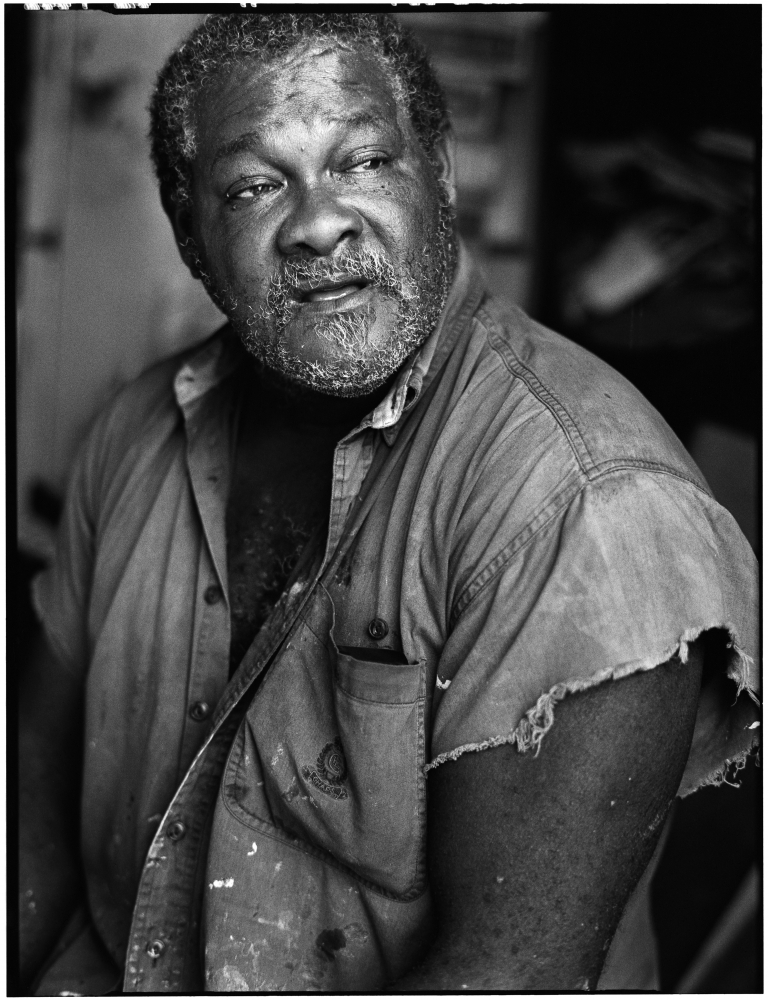
Purvis Young Photo by: David A. Raccuglia — Courtesy

Purvis Young Photo by: David A. Raccuglia — Courtesy

Eddie Mae Lovest, a petite 62-year-old in jeans and a tank top, slid through the crowd from painting to painting, pausing for a few seconds at each. Young’s works were among the first things that she noticed when she stepped off a Greyhound bus into downtown Miami in the early 1970s, a pregnant teenager fresh from the woods of Georgia. “It was me coming from a little old country town,” she had explained the day before the art show. “It was so many lights and so many people, and all these big buildings.”
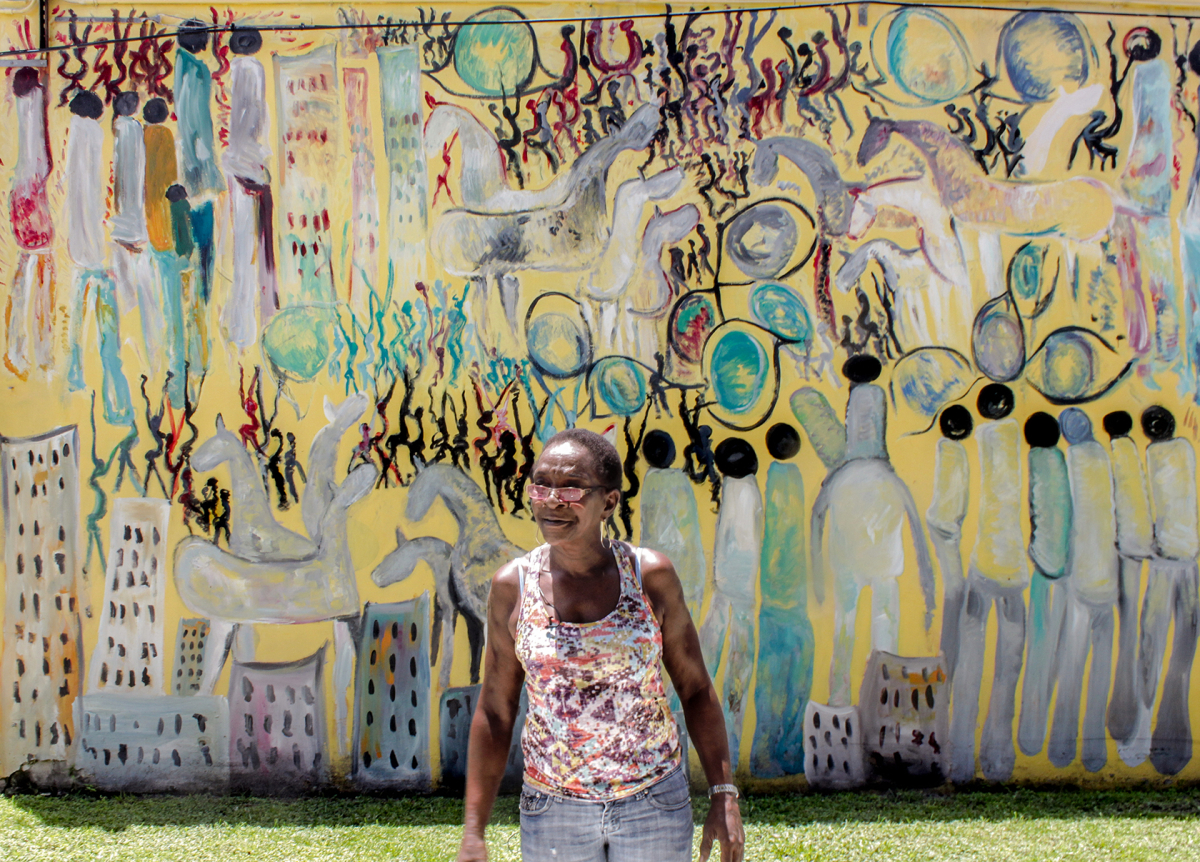
Eddie Mae Lovest, a close friend of Purvis Young's, in front of one of his murals. The artist willed most of his estate to her and her family. MUST CREDIT: Photo courtesy of KijiK Multimedia Inc.

Eddie Mae Lovest, a close friend of Purvis Young’s, in front of one of his murals. The artist willed most of his estate to her and her family. MUST CREDIT: Photo courtesy of KijiK Multimedia Inc.

She thought it was crazy that someone had nailed hundreds of paintings all over abandoned buildings in Goodbread Alley, a desolate stretch of 14th Street where, decades earlier, johnny cakes were sold out of shotgun shacks. The paintings, on scraps of wood and broken doors, depicted funerals, wars, celebrations. They were full of stringy figures with extra-long bellies, long arms stretched up to the sky. “I was like, ‘Who the hell let these kids be drawing on their buildings?’ ” Lovest said. “Where I come from, you don’t draw on people’s stuff!”

Walking to her job at a downtown dry cleaner, Lovest would pass the Bahamian restaurant where Young sometimes helped the owner. The artist had a thick build, serious face and a wisp of a mustache. Soon, “we became the best of friends. For 37 long years … I took care of him, and he took care of me, from the time I met him until the time he died. Never was married. Never was girlfriend and boyfriend. Just the best friend I could have ever had.”

Young never had a wife or biological children. When he died in 2010, he named Lovest and 12 of her daughters and grandchildren as the main beneficiaries of his will. He left hardly any cash, but he did leave 1,884 artworks. Lovest assumed a sale would eventually be arranged and her family given its due. So she was surprised in 2018 to learn that a judge had let lawyers take all of the art to satisfy a half-million dollars in bills racked up on Young’s behalf. Her family hadn’t gotten a cent – or a single painting.

At the Rubell Museum, Lovest’s friends and relatives arrived at the exhibit, congregating beside the gift shop, where hardcover catalogues of Young’s art retail for $49.95. “I’m just here for the dollar art,” one friend quipped. The group struggled to reconcile the crowded scene they were witnessing with what the judge had determined: that there was no market for the paintings Young left behind when he died. One court inventory had listed their value at $1 apiece.

Young’s heirs were, by the time of the exhibit, enmeshed in a bid to unscramble what had happened. Their saga would involve legal proceedings in three separate courts, attorneys trading accusations of misconduct, and troubling aspects of Florida’s laws that are supposed to protect the vulnerable.

Purvis Young grew up in Overtown, a historically black neighborhood in Miami once known as “the Harlem of the South.” The area was devastated when Interstate 95 was built right through it as part of urban renewal efforts of the 1950s and ’60s. Released from prison in 1964 after serving three years for breaking and entering, Young could be seen working near the highway in paint-splattered clothes, his outfit sometimes topped off with a beret. Neighborhood guys would scrounge scraps of plywood for him to use as canvases. Firefighters who were painting hydrants would bring him what was left in their buckets.

Young was moved by the troubles he saw in the news: the Vietnam War. Protests. Sit-ins. Angels, he said, visited him and told him to paint. “I didn’t have nothing going for myself. That was the onliest thing I could mostly do,” Purvis said in a 2001 book, “Souls Grown Deep.”

He returned to the same subjects over and over again: refugees arriving on boats, busy cityscapes full of trucks and buses, wild horses. The people in his work danced, prayed and grieved – often in crowds, suggesting an urgency. Pregnant women were a frequent theme; Purvis imagined them giving birth to angels and bringing forth a new nation. Sometimes his pregnant women had dozens of squiggly babies around them.

When he wasn’t painting, Young, a high school dropout, spent hours at the library, flipping through volumes about Vincent van Gogh and Henri de Toulouse-Lautrec, which charmed the librarians. When he learned about the “Wall of Respect,” a 1967 mural in Chicago that celebrated black history, he nailed up his own paintings in Goodbread Alley. “My feeling was the world might be better if I put up my protests,” he said in “Souls Grown Deep.” “I figured the world might get better, it might not, but it was just something I had to be doing.”

Young fit into the “self-taught,” “outsider” or “folk artist” genre that started gaining steam in the ’70s. His librarian friends arranged an exhibit of his work. The city hired him to do a few murals. Curious tourists coming off the new highway would stop and buy paintings for cash.

Sitting around the dining room table of Young’s friends Leon Rolle and his wife, Sharon, in December 2018, Eddie Mae and her 35-year-old daughter Taketha Lovest described how Young became a part of their household. Eddie Mae would cook him neck bones, or eggs and grits. He’d slip the kids money for candy and laugh when the little ones knocked over his paint cans. The family would buy him shirts; he’d immediately cut off the sleeves. “You get him some nice pants, he gonna cut ’em,” Taketha said. “He had ugly-lookin’ shoes. You wouldn’t think he had 50 cents to his name.”

Young called Eddie Mae his “common-law girlfriend.” He didn’t drive; the pair would ride their bicycles to pay bills. He treated her four daughters, and eventually her grandchildren, as his own. Eddie Mae chuckled that Taketha was his favorite: “He was clingy to [her].” He’d nod off on their couch watching public television, only to jump awake and start doodling. “I’d raise hell about him getting paint on my forks, my spoons, my refrigerator, my water jugs, my everything!” Lovest remembered. “Lampshades, sofas …” recalled Leon Rolle. “If you sat still long enough, he’d paint on you!”

By the mid-’70s when the buildings in Goodbread Alley were demolished, Young was being taken seriously as an artist. In 1989, a Miami art dealer, Joy Moos, signed Young to an exclusive contract and introduced his work to contemporary art galleries in New York and Chicago. Now 87, Moos recalled taking the artist to the dentist and helping him open his first bank account. In some ways, she said, “it was like taking a child.”

A Cuban Santeria priest named Silo Crespo acted as Young’s manager. According to Moos, Crespo told her that Young deserved a $30,000 or $60,000 base salary, plus commissions. When Moos balked – Young’s pieces sold for a few hundred or few thousand dollars, which she shared with the artist in an industry standard 50-50 split – Crespo put Santeria curses on her family. She hired a priestess to remove them: “I had to have the gallery cleaned. I had to do all this voodoo stuff with a cut chicken head.”

Leon Rolle, then a practicing lawyer, said Young asked him for help ending his contract with Moos so the artist could be free to negotiate with Gerard “William” Louis-Dreyfus – billionaire energy mogul, father of actress Julia Louis-Dreyfus and collector of self-taught artists. In Rolle’s telling, Louis-Dreyfus offered Young $3 million for 1,500 pieces and dangled the idea of sending him to Paris to paint. But the collector was worried about oversupply and wanted Young to destroy a third of his inventory. Rolle said Young rejected the deal, griping, “They never told Shakespeare he wrote too much!” (Both Crespo and Louis-Dreyfus have since died. Jeffrey Gilman, president of the William Louis-Dreyfus Foundation, doubted the billionaire would have wanted art destroyed: “He couldn’t even bring himself to sell anything!” Moos said Rolle and Crespo had unrealistic expectations of the value of Young’s work and didn’t understand the market.)

Young’s standing in the art world was solidified in 1994, when the Smithsonian American Art Museum (SAAM) bought one of his works, an untitled piece from around 1987. Leslie Umberger, current curator of folk and self-taught art, said that the SAAM went on to acquire four more of his pieces, including “The Struggle,” which she called “a treasure of the museum.” (The Smithsonian’s National Museum of African American History and Culture, which opened in 2016, also has a Purvis Young painting. Historical materials related to him are kept in the Smithsonian’s Archives of American Art and the Smithsonian Libraries.)

By the mid-’90s, Young had moved into a studio in Miami’s industrial Wynwood neighborhood, where he slept in a recliner with three TVs blaring at once. “One with Fox News,” said Sharon Rolle, “and one for the sex movie” – Eddie Mae laughed – “and one with his History Channel.” “And jazz music playing,” added Leon.

As his artwork piled up, the space became a fire hazard, and in 1999, Young faced eviction. By coincidence, art collectors Don and Mera Rubell, who had helped launch the careers of Keith Haring and Jeff Koons, admired Young’s work at a friend’s house and dropped by his studio. “With him, it’s all in the gesture,” Mera Rubell said at her museum this spring. “He could put 100 figures in a crowd just with his single wiggle and you could know they’re in protest, or a crowd witnessing a funeral.” She compared him to Edgar Degas, Georges Seurat and Alberto Giacometti.

The Rubells offered to buy his entire inventory, more than 3,000 pieces. Mera Rubell declined to disclose the price, but locals have speculated that it was anywhere from $60,000 to $1 million. Young told Lovest it was $85,000, but she’s not sure that’s right either. Whatever the amount, it was enough to save him from eviction. The Rubells vowed never to sell Young’s work and have gifted 493 of his pieces to institutions. When they gave 91 pieces to the Tampa Museum of Art in 2004, Sotheby’s appraised the gift at $1 million, an average of nearly $11,000 per piece; 109 works donated to Morehouse College in 2008 were valued at more than $1 million, over $9,000 apiece.

In Wynwood, around 2005, Young also met a gallerist named Martin Siskind who became his new manager. Now 78 and operating a gallery in Little Haiti, Siskind recalled the artist had a touch of cunning: “Everyone talks about, ‘He was a friendly giant, very ignorant, didn’t know the ways of the world.’ That couldn’t be further from the truth! People would try to take advantage of him. He felt he took advantage of them! Soon as they bought 10, 20 paintings, he’d say, ‘Man, I could paint another 20 paintings this afternoon.’ ”

It wasn’t long, though, before Young came to believe Siskind was the one trying to take advantage of him. He complained that Siskind allotted him just $500 a week, refused to provide an accounting of art sales and changed the locks to the warehouse where his paintings were stored, according to a lawsuit the artist later filed against Siskind. In January 2007, while Young was in the hospital for a kidney transplant, he fired Siskind from his bed in intensive care and retained a lawyer, Richard Zaden, to sue him. “We stopped what we were doing and put his case to the front burner,” Zaden recalled.

Siskind argued their relationship had been a partnership and demanded 50% of Young’s inventory – about 1,000 pieces – to end it. He also told a probate judge that Young required a guardian. Young found out only when a court-appointed lawyer appeared at his bedside to perform an evaluation.

Guardianship is intended to protect vulnerable people, such as those with dementia, from mismanaging their finances or making harmful decisions. But critics of the system say it’s too easy to put a ward under a guardianship and give a stranger power over his life. Under Florida law, any adult can file a petition alleging that another is incapacitated. A three-person team investigates and reports to a probate judge. (One of the three must be a physician.) The judge decides whether to appoint a guardian, who can suggest which of the ward’s rights – such as voting or determining his own residence – should be taken away.

Any high school graduate can become a professional guardian if they fulfill certain requirements, which include completing a 40-hour course and passing an exam, a credit check and a background check. Guardians are paid by the ward, as are lawyers brought in for court proceedings. As these bills add up, they can drain a ward’s savings. Critics also complain of coziness between judges and lawyers who work closely in guardianship courts.

People close to Young felt Siskind had sought the guardianship as retaliation, but Siskind insists he only had good intentions. “I thought [the guardians] would take care of him, and I could step aside and hope for the best,” he told me.

Miami-Dade probate court judge Maria Korvick, who oversaw Young’s guardianship case, declined to comment for this story, citing ethics rules, but in a 2018 court transcript, she remembered Young as someone who was in “very, very bad shape. … He didn’t like to listen to doctors, and he didn’t like to eat what he was supposed to, but he was a darling man.” She appointed two guardians: Anthony Romano, as “guardian of the person,” was tasked with overseeing Young’s housing and medical care; and David Mangiero, as “guardian of the property,” was charged with overseeing the artist’s assets and finances.

After Young was discharged from the hospital, he moved into the Rolles’ detached garage. He filled it, then the yard, with paintings. A plastic tray on the Rolles’ kitchen table still shows signs of attack: three yellow squiggles. Mangiero and Zaden decided to settle with Siskind – resulting in Young having to give the gallerist 20% of his inventory, about 200 paintings, according to news accounts. (Mangiero did not respond to repeated requests for comment.)

Meanwhile, bills from the guardians and lawyers started to come in. Rolle recalled the artist complaining as the costs added up: “Why I got to pay them? I didn’t send for them!” But to get the guardianship removed required going to a court-appointed doctor. The Rolles said in Young’s case, that meant a psychiatrist, which he refused to see. Leon Rolle recalled Lenny Kravitz coming to his house one day to visit Young. “He sat for an hour and a half. He said, ‘Ain’t nothing wrong with this guy – why is he in a guardianship?’ ” (Kravitz did not respond to requests for comment.)

In June 2009, Young crafted a will naming Lovest and 12 of her children and grandchildren as the beneficiaries of 99% of his estate; 1% would go to his brother, Irvin Byrd. That winter, Romano, his guardian of the person, moved Young into a nursing home. “Lights out at 10:30,” said Sharon Rolle. “He couldn’t paint. He lasted five months.”

On April 20, 2010, Young died of cardiac arrest and pulmonary edema. Upon hearing of his passing, Kravitz recorded a video from the Bahamas: “May your spirit rise up to the heavens as they do in your paintings. Peace, my brother.” He blew a kiss.

What followed was a legal drama so complex that one judge who presided over part of it suggested it be studied in law schools. Court records show that after Young died, the guardianship case was closed. A separate probate case was opened to deal with Young’s estate assets. Korvick was in charge of both. In February 2011, she named Mangiero the personal representative of the estate, meaning that he was responsible for paying creditors – including himself, Romano and six lawyers – then distributing any remaining assets to Young’s beneficiaries, per the will. (Florida law allows a guardian to serve as a personal representative.)

In July 2011, Mangiero filed an inventory listing the assets in the estate: about $6,000 in cash and 1,884 paintings, for which Mangiero gave an estimated fair-market value of $1 apiece. But the debts – about a half a million dollars – far surpassed that. Mangiero then successfully petitioned Korvick to reopen the guardianship case. Mangiero’s attorney explained at a court hearing that by doing so, the lawyers and guardians stood to be paid before other creditors (Young also owed Medicaid over $100,000). Only after the estate’s debts were satisfied would the beneficiaries stand to inherit anything. Mangiero in court filings also asked that the guardians and lawyers be paid in artwork and eventually proposed that they choose pieces worth twice the amount they were owed to offset dealer commissions should they place the work with a gallery.

Korvick agreed and required an appraisal. But the guardians and lawyers did not immediately split up the art because, as Mangiero testified in a lawsuit later filed by the Lovests, a formal appraisal could have cost tens of thousands of dollars. He opted instead to hold on to the collection, hoping a “white knight” would appear and buy it. The case fell dormant for years.

Leon Rolle continued to work with Mangiero, facilitating the occasional art sale. According to court filings and Mangiero’s own testimony, they fielded five offers to sell the collection for $700,000 to $3.7 million. But, according to court transcripts, Mangiero said either the offers were never formalized or he objected to the proposed deal structure – a down payment of a few hundred thousand dollars plus a percentage of unspecified profits over time. Rolle kept the Lovests informed of such developments. They still expected that Mangiero would eventually find a buyer and the art would sell for millions. It would have to sell for at least $1 million to cover the debts owed to the guardians and lawyers.

In 2017, former Talking Heads frontman David Byrne was working on his first solo album in 14 years, “American Utopia.” He explained in a blog post how he was drawn to a Young painting he saw online: “a head, a face – of indeterminate race and possibly gender – dreaming, meditating, contemplating.” He wanted to use it on the album cover (and eventually did). His emailed request found its way to Rolle, who said he forwarded it to Mangiero. When he didn’t get a reply, Rolle wondered if something was wrong.

Then in early 2018, a gallerist forwarded Rolle an email that he’d received from a Fort Lauderdale man. “I JUST PURCHASED YOUNG’S ESTATE,” it read. Alarmed, Rolle went to the courthouse to check the record. Rolle saw that in spring 2017, Mangiero had again petitioned to take artwork as pay. Korvick issued a new order in which she agreed and dropped the appraisal requirement. Receipts showed that in August and September 2017, seven of the eight attorneys and guardians had divided the artwork (one declined to take any), with Mangiero hanging on to the shares now owned by himself and three other attorneys to try to sell them. As for the separate estate case, Korvick had closed it in February 2018, for inaction.

Rolle left the courthouse angry. He grumbled about coziness between lawyers and judges. (Election records dating to 2000 show that four of the eight creditors, either individually or via their firms, had donated to Korvick’s election campaigns.) The Lovests hadn’t known the art was being split up because, technically, they were only “interested parties” in the estate case, not in the guardianship, so hadn’t received copies of all court filings for the latter.

The family retained an attorney, Kristen Goss, who argued in court filings that the paintings were worth millions of dollars and cited the valuation of the Rubells’ donations and the offers that had been floated. She contended that Mangiero had an “obvious conflict” serving as both a creditor and personal representative of the estate; the heirs had expected him to stand up for them. Stunned that a judge had let the art go without an appraisal, Goss sought to find out where all the pieces had ended up and how much they might have sold for, and to recover some assets for the heirs.

Mangiero countered that the lawyers had gone unpaid for a decade, and he’d spent $200,000 of his own money storing the art, to no avail. While he didn’t truly think the art was worth only $1 per piece – that was just a placeholder, he explained in filings after Goss tried to challenge Korvick’s orders – it wouldn’t garner millions of dollars.

“I have done everything possible in this guardianship to help [Young], to hold those paintings, to try and find buyers,” Mangiero said at a 2018 hearing. He mentioned having contacted Sotheby’s. “I’ve had things out to auction houses. The most they have gotten is less than $1,000 on any one painting. I’ve got emails from them saying, ‘We didn’t want it. It didn’t do good.’ ”

Korvick declared that Mangiero had “exhausted all potential sales avenues” and that there was “no market” for the art. There would be hard costs involved in transporting work for sale, and flooding the market could drive down the price, she reasoned. “Everyone would have wanted willing buyers with large monetary offers for the artwork, but this did not happen,” Korvick wrote in her final order in November 2018. The heirs did not have buyers lined up, nor did they have facilities to store the art, she pointed out – and she dismissed Goss’ objections.

Korvick also declared the copyright to Young’s work could go to his estate, allowing it – and potentially his heirs – to collect royalties paid by David Byrne and anyone else seeking to license Young’s images. But unbeknown to the judge, it was too late; the agency that handles such payments told me that Young had sold his copyright before he died to one of his old gallerists.

Goss appealed, arguing that Taketha Lovest’s due process rights had been violated. But the court sided with Mangiero and found that Lovest lacked proper standing to challenge Korvick’s ruling. Goss also filed a complaint in civil court, accusing the eight attorneys and guardians of unjust enrichment, negligence, breach of fiduciary duty and malpractice, arguing they’d taken art worth more than they deserved. This past September, the civil court determined that the matter had already been adjudicated in the guardianship court. The legal battle left the beneficiaries empty-handed and possibly on the hook for tens of thousands of dollars in attorneys’ fees.

Alex Diaz, a lawyer for Romano (the other guardian) and four attorneys, said, “I’m sure they feel Purvis was a fantastic artist and they believe with conviction his work is special, worth $10,000 for each individual piece – but the record here over the number of years that this has been going on reflects that there is not a market for this. Unfortunately, it went south for everybody.” Mangiero’s attorney in the civil case did not respond to a detailed list of questions. After the ruling, neither the Lovests nor Goss wanted to comment. “They’re tired,” Leon Rolle said. “We ain’t going to get no justice.”

Much of the artwork that Young had left when he died now sits in a warehouse owned by Alan Bluestein, a financial adviser in Fort Lauderdale and an art collector. When Bluestein came across Young’s work, he felt drawn to it. He particularly liked the white horses. In late 2017, he bought a few pieces on eBay. Then the seller emailed a private invitation to visit a warehouse in North Miami, where additional, never-before-seen work by Young would be available. “There was a huge amount in this warehouse,” Bluestein recalled. He picked out a few paintings, then “I asked the guy on my way out, ‘Would you be willing to sell the whole collection?’ ”

It turned out that once Mangiero had taken possession of the art granted to himself and three other lawyers, he enlisted a nephew to help sell it, he testified in the civil case. Through the nephew, Bluestein made the deal to buy all of it – about 1,000 pieces. Bluestein had no idea there was a legal dispute over it until he got a call from Goss, demanding to know how much he’d paid. Not wanting to get drawn into litigation, he refused to tell her. Though he testified in the civil case in July, a judge let him keep the figure confidential.

In January 2019, Christie’s Auction House held its fourth annual auction of “Outsider and Vernacular Art.” A 1974 piece by Purvis Young called “Three Jazz Mans,” from Louis-Dreyfus’s collection, had been projected to sell for $4,000 to $8,000. The “price realized” – which is the “hammer price” (the winning bid) plus the “buyer’s premium” (the fee due to the auction house, typically 13 to 25 percent of the hammer price) – was $22,500. Two more of his works sold for $21,250 each, and one for $13,750.

The Christie’s sales are the highest of the 253 Purvis Young sales listed on Artnet, a database that has tracked worldwide auction sales over $500 since 1985 – although LiveAuctioneers.com lists a Young painting having sold for $42,500 in 2013. (This was far from a record for outsider art. A limestone sculpture, “Boxer,” by William Edmondson, sold for $785,000 in 2016.) That said, Young’s works also sell for much less. On a recent day, LiveAuctioneers.com listed 20 works by Young, for $25 to $750.

One major marketplace for outsider art is the Slotin Folk Art Auction, held twice a year in Georgia. Folk art auctioneer Steve Slotin said he would have been interested in the paintings that Young left behind. “There’s not a lack of people who want it,” he explained. “Me and Christie’s fight tooth-and-nail.” Stronger pieces or originals from Goodbread Alley can fetch $10,000 to $30,000, according to Slotin. During his most recent auction in April, he sold 15 of Young’s works, for $1,800 to $12,000.

New York gallerist James Fuentes, who last year organized a solo show of Young’s work, has sold Young’s paintings for about $35,000. He said that Young’s case “defies this elitist logic of scarcity” and that Young’s prolific output was part of his allure. In sourcing his show, Fuentes dealt with six or 10 collectors known to own numerous Youngs but hadn’t heard of any trove of work left after his death. “That’s astonishing,” he said, adding he would have leaped at the chance to see it.

As for Bluestein, he said he’s not selling any of his newly acquired Young works – yet – because he’s sure that “it’s going up in value.”

At the Rolles’ house in 2018, Young’s friends reminisced about his funeral. Young wouldn’t have wanted anything too fancy, so they dressed him in a linen shirt. A blue one. His favorite color. Eddie Mae Lovest remembered seeing him: “Goddamn, Purvis, you looked good!”

“Somebody’s doing a huge show for Purvis in Venice,” Leon Rolle said. That would be the Venice Biennale – the prestigious every-other-year art fair during which Young’s work was shown in May, at a satellite exhibit. What this signified, according to the New York Times, was that “the self-taught artist who lived and worked so far from the rarefied world of contemporary art is now at its very center.”

Paris was the place Young had always dreamed of going. Leon remembered Kravitz telling Young that because he didn’t fly, as soon as he got healthy, ” ‘I’m going to put you on a Winnebago to New York! Then put you on the QE2’ ” – the Queen Elizabeth 2 cruise ship – ” ‘and send you to Paris! And have a show for you!’ But Purvis never could get healthy.”

“If I ever got a lot of money, I’m going to take him there, to his resting place,” Lovest declared. “Until then, he’s gotta stay inside.” She has his ashes at home.

“One day,” Sharon said, a smile spreading across her face, “We’re all going to make the trip for Purvis to go to Paris!”

“Yeah!” Lovest agreed. “And say, ‘Purvis, this is it! You made it!’ ”

Somtow treads dangerous ground with love story in Nazi death camp #ศาสตร์เกษตรดินปุ๋ย

#ศาสตร์เกษตรดินปุ๋ย : ขอบคุณแหล่งข้อมูล : หนังสือพิมพ์ The Nation

https://www.nationthailand.com/lifestyle/30380475?utm_source=category&utm_medium=internal_referral

Somtow treads dangerous ground with love story in Nazi death camp

Jan 13. 2020
By Tomáš Bazika
Special to The Nation

The long-awaited world premiere of Somtow Sucharitkul’s opera about the Holocaust in memory of the 75th anniversary of the Liberation of Auschwitz is ready. Somtow’s opera “Helena Citrónová” tells the true story of a Slovak Jew in the death camp who had a searing, intense relationship with an SS man.

The opera stars an international cast and is conducted by Trisdee na Patalung. Excerpts have been played already in Slovakia, Hungary, Czechia and Germany to great critical acclaim and standing ovations and this opera production may be one of Opera Siam’s most remembered achievements.

In an interview, Thai-American composer-conductor Somtow Sucharitkul talks about his most recent opera and his work on Paul Spurrier’s film “Eullenia”:

Q: The real character of your new opera Helena Citrónová is not free from controversy. A Jewish concentration camp inmate who had a love affair with a German camp guard. What drew you to this subject?

A: I discovered the story of this opera in a BBC documentary about Auschwitz. There was an interview with Helena and the story was very haunting. It was not a story about a triumphant love. It was full of ambiguity. It makes you ask all sorts of questions about the nature of love itself. I try to avoid answering any of the questions in the opera. I just want to present the story almost exactly as it happened according to the documented historical record. In a very real sense, the story came to represent to me what the holocaust really meant. Because it was not about people being horrible to other people. Of course, that happened. What it was really about was one group of people telling another group of people that they are not human. And in doing so, destroying their own humanity. Because the more you take away the humanity of other people, the more you reduce your own humanity. To me, Helena was a great hero because she refused to give up who she was.

Q: How is it relevant today – why should people care?

A: It’s relevant today because people have not learned their lessons. Many years ago, I started working with the Israeli, German and Czech embassies in Thailand about teaching young people about the Holocaust. I asked my students whether Thailand lost or won in the Second World War and they didn’t know the answer. Somebody had to tell them. This was when I started working on this, creating different programmes each year. In a sense, producing this opera on the 75th anniversary of the liberation of Auschwitz is basically a culmination of all these other works that I have done. It’s not just to teach local children about it. It’s about reminding everybody that the Holocaust is about six million people and it’s also about six million individuals.

Q: What role does Helena’s moral ambiguity have in your opera?

A: If you look at the story completely dispassionately, you might accuse the two people of having a selfish and transactional sort of relationship. That is one possible way of looking at the facts. It’s in contrast to this “great passion that conquers the universe” theme, which is another way of looking at it. Perhaps both of those stories are present. In the end it is a story about redemption. Therefore I don’t buy the sordid, transactional interpretation. In the opera you will see that the other girls call her a whore.

Q: Is your own view of the real-life Helena reflected in the opera?

A: I wouldn’t have written an opera about her if I didn’t see her as an extremely inspired character, despite some elements of ambiguity. I feel she represents for me a complete refusal to allow somebody to take away one’s personhood, no matter how awful the circumstances were. I think that Franz Wunsch even said afterwards that this is the lesson she had taught him. He felt somehow redeemed. Of course, he may have been making it up for the judges. Who knows? But there is a deep truth in the story that we can all learn from. There was some fear on the part of some Israelis when they heard that I was writing this opera that by making it a love story between “the bad guys” and the victims that somehow they were being made sort of equal. If you read the libretto or look at the opera that’s completely untrue. There is absolutely no whitewashing of the evil. The first time you see the hero of the story, he shoots an old man in the head and Helena sees this. That’s an incident that I created – it’s not in the historical record – because I wanted the audience to realise right away that this is not a misunderstood Nazi little boy. I wanted people to realise he was part of this operation.

Q: What is the lesson you would like the audience to consider?

A: I think it’s most important for people to see themselves in this work. To not think of it as some remote history in a fantasy universe that could never happen again. Things like this have happened again already. And it’s because we didn’t learn the lessons enough.

Q: You premiered an orchestral suite from “Helena” in Slovakia and in the Czech Republic this September. How was it received?

A: Well, I was quite frightened because, you know, Slovakia is Helena’s country. I had no idea how people would react to some total stranger bursting in on somebody else’s history. It was heartwarming because the reception in the places that were most involved in the story was extremely positive and enthusiastic. And it was then that I understood that the opera seems to have something to say to everyone. One of the most exciting things that happened was that the Slovaks immediately started the discussion about opening the opera in the National Theatre in Bratislava. This is already in talks. I was very happy about that. It was kind of a validation of the idea of universality in the story. I am having similar questions in Thailand. Why in the hell are you doing this? This has nothing to do with you. I mean, in a sense, not to say something is kind of complicity.

Q: What are your expectations for the premiere of “Helena” in January 2020?

A: Well, the Bangkok premiere is happening in January and this production will go to Europe. I don’t know. I’m actually quite frightened [laughs] because we are opening this opera in a country where there’s a fast food chain called Hitler Fried Chicken and where a common slang in Thai for stingy is “Jew”. This is amazing because as far as I know the actual number of Jewish people that the Thais may have met in person is probably almost non-existent. For some reason, many of the tropes of this have infiltrated this culture. We had to do a lot of explanation about why Hitler Fried Chicken is not cool.

Q: You made a new recording – the first recording in Thailand – of Carlo Gesualdo’s music for Paul Spurrier’s film “Eullenia”. Do you recall your first conversation with Spurrier about your involvement in the film?

A: He consulted me about it. He said that the character of the crazy composer Gesualdo is deeply rooted in the story. The fact that there is a serial killer who sort of bases himself on Gesualdo means that you can’t just have a random piece of music. It had to be that [Gesualdo’s] piece of music. And then he looked around for a version that he could buy the rights to. I pointed out that I always wanted to do a lot of Gesualdo here and that this should be a good excuse for me to do an all-Gesualdo concert. Or maybe doing the concert was a good excuse to record the music. I don’t know what happened. It was a kind of serendipity. We were all thinking of Gesualdo at the same time.

Q: Gesualdo was an Italian Renaissance composer, a financially independent prince and a count, who murdered his wife and got away with it. Did Gesualdo’s life story influence you or inform your interpretation of his music?

A: Well, I haven’t killed my wife [laughs]. Gesualdo was in many ways completely brilliant. He did things that were not done in music for another 300 years. Actually, I think people who have studied music of the Renaissance do realise this. He is not as obscure as one might think. It’s just that his music is never performed because it’s so difficult. It’s unperformable. So getting local musicians to do it was very challenging.

Q: How was it collaborating with the Calliope Chamber Choir and the Jatava Quartet on the Gesualdo recording?

A: For the Jatava Quartet it was pretty easy. They’d played really hard stuff before. But for the Calliope Choir, it was very challenging. In fact, the reason I used the string quartet and the choir in many of the compositions, as well as other instruments, was because for some of this music to be sung a cappella might have been impossible for this group. In the 16th and the 17th centuries, it was customary for the different parts in madrigals to be performed either by people or by instruments. It wasn’t really specified as much. So I used this idea to sometimes use the instruments to help the singers and also to create different colouristic effects by having different combinations for each piece.

Q: The music features prominently in the scene in which the protagonist Marcus Hammond reveals himself and his inspiration to the final victim. What do you think about how the music is used in the film?

A: It seems to be used the way the director intended and it seems to work in the way he intended. The whole film is, in a way, the opposite of a Gesualdo piece because the film is frighteningly inexorable. It moves like a really slow steam roller towards a woman who is chained to the pavement. It doesn’t stop and it doesn’t speed up. It just goes and goes. And the anticipation of crushing this person gets almost unbearable. It’s Paul’s relentless, unbroken pacing so that the entire film is like one [musical] movement. One arc. This is very unusual. Now, Gesualdo’s music is not like that at all because he’ll just go for a few bars and then he’ll suddenly interrupt it with a completely different thing. In fact, it’s the opposite of Paul Spurrier’s way of conceiving a work of art. So it’s quite interesting that it becomes the metaphor for the art. Outside of that, we talked about the fourth wall a lot. The fourth wall is a visual idea. Basically, the character suddenly looks straight into the camera at the audience and this is breaking that wall. But this film breaks that wall in an auditory way. Another instance of that happening is in the film “Philadelphia” in the scene where Tom Hanks talks about a particular operatic aria. This scene [in Eullenia, in which the protagonist looks into and speaks to the camera] to me is a parallel take on that idea. I don’t know many others that are like it. I don’t know if Paul was referencing it deliberately.

Q: Can we forget when listening to Gesualdo the fact that the music was composed by a person who did horrible things like murdering his wife?

A: I would say it’s extremely rare for any really, really brilliant person to not have a few dark places. Gesualdo had more than a few, of course. I mean if we stopped listening to every composer who we found morally repugnant we would probably end up not listening to most of the music we listen to. A lot of the time there’s a price for genius. Geniuses have shadows. Sometimes their demon comes from an inner dark world. So I would try not to think about the composer as a person. I would rather think about their work. I mean often the very brilliance of their work stems from the darkness of their life. That’s the problem. But you can’t really perceive it as a separate thing. It’s just that that’s how the package comes. I am not saying being a creative genius is an excuse to kill your wife. I am just saying it seems to go together pretty often. That’s all.

“Helena Citronova” played this summer to standing ovations in Germany, Czech Republic, Slovakia and Hungary. Thailand will see the opera before any other country; the European premiere will be 10 months later. The play is performed at Thailand Cultural Centre 8pm on January 15, press preview (invitational), January 16 – official world premiere, and January 17 – second performance.

Kingtun’s Big-head girl to raise money for cancer ‘Again’ #ศาสตร์เกษตรดินปุ๋ย

#ศาสตร์เกษตรดินปุ๋ย : ขอบคุณแหล่งข้อมูล : หนังสือพิมพ์ The Nation

https://www.nationthailand.com/lifestyle/30380060?utm_source=category&utm_medium=internal_referral

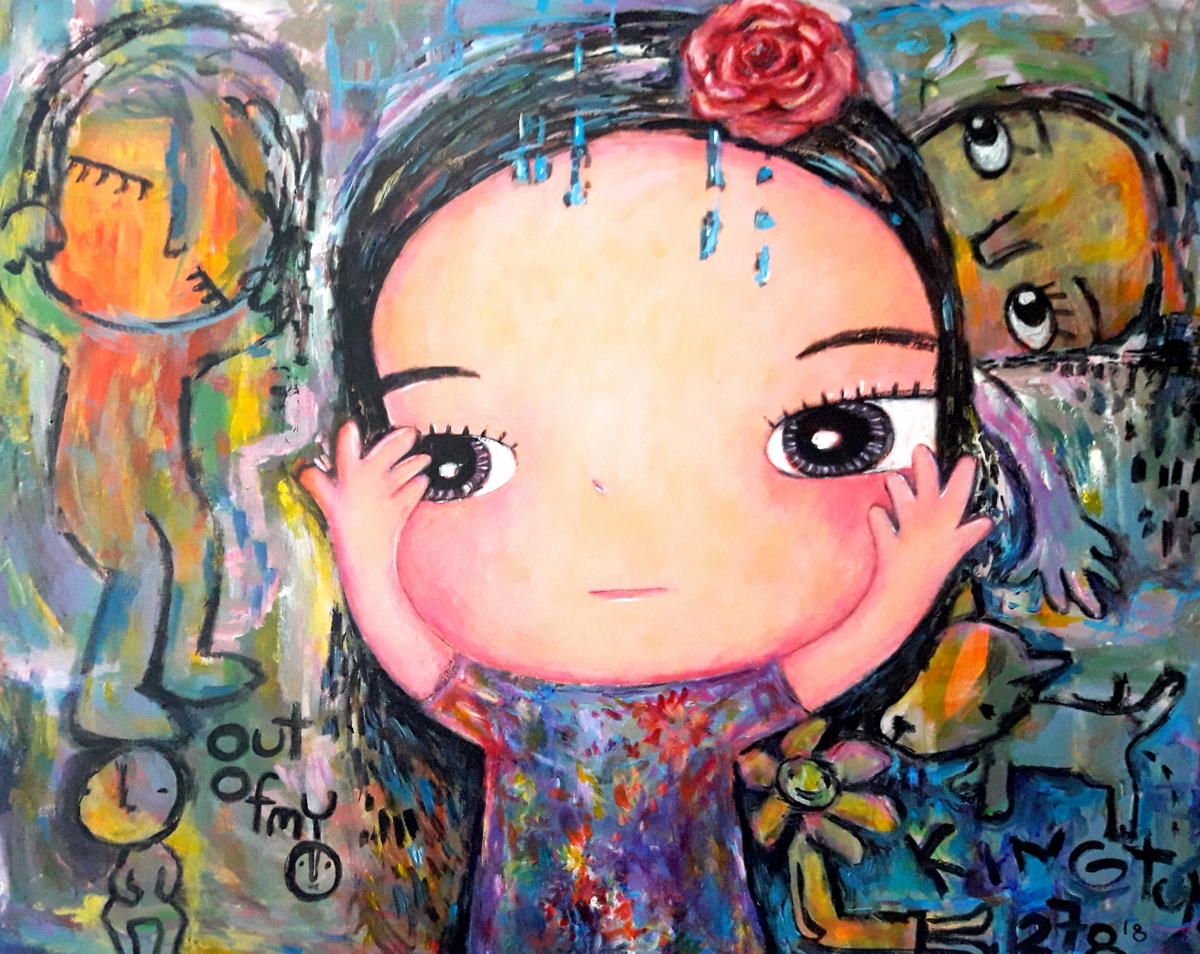
Kingtun’s Big-head girl to raise money for cancer ‘Again’

Jan 02. 2020
By The Nation

Artist Kingtun Pakinee Rattana, creator of the popular Big-head girl character, will devote part of the proceeds from sales at her upcoming exhibition “Again” to the Ireal Foundation’s Art for Cancer project.

The show takes place in Sky Lobby 23 of Centara Grand at Central World in Bangkok from January 10-April 10.

“Again” will feature Kingtun’s latest acrylic paintings that depict her personal experiences with humour, gentle sarcasm and a charming innocence, bringing viewers a warm and positive energy.

Heritage destroyed: why the ASA is trying to raise consciousness of preserving our history #ศาสตร์เกษตรดินปุ๋ย

#ศาสตร์เกษตรดินปุ๋ย : ขอบคุณแหล่งข้อมูล : หนังสือพิมพ์ The Nation

https://www.nationthailand.com/lifestyle/30379911?utm_source=category&utm_medium=internal_referral

Heritage destroyed: why the ASA is trying to raise consciousness of preserving our history

Dec 28. 2019
By Kitchana Lersakvanitchakul
Special to The Nation

In recent years, Bangkok has been busy demolishing its historic buildings with the sad result that some of them are gone for good, taking them with their historical and cultural heritage.

Take for example, the British Embassy in Ploenchit, which was knocked down after being sold Bt18.7 billion to a joint-venture consortium of Hongkong Land, a member of the Jardine Matheson Group, and Central Group.

The colonial-era embassy was built in 1922 in the reign of King Rama VI and considered one of the prime properties in the Wireless Road area.

Mahakan Fort, which was built in 1783 to protect the new capital from potential invasions and home to nearly 300 people who shared walls and pride in their history, has been turned into a public park.

Tourists may know it as Bangkok’s “living heritage museum” due to each home putting up signs, posters, and newspaper articles on their doors, telling their stories.

The planned 14-kilometre-long Chao Phraya Riverside Promenade will be a major risk to the area’s environment, the river’s ecology, history and culture, and to water transport.

The construction of a concrete walkway out into the river would destroy its history and status as a cultural symbol of the country.

The Association of Siamese Architects under royal patronage (ASA) is bringing up the demolition of the British Embassy, the eviction of Mahakan Fort Community, and the construction of the promenade extension above the river – the most discussed issues on Facebook – in its “10 Most Controversial Topics” section of the 34th edition of “Architect ‘20”, the largest building technology exposition in Asean, which will be held at Challenger Halls 1-3, Impact Arena, Exhibition and Convention Centre, Muang Thong Thani, from April 28 to May 3.

“We will catch up with the 10 hot heritage issues on social media these days,” says Dr Vasu Poshyanandana, the chairperson of the Architect ’20 committee, during the recent press conference at Nai Lert Park Heritage Home.

Dr Vasu Poshyanandana

Dr Vasu Poshyanandana

“We will help people to better understand heritage preservation and give them good and successful examples, so that they have a new perspective to find the wayout. When you are back home, you look for your heritage and think how you will keep up it and make it useful. We would like everyone to think that the heritage conservation is really useful for us. It isn’t just about maintaining old buildings.”

“Refocus Heritage” is the theme of this edition. It has been chosen to bring back the architectural heritage from the past, as well as the conservation and maintenance of heritage sites for the next generations.

Today, the conservation of architecture is the new mission of the association.

“This theme aims to raise public awareness and understanding on the concept of ‘heritage’ across several dimensions. Many might suppose that conservation and maintenance of heritage sites is limited to government officers or conservators, and therefore is not relevant to them. However, it is present in everyday life and concerns everyone regardless of the jobs and roles that we hold. The owner of an old house in need of a maintenance, for example, will need information on the right materials and construction to use, as well as the costs that will be incurred. Similarly, the renovation of an old building to create new business opportunity, can generate value added for the community and society, as we can see from the several creative communities that have risen from old quarters throughout the country,” says Dr Vasu.

“It depends on how we think of that word, heritage. I think that some people have the negative thinking of two Thai words, ‘boran’ (ancient) and ‘kao’ (old). If the ancient place is very valuable, we think that it is a far cry from our life and is the national treasure, which will be under the responsibility of the Fine Arts Department. We feel afraid of doing anything to that ancient place and end up by demolishing it. So, we would like everyone to forget those two words and look at heritage instead. The heritage is property that is passed down to an heir, and we will pass it on the next generation. But, how will make these heritages sustainable and useful? That is what we need to communicate,” he comments.

Architect ’20 will be spread over 75,000 square metres and divided into two sections.

The first section houses exhibitions from more than 850 international exhibitors, while the other will be home to thematic exhibitions by ASA covering 5,000 square metres. The latter is constructed with environment-friendly materials and adopts a contemporary design, representing the forms of the past.

Visitors will enjoy different exhibitions, such as “Workmanship and Heritage Exhibition” where rare traditional materials and technology in construction are displayed.

Curious architectural knowledge from the past centuries is also on show in this section. The film screenings section will show 63 heritage short films from 63 interviewees on the topic of heritage site conservation. The screenings will take place in a theatre made from bamboo – a local savoir-faire of the past.

“Heritage Crisis on Online Platform Exhibition” deals with the hot topics on social media including the dismantling of heritage sites, uninformed maintenance or renovation of temples. It aims to raise awareness of and invite the public to question the current heritage events, as well as provide relevant professional information.

“We will create a walking route to lead visitors more easily into several stories and information covering such topics as ‘What is the definition of ‘Refocus Heritage’?’, ‘What does Thai society think about the heritage?’and ‘How will we maintain and manage those heritages?,” says Dr Vasu.

The annual “Architecture Competition” for this event will be raised a level to the National Architecture Competition on the theme

“Everyday Heritage”. The organisers aim to include every sector of the public, especially school students with creative ideas, and for the competition to serve as a platform for further development.

Other showcases at the event include “2020 ASA Award Exhibition”, where the works of ASA-award recipients are displayed; “Art and Architectural Conservation Award Exhibition”, whose criteria this year has been developed to align with the Unesco Asia-Pacific Awards, and “Heritage in Danger Exhibition”, where local architecture students are given space to exhibit their ideas on the recovery and maintenance of existing heritage buildings in areas neighboring their schools.

Other activities include ASA Clinic (Mobaan ASA), where architects, engineers and other professionals are available for advice and information on design and construction; ASA Place, an activity area for the public, where talks and workshops are available in rotation throughout the 6 days of the event.

Demonstrations on the latest technology for conservation including 3-D object scan are also available.

Visitors, especially architects, can join ASA Forum for talks on the newest happenings in the international architecture scene. ASA Club returns as always for ASA members to gather and mingle. ASA shop and ASA Book Club are also back with the newest titles from all over the world and book launches.

The theme “Refocus Heritage” invites the public to look back on the heritage, as well as sharpen their vision and awareness on the topic. The theme also deals with the flexibility of the coexistence between society and the heritage sites, in order to preserve the values of the old buildings and the vivacity of their contemporary counterparts.

The Expo aims to widen the public’s focus on architecture and lend dimensions to the vision of visitors of various age and background, encouraging them to re-consider their ownership of the heritage, and their contribution in the conservation and legacy of these valuables heritage of the future.

“The alertness of the heritage conservation in Thailand is still following behind other countries in Asia. The more we have our heritage buildings, the more they are destroyed,” concludes Dr Vasu.

Beethoven X to kick off December 17 with “Reverse Flashmob”

#ศาสตร์เกษตรดินปุ๋ย : ขอบคุณแหล่งข้อมูล : หนังสือพิมพ์ The Nation

https://www.nationthailand.com/lifestyle/30379313?utm_source=category&utm_medium=internal_referral

Beethoven X to kick off December 17 with “Reverse Flashmob”

Dec 11. 2019
Siam Sinfonietta

Siam Sinfonietta
By THE NATION

752 Viewed

Beethoven’s 250th anniversary is being celebrated all over the world, and festivities are due to kick off next Tuesday, December 17. Beethoven’s birthday will be marked worldwide in events that will be widely streamed and televised through the organisers in Bonn, Germany, Beethoven’s birthplace.

Bangkok will have a unique “Beethoven X Project” by Bangkok Opera Foundation, which will feature young people interacting with the iconic composer’s legacy.

The centerpiece is the collaboration between four youth orchestras including Siam Sinfonietta, Thai Youth Orchestra, Immanuel Orchestra and Isaan Duriyang Orchestra League (IDOL) in performing all of Beethoven’s symphonies over the course of the year, starting this month and running through to December 2020.

To kick off the “Beethoven X Project” in Thailand, Bangkok Opera Foundation will perform “Big Bang Beethoven X,” a flashmob performance of Beethoven’s “Ode to Joy” on December 17 at 12:00pm, Bangkok Art and Culture Centre.

“Big Bang Beethoven X” was conceived by Somtow Sucharitkul, president of Bangkok Opera Foundation and artistic director of Opera Siam International, as a kind of “reverse flashmob”.

“Flashmobs,” according to Somtow, “begin at a single point in space, and more and more show up until the space is crammed with performers. Our idea is dictated by the structure of Beethoven’s Ninth Symphony — it begins with just cellos and basses in one spot of the BACC. Other musicians join them from different balconies and verandas. And finally, in a cosmic ending, a chorus joins from the highest balcony, symbolizing how the seed of Beethoven’s genius has grown over the years to fill the whole world.” Instead of the world coming to a point, he explains, it is about a point expanding to fill the world — a musical “big bang”.

The most venerable ensemble in this collaboration is the Thai Youth Orchestra, Thailand’s “establishment” youth orchestra, under the aegis of the Culture Ministry’s Department of Cultural Promotion and directed by the Akkrawat Srinarong, scion of one Thailand’s leading classical music families. Recently the TYO joined Siam Sinfonietta as one of the two Thai orchestras to win first place at the prestigious Summa Cum Laude competition in the Musikverein, Vienna.

Siam Sinfonietta is the groundbreaking youth orchestra founded by Somtow and featuring the “Somtow Method”, a revolutionary new style of music teaching. The orchestra has won multiple first place awards around the world including three times in Carnegie Hall, and has toured extensively in Europe, America and the Middle East. The orchestra is noted for tackling some of the most ambitious music in the repertoire, such as the Mahler symphonies, Stravinsky and Bartok.

Immanuel, an exciting young orchestra from Bangkok’s Music for Life Foundation, and IDOL, the most recent of the orchestras established in Korat last year, are the other two orchestras in this Beethoven X project.

The Siam Sinfonietta and its founder Somtow have teamed up with Akkrawat and with Trisdee na Patalung, Thailand’s internationally popular conductor as well as Welsh conductor Jonathan Mann of the Immanuel Orchestra and Voraprach Wongsathapornpat, a young conductor who recently returned to Thailand from Cambridge.

A nose for tea

#ศาสตร์เกษตรดินปุ๋ย : ขอบคุณแหล่งข้อมูล : หนังสือพิมพ์ The Nation

https://www.nationthailand.com/lifestyle/30379309?utm_source=category&utm_medium=internal_referral

A nose for tea

Dec 11. 2019
The Lahu people pick tea leaves

The Lahu people pick tea leaves
By KitchanaLersakvanitchakul
Special to The Nation

1,678 Viewed

Local producer Raming ramps up knowledge about everyone’s favourite brew with a series of appreciation programmes

Savouring a cup of tea is a lot like savouring a glass of wine – you breathe it in, sip with as much air as you can, roll it around your mouth to let the flavours express themselves, swallow, and wait for the lingering notes left on your tongue.

Tea is said to be the world’s most popular beverage after water and is consumed in different ways. The tea tree, Camellia Sinenses, is native to different regions of China, Thailand, Myanmar, Vietnam and India due to their perfect climate and soil. But while many people, especially in Asia, enjoy a cuppa, how many of them actually know the right way to drink tea?

“It is the science and art of tea making,” says Wongduan “Nan” Wangviwat, the executive director of Cha Raming and the wife of Jakarin Wangviwat, the third generation of the Raming Tea family, the first black tea producer in Thailand, at their Ramino coffee shop in Chiang Mai. “We would like Thai people to know more about tea.”

“We would like Thais to know more about tea,” says  Wongduan Wangviwat, the executive director of Cha Raming.

Determined to do just that, Wongduan took to the internet to look for tea institutes and discovered the Asian School of Tea in Darjeeling, India.

“We wanted a place that specialised in black tea of the same type as our Raming tea, and that meant India and Sri Lanka which produce Assam tea. Darjeeling in India is the source of some of the best tea in the world and so I contacted Souvik Nandy, the founder of the Asian School of Tea, and signed up for a course,” says Wongduan.

“His idea in setting up his school was similar to what I had in mind – connecting with the culture and community. I didn’t want to know about the production but about how tea is used and how it relates to the way of life. We want to be a part of the community and also want people to know more about our tea, so we can improve cultural values and attract tourists. These days, people tend to travel not just for pleasure but also to gain knowledge and tea is a good example of their interest.”

The Asian School of Tea is one of the best tea schools in the world and known for successfully integrating cultural aspects of growing. Its founder says it takes pride in “reaching the learners” and does this through three programmes. The first is “Tea Sommelier”, a course on the fundamentals of tea. The second is “Tea Tourism” designed for tea lovers to appreciate the origins of their preferred cup that includes visits to the tea plantations, and the last is “Personalised Programme” designed to cater to the specific requirements of a group.

 Wongduan Wangviwat, left, demonstrates the right way to make tea after attending the Tea Sommelier programme at the Asian School of Tea, founded by Souvik Nandy, right, in India.


“I find something very harmonising about tea. It is a good reason to communicate – during sessions we talk about tea all the time. We don’t have fixed classroom sessions as such but tea in all its dimensions is at the very centre of each of our programmes. We can only teach the technique and pass on the knowledge. After finishing in the course, participants havea responsibility to carry on the practice,” says Souvik Nandy, 28, who is also the lecturer at the Asian School of Tea.

“The Tea Sommelier runs for seven days. Here, participants learn about tea cultivation, tea processing and tea testing. They learn about organic cultivation, about badami cultivation, and then we go beyond conventional tea to herbal tea. We have now added tea and food pairing. We drink tea all day but different teas. The Chinese drink green tea or jasmine tea, but we have Masala chai (a flavoured tea beverage made by brewing black tea with a mixture of aromatic Indian spices and herbs). You find it in all the streets in India, everywhere,” he adds.

Early this year, Wongduan took part in the 10-day Tea Sommelier programme, visiting several tea sources, learning the way of collecting tea leaves from the community, and discovering the varieties of teas grown at different altitudes.

 “Tea is a good reason to communicate,” says Souvik Nandy, the founder of the Asian School of Tea in India.

“A tea sommelier is similar to a wine sommelier. He or she who must first know the basics of tea before going on to how and when tea is served and which type of tea is paired with what kind of food. Tea is interesting, and we will help consumers learn more about tea and the right way of brewing and drinking it. Tea is really good for the health, as it can control blood sugar, cholesterol, blood pressure, diabetes and atherosclerosis. So, it is our responsibility as producers to communicate those benefits to consumers,” she adds.

Wongduan has now created three courses of her own, namely “Tea Sommelier”, “Art School of Tea” and “Personalise.” “Tea Sommelier” is a 5-day course for 5-10 entrepreneurs who run tea and coffee shops, bakeries and the food and beverage departments of hotels. It is priced at Bt25,000 with a certificate and will be taught by Souvik himself. “Art School of Tea” is a 3-day, 2-night course for the public and tourists and includes a visit to a tea plantation, learning how to pick the delicate leaves and the process of turning these into the tea we buy in stores as well as spending time with the Lahu hilltribe. It also features a painting working with Siam Celadon and mixing types of tea with other ingredients to make participants’ very own blends. It’s priced at Bt10,000 including food and accommodation. The “Personalise” course is designed for 5-10 persons.

“In the near future, we will introduce an intensive course for entrepreneurs thinking about opening their own cafes which will cover pairing bakery items with tea and blending a signature tea,” she says. “Our aim is to spread the word about tea far and wide.”


Tea testing is a sensory experience


Staff pack tea in a box

For more information or to register for a course, call (086) 430 3165 or contact Line: @ramingtea, Facebook: Ramingtea, or visit www.ramingtea.com or www.asianschooloftea.org.

Da Vinci’s scientific writings to unfold in Bangkok

ศาสตร์เกษตรดินปุ๋ย : ขอบคุณแหล่งข้อมูล : หนังสือพิมพ์ The Nation

https://www.nationthailand.com/lifestyle/30378719?utm_source=category&utm_medium=internal_referral

Da Vinci’s scientific writings to unfold in Bangkok

Nov 25. 2019
By The Nation

111 Viewed

Sheraton Grande Sukhumvit has been chosen as the host for “A Taste of Leonardo” exhibition, which will offer a unique opportunity to see rare museum copies of works by Leonardo da Vinci.

The art will be on show in The Library from December 2 to 14, with the official opening night on December 3 featuring a museum copy of Da Vinci’s Codex Leicester. The original piece was purchased by Bill Gates in 1994 for $30 million and is regarded as a testimony to da Vinci’s extraordinary working process. The Codex Leicester focuses on da Vinci’s thoughts relating to water, tides, eddies and dams, and the relationship between the moon, the earth, and the sun. It is one of his 30 scientific journals and considered the most important.

All material in the exhibition are rare museum copies, limited editions, authorised and certified by the Commissione Vinciana International Board of Studies of Leonardo da Vinci under the patronage of the President of the Italian Republic.

Guests at the opening night will enjoy canapés prepared by Executive Chef Gaetano Palumbo.

For more information, call (02) 649 8368 or email bkklcdining@marriott.com

How app culture turned astrology into a modern obsession

ศาสตร์เกษตรดินปุ๋ย : ขอบคุณแหล่งข้อมูล : หนังสือพิมพ์ The Nation

https://www.nationthailand.com/lifestyle/30378580?utm_source=category&utm_medium=internal_referral

How app culture turned astrology into a modern obsession

Nov 21. 2019
By The Washington Post · Maura Judkis · FEATURES

319 Viewed

The first thing the astrology apps did was shred me to pieces. Co-Star told me that I express love through work and routine, and that I am preoccupied with death. The Pattern told me that I have trouble with codependency, that others might see me as insensitive, and that I have dated emotionally unstable partners. Sanctuary told me I can be selfish, competitive, and preoccupied with fears and doubts.

The apps are, regrettably, correct. Not only am I all of those things, I’m a Cancer sun, Sagittarius rising, and an Aries moon. I found this out when I fulfilled a typical millennial trope: Texting my mom to ask her what time I was born.

“It was early,” my mom replied. (Wrong. It was evening, we later determined.)

It was Co-Star that told me to text my mom, because the app needed the information to produce my natal chart, which utilizes the positions of many more planets and stars at the exact time of one’s birth. It produces horoscopes that some say are far more sophisticated than the generic “good luck in finance and love” you see in this and other newspapers.

“Astrology is this incredible way of looking at a story about you,” said Ross Clark, CEO of Sanctuary. “So your chart is a representation of different elements of yourself, or parts of your life’s journey.”

Amid the millennial self-care set, astrology is back. After the heady “What’s your sign?” spirituality of their parents’ youth, the practice receded to the edges of culture as a kooky space-filler in the newspaper, albeit one that was read devotedly.

But now, the pseudoscience isn’t as much of a taboo as it used to be. It’s been embraced by young people, who jokingly ascribe the inconveniences of life – a delayed train, a broken laptop – to Mercury’s retrograde. They know that Pisces are sensitive and Leos are self-involved and Geminis are kind of the worst. They follow astrology podcasts such as “Stars Like Us,” buy zodiac-themed candles and fragrances and crystals, and share astrology memes from Instagram accounts such as Drunk Astrology and Not All Geminis.

I mean, come on. No one actually thinks that the stars and planets determine their personality. Except, the tumult of one’s late twenties is because of Saturn’s return, and right now, you’re probably feeling that Scorpio season energy, and what if water and earth signs really do just get along better?

“I call it getting into the woo,” said Shanna Quinn, 37, a Chicagoan who checks four astrology apps daily. Woo, for that “woo-woo” stuff.

For the past few weeks, I’ve been getting into the woo, too. A skeptic, I wanted to learn why seemingly everyone my age was looking to the stars. I downloaded all the apps. I got a few readings, and I am now the reluctant owner of four crystals. And I realized why it seems like everyone’s so into astrology again, even if no one claims to believe in it, and it isn’t real: It’s kind of like psychotherapy plus magic.

– – –

Astrology is an ancient art, but the modern horoscope came about in 1930, as a gimmick for the British newspaper the Sunday Express, which wanted something splashy in its pages after the birth of Princess Margaret. Astrologer R.H. Naylor wrote an article predicting that the princess would have “an eventful life” – bold prediction there – and that “events of tremendous importance to the royal family and the nation” would happen in her seventh year. That last one basically came true – in 1936, her uncle, King Edward VIII, abdicated the throne, and her father, George VI, became king. And Naylor became a star astrologer with a weekly column.

One enters the craft by taking courses, or training under experienced astrologers. The practice has undergone technological upgrades: There used to be a lot of math involved, but modern astrologers can pull up a natal chart in seconds by plugging your birth details into a software program.

“Astrology is a combination of myth and math,” said astrologer Shelley Ackerman, publicity director for the International Society for Astrological Research.

There’s a good chance some of the descriptions of me above may have resonated for you. Plenty of people are riddled with doubt, or have dated people who weren’t right for us.

That’s how horoscopes work, said James Alcock, a professor who researches parapsychology at York University in Canada. It’s a phenomenon called the Barnum Effect, named after circus founder P.T. Barnum. Basically: If an astrologer or palm reader makes a statement that could apply to many people in the course of a reading – something like, “You’re generally a very open person, but sometimes find it hard to share things even with your closest friends” – someone is more likely to ascribe it to the teller’s abilities.

Astrology is “part of my routine,” said Katie Murtha, 29, from Cleveland, who reads the Elle magazine horoscopes online. “When it’s right, it feels really interesting and kind of weird and magical. And if it’s totally wrong, it’s just something to laugh about.”

So when Dave Campbell, the president of the American Federation of Astrologers, told me that my chart showed that I had a brother who was born when I was 3, and that age 19 was a bad year for me, he was correct. When he told me that the position of the asteroid Sappho in my chart could indicate that I’m a lesbian, or bisexual, he was not.

“But one of my best friends is bi, and many of my male friends are gay,” I volunteered, because that’s the trick astrology plays on your mind: You’re compelled to think of ways the predictions might be true.

(P.S., to all of my bosses that are editing this story: Campbell also said the stars are aligned for me to get a raise next year.)

– – –

Eighty years later, Naylor’s professional descendants are branching out into new mediums – ones that have a potential to earn a lot of money in the $2 billion “mystical services market.” Bull and Moon is a recently launched app that purports to help users pick stocks according to their astrological signs. Collective Gain is a company that brings astrologers, intuitives and energy healers to the workplace, using staffers’ astrological charts to help them work better together.

“It is costing organizations money when people are showing up not engaged and not knowing who they are,” said Lizzie Alberga, the company’s founder and CEO. Some might balk at the notion of astrological readings in the workplace, but Alyssa Rogers, a 31-year-old Collective Gain astrologer, said they’re a means of understanding “the complexity of a group and getting a team to understand that, you know, not everyone is the same. And the complexity is actually what makes that dynamic really strong,” she said.

Another astrology business takes its cues from the gig economy.

“It’s sort of like a cosmic ride-share app, if that makes sense,” said Clark, of Sanctuary, which raised $1.5 million in venture capital. With the premium version, $19.99 a month, users can summon an astrologer for a 15-minute text message reading each month, on demand. I logged on, and was soon joined by an astrologer who, by request, focused the reading on relationships with my friends, which he said would be important next spring.

“I’m sure most of your friends are women and/or quite pretty,” wrote Arthur, and I wondered: Is my astrologer sucking up to me? It was not a generic prediction, he later told me.

“The 11th house is friends and groups, and yours is ruled by Venus, the planet of love and beauty and feminine things,” he said. “Yours is very close to an angle, it gives it a lot of extra strength.”

The astrologer, it turned out, was Arthur Lipp-Bonewits, a 29-year-old who had achieved internet fame after procuring the birth time of Rep. Alexandria Ocasio-Cortez, to read her natal chart. (Dissecting celebrity natal charts is a popular hobby among astrologers, who are intimately familiar with President Donald Trump’s: That he released his long-form birth certificate is “one of the few good things to come out of the birther controversy,” Lipp-Bonewits said.)

Lipp-Bonewits specializes in predictions. Here’s one of his: The winner of the 2020 election, “whether it’s Trump, whether it’s one of the Democrats, is almost certainly going to be assassinated or die in office,” he told me.

– – –

Because the apps are social and often free, they’re like the gateway drug to the woo. Get sucked in, and you may find yourself researching Akashic Records or Human Design, or getting your aura photographed – like a cosmic Instagram filter. At Campbell’s suggestion, I built a small altar at my work desk to help “manifest the positive” into my life.

I covered a piece of gold tissue paper with talismans of good fortune, including a seashell to represent a vacation I hoped I could take, a check from a journalism award I’d recently won, and the New York Times bestseller list, for the book I hoped I would write one day (“Aim high,” my editor said). I went online and bought my first crystal – moonstone, associated with my zodiac sign – which came with instructions to “activate” it by leaving it out in sunlight or a full moon, and then speaking my intentions to it.

“I activate this stone,” I whispered, so my colleagues wouldn’t make fun of me. I was instructed to “feed” my altar every day with some pennies to “create positive energy.” But by day four I had forgotten them, so I fed it some paper clips.

That’s what happens if you analyze the woo too much: You realize you seem totally nuts. Alcock, no fan of astrology, compares it to another nonscientific, ancient method for supposedly gaining insight: “If I said, ‘Look, I just killed a fox and I’ve read its entrails, and you’re going have a really great day,’ most people would say, ‘Oh my God, don’t do that. That’s just disgusting,’ ” he said.

But as long as people aren’t letting their lives revolve around astrology, they’re not doing much harm. They may even be doing some good.

“It gets people to talk about their personality and their emotions and life experiences in a way that they usually wouldn’t,” said Tayla Jones, 23, who runs the meme account Drunk Astrology with her friend Sam Gorman, 24. Astrology makes expressing your feelings “kind of a game.” It isn’t about telling people who they will become, but rather, who they may not realize they already are.

The messages I kept getting from the apps encouraged me to be introspective and gentle with myself. They required no leap of faith.

“Tap into your inner voice. What is your gut telling you?” Sanctuary said.

“It takes real courage to let another human see you,” Co-Star said.

“Your struggles may be the source of your greatest strength,” the Pattern said.

Those didn’t seem like horoscopes to me. They seemed like therapy. In fact, some of the things the apps had pinned on me were things I was already working on with a professional.

Astrology has seamlessly integrated with the wellness industry. Most people who are using these apps aren’t trying to predict the future – they see it as a tool for self-discovery and emotional exploration. And its marketing has kept pace, pivoting from witchy spirituality to the blandly luxe aesthetic of Goop. It’s talked about in the same breath as vitamins, yoga or a spa treatment. And for a generation that has struggled financially and emotionally but lacks access to affordable mental health care, some may even be using it as a cheap substitute.

Even though some of the self-empowering platitudes in the astrology apps could have just as easily been found on the inside of a Dove chocolate wrapper, people could put more stock into them because of their medium.

“There’s a tendency that if there’s an app for it, it somehow gives it more credibility,” Alcock said.

But the app horoscopes are just like the wrappers: momentarily poignant, but disposable. When you look at your natal chart, you’re the center of the universe. But everyone else is the center of theirs.

There was one other thing several of the apps and astrologers could agree on, in my chart. Maybe this article has been in the works for 34 years, or perhaps since the beginning of time and the creation of the universe. Because 13.8 billion years later, the alignment of the stars and planets and constellations at the precise time of my birth in 1985 drew a distinct pattern.

My Mercury is in the eighth house, which rules Scorpio and is forming an aspect to Uranus, Rogers said. I have the natal chart of a person interested in the “occult, the things that are different, unconventional, maybe even taboo.”

So, it was in the midst of working on a story about astrology that I found out my astrological chart indicates that I am interested in … astrology.

Graffiti wall become the longest landmark in the northeast

ศาสตร์เกษตรดินปุ๋ย : ขอบคุณแหล่งข้อมูล : หนังสือพิมพ์ The Nation

https://www.nationthailand.com/lifestyle/30378236?utm_source=category&utm_medium=internal_referral

Graffiti wall become the longest landmark in the northeast

Nov 11. 2019
By The Nation

1,962 Viewed

Nakhon Ratchasima’s Culture Office has invited more than 30 graffiti artists to create works on the theme ”Korat: the art city” after the government named Chiang Rai, Krabi, and Nakhon Ratchasima or Korat as it is colloquially known, as pilot cities for arts. The city has also been selected to host the 2nd Thailand Biennale, a biannual international contemporary art exhibition.

Local residents are working alongside government officials and the private sector to plan future art events and city development that will see it truly become an art city.

The graffiti artist answered the call and joined forces to create the “K Battle Thailand Present” work last Friday (November 8), which stretches for 49 metres and is the longest graffiti work in the northeast region of Thailand.