Culture filled weekend celebrates His Majesty’s birthday

ศาสตร์เกษตรดินปุ๋ย : ขอบคุณแหล่งข้อมูล : หนังสือพิมพ์ The Nation

https://www.nationthailand.com/lifestyle/30373462

Culture filled weekend celebrates His Majesty’s birthday

Jul 23. 2019
Cultural performance by China

Cultural performance by China
By The Nation

109 Viewed

Commemorating the 67th birthday of His Majesty King Maha Vajiralongkorn Bodindradebayavarangkun, which falls on July 28, Siam Piwat group and Siam Paragon will collaborate with foreign embassies in Thailand to host an event, “Long Live Our Beloved King”, on July 25.

The celebration will feature international cultural performances along with an exhibition of the King’s portraits by acclaimed artists. The event runs from July 25-28, 2019 at Parc Paragon, at Siam Paragon Shopping Centre.

International royal embassies including those of Cambodia, Kazakhstan, China, Japan, Myanmar, Mongolia, Russia, Laos, Spain, Switzerland and Indonesia will present their special cultural performances.

Cambodia

Cambodia

Thailand itself will showcase folk dance performances from four regions of the country, representing its rich cultural heritage. These are a Klong Sabatchai drum performance from the North, and two from the Northeast – a Klong Sabatchai spirit worship show and a Taree Bu-ngha peacock dance – along with a Norah dance from the South and a Gold and Silver Branch dance from Central region.

Mongolia

Mongolia

The free public event offers locals and visitors from around the world the opportunity to celebrate this auspicious occasion by enjoying cultural experiences.

Russia

Russia

Meanwhile, an exhibition of HM King Rama X’s portraits reflecting his royal duties has been categorised in 10 segments – military, sports, religion, agriculture, education, foreign affairs, social, administration, medical and healthcare, and art. Led by renowned artist Roengsak Boonyawanichkul, groups of volunteer artists from Silpakorn University Painting Department, both current and alumni, together created HM the King’s portraits in celebration and gratitude for the beloved king.

Switzerland

Switzerland

Enjoy performances from July 25-28 at 4-8.30pm. Admission is free. The opening ceremony will take place on Thursday at 5.30pm at Parc Paragon. Then on July 26, the public are invited to join a ceremony of Buddhist alms-giving to monks and novices at Parc Paragon as well as to join the candle blessing ceremony on HM The King’s birthday on July 28 at 7.19pm also at Parc Paragon.

Spain

Spain

Rivers and royal barges — a rich cultural heritage

ศาสตร์เกษตรดินปุ๋ย : ขอบคุณแหล่งข้อมูล : หนังสือพิมพ์ The Nation

https://www.nationthailand.com/lifestyle/30373337

Rivers and royal barges — a rich cultural heritage

Jul 22. 2019
Photo by: Fine Art Department of Culture Ministry

Photo by: Fine Art Department of Culture Ministry
By Compiled by Ornvipa Rumroy
The Nation

681 Viewed

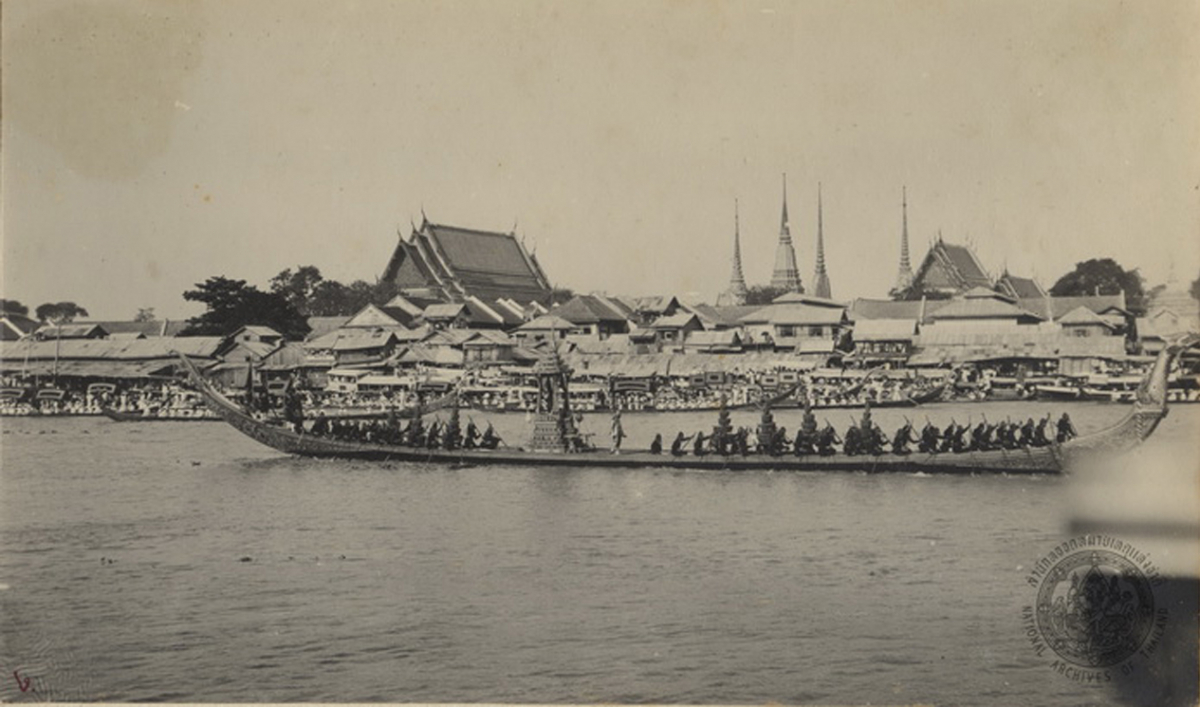
From the times of the Kingdom of Siam to modern-day Thailand, rivers have been at the heart of transportation for the people of this Kingdom.

Besides serving as a mode of transport, there are also many religious ceremonies associated with rivers. They have played a significant role in Thai culture, economy and politics. They have even had royal relevance, with many Thai kings travelling in processions on the river, surrounded by military and police barges.

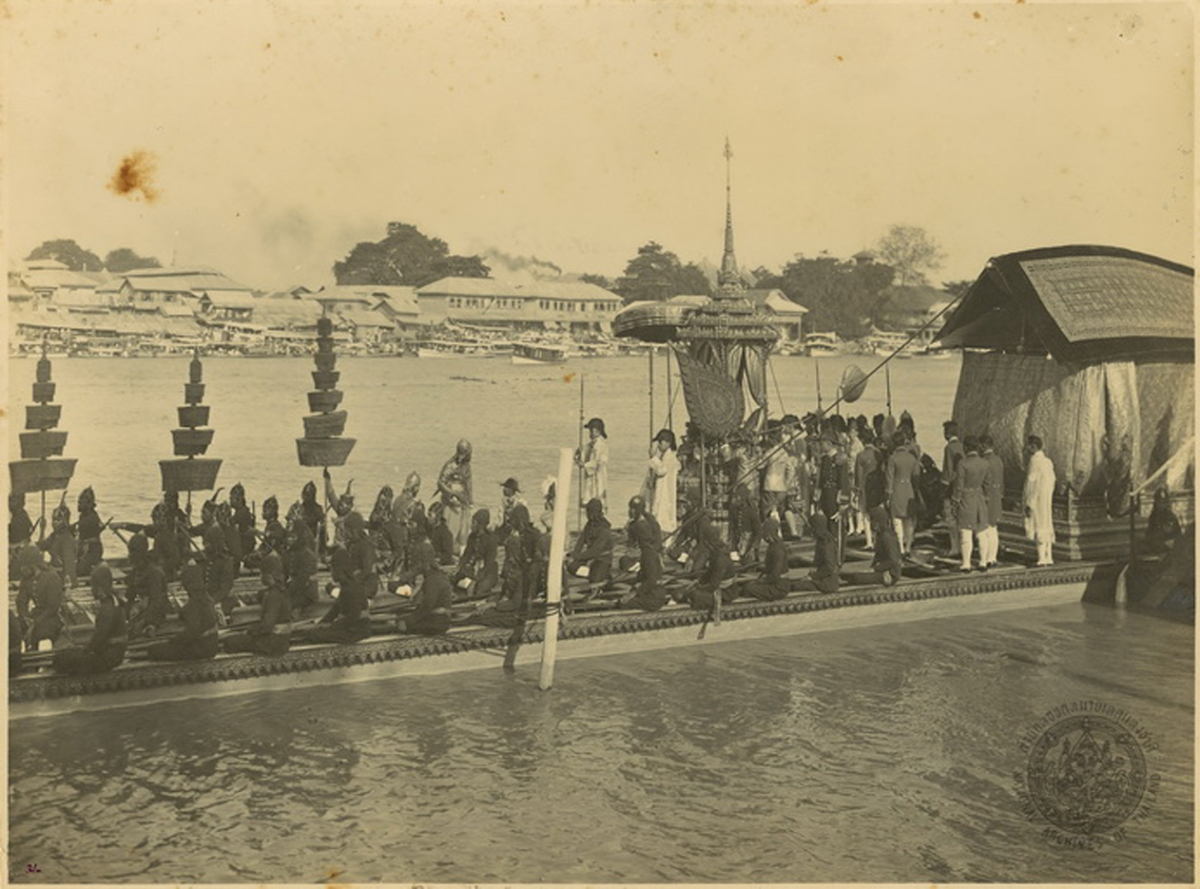
At the beginning of the lent season in August, Buddhists have a tradition of making merit, called the Kathin ceremony. It is a religious occasion when the devout donate new robes to monks. In the past, communities mostly settled down by the river. The royal barges procession was held for the Royal Kathin Ceremony as well, as a reflection of not only the religious significance but also a depiction of His Majesty the King’s glory.

The first Royal Kathin Ceremony during the reign of King Rama X of the Chakri dynasty will take place on October 24. The event will showcase the rich cultural heritage of the Kingdom of Siam. His Majesty King Maha Vajiralongkorn Bodindradebayavarangkun will travel down the Chao Phraya River in a royal barge procession to present robes to monks as part of the Royal Kathin Ceremony, which will mark a grand finale of his coronation that took place in May.

The history of these processions go back to the Ayutthaya period (1351-1776) when a large fleet of barges assembled on the rivers and rowed around the capital of Ayutthaya. Royal barge processions were held for various occasions, such as royal ceremonies, religious events, ceremonies to welcome foreign ambassadors, royal coronations and the Royal Kathin Ceremony.

Royal barge processions were organised for the Royal Kathin Ceremony when the kings travelled to a royal temple for Tod Kathin (making robes and other offerings to the monks). During this period, processions were composed of 33 types of barges; the king sat on a throne placed in the centre of the royal barge surrounded by items of royal regalia such as the state umbrella, fan, flag and four swords. To guard the king and his regalia, two general officers sat in front of the throne, watching for any kind of threat and always prepared to defend the monarch.

A Jesuit priest, who arrived when King Louis XIV of France sent a new ambassador to Siam, has described in detail the procession of more than 150 barges sailing down the Chao Phraya River to welcome them.

The event was held occasionally until absolute monarchy ended in 1932. During World War II, most of the royal barges kept near Thonburi train station were bombed and destroyed. The river processions stopped until the celebration of the 25th century of the Buddhist Era in 1957. In 1959, the Great King Rama IX revived the royal barge procession along with the Royal Kathin Ceremony in order to preserve Thai cultural heritage.

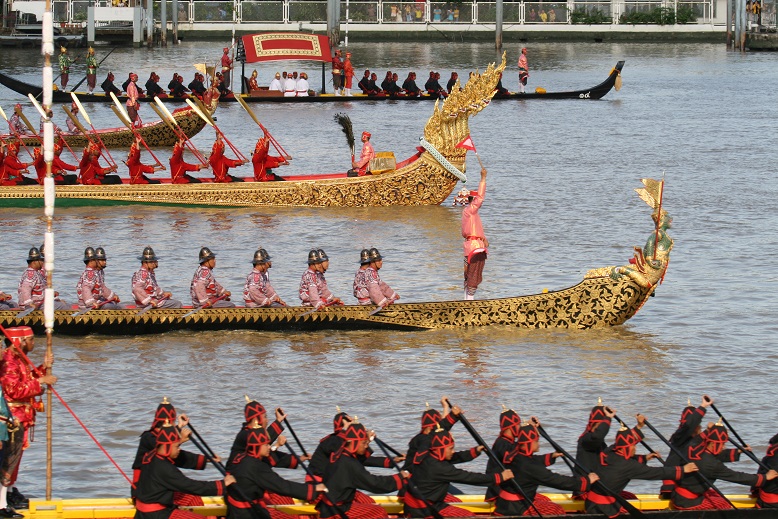
There are two formations in the royal barge procession. The major formation, known as the major battle formation (Petch Phuang major battle formation) is reprised from the King Narai period. This formation is used for important ceremonies such as the Royal Kathin Ceremony or important state circumstances. The major formation has five columns of barges with the royal one in the centre flanked by two rows of battle barges. The minor formation consists of three columns — the royal barge in the middle, and a single row on each side.

The royal barge Suphannahong (“the Golden Swan” or the “Phoenix”) was built in 1911 during the King Rama VI period. The barge resembles a mythical swan, or Hong. This 46-metre-long barge crafted from a single trunk is painted with golden lacquer and decorated glass, with a crystal ball dangling from the swan’s mouth. There is a golden pavilion on the barge to accommodate the king and the royal family. In 1992, the World Ship Trust honoured the royal Suphannahong barge as a world heritage.

The original royal barge, Anantanakkharat (“Ananta, the King of Serpents”), was built during the reign of King Rama III and was used as the primary Royal Barge of King Rama IV, while the current one was built during the Rama VI era. A distinguishing feature of this barge is the carved seven-headed Nakkharat, the mythical snake-like creature, on the bow in gold paint and glass with a green hull. Unlike the other royal barges that are equipped with pavilions, Anantanakkharat has a pagoda-like structure to carry holy objects.

The Royal Barge, Anekkachatphuchong (“A Variety of Serpents”), is the oldest of the four barges, built in the late 19th century during the reign of King Rama V. The hull is painted pink without any mythical figures on the bow but it is decorated with numerous ornamental small Naga figures.

The royal barge Narai Song Suban Ratchakan Thi Kao or The Royal Barge Narai Song Suban HM King Rama IX (“God Narayana on his vehicle, Garuda”) is the only barge built during the reign of the late King Bhumibol Adulyadej, commissioned by the Royal Thai Navy and the Thai Department of Fine Arts in order to celebrate the fifth anniversary of King Rama IX’s accession to the throne. This barge has a striking red hull with the image of god Vishnu, commonly known in Thailand as Narayana, on a Garuda figure carved on the bow.

Travelling with the printed page

ศาสตร์เกษตรดินปุ๋ย : ขอบคุณแหล่งข้อมูล : หนังสือพิมพ์ The Nation

https://www.nationthailand.com/lifestyle/30373262

Travelling with the printed page

Jul 19. 2019
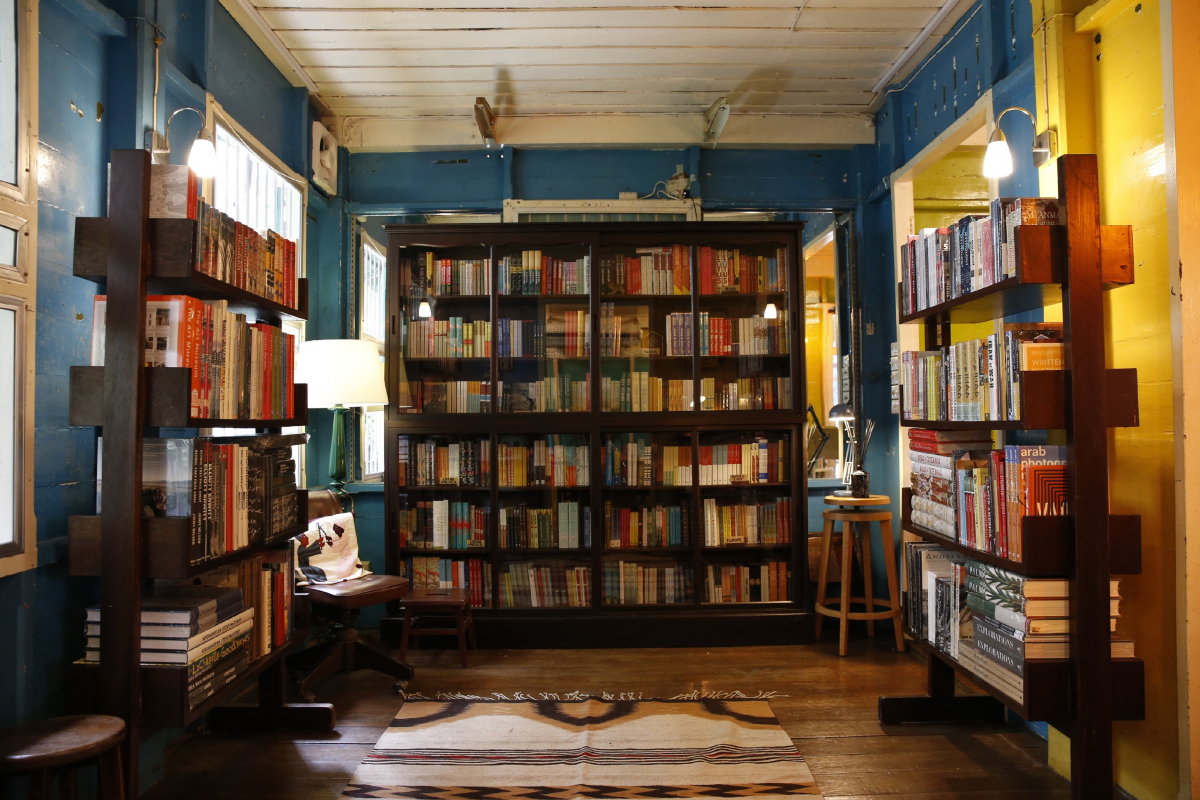
New bookshop World at the Corner in Bangkok’s old town located in a classic wooden house in Soi Mahannop and its shelves groan under a fascinating selection of books from around the world. 

New bookshop World at the Corner in Bangkok’s old town located in a classic wooden house in Soi Mahannop and its shelves groan under a fascinating selection of books from around the world.
45 Viewed

New bookshop World at the Corner in Bangkok’s old town is the brainchild of the Prakobsantisuk siblings: Nat, a well-known fashion photographer and his sister Sivika, a talented writer with a unique style that successfully conveys the passion and soul of each travel destination she has visited.

The bookshop is located in a classic wooden house in Soi Mahannop and its shelves groan under a fascinating selection of books from around the world.

Nat seeks new inspirations from meeting new people and says his passion from reading from a young age made him want to set up the bookshop offering inexpensive titles.

“Back when I was studying for my bachelor’s degree (at Chulalongkorn University), I was assigned to read books that were only available at DK Bookstore at Siam Square. They were very expensive and I could not afford them, so I had to borrow from either my friends or my teachers and photocopy them. It was my dream to own beautiful foreign books. Seeing them and owning them brought me great joy, so I’d always wanted to have my own bookshop. I felt it would make me very happy to be surrounded by my passion, and that’s one of my goals in life,” says Nat.

Nat and Sivika Prakobsantisuk

Nat and Sivika Prakobsantisuk

He wants to make World at the Corner a bookshop that introduces people to deeper stories about various countries beyond what guide books offer. The Prakobsantisuk siblings source books from around the world, from novels written by local writer to books about various aspects of a country, such as cooking, art and culture. These stories will inspire readers to learn more about that country or travel to that country.

And he isn’t worried about the move to digital books, pointing out that printed books are forever, and every book in this shop is new, purchased from his favorite countries.

“These books are popular among a specific group of readers because they tell interesting stories, such as historical aspects that are not available online. The touch of paper and the layouts make reading books more engaging than reading stuff online. This is the beauty of reading books.”

“When I travel, I always bring back books, and I find that there are usually interesting books in smaller bookshops, something not available in big bookstores. I like going to these little bookshops and I find interesting books from China and India, for example. In the future, we will add more books to our shop. The highlight of World at the Corner is a selection of rare books and local books offering stories about each country. This is what makes us different from other bookstores — it is a place for exchanging experiences.

Actor Sunny Suwanmethanont

Actor Sunny Suwanmethanont

“You can go to a big bookstore with thousands of books, but sometimes it can be overwhelming and it’s hard to know where to begin. If you come here, you only have to pick a destination and there are many books for you to choose from. We’ve selected the best books for our readers,” Nat adds.

World at the Corner is on Soi Mahannop 1 in Phra Nakhon and open Fridays to Sundays from 10am to 7pm. Find out more at www.facebook.com/worldatthecorner.

In celebration of lacquer artistry

ศาสตร์เกษตรดินปุ๋ย : ขอบคุณแหล่งข้อมูล : หนังสือพิมพ์ The Nation

https://www.nationthailand.com/lifestyle/30373165

In celebration of lacquer artistry

Jul 18. 2019
The “Lacquer Paintings Exhibition 2020” due to open at HCM City Fine Arts Museum on September 13 will showcase both traditional and contemporary works. --Photo/ HCM City Fine Arts Museum

The “Lacquer Paintings Exhibition 2020” due to open at HCM City Fine Arts Museum on September 13 will showcase both traditional and contemporary works. –Photo/ HCM City Fine Arts Museum
By Viet Nam News
Asia News Network
HCM CITY

281 Viewed

Professional and amateur artists are being encouraged to submit their work to the HCM City Fine Arts Association for display in South Vietnam’s largest Lacquer Paintings Exhibition 2020 that gets underway in September.

The exhibit will include a variety of traditional and contemporary works by artists from the city and provinces from the Cuu Long (Mekong) River Delta.

Participants can submit two creative works each for consideration by the association’s jury.

Works featuring HCM City’s development and that reflect the artists’ passion are encouraged.

The organiser hopes the showcase will display a variety of tastes about contemporary southern Vietnam.

“We want to help young artists develop their careers and help them learn more about art as well,” said a representative of the event’s organising board.

Lacquer is a unique kind of Vietnamese painting and is generally more difficult than other styles of painting.

Lacquer artists often spend one to three years painting one work.

Submissions to the Lacquer Paintings Exhibition 2020 should be sent to the HCM City Fine Arts Association at 97A Phoduc Chinh Street in District 1 before September 2.

The exhibition is expected to open at HCM City Fine Arts Museum on September 13.

Kremlin Ballet set to charm audiences with three tales in October

ศาสตร์เกษตรดินปุ๋ย : ขอบคุณแหล่งข้อมูล : หนังสือพิมพ์ The Nation

https://www.nationthailand.com/lifestyle/30373148

Kremlin Ballet set to charm audiences with three tales in October

Jul 18. 2019
“The Hunchback of Notre Dame (Esmeralda)”

“The Hunchback of Notre Dame (Esmeralda)”
By The Nation

431 Viewed

Ballet has always been an essential component of the Bangkok International Festival of Dance and Music, and this time it is bringing the critically acclaimed Russian powerhouse – the Kremlin Ballet – to stage three routines in October at the Thailand Cultural Centre.

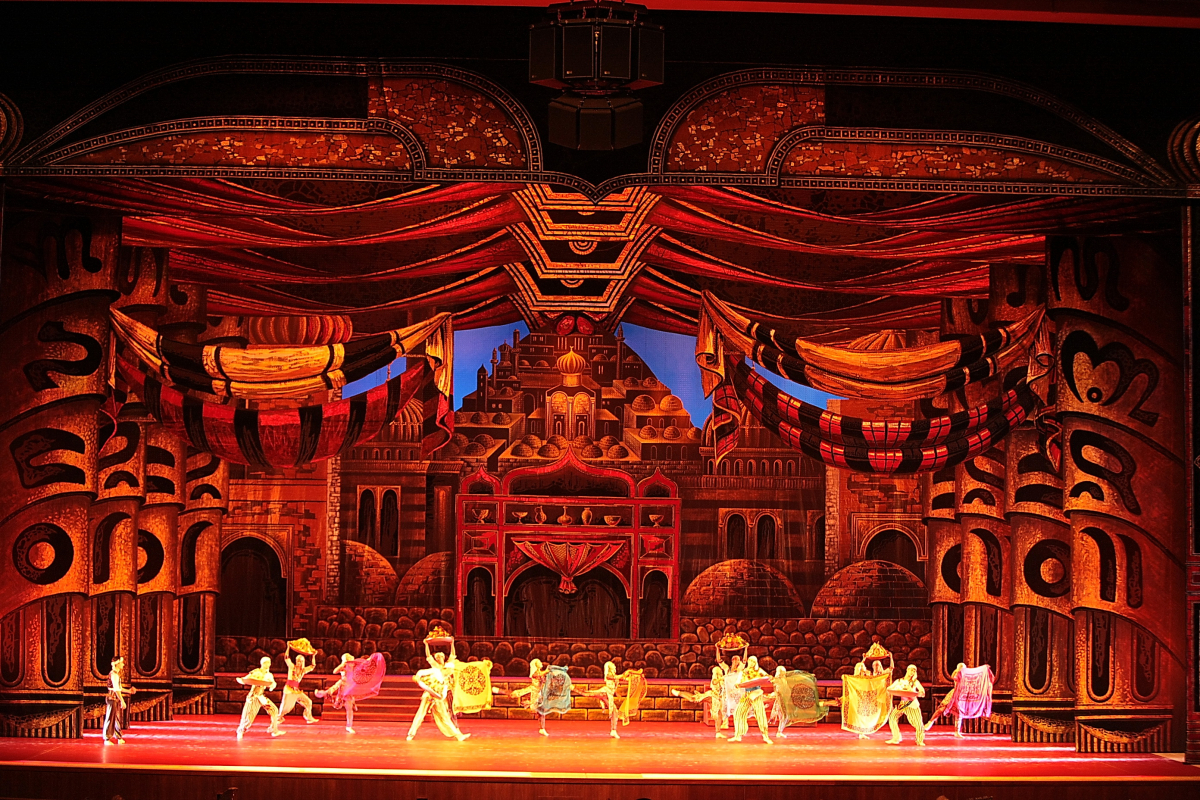
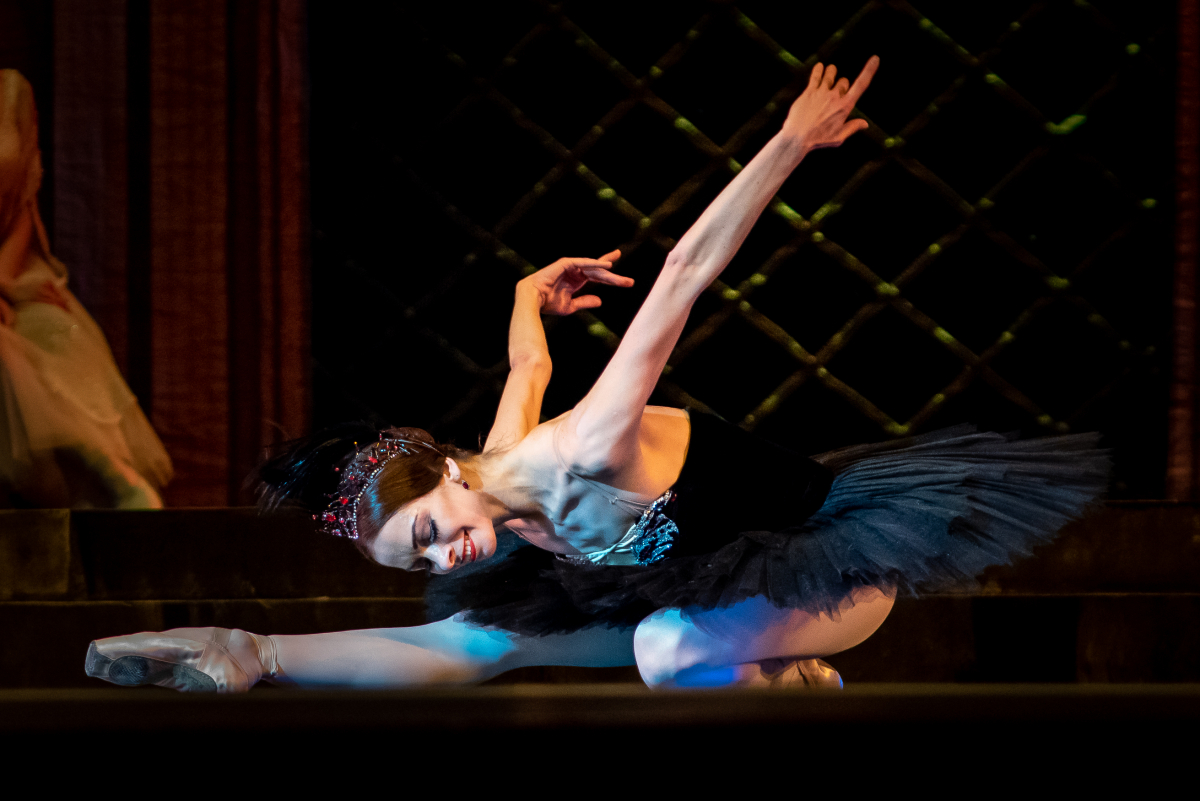
The troupe will be performing “The Hunchback of Notre Dame (Esmeralda)” on October 15, “A Thousand and One Nights” on October 17 and the classic “Swan Lake” on October 19. All three performances are choreographed by artistic director Andrei Petrov and will bring the company’s three soloists sharply into focus.

Kremlin Ballet is one of Russia’s top ballet companies and an integral component of the creative achievements in Russian ballet. Set up in 1990 by Petrov at the Kremlin Palace – the largest and most prestigious theatre and concert hall – the troupe features some of Russia’s best ballet dancers like Vladimir Vasiliev, Yury Grigorovich, Ekaterina Maximova, Galina Ulanova, Marina Semyonova, Sofia Golovkina and Boris Pokrovsky.

"The Hunchback of Notre Dame (Esmeralda)"

“The Hunchback of Notre Dame (Esmeralda)”

The first performance on October 15, based on Victor Hugo’s “The Hunchback of Notre Dame (Esmeralda)”, remains true to the original plot. The tale, which has been part of Russian ballet companies’ repertoire since 1848, is set in 15th century Paris and tells the story of three men from different walks of life – the hunchback church bell ringer Quasimodo, the evil priest Claude Frollo and the captain of the King’s archers Phoebus – all competing to win the heart of a beautiful gypsy woman Esmeralda.

As the story unfolds, Esmeralda is pursued by Frollo, betrayed by the man she loves, Phoebus, who marries another woman, and is adored by Quasimodo. The romantic story, set to the music of Cesare Pugni and Riccardo Drigo, is a tale of passion crossed with an action thriller where the plot twists and turns almost at will, having the audience at the edge of their seat.

 “A Thousand and One Nights”

“A Thousand and One Nights”

On October 17, Bangkok will witness “A Thousand and One Nights”, based on an Arabian folktale. This classical ballet, set to the music of Fikret Amirov, and libretto by Maksud, Rustam Ibragimbekov and Nailia Nazirova, is a two-act performance with a backdrop of spectacular sets.

This exotic tale is about Shahryār, a Sasanian king, who on discovering his wife making love with a slave has them both killed and vows revenge by marrying a succession of virgins to only have them executed the following morning before they can dishonour him.

The minister, whose duty it is to provide the brides, finds there are no more virgins left in the kingdom so decides to offer his own daughter, Scheherazade. On the wedding night, Scheherazade starts telling a tale to the king, but decides not to reveal the conclusion. So, curious to know the ending, the king is forced to postpone her execution. The following night, Scheherazade completes the tale, but starts another one. Her constant cliffhangers ensures this continues for 1,001 nights, until his thirst for revenge subsides.

The Kremlin Ballet dancers weave their magic with consummate finesse helped with dramatic sets and costumes.

"Swan Lake"

“Swan Lake”

The last offering on October 19 is the eternal favourite “Swan Lake”. This lyrical masterpiece created by Tchaikovsky tells the story of ill-fated Prince Siegfried and the lovely swan princess Odette. As the lovers outline their destiny in dance, Odile and evil sorcerer add to the dark drama. The libretto for this piece was created by Vladimir Begichev and Vasily Geltser.

All three performances underline the mastery of the Kremlin Ballet troupe and underscore Russian ballet traditions at their best. Conducting the orchestra for all three shows is Evgeny Volynsky, who won the prestigious Golden Mask in Russia twice as best conductor.

For more information visit www.bangkokfestivals.com. Tickets can be bought through www.thaiticketmajor.com; at the event as well as via the (02) 262 3191 hotline. They go for Bt4000, Bt3,500, Bt3,000, Bt2,500 and Bt1,500.

Also supporting the festival are Bangkok Bank, Bangkok Marriott Marquis Queen’s Park, BMW Thailand, B Grimm Group, Indorama Ventures, Major Cineplex Group, Nation Group, PTT, PTT Global Chemical PCL, Singha Corporation, Thai Union Group, Thai Airways International, Tourism Authority of Thailand and Culture Ministry.

Artistic rites of passage

ศาสตร์เกษตรดินปุ๋ย : ขอบคุณแหล่งข้อมูล : หนังสือพิมพ์ The Nation

https://www.nationthailand.com/lifestyle/30373082

Artistic rites of passage

Jul 17. 2019
 The tattoos of Lanna people of northern Thailand is on exhibit at  the exhibition “Tattoo COLOUR, Tattoo HONOR” that runs through October 27 at the museum on Sanam Chai Road.

The tattoos of Lanna people of northern Thailand is on exhibit at the exhibition “Tattoo COLOUR, Tattoo HONOR” that runs through October 27 at the museum on Sanam Chai Road.
By The Nation

114 Viewed

Long before body art became a fashion statement, it played a major role in culture and symbolism, with meanings ranging from giving magic powers to showing respect and protecting from danger.

Now Bangkok’s Museum Siam in collaboration with the National Taiwan Museum and the Taiwan Cultural Centre in Thailand is exploring cultural heritage through body art in the exhibition “Tattoo COLOUR, Tattoo HONOR” that runs through October 27 at the museum on Sanam Chai Road.

This is the first time Thailand is showing tattoos from three indigenous groups: the Atayal and Paiwan from Taiwan and Lanna from Thailand, which illustrate courage, honour, wisdom and beliefs.

The exhibition also features a variety of rare exhibits including a carved wooden puppet, a carved wooden hand and historical photographs of indigenous tattoos plus a documentary about tattooing, discussions and workshops.

“The collaboration between the National Discovery Museum Institute (Museum Siam) and National Taiwan Museum shows that tattoos are not only given for aesthetic purposes but also signify honour and pride in the indigenous traditions both in Thailand and Taiwan. ‘Tattoo COLOR, Tattoo HONOUR’ will encourage learning and understanding of cultural heritage and the history of indigenous groups as well as preserve them,” says Assoc Prof Dr Boonyong Rattanasuntharakun, acting president of the Office of Knowledge Management and Development

The exhibition consists of three zones, the first a photography and exhibit zone showcasing carved wooden puppets, carved wooden hands and historical photographs of indigenous tattoos.

Tattoos based on patterns, characters, numbers or various animal shapes have long been a part of human culture and visitors will be able to learn why people opt for body art, a decision that differs from society to society depending on customs, magical power, sacredness, power or aesthetics. Tattoos are embedded with implications, symbolism and cultural meanings and thus reveal the beliefs and cultures of a particular indigenous group.’

Hung Shih-Yu

Hung Shih-Yu

Hung Shih-Yu, director of the National Taiwan Museum, said that facial tattooing among Taiwan’s ethnic minorities also indicates their skills. Before getting the tattoo, men must prove themselves and be accepted for their courage, while women must prove themselves and be accepted for their weaving and agricultural skills.

Males from the Paiwan indigenous group living in southern Taiwan have tattoos on the body while women have the art on the hand. The tattoos indicate social status and responsibilities although only those who are of high rank in the tribe are able to have the tattoo. The art reflects social honor, indigenous traditions, wisdom and religious beliefs, which makes tattooing aesthetic but also demonstrates sacredness and social relationships in that one must be granted permission or acceptance from the group before having the tattoo.

The exhibition also showcases the tattooing of the Atayal indigenous group who live in northern Taiwan who they have a tradition of facial tattooing for men to show courage and strength and for women to show weaving skills. This kind of tattooing was accepted in the first half of the 20th century. After Japan came to play a role in governing and social order, tattooing was considered uncivilized. But while many people underwent surgery to remove their tattoos, others continued to have them in secret.

The tattooing of The Atayal indigenous group from Taiwan.

The tattooing of The Atayal indigenous group from Taiwan.

The Atayal believe that only those who have a facial tattoo can cross the Rainbow Bridge after death. This bridge is a gateway to the spirit world where one can reunite with his ancestors. For men, facial tattooing requires courage as a hunter; they must hunt big wild boars or other large animals or bring back the head of their enemy to prove their courage. Women need to prove their diligence and weaving and agricultural skills. Only after getting the facial tattoo will they be accepted as Atayal.

Meanwhile the Thai exhibit focuses on the tattoos of Lanna people of northern Thailand. Lanna tattooing culture is divided into 2 parts: the upper part from the waist up to the arms and the head called Sak Ya Kham (invincibility) and Sak Piya (lucky charm), and the lower part from the waist down to the feet called Sak Kha Lai and Sak Kham Priew (protection from poisonous animals).

Sak Ya Kham, Sak Piya and Sak Kham Priew are made with soot ink mixed with animal bile and herbal medicine or sacred elements. The tattoo takes the form of a character, talisman or an animal figure, and the tattooist chants while tattooing. However, for Sak Kha Lai, the tattoo takes the form of animal figure in a square or rounded frame located from the waist to the leg without the tattooist chanting or using sacred medicine. This kind of tattoo is to test patience, courage and manhood.

Sak Kha Lai tattooing is a sign of manhood, courage and patience that one can practice voluntarily, and it is an expression of the Lanna tradition among men through the animal patterns, such as rats, weaver birds, vultures, lions, bats, musk, painted storks, tigers, elephants, monkeys and Hanumans according to beliefs from Buddhism and Hinduism.

The showcase of Lanna tattoo pattern.

The showcase of Lanna tattoo pattern.

Other patterns are also popular, such as flowers, big lizards, lions, peacocks, clouds or winds. Sak Kha Lai tattooing is traditional tattooing without herbal medicine, elements or spells. Before tattooing comes a ritual of paying respect to the teacher by presenting betel nut, betel leaf, and tobacco and donation money. The more money, the more beautiful and refined the patterns. After it is finished, the tattooist will have the person eat rice, chilli, salt and water and tie a white thread on the person’s wrist.

Visitors can also attend discussions and workshops facilitated by experts in cultural heritage from Thailand and Taiwan on tattoos that tell a story, relate ethnic history and reflect value. The art of tattooing can also be learned through the creation of a rubber stamp.

For more information, call Museum Siam at (02) 225 2777 or visit the website www.museumsiam.org or www.facebook.com/museumsiamfan.

Males from the Paiwan indigenous group living in southern Taiwan have tattoos on the body while women have the art on the hand.

Males from the Paiwan indigenous group living in southern Taiwan have tattoos on the body while women have the art on the hand.

Beautiful shapes, fantastic prizes

ศาสตร์เกษตรดินปุ๋ย : ขอบคุณแหล่งข้อมูล : หนังสือพิมพ์ The Nation

https://www.nationthailand.com/lifestyle/30372966

Beautiful shapes, fantastic prizes

Jul 15. 2019
By The Nation

127 Viewed

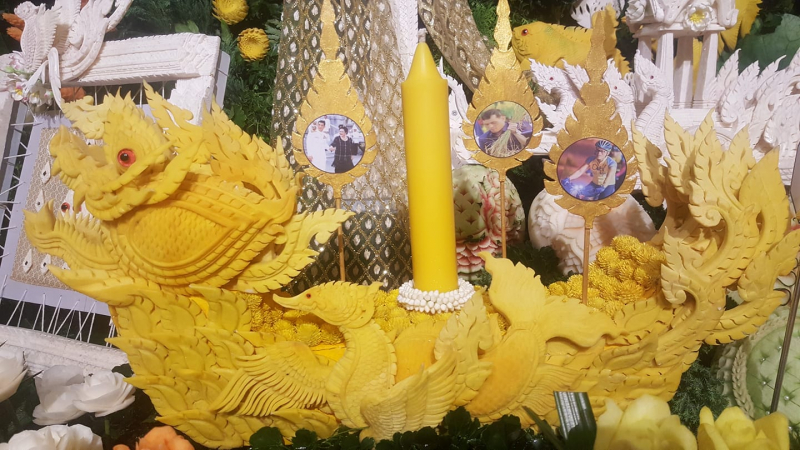
The Grand Mercure Bangkok Fortune joins up with the Culture Ministry and the Tourism Authority of Thailand in celebrating artistic talent this Friday (July 19) as it plays host to the 21st edition of the Fruit and Vegetable Carving Contest.

Coinciding with Thailand’s presidency of Asean and taking place at the hotel grand ballroom from 10am to 5pm, the theme of this year’s contest is “In Celebration of His Majesty King Rama X’s Supreme Glory on the Auspicious Occasion of the Royal Coronation” and will see the winner take home the first Queen’s Cup which is engraved with Her Majesty’s abbreviated name granted by Her Majesty Queen Suthida Bajrasudhabimalalakshana.

Contestants will carve fruit and vegetables decorated with banana leaves and fresh flowers in ways that reflect their respect for the grandeur of the Royal Coronation and the Magnitude of His Majesty the King’s Supreme Glory, both for Thailand and beyond.

The contest aims to encourage younger generations to optimize their time, be creative and generate income from art, cultivate peacefulness, and to conserve the unique and valuable Thai heritage.

More than 20 of the finest carving teams will submit their masterpieces in the contest. The opening ceremony and award presentation will be hosted by Deputy Prime Minister Prof Dr Wissanu Krea-ngam.

The organizing committee is chaired by Araya Arunanondchai, the hotel president and Prof Dr Maneeratana Sawasdiwat Na Ayutthaya heads up the judging panel. Prof Maneeratana is a daughter of late national artist in visual arts Penpan Sittitrai who was known for Fruit and Vegetable Carving.

The contest is divided into 2 categories covering hotel personnel and members of the general public, and educational institutions.

The contest comprises 13 prizes and all of the contestants will receive certificates. The overall winner takes home the Queen’s Cup, a cash award and a certificate from TAT and Ministry of Culture.

hangka scrolls go on show in Hong Kong

ศาสตร์เกษตรดินปุ๋ย : ขอบคุณแหล่งข้อมูล : หนังสือพิมพ์ The Nation

https://www.nationthailand.com/lifestyle/30372335

hangka scrolls go on show in Hong Kong

Jul 05. 2019
A visitor examines a piece of Thangka on display at the Qinghai Thangka Painting Exhibition at Hong Kong Central Library in Causeway Bay. (ROY LIU / CHINA DAILY)

A visitor examines a piece of Thangka on display at the Qinghai Thangka Painting Exhibition at Hong Kong Central Library in Causeway Bay. (ROY LIU / CHINA DAILY)
By Julianna Wu
China Daily
Asia News Network

1,028 Viewed

Artworks reflecting traditional Buddhism drew an enthusiastic response from Hong Kongers during the five-day Qinghai Thangka Painting Exhibition, which wrapped on Wednesday. The exhibition presented a series of scrolls portraying events in the lives of the Buddha and of bodhisattvas.

The Tibetan scrolls were traditionally painted with natural pigments like coral, gold and sapphire or embroidered with silk.

The exhibition team from the co-sponsoring Qinghai Culture and Tourism department showcased between 70 and 80 pieces of painted and embroidered Thangka at Hong Kong Central Library.

“To become a real master in Thangka painting, you have to practise for decades” said Qu Zhi, who has been painting for more than 40 years and is the 10th generation Thangka painter in his family.

In addition to the paintings, the exhibition featured pottery, traditional costumes, and silver and bronze ware from the Regong region of Qinghai province.

Chan Yung, the honorary president of the Hong Kong Celebrations Association and co-organiser of the exhibition, says that although Hong Kong is geographically distant from the province next to Tibet, Hong Kong people have a strong interest in Qinghai.

Religion is also a contributing factor to the interest in Thangka. According to the Home Affairs Bureau, Buddhism is one of the largest religions in the city, which counted more than 1 million Buddhists in 2016.

“Besides their use in religious practices, many people in Hong Kong love to collect Thangka for their artistic value,” Chan noteds.

During the exhibition, viewers also watched as artists sketched, painted and embroidered Thangka.

Auction prices of Thangka have increased dramatically in recent years, with the highest bid soaring from HK$30.87 million (Bt121.6 million) in 2002 to a record HK$348.4 million in 2014 for a single piece, according to auction company Christie’s.

Buddhism art in Regong was listed as an intangible cultural heritage in 2009 by Unesco.

The second day of the exhibition draw more than 100 people, many of them awed by the detail in the Thangka and the unique technique used to create them.

“This is a very special art that’s not commonly seen in Hong Kong,” said Maria Leung, a 28-year-old who came with her boyfriend. “There are so many details in the paintings.”

“Hong Kong people know how to appreciate Thangka, and that makes me very happy,” added Qu Zhi, director and Thangka master of Regong Longshu Art Academy in Qinghai province, who has exhibited his artwork in Japan, Taiwan and elsewhere. “Viewers in Hong Kong understand the context behind the pieces better than others and pay greater attention to the details of the artwork,” Qu commented.

Fresh from a recent trip to Tibet, Lisa Cheung, in her 50s, also enjoyed the exhibition. “I love their choice of colours, they make the whole picture so bright and so beautiful.”

Besides the exhibition, visitors also enjoyed a folk dance drama titled “Thangka” at Hong Kong Coliseum for free. The show, which has been performed more than 39 times since 2017, was included in 2018’s CCTV New Year’s Gala as a showcase of Qinghai’s Tibetan ethnic culture.

A lesson in ‘outsider art’

ศาสตร์เกษตรดินปุ๋ย : ขอบคุณแหล่งข้อมูล : หนังสือพิมพ์ The Nation

https://www.nationthailand.com/lifestyle/30372628

A lesson in ‘outsider art’

Jul 09. 2019
By The Nation

135 Viewed

Being billed as the first large-scale Art Brut exhibition in Southeast Asia, “Art Brut: Figure of Unknown Beauty” will be unveiled on July 19 at the Bangkok Art and Culture Centre’s main gallery on the eighth floor.

The show, which runs until November 3, will introduce the works of about 50 artists from Japan and Thailand through paintings, ceramics, three-dimensional works, photographs and images.

Organised by the BACC, the Agency for Cultural Affairs, Government of Japan, the International Exchange Programme Executive Committee for Disabled People’s Culture and Arts and The Rainbow Room Foundation, the exhibition will be divided into five categories.

The first category will introduce works on the topic of “freshness”, the tendency seen in many art brut works. The second category shifts the point of view to the works’ production environment and looks at materials and techniques in the context of how they are used and created in everyday life. The third will show the authors’ thoughts and wishes at the source of creations for each topic. The second half of the fourth category focuses on the background of the works’ production and introduces the relationship between the authors and others around them. In the fifth category, collaborative works of contemporary artists and Art Brut artists who attempted new productions will be exhibited.

Art Brut, which is sometimes referred to as “Outsider Art” is art by self-taught or naive art makers who have little or no contact with the mainstream art world or art institutions. Introduced by Jean Dubuffet in 1945, it serves as a particular genre of creativity, exposing hidden dialogue and art that’s raw and boundary-less.

A featured principle of Art Brut refers to a person or group living in social and cultural isolation – such as the disabled, prisoners or senior citizens – who employ creative practices for personal purposes but do not consider themselves to be artists nor designate their production as art.

Find out more at the BACC website.

Home and away

ศาสตร์เกษตรดินปุ๋ย : ขอบคุณแหล่งข้อมูล : หนังสือพิมพ์ The Nation

https://www.nationthailand.com/lifestyle/30372612

Home and away

Jul 09. 2019
By The Nation

158 Viewed

Art lovers have plenty to look forward this month with two exhibitions all set to open this week on very different subjects.

Organised by the Rotary Club of Yaowarat, the Embassy of the Republic of Kenya in Thailand and Siam Paragon, David Lau’s photo exhibition “Magical Kenya” opens tomorrow (July 10), at the Life Style Hall on the 2nd floor of Siam Paragon.

Lau will share his amazing experiences in Southeast African countries while the Kenyan charge d’affaires to Thailand will introduce beautiful tourist attractions in Kenya.

“Kenya is a country with fertile savanna. It is considered the best safari tourism spot in the world and brims with wildlife. I have collected the memories of my visit through photos of wildlife, the lifestyle of Masai Mara tribe, and millions of flamingos. If you love wildlife and photography, Kenya is the place for you,” says Lau.

The event will also feature a Kenya tourism promotion booth by Kenya Airlines which offers safe and affordable flights to Kenya.

The exhibition is open daily from 10am to 9pm and continues through July 15.

Meanwhile, over at Pullman Bangkok Hotel G, Naruemon Yimchavee aka Banana Blah Blah is holding her first solo exhibition “It’s Okay to Take a Break” from July 13 to September 8.

On display at The Gallery on the hotel’s 36th floor, “It’s Okay to Take a Break” encourages viewers to live life in the present. Aware that we all tend to work hard to achieve our goals and earn a decent living, she encourages us to take a break and use the time to think and reflect, worry less and be inspired by new ideas.

Naruemon graduated in Communications Art & Design from Bangkok University. She currently works as a freelance illustrator and part-time musician with Blue Yogurt Band. Her work has featured in numerous magazines, including “1001 Nights Editions”, “a day BULLETIN” and “The Jam Mag”

The preview night will be held on July 13, from 6 to 10pm. The Gallery is open daily from 10am to 5pm. Find out more by calling Betty Pongstaporn at (02) 352 4000 extension 1419 or email nicha@pullmanhotelg.com.