Thailand and Germany join hands to provide alcohol gel to healthcare workers during the COVID-19 crisis
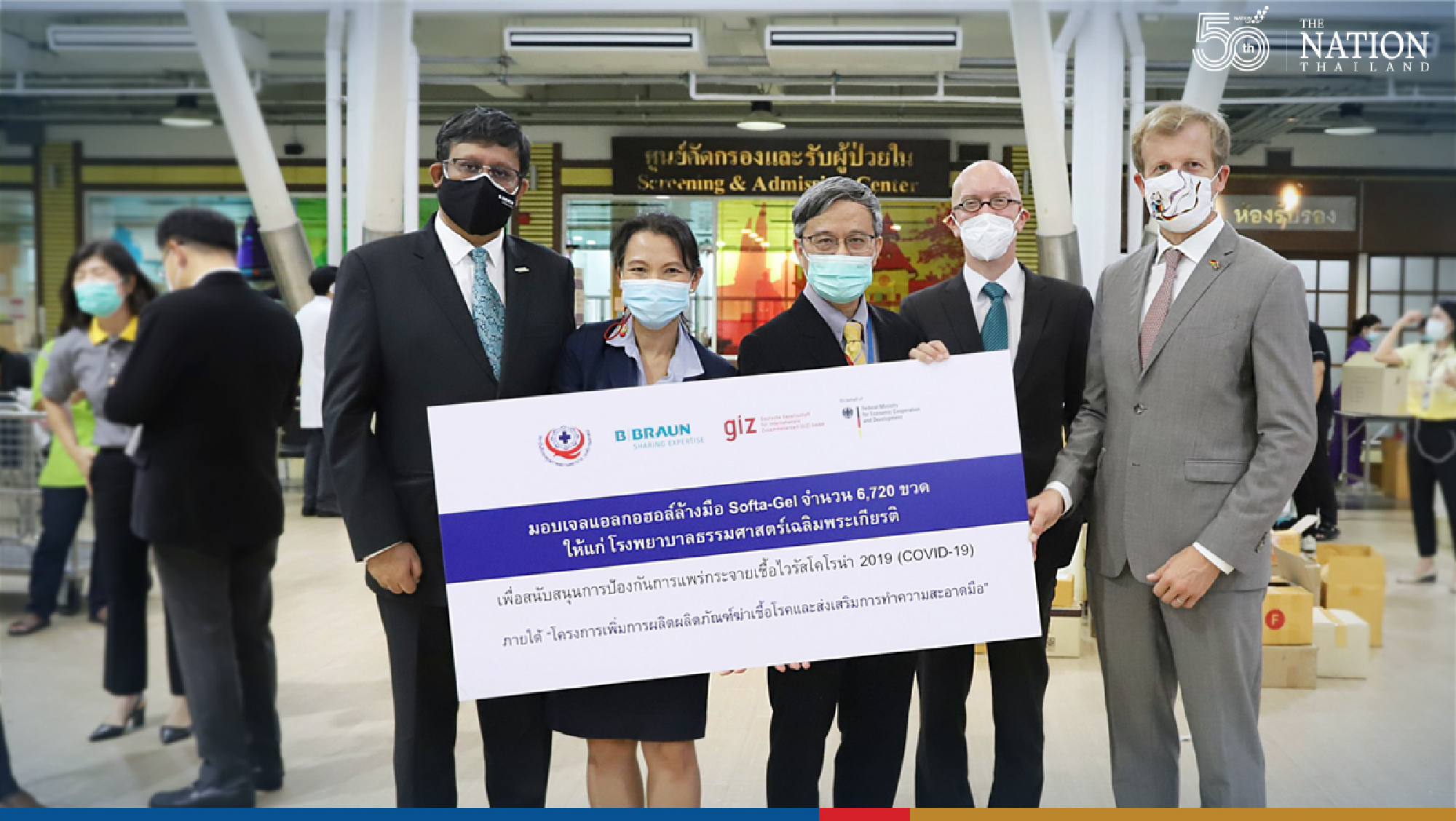
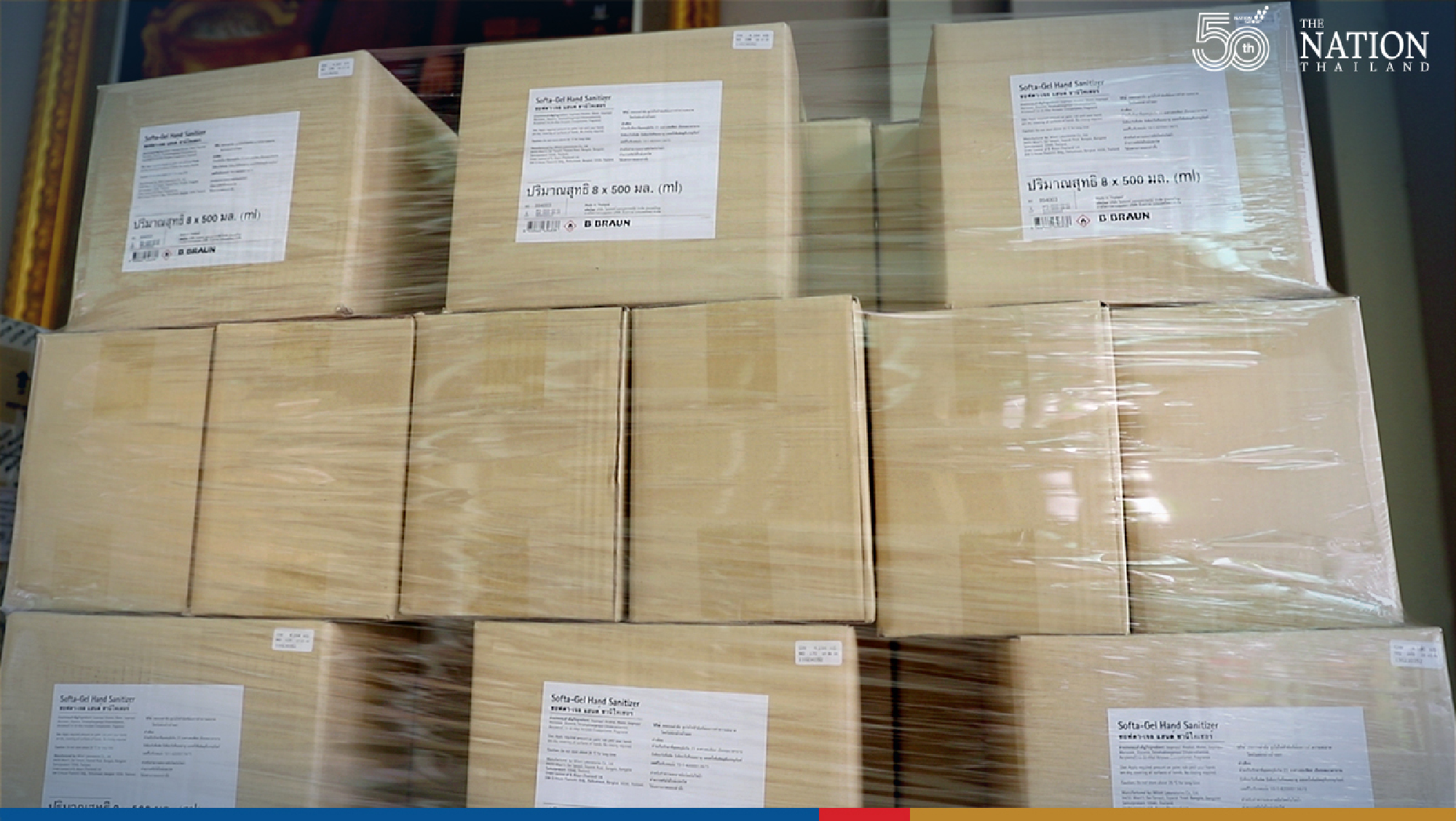
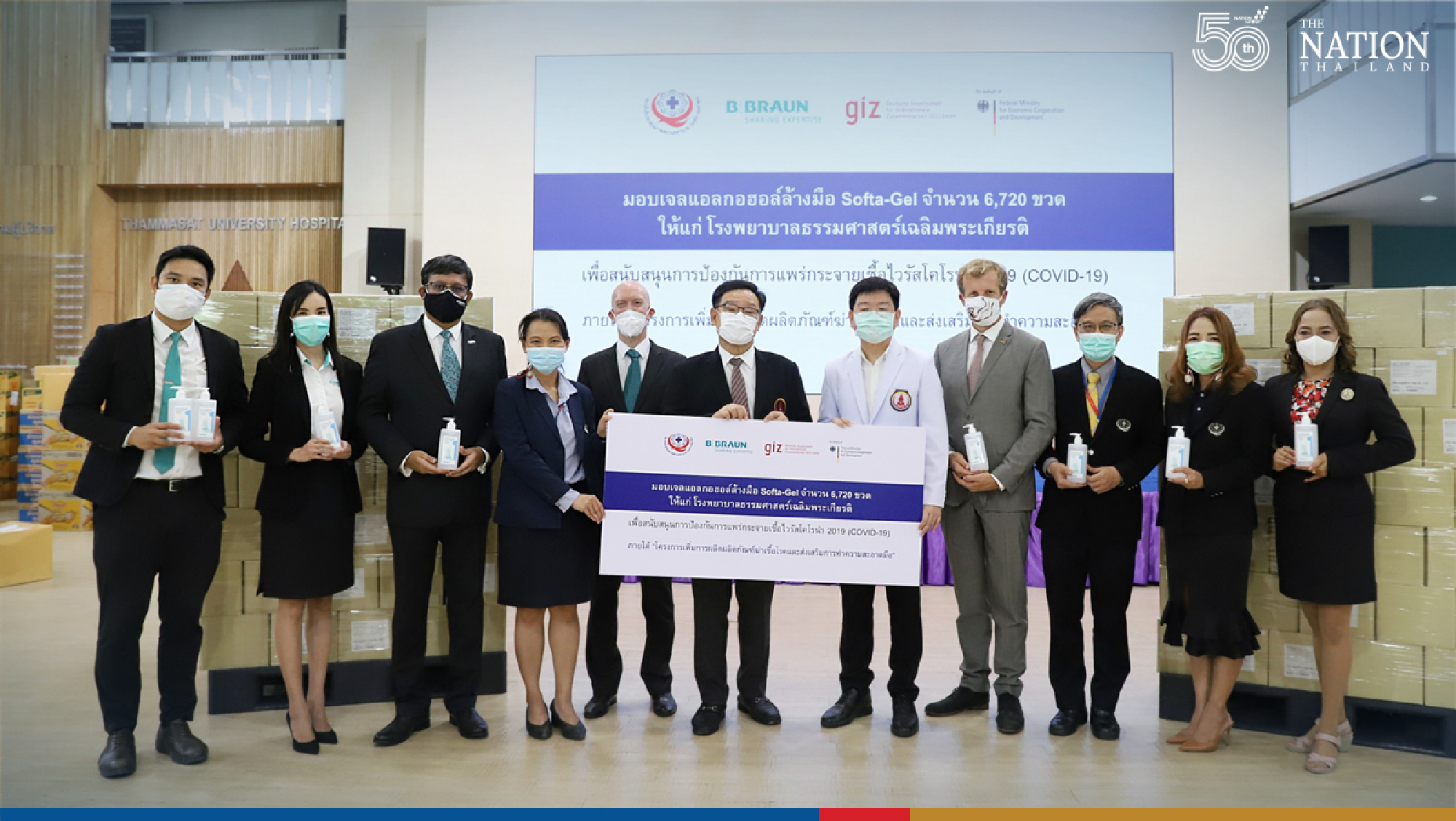
20 May 2021 / Bangkok – Dr. Kittinan Anakamanee MD., CEO of the Healthcare Accreditation Institute of Thailand (Public Organization) – HAI, together with Mr. Sayan Roy, Managing Director of B. Braun (Thailand) Co., Ltd. and Mr. Reinhold Elges, Country Director of GIZ Thailand and Malaysia recently handed over 6,720 bottles of alcohol-based hand sanitizer to healthcare workers at the Thammasat University Hospital.
This activity is implemented as part of the COVID-19 DPP Measure: Upscaling Sanitizing Production in Thailand and Promoting Hand Hygiene project. Thammasat University Hospital director Paruhas Tor-Udom was on hand to receive the hand sanitizers.
The donation of hand sanitizer aims to support the work of the healthcare and public health personnel in dealing with the COVID-19 pandemic and to reduce the risk of spreading the virus in hospitals. It is also meant to show moral support and gratitude to the healthcare and public health personnel as well as all relevant departments for their dedication in working for the people to get Thailand through this crisis as quickly as possible.
“The new wave of COVID-19 is hitting us harder than the first wave. The number of COVID-19 infections has risen significantly. Healthcare workers have been working hard combatting the coronavirus outbreak on the frontline and that puts them at the highest risk. We are therefore delighted to join forces with GIZ and B. Braun (Thailand) Co., Ltd to provide high-quality alcohol-based hand sanitizer to 62 hospitals and healthcare facilities in COVID-19 red zones across Thailand. In addition, HAI has jointly designed e-leaning on proper hand cleaning and the use of personal protective equipment, or PPE, to prevent the spread of COVID-19 and ensure the safety of patients and healthcare workers including village health volunteers,” said Dr. Kittinan Anakamanee MD., CEO of the Healthcare Accreditation Institute of Thailand (Public Organization) – HAI.
Thailand and Germany join hands to provide alcohol gel to healthcare workers during the COVID-19 crisis
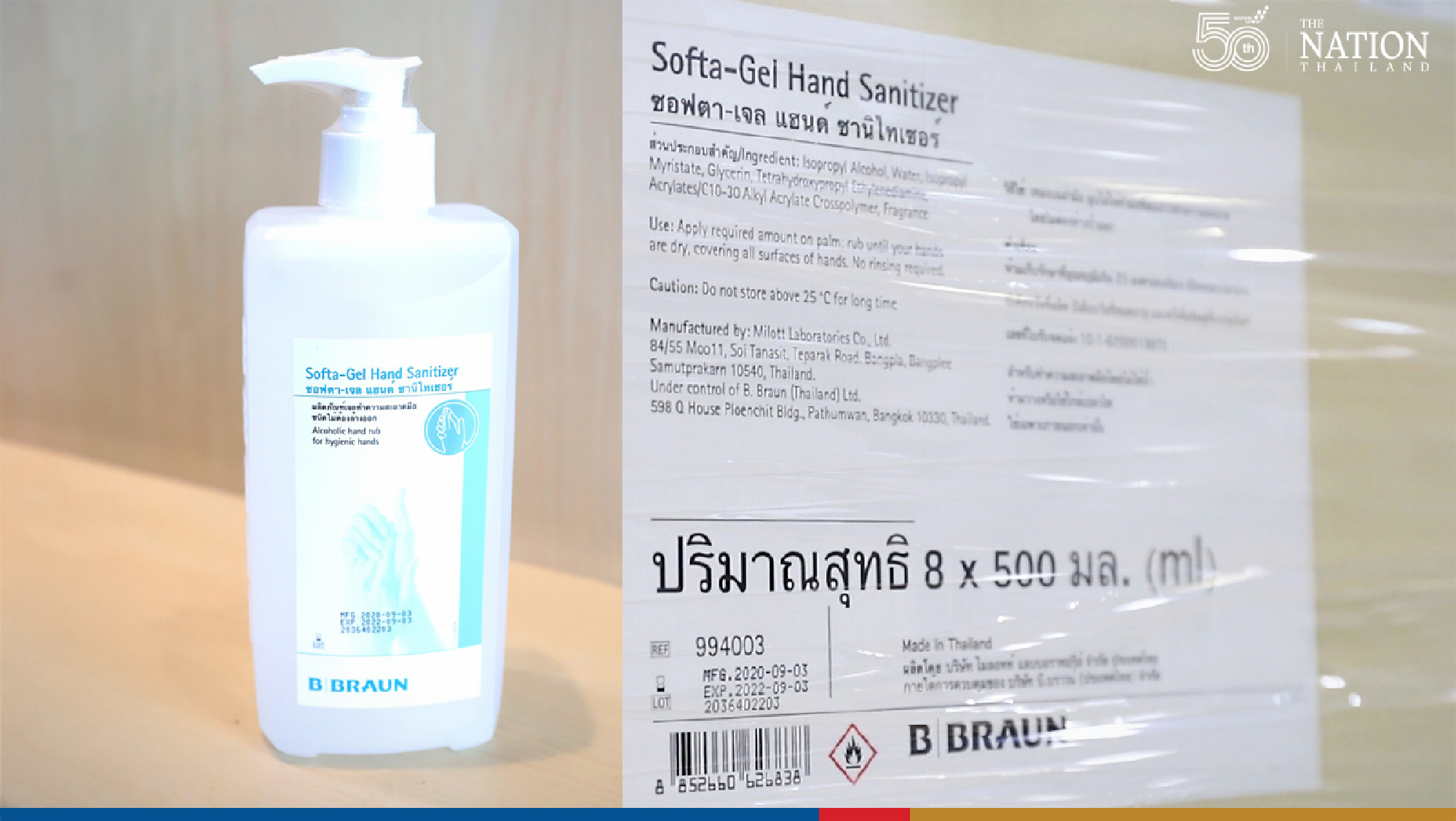
Mr. Sayan Roy, Managing Director of B. Braun (Thailand) Co., Ltd. said: “With the pandemic continuing, we at B Braun (Thailand) Co., Ltd. are supporting the communities and the healthcare workers by providing them with our quality product, SOFTA-GEL alcohol hand rub, which has been tested according to global testing standards, namely EN14476 efficacy against developed viruses, which include Coronavirus, EN1500 recommended by World Health Organization (WHO) and EN1276 in line with the recommendation of the Department of Medical Sciences, Ministry of Public Health. With support from the German Federal Ministry of Economic Cooperation and Development (BMZ), B. Braun (Thailand) Co., Ltd has been able to increase production capacity of alcohol hand sanitizer so as to have enough to meet the needs of the Thai people”.
Dr. Paruhas Tor-Udom, Director of the Thammasat University Hospital said, “Today, I would like to thank HAI, B. Braun and GIZ for donating SOFTA-GEL hand sanitizer to the Thammasat University Hospital. In the midst of the COVID-19 pandemic, good hygiene is essential. Knowledge about health care and proper use of alcohol gel is also important for healthcare workers, patients and everyone in general. This donation will help increase the amount of alcohol gel for hospital use since we have more than 4,000 healthcare workers and patients per day. This will help reduce the spread of COVID-19 in the hospital.”
The project, which is being implemented through the cooperation between HAI, B Braun (Thailand) Co., Ltd., and GIZ also supports the fight against COVID-19 among Thais by encouraging them to regularly wash their hands properly, avoid crowded places and gathering, and wear a mask every time they leave the house. This is because hygiene care is very important and can help reduce the spread of the virus and infection.
Thailand and Germany join hands to provide alcohol gel to healthcare workers during the COVID-19 crisis
Thailand and Germany join hands to provide alcohol gel to healthcare workers during the COVID-19 crisis
Fed signal on QE, oil price expected to cast shadow over SET
The Stock Exchange of Thailand (SET) Index rose by 2.59 points, or 0.17 per cent, to 1,557.13 at 10am on Friday. The volume of total transactions was worth THB4.82 billion with an index high of 1,560.51 and a low of 1,556.97.
Krungsri Securities forecast that the SET Index would fluctuate between 1,545 and 1,565 points despite positive sentiment of a decline in US jobless claims.
It said the index would be under pressure due to uncertainty over the US Federal Reserve’s signal it would be open “at some point” to discussing a scaling back of its massive bond purchases, or quantitative easing (QE).
“Besides, the falling oil price would pressure energy shares,” Krungsri Securities added.
It recommended that investors buy:
▪︎ BDMS, BCH and CHG, which have gained positive sentiment from the mass vaccination.
▪︎ HANA, KCE, TU, CPF and EPG, which benefit from the weakening baht.
▪︎ CK, STEC, ITD, NWR, UNIQ, which benefit from the e-bidding of Den Chai-Chiang Khong double-track railway project.
The SET Index closed at 1,554.54 on Thursday, down 7.70 points or 0.49 per cent. Total transactions amounted to THB90 billion with an index high of 1,568.72 and a low of 1,554.54.
Baht opens stronger but could weaken in the short term, says analyst
The baht opened at 31.37 to the US dollar on Friday, strengthening slightly from Thursday’s closing rate of 31.45. The Thai currency is likely to move between 31.35 and 31.45 during the day, Krungthai Bank market strategist Poon Panichpibool said.
He predicted that the baht would weaken in the short term due to the market situation and the Covid-19 crisis in Thailand. However, the weakening of the dollar will prevent the baht from sliding further.
Poon said the baht’s resistance would be around 31.50 to 31.60 to the dollar, as exporters were expected to offload their dollars at that rate.
Also, the support point would be when the baht moves closer to 31.30, when importers would want to purchase the dollar.
Poon, however, believed the baht would strengthen in the near future because of a weakening dollar as well as Covid-19 vaccinations for the general Thai public, which would draw investors back to the country.
Gold up slightly on weaker dollar, lower US bond yield
The price of gold rose by THB50 per baht weight in morning trade on Friday, due to the weakening dollar and decline in US bond yield.
The Gold Traders Association report at 9.24am showed buying price of a gold bar at THB27,700 per baht weight and selling price at THB27,800, while gold ornaments were priced at THB27,197.04 and THB28,300, respectively.
The buying price of a gold bar at close on Thursday was THB27,650 per baht weight and selling price THB27,750, while gold ornaments were priced at THB27,151.56 and THB28,250, respectively.
Spot gold price on Friday was US$1,871 (THB58,712) per ounce compared to Thursday when it rose by 40 cents to $1,881.9 per ounce.
Hong Kong gold price on Friday dropped by HK$10 to $17,350 (THB70,135) per tael, the Chinese Gold and Silver Exchange Society reported.
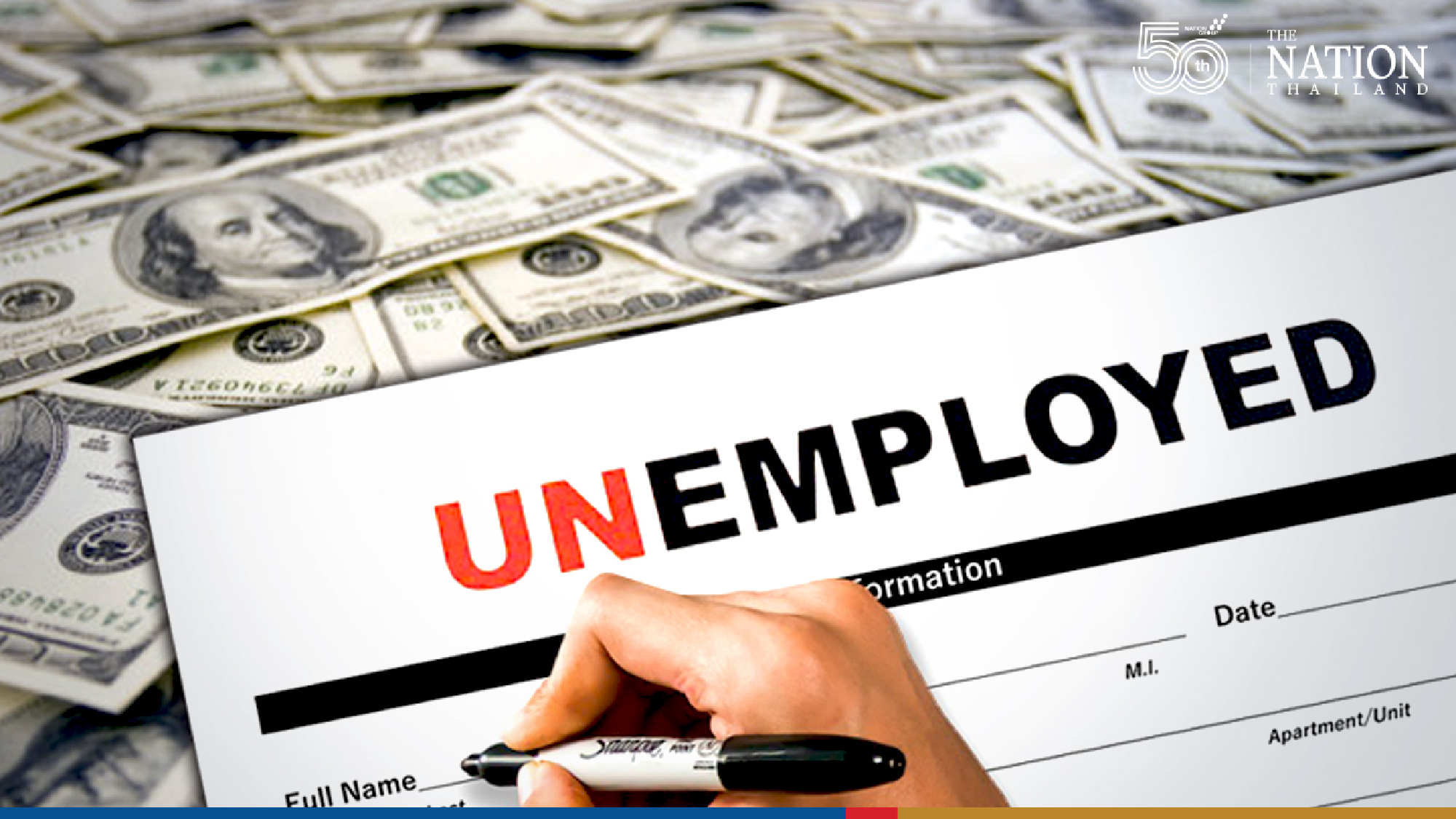
Jobless claims set a pandemic low as GOP-led states move to slash unemployment benefits
WASHINGTON – Some 444,000 Americans filed first-time unemployment claims last week, the Labor Department reported Thursday, chalking up another pandemic low as the labor market continues to recover and a cluster of state lawmakers threaten to slash benefits.
That’s down 34,000 from the previous week’s upwardly revised level, marking the third consecutive weekly decline in initial unemployment claims. Georgia, Kentucky, Texas, Michigan and Alabama saw some of the biggest drop-offs in filings. New Jersey, Washington and Oklahoma were among the only states with spikes in claims greater than 1,000.
At this time last year, weekly unemployment claims ballooned past 2.3 million.
Now, claims are at their lowest level since mid-March 2020. The report comes as a wave of 22 Republican-led states say they will opt out of expanded unemployment benefits, which they argue are preventing people from returning to the labor market. The temporary $300 weekly benefit was slated to expire in September, but states such as Texas, Arizona and Ohio plan to cut it off in June.
Job openings hit a record high in March, surging 8% to 8.1 million as loosening pandemic restrictions and widespread vaccinations boosted activity, the Labor Department reported. But businesses around the country say they are struggling to find workers: Applebee’s is offering free appetizers to job applicants, while a Florida McDonald’s is paying $50 to those who show up for an interview. About 44% of small businesses had job openings they couldn’t fill in April, a record high according to the National Federation of Independent Business.
“The current situation is extremely complicated, even as we rejoice over the progress with vaccinations, lower COVID case counts and the ability to resume previously restricted activities,” Mark Hamrick, senior economic analyst at Bankrate.com, said Thursday in comments emailed to The Post. “There are challenges to address including what the return to office or work looks like and resolving constraints of labor and supplies.”
Calls to slash benefits started after April’s jobs report came in wildly below expectations, with just 266,000 positions added to the U.S. economy when economists had been projecting 1 million. While Republican governors blamed overly generous benefits for hampering the labor market, Democrats and labor experts say the reality is more complicated. It’s the problems the pandemic has compounded: unaffordable child care, unsafe working conditions, low wages, in-person work requirements and the inconsistency of unemployment insurance.
Cuts are likely to fall hardest on roughly 3.4 million people who benefit from stimulus programs that Congress adopted at the height of the coronavirus pandemic, including one targeting those who either are self-employed or work on behalf of gig-economy companies such as Uber. Beginning next month, many of these workers are likely to receive no aid at all.
States reported more than 95 million initial claims for Pandemic Unemployment Assistance, for gig and self-employed workers, for the week that ended May 15. Nearly 6.6 million PUA claims were continued in early May for the benefits that are set to expire in September.
While initial claims declined, continuing unemployment claims edged up 111,000 from the previous week, to 3.75 million. The total number of Americans drawing some form of unemployment benefits is nearly 16 million, near historic highs.



 Thailand and Germany join hands to provide alcohol gel to healthcare workers during the COVID-19 crisis
 Thailand and Germany join hands to provide alcohol gel to healthcare workers during the COVID-19 crisis
 Thailand and Germany join hands to provide alcohol gel to healthcare workers during the COVID-19 crisis