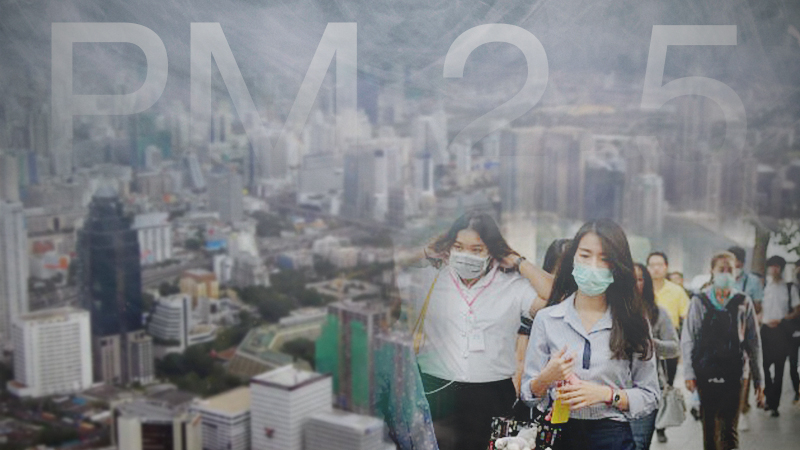
Air pollution in Samut Sakhon hit unsafe levels on Friday morning, with PM2.5 readings coming in at 54 to 58 micrograms per cubic metre (μg/m3), the Pollution Control Department reported.
Thailand’s standard for safe levels of PM2.5 (particles less than 2.5 micrometres in diameter) is 50μg/m3.
The two areas are:
1. Omnoi subdistrict, Krathum Baen district, Samut Sakhon province (54μg/m3)
People in provinces where the PM2.5 pollution is bad have been advised to monitor their health and reduce time spent on outdoor activities, especially the elderly, children, and patients with respiratory diseases.
Four new Covid-19 cases were found on Thursday in Chiang Mai, raising the accumulated active cases in the province to 11, deputy governor Weerapan Dee-on told the press.
“The 54th patient in Chiang Mai is a Thai man aged 23 from Sansai district. He displayed no symptoms,” Weerapan said. “The 55th patient is another Thai man aged 28 from Muang district. He also showed no Covid-19 symptoms.
“The 56th patient is a Thai woman aged 28, who works in Bangkok but recently returned home to Sankamphaeng district. She had symptoms of coughing and a blocked nose.
“The 57th patient is another Thai woman aged 22 from Muang district. She displayed symptoms of coughing and tiredness.”
Weerapan added that all patients had visited the Warm Up Café on the night of December 31.
On Monday, the province’s 50th Covid-19 case was found after a 25-year-old woman visited entertainment venues, pubs and restaurants. The provincial authorities took proactive steps on Tuesday to find out who else she may have infected, and discovered a 28-year-old male employee at Warm Up Café who tested positive. The employee did the 3pm-to-1am shift at the pub on December 31.
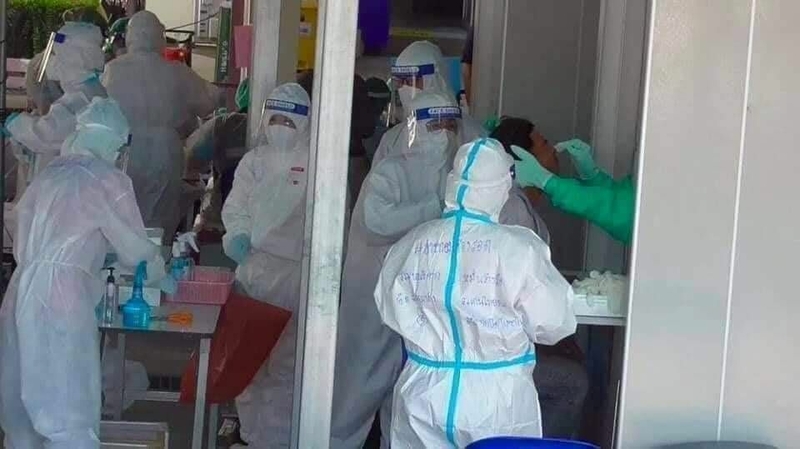
Chiang Mai public health officials have traced and tested 283 persons who visited the pub on New Year’s Eve and are awaiting the results.
The province’s communicable disease committee has also ordered all pubs, bars and karaoke venues, as well as similar entertainment businesses to shut down for 14 days, and urged people who visited the Warm Up Café on December 31 to January 3 to go for a Covid-19 test immediately.
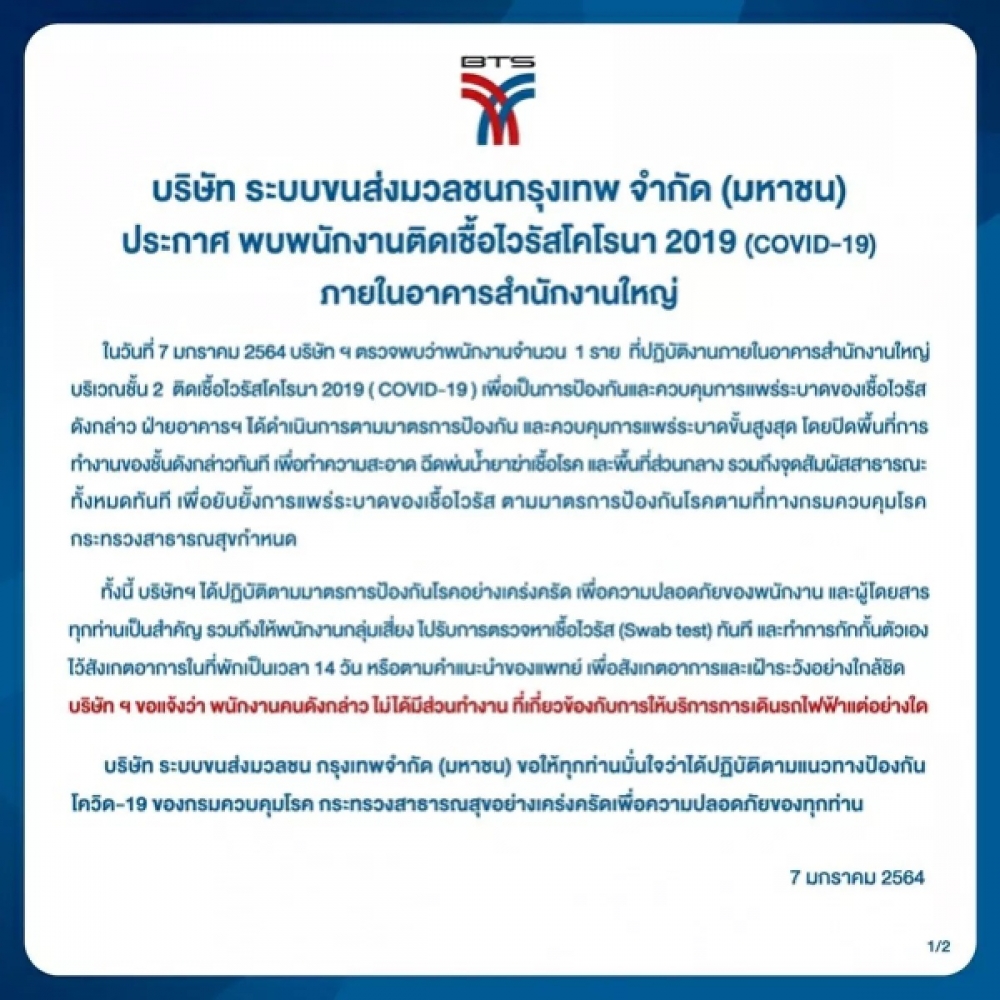
Skytrain operator Bangkok Mass Transit System announced on Thursday that one of its staff who worked at its headquarters in Bangkok’s Chatuchak district has tested positive for Covid-19.
“The staffer works on the 2nd floor of the headquarters and was not directly involved with train services,” BTS said. “After he tested positive on Thursday, the company immediately shut down the floor and nearby common areas to carry out cleaning and disinfection, following the measures laid out by the Public Health Ministry.”
BTS also said it ordered other staff who might have come into close contact with the patient to receive a swab test immediately and undertake self-quarantine at home for 14 days while closely monitoring their symptoms.
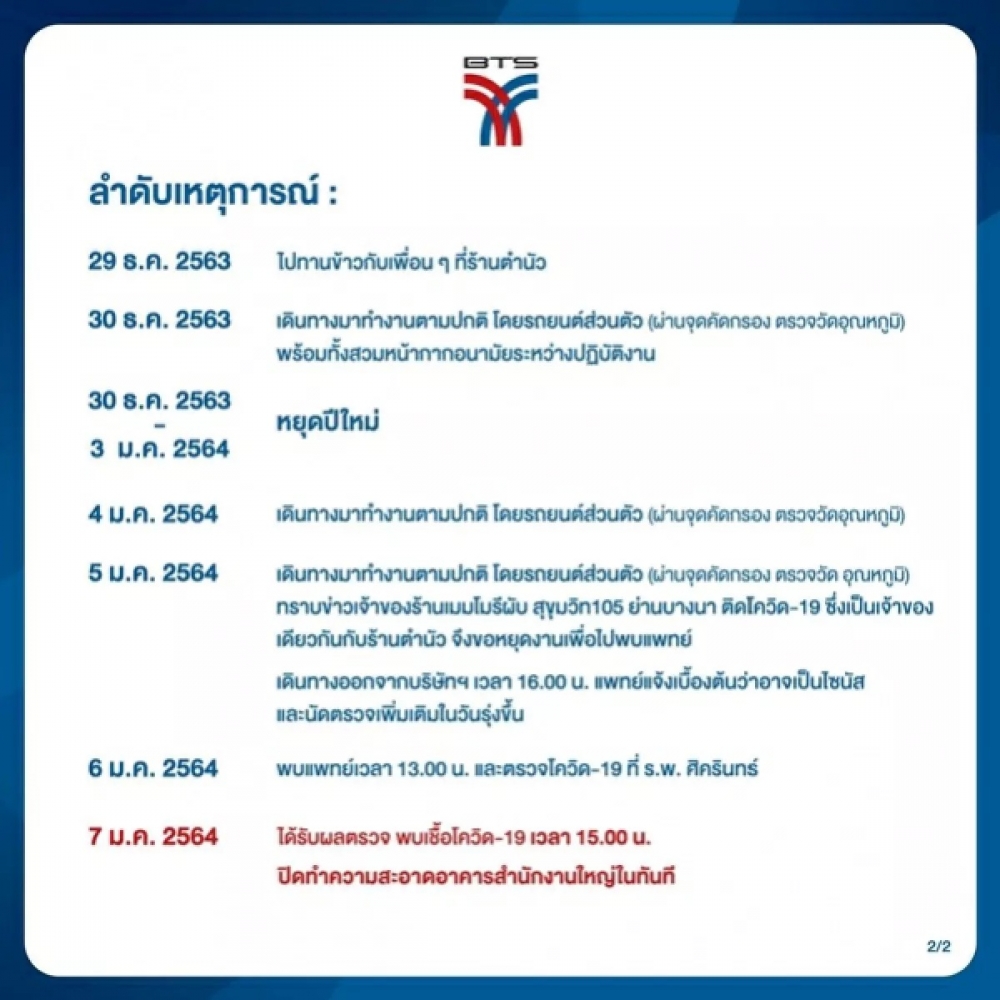
The company also listed the timeline and travel history of infected staffer:
December 29: He dined out with his friends at Tam Nua restaurant.
December 30: He came to work in a personal car and wore a face mask while working.
December 31-January 3: He stopped working during the New Year holidays.
January 4: He came to work in his car.
January 5: He came to work in his car and learnt that the owner of Memory Pub Sukhumvit 105, who also owns Tam Nua restaurant, tested positive for Covid-19. He then took leave to see a doctor, using his car. The doctor said he could have sinusitis and told him to come in again for a detailed test.
January 6: He took a Covid-19 test at Sikarin Hospital.
January 7: The test came back positive at 3pm. The company immediately shut down and cleaned its headquarters.
A strong high-pressure system from China is presently covering upper Thailand, resulting in cool to cold weather with a 3-5° C decrease in temperatures and strong winds, the Meteorological Department said on Friday.
Meanwhile, the moderate northeast monsoon prevailing over the Gulf and the South is becoming stronger, bringing thundershowers to the area and strong wind waves in the Gulf of Thailand, the department said, adding that waves in the upper Gulf are 2-4 metres high and more than 4 metres in areas experiencing thundershowers. It advised all ships to proceed with caution and small boats to stay ashore.
Here’s the weather forecast for the next 24 hours:
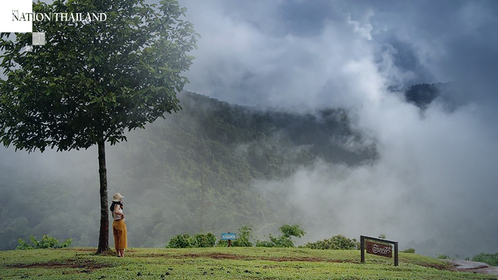
North: Cool to cold weather with fog in the morning; temperature lows of 16-22 degrees and highs of 31-35 degrees Celsius. Temperature on hilltops is likely to drop to 5-12 degrees Celsius.
Northeast: Cold weather with strong wind; temperature lows of 10-16 degrees and highs of 29-30 degrees Celsius. Temperature on hilltops is likely to drop to 8-13 degrees Celsius.
Central: Cool weather with strong wind; temperature lows of 17-21 degrees, highs of 33-35 degrees Celsius.
East: Cool weather with strong wind; temperature lows of 18-23 degrees, highs of 32-35 degrees Celsius; waves a metre high and 1-2 metres offshore.
South (east coast): Partly cloudy with thundershowers in 60 per cent of the area; temperature lows of 22-26 degrees, highs of 30-32 degrees Celsius; waves 2-4 metres high and over 4 metres during thundershowers.
South (west coast): Cloudy with thundershowers in 40 per cent of the area; temperature lows of 22-25 degrees, highs of 31-33 degrees Celsius; waves 1-2 metres high and 2 metres offshore.
Bangkok and surrounding areas: Cool weather with strong wind; temperature lows of 19-22 degrees, highs of 33-35 degrees Celsius.
Responding to complaints about the price of face masks sold by 7-Eleven stores, the Department of Internal Trade (DIT) said the products in question were not covered by the government’s Bt2.50 price control.
Department director general Wattanasak Sur-iam said his staff had checked 7-Elevens and found they were selling ordinary face masks, not the surgical masks whose price has been limited as part of virus-control measures.
However, under the regulation, the mark-up on the import price of ordinary masks must not exceed 60 per cent. The DIT has asked convenience store operators for the import prices of masks, to compare them with retail prices.
The director general said overpricing of masks carried a penalty of up to seven years in prison and/or a fine of Bt140,000.
Centre for Covid-19 Situation Administration (CCSA) spokesman Taweesin Visanuyothin apologised on Thursday for sparking public uproar with his threat of prison for people who conceal their travel information.
Netizens vented anger after Taweesin announced that people might be jailed for not installing the MorChana contact-tracing app on their phones. Social media users pointed out that many people don’t have smartphones capable of running apps.
Taweesin responded by apologising for the confusion on his personal Facebook. He clarified that the legal penalty only applied to Covid-positive individuals in the 28 “red” provinces who have no records of travel, including on the MorChana app. The penalty – up to two years in jail and/or a maximum fine of Bt40,000 – would be strictly applied in the five locked down provinces of Samut Sakhon, Chon Buri, Rayong, Chanthaburi and Trat, he said.
The MorChana app identifies the Covid status of users according to four colour codes – from green for low risk to red for high risk – and tracks their location.
Popular Facebook medic Mor Lab Panda (aka Parkpoom Dejhutsadin) said on Thursday afternoon that Taweesin had assured him that Covid patients who do not own a smartphone will not face charges if they cooperate with health officials. Parkpoom said the CCSA just wanted to encourage people to install the application as a powerful tool to investigate and track timelines.
Government Savings Bank (GSB) has postponed the Children’s Day occasion of opening special accounts for young people on January 9 in a bid to curb the spread of Covid-19.
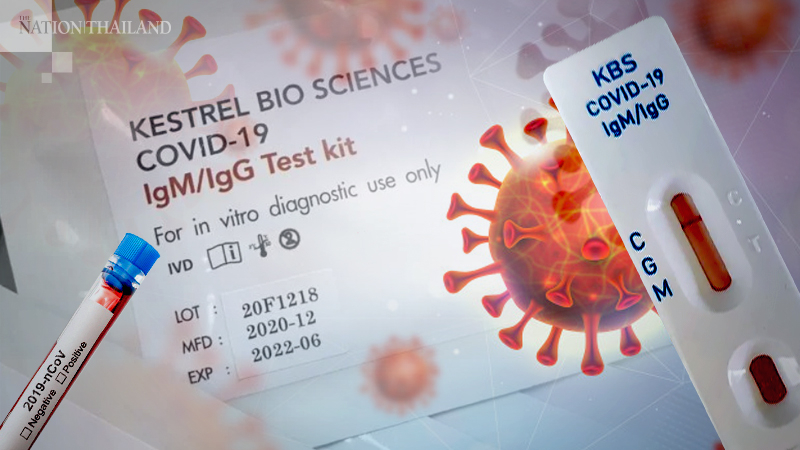
A research team from Prince of Songkla University’s (Hat Yai Campus) Faculty of Medical Technology has successfully designed Covid-19 detection kits under the concept of “easy, fast and accurate” testing, using 2-3 drops of blood from a person’s fingertips, with results being obtained within 15 minutes and at 99 per cent accuracy, according to the university.
Asst Prof Pengsakul,Theerakamol, who led the research team, said more than 90 per cent of Covid-19 cases are asymptomatic. Therefore, the test kit detects antibodies or immunity of an infected person as patients normally build immunity within 1-2 weeks.
The team designed a specific protein to detect Covid-19, using accurate gold nanotechnology. The result displays like a pregnancy detection kit and can indicate the stage of infection in four stages – those who have never been infected; early-stage infection; infected for a while; and infected for a long time.
The test kits have been standardised and can be used in real time. With a production capacity of 100,000 per day, the kits are also attracting international attention, including from the United States, India and Arab countries, he said.
The kits have not yet gone on sale to the general public because they are medical devices that require professional and legal certification.
Two tests kits have been developed:
The KBS kit was jointly developed by the research team and KBS company, which has passed FDA standards.
The PSU kit, developed by the university, is awaiting FDA assessment.
The Centre for Covid-19 Situation Administration (CCSA) has tightened control measures at five of the most at-risk provinces, namely Chanthaburi, Chonburi, Trat, Rayong and Samut Sakhon.
Strict travel measures and stringent screening checkpoints will be set up at these provinces, while residents will be tracked via smart phone applications and will be penalised if they violate the restrictions.
These measures are in line with the emergency decree, the authorities said.
CCSA spokesman Dr Taweesin Visanuyothin said these were not lockdown measures, but just an effort to slow down the transmission of the virus.
People who absolutely need to enter the maximum-controlled area must provide official identification documents along with proof of purpose of travel. Logistics personnel will also have to provide documents clarifying origin and destination of the cargo.
Each individual in these five provinces are required to register with the MorChana app, so their movements can be traced.
Police have been instructed to arrest anybody found to be involved in illegal labour smuggling, including officials who are negligent in their duties, allow the trafficking of workers or turn a blind eye to gambling dens. This negligence has been blamed for the new clusters of Covid-19 infections.
Offenders of the new measures will face up to two years in jail and/or a fine of up to Bt40,000.
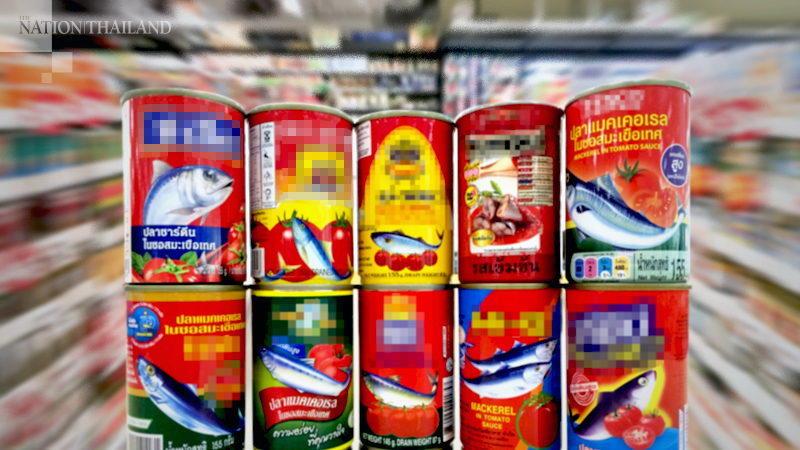
Thailand’s Food and Drug Administration (FDA) has said that canned fish is perfectly safe to consume. This announcement was in response to concerns raised after people heard rumours that 914 workers at a canning factory in Samut Sakhon had tested positive for Covid-19.
The Public Health Ministry debunked the rumour on Wednesday, saying the 914 cases came from several factories in the province, not just one factory as rumoured.
“Canning factories in Thailand follow good manufacturing practices [GMP] standards that require sterilisation of cans at 100 degrees Celsius or higher, which is hot enough to kill all germs, including the Covid-19 virus,” said Suphattra Boonserm, FDA’s deputy secretary-general.
“Once the food and cans are sterilised, nobody touches them directly so consumers should not be concerned about the virus being spread from infected workers.
“However, it is recommended that you wash the can clean before you open it,” she said.




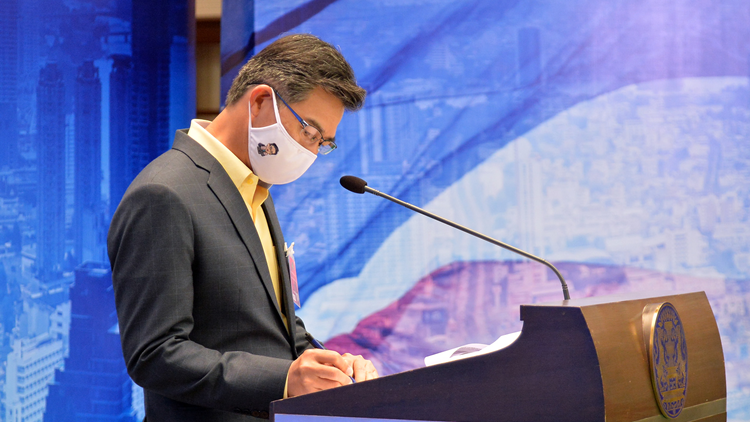 CCSA spokesman Taweesin Visanuyothin