Upper Thailand will continue to see a hot to very hot day with haze and isolated thundershowers as a heat low system accompanied by southerly and southeasterly winds prevail, the Meteorological Department said on Thursday.
It also said that due to an active low pressure cell over the Andaman Sea on April 1 and 2, the South will experience more rains with isolated heavy showers, waves and strong wind in the Andaman sea, with wave heights being about 2 metres and above 2 metres during thundershowers. The department advised all ships in the Andaman to proceed with caution and keep away from areas with thundershowers.
Here’s the weather forecast for the next 24 hours:
Bangkok and surrounding areas: Hot day with haze and isolated light rain; temperature lows of 27-28 degrees, highs of 36-39 degrees Celsius.
North: Hot to very hot with haze and isolated light rain; temperature lows of 21-28 degrees and highs of 38-41 degrees Celsius.
Northeast: Hot to very hot with haze and thundershowers in 20 per cent of the area; temperature lows of 23-27 degrees and highs of 38-40 degrees Celsius.
Central: Hot to very hot with haze and thundershowers in 10 per cent of the area; temperature lows of 26-27 degrees, highs of 37-40 degrees Celsius.
East: Hot with haze and thundershowers in 10 per cent of the area; temperature lows of 25-28 degrees, highs of 33-39 degrees Celsius; waves less than a metre high and 1 metre during thundershowers.
South (east coast): Thundershowers in 40 per cent of the area with gusty wind and heavy rains in some areas; temperature lows of 24-26 degrees, highs of 33-36 degrees Celsius; waves a metre high and 1-2 metres during thundershowers.
South (west coast): Mostly cloudy with thundershowers in 60 per cent of the area and heavy rains in some areas; temperature lows of 23-25 degrees, highs of 32-35 degrees Celsius; waves 2 metres high and over 2 metres during thundershowers.
The Digital Economy and Society Ministry is investigating mobile loan-shark apps after customers complained that the apps steal users’ data to send them threatening messages via Facebook, Line and SMS.
The personal data is hacked by malware embedded in the mobile phone when the borrower installs the application, complainants said.
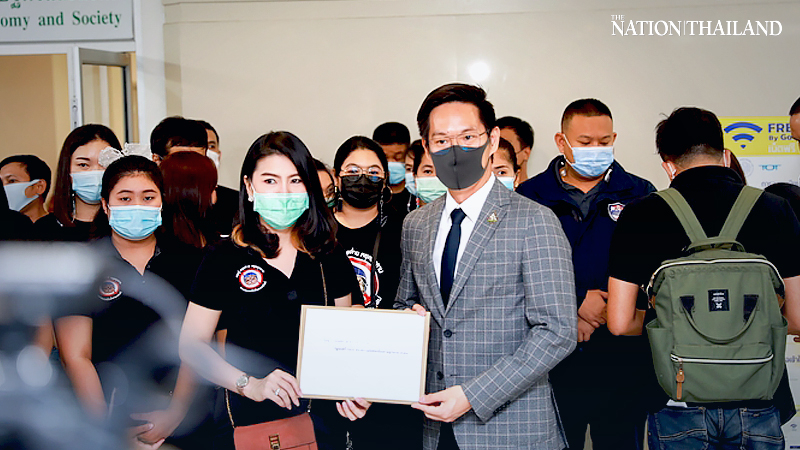
Newin Chochaiyathip, assistant to the Digital Economy and Society minister, said the ministry had received a letter from a group of people who said their mobile phone data had been hacked by illegal loan apps, leading to intimidation and harassment.
In response, the ministry was coordinating with police and had contacted the operating system providers, Apple Inc (iOS) and Google (Android), to combat the mobile loan sharks, Newin said.
The ministry was taking urgent steps to resolve the problems since the case had caused widespread damage, he added.
However, he said the best way to deal with the problem was for borrowers to use caution when taking loans online. If an app’s interest rates were unusual or illegal, he advised users to report it to the police and delete the app.
More than 2,000 customers have reported loan apps for hacking their mobile phone data, including contact lists, images and videos, mobile banking, location, SMS message box, and Facebook and Line accounts.
When a borrower fails to make a payment on time, the app calls or sends a message via SMS, Line or Facebook. The messages often use impolite, vulgar or threatening language, even threatening the user’s life unless they pay up.
Despite some advances, children in the far South remain more disadvantaged in key areas such as nutrition, immunisation, availability of books at home, basic learning skills and secondary school attendance, according to a Unicef-supported survey by the National Statistical Office (NSO) released today.
Drawing on data from a national survey conducted in May-November 2019, the report identifies issues impacting the well-being and development of children in Songkhla, Satun, Pattani, Yala and Narathiwat.
“I am encouraged to see evidence that Thailand has made considerable progress in several areas of child well-being in the far South,” said Kyungsun Kim, Unicef representative for Thailand.
“[But] thanks to the National Statistical Office we now have evidence that too many children in the far South remain malnourished, vulnerable to serious diseases, out of school and lacking skills and resources to learn at home and school – setting them back not just a few years behind their peers in other provinces but for a lifetime.”
Kim added that the data was collected before the Covid-19 pandemic, so the situation now was even more concerning. “The pandemic must be seized as an opportunity to invest in these key areas for children’s well-being so that those most in need can grow up healthy, develop to their full potential and contribute to the progress and well-being of society no matter where they come from,” she added.
The survey shows positive trends in the far South, including a lower proportion of children not living with their parents (5-15 per cent) compared with the average of 24 per cent in other regions. Child protection has also improved with all five southernmost provinces seeing lower adolescent birth rates.
Yet the survey also highlights an alarming trend of childhood malnutrition in the far South. In Pattani, Yala and Narathiwat provinces, around 23 per cent of children under 5 are stunted or have a low height-for-age. These stunting rates are almost double the national average of 13 per cent.
Narathiwat province also has the highest rate of wasting or low weight-for-height among the 17 provinces surveyed. About 16 per cent of children under 5 are wasted, while the national average stands much lower at 8 per cent. The wasting rate in Pattani province is also concerning at 10 per cent.
Immunisation is also a major concern in the far South. While 82 per cent of 1-year-olds in Thailand are fully immunised, almost half of their peers in Narathiwat province are not.
Also, while 34 per cent of children under 5 in Thailand have three or more books at home, fewer than 27 per cent in the five southernmost provinces do. Hardly any children under 5 in Narathiwat province have books at home at 3 per cent, the survey shows.
While almost all primary school age children in the far south are attending school, few have skills that make learning possible. Thirty-six to as low as 18 per cent of children of ages 7-8 in Narathiwat, Songkhla, Pattani and Yala provinces can successfully complete three foundational reading tasks – far lower than the national average of 52 per cent. Only 32 per cent and 12 per cent of children of ages 7-8 in Yala and Pattani provinces are able to complete four foundational numeracy tasks, respectively, compared with the national average of 47 per cent.
Children in the far South are out of school at much higher rates than across the country. Five to 8 per cent of lower secondary school-age children in Narathiwat, Songkhla, Pattani and Satun provinces are out of school, above the national average of 3 per cent. This gap further widens with 19-36 per cent of upper secondary school-age children in Pattani, Songkhla and Narathiwat provinces out of school, while the national average is 18 per cent.
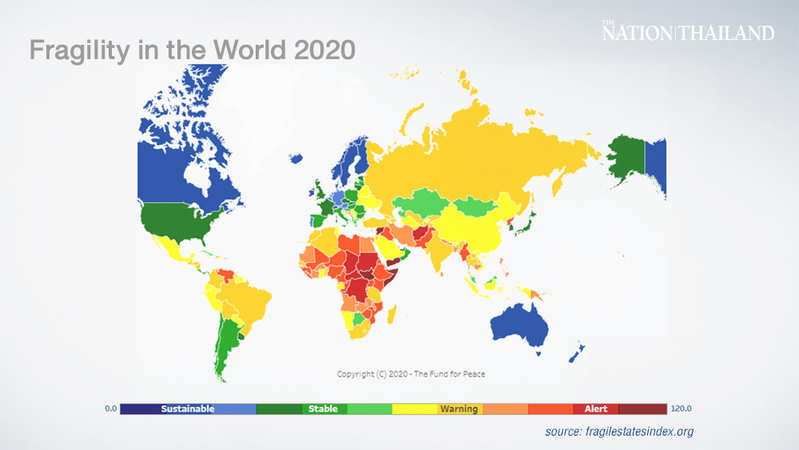
Thailand is ranked 82nd in the latest annual Fragile States Index published by the Fund for Peace (FFP), a US-based thinktank.
Formerly known as the Failed States Index, the list measures 178 countries’ vulnerability to collapse by assessing their political, social and economic pressures.
Countries are given a score from 0-120, with 120 representing “most fragility”.
The FFP’s Fragile States Index of 2020 ranks war-torn Yemen in first place with a score of 112.4.
Next come Somalia, South Sudan and Syria.
These countries are classified as “very high alert” fragile states.
Countries with the lowest index score and classified as “highly sustainable” are led by Finland at 14.6, followed by Norway, Switzerland and Denmark.
The 2020 index ranks Thailand in 82nd place with an index score of 70.8, slightly up from its 2019 ranking at 77th place with 73.1, but still in the “elevated warning” group together with Laos, India, Brazil and Russia.
Myanmar is the most fragile state among Southeast Asia nations, with a ranking of 22nd and an index score of 94. Myanmar is in the “alert” group together with Iraq, Libya, Venezuela and North Korea. However, the index does not take into account the effect of the February 2021 military coup on Thailand’s neighbour.
Said FFP executive director JJ Messner de Latour: “There is still widespread fragility and vulnerability, plenty of poverty and inequality, and conflict and illiberalism. But broadly speaking, over the long term, the world is becoming steadily less fragile.”
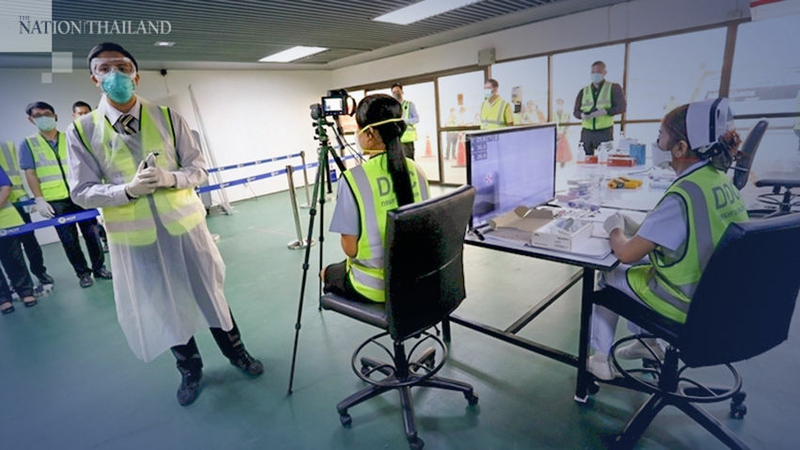
From Thursday (April 1), Thailand will reduce its quarantine period for foreign travellers with Covid-19 vaccination certificates from 14 days to 10 days.
However, travellers from 11 countries where the South African variant of coronavirus is prevalent will still have to undergo the full 14-day quarantine period, according to the Department of Disease Control.
Travellers from the following African countries, both Thai returnees and foreign nationals, will have to spend 14 days in Thai quarantine:
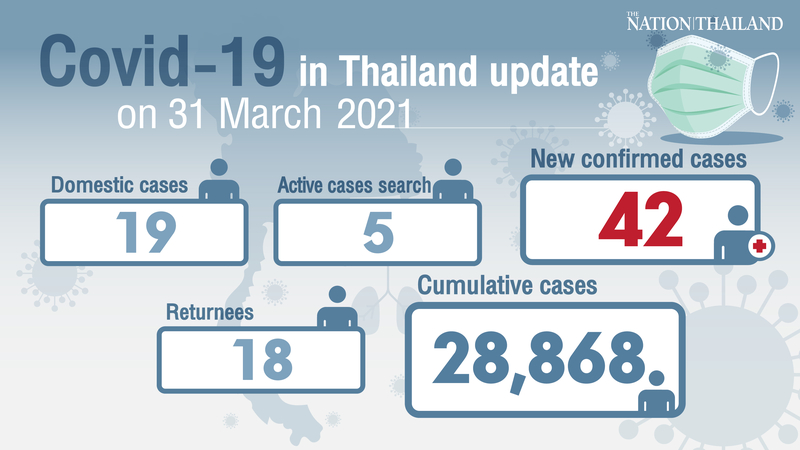
The Centre for Covid-19 Situation Administration (CCSA) on Wednesday reported 42 new cases, 18 of whom are returnees and illegal border crossers.
Of the total, 19 were exposed to the virus while visiting high-risk areas, with Bangkok and Samut Sakhon leading the list with eight cases each, followed by three in Samut Prakan.
Apisamai Srirangsan, assistant CCSA spokesperson, said the cases include a 28-year-old woman working in the kitchen of a Bangkok hotel being used as an alternative quarantine facility, who came in close contact with eight family members and workmates. The woman lives in Samut Prakan.
She tested positive on March 22 after developing a fever and losing her sense of smell and taste.
Health officials learned that her job at the hotel was serving food to quarantined people and taking out the trash. The patient confessed she sometimes forgot to wear gloves and clean her hands properly after taking out the trash. Officials are now tracing everybody she may have come close in contact with.
Proactive tests, meanwhile, have led to the discovery of five cases – two in Bangkok and three in Samut Sakhon.
Of the 18 returnees, nine are Thai nationals, two Filipino ship crew, and a traveller each from Pakistan, Holland, Malaysia, Britain and Canada. Two Thais were also arrested at Thailand’s borders with Malaysia and Myanmar on March 16 and found positive on March 27.
Meanwhile, 47 patients have recovered and been discharged. As of Wednesday, the number of confirmed cases in Thailand had risen to 28,863. Of them, 25,766 had contracted the virus locally, including 16,062 who were found via proactive testing, while 3,097 were returnees.
So far, 27,426 people have recovered and been discharged, 1,343 patients are still being treated, and the death toll remains at 94.
According to Worldometer, as of 10am, the number of confirmed cases globally has risen to 128.82 million (up by 541,919), 103.95 million have recovered, 22.05 million are active cases (95,876 in severe condition) and 2.82 million have died (up by 10,866).
Thailand ranks 116th on the global list of most cases, which is topped by the US with 31.1 million, followed by Brazil at 12.66 million, India at 12.15 million, France at 4.59 million and Russia 4.53 million.
No boats will be plying Bangkok’s Saen Saeb canal from April 11 to 15 because the company running the service is giving its 350-strong team of drivers and fare collectors a Songkran break for the first time in two years.
The company, Family Transport, said suspending services during the Songkran break was reasonable because there will not be many commuters during that period.
Close to 18,000 people use the Saen Saeb canal boat service daily, especially during the 6am to 9am and 3pm to 7.30pm rush hour, Family Transport said. It operates some 55 boats in the Saen Saeb canal route.
The operator believes the number of daily commuters will return to 40,000 or 50,000 once the Covid-19 situation improves and Thailand opens its doors to foreigners.
The boat operator was severely affected when the virus hit Thailand in April 2020 and the number of commuters dropped to less than 5,000 daily, resulting in a loss of Bt15 million per month.
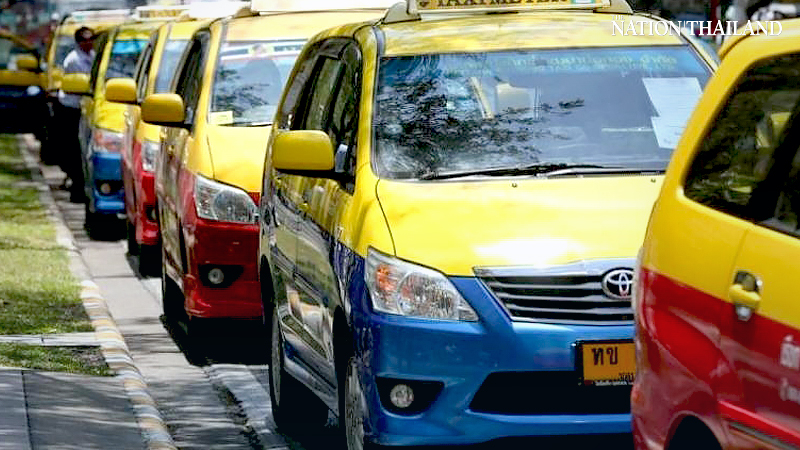
The Royal Gazette website on Wednesday published a Transport Ministry announcement that extends the service life of taxis from nine to 12 years, to be effective retroactively from January 21.
The announcement, signed by Department of Land Transport director-general Jirut Wisanjit, stipulates that taxis with less than seven seats registered from December 26, 2008, to December 31, 2020, will have a service life of 12 years starting from the date that its fare meter is first used after being issued by the department.
The measure was approved by the Cabinet back in September 2020 in a move to reduce the financial burden on cabbies during the Covid-19 crisis.
More than 80 participants representing the Thai government, academia, non-governmental organisations and the private sector convened at Bangkok’s Pullman Hotel for the launch of the Green Climate Fund (GCF)-financed programme titled “Increasing resilience to climate change impacts in marine and coastal areas along the Gulf of Thailand”.
The GCF approved a US$3-million (Bt93.6 million) grant for Thailand – to be implemented by UNDP – over a four-year period starting August 2020.
The programme was developed in collaboration between the Office of Natural Resources and Environmental Policy and Planning (ONEP), the Department of Marine and Coastal Resources, both under the Natural Resources and Environment Ministry, and UNDP in Thailand.
The project was launched with key partners discussing its concept, objectives and expected outcome, and the overall implementation plan.
Thailand’s coastal zones are rich with biodiversity, marine life and mangroves that are distributed along both coasts of 24 provinces. With Thailand located in the monsoon region, it is highly susceptible to extreme climate events, such as sea-level rise, flooding, cyclones and erosion. Healthy mangrove systems offer tremendous protection to coastal communities against storm surges and coastal erosion; they are also critical nursery areas that help support local fisheries and overall marine biodiversity.
With more than 1 million tourists visiting Phang-nga Bay annually, Thailand is working to protect and adapt its marine and coastal areas to global warming. Climate change will impact local tourism, agriculture, fisheries and aquaculture and natural resources, while creating additional stress on land and water resources.
To address this issue, the new programme will support the kingdom in advancing its climate change adaptation planning in relation to marine and coastal areas in the Gulf of Thailand.
In addition, the programme aims to contribute towards several Sustainable Development Goals as outlined in the 2030 agenda, including gender-responsive solutions to reduce disaster risks, enabling climate change adaptation and mitigation.
The new GCF-financed programme is an important contribution to Thailand implementing its National Adaptation Plan (NAP) that was finalised in 2018. Throughout the implementation of the NAP, the programme will utilise best practices and information from other interventions, such as the Safe Marine for Life project implemented by the Department of Marine and Coastal Resources, and will meaningfully expand the knowledge and regulatory framework, particularly for sub-national levels.
The programme will ensure close coordination among provincial-level agencies to set aside a budget for fishermen and farmers along coastal areas to better adapt to natural disasters, such as tropical storms, and keep beaches clean in order to maintain eco-friendly tourist destinations.
“I hope this programme will serve as a mechanism for cooperation among our two agencies and drive the implementation of the adaptation process considering climate change factors along Thailand’s coastal areas to create climate resilience,” said Raweewan Bhuridej, ONEP secretary-general. “This will contribute to Thailand’s 20-year strategy as well as the Sustainable Development Goals.”
Within the framework of Thailand’s nationally determined contribution under the Paris Agreement, climate change adaptation is noted as being a “top priority in Thailand’s national response to climate change”.
To date, Thailand’s GCF-financed programme has focused on NAP preparation, national climate risk modelling and a vulnerability analysis.
“The UNDP is a long-time partner of Thailand when it comes to climate action and we have been working with our Thai partners at both the policy level and local communities on mitigation and adaptation measures,” UNDP resident representative in Thailand Renaud Meyer said during the launch.
“This new GCF-funded project is timely and will provide a great platform to apply the Bio-Circular-Green development model promoted by Thailand as part of the Covid-19 recovery.”
He also emphasised the need to redefine the relationship between humans and nature to ensure win-win cohabitation. Involving coastal communities in this effort is both urgent and required to strengthen the resilience of Thailand, safeguard progress towards the Sustainable Development Goals and continue with efforts towards sustainability.
At the country level, the ONEP will act as a key government agency to coordinate and seek collaboration from 12 other relevant Thai government agencies.
The programme seeks to build additional partnerships with interested development parties, including international organisations, civil society organisations, academic institutions and the private sector.
Linkages will be made to this programme through integrated approaches to mainstreaming and piloting adaptation responses in key NAP sectors, including tourism, agriculture, health, and human settlements.