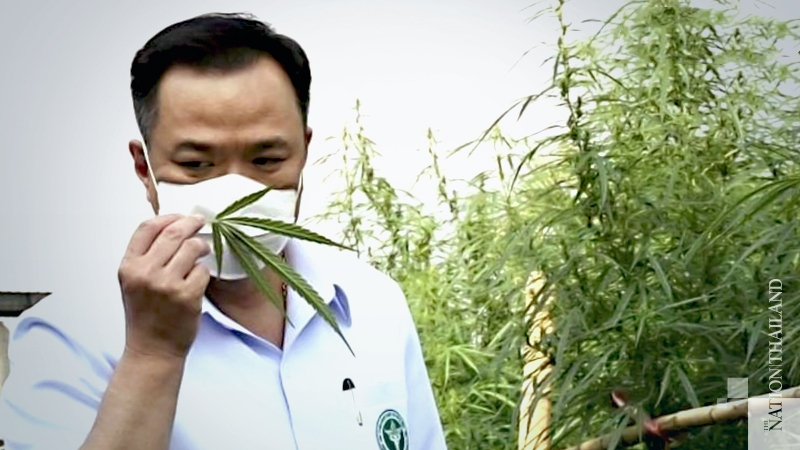
A group of households in Buri Ram’s Non Malai area will receive ganja plants on Thursday as part of a pilot project allowing the cultivation of marijuana for commercial purposes.
Dr Kitti Losuwannarak, director of the Public Health Ministry’s medical ganja research group, said six cannabis plants will be given to each member of the Non Malai Community Enterprise.
He said flowers from these plants will be bought for use at the provincial Khu Muang Hospital, and other parts of the plants will be processed as health products.
CentralPlaza Nakhon Ratchasima has prepared a dragon made from 160 kilos of sea salt to welcome the Year of the Ox.
The four-metre high and 35m-long dragon, which was unveiled on Wednesday as part of the “Central Korat the Great Chinese New Year 2021” event, took 27 days to complete.
In Feng Shui, salt is believed to repel bad luck, while scientifically salt is said to kill certain types of bacteria and absorb moisture.
As part of the Chinese New Year celebrations, the mall has organised the traditional dragon and tiger dance and will put on display a 100-year-old wooden statue of the Goddess of Mercy. It is also setting up a salt spa workshop and a food fair. The festivities will last until Sunday, the last day of Chinese New Year.
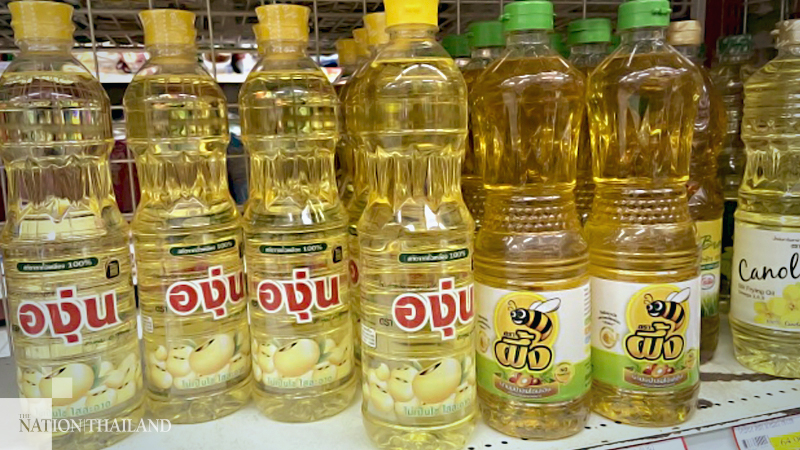
The Commerce Ministry’s Department of Internal Trade has asked manufactures and distributors of bottled palm cooking oil to fix the price for as long as possible to alleviate the financial burden faced by consumers after the crude palm price jumped to Bt7.5 per kilogramme.
“We also urge consumers to use an alternative to palm oil, such as soybean oil, the price for which has not changed much, until the oil palm price stabilises, which we estimate will be around the end of March,” said department deputy director-general Watthanasak Sua-Iam.
The price of crude palm has been increasing steadily from Bt3-Bt3.5 in mid-2020 to Bt7 at the end of last year. This has resulted in the crude palm oil price jumping to Bt39 per kilogramme, in turn raising the price of bottled palm cooking oil to Bt46-Bt48 per litre.
The department had previously revoked price ceilings for palm and soybean cooking oils so these prices would reflect the true cost of production. The ceiling for palm oil had been set at Bt42 per litre and for soybean oil Bt55 per litre.
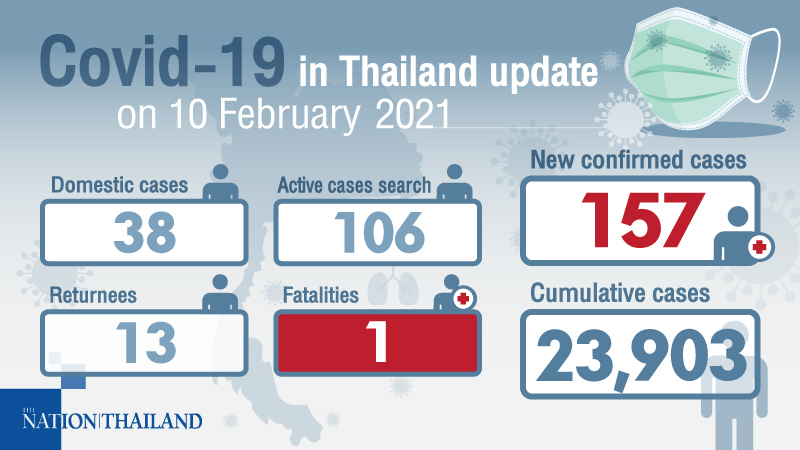
The Centre for Covid-19 Situation Administration (CCSA) on Wednesday reported one death and 157 new cases in 24 hours, eight being returnees in quarantine facilities.
Thirty-eight people contracted Covid-19 after visiting high-risk areas. Samut Sakhon leads the list with 28 cases.
Meanwhile, proactive testing led to the discovery of 106 cases, most found in Samut Sakhon – 104 – followed by two in Samut Songkhram.
The 80th death is a Samut Sakhon woman, 65, who had laryngeal cancer, hyperlipidemia and chronic kidney disease. She got infected by one of her family after five of the eight members contracted the virus. She was found to be infected when she went to a private hospital on December 29 for dialysis. Doctors spotted her shivering before dialysis and ran a test, leading to the positive result on January 1. Her condition worsened after she was transferred to a hospital in Bangkok. She had difficulty breathing and was put on a respirator. She had bleeding around her tracheostomy tube and fungus was found in her blood. She passed away on February 8 after her heart rate dropped drastically.
Of the returnees, three are Thais who returned from Malaysia, Philippines and the United States. A Kuwaiti, an Argentinian, an Indian, a Japanese, and an American who flew in from their respective nations were also found positive.
It was also reported that five Indonesian aircrew, who sought temporary stay in Thailand on January 31, were found positive on February 3-4 and taken to a private hospital in Chon Buri.
Meanwhile, 548 patients have recovered and been discharged.
As of Wednesday, the number of confirmed cases in Thailand has risen to 23,903. Of these, 21,329 had been contracted locally, including 13,545 who were found via proactive testing, while 2,574 were returnees. So far, 18,914 have recovered and been discharged, 4,909 patients are undergoing treatment (2,593 in hospital and 2,316 in field hospitals) and the death toll has increased to 80.
According to Worldometer, as of 10am the number of confirmed cases globally had risen to 107.41 million (increasing by 383,614 in 24 hours), 79.47 million have recovered, 25.59 million are active cases (102,583 in severe condition) and 2.35 million have died (up by 13,166).
Thailand ranks 114th on the global list of most cases, which is topped by the US with 27.8 million, followed by India 10.86 million, Brazil 9.6 million, Russia 3.99 million and the United Kingdom 3.97 million.
ITU to advance AI capabilities to contend with natural disasters
NationalFeb 10. 2021Muralee Thummarukudy, operations manager for Crisis Management at UNEP
By THE NATION
The International Telecommunication Union (ITU) – the United Nations specialised agency for information and communication technologies – has launched a new focus group to contend with the increasing prevalence and severity of natural disasters with the help of artificial intelligence (AI), the union said in press release on Tuesday.
In close collaboration with the World Meteorological Organisation (WMO) and the United Nations Environment Programme (UNEP), the ITU Focus Group on AI for natural disaster management will support global efforts to improve world understanding and modelling of natural hazards and disasters. It will distill emerging best practices to develop a road map for international action in AI for natural disaster management.
The group’s first meeting is scheduled for March 15-17. Participation is open to anyone interested.
“With new data and new insight come new powers of prediction able to save countless numbers of lives,” ITU secretary-general Houlin Zhao said. “This new focus group is the latest ITU initiative to ensure that AI fulfils its extraordinary potential to accelerate the innovation required to address the greatest challenges facing humanity.”
Clashes with nature impacted 1.5 billion people from 2005 to 2015, with 700,000 lives lost, 1.4 million injured and 23 million left homeless, according to the Sendai Framework for Disaster Risk Reduction 2015-2030 developed by the UN Office for Disaster Risk Reduction.
AI can advance data collection and handling, improve hazard modelling by extracting complex patterns from a growing volume of geospatial data, and support effective emergency communications.
The new focus group will analyse relevant use of AI to deliver technical reports and accompanying educational materials, addressing these three key dimensions of natural disaster management, the press statement said.
Its study of emergency communications will consider both technical as well as sociological and demographical aspects of these communications to ensure that they speak to all people at risk.
“This focus group looks to AI to help address one of the most pressing issues of our time,” noted the chairwoman of the group, Monique Kuglitsch, innovation manager at ITU member Fraunhofer Heinrich Hertz Institute. “We will build on the collective expertise of the communities convened by the ITU, WMO and UNEP to develop guidance of value to all stakeholders in natural disaster management. We are calling for the participation of all stakeholders to ensure that we achieve this.”
Muralee Thummarukudy, operations manager for Crisis Management at UNEP, explained: “AI applications can provide efficient science-driven management strategies to support four phases of disaster management: mitigation, preparedness, response and recovery. By promoting the use and sharing of environmental data and predictive analytics, UNEP is committed to accelerating digital transformation together with ITU and WMO to improve disaster resilience, response and recovery efforts.”
The focus group’s work will pay particular attention to the needs of vulnerable and resource-constrained regions. It will make special effort to support the participation of the countries shown to be most acutely impacted by natural disasters, notably small island developing states and low-income countries, the statement said.
“The WMO Disaster Risk Reduction Programme assists countries in protecting lives, livelihoods and property from natural hazards, and it is strengthening meteorological support to humanitarian operations for disaster preparedness through the development of a WMO Coordination Mechanism and Global Multi-Hazard Alert System,” WMO chief scientist and director of Science and Innovation Jürg Luterbacher said.
“Complementary to the focus group, we aim to advance knowledge transfer, communication and education – all with a focus on regions where resources are limited,” he added.
A 27-year-old Nakhon Phanom resident was on Tuesday charged with cruelty, assault and illegal detention of a minor aged under 15.
On February 3, local photographer Tawatchai Tanthong 38, reported his ex-wife Sudarat Muntha’s cruelty to their seven-year-old son after noticing several bruises on the boy’s body.
The child, who had mainly been raised by Sudarat, a lottery seller, after they separated, had allegedly been hit by clothes hangers and kicked.
The woman reportedly confessed to hitting her son out of anger because he had stolen money from her and was very naughty.
The boy was taken on Tuesday to the Shelter for Children and Families in Nakhon Phanom for care. Whether the child is returned to his family will depend on officials’ discretion.
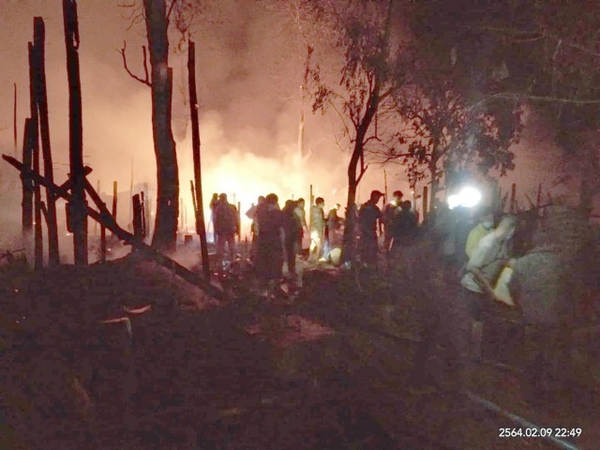
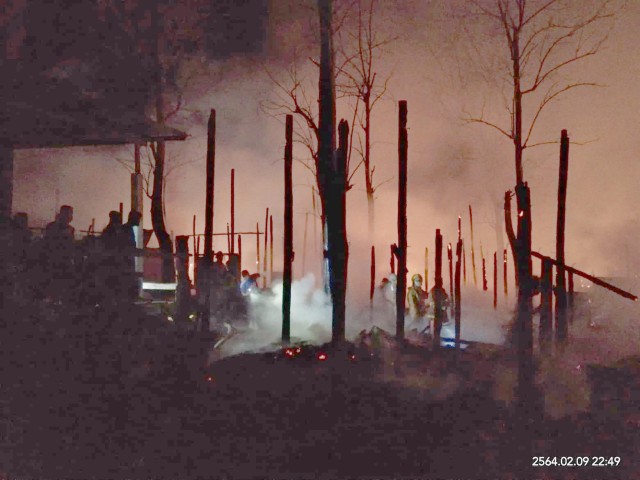
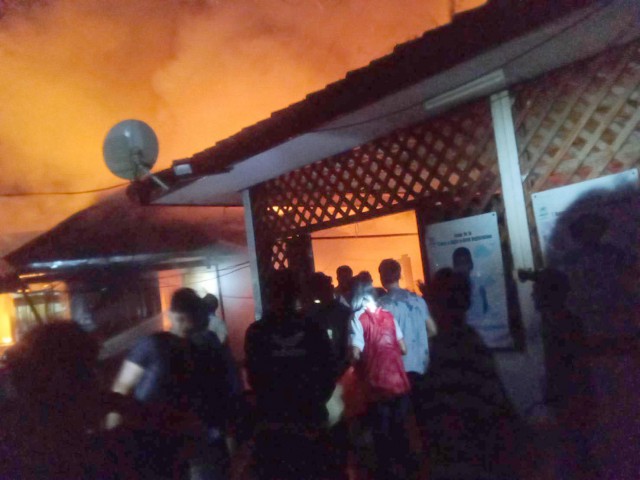
Fire swept through one the biggest refugee camps on the Thailand-Myanmar border, in Mae La subdistrict in Tak’s Tha Song Yang district, destroying more than 50 shelters. No injuries or deaths were reported.
Tha Song Yang sheriff Yongyut Suksiri reported on Wednesday that the Mae La refugee camp was ablaze at 9.30pm on Tuesday. More than 50 refugee shelters, including one for volunteers, went up in flames.
The roof of the registry building and temporary shelters were quickly dismantled to create a line to prevent the fire from spreading.
The blaze was finally extinguished at 11.20pm.
All refugees affected by the fire have been allowed to live with their relatives.
The United Nations High Commissioner for Refugees in Tak will provide assistance so new structures can be built.
The cause of the fire is still unknown.
A volunteer guarding the temporary shelter noticed a fire behind the refugee camps in Zone C3a and sounded the alarm as the blaze spread quickly to the office area and the temporary shelter.
PM appears on TikTok to wish Thais a ‘healthy, prosperous’ Year of the Ox
NationalFeb 10. 2021Prime Minister Prayut Chan-o-cha
By The Nation
Prime Minister Prayut Chan-o-cha went on widely popular TikTok on Wednesday to wish Thais for Chinese New Year.
The prime minister’s TikTok account name is “Thai Khu Fah”.
“I pray to all sacred things in the world to bestow upon Chinese and Thai people health and prosperity,” he said.
In Chinese culture and in East Asian countries, the festival is commonly referred to as the Spring Festival, as the spring season in the lunisolar calendar traditionally starts with “lichun”, the first of the 24 solar terms which the festival celebrates around the time of the Lunar New Year.
Rayong is allowing restaurants, pubs, bars, karaoke parlours and karaoke booths to open until 11pm from today, while massage parlours, traditional massage shops, spas, tattoo parlours, swimming pools, indoor stadiums, amulet shops and fitness centres can also open as usual.
Parties and seminars have additionally been given the go-ahead, but cannot allow more than 300 people at any given time and must have proper anti-Covid preventive measures in place.
However, chicken fighting or cattle fighting grounds and “fighting fish” sites must remain shut until further notice.
Rayong Governor Channa Iamsaeng said on Tuesday that the province has not found any new Covid-19 case for the ninth day in a row. The cumulative total was 580 cases, with 570 having recovered and the others undergoing hospital treatment and expecting to be released in a few days.
The overall situation in the province was improving, he said.
He added that Rayong would hold a Valentine’s Day activity to stimulate tourism. The event, called “Release sweet clams and create sweet love at Rayong Aquariam”, will feature a rich variety of seafood and Otop products on sale. Entry is free for tourists.
A Cabinet meeting on Tuesday approved a motion proposed by the Education Ministry to increase the lunch budget for students by 5 per cent, or to Bt21 per person per day, government spokesman Anucha Burapachaisri said.
“The ministry reported that the lunch budget would cover students from Anuban 1 [kindergarten] to Prathom 6 [Grade 6] levels in 49,861 schools nationwide, totalling 5,894,420 students,” he said.
“The total required budget is Bt25.43 billion, which will be distributed by local government organisations and the Education Ministry’s office of permanent secretary.”
Anucha said the adjustment of the budget aims to conform to the current economic situation while focusing on providing nutritious food in adequate quantity to school children.
“The ministry estimates that the new lunch budget will be implemented by October 1, in time for the 2nd semester of 2021 on November 1,” he added.
Earlier, in September last year, the Cabinet approved the increase of the lunch budget to Bt20 per student per day from the previous rate of Bt13 since 2008, after the Office of the Basic Education Commission suggested that the suitable budget for school children’s lunch should be Bt24-36 per person per day.




 Muralee Thummarukudy, operations manager for Crisis Management at UNEP

 Prime Minister Prayut Chan-o-cha