PTTEP announces 5-year investment plan

#ศาสตร์เกษตรดินปุ๋ย : ขอบคุณแหล่งข้อมูล : หนังสือพิมพ์ The Nation

https://www.nationthailand.com/business/30379492?utm_source=category&utm_medium=internal_referral

PTTEP announces 5-year investment plan

Dec 16. 2019
By THE NATION

1,349 Viewed

PTT Exploration and Production (PTTEP) has announced a five-year investment plan to focus on investing in legacy assets through its “Execute” strategy after recently acquiring projects to increase production volumes and sustain the company’s growth.

PTTEP president and chief executive officer Phongsthorn Thavisin said the company has set aside approximately Bt143 billion ($4.61 billion) for PTTEP and its subsidiaries in 2020, of which Bt82 billion is capital expenditure and Bt60.94 billion operating expenditure.

The company is allocating Bt716.2 billion under its five-year investment plan running from 2020 to 2024.

The expected compound annual growth rate during the 2020-2024 period of average petroleum sales from existing assets is around 6 per cent.

“Based on the investment plan in 2020, PTTEP expects an increase of 11 per cent of total petroleum sales compared to this year’s target,” Phongsthorn said.

The growth is the result of its Expand strategy, which includes acquisitions in Thailand, Malaysia and the Middle East.

“Most of the 2020 investment budget will be allocated to pursue its Execute strategy in order to maintain production volumes and concentrate on key development projects, besides accelerating exploration activities to add to future reserves and for the sustainable growth of PTTEP,” Phongsthorn said.

PTTEP in 2020 will focus on “maintaining its production plateau of existing projects, increase future petroleum production volumes from major development projects in Malaysia, Mozambique and Algeria, and accelerate exploration activities mainly in Malaysia and Myanmar, to enhance contingent resources for supporting long-term growth”.

The company is also focusing on innovation and technology development to support petroleum exploration, development and production activities.

PTTEP subsidiary AI and Robotics Ventures Limited (ARV) has been able to commercially launch services for both the petroleum exploration and production (E&P) industry and the non-E&P industry by employing inspection drones, swarm drones, and an Observation-class Autonomous Underwater Vehicle.

In 2020, ARV will develop robotics for commercial use, such as the Inspection-class Autonomous Underwater Vehicle, the Subsea Flowline Control and Repair Robot and the In-pipe Inspection Robot. ARV plans more than 30 development projects for upcoming years.
U.S. stocks start week on record-setting pace

#ศาสตร์เกษตรดินปุ๋ย : ขอบคุณแหล่งข้อมูล : หนังสือพิมพ์ The Nation

https://www.nationthailand.com/business/30379525?utm_source=category&utm_medium=internal_referral

U.S. stocks start week on record-setting pace

Dec 17. 2019
By Syndication Washington Post, Bloomberg · Sarah Ponczek, Yakob Peterseil 

359 Viewed

U.S. equities climbed to a new high Monday amid hopes that a partial trade deal between America and China will ease a key risk for investors heading into year-end. Treasuries and the dollar fell.

With tech and health-care leading the charge, the S&P 500 index rose in the wake of the agreement, which will see Washington reduce tariffs and Beijing increase purchases of American farm goods, although many details are still to be ironed out. In another positive sign, the Federal Reserve Bank of New York’s survey measure of general business conditions in the next six months jumped to a five-month high.

The Stoxx Europe 600 also hit a new peak as it jumped for a fourth day. The U.K.’s FTSE 100 index reached a 19-week high. Stocks were mixed in Asia, but equities in Shanghai rose after Chinese data showed industrial output and retail sales both exceeded expectations.

The announcement of the preliminary U.S.-China deal staved off a scheduled Dec. 15 tariff hike, a prospect that had loomed large for markets. It remains unclear how China will follow through on pledges to boost American agricultural imports, or how quickly the U.S. promise to roll back half of a September tariff hike will happen.

“Now that the ‘good news’ is here, what is next for stocks? This week should be the last week with any decent volume as investors head for home for Christmas and the New Year’s holiday,” Paul Nolte, a portfolio manager at Kingsview Asset Management in Chicago, wrote to clients. “Slow volume should also mean modest moves in stocks, so investors should be able to sleep easy and dream of sugar plum fairies to close out a very good year.”

Still, China’s threat of retaliation against Germany if it excludes Huawei Technologies Co. as a supplier of 5G wireless equipment shows that tensions remain high elsewhere. Also, the U.S. spent Monday acting to ease Mexico’s concerns over labor monitors under the USMCA trade deal.

Elsewhere, oil hovered near a three-month high and gold held steady. Bitcoin slipped below $7,000.

Here are some key events to watch for this week:

–Policy decisions are due Thursday from the Bank of Japan and the Bank of England.

–Federal Reserve district bank presidents including Robert Kaplan of Dallas, Eric Rosengren of Boston and John Williams of New York are scheduled to speak this week.

–Revised U.S. GDP data are due Friday.

–Friday brings quadruple witching in the U.S., the simultaneous expiration date of stock index futures, stock index options, stock options and single stock futures. Expect elevated trading volume, particularly in the last hour of trading.

These are the main moves in markets:

Stocks

-The S&P 500 index gained 0.7% to 3,191.40 as of 4:00 p.m. New York time, the highest on record.

-The Stoxx Europe 600 index gained 1.4% to 417.75, the highest on record with the biggest rise in more than two months.

-The U.K.’s FTSE 100 index increased 2.3% to 7,519.05, the highest in more than 19 weeks on the largest climb in almost a year.

-Germany’s DAX index rose 0.9% to 13,407.66, the highest in almost 23 months on the biggest advance in more than a week.

-The MSCI Emerging Market index increased 0.3% to 1,089.76, the highest in eight months.

Currencies

-The Bloomberg Dollar Spot index declined 0.2% to 1,192.66, the lowest in five months.

-The euro climbed 0.2% to $1.1144, the strongest in more than six weeks.

-The British pound increased 0.1% to $1.3343, the strongest in 18 months.

-The Japanese yen depreciated 0.2% to 109.57 per dollar, the weakest in almost seven months.

Bonds

-The yield on 10-year Treasuries climbed six basis points to 1.88%.

-Germany’s 10-year yield increased one basis point to -0.28%.

-Britain’s 10-year yield gained three basis points to 0.822%, the highest in about five months.

Commodities

-West Texas Intermediate crude rose 0.3% to $60.23 a barrel, the highest in three months.

-Gold was little changed at $1,476.45 an ounce, the highest in almost two weeks.

Oil near three-month high on cautious optimism over trade deal

#ศาสตร์เกษตรดินปุ๋ย : ขอบคุณแหล่งข้อมูล : หนังสือพิมพ์ The Nation

https://www.nationthailand.com/business/30379517?utm_source=category&utm_medium=internal_referral

Oil near three-month high on cautious optimism over trade deal

Dec 17. 2019
By Syndication Washington Post,  Bloomberg · Elizabeth Low, Grant Smith 831 Viewed

Oil steadied near a three-month high on cautious optimism that a preliminary trade deal between the U.S. and China will support global fuel consumption.

Futures held near $60 a barrel in New York after settling at the highest since Sept. 16 on Friday. The deal involves China buying more American farm products and making new commitments on intellectual property, while the U.S. will suspend new levies and halve existing tariffs on $120 billion of Chinese imports. It’s expected to be signed and released publicly in early January.

While the partial trade deal leaves most of the tariffs built up over the 20-month conflict in place, it’s adding to a more positive outlook for oil prices, which were already drawing support from deeper-than-expected production cuts announced this month by OPEC and its partners. Hedge funds increased net-bullish wagers on West Texas Intermediate crude by the most in three years in the week through Dec. 10.

“The latest Christmas present for oil bulls is a long-awaited trade agreement between the U.S. and China,” Citigroup Inc. analysts including Francesco Martoccia said in a report.

WTI for January delivery was little changed at $60.08 a barrel on the New York Mercantile Exchange at 8:16 a.m. local time. It gained 1.5% last week.

Brent for February settlement was 22 cents higher at $65.44 a barrel on the London-based ICE Futures Europe Exchange after rising 1.6% on Friday and 1.3% last week. The global benchmark was at a $5.39 premium to WTI for the same month.

Chinese crypto scam unwind suggests Bitcoin risks extending drop

#ศาสตร์เกษตรดินปุ๋ย : ขอบคุณแหล่งข้อมูล : หนังสือพิมพ์ The Nation

https://www.nationthailand.com/business/30379514?utm_source=category&utm_medium=internal_referral

Chinese crypto scam unwind suggests Bitcoin risks extending drop

Dec 17. 2019
File Photo/ GettyImages

File Photo/ GettyImages
By Syndication Washington Post, Bloomberg · Olga Kharif, Zheping Huang 

1,366 Viewed

Bitcoin may have a tough time getting out from under the fallout from one of the biggest cryptocurrency scams ever, according to researcher Chainalysis.

The largest cryptocurrency is likely to remain under pressure as perpetrators of the estimated more than $2 billion PlusToken scandal dump coins to cash out, the New York-based firm said Monday in the wake of a five-month investigation that continues to track the tokens as they filter through various blockchain ledgers.

Bitcoin has tumbled almost 50% from its 2019 peak in late June, when Chinese authorities arrested multiple suspects in the pyramidscheme that promised returns as high as 600% and guaranteed that investors would be rewarded for inviting new members. Since that time, market observers have often pointed to possible sales tied to PlusToken suspects not in custody as one of many reasons for price declines.

Chainalysis estimates that PlusToken conspirators have sold about 25,000 Bitcoins and another 20,000 Bitcoins are spread out across more than 8,700 anonymous crypto addresses. Additional coins such as Ether were also used to bilk investors.

“That’s certainly something to consider when you are thinking about where the price is going, at least in the short term,” Kim Grauer, senior economist at Chainalysis said in a phone interview. “It could be, according to our research, continued downward pressure.”

While the transparency of the decentralized ledger technology that powers cryptocurrencies makes it easier to monitor transactions, criminals still take advantage of the anonymous nature of the accounts to mask movements.

Many of the transactions were conducted through so-called mixers such as Wasabi Wallet that offer coin shuffling services that make it almost impossible to identify the user, the researcher said.

Chainalysis suspects that over-the-counter trading desks that deal directly with individuals outside of exchanges are helping to launder the proceeds and cycling the coins through exchanges in China such as Huobi.

SET falls sharply as capital exits amid looming political uncertainty

#ศาสตร์เกษตรดินปุ๋ย : ขอบคุณแหล่งข้อมูล : หนังสือพิมพ์ The Nation

https://www.nationthailand.com/business/30379512?utm_source=category&utm_medium=internal_referral

SET falls sharply as capital exits amid looming political uncertainty

Dec 17. 2019
Many who had joined Saturday rally posted on their social media platforms that they did not like Thanathorn but could not tolerate the double standard practice of government institutions, signalling that many more may participate in political protests next year.

Many who had joined Saturday rally posted on their social media platforms that they did not like Thanathorn but could not tolerate the double standard practice of government institutions, signalling that many more may participate in political protests next year.
By Wichit Chaitrong
The Nation

1,080 Viewed

The Stock Exchange of Thailand Index fell 1.54 per cent or 24.17 points to close at 1,549.74 on Monday (December 16).

“Investors might be concerned about the looming political uncertainty,” said Pipat Luengnaruemitchai, assistant managing director at Phatra Securities.

A group of political activists announced yesterday to go ahead with a planned ‘Run Against Dictatorship’ campaign, starting on January 12 next year.

They were forced to hold the press conference at Thammasat University after police ordered owners of two venues, Foreign Correspondents’ Club of Thailand and the Royal Rattanakosin Hotel, to cancel bookings for the event.

Their political activity coincided with a move by popular opposition figure Thanathorn Juangroongruangkit, leader of Future Forward Party who has been disqualified as a member of parliament by the Constitutional Court. Thanathorn and his supporters held a brief protest on Saturday and vowed to continue their protest against what they described as double standard practice by law enforcement agencies, the Thai court and the Election Commission.

Many who had joined Saturday rally posted on their social media platforms that they did not like Thanathorn but could not tolerate the double standard practice of government institutions, signalling that many more may participate in political protests next year.

“Looking ahead, investors may be worried about a possible return to political chaos” said Pipat.

Another factor is the economic situation with growth showing signs of continuous deceleration. The current slowdown has started to affect profits of listed companies, the manufacturing sector and employment, he said.

The phase one deal reached between the US and China is just a temporary truce of the trade war, he added.

Investors should monitor how the world’s two largest economies will negotiate in the phase two deal, he said, in referring to the trade deal under which the US will reduce tariffs but keeping the 25 per cent import duty on Chinese products worth US$ 250 billion that started last year. Some good news is that the trade war is not escalating for now, Pipat said.

Before the market opened on Monday, Tisco Market Insight raised the issue of domestic political factor as key focus as well as the meeting of Bank of Thailand’s monetary policy committee on interest rate on December 18 and Bank of Japan meeting on December 19.

Foreign investors made net sales worth Bt4.8 billion on Monday, compared to Bt20.8 billion between December 1 to 16, and total next sales of Bt41.3 billon year-to-date.

Meanwhile, Ariya Tiranaprakit, senior executive vice president of Thai Bond Market Association said:” the bond market is quiet as many investors have left ahead of the year-end holidays. Moreover, the US-China trade deal has made the bond market less attractive than the equity market or gold as investors want to buy more risk assets”.

Year-to-date, foreign investors have sold Thai bonds worth almost Bt70 billion, largely caused by the central bank cutting its key policy rate twice this year to 1.25 per cent, a very low level, she said. The rate cuts led to drops in Thai bond yields. For example, yield of 10-year maturity bond has decreased from about 2.5 per cent to 1.6 per cent , she said.

She pointed out that while investors have been leaving the bond and stock markets, value of the baht has remained strong. “This demonstrate that capital flows have nothing to do with the baht value, rather it is the high current account surplus that keeps baht strong,” she said.

According to Bank of Thailand , weighted exchange rate was Bt30.212 per dollar on Monday (December 16) compared with Bt30.346 on Monday last week

Thailand is expected to continue to post a large current account surplus this year, estimated to reach US$ 30.4 billion,from $28.5 billion last year. The Bank of Thailand earlier warned importers and exporters to brace for a two-way movement of the baht in an attempt to sway market sentiment which heavily bets on continuous appreciation of the Thai currency.

U.S. stocks climb to record on trade momentum

#ศาสตร์เกษตรดินปุ๋ย : ขอบคุณแหล่งข้อมูล : หนังสือพิมพ์ The Nation

https://www.nationthailand.com/business/30379516?utm_source=category&utm_medium=internal_referral

U.S. stocks climb to record on trade momentum

Dec 17. 2019
File Photo: GettyImages

File Photo: GettyImages
By Syndication Washington Post,  Bloomberg · Yakob Peterseil, Sarah Ponczek

787 Viewed

U.S. equities climbed toward a new high, and European stocks reached a record, amid hopes that a partial trade deal between America and China will ease a key risk for investors heading into year-end. Treasuries fell.

With tech and health-care leading the charge, the S&P 500 index gained in the wake of the agreement announced Dec. 13 that will see Washington reduce tariffs and Beijing increase purchases of American farm goods, although many details are still to be ironed out. In another positive sign, the Federal Reserve Bank of New York’s survey measure of general business conditions in the next six months jumped to a five-month high. The dollar retreated.

The Stoxx Europe 600 became the latest major equity gauge to hit a new peak as it jumped for a fourth day, led by gains in financial and industrial shares. Stocks were mixed in Asia. Equities in Shanghai rose after Chinese data showed industrial output and retail sales both exceeded expectations.

The pound strengthened, though it trimmed gains after U.K. factories posted the weakest performance in more than seven years. European bonds mostly edged higher.

The announcement of the preliminary U.S.-China deal staved off a scheduled Dec. 15 tariff hike, a prospect that had loomed large for markets. It remains unclear how China will follow through on pledges to boost American agricultural imports, and how quickly the U.S. promise to roll back half of a September tariff hike will happen.

“Now that the ‘good news’ is here, what is next for stocks? This week should be the last week with any decent volume as investors head for home for Christmas and the New Year’s holiday,” Paul Nolte, a portfolio manager at Kingsview Asset Management in Chicago, wrote to clients. “Slow volume should also mean modest moves in stocks, so investors should be able to sleep easy and dream of sugar plum fairies to close out a very good year.”

China’s threat of retaliation against Germany if it excludes Huawei Technologies Co. as a supplier of 5G wireless equipment shows tensions remain high elsewhere.

Elsewhere, oil held near a three-month high and gold was steady. Turkey’s lira dropped the most in almost two months as President Recep Tayyip Erdogan warned of retaliation over potential U.S. sanctions.

Here are some key events to watch for this week:

– Policy decisions are due Thursday from the Bank of Japan and the Bank of England.

– Federal Reserve district bank presidents including Robert Kaplan of Dallas, Eric Rosengren of Boston and John Williams of New York are scheduled to speak this week.

– Revised U.S. GDP data are due Friday.

– Friday brings quadruple witching in the U.S., the simultaneous expiration date of stock index futures, stock index options, stock options and single stock futures. Expect elevated trading volume, particularly in the last hour of trading.

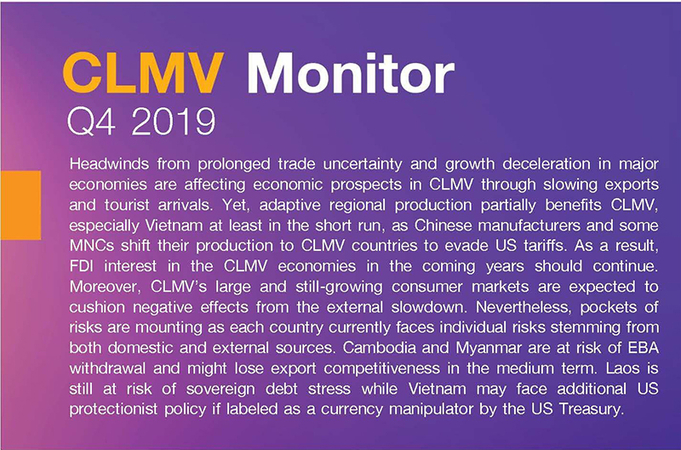
Amid mounting risks, CLMV to witness 6-7% growth in 2020: SCB centre

#ศาสตร์เกษตรดินปุ๋ย : ขอบคุณแหล่งข้อมูล : หนังสือพิมพ์ The Nation

https://www.nationthailand.com/business/30379508?utm_source=category&utm_medium=internal_referral

Amid mounting risks, CLMV to witness 6-7% growth in 2020: SCB centre

Dec 16. 2019
By THE NATION

762 Viewed

Growth in the CLMV (Cambodia, Laos, Myanmar, Vietnam) bloc will likely moderate to 6-7 per cent in 2020 as headwinds from prolonged trade uncertainties and growth deceleration in major economies affect economic prospects through slowing exports and tourist arrivals, according to Siam Commercial Bank’s Economic Intelligence Centre.

However, adaptive regional production will partially benefit the bloc, especially Vietnam, at least in the short run, as Chinese manufacturers and some multinational corporations shift their production to CLMV countries to evade US tariffs.

As a result, foreign direct investment in CLMV economies in the coming years should continue, the centre said.

Moreover, consumption in the bloc and growing consumer markets are expected to cushion the negative effects from an external slowdown.

However, pockets of risks are mounting as each country currently faces individual risks stemming from both domestic and external sources.

Cambodia and Myanmar are at risk of Everything But Arms (EBA) withdrawal by the European Union and might lose their export competitiveness in the medium term.

Laos is still at risk of sovereign debt stress while Vietnam may face additional US action if labelled a currency manipulator by the US Treasury.

Vietnam is expected to grow at 6.7 per cent in 2020, supported by both domestic demand and exports.

With slowing exports and mounting external risks from US protectionist policies, private consumption should support growth from a strong labour market and moderate inflation.

Meanwhile, continued structural reforms should help spur both private and foreign investment in the country.

Cambodia’s growth is expected to moderate to 6.8 per cent in 2020 due to slow global trade.

Tourism and FDI grew at a slower rate, but the country’s fiscal situation and exports remained strong.

Still, the EBA withdrawal risk remains high and may affect exports to the European Union, Cambodia’s largest export market. Its fast-growing microfinance in household loans may also undermine its future financial stability and consumption outlook.

Laos’s economy is projected to recover to 6.5 per cent in 2020.

Overall economic activity slowed due to the effects of natural disasters in 2018, the trade war, and a China slowdown.

Meanwhile, Laos’s short-term vulnerabilities include limited foreign reserves and fiscal stress from low revenue in tax collection. However, future infrastructure and hydro projects, and policy reforms should boost the economy in the medium term.

Myanmar’s economy is expected to grow by 6.3 per cent in 2020 amid domestic risks before an election next year.

Recent FDI fell considerably, but ongoing policy reforms, continued financial liberalisation and foreign investment from other Asian countries should support its economic recovery. But downside risks come from the unsolved Rohingya crisis as Myanmar is also at risk in the event of an EBA withdrawal.

Community power project gets the nod

#ศาสตร์เกษตรดินปุ๋ย : ขอบคุณแหล่งข้อมูล : หนังสือพิมพ์ The Nation

https://www.nationthailand.com/business/30379506?utm_source=category&utm_medium=internal_referral

Community power project gets the nod

Dec 16. 2019
By The Nation

759 Viewed

The Energy Policy and Planning Office (EPPO) has approved the community-based power plant project, setting the rate of sale at Bt3-5 per unit depending on fuel types while the community can owns 10-40 per cent of the facility.

Energy Minister Sontirat Sontijirawong revealed the decision of EPPO committee today (December 16), approving feed-in tariffs economic policy mechanism in renewable power investment and sell rate for Very Small Power Producers (VSPP).

The committee also tasked the Energy Regulatory Commission (ERC) to draft regulations and make an announcement. It also appointed an executive to oversee trading and manage the project.

The electricity contract of the community-based power plant is a Non-Firm contact, wherein the power producers are able to co-store the power but prohibited from using fossil fuel to generate electricity.

Next year, the government will start buying 700 MW from private producers and has scheduled the commercial operation dates for two types of projects: Quick win project in 2020, followed by general project the year after.

Phase one deal welcomed by businesses

#ศาสตร์เกษตรดินปุ๋ย : ขอบคุณแหล่งข้อมูล : หนังสือพิมพ์ The Nation

https://www.nationthailand.com/business/30379505?utm_source=category&utm_medium=internal_referral

Phase one deal welcomed by businesses

Dec 16. 2019
By China Daily/ANN

815 Viewed

The phase one trade deal between China and the United States, which holds off a planned US tariff increase on billions of dollars of Chinese imports previously set to take effect on Sunday, was welcomed by US business groups. But they urged the removal of all additional duties as well.

Beijing and Washington announced the deal on Friday. China said the two sides had agreed that the US will fulfill its commitments to phase out additional tariffs on Chinese products.

The US has dropped plans to impose new tariffs on $160 billion in Chinese-made consumer goods, including laptops, smartphones and clothing, and cut in half tariffs imposed in September on another $112 billion to 7.5 percent. But it will continue to levy a 25 percent import tax that started last year on $250 billion in Chinese goods.

State Councilor and Foreign Minister Wang Yi said the deal is bullish news for the world.

At a joint news conference on Saturday with Miro Cerar, Slovenia’s deputy prime minister and foreign minister, Wang remarked that China has always been opposed to settling economic and trade disputes by imposing tariffs because there is no winner in a trade war. China also rejects the use of unilateral pressure, as it violates the rules of the World Trade Organization, he said.

The wording of the phase one agreement was settled after rounds of back-and-forth negotiations, Wang noted.

The agreement is conducive to gradually bringing China-US economic and trade relations back to a normal development track and will inject confidence into world economy facing downward pressure, he said, adding that it will also help to stabilize the global trade order.

“The tariff relief included in the phase one deal is welcome and could be a sign that the end of the trade war is in sight,” said Rick Helfenbein, president and CEO of the American Apparel & Footwear Association.

However, Helfenbein noted, US businesses, consumers and workers are still being hammered by tariffs imposed by the US and by China’s retaliatory tariffs on incoming US goods.

“The trade war is a self-inflicted wound that has caused a lot of pain for America. The sooner these tariffs are eliminated, the better. And we won’t stop pressing our case until this happens,” he said in a statement.

Americans for Free Trade, a coalition of more than 150 business groups from every sector of the economy — which are united in the fight against tariffs — said the rollback of tariffs and cancellation of new levies is a small step forward.

“However, the tariffs still in place are a tax that Americans, and not China, continue to pay, to the tune of tens of billions of dollars,” the coalition’s spokesman Jonathan Gold said. “By only reducing the tariffs on a few items, the administration is picking winners and losers in this trade war.”

People in the US have paid an additional $42 billion in tariffs since the beginning of the trade war in early 2018 through October this year, including an additional $4 billion in October alone, the coalition said in a statement on Friday after the announcement of the deal.

“That’s why we urge the administration to continue to work diligently to come to a final agreement with China that will remove all the tariffs currently in place,” Gold said.

The US Chamber of Commerce said the phase one agreement creates “greater certainty” for US businesses as they plan for the year ahead, after months of uncertainty.

“We call upon both governments to continue working diligently toward a final agreement within six months,” Myron Brilliant, the chamber’s executive vice-president and head of international affairs, said in a statement.

Another US industrial group, the National Retail Federation, also underscored the need to eliminate all the remaining tariffs.

“Tariffs create uncertainty and costs for American retail supply chains, and the trade war won’t be over until they are eliminated completely,” said David French, the group’s senior vice-president for government relations.

Mary Lovely, a trade economist at the Peterson Institute for International Economics, said the current 25 percent tariffs fall largely on intermediate inputs, so US factories are feeling the pinch.

“A cease-fire in the trade war will bring much needed relief to America’s factories and farms,” she wrote in an article posted on the institute’s website.

Levies on certain US imports suspended

#ศาสตร์เกษตรดินปุ๋ย : ขอบคุณแหล่งข้อมูล : หนังสือพิมพ์ The Nation

https://www.nationthailand.com/business/30379502?utm_source=category&utm_medium=internal_referral

Levies on certain US imports suspended

Dec 16. 2019
[Photo/VCG]

[Photo/VCG]
By China Daily/ANN

739 Viewed

China suspended extra tariffs on certain products from the United States that had been scheduled on Sunday — a part of the two countries’ broader move to scale back tariffs after agreeing on the text of a phase one trade deal.


Experts said de-escalation of the protracted trade war will help restore the confidence of the global financial market. They also urged both governments to build on this progress and fix more underlying problems.

China suspended extra 10 percent and 5 percent tariffs on some products imported from the US, the Customs Tariff Commission of the State Council said in a statement on Sunday. The country also refrained from implementing tariffs on vehicles and auto parts from the US.

Other additional tariff measures will continue to be implemented, and work on tariff exemptions for imports from the US will proceed, it said.

Stephen Roach, a senior fellow at Yale University’s Jackson Institute of Global Affairs, told Xinhua: “The good news is that the threat of tariffs has been moderated to some degree. It underscores the commitment of both nations to provide some relief to the tariff-related pressures on both economies as well as the broader global economy.”

On Friday, Chinese officials said China and the US have reached agreement on the text of a phase one trade deal on the basis of equality and mutual respect, and the US will implement its promise to eliminate tariffs on Chinese goods “phase by phase”.

Ma Yu, a researcher at the Chinese Academy of International Trade and Economic Cooperation in Beijing, said, “The phase-one trade agreement is considered a clear signal toward de-escalation.

“Companies from the US, China and other major economies, such as Japan and Germany, will restart investment in projects that have been on hold, because unstable elements arising from the trade dispute since March 2018 have caused a number of companies to stop their investment activities,” Ma said.

In addition to boosting investment in many parts of the world, the deal, when signed, will also boost the confidence to global financial markets, stabilize market expectations and build a better environment for trade activities and regional trade deals, he said.

“This is an encouraging first phase that puts a floor under further deterioration of the bilateral relationship,” US-China Business Council President Craig Allen said.

“But this is just the beginning,” he added, noting that the issues facing the US and China are “complex and multifaceted”, and more efforts are needed to address them.

Yale’s Roach said both sides need to focus more on the common ground “that will continue to bind the two economies together, rather than underscore differences in conflicts”, if they want to repair the soured relationship.