Thai Oil has signed a memorandum of understanding with Eastern Water Resources Development and Management (East Water), which will undertake water distribution and resource development programmes to support Thai Oil’s clean-fuel project in the Eastern region, chief executive officer and president Wirat Uanarumit said.
“Under this MOU, East Water will also be responsible for operating and maintaining water pumps and machinery under the project. We estimate that it could start operating by early 2022,” he said.
“This project will be a key effort in developing water resources for users in the Eastern region and will support Thai Oil’s future clean-fuel campaigns,” Wirat added.
Meanwhile, Office of National Water Resources (ONWR) secretary-general Somkiat Prajamwong said the ONWR board has agreed to a budget of Bt1.37 billion to build a 15-million-cubic-metre reservoir in Ban Nong Krathing, Chachoengsao, to support increasing water usage in the Eastern Economic Corridor (EEC).
“We expect the reservoir to be completed in 2025. It will help provide water to 10,000 rai of farmland in the rainy season and 3,000 rai during the dry season,” he said.
“It will also help maintain the ecosystem balance and push salt water away from Bang Pakong river during storm surges.”
Somkiat said the ONWR is studying the possibility to produce freshwater from sea water to solve the water shortage problem in EEC areas during the dry season.
“The project will be piloted in Chon Buri and Rayong and is expected to start next year,” he added.
Sakol Energy (SKE) has unveiled plans to acquire businesses related to the clean energy and the environment to boost its revenue and profits next year.
Jakkraphong Sumethchotimetha, the managing director of the gas station operator, said green and clean energy business trends are likely to grow for many years.
“Also, the company plans to expand its existing business while also seeking new opportunities, pending approval from the Securities and Exchange Commission.” Meanwhile the rapidly changing situation meant risk assessment was necessary for some SKE projects.
“The company still has sufficient funds for investment and we will consider issuing warrants based on the company’s and shareholders’ benefits,” he said
SKE would also produce and sell compressed biomethane gas (CBG) to industries in Bangkok and its vicinity rather than in other provinces where demand had dropped.
Jakkraphong expects SKE revenue and profit to increase next year, forecasting performance in the fourth quarter this year would not improve from the third quarter due to a decline in demand for CBG and Natural Gas Vehicle (NGV) fuel amid the economic slowdown and falling oil prices.
“Also, we have maintained our target to boost electricity production capacity to 30 megawatts by 2022.”
He said long-term contracts with strong partners meant company operations would not be disrupted next year, while expressing confidence the government would be able to contain the spread of Covid-19.
“However, the company will make efforts to diversify risks based on the Covid-19 crisis and economic situation in order to seek opportunities for investment in other types of energy in the future,” he added.
The price of gold dropped by Bt150 per baht weight in morning trade on Wednesday after rising by Bt100 per baht weight at close on Tuesday, the Gold Traders Association reported.
As of 9.26am, the buying price of a gold bar was Bt26,550 per baht weight and selling price Bt26,650, while gold ornaments cost Bt26,075.20 and Bt27,150, respectively.
At close on Tuesday, the buying price of a gold bar was Bt26,700 per baht weight and selling price Bt26,800, while gold ornaments cost Bt26,226.80 and Bt27,300, respectively.
The spot gold price moved to US$1,863 (Bt56,295) per ounce in the morning, while the Comex (Commodity Exchange) gold price to be delivered in February next year dropped by $12.50 to $1,870.30 per ounce on Tuesday due to a dollar appreciation and the historic rise in the US gross domestic product, resulting in mass sell-offs of safe-haven assets.
The Hong Kong gold price meanwhile dropped by HK$90 to $17,210 (Bt67,082) per tael, the Chinese Gold and Silver Exchange Society reported.
The Stock Exchange of Thailand (SET) Index fell by 7.55 points, or 0.53 per cent, to 1,431.94 in the morning session on Wednesday.
An analyst at Krungsri Securities expected the day’s index to fluctuate between 1,415 and 1,435 points amid an influx of foreign funds.
“However, uncertainty over the coronavirus mutation in Britain and fears of a new Covid-19 wave in Thailand would pressure the index,” he predicted, adding that some Thai provinces have already imposed lockdown measures to curb the spread of the virus.
He recommended investors buy:
> TQM, BLA, STGT, AJ, PTL, Synex and Com7, which actually benefit from a fresh Covid-19 outbreak.
> PTTEP, PTTGC, Top and IVL, which benefit from the rising oil price, while their fourth-quarter performance is expected to improve.
The SET Index closed at 1,424.39 on Tuesday, up 22.61 points, or 1.61 per cent. Total transactions amounted to Bt87.82 billion, with an index high of 1,428.11 points and a low of 1,388.23.
By Syndication Washington Post, Bloomberg · Kamaron Leach, Cecile Gutscher
U.S. stocks fell for a third day as optimism over a covid-19 relief bill was tempered by the emergence of a new variant of the virus and a slew of lockdowns and travel curbs to contain it. The dollar advanced and Treasuries gained.
The benchmark S&P 500 fluctuated between gains and losses before closing lower, with consumer services and energy the biggest sector decliners. The Nasdaq Composite and Russell 2000 set record highs in what is a holiday shortened week. U.S. lawmakers cleared a $2.3 trillion year-end spending bill and stimulus package. President-elect Joe Biden warned the “darkest days” of the pandemic were still to come and called on Congress to be ready early next year to produce another stimulus package.
“Sometimes you get exaggerated moves in stocks due to lack of liquidity,” said Jonathan Boyar, managing director at BoyarValue Group.
Amgen Inc. was among the biggest losers in the Dow Jones industrial average, falling after a study showed an experimental drug failed to cut asthma patients’ dependence on steroids. Apple Inc. paced the gain in the Nasdaq after a report said the company is planning to make a battery-powered self-driving car as soon as 2024. Tesla Inc. fell for a second day.
In Europe, stocks rebounded from their steepest slump in almost two months Monday, with all industry groups in the green. British Airways owner IAG SA surged more than 5% as travel shares bounced back. Crude oil edged lower for a second day.
The global stock rally is looking increasingly fragile after equities touched a record high last week, as lockdowns and rising virus cases threaten to overshadow U.S. pandemic relief and the initial rollout of vaccines. The bill passed by Congress on Monday represents the second-biggest economic rescue package in American history.
“The agreed fiscal relief package will undoubtedly help mitigate some of the negatives but unfortunately, it won’t be able to fully offset the effects of people staying at home as many businesses face tighter restrictions or are even forced to close,” according to James Knightley, chief international economist at ING Groep.
In the U.K., where the virus variant has taken hold, a full lockdown came into force in London and southeast England. Europe and regions from Canada to Hong Kong have suspended travel links to the island nation, piling pressure onto the government as it tries to salvage a free-trade agreement with the European Union.
The bloc rebuffed Prime Minister Boris Johnson’s latest concessions on fishing rights, keeping the pound lower.
These are the main moves in markets:
Stocks
The S&P 500 Index decreased 0.2% to 3,687.27 as of 4:02 p.m. EST, the lowest in more than a week.
The Dow Jones industrial average sank 0.7% to 30,015.51, the lowest in more than a week on the biggest dip in more than three weeks.
The Nasdaq Composite Index increased 0.5% to 12,807.92, the highest on record.
The Stoxx Europe 600 Index surged 1.2% to 391.25, the biggest jump in five weeks.
Currencies
The Bloomberg Dollar Spot Index jumped 0.6% to 1,132.18, the highest in more than a week on the largest climb in almost eight weeks.
The euro sank 0.7% to $1.2162, the weakest in a week on the biggest dip in more than four months.
The British pound fell 0.7% to $1.3368, the weakest in more than a week on the largest drop in more than a week.
The Japanese yen depreciated 0.3% to 103.66 per dollar, the weakest in a week on the biggest dip in more than two weeks.
Bonds
The yield on 10-year Treasuries declined two basis points to 0.92%, the largest drop in more than a week.
Germany’s 10-year yield declined two basis points to -0.60%, the lowest in a week on the biggest fall in more than a week.
Britain’s 10-year yield declined two basis points to 0.183%, the lowest in more than a week.
Commodities
West Texas Intermediate crude dipped 2.1% to $46.94 a barrel, the lowest in more than a week.
Gold depreciated 0.9% to $1,860.77 an ounce, the weakest in a week on the largest dip in almost two weeks.
Thailand plans to run a fiscal deficit until 2025, to combat projected low tax revenue from low economic growth, while targeting inflation of 1 to 3 per cent next year.
The Cabinet on Tuesday gave the nod to the inflation target set by the Finance Ministry and Bank of Thailand’s Monetary Policy Committee (MPC), said government spokesman Anucha Burapachaisri.
The target was set in line with economic conditions including inflation dynamics, Thailand’s ageing society, fast-changing technology, and uncertainty caused by the Covid-19 pandemic.
The MPC has retained its priority to support economic recovery together with maintaining stability of prices and a sound financial system, he said.
The Cabinet also approved a medium-term government spending plan for 2022 to 2025, proposed by the Finance Ministry, said Anucha.
The Finance Ministry projects the Thai economy will expand in a range of 2.7 to 4.2 per cent over that four-year period. Thailand has experienced slow economic growth of 3 to 4 per cent in recent years, while the Covid-19 crisis is forecast to bring a severe economic contraction this year.
The Finance Ministry’s medium-term spending plan exceeds projected revenue as government spending remains an important factor in driving the economy, given low tax revenue.
For fiscal year 2022, the government plans to spend Bt3.1 trillion against projected revenue of Bt2.4 trillion, resulting in budget deficit of Bt700 billion.
For 2023, spending will be Bt3.2 trillion against Bt2.49 trillion revenue, while for 2024 it is Bt3.31 trillion against 2.62 trillion revenue, and in 2025, Bt3.42 trillion against revenue of 2.75 trillion. Thailand has run a fiscal deficit since the 1997 Asian financial crisis.
Projected key sources of tax revenue between 2022 and 2025 include VAT, e-service tax collected from international tech giants, licensing of frequencies for telecom operators, and production sharing contracts from oil and gas exploration firms.
The ministry also projects a rise in public debt as the government will need to borrow more to finance the deficit.
Public debt this year has hit Bt7.85 trillion, accounting for 49.3 per cent of gross domestic product (GDP).
Public debt to GDP is projected to rise to 56 per cent next year, 57.6 per cent in 2022, 58.6 per cent in 2023, 59 per cent in 2024 and 58.7 per cent in 2025.
Historically, the Finance Ministry has set a limit of 60 per cent on public debt-to-GDP, in order to ensure fiscal sustainability.
“For the short and medium term, the fiscal plan aims to increase both revenue and spending in order to brace for future risks. While for long-term planning, the budget deficit will be narrowed to achieve fiscal balance eventually,” said Anucha.
Slower economic growth and the Covid-19 fallout has contributed to rising public debt in recent years.
Pathum Thani province announced on Wednesday that all public events, including concerts, boxing and cockfighting, will be cancelled until January 5 in a bid to curb the new wave of Covid-19 infections.
Those caught violating the order will face charges under the Communicable Disease Act and the emergency decree.
So far, three new Covid-19 cases have been found in the province.
Strict controls have been implemented in five provinces to curb infections, including Samut Sakhon, Samut Songkram, Samut Prakan, Chiang Mai and Suphan Buri.
Phuket announced its first Covid-19 patient in the new wave of infections on Wednesday and released details of the patient’s movements between December 1 and 22.
The man in question is 40 years old, lives in Phuket’s Kathu district and works as the manager of an automobile shop in Muang district’s Koh Kaew area.
The timeline is as follows:
• December 1-9: Worked from home.
• December 10: Left Phuket to join a big-bike event. That day, he and four friends stop for breakfast in Phang Nga province, where they also visit a local petrol station.
The patient then stops for lunch at a PTT station in Surat Thani’s Tha Chana district. He is joined by other bikers.
The group heads to Krabi where they cross over to Koh Lanta Noi before hopping over to Koh Lanta Yai island nearby.
There the group checks into the Anda Lanta Resort.
• December 11-12: The 40 or so bikers start partying, including a Samut Sakhon resident who later tested positive for Covid-19. At the party, this man sat at a different table from the Phuket resident, and did not wear a mask at the time.
• December 13: Phuket patient heads home, but before leaving he bids farewell to his biker friends, including the one from Samut Sakhon. He was not wearing a mask at the time.
At 7pm on the same day, he dines with four family members at the Super Beef restaurant in Muang district.
• December 14-16: The patient goes to work as usual, where he interacts with 15 colleagues who do not wear a mask all the time.
• December 17: He stays home due to a headache.
• December 18: Stays home after developing a cough.
• December 19: Goes to work for two hours despite having a cough, headache, sore throat and runny nose.
• December 20: He learns that his friend from Samut Sakhon has tested positive for Covid-19. He stays in and contacts other biker friends. He also tells members of his family to undergo Covid-19 tests.
• December 21: Patient visits Vachira Phuket Hospital to get tested.
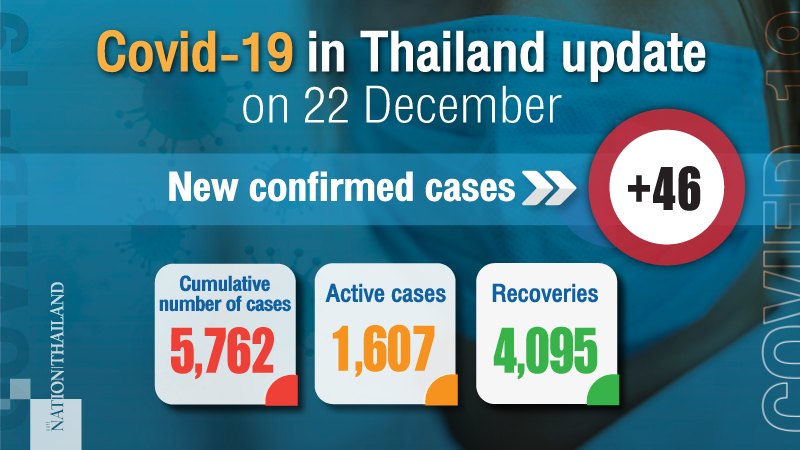
The Centre for Covid-19 Situation Administration (CCSA) on Wednesday reported 46 new cases over a 24-hour period, 39 domestic ones and seven in quarantine.
Spokesman Dr Taweesin Visanuyothin apologised that Wednesday’s report wasn’t comprehensive enough as test results were awaited in more cases. The Department of Disease Control would report the results around 4pm, he added.
There were 39 domestic cases in the past 24 hours – Bangkok 11, Chachoengsao 5, Nakhon Pathom 3, Kamphaeng Phet 2, Tak 2, Prachin Buri 2, Ayutthaya 2, Samut Prakan 2, Saraburi 2, Petchabun 1, Krabi 1, Khon Kaen 1, Nakhon Ratchasima 1, Nonthaburi 1, Pathum Thani 1, Phuket 1, and Suphan Buri 1.
Meanwhile, five Thais and two foreigner tested positive in quarantine.
The new cases under quarantine comprise one Thai who had returned from the United Kingdom, one from Bahrain, one from Myanmar, one from Russia and one from the United States, as well as a British man and a Pakistani businessman who travelled from their respective countries.
Meanwhile, 17 patients have recovered and been discharged.
As of Wednesday morning, the number of confirmed cases in Thailand has increased to 5,762 (1,394 in quarantine and 1,273 from active case findings). Of these, 1,607 are in hospital and ad-hoc quarantine facilities and 4,095 have recovered and been discharged. The death toll remains at 60.
Dr Taweesin said the government would take care of migrant workers, who have “helped the Thai economy and the business sector”.
He said the CCSA would hold a meeting on Thursday to consider measures to control migrant workers and apply laws so these workers have better access to healthcare and welfare.
“I want everyone to view them [Myanmar workers] as family. They have been helping us in driving our economy for a very long time. When family members are sick, we have to take care of them. Don’t hesitate to help by donating or providing necessities since they are living in hard times,” he told Wednesday’s press conference.
He also advised everyone to wear a mask, keep clean and abide by the social distancing practice.
According to Worldometer, as of 10am, the number of confirmed global cases has increased to 78.36 million (rising by 604,973). Of these, 55.12 million have recovered, while 21.51 million are active cases (106,353 in severe condition) and 1.72 million have died (an increase of 13,180).
Thailand ranks 144th for most cases in the world, while the US has the most number with 18.68 million, followed by India 10.09 million, Brazil 7.32 million, Russia 2.9 million and France 2.49 million.
Buri Ram province on Wednesday closed a fresh market for three days after learning that 200 people may have been exposed to Covid-19 there.
The market in Lam Plai Mat district will be sanitised over the three days.
Fear of transmission was sparked after a 57-year-old seafood vendor brought produce from Samut Sakhon to sell at the market, and initial investigation found that several people may have been exposed to the virus.
An outbreak was detected in Samut Sakhon over the weekend, where the number of cases has gone beyond the 1,000 marks.
Provincial governor Thatchakorn Hatthathayakul has also ordered shoppers who came to the market during this period to be tested for the virus.
So far, some 200 people have gone to Lam Plai Mat Hospital for tests. The 57-year-old vendor, meanwhile, has tested negative, but officials have said they will continue monitoring him.





 Government spokesman Anucha Burapachaisri