America’s biggest companies are flourishing during the pandemic and putting thousands of people out of work #SootinClaimon.Com

#SootinClaimon.Com : ขอบคุณแหล่งข้อมูล : หนังสือพิมพ์ The Nation.

America’s biggest companies are flourishing during the pandemic and putting thousands of people out of work (nationthailand.com)

America’s biggest companies are flourishing during the pandemic and putting thousands of people out of work

InternationalDec 17. 2020Gary Walker was laid off from Salesforce in August after 12 years with the company. MUST CREDIT: Washington Post photo by Jahi ChikwendiuGary Walker was laid off from Salesforce in August after 12 years with the company. MUST CREDIT: Washington Post photo by Jahi Chikwendiu 

By The Washington Post · Douglas MacMillan, Jonathan O’Connell, Peter Whoriskey, Chris Alcantara

As the coronavirus pandemic devastated small businesses and plunged millions of Americans into poverty this summer and fall, executives at some of the country’s largest corporations sounded surprisingly upbeat.
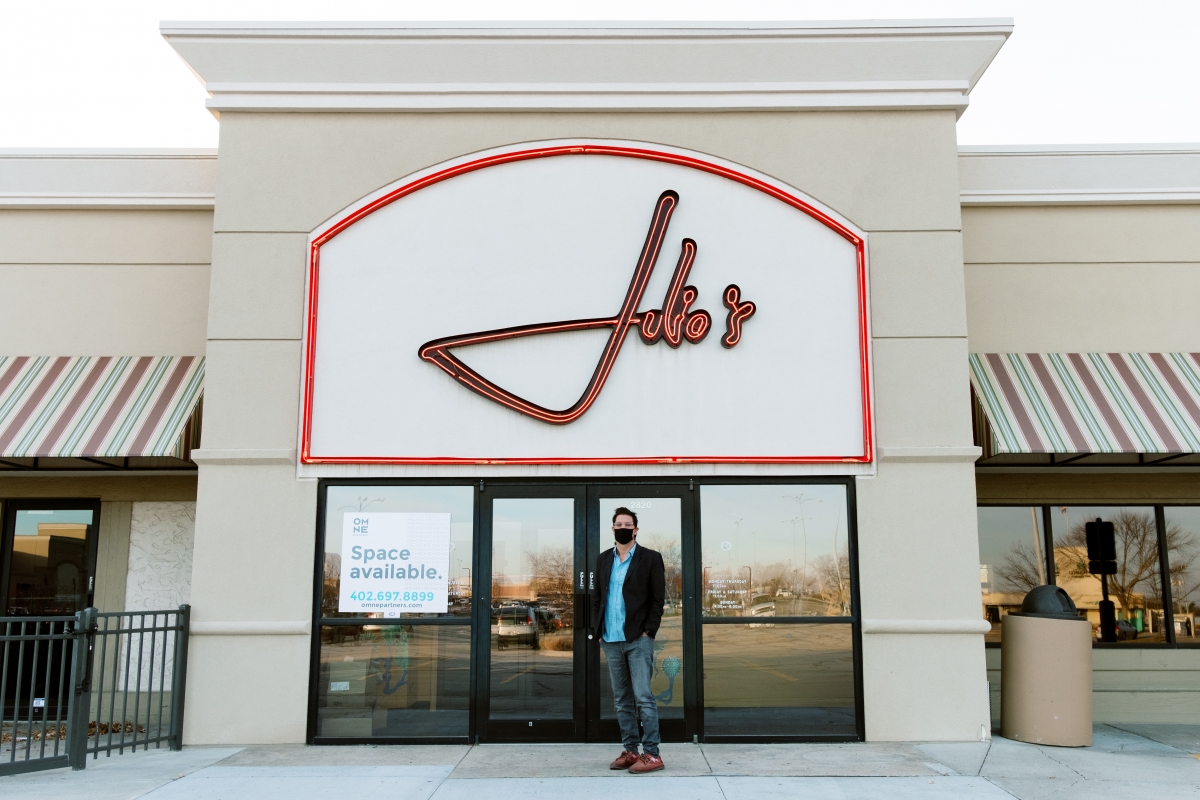
Restaurant owner David Mainelli stands in front of the former location of his family's restaurant, Julio's, in Omaha, Neb., earlier this month. The restaurant group has been a staple in the community since 1977, and announced they were closing their doors in June 2020. MUST CREDIT: Washington Post photo by Carley Scott Fields

Restaurant owner David Mainelli stands in front of the former location of his family’s restaurant, Julio’s, in Omaha, Neb., earlier this month. The restaurant group has been a staple in the community since 1977, and announced they were closing their doors in June 2020. MUST CREDIT: Washington Post photo by Carley Scott Fields

“I don’t think we’ve ever been more excited or energized about our prospects,” PayPal finance chief John Rainey said on a November conference call.

“These are times when the strong can get stronger,” Nike chief John Donahoe told analysts in September.

“With all that’s happening around the world, it’s really unfortunate,” said Jensen Huang, chief executive of graphics chip maker Nvidia, during an August earnings call. “But it’s made gaming the largest entertainment medium in the world.”

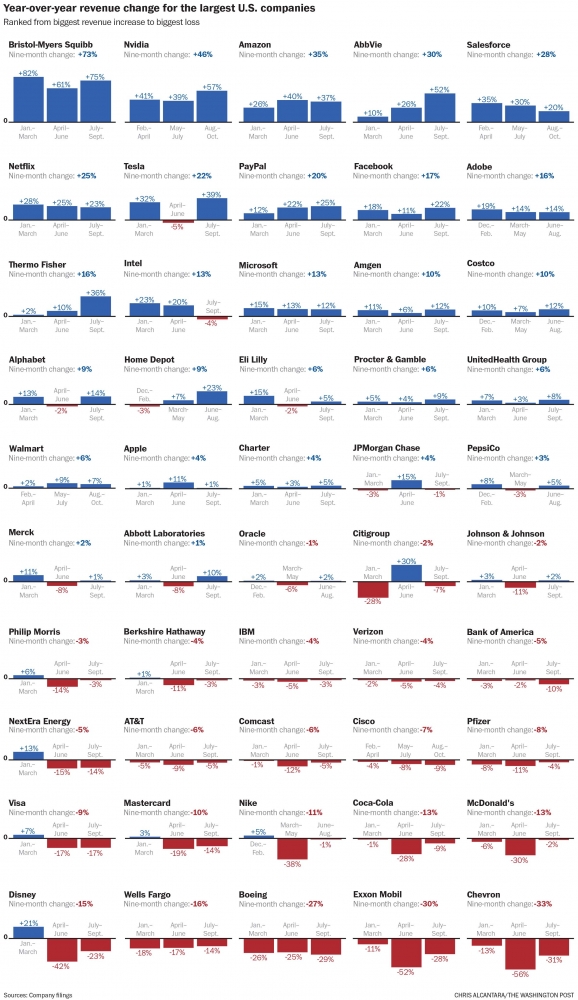
With few exceptions, big businesses are having a very different year from most of the country. Between April and September, one of the most tumultuous economic stretches in modern history, 45 of the 50 most valuable publicly traded U.S. companies turned a profit, a Washington Post analysis found.

Despite their success, at least 27 of the 50 largest firms held layoffs this year, collectively cutting more than 100,000 workers, The Post found.

The data reveals a split screen inside many big companies this year. On one side, corporate leaders are touting their success and casting themselves as leaders on the road to economic recovery. On the other, many of their firms have put Americans out of work and used their profits to increase the wealth of shareholders.

When the coronavirus struck, big companies promised to help battle the crisis. Dozens of prominent chief executives, who last year signed a public pledge to focus less on shareholders and more on the well-being of their employees and broader communities, appeared eager to make good on that promise. Many suspended payments to investors and vowed not to hold layoffs.

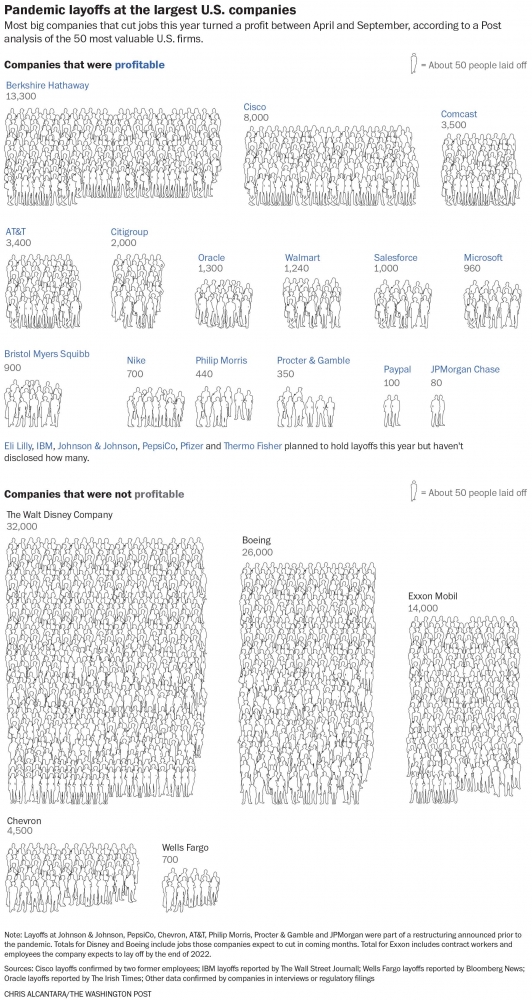
Then, 21 big firms that were profitable during the pandemic laid off workers anyway. Berkshire Hathaway raked in profits of $56 billion during the first six months of the pandemic while one of its subsidiary companies laid off more than 13,000 workers. Salesforce, Cisco Systems and PayPal cut staff even after their chief executives vowed not to do so.

Companies sent thousands of employees packing while sending billions of dollars to shareholders. Walmart, whose CEO spent the past year championing the idea that businesses “should not just serve shareholders,” nonetheless distributed more than $10 billion to its investors during the pandemic while laying off 1,200 corporate office employees.

Kirk Hanson, an author and longtime professor of business ethics, says it’s incumbent upon America’s top corporations to help pull the country through the worst recession in decades, particularly given the outsized profits they’re enjoying.

“There is an obligation on the part of the largest and most successful businesses to help buffer the human impact of the crisis,” said Hanson, now a senior fellow at Santa Clara University’s Markkula Center for Applied Ethics.

Instead, Hanson said, they have contributed to the country’s growing economic divide.

The Post contacted all 27 large firms that held layoffs this year. Many said the cuts were not related to the pandemic, but rather, a necessary part of broader “restructuring” plans, where companies shift spending from declining lines of business to growing ones. In some cases, these plans were decided before the pandemic.

Several emphasized that they hired more people this year than they let go. Anne Hatfield, a spokeswoman for Walmart, said everyone the retailer laid off during the pandemic was offered another job in the company, though she declined to say whether the new roles held the same level of pay and responsibilities as the jobs that were eliminated.

Others pointed to the work they have done to help ease the pain in their communities, such as expanding health and family benefits to employees and distributing personal protective equipment to front-line workers. Cisco gave $53 million in cash and PPE to vulnerable populations and PayPal pledged $530 million in investments in minority-owned small businesses.

In an email, Berkshire Hathaway chief executive Warren Buffett said he leaves all decisions at his subsidiary companies to the management of those companies. Airplane parts maker Precision Castparts, which Berkshire Hathaway acquired in 2015, was forced to cut staff due to a severe drop in demand for new planes, he said. Buffett added that he has given $2.9 billion of his personal wealth to charitable causes this year.

The majority of America’s largest corporations have prospered in the coronavirus economy.

Millions of consumers spent more time and money online during government-mandated lockdowns, watching Netflix, viewing ads on Google and Facebook pages, filling Amazon shopping carts and turning the video game business into a bonanza for Nvidia, Microsoft and others. (Amazon founder Jeff Bezos owns The Washington Post.)

Shoppers began splurging on cleaning supplies, hobbies, home cooking and home improvements, driving record growth at big-box stores including Home Depot and Walmart.

Even in the hardest-hit sectors, such as restaurants, travel and hospitality, the biggest companies were largely insulated from the worst of the virus’s reckoning. While independent restaurants struggled to survive, McDonald’s ramped up its takeout and drive-through operations, rolling out new apps and technology catering to on-the-go orders.

In many industries, the giants devoured market share ceded by small businesses, who lacked the resources to keep stores open during unpredictable swings in customer demand. While the 50 largest companies averaged 2% revenue growth over the first nine months of 2020, small business revenue shrank 12% over the same period, according to data collected by software provider Womply from thousands of small firms.

Economists estimate at least 100,000 small businesses permanently closed in the first two months of the pandemic alone.

“Once you kill competition, it’s always hard to restore it,” said Matt Stoller, director of research at the left-leaning American Economic Liberties Project. “This is an extinction-level event for small businesses.”

As the pandemic wore on, many companies kept their promises not to lay off staff. Others saw the recession as a good excuse for trimming labor costs.

In April, cigarette maker Philip Morris made a public commitment to forgo layoffs during the pandemic to help support the “job security and peace of mind” of its 73,000 workers.

“The company will not terminate the employment of any [Philip Morris] employee during this crisis period, unless for cause, and the company has also put on hold any restructuring plan,” Philip Morris said in a news release.

But in June, as infection rates continued to rise, Philip Morris said in a regulatory filing it would eliminate up to 440 workers in New York and Switzerland as part of a restructuring.

In a statement, Philip Morris spokesman Sam Dashiell said the company resumed the restructuring at its Swiss operations center because it determined “prolonging it further would be unfair to everyone.” He declined to explain why the New York layoffs resumed.

Current and former employees at some of these companies say they weren’t surprised to see their leaders renege on promises to retain staff through the pandemic. They didn’t put too much faith in those promises in the first place.

“The choices that they make are governed by, essentially, maximizing shareholder value,” said Gary Walker, a systems engineer who was one of 1,000 employees Salesforce cut in late August.
At the onset of the pandemic, Chuck Robbins described the need to keep workers employed as a moral imperative. The chief executive of Cisco, a $180 billion software and networking giant, said large companies like his shouldn’t lay off workers during a global crisis because, even in a bad year, they had the resources to maintain payrolls.

“Why would we contribute to the problem?” Robbins asked in an interview with Bloomberg News published in April. “To me, it’s just silly for those of us who have the financial wherewithal to absorb this, for us to add to the problem.”

Four months later, Cisco began implementing a plan to lay off at least 8,000 employees, according to two former employees briefed on the plan – the largest round of job cuts the San Jose, Calif.-based company has seen in years.

The majority of Americans who lost jobs this year were laid off from small businesses, many of which had no option but to cut workers to stave off financial collapse.

But larger companies actually laid off a greater portion of their workforces over that period – 9% for large firms versus 7% for smaller firms – despite having more resources to survive the downturn. Their layoffs were quietly acknowledged in regulatory filings and shrouded in corporate jargon, like an “involuntary reduction of associates” at Coca-Cola; and “operating model changes to streamline and speed up strategic execution” at Nike.

The Salesforce layoffs punctuated one of the software giant’s fastest periods of growth and followed frequent pledges by its chief executive to assist with coronavirus relief. Marc Benioff, a self-styled leader of the corporate philanthropy movement, said in a series of tweets in late March that Salesforce pledged “not to conduct any significant lay offs over the next 90 days.”

He suggested all CEOs should take a similar “90 day pledge” and encouraged all Salesforce employees to keep supporting hourly workers, such as housekeepers and dog walkers, who do work for them.

Making good on that pledge was not hard for Salesforce, a company sitting on more than $9 billion in cash and short-term investments. It generated $2.7 billion in profit during the first six months of the pandemic, as businesses flocked to Salesforce’s tools for helping them manage operations remotely.

The layoffs, about five months after Benioff’s tweet, were part of a plan to “reallocate resources” including “eliminating some positions that no longer map to our business priorities,” the company said in a statement. They were announced one day after the software giant announced its biggest quarter of profit and revenue in history, sending its stock soaring 30%.

“Of course I’m cheesed about it. How could you not be?” said Walker, who was laid off after 12 years at the company. “It’s not great timing.”

Walker, 48, who lives with his wife and two dogs in Herndon, Va., said he appreciates Salesforce giving him generous severance benefits and understands large companies sometimes have to cut labor costs to please investors.

Cheryl Sanclemente, a Salesforce spokeswoman, said in a statement the company offered to help all of the people who were affected find new jobs, including in some 12,000 openings it expects to fill over the next year. She added that the company has provided protective equipment to health-care workers throughout the pandemic and gave $30 million to organizations fighting the covid-19 crisis.

Salesforce declined to make Benioff available for an interview but pointed out that the company did make good on his promise not to hold layoffs within 90 days of his tweet.

Similarly, Wells Fargo explained that it never committed to a time frame when it pledged to pause layoffs – which the company referred to in a statement as “job displacements” – back in March.

“At that time, we said we would continue to evaluate and did not pledge to pause job displacements for a specific period of time,” spokeswoman Beth Richek said in an email. “Starting in early August, we resumed regular job displacement activity.”

She declined to comment on the number of workers who were affected, though sources told Bloomberg News the San Francisco-based bank was cutting the first 700 workers in what is expected to be a massive restructuring impacting tens of thousands of jobs over the coming years.

Then there’s Cisco, which started the year determined not to “add to the problem” of pandemic unemployment, in the words of its CEO. Despite benefiting from a quarantine-fueled boom in videoconferencing tools including its Webex software, the company lost ground to Zoom and reported slowing growth in its cloud computing business.

Robbins, who spent the first few months of the pandemic repeatedly reassuring staff that their jobs would be safe, by summer acknowledged a round of cost-cutting was needed, according to three former employees who were in meetings with Robbins this year and left the company within the past three months. The former employees – two who left voluntarily, one who was laid off – all spoke on the condition of anonymity while discussing their former employer.

Cisco began a restructuring plan to eliminate $1 billion in costs, including a campaign to ask employees to take voluntary retirement packages or a 20% pay cut in exchange for working four days a week, the people said. In addition to the voluntary departures, Cisco began conducting involuntary layoffs in the early fall with the goal of trimming at least 8,000 employees, or more than 10% of its workforce, said two of the former employees who heard this number directly from Cisco managers involved in the plan.

Jennifer Yamamoto, a Cisco spokeswoman, said the company is increasing its investments in certain business areas and reducing investments in others. She declined to specify the number of people Cisco laid off but said 8,000 was not accurate. Cisco was supporting employees who were transitioning out of the company, she said.

Asked about Robbins’s statements from earlier this year, Yamamoto said the CEO “did not commit to no layoffs, but rather said we would preserve what we could depending on how the pandemic played out, and he would then assess the needs of the business every 60 days before making any decisions. As the pandemic continued, things changed in the macro landscape and we had to make some tough choices.”
Nowhere has the disparity between big and small businesses ballooned during the pandemic the way it has for restaurants. Just ask Dave Mainelli.

For more than two decades Mainelli and his family have owned and run Julio’s Restaurant, a Tex-Mex joint in Omaha, Neb. His wife headed operations, his brother was a manager, and his son, a bartender. Customers held birthday parties and family reunions, plus wedding and funeral receptions there.

When the pandemic hit and business started to falter, Mainelli said he tried to keep Julio’s open because of the difficulty of telling many of his longtime employees that it was over. He cut back on hours and eventually on staff, dropping from 40 to a dozen as he tried to survive on delivery and pickup.

But with thin margins and debts beginning to mount, he closed Julio’s for good in June, after 25 years in business.

“There were a lot of tears. It was one of the hardest things I’ve ever been through and I’ve been through a lot of hard stuff,” he said.

While one in six restaurants permanently closed during the first months of the pandemic, according to the National Restaurant Association, big chains have ramped up their drive-through operations and rolled out new apps and menus catering to on-the-go orders.

Maybe no one has done this better than McDonald’s, which was battered by the pandemic in the spring but has since been gobbling up more business by the day, using its scale to outpace hundreds of thousands of competing restaurants.

Analysts say McDonald’s has leveraged its advantages by quickly simplifying its menu, allowing its locations to serve more customers in a shorter time without them having to enter its restaurants. Deliveries and mobile app use is growing. Drive-through orders grew to account for 90% of McDonald’s sales during the pandemic, up from two-thirds of sales before this year.

“The large companies have these asset bases that the smaller companies cannot compete with, particularly now,” said Lauren Silberman, an analyst at Credit Suisse.

Contrast that with the options available to Mainelli. To boost delivery sales he partnered with a local service in Nebraska, but it cut into profits dramatically. “When you rely on delivery, your margins get shrunk because you’re paying them a chunk,” he said.

McDonald’s and other chains have long focused on data analysis and app development, capabilities they are now employing during the pandemic. Its digital drive-through menus allow restaurants to customize menu items for factors such as time of day, the weather and current restaurant traffic.

It is also testing tools for tailoring menus more specifically to customers as they arrive. So, if you have been ordering a Big Mac meal with fries and a large Sprite since the beginning of the pandemic, McDonald’s could begin identifying you through the app running on your phone and start displaying that meal more prominently when you pull up to the drive-through.

Not every McDonald’s franchise has flourished. But for those facing a cash crunch, the company put up nearly $1 billion to allow franchise owners to defer rent and royalty payments until their business returned, a luxury few other restaurant owners enjoy. “Because of our scale and financial stability, we were able to quickly provide franchisees with financial support when they needed it most,” Kevin Ozan, McDonald’s chief financial officer, told investors in November. Company spokespeople declined to comment further.

The result for McDonald’s shareholders has been a gift better than the plastic toy at the bottom of any Happy Meal. In October, shares of its stock reached an all-time high – up 27% since the beginning of March – and the company increased its dividend 3%.

The gulf between McDonald’s and most independent restaurants is staggering. Restaurant employment is down 17% during the pandemic, according to the Independent Restaurant Coalition, with more than 2 million restaurant workers out of a job heading into winter. Many of the owners that are permitted to remain open are doing so by slashing staff and costs and focusing on takeout as much as possible.

At Kayla’s Kitchen and Closet, located in tiny Park Falls, Wis., the menu offers soups, salads and a spicy blackberry bacon panini. Owner Kayla Myers also operates a clothing store next door offering Levi’s jeans, Minnetonka moccasins, children’s clothing and tuxedo rentals.

She said she has been boosting sales with Facebook posts. But she closed off half of her six tables for social distancing measures and cut hours. “You don’t have any point in opening if people can’t even come in,” she said.

After closing Julio’s this year, Mainelli sold the brand and became a writing instructor at local colleges. He and his wife gawk at the long lines of cars at McDonald’s, and he predicts the same fate for independent restaurants that locally owned bookstores faced when Amazon first arrived.

“The same thing is going to happen to the restaurants,” he said. “It’s going to be Olive Garden, Applebee’s and Chili’s. There are not going to be any independents.”

– – –

When Apple announced its quarterly earnings in the spring, chief executive Tim Cook eagerly shared all the company was doing to combat the coronavirus, from manufacturing and distributing face shields to donating $15 million to relief efforts in the earliest days of the pandemic.

But those investments stood in stark contrast to the $50 billion Apple said it planned to spend on stock repurchases – an amount so closely watched by Wall Street that one analyst asked why it appeared slightly lower than previous years.

“The $50 billion share repurchase authorization is impressive enough in absolute terms, but it is a bit lower than the last couple of years,” Katy Huberty, a managing director at Morgan Stanley said during the April conference call. “Any context around the thought process of landing on $50 billion?”

The world’s largest companies have set extraordinary expectations for their annual cash payments to investors. After pausing dividends and share buybacks in the spring, many companies resumed investor payouts by the summer.

The top 50 firms collectively distributed more than $240 billion to shareholders through buybacks and dividends between April and September, representing about 79% of their total profits generated in that period. Except for the five companies that didn’t offer buybacks or dividends this year, no large firm came anywhere close to spending as much on coronavirus relief efforts as they did paying out investors.

Companies often buy their own stock during difficult economic periods to signal to the market that management still believes in their prospects. But those buybacks also mean companies are taking money that could have been invested into employees and innovation and giving it to shareholders, who tend to be high-income individuals and families.

“This is a global crisis but the big companies are not treating it as one – they haven’t skipped a beat,” said William Lazonick, an emeritus economics professor at the University of Massachusetts at Lowell. “Apple gave back tens of billions of dollars to shareholders,” he added. “It’s sick.”

Apple spent $41 billion buying shares and paying cash dividends between April and September, more than twice as much as the company with the next highest total, Microsoft. The tech giants top the list partly because they have come under pressure from shareholders to return some of their enormous stockpiles of cash.

Apple spokesman Josh Rosenstock said supporting worldwide covid-19 relief efforts has been the company’s top priority. Apple has donated “hundreds of millions of dollars” to supporting communities this year including distributing 30 million face masks and 10 million face shields, he said.

The computer maker also kept paying retail employees while its stores were closed, Rosenstock added, and is “working with our suppliers to ensure their staff, including janitors and shuttle drivers, are being paid as well.”

Giant companies across all sectors have raised their dividends and buybacks since 2017, when tax legislation championed by President Donald Trump and passed by Congress lowered the statutory corporate tax rate from 35% to 21%. As a result, many companies explicitly said they would spend some of their tax savings on higher payments to shareholders.

Pharmaceutical giant AbbVie achieved the lowest effective tax rate among all 50 largest firms, paying just 6.5% last year by structuring its business to take advantage of overseas tax havens, the company said in filings. According to Reuters, AbbVie holds dozens of patents for its best-selling rheumatoid arthritis drug Humira in Bermuda, which has no corporate income tax.

Shortly after the tax law was passed, AbbVie chief executive Richard Gonzalez said the company’s cash flow “far exceeds what we are able to use productively to support the business” and therefore would give larger sums to shareholders. This year, he delivered: AbbVie paid investors $4 billion during the first six months of the pandemic, more than twice the amount of profit the company generated in that period.

AbbVie did not appear to lay off any employees this year. The company did not respond to multiple requests for comment.

Fed to maintain bond buys until ‘substantial’ economy gains seen #SootinClaimon.Com

#SootinClaimon.Com : ขอบคุณแหล่งข้อมูล : หนังสือพิมพ์ The Nation.

Fed to maintain bond buys until ‘substantial’ economy gains seen (nationthailand.com)

Fed to maintain bond buys until ‘substantial’ economy gains seen

InternationalDec 17. 2020The Marriner S. Eccles Federal Reserve building. Photographer: Stefani Reynolds/BloombergThe Marriner S. Eccles Federal Reserve building. Photographer: Stefani Reynolds/Bloomberg 

By Syndication Washington Post, Bloomberg · Craig Torres

The Federal Reserve said it will continue to support the economy through massive monetary stimulus until it sees “substantial further progress” in employment and inflation.

At their final meeting of a tumultuous year, policymakers led by Chair Jerome Powell voted to maintain monthly bond purchases of at least $120 billion, according to a statement Wednesday, as many market analysts had expected. Policymakers made no changes to the composition of purchases, declining to shift them toward longer-term maturities.

“The Federal Reserve will continue to increase its holdings of Treasury securities by at least $80 billion per month and of agency mortgage-backed securities by at least $40 billion per month until substantial further progress has been made toward the Committee’s maximum employment and price stability goals,” the Federal Open Market Committee said.

The Fed meeting came as lawmakers on Capitol Hill tried to wrap up an agreement on new stimulus after months of deadlock, with both fiscal and monetary policy poised to help continue cushioning an increasingly shaky economy during the wait for widespread vaccine distribution.

Ten year Treasury yields rose after the statement was released to trade at about 0.94% – up from about 0.91% just before. Stocks were mixed.

The FOMC on Wednesday said “economic activity and employment have continued to recover but remain well below their levels at the beginning of the year.”

The committee unanimously kept the federal funds target rate in a range of zero to 0.25%, where it’s been since March, and a majority of Fed officials continued to forecast that their benchmark lending rate would be held near zero at least through 2023.

Powell is scheduled to hold a video press conference at 2:30 p.m. Washington time.

The FOMC “expects it will be appropriate to maintain this target range until labor market conditions have reached levels consistent with the committee’s assessments of maximum employment and inflation has risen to 2% and is on track to moderately exceed 2% for some time,” policy makers said, repeating language from their November statement.

The central bank’s meeting builds on their earlier response to the coronavirus pandemic, in which officials cut interest rates to near zero while unleashing massive bond purchases and a multitude of emergency lending programs.

U.S. central bankers are still far away from their goals, and Powell has repeatedly called on Congress to pass another round of fiscal stimulus to help the economy through the winter as the pandemic continues to rage. The unemployment rate stood at 6.7% in November, while inflation remains below 2%.

Even so, financial markets have been buoyed by investors counting on steady growth next year as more people are vaccinated, as well as pent-up consumer demand, low interest rates and maybe another round of fiscal stimulus. The S&P 500 index set a record high earlier this month, while yield spreads on corporate bonds are trading around pre-pandemic lows.

Despite the ebullience in markets, non-farm payroll growth slowed to 245,000 in November — less than half the gain in October — and employment is still down roughly 10 million compared with before the virus struck. U.S. retail sales dropped by more than forecast in November and the prior month was revised to a decline, the first drops since March and April, data showed earlier Wednesday.

Fed leaders more optimistic on jobs, GDP growth at final 2020 policy meeting #SootinClaimon.Com

#SootinClaimon.Com : ขอบคุณแหล่งข้อมูล : หนังสือพิมพ์ The Nation.

Fed leaders more optimistic on jobs, GDP growth at final 2020 policy meeting (nationthailand.com)

Fed leaders more optimistic on jobs, GDP growth at final 2020 policy meeting

InternationalDec 17. 2020The Federal Reserve Board building on Constitution Avenue in D.C. (Brendan Mcdermid/ Reuters)The Federal Reserve Board building on Constitution Avenue in D.C. (Brendan Mcdermid/ Reuters) 

By The Washington Post · Rachel Siegel

WASHINGTON – Federal Reserve leaders are more optimistic about jobs and growth than at any point in the pandemic, yet critical holes in the recovery remain, and filling them may hinge on a stimulus deal and the rollout of a coronavirus vaccine.

At a news conference after the Fed’s final policy meeting of 2020, Fed Chair Jerome Powell said the central bank was not out of tools to support the recovery, and could expand its asset purchases. But for sectors that are far from healed – such as restaurants and hotels that rely on person-to-person contact – “those are not being held back by financial conditions, but rather by the spread of the virus,” Powell said.

Powell reiterated his calls for more help from Congress, saying “the case for fiscal policy right now is very, very strong.”

Powell declined to point to what specifically should go into another stimulus bill. On Wednesday, congressional leaders neared an agreement on a roughly $900 billion relief package after months of partisan gridlock. The bill probably will include direct payments but leave out aid to state and local governments.

“All of these government policies are trying to work together to create a bridge across this economic chasm that was created by the pandemic,” Powell said. “But there is a group where they don’t have a bridge yet.”

In their latest round of economic predictions since September, Fed leaders predict that unemployment will fall to 5% by the end of next year, and 4.2% by the end of 2022. Officials also showed a more hopeful outlook for gross domestic product. In September, Fed leaders projected that GDP would grow 4% by the end of 2021, but they revised those estimates to suggest growth of 4.2%.

Yet there are signs the economic recovery is slowing. November marked the slowest month of job growth since the spring, with the unemployment rate falling slightly from 6.9% to 6.7%. Retail sales fell last month. Millions of Americans are behind on rent and utility bills, and nearly 8 million Americans have fallen into poverty since the summer.

“The path of the economy will depend significantly on the course of the virus,” the Fed said in a statement after the meeting. “The ongoing public health crisis will continue to weigh on economic activity, employment, and inflation in the near term, and poses considerable risks to the economic outlook over the medium term.”

The Fed is capping one of its most consequential years, one that involved an unprecedented response to the economic damage wrought by a global pandemic. This week also marks the Fed’s final policy meeting before the Biden administration begins, bringing with it a slate of new economic advisers.

A key question is what will happen to the Fed’s emergency lending programs, jointly run by the Fed and the Treasury Department. The facilities have become a test for how policymakers rate the strength of the recovery.

Saying the programs did their jobs, Treasury Secretary Steven Mnuchin last month announced that he would not extend most of facilities beyond the end of the year. Mnuchin also requested that the Fed return hundreds of billions of dollars that had been allocated for the programs under the Cares Act but never spent, saying the money could be reallocated by Congress for more direct use.

Mnuchin’s decision spurred a rare public clash between the Treasury and the Fed, which wanted the programs to stay in place as a backstop to the markets in case the recovery faltered. Democrats and many economists criticized Mnuchin’s move, saying it was premature to cut off the support.

The future of those programs could depend on the views of Janet Yellen, President-elect Joe Biden’s nominee for treasury secretary. Democrats have called for a reboot to the programs, while Republicans have said they should end.

Asked whether the Fed consider roll out more facilities if economic conditions turned south, Powell said “we do not have any plans for the future about this. We’re very focused on getting through year end.” Powell said that he had not discussed policy issues with Yellen, but that he did congratulate her on her nomination.

Vaccinating billions means finding ways around a patent impasse #SootinClaimon.Com

#SootinClaimon.Com : ขอบคุณแหล่งข้อมูล : หนังสือพิมพ์ The Nation.

Vaccinating billions means finding ways around a patent impasse (nationthailand.com)

Vaccinating billions means finding ways around a patent impasse

InternationalDec 17. 2020Customers wearing protective masks shop during the festival of Dhanteras at the Lajpat Nagar market in New Delhi on Nov.13, 2020. According to Oxfam, nine out of 10 people in underdeveloped countries will miss out on a vaccine in 2021. MUST CREDIT: Bloomberg photo by Prashanth Vishwanthan.Customers wearing protective masks shop during the festival of Dhanteras at the Lajpat Nagar market in New Delhi on Nov.13, 2020. According to Oxfam, nine out of 10 people in underdeveloped countries will miss out on a vaccine in 2021. MUST CREDIT: Bloomberg photo by Prashanth Vishwanthan. 
By Syndication Washington Post, Bloomberg · Hugo Miller, Susan Decker

Covid-19 vaccines look set to protect millions of citizens of the world’s richest countries in the coming months. But inoculating the rest of the planet’s population may mean finding a way around an impasse over intellectual property.

Representatives from all 164 member states of the World Trade Organization met last week in Geneva to discuss a proposal from India and South Africa to waive broad sections of the WTO’s intellectual property rules and to try to forge an agreement on how patents developed in the race against covid-19 should be recognized.

The meeting ended without consensus, leaving poorer countries who sponsored the proposal frustrated and legal protections for vaccines intact. That may be a victory for patent protection advocates, but pressure for change will only grow if billions of people in poorer countries go unvaccinated while the rich world starts getting a steady flow of doses from Pfizer Inc. and BioNTech, Moderna and AstraZeneca.

“With the biggest health crisis we’ve experienced, we’re still not able to find alternative ways of dealing with the IP issues when everyone’s lives are at stake,” said Tahir Amin, executive director of the Initiative for Medicines, Access & Knowledge, an organization promoting better access to drugs. “You’ve got the advocates saying ‘Let’s knock the wall down,’ and then you’ve got the investors who say ‘If we open the door it’s like the floodgates.’ We have to be smarter than that.”

A patent gives a drugmaker exclusive rights to manufacture a vaccine it developed, also providing it the power to charge a price that covers the costs of research and development. Their profit margin per dose, however, depends on the urgency of the situation, and amid a pandemic, charging anything more than development costs is bound to be controversial. India’s proposal would require that the waiver remain in place until there’s been widespread vaccination and the majority of the world’s population has developed immunity.

Whether it’s possible to reconcile will only be clear as the pandemic plays out. The European Union and U.S., home to leading drugmakers, are vehemently opposed to the proposition, though pricing may offer some room for negotiation.

Pfizer and its partner BioNTech have said their vaccine will cost $19.50 a dose in the U.S. That’s likely to be too much for many poorer countries, even if discounted, especially given the cost of the vaccine’s deep-freeze storage requirements. But AstraZeneca’s vaccine costs $4 to $5 a dose and is the big hope for the developing world right now.

The Covax alliance, an effort backed by more than 90 rich countries that seeks to boost access to vaccines in about 90 poor ones, has struck a deal with AstraZeneca to buy and distribute vaccines.Last month, Covax said it had raised $2 billion but that may not be enough as it needs another $5 billion next year to procure 2 billion doses. On Tuesday, the EU and European Investment Bank announced 500 million euros ($608 million) in financing to help vaccinate 1 billion people as part of that effort.

“We’re an integrated world,” said Fred Abbott, a professor at Florida State University College of Law. “Everyone understands you can vaccinate everyone in the United States, but if you don’t vaccinate everyone around the world you’re still going to have a problem.”

Pressure from developing countries however is only going to increase next year if they are left in the lurch. UNAIDS, the U.N. agency combating the immunodeficiency virus, calls it a choice between “a peoples’ vaccine or a profit vaccine.”

While the first vaccines have been distributed in recent days in the U.K., nine out of 10 people in poor countries will miss out on a vaccine in 2021, according to Oxfam. That echoes the early days of the AIDS response, said UNAIDS Executive Director Winnie Byanyima, when “treatment was only available to the rich while poorer countries had to wait years.”

The International Federation of Pharmaceutical Manufacturers and Associations argues that suspending patents is fraught with danger. If you waive patents this time round, you risk harming the whole medical infrastructure that allowed Covid vaccines to be developed in record time, said Director General Thomas Cueni.

“Eroding patent protections has far-reaching consequences,” he wrote in a recent New York Times opinion piece, citing the development of messenger RNA, the underlying innovation common to the Pfizer and Moderna vaccines. “Scientists eager to explore future uses of mRNA will struggle to find investment if intellectual property protections are snatched away when others deem it necessary.”Drugmakers like AstraZeneca have pledged not to profit from their vaccine for the length of the pandemic, while Moderna has said it won’t enforce its patents during the pandemic. Even frequent critics of the drugmakers have praised some of these efforts.

There are precedents for countries unilaterally suspending patents but they have been used rarely since 1945. Enforcement would be tough-most patent applications haven’t even been issued yet, and it’s hard to force companies to reveal trade secrets such as manufacturing processes that can have broad uses beyond vaccines.

Back at the WTO, delegates have agreed to keep discussions open and will submit a report to the WTO’s General Council meeting on Dec. 16, highlighting the “current lack of consensus” on the issue, according to a statement from the organization.

James Pooley, former deputy director general of the World Intellectual Property Organization, reckons that even though the proposal is “unlikely to go anywhere,” it may have an impact down the line.

“It’s the battering ram at the door,” he said. “If they keep bashing at it, a hinge may break.”

Some GOP-led states defy trump to Push for expanded voter access #SootinClaimon.Com

#SootinClaimon.Com : ขอบคุณแหล่งข้อมูล : หนังสือพิมพ์ The Nation.

Some GOP-led states defy trump to Push for expanded voter access (nationthailand.com)

Some GOP-led states defy trump to Push for expanded voter access

InternationalDec 17. 2020

By Bloomberg
Ryan Teague Beckwit

Some Republican state officials are newly open to expanded voting options after such moves proved popular and the party’s down-ballot candidates won in a high-turnout election, despite President Donald Trump railing against the changes.

Republican elections officials and state lawmakers in Kentucky, Missouri and Texas are considering changes that would either make vote-by-mail more accessible or increase early in-person voting.

Any such moves would be going against the current in the Republican Party, where Trump’s baseless claims of fraud have spurred GOP state lawmakers in Georgia, Michigan and Pennsylvania to consider tightening requirements on mail-in ballots.

Officials in Georgia have even filed suit to curtail the use of drop boxes for absentee ballots and add new layers of scrutiny to the signature-matching process before the Jan. 5 Senate run-off votes.

But in some Republican-led states, especially where the vote was less contentious, officials are looking to emulate a slew of Democratic-led ones and open up voting options in light of the success of the November election, which set records for turnout.

“The right to vote absentee — people didn’t exercise it before, didn’t know how it worked or didn’t trust it,” Kentucky Secretary of State Michael Adams, a Republican, said. “That’s changed.”

And while Trump argued that vote-by-mail and other loosened restrictions would mean “you’d never have a Republican elected in this country again,” Republicans gained seats in the U.S. House, did well in many state elections and may hold on to control of the U.S. Senate.

In Kentucky, Republicans are considering keeping in place early in-person voting set up because of the pandemic after it was well received by both voters and elections clerks.

“We’ve always been leery of early voting in Kentucky, but I think this election made a believer out of a lot of people,” said Republican state Senator Jimmy Higdon.

The state isn’t likely to change the law requiring an excuse to vote by mail — which was temporarily changed to no-excuse vote-by-mail this year — but Adams said its use may grow anyway.

Adams said many Kentuckians who first tried vote-by-mail this year may end up using excuses already allowed under state law — including being elderly, disabled or a college student away from home — a dramatic shift in a state where only 2% of voters cast mail-in ballots in the past.

Elections officials in other states expect similar shifts. In Nebraska, Assistant Secretary of State Cindi Allen said she expects a lot of people to continue voting early and by mail after they first tried it in November.

“Once they understand the process and have used it, they tend to follow the same pattern,” she said. “We all walk on our cowpaths.”

In Texas, state lawmakers have already prepped dozens of bills on elections, with Republican bills largely seeking to restrict options and Democratic measures looking to expand them.

But Republican consultant Derek Ryan said he sees some room for agreement on expanding in-person early voting, which had been expanded by an order from Republican Gov. Greg Abbott, after a high-turnout election in which the GOP did well.

“Republicans are finally seeing that, hey, maybe more voters doesn’t mean bad news for us,” he said.

Although vote-by-mail and early in-person voting have grown across the country in recent years, the November election was the most dramatic shift in how the nation votes in modern history.

In 2016, 24% of ballots were cast by mail, according to the U.S. Election Assistance Commission. But preliminary figures from the U.S. Elections Project show that as much as half of all ballots were cast by mail in November. In-person early voting, meantime, went from 17% to roughly 25% of all votes, according to those same sources.

Elections officials say that voter enthusiasm should provide a big boost in states that had not expanded options in the past.

“In the end, incumbents don’t like to upset their voters, and there will be some upset voters if they can’t vote as conveniently as they have this year,” said Rhode Island Secretary of State Nellie Gorbea, a Democrat who is pushing changes to elections law in her state.

In addition, a number of states are expected to update some of the more technical aspects of voting due to problems that the pandemic revealed.

Among the changes being considered: Allowing voters to register, request mail-in ballots and track their ballots online; buying more secure drop boxes for returning ballots; helping voters fix mail-in ballots that were rejected; and adding cameras to live-stream ballot counting.

Some states have already made administrative changes in response to the 325 lawsuits that have been filed over voting this year and the court challenges may bring more.

Another likely proposal will be to allow elections clerks to count mail-in ballots earlier. Restrictions on processing those ballots in the battleground states of Michigan, Pennsylvania and Wisconsin skewed early results, delayed reporting and fueled conspiracy theories touted by Trump and his allies.

Justin Levitt, a law professor at Loyola Marymount University who tracked the lawsuits, said that local and state elections officials will press lawmakers hard to lift those restrictions.

“The people they’re going to hear from the most are the county and town officials who had to wade into this and are now enduring death threats,” Levitt said.

Fed mulls shift in bond buying program: FOMC decision-day guide #SootinClaimon.Com

#SootinClaimon.Com : ขอบคุณแหล่งข้อมูล : หนังสือพิมพ์ The Nation.

Fed mulls shift in bond buying program: FOMC decision-day guide (nationthailand.com)

Fed mulls shift in bond buying program: FOMC decision-day guide

InternationalDec 17. 2020The Marriner S. Eccles Federal Reserve building in Washington, D.C., on Aug. 18, 2020. MUST CREDIT: Bloomberg photo by Erin Scott.The Marriner S. Eccles Federal Reserve building in Washington, D.C., on Aug. 18, 2020. MUST CREDIT: Bloomberg photo by Erin Scott. 

By Syndication Washington Post, Bloomberg · Steve Matthews

Federal Reserve Chair Jerome Powell and his colleagues, facing an economy slowing as the covid-19 outbreak worsens, are considering whether to alter their asset purchase program to provide more support for growth.

The Federal Open Market Committee is all but certain to keep its benchmark overnight interest rate in a target range of 0% to 0.25%, where it’s been since March 15 to help soften the pandemic’s blow. The panel will release a statement and economic forecasts at 2 p.m. Wednesday. Powell will hold a press briefing 30 minutes later.

Economists say the Fed may deliver fresh guidance on its asset purchases, now $120 billion a month, tying how long the buying will continue to substantial progress in meeting its goals of full employment and 2% inflation. That would be a stronger commitment than the existing pledge to maintain purchases “over coming months.”

The market has been primed for a change since the minutes of the November FOMC meeting showed officials discussed enhancing their description of the bond-buying program ”fairly soon.”

“The biggest disappointment would be a failure to deliver on some kind of guidance on asset purchases,” said Diane Swonk, chief economist at Grant Thornton in Chicago. “The Fed’s most powerful tool is the perception that they are there.”

– Asset Purchases. A slight majority of economists surveyed by Bloomberg expect new guidance on purchases this meeting, though other changes including increasing the scale of the buying are less likely. While nearly two-thirds of economists say the FOMC will extend the average maturity of bond purchases before the end of 2021, just 23% of those forecasting such a step saw it coming this week.

“If more stimulus is needed, they will have a better view in January or February,” said Bob Eisenbeis, vice chairman of Cumberland Advisors and a former Atlanta Fed official. With rates so low, “I am doubtful they can successfully communicate why tweaking the maturities will accomplish some employment or inflation objective.”

There may be dissenting votes over the issue of asset purchases, Deutsche Bank economists led by Matthew Luzzetti wrote in a note to clients. Dallas Fed’s Robert Kaplan and Minneapolis’s Neel Kashkari dissented in September over updated rate guidance, with Kaplan wanting more flexibility and Kashkari arguing it didn’t go far enough.

– Market reaction. The decision on asset purchases is likely to affect trading in Treasury securities. A failure to extend the maturity of Treasury buying or increase purchases could help to lift the 10-year Treasury yield to 1% or higher.

Since late March the 10-year yield has moved between 0.5% — a trough reached in August — and just under 1%. It nearly broke this upper barrier in the first few days of December, after a tepid employment report lifted hopes for more government spending as virus cases mounted.

Officials are expected to project rates staying near zero though 2023, reinforcing the message delivered by Powell that they will delay tightening policy to achieve inflation that averages 2% over time. In September, four of 17 FOMC participants saw a hike by 2023. Any increase would suggest a growing internal debate about an earlier rate liftoff.

The central bank may upgrade its 2020 unemployment and growth forecasts, reflecting a faster-than-expected recovery from the pandemic. With the first vaccines being distributed in the U.S. this week, the committee could tweak its 2021 or 2022 forecasts, though most economists say the committee will look for a slow return to normal, so expectations could be muted.

“Growth forecasts for 2021 and 2022 may be revised slightly higher fueled by optimism for a near-term vaccine,” said Lindsey Piegza, chief economist with Stifel Nicolaus in Chicago. “Given the extended timeline for a full recovery back to pre-pandemic levels both at home and globally, the committee’s inflation forecast is likely to remain subdued for some time.”

While St. Louis Fed director of research Christopher Waller was confirmed Dec. 3 by the U.S. Senate to take one of the two vacant governor seats on the Fed Board, he had not been sworn into office by the time the meeting began Tuesday. As a result, the number of forecasts submitted by Fed officials this month will remain at 17.

– FOMC statement. Recent economic data have shown slowing progress in the labor market and a surge in virus cases, hospitalizations and deaths, prompting some cities and states to increase curbs on economic activity. That will probably be reflected in the tone of the statement, even as the medium-term outlook has improved because of the rollout of vaccines.

“I would expect that the statement will acknowledge the worsening pandemic and slower progress in the labor market,” said Jonathan Wright, an economics professor at Johns Hopkins University. “There is a danger that progress in the labor market could stall completely. That is not yet there in the data, but slow progress is.”

– Press conference. Powell’s press conference will hash over the decision on asset purchases, as well as what would prompt future changes in bond buying. The chair is also likely to repeat his call for additional fiscal support, with Congress continuing to discuss aid before leaving for its Christmas break.

The Fed’s view on the need to re-install some of its emergency lending programs is another likely topic. Several, including its Main Street facility aimed at small and medium-sized borrowers, will wind down Dec. 31 following a decision by outgoing Treasury Secretary Steven Mnuchin that they should not be extended.

Seeking their resuscitation could be an early decision for Janet Yellen, Powell’s predecessor as Fed chair whom President-elect Joe Biden has tapped as Treasury secretary.

– IOER. Downward pressure on short-term rates due to supply-demand imbalances could encourage officials to make another technical adjustment in the interest rate the Fed pays on excess reserves, which is currently 0.10%. The rate could be increased to keep money-market rates further away from zero, Bank of America Corp. strategists said.

Year of pain sets stage for 2021’s top 10 emerging-market themes #SootinClaimon.Com

#SootinClaimon.Com : ขอบคุณแหล่งข้อมูล : หนังสือพิมพ์ The Nation.

Year of pain sets stage for 2021’s top 10 emerging-market themes (nationthailand.com)

Year of pain sets stage for 2021’s top 10 emerging-market themes

InternationalDec 17. 2020Recep Tayyip Erdogan, president of Turkey, in Brussels on March 9, 2020. MUST CREDIT: Bloomberg photo by Geert Vanden Wijngaert (Bloomberg).Recep Tayyip Erdogan, president of Turkey, in Brussels on March 9, 2020. MUST CREDIT: Bloomberg photo by Geert Vanden Wijngaert (Bloomberg). 

By Syndication Washington Post, Bloomberg · Livia Yap, Aline Oyamada, Sydney Maki

Some risks aren’t going away any time soon for emerging markets, irrespective of the overwhelming view among investors and strategists that 2021 will be a year of continued recovery.

Though the turbulence triggered by the coronavirus outbreak has given way to optimism that vaccines and central bank largess will keep the revival on track, a few themes are likely to keep dominating developing economies that collectively account for $30 trillion, or about 34%, of global gross domestic product.

1. Vaccine headway. After bringing much of the global economy to a halt in 2020, there’s growing optimism that multiple vaccines will help control the pandemic. Yet banks such as HSBC Holdings caution against too much enthusiasm as availability and distribution in emerging markets may lag behind their developed peers.

Wealthier countries have secured extensive supply deals to hedge their bets, while many developing ones may have to rely on international groups that have promised to make vaccines affordable. The logistics of transporting, distributing and administering them require advanced infrastructure and medical expertise that might not be available in every country.

2. Gauging policy turns. Central banks in emerging markets followed their developed peers in cutting interest rates to record lows this year, together easing more than during the 2008 financial crisis. A number of them even took a page from the developed-market playbook by buying bonds. Now, as vaccines are rolled out and the risk of inflation rises, some policymakers will come under pressure to reverse course, a theme that will come increasingly to the fore in 2021, according to Jean-Charles Sambor, head of emerging-markets fixed income at BNP Paribas Asset Management in London.

3. Debt mountain. Unprecedented stimulus in emerging markets drove debt levels to all-time highs. Brazil, for example, is spending the equivalent of 8% of its gross domestic product to counter the impact of the coronavirus. In 2021, the focus will likely turn to how such nations will pay for it all.

There are already worrying signs. Moody’s Investors Service predicts Turkey’s debt burden will jump above 40% of GDP in 2020 from 32.5% last year. South Africa just had its credit ratings cut due to a worsening debt trajectory, while Colombia’s widening deficit is putting its investment-grade rating at risk. Fitch Ratings has the highest balance of net negative outlooks for European emerging markets in more than a decade, while Oxford Economics says rising government debt will slow Latin America’s recovery.

4. Biden’s pivot. Emerging-market assets have been bolstered by Joe Biden’s victory in the U.S. presidential election, but concerns are growing that his administration may be less than positive for many developing nations in the longer run. Russia’s ruble slumped in the run-up to the U.S. polls as investors feared a harder crackdown under a Biden administration. Turkey’s Recep Tayyip Erdogan, who Biden has reportedly called an “autocrat,” and Saudi Arabia’s King Salman bin Abdulaziz are also preparing for a tougher time. The new president would probably pursue sanctions relief for Iran in the first half of 2021 in exchange for a freeze on nuclear activity, while ratcheting up the rhetoric against countries including Saudi Arabia, Israel and Egypt, according to Eurasia Group.

5. Rise of China. China has led the global recovery from the coronavirus, becoming the only major nation to see growth this year, and is widely forecast to continue driving the rebound in 2021. State Street Global Markets and JPMorgan Asset Management are among those predicting a Biden administration will take a softer stance on trade with China, burnishing the investor appeal of the Asian export powerhouse. At the same time, China’s gathering economic strength may embolden it further on the global stage, exacerbating geopolitical tensions.

6. Political risks. The year 2020 saw an upsurge in domestic political turmoil among developing nations, a trend that remains a key risk next year. Pro-democracy demonstrations in Thailand threaten to snuff out the prospect of a consumption-led recovery, according to Maybank Kim Eng Research. In neighboring Malaysia, Prime Minister Muhyiddin Yassin, having narrowly survived a leadership test, is under growing pressure to call an election. In Europe, Poland has been racked by protests over abortion rules. And in Latin America, Chile will embark on the process to rewrite its constitution as Peru’s government works toward stability after the unexpected ousting of Martin Vizcarra triggered a wave of street protests.

7. Latin America restructuring. Latin American debt woes ratcheted up several notches in 2020. Argentina and Ecuador reached accords with bondholders, but the euphoria didn’t last long. Argentine bonds have tumbled on concern over the government’s ability to reignite economic growth, and the country’s negotiations with the International Monetary Fund will continue to be a focus next year. Ecuador’s debt has also swooned on speculation leftist candidate Andres Arauz may win next year’s presidential vote, a prospect Amherst Pierpont Securities says will fuel price volatility in early 2021.

8. Spotlight on Turkey. Turkey had its fair share of headlines in 2020 as the lira depreciated more than any peer except the Argentine peso. Authorities resisted rate increases until November, when President Erdogan, after firing the central bank governor, allowed his replacement to raise the benchmark interest rate by the most in two years. While Erdogan has pledged to pursue more market-friendly policies, investors will be waiting for further proof that the change of stance is real. Governor Naci Agbal said Wednesday the country will tighten monetary policy further to curb inflation, with price stability a key prerequisite for sustainable economic growth. Goldman Sachs Group Inc. says more policy tightening is necessary to restore confidence. Recent U.S. sanctions are hardly helping sentiment.

9. African distress. A backwater of the emerging-market landscape took on fresh significance in 2020 as a debt crisis erupted in Zambia, a reminder to investors of the financial strains in the world’s poorest continent. After borrowing heavily since 2012, Zambia became the first in Africa to default during the pandemic after bondholders refused to grant it an interest-payment freeze. The government is in talks with the IMF and has pledged to restore budget credibility. Carmen Reinhart, the World Bank’s chief economist, sees many low-income economies and several emerging markets at risk.

10. Ethical investing. Investments linked to environmental, social and governance criteria took a step toward the mainstream this year and are set to gather pace in 2021. ESG-focused stocks and bonds fared much better then traditional peers amid the coronavirus sell-off. Governments and companies across the developing world have this year sold an unprecedented amount of so-called social bonds — debt securities whose proceeds are used to address human needs. With China making a new pledge to address climate change, and Biden an outspoken supporter of environmental initiatives, low-carbon and fossil-free assets may outperform next year, according to Bloomberg Intelligence.

U.S. retail sales tumble in sign economic rebound is sputtering #SootinClaimon.Com

#SootinClaimon.Com : ขอบคุณแหล่งข้อมูล : หนังสือพิมพ์ The Nation.

U.S. retail sales tumble in sign economic rebound is sputtering (nationthailand.com)

U.S. retail sales tumble in sign economic rebound is sputtering

InternationalDec 17. 2020A pedestrian passes an available retail space in Chicago on May 7, 2020. MUST CREDIT: Bloomberg photo by Christopher Dilts.A pedestrian passes an available retail space in Chicago on May 7, 2020. MUST CREDIT: Bloomberg photo by Christopher Dilts. 

By Syndication Washington Post, Bloomberg · Olivia Rockeman

U.S. retail sales dropped by more than forecast in November and the prior month was revised to a decline, indicating the economic rebound is hitting bumps amid record coronavirus cases and lawmakers’ extended wrangling over a new stimulus package.

Total retail sales decreased 1.1% from the prior month, following a 0.1% October decline, the first drops since March and April, Commerce Department figures showed Wednesday. That was worse than all but one economist had forecast in a Bloomberg survey calling for a 0.3% decline, and October’s figure was originally reported as a 0.3% increase.

The figures signal that the third U.S. surge in covid-19 cases, along with the arrival of colder weather, is taking an increasing toll on the economy as governments re-impose lockdowns, with more people losing their jobs and businesses shutting temporarily or permanently. Consumers are becoming more conservative with their finances during the wait for widespread vaccine distribution and a fresh stimulus package.

“The story is pretty simple: It’s clear the shutdown and third wave are affecting activity,” particularly at restaurants, said Brett Ryan, senior U.S. economist at Deutsche Bank. “The report highlights the need for more fiscal aid.”

After months of stalemates and talks, the top congressional leaders from both parties were close to agreement Wednesday on a relief package, which they hope to attach to crucial government spending legislation and pass by the end of the week, Bloomberg News reported.

Federal Reserve policymakers also conclude a two-day meeting later Wednesday, where officials are considering whether to alter their asset purchase program to provide more support for growth.

U.S. stocks were little changed at the open, while 10-year Treasury yields were higher and the dollar was lower.

Excluding autos and gasoline, sales fell 0.8%, compared with estimates for a 0.1% gain. So-called control group sales, which exclude food services, car dealers, building-materials stores and gasoline stations, dropped 0.5%. The measure is often considered more reflective of underlying consumer demand.

The monthly drop in retail sales was most pronounced for clothing stores and restaurants, while sales at nonstore retailers — mostly e-commerce — barely rose from October. The only other categories to record gains were building materials and food and beverage stores.

Motor vehicle and parts dealers, the largest category at about a fifth of all retail sales, fell 1.7%.

The total retail sales figure was still 4.1% above the same period last year. Illustrating the deep shifts in composition of sales, nonstore retailers were up 29.2%, while restaurant receipts plunged 17.2%.

Merkel ties pandemic exit to immunization rates of over 60% #SootinClaimon.Com

#SootinClaimon.Com : ขอบคุณแหล่งข้อมูล : หนังสือพิมพ์ The Nation.

Merkel ties pandemic exit to immunization rates of over 60% (nationthailand.com)

Merkel ties pandemic exit to immunization rates of over 60%

InternationalDec 17. 2020German Chancellor Angela Merkel in the Bundestag in Berlin, on Dec. 16., 2020. MUST CREDIT: Bloomberg photo by Rolf Schulten.German Chancellor Angela Merkel in the Bundestag in Berlin, on Dec. 16., 2020. MUST CREDIT: Bloomberg photo by Rolf Schulten. 

By Syndication Washington Post, Bloomberg · Arne Delfs, Raymond Colitt

Chancellor Angela Merkel tied an exit from the coronavirus pandemic to immunizing more than 60% of the population, indicating a long fight still ahead.

Germany is targeting so-called herd immunity, which means most of the population is resistant to the disease, Merkel said Wednesday in Germany’s lower house of parliament, as a hard shutdown takes effect across Europe’s largest economy.

The German leader has hinted that stringent restrictions, which are set to run until Jan. 10, will remain in force longer. The country’s daily death toll jumped on Wednesday to a record 910 people, the latest reminder of the risks posed by covid-19.

Merkel told her parliamentary caucus that Germany faces a new peak of infections next month and predicted that the first two months of 2021 will be particularly tough, according to a participant in the virtual meeting Tuesday. The nation is heading toward a seven-day incidence rate of 200 cases per 100,000 people, four times the level the government has determined to be manageable, she said.

Europe’s biggest economy began a strict lockdown on Wednesday, with non-essential stores closed, employers urged to shutter workplaces where possible and parents encouraged to keep children away from school. The tougher rules follow weeks of a partial shutdown, delivering a blow to Germany’s recovery and an extension could deepen the impact.

Despite the German government’s aggressive spending to prop up the economy, the fallout from the pandemic will likely depress business activity and lead to company failures, according to the head of the DIW economic institute.

“One of the biggest risks for the German economy is a wave of corporate bankruptcies next year,” Marcel Fratzscher, DIW’s president, said in a Bloomberg TV interview. “It’s not the question of whether it’s going to come. It’s more a question of when exactly companies will fail,” he said, adding that the thinktank is forecasting a contraction in the German economy in the first quarter.

As the restrictions take effect, fatalities surged to more than 900 in the 24 hours through Wednesday morning, well above Friday’s previous record of 604 and taking the total beyond 23,000. The number of new cases rose by 21,456, to 1.38 million, according to data from Johns Hopkins University.

The seven-day incidence rate has risen sharply in the past few weeks and currently is at a peak of 180 per 100,000 inhabitants, according to the RKI public health institute. Officials have said the rate needs to come down to 50 and stay there to allow effective contact tracing.

Germany is in the uncomfortably position of tightening restrictions after some countries such as France and the U.K. imposed stricter curbs earlier and are now gradually easing. Still, there are concerns across the continent that Christmas celebrations could lead to a renewed spike in infections.

Merkel will meet in early January with regional leaders to evaluate the impact of the measures and could move to extend the lockdown then. German law requires the government to reassess a nationwide lockdown every four weeks.

The chancellor told her caucus lawmakers that it’s impossible to develop a long-term strategy to tackle the pandemic because there are still too many unknowns.

She appealed to regional leaders to stick to lockdown rules, warning that failure to do so would risk extending them even longer. She said it’s too early to tell when the pandemic will be over, damping optimism that the expected European approval of a Covid-19 vaccine next week could quickly provide a way out of the crisis.

Trump sits out debut of covid-19 vaccine that he long championed #SootinClaimon.Com

#SootinClaimon.Com : ขอบคุณแหล่งข้อมูล : หนังสือพิมพ์ The Nation.

Trump sits out debut of covid-19 vaccine that he long championed (nationthailand.com)

Trump sits out debut of covid-19 vaccine that he long championed

InternationalDec 17. 2020A health care worker receives the Pfizer-BioNTech Covid-19 vaccine in San Diego on Dec. 15, 2020. MUST CREDIT: Bloomberg photo by Bing Guan.A health care worker receives the Pfizer-BioNTech Covid-19 vaccine in San Diego on Dec. 15, 2020. MUST CREDIT: Bloomberg photo by Bing Guan. 

By Syndication Washington Post, Bloomberg · Josh Wingrove

President Donald Trump pinned all his hopes for ending the pandemic on a vaccine, but as shots started going into American arms this week, he has barely acknowledged the moment and has wavered on when he’ll be inoculated.

The first shipments of a coronavirus vaccine created by Pfizer and German company BioNTech arrived on Monday, with front-line health-care workers receiving injections on live television to mark the occasion. The rollout coincides with the U.S. setting records for daily cases, daily deaths and hospitalizations.

The president has had little to say about any of it, beyond a single congratulatory tweet buried among a stream of false assertions and conspiracy theories about the election he lost. He has not made a public appearance since Saturday, when he attended the Army-Navy football game at the U.S. Military Academy at West Point.

Trump’s administration bet heavily on fast-tracking vaccine development, defying critics who said it would be nearly impossible for a shot to reach consumers less than a year after the coronavirus hit American shores.

The White House is now preparing to publicly inoculate a handful of officials in an event to celebrate the breakthrough and encourage Americans to get vaccinated. Vice President Mike Pence, who is not known to have contracted the virus, said he’ll receive a vaccination within days, but his office declined to say if it would be in front of cameras.

Public vaccination of top government officials, including the president, is regarded as a confidence-booster by health authorities for Americans wary of the shots. The director of the National Institute of Allergy and Infectious Diseases, Anthony Fauci, has said he intends to receive an injection in public as soon as practicable.

But Trump said Sunday he is not “scheduled” to be vaccinated, after Bloomberg News reported that top White House officials including the president had been given priority for shots. His press secretary, Kayleigh McEnany — who has called the shots the “Trump vaccine” — wouldn’t say Monday whether Trump would be vaccinated while he’s still in office.

“He will receive the vaccine as soon as the medical team determines it’s best,” she said. “These are vaccines that he oversaw the development of, he has great confidence in. He wants to see all Americans get this vaccine and he wants to see the most vulnerable among us get it first.”

President-elect Joe Biden said Tuesday that he would get the vaccine in public, but also didn’t say when. “Dr. Fauci recommends I get the vaccine sooner than later. I want to make sure that we do it by the numbers and when I do it you’ll have notice and we’ll do it publicly.”

The course of the pandemic has become intertwined with Trump’s own political fortunes. The U.S. outbreak soared under his watch, with far more publicly reported cases and deaths than anywhere else in the world, even as Trump promised the virus would fade away and downplayed its danger. Most Americans rated his handling of the crisis poorly, opening the door for Biden’s victory.

But now the efficacy of the U.S. vaccination campaign rests in part with Trump. Before he was president, Trump gave credence to the American anti-vaccine movement by publicly questioning the childhood vaccine schedule and suggesting, falsely, that pediatric inoculations may be linked to autism.

Former presidents have already volunteered to publicly take the vaccine as a signal of its efficacy. Recent polls have shown that confidence in the vaccine is increasing but that many Americans still harbor doubts.

Fauci, who has agreed to be the new president’s top medical adviser, said Tuesday that the pandemic will only truly be curbed when 75% or 80% of Americans are vaccinated.

McEnany said Trump was trying to send a “parallel message” by waiting to get it himself: promoting the vaccine as safe but wanting higher-risk groups to receive it first. Trump contracted covid-19 in October, McEnany pointed out, and the president has described himself as “immune,” though the extent and duration of protection from naturally attained antibodies is unknown.

“Even though the president himself was infected, and he has, likely, antibodies that likely would be protective, we’re not sure how long that protection lasts. So, to be doubly sure, I would recommend that he get vaccinated as well as the vice-president,” Fauci said.

Trump has said he’d be criticized for getting a shot too early.

“If I’m the first one, they will say, ‘He’s so selfish, he wanted to get the vaccine first,'” he said in a Fox News interview over the summer, before he was infected. “Either way, I lose on that one, right?”

By many metrics, the pandemic is worse than ever, and continues to worsen. Trump has met the milestones with silence, saying nothing on Friday when daily deaths hit a record of 3,306, or on Monday when there were 264,000 new cases, also a record. He hasn’t asked Americans to do anything to slow transmission of the virus, such as wearing masks.

Pence has found himself filling the vacuum. At a roundtable event on the vaccine rollout Tuesday in his home state of Indiana, he assured Americans the vaccine is safe and pledged to get a shot himself.

“We have come to the beginning of the end of the coronavirus pandemic in America, but as I expect you will hear from our panel and you’ll continue to hear, we have a ways to go,” he said. “Wear a mask and put the health of your family and your neighbors first.”

The Pfizer vaccine’s arrival, with others expected to follow shortly, will focus attention on distribution efforts, the infrastructure developed by the Trump administration and the question of who should receive shots first.

McEnany said Tuesday that two groups of White House officials would get an early vaccine. “Some career staff, national security staff, for the purposes of continuity of government, will have access, in addition to a very small group of senior administration officials for the purpose of instilling public confidence,” she said.

McEnany, like Trump himself and several White House staff, tested positive for the virus earlier this year. She said she “absolutely would be open to taking the vaccine.”

Moncef Slaoui, a leader of the Trump administration’s “Operation Warp Speed” program to accelerate vaccine development, also said Tuesday that both Biden and Trump should be inoculated.

“It is very important that our leaders, departing ones and arriving ones, are protected. And I think both President Trump and President-elect Biden, they are both parts of the higher age group and, therefore, higher risk. So, yes, I think they should be vaccinated,” he told CNN. “That’s an example for the population to follow.”