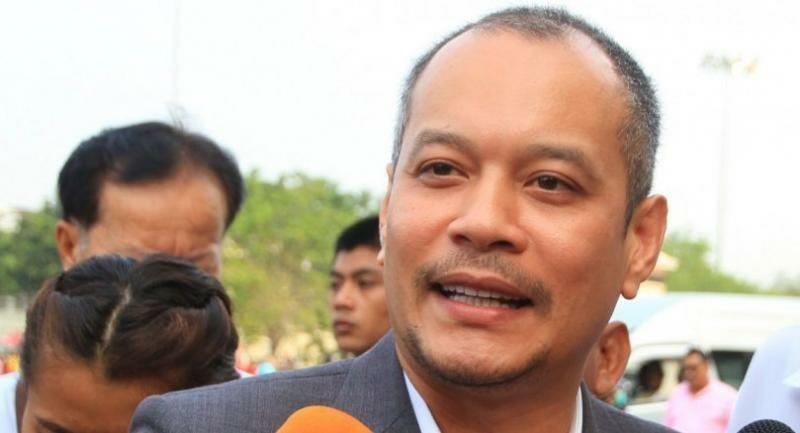
EconDec 17. 2020EEC Office secretary general Kanit Sangsubhan
By The Nation
The Eastern Economic Corridor (EEC) has set a new target for all 10,000 factories in the zone to adopt robotics and automation.
Of the total factories in the EEC, about 1,000 are large, 2,000 medium-sized and 7,000 small.
The target will see 3,000 large and medium-sized factories pilot the robotics and automation systems from next month, said Djitt Laowattana, EEC special adviser on education/human capital and technology development.
He added that the EEC Office and SMEs Promotion Office would fund half of the Bt500,000 automation cost for each of 50 small and medium-sized enterprises.
The SMEs will take three months to complete the transition and another three months to test whether the system can help them boost production capacity and reduce costs.
Djitt added that the EEC Office will produce 50,000 workers with robotics knowledge over the next five years to support the EEC’s automation switch.
The EEC will also coordinate between manufacturers and Thai and Japanese developers of automation and robotics systems.
The manufacturing sector must adopt advanced technologies because Thailand was facing a labour shortage as it became an ageing society, he said.
EEC Office secretary general Kanit Sangsubhan said robotics and automation was already extensively deployed in the corridor’s automative, petrochemical and food business sectors.
The EEC has also adopted 5G technology to support the new systems. It will launch a campaign to encourage all 1,000 factories to utilise 5G to support their adoption of automation and robotics.
Last year, Thailand ranked 14th in the world for adoption of industrial robotics, he said, adding that much more had to be done before the country entered the top 10 or top five.
Airports of Thailand (AOT) has said it is revising its Environmental Impact Assessment (EIA) report for Phase 3 of the Don Mueang Airport expansion.
Meanwhile, the Natural Resources and Environment Ministry has asked AOT to review the report following a change in details of the project.
Kerati Kijmanawat, AOT’s senior executive vice president for engineering and construction, said the new EIA version should be approved by the National Environment Committee by April next year. It has also sent the project plan to the National Economic and Social Development Council for consideration.
If the NESDC approves the project, AOT should forward it to the Cabinet by June next year and call for bids after that. Bidding is expected to be completed within 2021 and construction should begin the following year and be completed in three years.
The Joint Foreign Chambers of Commerce in Thailand (JFCCT) on Wednesday offered recommendations on what can be done to attract investments, its chairman Stanley Kang said.
The recommendations were made at a meeting held with Deputy PM Supattanapong Punmeechaow to discuss how doing business can be made easier in Thailand.
One recommendation was reducing the 14-day mandatory quarantine for foreign businesspersons and technicians, so investors will be encouraged to come here.
They also said that the authorities should remove or revise certain regulations, especially those related to visa applications, that are unfavourable to foreign investment.
The Stock Exchange of Thailand (SET) Index closed at 1,482.09 on Wednesday, up 4.88 points or 0.33 per cent. The volume total transactions tipped Bt106.4 billion with an index high of 1,488.86 and a low of 1,475.09.
The 10 stocks with the highest trade value today were BANPU, CPALL, KBANK, BAM, PTTGC, IRPC, AOT, PTT, SCC and IVL.
As of 4.30pm, the price of oil dropped by US$0.10 or 0.21 per cent to $47.52 per barrel, while gold rose by $10.40 or 0.56 per cent, to $1,865.70 per ounce.
Other Asian indices were mixed:
Japan’s Nikkei Index closed at 26,757.40, up 69.56 points or 0.26 per cent.
China’s Shang Hai SE Composite Index closed at 3,366.98, down 0.25 points or 0.0074 per cent, while Shenzhen SE Component Index closed at 13,751.09, down 12.22 points or 0.089 per cent.
Hong Kong’s Hang Seng Index closed at 26,460.29, up 253.00 points or 0.97 per cent.
South Korea’s KOSPI Index closed at 2,771.79, up 14.97 points or 0.54 per cent.
Taiwan’s TAIEX Index closed at 14,304.46, up 235.94 points or 1.68 per cent.
When it comes to qualifying for a loan to buy a home or to refinance your mortgage, there are plenty of numbers to consider, such as your credit score and the appraised home value. Perhaps one of the most important numbers is your debt-to-income (DTI) ratio, which compares the minimum payments on all debt you must make each month with your gross monthly income.
“The DTI ratio is one of the most important considerations lenders take into account when evaluating the risk associated with a borrower taking on another payment,” says Paul Buege, president and chief operating officer of Inlanta Mortgage in Pewaukee, Wis. “The lower the DTI ratio a borrower has, the more confident the lender is about getting paid on time in the future based on the loan terms.”
It’s not just the lender who benefits from knowing your DTI, says Buege.
“Calculating your DTI ratio can help you determine how comfortable you are with your current debt and whether you have enough income to take on a mortgage payment,” he says.
Your DTI tells a lender what percentage of your income is being consumed by debts, says Joseph Mayhew, chief credit officer of Evolve Mortgage Services in Frisco, Texas.
“Lenders like to see low DTI ratios because it means a borrower has excess income to cover unforeseen emergencies and to save for a rainy day,” says Mayhew. “As DTI ratios go higher, lenders become less willing to lend. In the eyes of a mortgage lender, a high DTI can signify poor credit management, living beyond your means and difficulty saving money for the future.”
– How to calculate your DTI
A simple DTI calculation is to divide your total monthly obligations by your total monthly income to generate a percentage, says Mayhew. For example, if your total monthly debts are $1,000 and your total monthly income is $4,000, your DTI would be 25%.
However, not every monthly bill is included in your DTI.
“Lenders typically look at installment loan obligations, such as auto and student loans, as well as any revolving debt payments such as credit cards or a home equity line of credit,” says Buege. ”Alimony and child support payments are also included. When calculating DTI ratios, lenders don’t include utilities, cable and phone bills or health insurance premiums. Medical bills are generally not included. Everyday items like food and gas are also not included when calculating DTI ratios.
Your mortgage payments, including principal, interest, taxes and insurance, are contained in the DTI calculation, but auto insurance and life insurance payments, 401(k) contributions, income tax deductions and college or private school tuition payments are not, says Mayhew.
– What’s a good DTI?
While an ideal DTI would be 25% or less, says Buege, the lower the DTI the better. Various loan programs have different DTI ratio requirements.
“For consumers with a good credit history, stable income and a down payment of 5% or more, most lenders will easily lend up to 45% DTI,” says Mayhew. “Those with smaller down payments or problems in their credit history may find themselves limited to a DTI around 38%.”
If your DTI is between 45 and 50%, many lenders will still approve a loan, says Mayhew, but they will require a perfect credit history, a larger down payment of 20% or more and plenty of cash in the bank for an emergency. Applicants with a higher level of debt will usually need to reduce their debt and/or increase their income.
The Twitter hashtag #saveทรายเจริญปุระ (Save Sai Charoenpura) became a top trending topic on Thursday after actress Intira “Sai” Charoenpura reportedly received a summons over lese-majeste and sedition charges.
On Wednesday, the popular pro-democracy actress posted on her Facebook page that she had received a summons from Bang Khen Police Station in Bangkok.
According to the summons, Intira was charged with violating Sections 112 and 116 of the law along with protest leader Arnon Nampa and others. However, the summons did not clarify on which date or during which demonstration she had violated the laws.
Intira was scheduled to visit the station on December 21 to hear the charges.
As of 11.30am, the hashtag #saveทรายเจริญปุระ was retweeted 139,000 times.
Intira has also become well known for her political views and moves. During a series of demonstrations, she supported food for protestors free of charge.
Update: Justice Minister Somsak Thepsutin said today that Nattawut’s release was already processed but he has not signed the document yet, therefore Nattawut will not be released today, but he will be “soon”.
Red-shirt leader Nattawut Saikua is to be released from the Bangkok Remand Prison in Chatuchak district on Thursday (December 17), a news source from the Department of Corrections revealed.
He was among five red-shirt leaders who were handed jail sentences by the Supreme Court on June 26 for bringing together more than 10 people, allegedly creating chaos in the city and fighting the authorities.
In 2007, the leaders of the United Front for Democracy against Dictatorship, also known as red shirts, had led a march to late Privy Council president Prem Tinsulanonda’s Si Sao Thewes resident to pressure him to step down as chief royal adviser.
Nopparut Worachitwutthikul was given two years and eight months jail time, while Veerakarn Musikapong, Wiputhalaeng Pattanapoom, Weng Tochirakarn and Natthawut were each given four years and four months.
In 2010, Natthawut was detained in prison after the military crackdown on demonstrators on May 19, and remained incarcerated for nine months before being bailed out.
The source added that Natthawut’s release is due to him receiving a royal pardon under Royal Pardon Decree BE 2563. He will be monitored under parole and would therefore have to wear an electronic monitoring bracelet.
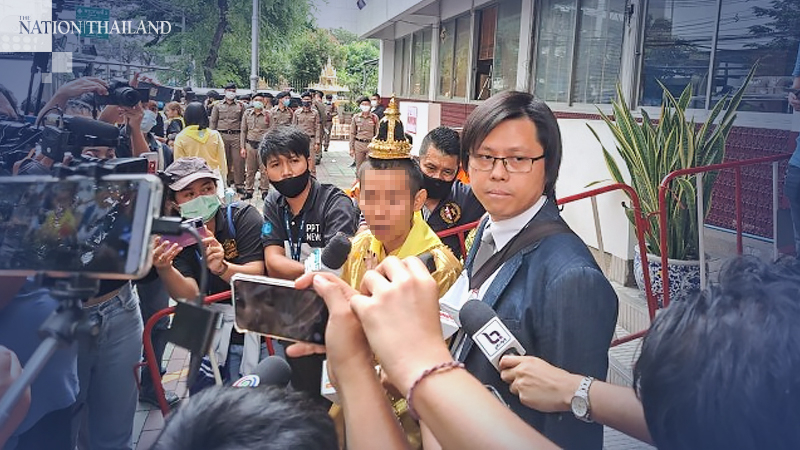
Pro-democracy protester Jatuporn Sae-Aueng visited Yannawa Police Station in Bangkok on Thursday to hear a lese-majeste charge against her.
Jatuporn is a member of the pro-democracy group Free for Buriram. Attired in a particular Thai traditional costume, she took part in a demonstration in Bangkok’s Silom area on October 28.
She was charged, along with some others, under Section 112 for violating the lese-majeste law.
Yannawa police reportedly set up barriers to deal with any unexpected situation.
On Thursday morning, the We Volunteer pro-democracy group urged people via social media to wear traditional Thai costumes when they visit the station in a show of support for Jatuporn and others.
The long and controversial history of Thailand’s law against royal insults PoliticsDec 16. 2020
Photo credit: Thai PBS Photo
By Thai PBS World Syndicate /ANN The draconian lèse majesté law is back in the spotlight after at least 41 people were slapped with royal defamation charges in relation to anti-establishment protests over the past few weeks.
The move to resume charging people with lese majeste after a two-year hiatus followed Prime Minister Prayut Chan-o-cha’s declaration in November that “all relevant laws and their sections” will be applied against protesters who break the law.
Leaders of the pro-democracy movement have stepped up the pressure in their push for Prayut’s resignation, a new, democratic Constitution and reform of the monarchy.
Protest leaders have broken the long-held taboo on debate of the monarchy with harsh criticism of the institution, especially the King. Meanwhile messages deemed by many as insulting to the royals were spray-painted at protest sites and posted on social media.
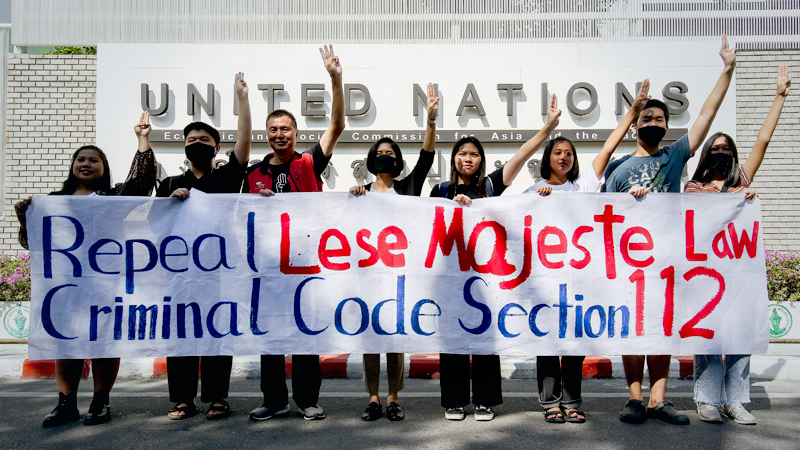
The protesters’ 10-point manifesto for monarchy reform includes a demand to repeal the lèse majesté offence in Article 112 of the Criminal Code, so that citizens can discuss the monarchy freely.
Lèse majesté has been an offence under Thailand’s Criminal Code since 1956. Article 112 of the law states: “Whoever defames, insults or threatens the King, the Queen, the Heir-apparent or the Regent shall be punished with imprisonment of three to 15 years.”
Debate has continued for decades as to whether the law should be repealed.
Advocates for abolition
Those who advocate the law should be abolished point to the fact that Article 112 has often been used for political purposes, to silence critics of those in power. Their argument is that the penalty is far too severe – with up to 15 years of imprisonment for each offence – and that it restricts citizens’ democratic right to free expression.
“Authorities base their decisions to enforce Article 112 on political reasons. It is used as a tool to retain political power and gag critics,” opposition Pheu Thai Party MP Somkid Chueakong said.
More than 1,000 people have been prosecuted under Article 112, according to political activist Somyot Prueksakasemsuk, who in 2013 was sentenced to 11 years in prison after being found guilty of lèse majesté.
Somyot, then editor of political journal “Voice of Taksin”, was held responsible for an article he published that was deemed to be insulting to the monarchy.
Other high-profile cases include award-winning activist Jatupat “Pai Daodin” Boonpattararaksa, who was slapped with lèse majesté charges in December 2016 for sharing a BBC biography of the King on Facebook. He was the first person to be arrested for lèse majesté in the new reign.
In November 2011, 61-year-old former truck driver Ampon Tangnoppakul was sentenced to 20 years in prison for four counts of lèse majesté and computer crime offences. A cancer patient, he died in jail while serving his sentence.
Called Akong (Grandpa) by the media, Ampon was accused of sending four short messages to a government official in 2010 containing insulting and threatening content directed at late King Bhumibol and Queen Sirikit. The defendant denied the charge, arguing that he did not know how to send a text message.
Records show lèse majesté cases soared after the 2006 military coup. The period from 1990 and 2005 brought just four to five cases per year, but the five years after the 2006 coup saw more than 400 cases.
The number of lèse majesté cases spiked again after the coup in May 2014 – to more than 350 between 2014 and 2017.
Thai Lawyers for Human Rights noted that under junta rule, courts tend to impose harsher punishments under Article 112 – up to 10 years’ imprisonment for each count. Meanwhile, defendants tried in military courts could face sentences of 50 to 70 years behind bars, the group said.
Supporters’ views
Royalists believe Article 112 is necessary to protect the King from being defamed since the monarch cannot file libel charges against his accusers, as ordinary citizens can. They argue that most countries have a similar law to protect their heads of state.
Anon Sakworawit, a lecturer at the National Institute of Development Administration, said that insults against the King “clearly increased” after Prayut revealed in June that Rama X had advised the government against enforcing Article 112.
There have also been calls for amendment of the lèse majesté law, with the most concrete and powerful coming from a group of law lecturers called Nitirat in March 2011.
Nitirat’s seven-point proposal includes removing the minimum punishment and fixing the maximum penalty to three years. It also says only the Royal Household Bureau should be allowed to file the charge – not any individual, as is the case now.
History of the law
The lèse majesté offence was first added to the Kingdom’s Penal Code in June 1908, during the reign of King Chulalongkorn (Rama V). The law prohibited insulting the king, the queen, the crown prince and the regent, as well as children of any Thai king – past or present.
For insults directed at the king, queen, crown prince and the regent, offenders faced up to seven years in prison and a hefty maximum fine of Bt5,000 – equivalent to more than Bt1 million in today’s currency.
Insulting the children of any Thai king carried a maximum penalty of three years in jail and a fine of up to Bt2,000.
In November 1956, the government of Field Marshal Plaek Phibunsongkhram promulgated a new Criminal Code which is still in force today.
The 1956 version removed the fine as well as the clause protecting the children of kings.
After the October 6, 1976 military coup, the junta issued an order to amend the Article 112 penalty from “no more than seven years” to “three to 15 years”.
This was the first time that a minimum penalty was set for lèse majesté, while the maximum term was more than doubled.
Amendment attempts
After the 2006 coup, more moves were made to amend the law through the National Legislative Assembly (NLA).
The proposed amendment called for a fine of Bt20,000 to Bt140,000, and additional protection for the King’s children, Privy Council members and the King’s representatives.
However, the NLA withdrew the amendment bill following strong opposition both at home and from the international community.
Two years later, Samak Sundaravej’s government – viewed as a proxy of former prime minister Thaksin Shinawatra – proposed a bill to amend Article 112.
The amendment called for anyone who makes lèse majesté accusations for political purposes without formally filing a police complaint, to be punished in the same way as those convicted of insulting the monarchy.
The proposal was withdrawn following criticism that it would make the lèse majesté law even more harsh.
FDA says Pfizer vaccine contains extra doses, expanding nation’s supply
InternationalDec 17. 2020Health and Human Services Secretary Alex Azar speaks at George Washington University Hospital after the administration of some of the nation’s first doses of a vaccine to frontline healthcare workers there on Dec. 14, 2020, in Washington, D.C. MUST CREDIT: Photo for The Washington Post by Jahi Chikwendiu
By The Washington Post · Fenit Nirappil
WASHINGTON – The Food and Drug Administration said Wednesday that pharmacists can draw additional doses from vials of the Pfizer coronavirus vaccine, potentially expanding the country’s supply by millions of doses as the Trump administration negotiates with Pfizer to speed up the next round of vaccine deliveries.
The government’s existing supply of the first authorized vaccine can be stretched further after pharmacists began to notice that vials contain more than the expected five doses.
The FDA is in touch with Pfizer about how to handle this issue, the agency said. In the meantime, regulators say those extra doses from a single vial can be used.
“At this time, given the public health emergency, FDA is advising that it is acceptable to use every full dose obtainable – the sixth, or possibly even a seventh – from each vial, pending resolution of the issue,” an agency spokesman said, confirming news first reported by Politico.
That means the supply of remaining vaccine could be up to 40 percent greater, though the drugmaker cautions that it’s uncertain how many extra doses are available. The FDA and Pfizer also caution that any leftover vaccine from different vials that is smaller than a full dose should not be mixed together , which experts say risks cross-contamination.
“The amount of vaccine remaining in the multidose vial after removal of 5 doses can vary, depending on the type of needles and syringes used,” Sharon Castillo, a spokeswoman for Pfizer, said in a statement.
The Pfizer-BioNTech vaccine is also getting a boost from the White House this week with Vice President Mike Pence expected to receive a vaccination Friday, live on camera. Second lady Karen Pence and Surgeon General Jerome Adams are expected to be vaccinated as well.
Meanwhile federal health officials said Wednesday they are in talks with Pfizer to purchase tens of millions of additional doses this spring after the drug company said the United States probably would have to wait until summer.
Health and Human Services Secretary Alex Azar said he is “very optimistic” about negotiations in which federal officials are trying to help Pfizer ramp up production to meet the government’s demand for the second quarter of 2021.
“We are working with them to provide them whatever assistance, now that they have identified some of the production challenges,” Azar said at a Wednesday briefing.
The negotiations come after Pfizer told the Trump administration that other countries have rushed to buy most of the supply that will be available in the second quarter of the year. The federal government turned down an opportunity as recently as October to double its purchase of 100 million doses of the Pfizer-BioNTech vaccine, the first authorized for use in the United States, over disagreements on delivery dates.
Jeanne Marrazzo, director of the division of infectious diseases at the University of Alabama at Birmingham, said the potential for millions of extra doses is “incredibly good news,” especially in light of the dispute over additional Pfizer-BioNTech vaccines.
“If vaccine is as good as its been in the trials, it’s a silver lining of the fact that we didn’t get as much of the Pfizer vaccine as we originally could have,” she said.
Federal officials have insisted they have enough doses with other vaccines likely to receive emergency authorization, including the Moderna vaccine, which is expected to be cleared by regulators in the coming days.
Azar noted that the federal government has been more heavily involved in the development and manufacture of the five other coronavirus vaccines, which accepted government research funding. Pfizer declined the funding.
That made it harder for the federal government to intervene when Pfizer ran into production problems, health officials said.
“Part of our ongoing discussions is to remediate that and to get better visibility into what they are doing, what challenges they are facing, because they made significant commitments to us and others, ” Azar said.
Pfizer disputed Azar’s comments, saying through the spokeswoman that it does not “currently have manufacturing” issues and it has been transparent with the federal government on its production and distribution capabilities.
“They have visited our facilities, walked the production lines, and been a part of key decisions that have been made,” said Castillo.
Pfizer CEO Albert Bourla said Monday that the company could provide an extra 100 million doses in the third quarter of the year and confirmed the negotiations to deliver the additional vaccine sooner.
“We are working very collaboratively with them to make sure that we can find ways to produce more or allocate the doses in their second quarter as well, but we haven’t signed this agreement yet,” Bourla said in an interview with CNN’s Sanjay Gupta.
Trump administration officials on Wednesday defended their previous decision to decline to purchase additional Pfizer-BioNTech vaccine doses.
“You wouldn’t buy something before you knew it works if you had six opportunities to have one provider provide you with what you needed,” said Moncef Slaoui, chief science adviser to Operation Warp Speed, the initiative overseeing vaccine distribution.
Officials said they are on track to meet initial vaccine delivery targets this week, with deliveries to 636 facilities so far and an additional 886 planned for Thursday.
An additional 2 million Pfizer-BioNTech doses are scheduled for delivery next week, and 5.9 million Moderna doses are allocated if the vaccine clears regulatory hurdles in the coming days.

 EEC Office secretary general Kanit Sangsubhan
 Deputy PM Supattanapong Punmeechaow


 Health and Human Services Secretary Alex Azar speaks at George Washington University Hospital after the administration of some of the nation’s first doses of a vaccine to frontline healthcare workers there on Dec. 14, 2020, in Washington, D.C. MUST CREDIT: Photo for The Washington Post by Jahi Chikwendiu
