Vietmam in top five markets globally for cost efficiency
Dec 28. 2020Total Workforce Index 2020 has identified the top five markets globally for cost efficiency: the Philippines, Croatia, Morocco, Việt Nam and Thailand. Photo ManpowerGroup
By The Viet Nam News/ANN
HCM CITY — The US, New Zealand and Canada are the most attractive countries for employer investment based on 200 factors that evaluated skills availability, cost efficiency, regulation and productivity, while Việt Nam is among the top five in cost efficiency, according to ManpowerGroup Talent Solutions’ Total Workforce Index (TWI).
The annual TWI report combined Big Data with expert analysis to identify the workforce engagement potential of 76 markets.
New Zealand, Hong Kong, Singapore, Japan and South Korea were ranked as the top markets in the Asia-Pacific region, according to the report. Singapore and Hong Kong ranked highly for workforce productivity.
The TWI also identified the top five markets globally for cost efficiency: the Philippines, Croatia, Morocco, Việt Nam and Thailand. These markets are driven by favorable country dynamics, such as cost of labour and regulations.
The average Vietnamese monthly wage was US$321 a month in 2020, up by 32.6 per cent compared to the year earlier, while the regional average was US$1,835 a month.
In an increasingly complex global market, access to skilled talent is a top priority for organisations looking to build or grow their business.
For this year’s analysis, ManpowerGroup Talent Solutions took a deeper look at talent availability, comparing the percentage of remote-ready workforces in different markets and exploring the availability of cybersecurity resources.
IT skills, particularly those that support remote work such as cybersecurity, continue to be in demand, along with an ongoing need for medical, operations and logistics skills and roles that are deemed essential. —VNS
[Singapore] Healthcare workers to receive Covid-19 vaccine from Dec 30, S’pore residents aged 70 and older from Feb ’21: MOH
Dec 28. 2020The committee has also assessed that the Pfizer-BioNTech vaccine is suitable for use in people aged 16 and above. ST PHOTO: CHONG JUN LIANG
By Lim Min Zhang The Straits Times/ANN
SINGAPORE – Singapore’s Covid-19 vaccination exercise will begin on Dec 30 with healthcare workers at the National Centre for Infectious Diseases, followed by the elderly aged 70 and older next February.
Vaccinations will roll out to more healthcare institutions in the coming weeks, with public healthcare institutions and private hospitals to arrange for their staff to be vaccinated at their respective premises.
This is in line with recommendations by an expert committee that front-line and healthcare workers and those most vulnerable to severe complications if they contract Covid-19 should be vaccinated first, said the Ministry of Health (MOH) on Sunday (Dec 27).
The elderly will be vaccinated from February next year, followed by other Singaporeans and long-term residents who are medically eligible, said the MOH.
This follows the Government’s full acceptance of a 14-member expert committee’s recommendations that were submitted last Thursday.
“Vaccination is not a silver bullet that can end the pandemic immediately, but it is a key enabler to getting us back to a safer state of affairs,” the ministry said.
The MOH said vaccination will complement other “key enablers”, such as safe management measures, testing and contact tracing, to mitigate any spread and to keep community transmission low.
In its statement, the committee noted that Covid-19 patients aged 70 and older have worse health outcomes than those aged 60 to 69, and so it is recommended to start vaccination for the older group first.
Protecting older people minimises Covid-19-related mortality and morbidity, as well as the potential strain on the healthcare system.
The committee has also assessed that the Pfizer-BioNTech vaccine, which arrived in Singapore earlier this month, is suitable for use in people aged 16 and older for the prevention of Covid-19, it said, although taking the vaccine is still not recommended for pregnant women and immunocompromised individuals until more information is available.
This was after it conducted an independent review of the clinical data on the safety and efficacy of the vaccine, which has been approved by the Health Sciences Authority.
The committee said the vaccine has demonstrated a high efficacy of 95 per cent, and its safety profile is consistent with the high standards set for other registered vaccines used in immunisation against other diseases.
The recommendations follow Prime Minister Lee Hsien Loong’s announcement on Dec 14 that Covid-19 vaccines will be free for all Singaporeans and long-term residents who are currently here, with plans to cover everyone who wants one by the end of next year.
Other recommendations by the expert committee include:
– Everyone living in Singapore who is medically eligible for vaccination should be vaccinated when vaccines become more widely available, although it should remain voluntary.
Achieving as high a level of population coverage for Covid-19 vaccination as possible can markedly reduce the overall proportion of the population that is susceptible to the disease and the likelihood of uncontrolled chains of transmission, said the committee.
A high vaccination coverage also indirectly protects others who may not be suitable for vaccination yet, it added.
– Set aside about 5 per cent of available vaccine stocks at any point in time for specific groups of people who are of critical importance to the functioning of Singapore. These could include people involved in ensuring the country’s water, utilities and other “nationally essential services” are not disrupted.
This is separate from public health considerations to prioritise certain population subgroups, so as to ensure Singapore would be able to continue functioning effectively amid a local outbreak, said the committee.
But the detailed identification of these groups is beyond the remit of the expert committee, it said, and will be left to the Government.
– Ongoing public health measures such as safe distancing, mask wearing and good hand hygiene should continue to be practised, until a significant proportion of the population is vaccinated and more data is available on the vaccine’s duration of protection and its ability to prevent infections.
The committee was convened in October by the MOH to recommend a vaccination strategy for Singapore.
Chairman of the expert committee, Associate Professor Benjamin Ong, said that while Singapore currently has a low rate of local transmission of Covid-19, it remains vulnerable to the threat of a surge in cases.
“As such, it is important that we achieve as comprehensive a coverage of Covid-19 vaccination as possible across the entire population. We strongly encourage all persons who are medically eligible to be vaccinated when the vaccine is made available to them,” he added.
Other members of the committee include MOH chief health scientist, Professor Tan Chorh Chuan, Associate Professor David Lye from the National Centre for Infectious Diseases, and Dr Anuradha Poonepalli from the HSA’s Health Products Regulation Group.
The committee’s report to the Singapore Government was based on information available as at last Wednesday.
It also said that while public health measures have been shown to be effective in containing outbreaks, the “fundamental challenge” is that the vast majority of people in Singapore and the world do not have any immunity to the novel virus.
“The development and availability of effective Covid-19 vaccines is a critically important milestone, providing the means to fundamentally contain the pandemic, diminish its impact in terms of morbidity and deaths from infection, and eventually allow societies to return to normalcy,” the report added.
Singapore currently has a low rate of transmission, it noted, but the threat of an outbreak persists as the global pandemic intensifies and as the country resumes more activities.
It remains vulnerable to the disease and its spread, with the country’s high population density and a significant proportion of older people, said the report, adding that there is great value in vaccinating the population widely to pre-emptively protect against the risk of Covid-19.
The committee said it considered four key criteria in assessing the suitability of vaccine candidates: Vaccine safety, efficacy, tolerability, and data adequacy of clinical trials.
It noted that the HSA’s clinical assessment of the Pfizer-BioNTech vaccine includes how it has high efficacy of 95 per cent, with no significant safety concerns detected so far.
But continued monitoring for long-term efficacy of the vaccine will be needed to determine the duration of protection, as well as for rare and serious adverse effects.
As more vaccines become available, the committee will make further recommendations on other groups to be prioritised, it said, such as those who live or work in settings where there is potential for rapid transmission and large outbreaks.
S. Korea investigating new suspected case of highly pathogenic bird flu
Dec 28. 2020Officials control the entry of automobiles into a chicken farm in Gyeongju, 371 kilometers south of Seoul, on Sunday. (Yonhap)
By The Korea Herald/ANN
South Korea’s agricultural ministry said Monday it has identified a new suspected case of highly pathogenic bird flu, amid the growing concerns over the disease further straining the local poultry industry.
The new suspected case was reported from a duck farm in Jeongeup, North Jeolla Province, according to the Ministry of Agriculture, Food and Rural Affairs.
The country has so far reported 29 farm-related avian influenza cases since late November, including an infection from a guest ranch.
South Jeolla Province accounted for eight cases, and Gyeonggi Province, which surrounds the capital city, took up seven.
The latest case was confirmed from a duck farm in Gurye, 422 kilometers south of Seoul, on Sunday.
To prevent the further spread of the disease, South Korea has been speeding up the process to destroy birds from infected farms and their surrounding areas.
As of Monday, local authorities have culled around 9.6 million birds. All poultry within a 3-kilometer radius of infected farms are culled.
Meanwhile, 42 cases in wild birds have been confirmed since late October.
Authorities are investigating seven more suspected cases from wild bird habitats as well. (Yonhap)
Births in Japan expected to fall below 800,000 in 2021
Dec 28. 2020(The Yomiuri Shimbun)
By The Japan News/ANN
Births in Japan are expected to fall below 800,000, according to estimates released by several private research institutes, partly due to delays in having children as a result of uncertainty over the future amid the novel coronavirus crisis.
Some in the government have pointed out the possibility of the number falling below 800,000, and there is growing concern that the coronavirus disaster will accelerate the decline in the birthrate.
If the estimates are correct, the number of births will fall below 800,000 in just two years, after falling below 900,000 to about 865,000 in 2019. The number of births in Japan peaked during the first baby boom in 1947-1949, making the new estimates less than one-third of the about 2.7 million births recorded in 1949.
According to the Health, Labor and Welfare Ministry, the number of pregnancy notifications received by local governments nationwide from women between January and October decreased by 5.1% from the same period last year.
The Dai-ichi Life Research Institute Inc. estimated that the number of births in 2021 will drop to 776,000 if the decline in pregnancy notifications continues. The Japan Research Institute Ltd., which conducted a similar estimate, put the figure at 792,000.
If the birthrate continues to decline at a faster pace than expected and the impact is prolonged, it could shake the structure of the social security system, in which the working-age population mainly supports the elderly.
Virus risks at forefront
“I don’t recommend proceeding with treatment at this time,” a doctor told a 35-year-old female company employee living in Kanagawa Prefecture, influencing her decision to suspend fertility treatments, citing a risk of contracting the novel coronavirus.
Although she plans to resume treatment next year, the woman said: “I had sorted out my feelings and made up my mind to ‘take the first step,’ but I lost my determination. It’s hard to turn my mind to treatment again.”
The virus outbreak is causing people to hold off on childbearing due to uncertainty about the future, and is also changing demographic trends, such as the number of births between 2020 and 2021.
According to the health ministry, the preliminary number of births for the period from January to October was 733,907, down about 17,000 from the same period last year. The annual number of births is expected to fall below last year’s figure of 865,239, the lowest on record.
Impact on employment, security
The number of marriages, which are strongly linked to childbirth rates in Japan, was 424,343 in the preliminary figures for January to October, down about 65,000 from the same period last year.
In addition, the number of reported pregnancies in January to October decreased by 5.1% from the same period last year. If the figures are as estimated by the Dai-ichi Life Research Institute and the Japan Research Institute, it will become a reality 12 years earlier than the estimate by the National Institute of Population and Social Security Research that the number will fall below 800,000 in 2033.
Takumi Fujinami, senior chief researcher at the Japan Research Institute, has concluded that the decline in the number of births is largely due to the economic insecurity of the younger generation, rather than concerns about infectious diseases. Many young people work in the restaurant and tourism industries, which have been hit hard by the coronavirus disaster.
Takuya Hoshino, deputy chief economist at the Dai-ichi Life Research Institute, said: “There are concerns about the impact of telecommuting, online classes and other activities that will reduce personal interactions and decrease marriages. Even if the virus is contained, we don’t know if the number of births will return to normal.”
Hoshino also predicts that the increasingly low birthrate will accelerate the pace of Japan’s population decline and that the population will fall below 100 million by 2049, four years earlier than the estimate of 2053 assumed by the National Institute of Population and Social Security Research.
The national institute publishes population projections every five years, based on the results of the national census and other data. If the current trend continues for a prolonged period, a review of future projections will be inevitable.
If the number of working-age people in the future decreases due to the declining birthrate, it will affect the design of social security systems such as pensions, medical care and nursing care. Currently, one elderly person at the age of 65 or older is supported by two working-age people between the ages of 15 and 64.
Chinese automakers sailing ahead on route to go global
Dec 28. 2020A cargo ship loads up vehicles for export at the Lianyungang Port in East China’s Jiangsu province on Dec 14. [Photo by WANG CHUN/FOR CHINA DAILY]
By ZHANG DANDAN China Daily/ANN
But insiders warn improvements are needed in foreign marketing, aftersales service networks
Chinese automakers are ramping up efforts to enter overseas markets with some recent successes this year. However, insiders claim there is a long way to go to achieving a solid foothold.
SAIC-GM-Wuling Automobile is to make inroads into North America, with the export of vehicles to Mexico starting from January.
The Sino-US joint venture said 500 Baojun-branded compact SUVs, the first shipment, have rolled off the assembly line.
“Considering the presale orders, Mexico can become the largest overseas market for the model,” said the carmaker in a statement.
The SUV, called Baojun 530, is the first model the carmaker has specifically developed for global markets.
Since its launch in 2019, it has been sold in 21 countries and regions, with deliveries totaling 96,584 units.
On Dec 12, SAIC-GM shipped the first batch of more than 290 Chevrolet Trax to Uzbekistan.
Since 2001, the joint venture has exported its products to markets in North America, South America, Europe and Asia.
According to statistics from the China Association of Automobile Manufacturers, SAIC ranked first in terms of exports during the first 11 months this year, followed by Chery, Changan and Great Wall Motors.
From January to November, Chery exported a total of 100,126 vehicles, up 15 percent year-on-year. The automaker’s high-end brand Exeed has entered the Russian market.
According to Chery, it is expected to export 500,000 vehicles with a value of $5 billion annually by 2025.
Besides traditional automakers, Chinese new energy vehicle startups are poised to enter overseas markets.
Last week, NEV startup WM Motor reached cooperation with two foreign companies to explore more opportunities in overseas markets.
On Wednesday, WM Motor joined hands with South Korea’s Myoung Shin Group. The cooperation between the two focuses on fields including vehicle exports, production, retail and smart mobility.
WM Motor, as a leading Chinese NEV maker, has strength in NEV technologies and products, which is very much in line with the needs of South Korean electric vehicle consumers, according to a senior executive with Myoung Shin Group.
The day before, on Tuesday, the startup inked an agreement with Enel X, a subsidiary of Italian energy giant Enel.
Based on the strategic cooperation agreement reached by the two sides, WM Motor will take advantage of Enel X’s network covering more than 80 countries and regions, to promote its export of electric vehicles.
As scheduled, WM Motor’s products will arrive in the Southeast Asian market in the first quarter of 2021.
Nio founder and CEO William Li said: “We hope to enter some countries that are more welcoming to electric cars in the second half of 2020.”
It is reported that Nio’s first foray into the foreign market will be in Europe, with no specific country disclosed.
Statistics show that China exported 36,900 NEVs in total in the first six months this year, up 140.7 percent from the same period of 2019.
However, insiders said that Chinese NEV makers’ exporting vehicles to Europe may have gained more publicity significance than practical. In order to gain a foothold in overseas markets, they should first solve the problems of the lack of overseas marketing and aftersales service networks.
Chinese NEV companies should pay attention to not only improving their products, but also developing related industries like charging and battery swapping, to make solid strides in overseas markets, insiders said.
The Stock Exchange of Thailand (SET) Index rose by 16.74 points, or 1.13 per cent, to 1,503.05 in the morning session on Monday.
An analyst at Krungsri Securities expected the day’s index to hit 1,500 points before falling amid the Thai government’s zoning lockdown, window dressing and mass buy-ups of Super Savings Funds (SSFs) and Retirement Mutual Funds (RMFs) at the end of this year.
“However, the index would be under pressure from the rise in the number of domestic Covid-19 cases, tight SET valuation and the decline in foreign funds flow,” he said.
He recommended that investors buy:
▪︎ PTTEP, PTTGC, TOP and IVL, which benefit from rising oil price.
▪︎ PSL, TTA and RCL, which would benefit from the rise in the Baltic Dry Index.
▪︎ TQM, BLA, STGT, AJ, PTL, SYNEX and COM7, which benefit from the Covid-19 outbreak.
Meanwhile, an analyst at Tisco Securities expected the day’s index to fluctuate due to investors’ short-term speculation, SET’s limited upside and domestic Covid-19 situation.
“However, we do not expect the SET to fall below 1,450 points as we believe that window dressing and mass buy-ups of SSFs and RMFs will help support the index,” he said.
He estimated the index’s support line at between 1,465 and 1,475 and resistance line between 1,495 and 1,500.
He advised investors to sell shares to take profits when the index hits 1,500 and buy back when the index faces volatility.
“Also, we advise investors to stop loss when the SET closes below 1,450 points,” he added.
The SET Index closed at 1,486.31 on Friday, up 34.79 points or 2.40 per cent. Total transactions amounted to Bt88.24 billion with an index high of 1,486.84 and a low of 1,462.77, on the back of news that the European Union and Britain had reached a deal on Brexit.
The price of gold surged by Bt250 per baht weight in morning trade on Monday, the Gold Traders Association reported.
As of 9.27am, the buying price of a gold bar was Bt26,900 per baht weight and selling price Bt27,000, while gold ornaments were priced at Bt26,408.72 and Bt27,500, respectively.
At close on Saturday, the buying price of a gold bar was Bt26,650 per baht weight and selling price Bt26,750, while gold ornaments were Bt26,166.16 and Bt27,250, respectively.
Spot gold price moved to US$1,898 (Bt57,157) per ounce in the morning. However, some important gold markets worldwide were closed for Christmas holidays.
Hong Kong gold price rose by HK$60 to $17,440 (Bt67,750) per tael, the Chinese Gold and Silver Exchange Society reported.
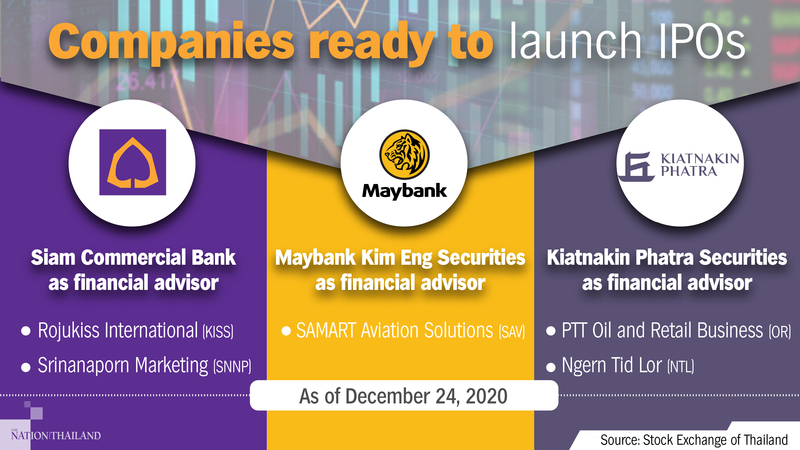
Initial public offerings (IPO) will become more popular with investors next year, experts said recently.
Prasert Tantayawit, managing director of investment banking for Maybank Kim Eng Securities, said investors are paying attention to IPO shares as the stock market is moving into positive territory.
“Businesses related to aviation and retail have postponed plans to launch IPO shares owing to the Covid-19 impact, but we believe they will start raising funds once the pandemic is resolved,” he said.
“Meanwhile, businesses related to healthcare, construction and industrial estate which have been able to escape the Covid-19 fallout are ready to launch their IPO next year.”
He added that many leading Thai firms plan to expand into neighbouring countries next year.
“Recently, Maybank Kim Eng Securities became an adviser for SCG on the acquisition of a Vietnamese company,” he added.
SCB Securities’ director Veena Lertnimitr said companies aiming to launch an IPO next year will attract more investors to the stock market, especially if they are companies related to digital platforms, e-commerce or branding focused food businesses. She added that five such firms will be listed in the stock market next year.
“Most companies that aim to launch an IPO next year have authorised capital of over Bt300 million, while some may need to improve their business plan to deal with the post-Covid-19 era,” she said.
The Thai stock market is expected to face sell-offs in the final week of the year, as new cases of coronavirus infections soar, Anusorn Tamajai, former dean of Rangsit University’s Economics Faculty, has warned.
People who pay respects at the Hindu shrine outside Isetan department store in Bangkok have to stay in the marked space as a precaution against virus infection.
A new round of coronavirus infections globally and the threat of new virus variants may force many countries to impose ban on foreign arrivals, and such restrictions would disrupt recovery of the global economy, he said.
The Stock Exchange of Thailand (SET) may plunge below 1,400 from Friday’s close of 1,486.31, he predicted.
The SET’s new barrier may be at 1,380. The baht will not change much in the final week of the year but it could have a tendency to appreciate in the first quarter of next year due to large contraction in imports, he said.
Investors may shift their funds to more secure asset classes, such as gold and government bonds, as Thailand and other Asian countries are facing a new round of infections which threatens economic recovery. The threat of a US government shutdown could also make global stock markets jittery, as incumbent President Donald Trump has not yet signed the virus relief package into law. That would also adversely affect US stocks and the dollar, said Anusorn.
The Thai government reported 121 new Covid-10 cases on Sunday and authorised partial lockdowns in several provinces.
“The challenge for the government is how to prevent multiple clusters and superspreading events in the next two months,” he said.
If the government can do that, then the virus will be contained as it was in the first round of infection, therefore any large gathering of people must be avoided over the next two months, he noted.
He said the government’s budget of Bt6 billion to buy vaccines is not adequate. The Bt6 billion will buy just 26 million doses of vaccine and only 13 million people will get shots as everyone needs two shots.
Thailand needs to vaccinate at least 53 to 54 million people, including migrant workers, to control the virus and pave the way for reopening of the economy in the third quarter next year, he suggested.
So the government needs Bt18.69 billion more for vaccine sourcing, as the country needs to import at least 107 million vaccine doses, he said.
“If Thailand cannot reopen the economy in the third quarter of next year, more people will lose their jobs, more small businesses will go bankrupt and financial institutions will face serious trouble,” he warned.
The government has to go ahead with its plan to collect land and building tax in order to get more revenue from wealthy people who have the capacity to pay more taxes, he said.
He also urged the government to allow private hospitals to provide vaccinations to high-income groups in order to reduce government spending.
The Bank of Thailand on Wednesday cut its economic growth projection for next year to 3.2 per cent, down from the previous projection of 3.6 per cent, due to the impact of the new round of Covid infections worldwide.
The central bank, however, revised upward its forecast for this year’s growth, predicting a contraction of 6.6 per cent compared with the 7.8 per cent contraction predicted previously.
Just a month after Joe Biden’s victory in the US presidential election, the European Union recently announced that it had adopted the EU Human Rights Global Sanctions Regime to celebrate the world Human Rights Day on the eve of December 10.
The legislation will equip the EU with transnational powers to impose sanctions on those accused of committing crimes that included mass genocide, arbitrary detentions, slavery and other human rights-related issues. While acting on its own, the move has been widely seen as a symbolic gesture by Brussels to re-emphasise its commitment to democracy alongside the US after a tumultuous decade of the world’s right-wing populist turn.
The EU’s new sanctions regime is commonly known as a twin of the Global Magnitsky Act that grants the US the same absolute power to impose travel bans and freeze assets individually of officials from illiberal regimes. Though it does not target the whole country, it essentially aims to cause difficulties and irritations to most human rights abusers from conducting business with EU member states. Put simply, this development is believed, among diplomats and policymakers from both sides of the Atlantic region, to be a mechanism that halts dictators and political strongmen from acts of despotism against their opposition.
Meanwhile, there is not much of a reaction from Bangkok and its foreign policy community. One possibility is that Bangkok might already be familiar with the EU sanctions regime since Thailand was previously attacked by the illegal, unreported and unregulated (IUU) yellow card, a warning against Thailand’s malpractices in fisheries, and that the new sanctions regime is far less threatening than the IUU. On one hand, the worst damage caused by the IUU sanction regime is that Thailand, as the third-largest seafood provider in the world, will be prohibited from exporting its seafood to the EU. On the other hand, the worst damage that can be done by the new regime is as small as individuals having hardship in accessing and locating assets in Europe.
Moreover, such a minor punishment will have little effectiveness in dealing with the global human rights situation, even when both the US and the EU impose it simultaneously. The world already has witnessed what has happened in Hong Kong, Xinjiang and Myanmar where violent abuses by states are not uncommon. To be clear, under the Global Magnitsky Act, outgoing US President Donald Trump had decisively slapped sanctions against many top military and party officials from those countries for alleged abuses and genocide, with asset freezes. The move, however, did not appear to be sufficient to stop those countries’ hawkish leaders from citizen abuses. Since some officials do not even have houses in the US and the targets of the sanctions are also merely not the true decisionmakers, in the realist’s playbook the twin of the Global Magnitsky Act is therefore not that frightening. Even if Bangkok is one of its targets, persons who hold top jobs in the Thai government are surely out of the radar, as the persons who receive punishment maybe some mid-level or other not-that-top officials from the Army that are not deemed as vital to the government. Besides, the strategy of diverging sanctions targets from the countries or states to individuals separately reveal that the EU does not really have an intention to create a wider range of casualties from its sanctions regime. For, there are still some friendly and strategically useful dictator regimes that are important for the EU’s geopolitics.
The new EU sanctions regime was also firmly criticised by EU diplomats and policymakers as for that consensus from EU member-states is required before drawing up the sanctions lists. And there are no independent organisations or civil society bodies that have an ability to recommend sanctions like that in the US. As a result, it is almost near impossible for the EU to effectively impose sanctions on illiberal regimes, especially in a certain circumstance where many of the European leaders are conservative-oriented. Given that Budapest, Warsaw, and Vienna are unwilling to play by the rule, an initiative from Brussels will merely be a failed attempt.
Plus, there is still an unusual belief among the elite and the foreign-policy community in Bangkok that as long as Thailand maintains its cooperation with the EU in other aspects, to be precise a strategic cooperation, it will easily have the EU’s nod no matter how undemocratically it behaves. The Bangkok elite had mistakenly understood that importing arms and giving a long-term security commitment to either the EU or the US will grant it an all-time pass from the sanctions regime. In practical terms, the new tool from Brussels is not going to bother Bangkok even when it is being critically targeted. Particularly not the current government where conservative military leaders have all the say in its decision-making process.

 Total Workforce Index 2020 has identified the top five markets globally for cost efficiency: the Philippines, Croatia, Morocco, Việt Nam and Thailand. Photo ManpowerGroup
 The committee has also assessed that the Pfizer-BioNTech vaccine is suitable for use in people aged 16 and above. ST PHOTO: CHONG JUN LIANG
 Officials control the entry of automobiles into a chicken farm in Gyeongju, 371 kilometers south of Seoul, on Sunday. (Yonhap)
 (The Yomiuri Shimbun)
![A cargo ship loads up vehicles for export at the Lianyungang Port in East China's Jiangsu province on Dec 14. [Photo by WANG CHUN/FOR CHINA DAILY]](https://media.nationthailand.com/images/news/2020/12/28/30400321/800_97fddc6e18b216f.png?v=1609122651) A cargo ship loads up vehicles for export at the Lianyungang Port in East China’s Jiangsu province on Dec 14. [Photo by WANG CHUN/FOR CHINA DAILY]
A cargo ship loads up vehicles for export at the Lianyungang Port in East China’s Jiangsu province on Dec 14. [Photo by WANG CHUN/FOR CHINA DAILY]

 Anusorn Tamajai


