As omicron arrives in China, covid restrictions leave millions facing holidays without family

#SootinClaimon.Com : ขอบคุณแหล่งข้อมูล : หนังสือพิมพ์ The Nation.

https://www.nationthailand.com/international/40010086


All year, Shirley Zhang – a translator in Hangzhou, China – has been looking forward to going home to Xian for Lunar New Year, when small things such as running errands for her parents or catching up on neighborhood gossip fill her with joy. Last year, because of the pandemic, she spent the holiday in her adopted city with friends, heeding government calls not to travel.

As omicron arrives in China, covid restrictions leave millions facing holidays without family

“The meaning of new year is getting together with family. This kind of happiness isn’t the same as with friends,” said the 29-year-old. “We all hope to go home.”

For the third year in a row, millions of people such as Zhang are likely to miss out on Lunar New Year, the most anticipated holiday on the Chinese calendar, as the omicron variant breaches China’s stringent covid-19 defenses and prompts even more severe restrictions ahead of the 2022 Winter Olympics in Beijing.

Authorities this week detected the country’s first omicron cases – one in the port city of Tianjin, close to Beijing, and another in the southern manufacturing hub of Guangzhou. Both municipal governments have rushed to halt transmission with targeted tracing, mass testing and lockdowns.

Even before the new variant’s arrival, officials were tightening border controls and discouraging residents from traveling over the holiday that begins on Jan. 31 and ends, officially, on Feb. 6. In Zhejiang province, the site of a new outbreak of almost 300 cases, more than half a million people have been ordered to stay home and another 100,000 have been sent to quarantine facilities.

China, one of the last countries to maintain a “zero covid” policy, has insisted on the merits of its approach, from locking down entire theme parks, residential blocks and schools when a single case is detected, to quarantining incoming travelers for up to six weeks.

But as residents prepare to spend another Spring Festival, as the holiday is known, without their families, the costs of China’s zero-covid policy have come to the fore, sparking frustration over how long ordinary citizens can be expected to put their lives on hold.

Deng Juanjuan, a 34-year-old English teacher in Beijing, and her husband, an IT engineer at a state-owned securities company, will be “celebrating in place,” as local officials have been encouraging. “We were told that it’s not a mandate, but strongly recommended,” she said, referring to instructions from her husband’s company. Deng’s husband had planned to go home to Hunan province to visit his mother, who lives alone.

“It’s depressing to see the restrictions go on and on, and there is no escape. When is our life going to be normal again?” Deng said.

For many of China’s 370 million migrant workers, the Lunar New Year is their only chance to visit family for an extended break.

“How many three years are there in a person’s life?” one user on the microblog Weibo asked. “Families reuniting for new year has been a tradition for thousands of years. For us, this is as important as defending against the pandemic.”

“When you asked us to get booster shots, I complied. Nucleic acid tests, I also complied. But three years of not going home is too much,” another wrote.

Other residents such as Zhang say they accept the containment measures but wonder whether the current approach can last. “Zero covid is really difficult. People have to follow all kinds of restrictions. You can require that of one person, of 10 people, but you can’t demand that of 1 billion people,” she said.

Citing the risk of omicron spreading, officials in Taiyuan in Shanxi province on Wednesday called on those working for government or state-owned companies to “set an example” and forgo trips home for the holidays.

Langzhong city in Sichuan province on Sunday published an open letter calling on migrant workers not to return unless necessary. In Yulin, in Guangxi province, authorities suggested substituting a trip with video calls. Officials in Shanghai called on residents to cancel nonessential trips.

Additional measures have been taken to prevent omicron from disrupting the Winter Games. Beijing has asked travelers from about a dozen locations deemed risky to report to local health officials on their return to the capital. In Zhangjiakou, 45 minutes from Beijing by high-speed rail, government workers, state company employees and civil servants in an Olympics development zone were asked to cancel nonessential trips over Lunar New Year.

The announcements sparked criticism even in state-run outlets. Hu Xijin, the editor of the Global Times, warned in a post on Sunday against “rashly” asking people to forgo visits to loved ones.

“It’s obvious that the pandemic will not disappear in the short term . . . but life must continue, the economy must continue,” he wrote. The point of the zero-covid approach, he added, is “to minimize the costs of pandemic measures, not disregard the costs.”

“As the pandemic lengthens, it is necessary to consider people’s psychological endurance. In the context of the pandemic, Spring Festival is also a kind of therapy,” an editorial in Beijing News said on Wednesday.

Over the summer, China’s rising vaccination rates and the arrival of the delta variant sparked a debate about whether it was time to join other nations in gradually opening borders.

After pushback and official studies arguing that border relaxation would rapidly lead to more cases than China had faced in Wuhan in early 2020, few experts have since argued for changing course.

The arrival of omicron is likely to reinforce that resolve. Tianjin has set up omicron-only quarantine areas in designated hospitals. In Guangzhou, more than 1,000 people deemed close contacts or suspected close contacts of the infected individual have been placed in centralized quarantine.

Health officials argue that the zero-covid strategy remains the most cost-effective for China. Liang Wannian, head of the National Health Commission’s team for the covid-19 response, told a briefing last week that the “dynamic” approach was not aiming for total eradication of local transmission, which was now impossible, but rather to break new transmission chains as quickly as possible.

“‘Dynamic zero-tolerance’ is not lying flat,” he said, referring to a trend, discouraged by the government, of young Chinese taking it easy in the face of social pressure. “It’s not just letting the epidemic grow, but rather controlling it, cutting it off.”

Published : December 17, 2021

By : The Washington Post
EU strikes deal with Moderna to speed German vaccine supply

#SootinClaimon.Com : ขอบคุณแหล่งข้อมูล : หนังสือพิมพ์ The Nation.

https://www.nationthailand.com/international/40010083


The European Union brokered a deal to expedite deliveries of the Moderna Covid-19 vaccine to countries like Germany that are experiencing temporary shortages as they try to accelerate inoculation and ward off the omicron variant.

EU strikes deal with Moderna to speed German vaccine supply

Moderna agreed to bring forward delivery of 10 million doses to Germany in December, enough for 20 million boosters, the European Commission said Thursday. The company will also provide 25 million extra shots to Germany in the first quarter of 2022.

Germany has started rationing Covid vaccines through the rest of the year as it seeks to maintain momentum in its ramped-up booster campaign going despite an unexpected shortage of BioNTech vaccines.

The country’s new health minister, Karl Lauterbach, said he wants most of the 25 million shots for the first quarter already in January. He’s also seeking to purchase unused doses from countries including Portugal, Romania, Poland and Bulgaria, and is pursuing fresh supplies directly from manufacturers.

“I hope that I can bring you some news of success on this in coming days or weeks,” he said Thursday at a news conference in Berlin.

Germany has already administered over 20 million Covid shots since it kicked off a booster campaign in mid-November, according to data from the RKI public-health institute.

The goal through the end of the year is 30 million, and the country is also seeking to ramp up a program to inoculate children against Covid.

Lauterbach said he had spoken to his counterpart in the U.K., Sajid Javid, earlier Thursday and the latest data on the rapid spread of the omicron strain there were “very worrying.”

Getting third Covid shots administered as quickly as possible is key for ending the current wave of the pandemic and heading off the risk posed by the new omicron strain, he added.

“Our strategy is that we will try to keep the omicron variant under control as far as possible via a very fast, offensive booster campaign,” Lauterbach said. “This is to prevent the health system becoming overloaded and possibly even wider society.”

Germany is also hoping get more BioNTech vaccine from the EU in the first quarter, Lauterbach said. He thanked the German parliament’s budget committee and Finance Minister Christian Lindner for making an extra 2.2 billion euros ($2.5 billion) available for vaccine procurement.

“I want there to be clearly more vaccine available than is being called for at any given time, so that we can cover our needs without delay,” he told reporters.

Germany’s overall vaccination campaign has been less successful than in many of its fellow EU members, with just 70% of the population already receiving at least two doses as of Wednesday. That compares with almost 80% in France and nearly 75% in Italy, according to the Bloomberg Vaccine Tracker.

EU leaders are meeting in Brussels on Thursday, where they’re discussing how to accelerate booster shots across the continent.

Published : December 17, 2021

By : Bloomberg

Amid warnings to Russia over feared Ukraine attack, E.U. struggles over how tough to set sanctions

#SootinClaimon.Com : ขอบคุณแหล่งข้อมูล : หนังสือพิมพ์ The Nation.

https://www.nationthailand.com/international/40010082


BRUSSELS – E.U. leaders are warning Russia that any military move into Ukraine will come at a high cost, with new sanctions from Moscows critical trading partner.

Amid warnings to Russia over feared Ukraine attack, E.U. struggles over how tough to set sanctions

The stern messages to Russia, however, are the easy part.

It’s much more challenging for the European Union’s 27 members to agree on potential economic and diplomatic blows against Russia over any military action in Ukraine, which lost Crimea to a Russian invasion in 2014 and has fought a nearly eight-year war against Moscow-backed separatists in eastern Ukraine. Since spring, Russia has significantly boosted its forces along the Ukrainian border.

All E.U. members have to agree on sanctions but have long been divided on how to handle relations with Russia. Countries including Poland and Sweden have criticized moves to maintain diplomatic contact with Russian President Vladimir Putin. French and Germany, however, have held direct talks with Putin. Hungary’s president, Viktor Orban, is often considered an ally of Putin.

And then there’s the nearly completed Nord Stream 2 pipeline to bring natural gas from Russia to Germany – and bypass current routes through Ukraine. Opposition to the pipeline is widespread in Europe, and some E.U. leaders argue that it is contradictory to sanction Russia while also forming business deals with it. But Germany – one of the European Union’s most-powerful members – wants the pipeline, and E.U. officials haven’t yet indicated if they are considering Nord Stream as part of potential sanctions.

Still, E.U. leaders appear united that they need to spell out the possible fallout to Russia.

“Any aggressive action will be met with a high political and economic cost,” the European Union’s top diplomat, Josep Borrell, said Thursday ahead of a meeting with European leaders. Germany’s new chancellor, Olaf Scholz, said it would be a “serious mistake to believe that violating the borders of a European country would remain without consequences.”

“We are convinced that Russia is actually preparing for the all-out war against Ukraine,” Lithuanian Foreign Minister Gabrielius Landsbergis said, adding that “an unprecedented attack on a country that shows a Western direction” would warrant an “unprecedented” response.

Russia insists it has no plans to send forces over the border. But Putin strongly opposes Ukraine’s deepening ties with the West and called Ukraine’s dream of NATO membership a “red line.”

The Biden administration warned that it would be willing to impose more severe economic sanctions against Russia than it did in 2014 and said the pipeline could be strong leverage in negotiations.

E.U. officials have so far not revealed details about any sanctions they are considering, but many analysts and diplomats say that the bloc is better positioned to take tougher actions than in 2014 after Russia’s annexation of Crimea. Among the reasons: Since 2014, Ukraine has bolstered its alliances with the West, creating a more fervent consensus within the European Union that Ukraine must be protected from Russia.

“I think all of us are willing to put our money where our mouth is when it comes to the red line,” a senior European diplomat, who spoke on the condition of anonymity due to the sensitivity of the internal deliberations, said Wednesday.

“This time, yes,” Borrell told reporters Thursday, when asked if he thought European countries would agree on sanctions.

When Russia invaded Crimea in 2014, the European Union responded with sanctions largely aimed at preventing 44 businesses and organizations and nearly 200 people from borrowing money from European banks. The sanctions prevented these people from traveling into the European Union.

After criticism for limited sanctions, the European Union later ramped up the severity of the penalties, which have been renewed multiple times and are still in place.

The European Union’s close economic ties to Russia positions the bloc to deliver potentially more-consequential sanctions than the United States. But that also means that sanctions could hit its own coffers.

Edward Hunter Christie, a senior research fellow at the Finnish Institute of International Affairs, said the sanctions stemming from the Crimea invasion barely touched Russia’s energy industry, which the European countries rely on.

Yet the International Monetary Fund estimated in 2015 that Western sanctions reduced Russia’s gross domestic product by more than 1%. A subsequent IMF study determined that sanctions slowed the country’s economic growth since then. Those sanctions arrived around the same time as oil prices tanked, delivering Russia a much bigger blow to its economy.

“The [current] sanctions are strong enough that you are going to notice it, but it’s not strong enough that you are going to feel that countries are trying to demolish you,” said Christie, who was a defense economist for NATO in 2014. “And that was deliberate. “

Francesco Giumelli, associate professor of international relations at the Netherlands’ University of Groningen, said that the European Union will have to think of different types of sanctions this time, another potential challenge. When Russians were blocked from accessing European and American banks, many then turned to China.

Giumelli, whose research focuses on international sanctions, warned that if Russia is set on invading Ukraine, economic sanctions alone would be hard to deter them.

So far, leaders appear to divided on whether the Nord Stream 2 pipeline should be included in sanctions.

“It is important to keep energy policy out of the conflict,” Finnish Prime Minister Sanna Marin said Thursday.

Gwendolyn Sasse, senior fellow focusing on Eastern Europe at the Carnegie Europe think tank, said this latest crisis in Russia gives the European Union an opportunity to display its strength during a crisis.

“The urgency is much greater. It’s such a massive buildup. Nothing is covert,” Sasse said. “What’s at stake is whether the E.U. can act and is seen as a strong and coherent foreign policy actor if something happens.”

Published : December 17, 2021

By : The Washington Post
Remaining U.S., Canadian missionaries kidnapped in Haiti have been released: Police

#SootinClaimon.Com : ขอบคุณแหล่งข้อมูล : หนังสือพิมพ์ The Nation.

https://www.nationthailand.com/international/40010081


The remaining members of a U.S.-based Christian missionary group who were kidnapped in Haiti in October have been released, Haiti national police spokesman Gary Desrosiers told The Washington Post on Thursday.

Remaining U.S., Canadian missionaries kidnapped in Haiti have been released: Police

The 17 hostages, who included 16 Americans and one Canadian, were seized by the notorious street gang 400 Mawozo outside Port-au-Prince on Oct. 16 as they were returning from a visit to an orphanage some 90 minutes from their base. The group from Ohio-based Christian Aid Ministries included women and five children, one of whom was 8 months old at the time.

Two of the hostages were released in November and three more were released this month.

Christian Aid Ministries thanked supporters for their “fervent prayers” over the past two months and said they would provide more information “as we are able.”

“We glorify God for answered prayer – the remaining twelve hostages are FREE,” the group said. “Join us in praising God that all 17 of our loved ones are now safe.”

400 Mawozo had demanded $1 million for the return of each victim; its leader had threatened to “put a bullet” in them if the demand wasn’t met. It’s unclear whether a ransom was paid for any of the hostages. The U.S. and Canadian governments have said that they typically do not pay ransoms.

Officials from the State Department and the FBI have been on the ground in Haiti to help secure the release of the hostages.

The kidnapping of the missionaries focused international attention on a terrifying wave of mass abductions by the armed gangs that have tightened their grip on the beleaguered Caribbean nation. The gangs have targeted Haitians of all ages and all walks of life, including doctors, busloads of passengers, even police.

The kidnapping of fuel trucks and their drivers have caused fuel shortages, impacting hospitals and triggering nationwide strikes that have paralyzed the country. When a 7.2-magnitude earthquake struck Haiti in August, gangs temporarily blocked aid convoys from reaching victims.

Police have struggled to respond as gangs have grown more powerful and gained control of more territory. Haiti now has the world’s highest kidnapping rate per capita. U.S. and Canadian officials have urged their nationals to leave the country.

400 Mawozo controls parts of Ganthier, the town east of Port-au-Prince where the missionaries were seized. The gang has grown notorious for targeting religious groups and members of the clergy, who were long considered off-limits. In recent months, it has engaged in mass kidnappings of buses and cars. In April, it kidnapped several priests and nuns, including some French nationals, prompting Catholic schools and universities to close in protest.

The release of the hostages is one piece of bright news in an otherwise difficult year for Haiti, which has been slammed by a convergence of calamities. In July, President Jovenel Moïse was assassinated in a brazen attack at his home that remains unsolved, plunging the nation into turmoil. The earthquake in southern Haiti the next month killed more than 2,200 people. On Monday, a tanker truck carrying gasoline overturned and exploded in the country’s second-largest city, killing at least 66 people and injuring scores more.

Published : December 17, 2021

By : The Washington Post

Five children killed after strong winds send bouncy castle flying in Australia

#SootinClaimon.Com : ขอบคุณแหล่งข้อมูล : หนังสือพิมพ์ The Nation.

https://www.nationthailand.com/international/40010080


SYDNEY – It was meant to be a day of celebration for the children of Hillcrest Primary School in the Australian island state of Tasmania.

Five children killed after strong winds send bouncy castle flying in Australia

Instead, the final day of the school year was marred by tragedy: Five children were killed and at least four others were seriously injured when a bouncy castle was blown into the air by strong winds. As the castle took flight, with the students and a number of inflatable plastic balls inside, nine children tumbled more than 30 feet to the ground below, Tasmanian police said.

Four of the dead – two boys and two girls – were sixth graders. They had been due to begin high school in the new year. (Australian schools follow the calendar year.)

“On a day when these children were meant to be celebrating … we’re all mourning their loss,” Tasmanian Police Commissioner Darren Hine told reporters. “Our hearts are breaking for the families and the loved ones, schoolmates, teachers of these young people who were taken too soon.”

It wasn’t immediately clear whether the castle was tied down at the time of the incident, or how many children were on the castle when it took off. An investigation is underway.

Pictures posted on social media by an Australian Broadcasting Corp. reporter showed part of the deflated castle dangling from a nearby tree. A blue plastic tarpaulin cordoned off an area where the children were likely to have landed. In another photo, two police officers huddled on the grass in front of a deserted playground, comforting each other.

“This is a very tragic event and our thoughts are with the families and the wider school community, and also our first responders,” Commander Debbie Williams told reporters. “There is no doubt that this has been a very confronting and distressing scene.”

Parents rushed to the school, uncertain whether their children were among the injured, the ABC reported. In a statement posted on Facebook, the school asked parents to collect their children “as a matter of urgency” and said it would close for the rest of the day.

It’s not the first time bouncy castles have been sent flying by strong winds. In the United States, four children were reportedly injured in Mesa, Ariz., in May when a gust of wind picked up a bouncy castle along with several children who were playing inside. The structure flew several feet and then collapsed, local media reported at the time. The children, aged 5 to 11, were taken to a nearby hospital after some reportedly suffered severe injuries.

In 2017, a 6-year-old girl was killed in Spain after an inflatable castle went soaring into the sky with seven children inside. A similar incident led to the death of a 7-year-old girl in Britain in 2016.

Australian Prime Minister Scott Morrison said the Tasmanian incident was “unthinkably heartbreaking.”

“Young children on a fun day out, together with their families and it turns to such horrific tragedy, at this time of year, it just breaks your heart,” he said.

Published : December 17, 2021

By : The Washington Post

U.S. Fed announces faster tapering of asset purchases amid rising inflation

#SootinClaimon.Com : ขอบคุณแหล่งข้อมูล : หนังสือพิมพ์ The Nation.

https://www.nationthailand.com/international/40010053


The U.S. Federal Reserve on Wednesday announced a faster tapering of the central banks asset purchase program beginning in January amid the rising inflation.

U.S. Fed announces faster tapering of asset purchases amid rising inflation

— The announcement put the Fed on track to end asset purchases by March, earlier than initially expected of June.

— Fed officials’ median interest rate projections released Wednesday showed that the central bank could raise the benchmark interest rate three times next year, up from just one rate hike projected in September.

“Supply and demand imbalances related to the pandemic and the reopening of the economy have continued to contribute to elevated levels of inflation,” the Federal Open Market Committee (FOMC), the Fed’s policy-making committee, said in a statement after a two-day policy meeting.

“In light of inflation developments and the further improvement in the labor market,” the committee decided to reduce the monthly pace of its net asset purchases by 20 billion U.S. dollars for Treasury securities and 10 billion dollars for agency mortgage-backed securities, starting with the mid-January purchase schedule.

“The Committee judges that similar reductions in the pace of net asset purchases will likely be appropriate each month, but it is prepared to adjust the pace of purchases if warranted by changes in the economic outlook,” the statement said.

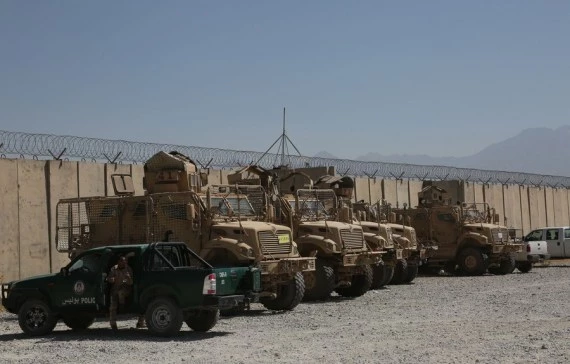
Photo taken on July 8, 2021 shows military vehicles abandoned by U.S. forces at the Bagram Airfield base after all U.S. and NATO forces evacuated in Parwan province, eastern Afghanistan. (Xinhua/Rahmatullah ALizadah)Photo taken on July 8, 2021 shows military vehicles abandoned by U.S. forces at the Bagram Airfield base after all U.S. and NATO forces evacuated in Parwan province, eastern Afghanistan. (Xinhua/Rahmatullah ALizadah)

The Fed in early November agreed to reduce its monthly asset purchase program of 120 billion dollars by 15 billion dollars. The announcement on Wednesday put the central bank on track to end asset purchases by March, earlier than initially expected of June.

“We are phasing out our purchases more rapidly because with elevated inflation pressures and a rapidly strengthening labor market, the economy no longer needs increasing amounts of policy support,” Fed Chairman Jerome Powell said Wednesday afternoon at a virtual press conference.

“In addition, a quicker conclusion of our asset purchases will better position policy to address the full range of plausible economic outcomes,” Powell said.

Over the past several weeks, some Fed officials and economists have urged the central bank to accelerate the pace of tapering to give more leeway to raise rates sooner amid inflation pressures.

The consumer price index (CPI) rose 6.8 percent in November from a year earlier, the fastest annual pace in almost 40 years, according to the U.S. Labor Department.

Fed officials’ median interest rate projections released Wednesday showed that the central bank could raise the benchmark interest rate three times next year, up from just one rate hike projected in September.

Fed officials also expected the U.S. economy to grow at 5.5 percent in 2021, lower than 5.9 percent estimated in September.

The Fed has pledged to keep the federal funds rate unchanged at the record-low level of near zero since the start of the pandemic.

“The bar for rate hikes now rests squarely on the labor market, with the statement indicating that the inflation threshold even under the Fed’s new flexible regime has been met,” Sarah House and Michael Pugliese, economists at Wells Fargo Securities, said Wednesday in an analysis.

“Market pricing over the next two years is roughly in line with the median projection for six cumulative rate hikes through year-end 2023, but beyond that markets are priced for very little additional tightening,” they noted. 

Published : December 16, 2021

By : Xinhua

Fun fact behinds BITEC’s building design

#SootinClaimon.Com : ขอบคุณแหล่งข้อมูล : หนังสือพิมพ์ The Nation.

https://www.nationthailand.com/property/40009404


Bangkok, Thailand, 29 November 2021- Architectural design does not only respond to the exterior and physical appearance of buildings, it also conceals meanings and functional benefits beyond our perception.

Fun fact behinds BITEC’s building design

Bangkok International Trade & Exhibition Centre (BITEC), a leading MICE venue in Thailand and ASEAN revealed fascinating facts behind its iconic building design that respond to the needs of MICE business.

BITEC’s top priority is to deliver excellent services to customers and visitors, providing convenient, safe and full access to its functional facilities where organisers require specific attention to detail. BITEC focused on all aspects of the architecture, engineering, interior design and landscaping to meet the international standards. The following are the ten remarkable highlights that are considered parts of BITEC’s brand identity.

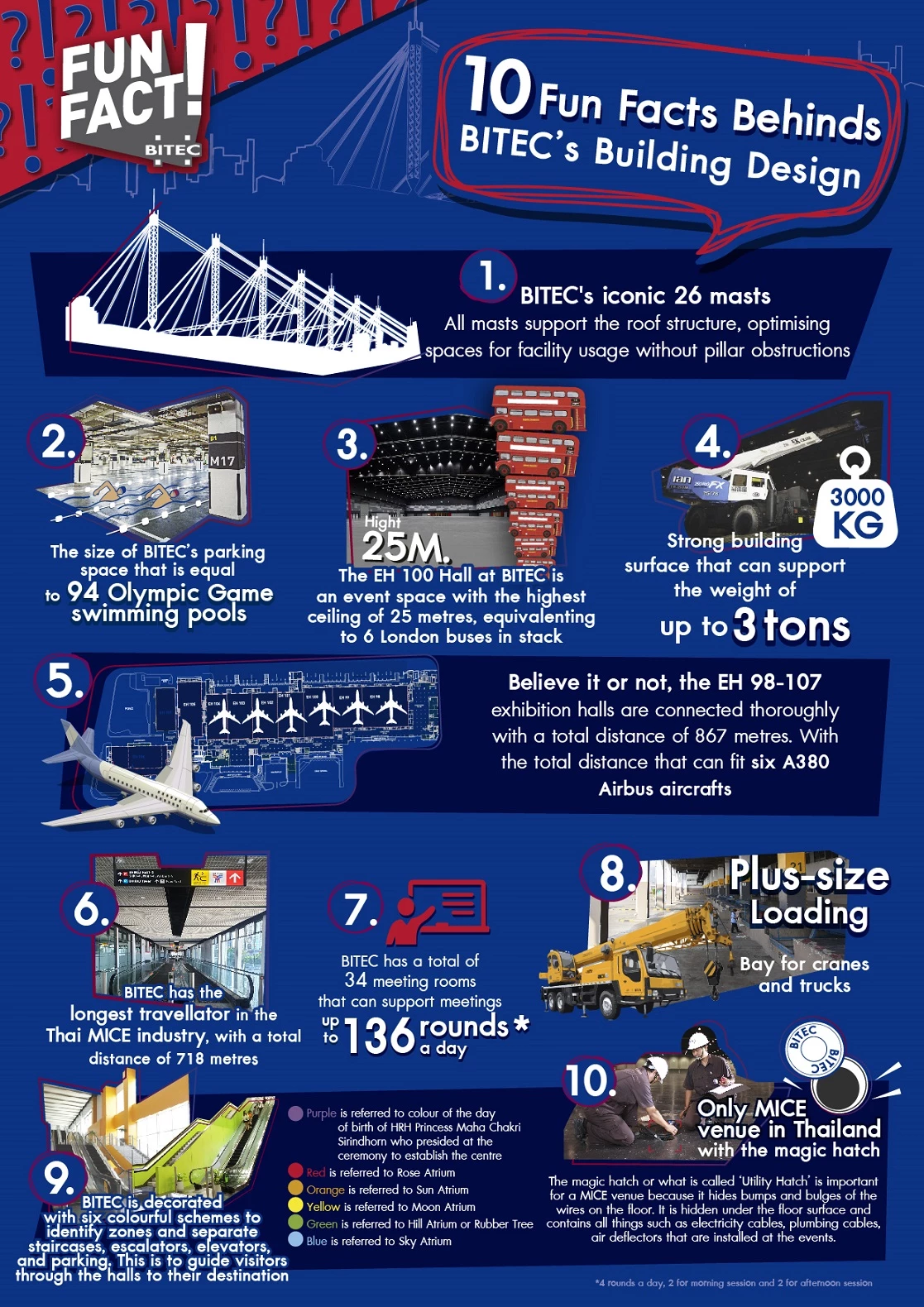
1. BITEC’s iconic masts

BITEC’s masts are considered as Iconic Architecture that have become like a landmark of the Eastern district of Bangkok. The idea of the design is of the plan to build an exhibition centre without pillars in order to make the most of every square metre.

Apart from an outstanding architectural appeal, all 26 masts support the roof structure, optimising spaces for facility usage without pillar obstructions. This allows for more flexible movement when installing equipment or industry machinery that requires manufacturing lifting. It is also beneficial for exhibitions that require vertical change of scene as the Hanging Point of the main roof structure has a bearing capacity of 2,000 kilograms per trussing line.

2. The size of BITEC’s parking space that is equal to 94 Olympic Game swimming pools

Many may think that BITEC does not have enough parking spaces, but in fact BITEC has a total capacity of up to 5,050 cars. BITEC has an indoor car park on the basement B1, B2 and B3 floors as well as the outdoor area which the total space is comparable to 94 standard Olympic swimming pools putting together. The parking space also includes special parking zones well as parking and charging outlets for electric vehicles (EV).

Fun fact behinds BITEC’s building design

3. Freedom of heights

The EH 100 Hall at BITEC is an event space with the highest ceiling of 25 metres, equivalenting to 6 London buses in stack. The height freedom benefits events that require manufacturing lifting or high ceiling space for loading and installation such as acrobatics, concerts and performing shows.

4. Strong building surface that can support the weight of up to 3 tons

BITEC is the only venue in Thailand that can host industrial exhibitions and trade shows. The building’s Floor load that has an ability to support the weight of up to 3 tons per square metre, allows BITEC to be the venue of choice for organisers in the public and private sectors.

5. Connected open exhibition halls that are big enough to fit 6 airplanes

Believe it or not, the EH 98 to EH 107 exhibition halls are connected thoroughly with a total distance of 867 metres. With the total distance that can fit six A380 Airbus aircrafts, the connected halls are suitable for exhibitions that need to be separated into zones without pillar obstructions such as the Expo. The halls are also a great venue to host an event like an indoor marathon, creating an open space event for visitors as well as avoiding the traffic and PM2.5. pollution.

Each building has its own loading point with truck access, allowing for easy transportation, installations and dismantles

6. The longest travellator in the Thai MICE industry

BITEC has the longest travellator in the Thai MICE industry, with a total distance of 718 metres. The travellator allows users to commute within the space through each hall faster and more convenient. It is specially designed to match the style of the building with high safety standards equivalent to the ones at the airports, shopping malls and five-star hotels. BITEC also considered power and energy-saving as one of the top priorities, hence the travellator will automatically stop when there are no users. As for its long narrow path, this might be a good idea for those who look for a photogenic corner for photos and posts on social media.

7. BITEC has a total of 34 meeting rooms that can support meetings up to 136 rounds a day

Not only BITEC has exhibition halls and trade show venues, BITEC also provides 34 functional rooms that can support banquets and meetings up to 136 rounds a day. The rooms can accommodate up to 5,155 seats per day (4 rounds a day, 2 for morning session and 2 for afternoon session). With services and facilities that meet the international standards, the functional meeting rooms are choice of full benefits for corporate meetings, seminars, and annual parties.   

8. Plus-size Loading Bay for cranes and trucks

BITEC is the only venue in Thailand that allows cranes and trucks to enter the halls for loading and setting up. The access through a plus-size Loading Door is six metres tall and eight metres wide. This allows exhibitors to set up industrial machineries in a more cost-effective and convenient way. Also, facilitating loading by Dock leveller.

9. The colours have meanings

Noticeably, the interior at BITEC is decorated with six colourful schemes to identify zones and separate staircases, escalators, elevators, and parking. This is to guide visitors through the halls to their destination. The six colours all have meanings in relation to BITEC.

  • Purple is referred to colour of the day of birth of HRH Princess Maha Chakri Sirindhorn who presided at the ceremony to establish the centre
  • Red is referred to Rose Atrium
  • Orange is referred to Sun Atrium
  • Yellow is referred to Moon Atrium
  • Green is referred to Hill Atrium or Rubber Tree
  • Blue is referred to Sky Atrium

The colour codes will help to guide visitors throughout BITEC.

10. Only MICE venue in Thailand with the magic hatch

The magic hatch or what is called ‘Utility Hatch’ is important for a MICE venue because it hides bumps and bulges of the wires on the floor. It is hidden under the floor surface and contains all things such as electricity cables, plumbing cables, air deflectors that are installed at the events. The magic hatch is a must-have facility for industrial machinery exhibitions or events with machinery demonstration. Apart from being practical for setting up and providing a seamless appearance, the magic hatch also adds safety and security for the venue. Those hatches installed at every 9 meters on standard exhibition floor.

Apart from the outstanding architectural and meanings behind the design, BITEC also offers the international standards services and facilities to all users to utilise and benefit from the use of the space. The centre is working to provide services, safety and security that respond to alternating needs of MICE business in the next normal era.

Published : November 29, 2021

By : THE NATION

Apple builds team in new office to make own wireless chips

#SootinClaimon.Com : ขอบคุณแหล่งข้อมูล : หนังสือพิมพ์ The Nation.

https://www.nationthailand.com/tech/40010088


Apple is hiring engineers for a new office in Southern California to develop wireless chips that could eventually replace components supplied by Broadcom and Skyworks Solutions.

Apple builds team in new office to make own wireless chips

The company is seeking a few dozen people to develop wireless chips in Irvine, where Broadcom, Skyworks and other companies have offices. Recent job listings show that Apple wants employees with experience in modem chips and other wireless semiconductors.

It’s part of a broader strategy of expanding satellite offices, letting the tech giant target engineering hotbeds and attract employees who might not want to work at its home base in Silicon Valley. The approach also has helped Apple further its goal of making more of its own components.

Shares of wireless-chip makers slid Thursday after Bloomberg reported on the effort. Skyworks fell as much as 11%, marking its biggest intraday plunge since March 2020. Broadcom and Qualcomm Inc. declined more than 4% each.

Apple’s interest in hiring talent related to a particular technology is usually bad news for the existing providers. The company has increasingly touted the importance of its in-house chip designs in making its products stand out. Intel Corp., the industry’s biggest company, has joined growing a list of chipmakers that have lost their grip on Apple products.

In 2018, Apple started recruiting engineers in San Diego, home of Qualcomm. Two years later, Apple chip chief Johny Srouji told employees that the company is developing its own cellular modem to eventually replace Qualcomm’s offerings.

An Apple spokesman declined to comment on the Irvine push. Representatives for Broadcom and Skyworks didn’t respond to requests for comment.

The Irvine expansion is in its early stages, and Apple plans to increase its presence gradually. The company also is still working out its companywide return-to-office plans. Just Wednesday, Apple scrapped its Feb. 1 deadline for corporate employees to go back to in-person work.

But staffing up in Irvine is the latest sign Apple is bringing more technology in-house. Engineers will work on wireless radios, radio-frequency integrated circuits and a wireless system-on-a-chip, or SoC. They’ll also develop semiconductors for connecting to Bluetooth and Wi-Fi. Those are all components currently provided to Apple by Broadcom, Skyworks and Qualcomm.

The effort builds on Apple’s earlier work in wireless chips. The AirPods and Apple Watch already include custom parts that let them pair with devices, and Apple’s latest iPhones include U1 ultra-wideband chips for more accurately pinpointing their location and connecting with the AirTag accessory and other products.

“Apple’s growing wireless silicon development team is developing the next generation of wireless silicon!” one job listing says. Another says employees will “be at the center of a wireless SoC design group with a critical impact on getting Apple’s state-of-the-art wireless connectivity solutions into hundreds of millions of products.”

Apple, and particularly the iPhone, is a key source of revenue for chipmakers. In early 2020, Apple and Broadcom reached a $15 billion supply agreement for wireless components that ends in 2023. Apple accounts for about 20% of Broadcom’s sales, according to data compiled by Bloomberg. Skyworks is even more dependent on Apple, which makes up nearly 60% of its revenue, the data shows.

Irvine — located in Orange County, south of Los Angeles — is also home to wireless chip design offices for NXP Semiconductors NV, another company Apple could hire engineers from. Apple currently relies on NXP’s near-field-communication chips for mobile payments.

The office also is near the University of California at Irvine, which is known for its engineering programs.

Apple will emerge from the pandemic in a less centralized form. While Cupertino remains the heart of the company, it has turned San Diego into a bigger hub. Apple has added headcount and expanded hiring there beyond chips to smart home technology, displays and software.

It’s also expanding in Los Angeles, hiring employees to work on Apple TV+ and other digital services. And it has an office in Newport Beach, near Irvine, for development of augmented reality content from its NextVR acquisition.

Apple has a history of setting up offices near existing suppliers — in some cases, as the first step toward eventually replacing them.

That includes its chip offices in Portland, Oregon, near Intel buildings, as well as its operations in Austin, Texas, and Orlando, Florida, where Advanced Micro Devices Inc. has campuses. And it’s expanded in Haifa and Herzliya, Israel, where Intel has engineers, and in Munich, Germany, home to Infineon Technologies’s headquarters.

Srouji has also pushed Apple to open new offices in Massachusetts, where Skyworks has offices, and Japan, where chipmakers like Toshiba Corp. have design centers. In 2018, Apple invested in Dialog Semiconductor, which specializes in power management chips, and acquired hundreds of employees and offices in the U.K. and Italy.

Last year, the company started transitioning away from Intel chips for its Macs, while also designing its own in-house camera and display technologies. Apple bought Intel’s modem unit for $1 billion as well, setting the stage to replace the component from Qualcomm.

Apple’s chip development strategy has allowed the company to build devices with unique features, helping its market value soar to nearly $3 trillion, and its chip unit is now considered one of its most prized assets. But the strategy hasn’t been without its snags.

Apple had a public dispute with U.K. graphics chip designer Imagination Technologies Group in 2017 after transitioning to its own custom graphics processors. Apple’s move left Imagination nearly bankrupt. In 2020, the two companies reached a licensing agreement.

Published : December 17, 2021

By : Bloomberg

Nearly 50,000 Facebook users may have been targets of private surveillance, company says

#SootinClaimon.Com : ขอบคุณแหล่งข้อมูล : หนังสือพิมพ์ The Nation.

https://www.nationthailand.com/tech/40010087


Facebook is notifying nearly 50,000 users in more than 100 countries that they may have been targets of hacking attempts by surveillance companies working for government agencies or private clients, the company said Thursday.

Nearly 50,000 Facebook users may have been targets of private surveillance, company says

The notification is the result of a months-long investigation by Meta, Facebook’s parent company, into what Meta officials called “cyber-mercenaries” who engage in “surveillance-for-hire.” As a result, Facebook said it was taking enforcement actions against seven surveillance companies based in four countries, removing about 1,500 fake accounts, blocking malicious Web addresses and sending cease-and-desist letters to the companies.

Meta’s investigators concluded that these companies used Meta’s Facebook and Instagram subsidiaries for surveillance activities, mainly to research and groom targets for later infections by spyware. Each step was part of a broader targeting process the researchers called the “surveillance chain.”

The investigation’s final report, titled “Threat Report on the Surveillance-for-Hire Industry,” took aim at long-standing industry claims that the spying software is used only against terrorists and serious criminals such as drug kingpins and pedophiles. Meta’s investigation found that surveillance companies “regularly” target politicians, human rights workers, journalists, dissidents and family members of opposition figures, with few legal controls or other forms of accountability.

These findings echo those of the Pegasus Project, a global investigation of Israel-based surveillance company NSO Group by The Washington Post and 16 other news organizations, led by Paris-based journalism nonprofit Forbidden Stories. But Meta officials said that while they previously have taken enforcement actions against NSO and sued the company in 2019 for allegedly delivering spyware to users through WhatsApp, the problems posed by private surveillance companies are broader.

“The surveillance industry is much bigger than just one company, and it’s much bigger than just malware-for-hire,” said Nathaniel Gleicher, head of security policy for Meta and a co-author of Thursday’s report. “The targeting we see is indiscriminate. They’re targeting journalists. They’re targeting politicians. They’re targeting human rights defenders. They’re also targeting ordinary citizens.”

Among the companies that Meta sanctioned was a little-known surveillance firm, Cytrox, based in North Macedonia. The Meta report, which said it had removed 300 Facebook and Instagram accounts the company used to engage and deceive targets, lists 10 governments that hire Cytrox, including Egypt, Armenia, Greece, Saudi Arabia, Oman, Colombia, Ivory Coast, Vietnam, the Philippines and Germany.

Overall, Meta’s report listed more than two dozen countries across six continents that used the surveillance services provided by the seven companies in the report; the victims were in more than 100 countries. The report included an example of the nearly 50,000 notifications, which are to start arriving Thursday, reading, “We believe that a sophisticated attacker may be targeting your Facebook account. Be cautious when accepting friend requests and interacting with people you don’t know.”

Pegasus and other forms of spyware allow operators to remotely turn smartphones and other computers into surveillance devices capable of listening to calls and tracking user locations, as well as stealing photos, videos, contact lists and other files. Advanced spyware can be delivered without the users knowing or taking any action, often by text message or a chat app, and then can activate the cameras and microphones built into smartphones.

The claim about Cytrox being used by Egyptian authorities is backed by a separate report, also released Thursday, by Citizen Lab, a research group at the University of Toronto that specializes in investigating spyware. It found that the iPhone 12 of Egyptian opposition figure Ayman Nour was infected by both NSO’s Pegasus spyware and a similar one by Cytrox, called Predator, on a single day in June.

An initial sign of infection was that the smartphone began “running hot” as it managed the computational demands of two types of spyware at once, the report said. These infections happened even though Nour’s iPhone had the latest version of iOS, the mobile operating system made by Apple.

Nour, speaking by video call from exile in Istanbul, said this intrusion was just the latest after years of efforts by the Egyptian government to undermine him and suppress democratic activity in the country going back to 2005, when he ran unsuccessfully for president against then-strongman Hosni Mubarak.

More recently Nour has had personal photos of himself and private phone conversations made public in what he said were government efforts to embarrass him and undermine his role as a leader in Egypt’s political opposition. Currently the head of the Ghad EL-Tahwra Party, Nour called private surveillance companies “digital monsters” that should face international sanctions.

“This is something that is really dangerous, and it has real impact on politicians,” Nour said through an interpreter. “They are making use of every single word we say on our mobile phones.”

Citizen Lab said the Cytrox hack probably came from the Egyptian government, and the Pegasus one probably from the Saudis or the United Arab Emirates, both of which have been repeatedly identified by researchers as aggressive users of private surveillance services.

Cytrox did not reply to a request for comment on Thursday, nor did the Egyptian Embassy in Washington.

NSO Group issued a statement saying it did not have enough information to comment fully. “The details we do have from reporters are ambiguous both from contractual and technological perspectives and indicate with high probability there is no connection to Pegasus,” the statement said.

Meta’s actions are the latest developments in months of growing scrutiny of the global surveillance industry since the Pegasus Project in July. The NSO Group has repeatedly denied its findings and said it works only with vetted countries and terminates contracts with any that violate company policies limiting the use of its spyware to only terrorists and serious criminals.

Even so, the U.S. government blacklisted NSO in November following an investigation that backed the key claims of the Pegasus Project. Apple sued NSO soon after and issued warnings to users across the world – including 11 employees working for the U.S. government in Uganda – that they had been targeted by Pegasus.

These repercussions have done little to slow the global surveillance industry, said Bill Marczak, a senior research fellow at Citizen Lab who discovered the attacks on Nour’s phone and on a phone belonging to another Egyptian. This person, who hosts a popular news program in Egypt, has opted to remain anonymous and is not named in the report.

Marczak called the nearly simultaneous hacking of Nour’s iPhone by two types of spyware remarkable evidence of how widespread such techniques have become. Never before had Citizen Lab researchers seen a single target “doubly hacked.”

“It really drives home that the story of spyware is not just the story of NSO,” said Marczak. “This is an industry that is really growing.”

The Meta report cites six other companies. One, BellTrox, is based in India, and one is based in China, but Meta researchers were unable to determine its name, they said. The remaining four are based in Israel: Cognyte, Cobwebs Technologies, Bluehawk CI and Black Cube, the last of which was hired by disgraced Hollywood producer Harvey Weinstein to collect information on women accusing him of sexual misconduct and journalists covering that story.

Meta said it removed 300 fake Facebook and Instagram accounts linked to Black Cube, which it said specialized in serving people involved in legal battles – a leading purpose for hiring private surveillance, Meta investigators found. That company’s clients included private individuals, businesses and law firms worldwide, Meta’s report said.

In response to the report, Black Cube issued a statement denying Meta’s allegations and saying it complies with the laws wherever it operates. “Black Cube does not undertake any phishing or hacking and does not operate in the cyber world,” the statement said.

Cobwebs Technologies denied that it had violated any laws. “We have not been contacted by Facebook (Meta) and are unaware of any claims it has allegedly made about our services,” the statement said. Cobwebs Technologies “operates only according to the law and adheres to strict standards in respect of privacy protection.”

The list of clients for Cobwebs Technologies included an unnamed customer in the United States, as well as Bangladesh, Hong Kong, New Zealand, Mexico, Saudi Arabia and Poland.

The other companies named in the report did not respond to requests for comment.

Experts in the surveillance industry say it includes more than 100 companies that span the globe, with many having numerous international hubs of operation – a fact making a crackdown by any one country, or even a group of countries, unlikely to stop abuses.

The Meta report says surveillance companies operate by steps, starting with reconnaissance to identify information about prospective targets, and followed by a period of engagement, sometimes over social media or other communications services. This often involves the use of fake accounts – sometimes supposedly belonging to TV producers, journalists or academic researchers – that gain the trust of targeted individuals.

Finally, during the exploitation phases, the spyware is delivered to a user’s device, infecting it and allowing data collection to begin.

“The scrutiny and the pressure on NSO Group is welcome,” said David Agranovich, director of threat disruption for Meta and a co-author of the threat report. “But it can’t just be one and done. Part of the reason why we’re including all of these cases in our threat report, and while we are leaning so heavily into making people understand that this is an industry that is bigger than just one company . . . is in hopes that it inspires more pressure, more action and broader impact across the entirety of the surveillance-for-hire industry.”

Published : December 17, 2021

By : The Washington Post

NASA begins its new discoveries on solar atmosphere for the first time in history

#SootinClaimon.Com : ขอบคุณแหล่งข้อมูล : หนังสือพิมพ์ The Nation.

https://www.nationthailand.com/tech/40010046


National Aeronautics and Space Administration (NASA) said on Wednesday (December 15) that its spacecraft, Parker Solar Probe, has touched the Sun for the first time in history.

NASA begins its new discoveries on solar atmosphere for the first time in history

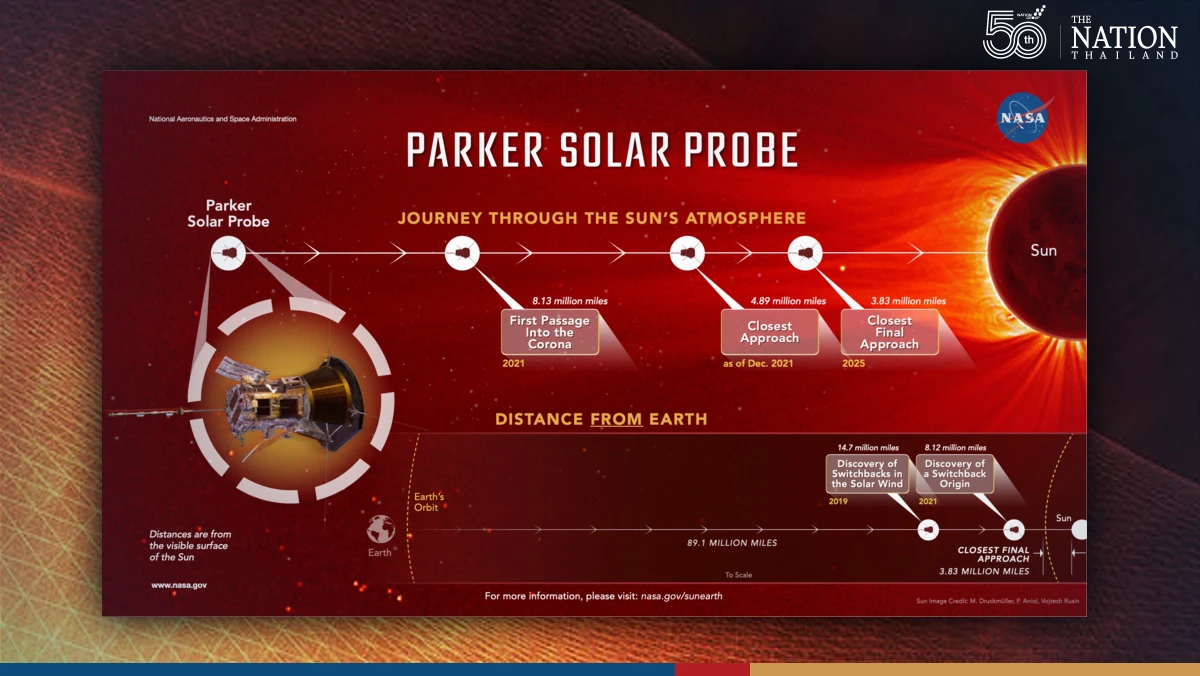
NASA’s Parker Solar Probe has now flown through the Sun’s upper atmosphere – the corona – and sampled particles and magnetic fields there. 

The new milestone marks one major step for Parker Solar Probe and one giant leap for solar science. Just as landing on the Moon allowed scientists to understand how it was formed, touching the very stuff the Sun is made of will help scientists uncover critical information about our closest star and its influence on the solar system. 

“Parker Solar Probe “touching the Sun” is a monumental moment for solar science and a truly remarkable feat,” said Thomas Zurbuchen, the associate administrator for the Science Mission Directorate at NASA Headquarters in Washington. “Not only does this milestone provide us with deeper insights into our Sun’s evolution and it’s impacts on our solar system, but everything we learn about our own star also teaches us more about stars in the rest of the universe.”

As it circles closer to the solar surface, Parker is making new discoveries that other spacecraft were too far away to see, including from within the solar wind – the flow of particles from the Sun that can influence us at Earth. In 2019, Parker discovered that magnetic zig-zag structures in the solar wind, called switchbacks, are plentiful close to the Sun. But how and where they form remained a mystery. Halving the distance to the Sun since then, Parker Solar Probe has now passed close enough to identify one place where they originate: the solar surface.

NASA begins its new discoveries on solar atmosphere for the first time in history

The first passage through the corona – and the promise of more flybys to come – will continue to provide data on phenomena that are impossible to study from afar.

“Flying so close to the Sun, Parker Solar Probe now senses conditions in the magnetically dominated layer of the solar atmosphere – the corona – that we never could before,” said Nour Raouafi, the Parker project scientist at the Johns Hopkins Applied Physics Laboratory in Laurel, Maryland. “We see evidence of being in the corona in magnetic field data, solar wind data, and visually in images. We can actually see the spacecraft flying through coronal structures that can be observed during a total solar eclipse.”

Closer than ever before 

Parker Solar Probe was launched in 2018 to explore the mysteries of the Sun by travelling closer to it than any spacecraft before. Three years after launch and decades after the first conception, Parker has finally arrived.

Unlike Earth, the Sun doesn’t have a solid surface. But it does have a superheated atmosphere, made of solar material bound to the Sun by gravity and magnetic forces. As rising heat and pressure push that material away from the Sun, it reaches a point where gravity and magnetic fields are too weak to contain it.

That point, known as the Alfvén critical surface, marks the end of the solar atmosphere and beginning of the solar wind. Solar material with the energy to make it across that boundary becomes the solar wind, which drags the magnetic field of the Sun with it as it races across the solar system, to Earth and beyond. Importantly, beyond the Alfvén critical surface, the solar wind moves so fast that waves within the wind cannot ever travel fast enough to make it back to the Sun – severing their connection. 

Until now, researchers were unsure exactly where the Alfvén critical surface lay. Based on remote images of the corona, estimates had put it somewhere between 10 to 20 solar radii from the surface of the Sun – 4.3 to 8.6 million miles. Parker’s spiral trajectory brings it slowly closer to the Sun and during the last few passes, the spacecraft was consistently below 20 solar radii (91 per cent of Earth’s distance from the Sun), putting it in the position to cross the boundary – if the estimates were correct.

On April 28, 2021, during its eighth flyby of the Sun, Parker Solar Probe encountered the specific magnetic and particle conditions at 18.8 solar radii (around 8.1 million miles) above the solar surface that told scientists it had crossed the Alfvén critical surface for the first time and finally entered the solar atmosphere.

“We were fully expecting that, sooner or later, we would encounter the corona for at least a short duration of time,” said Justin Kasper, lead author on a new paper about the milestone published in Physical Review Letters, and deputy chief technology officer at BWX Technologies, Inc. and University of Michigan professor. “But it is very exciting that we’ve already reached it.”  

Into the eye of the storm 

During the flyby, Parker Solar Probe passed into and out of the corona several times. This is proved what some had predicted – that the Alfvén critical surface isn’t shaped like a smooth ball. Rather, it has spikes and valleys that wrinkle the surface. Discovering where these protrusions line up with solar activity coming from the surface can help scientists learn how events on the Sun affect the atmosphere and solar wind.

At one point, as Parker Solar Probe dipped to just beneath 15 solar radii (around 6.5 million miles) from the Sun’s surface, it transited a feature in the corona called a pseudostreamer. Pseudostreamers are massive structures that rise above the Sun’s surface and can be seen from Earth during solar eclipses.

Passing through the pseudostreamer was like flying into the eye of a storm. Inside the pseudostreamer, the conditions quieted, particles slowed, and number of switchbacks dropped – a dramatic change from the busy barrage of particles the spacecraft usually encounters in the solar wind. 

For the first time, the spacecraft found itself in a region where the magnetic fields were strong enough to dominate the movement of particles there. These conditions were the definitive proof the spacecraft had passed the Alfvén critical surface and entered the solar atmosphere where magnetic fields shape the movement of everything in the region.

The first passage through the corona, which lasted only a few hours, is one of many planned for the mission. Parker will continue to spiral closer to the Sun, eventually reaching as close as 8.86 solar radii (3.83 million miles) from the surface. Upcoming flybys, the next of which is happening in January 2022, will likely bring Parker Solar Probe through the corona again.

“I’m excited to see what Parker finds as it repeatedly passes through the corona in the years to come,” said Nicola Fox, division director for the Heliophysics Division at NASA Headquarters. “The opportunity for new discoveries is boundless.”

The size of the corona is also driven by solar activity. As the Sun’s 11-year activity cycle – the solar cycle – ramps up, the outer edge of the corona will expand, giving Parker Solar Probe a greater chance of being inside the corona for longer time.

“It is a really important region to get into because we think all sorts of physics potentially turn on,” Kasper said. “And now we’re getting into that region and hopefully going to start seeing some of these physics and behaviours.”  

Narrowing down switchback origins

Even before the first trips through the corona, some surprising physics was already surfacing. On recent solar encounters, Parker Solar Probe collected data pinpointing the origin of zig-zag-shaped structures in the solar wind, called switchbacks. The data showed one spot that switchbacks originate is at the visible surface of the Sun – the photosphere. 

By the time it reaches Earth, 93 million miles away, the solar wind is an unrelenting headwind of particles and magnetic fields. But as it escapes the Sun, the solar wind is structured and patchy. In the mid-1990s, the NASA-European Space Agency mission Ulysses flew over the Sun’s poles and discovered a handful of bizarre S-shaped kinks in the solar wind’s magnetic field lines, which detoured charged particles on a zig-zag path as they escaped the Sun. For decades, scientists thought these occasional switchbacks were oddities confined to the Sun’s polar regions.  

In 2019, at 34 solar radii from the Sun, Parker discovered that switchbacks were not rare, but common in the solar wind. This renewed interest in the features and raised new questions: Where were they coming from? Were they forged at the surface of the Sun, or shaped by some process kinking magnetic fields in the solar atmosphere?

The new findings, in press at the Astrophysical Journal, finally confirm one origin point is near the solar surface. 

The clues came as Parker orbited closer to the Sun on its sixth flyby, less than 25 solar radii out. Data showed switchbacks occur in patches and have a higher percentage of helium – known to come from the photosphere – than other elements. The switchbacks’ origins were further narrowed when the scientists found the patches aligned with magnetic funnels that emerge from the photosphere between convection cell structures called supergranules.

In addition to being the birthplace of switchbacks, the scientists think the magnetic funnels might be where one component of the solar wind originates. The solar wind comes in two different varieties – fast and slow – and the funnels could be where some particles in the fast solar wind come from. 

“The structure of the regions with switchbacks matches up with a small magnetic funnel structure at the base of the corona,” said Stuart Bale, professor at the University of California, Berkeley, and lead author on the new switchbacks paper. “This is what we expect from some theories, and this pinpoints a source for the solar wind itself.”

Understanding where and how the components of the fast solar wind emerge, and if they’re linked to switchbacks, could help scientists answer a longstanding solar mystery: how the corona is heated to millions of degrees, far hotter than the solar surface below.

While the new findings locate where switchbacks are made, the scientists can’t yet confirm how they’re formed. One theory suggests they might be created by waves of plasma that roll through the region like ocean surf. Another contends they’re made by an explosive process known as magnetic reconnection, which is thought to occur at the boundaries where the magnetic funnels come together.

“My instinct is, as we go deeper into the mission and lower and closer to the Sun, we’re going to learn more about how magnetic funnels are connected to the switchbacks,” Bale said. “And hopefully resolve the question of what process makes them.”

Now that researchers know what to look for, Parker’s closer passes may reveal even more clues about switchbacks and other solar phenomena. The data to come will allow scientists a glimpse into a region that’s critical for superheating the corona and pushing the solar wind to supersonic speeds. Such measurements from the corona will be critical for understanding and forecasting extreme space weather events that can disrupt telecommunications and damage satellites around Earth.

“It’s really exciting to see our advanced technologies succeed in taking Parker Solar Probe closer to the Sun than we’ve ever been, and to be able to return such amazing science,” said Joseph Smith, Parker program executive at NASA Headquarters. “We look forward to seeing what else the mission discovers as it ventures even closer in the coming years.”

Parker Solar Probe is part of NASA’s Living with a Star program to explore aspects of the Sun-Earth system that directly affect life and society. The Living with a Star program is managed by the agency’s Goddard Space Flight Center in Greenbelt, Maryland, for NASA’s Science Mission Directorate in Washington. The Johns Hopkins University Applied Physics Laboratory in Laurel, Maryland, manages the Parker Solar Probe mission for NASA and designed, built, and operates the spacecraft.

Source: NASA

Published : December 16, 2021

By : THE NATION