China launches first section of its massive space station #SootinClaimon.Com

#SootinClaimon.Com : ขอบคุณแหล่งข้อมูล : หนังสือพิมพ์ The Nation.

https://www.nationthailand.com/international/40000370

China launches first section of its massive space station


Sixty years after Yuri Gagarin undertook mankinds first space journey, China launched the core capsule of its space station on Thursday morning, formally embarking on the buildup of one of the humanitys largest and most sophisticated space-based facilities.
China launches first section of its massive space station

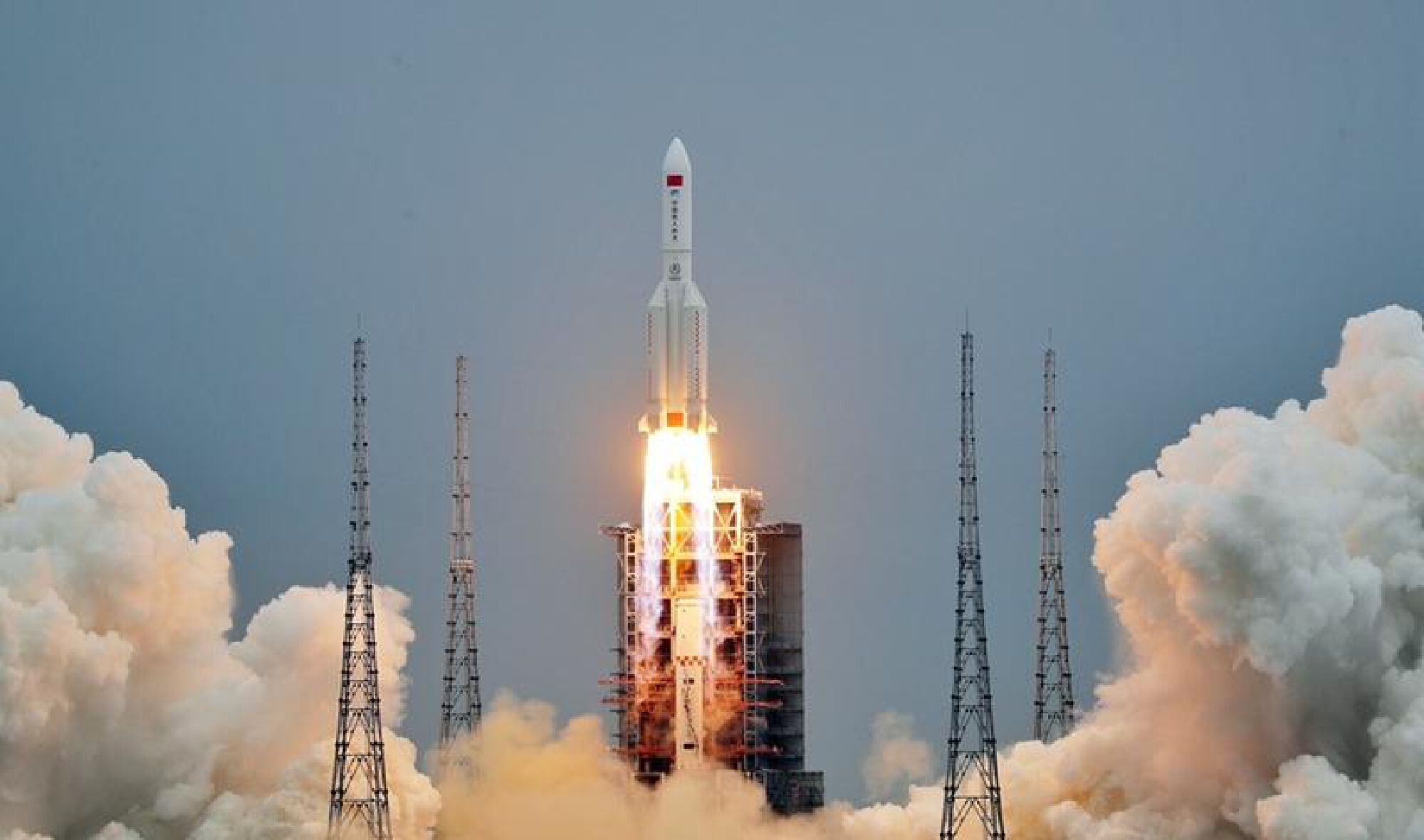
Photo credit: China launches the core capsule of its space station at the Wenchang Space Launch Center in Hainan province on Thursday morning, April 29, 2021. (PHOTO BY GUO WENBIN / PROVIDED TO CHINADAILY.COM.CN)

As the countdown ticked down to zero at 11:22 am at the Wenchang Space Launch Center in Hainan province, 10 engines at the bottom of a Long March 5B heavy-lift carrier rocket roared to life, generating a thrust power of 1,068 metric tons to lift the 18-story-tall vehicle through thick rain clouds covering the coastal city of Wenchang.

The launch is tasked with transporting the 22.5 ton capsule, the biggest and heaviest spacecraft China has ever constructed, to a low-Earth orbit about 400 kilometers above the land to place the first piece of the country’s space station.

China’s most adventurous space endeavor, the multimodule space station, named Tiangong, or Heavenly Palace, will be mainly composed of three components-a core module attached to two space laboratories-with a combined weight of nearly 70 tons.

The core capsule, named Tianhe, or Harmony of Heavens, is 16.6 meters long and has a diameter of 4.2 meters. It has three parts-a connecting section, a life-support and control section and a resources section.

The module will be central to the space station’s future operations, given that astronauts will live there and control the entire station from inside. It will also be used to host scientific experiments.

Thursday’s launch marked the second flight of Long March 5B, the most powerful Chinese rocket when it comes to carrying capacity to low-Earth orbit.

With a core stage and four side boosters, the rocket has a liftoff weight of 849 tons, capable of sending a 25 ton payload to orbits near Earth.

It is now the only rocket in China that can launch Tiangong’s heavy components.

The craft is so big that each of its side boosters is nearly 28 meters tall – the height of a 9-story building — and 3.35 meters wide. Each of them has a thrust power of 240 tons, even stronger than many mid-lift rockets.

To hold huge spacecraft, the rocket has China’s largest payload fairing that is 20.5 meters tall and 5.2 meters wide.

Long March 5B made its debut flight in May 2020 at the Wenchang space complex, deploying the prototype of China’s new-generation manned spacecraft, an experimental cargo retrieval craft as well as more than 10 experimental payloads into low-Earth orbit.

Construction for the space station marks the beginning of the third stage in China’s manned space program, which was approved by the government in 1992.

The program’s first two stages had concluded successfully with six manned spaceflights and two experimental space lab missions.

Once completed, the space station will be capable of docking with multiple crewed and cargo spaceships at the same time and will also be able to link with foreign spacecraft if they have designated docking hatch

After the capsule was launched, astronauts on the Shenzhou XII and XIII missions and two cargo ships will be launched within a few months to prepare the module for docking with other parts of the station.

Next year, Tiangong’s two space labs, two manned missions and two robotic cargo flights will be made to continue construction of the station.

It will be manned by three astronauts in extended shifts that will last several months. During handovers between shifts, the station will accommodate up to six astronauts.

The entire Tiangong station is expected to become fully operational around the end of 2022 and is set to work for about 15 years, mission planners have said.

In addition to its own components, the station will also be accompanied by an optical telescope that will be lifted after the station’s completion to fly together with it, according to them.

Hao Chun, director of the China Manned Space Agency, said his agency will strive to make sure that the space station will be made best use of to advance space science, technology and application.

He said scientists will be able to use the facility’s unique environment to perform mutation breeding, produce special medicines and create new materials, thus generating scientific, technological and economic benefits.

The official also said that China is open to cooperation with foreign nations in the space station project.

The Chinese agency has signed agreements with the United Nations Office for Outer Space Affairs on space station cooperation. The two organizations jointly published an announcement of opportunity, inviting scientists from around the world to submit their research proposal for an opportunity to conduct their own experiments on board the Chinese station.

“By now, 17 foreign nations have confirmed their participation in nine scientific tasks on our station and related work is proceeding well,” Hao said. “Next, we will continue working with the UNOOSA to solicit proposals for future scientific collaborations.”

Published : April 29, 2021

By : China Daily/ANN
Samsung sees chip recovery in Q2 after forecast-beating Q1 results #SootinClaimon.Com

#SootinClaimon.Com : ขอบคุณแหล่งข้อมูล : หนังสือพิมพ์ The Nation.

https://www.nationthailand.com/international/40000352

Samsung sees chip recovery in Q2 after forecast-beating Q1 results


Samsung Electronics Co. on Thursday expected its semiconductor business to rebound in the current quarter following mediocre performance, although its mobile unit is projected to suffer a profit decline after spearheading its strong first-quarter earnings.

Samsung sees chip recovery in Q2 after forecast-beating Q1 results

Samsung’s net profit stood at 7.14 trillion won ($6.4 billion) in the January-March period, up 46.2 percent from a year earlier, the world’s largest memory chip and smartphone vendor said in a regulatory filing.

Its operating profit jumped 45.5 percent on-year to 9.38 trillion won in the first quarter of the year. Sales rose 18.2 percent on-year to 65.38 trillion won, the largest-ever figure for any first quarter.

The figures were in line with its earnings guidance announced earlier this month that beat the market consensus.

Samsung said its upbeat performance came as smartphone sales soared on the back of new handset launches, while its chip business suffered from a monthlong shutdown of the company’s semiconductor plant in Austin, Texas, where a severe winter storm caused a power outage in February.

Revenue from the semiconductor unit stood at 19.01 trillion won in the first quarter of the year, up 7.76 percent from a year earlier, but its operating profit plunged 15.53 percent to 3.37 trillion won.

“The memory business saw a slight profit decline due to a downward trend in NAND prices and investment for new production lines, despite overall decent demand backed by server and mobile products,” the company said.

“The foundry business saw its earnings decline in the first quarter due to a disruption of production at the Austin fab in the US from a major power outage.”

However, the company said its semiconductor unit is projected to see improved earnings in the second quarter on the back of strong server demand.

Samsung said its Austin factory has been fully normalized and that that will boost its foundry business, although its System LSI unit will still be suffering from the impact of foundry disruption.

Samsung’s IT & Mobile Communications (IM) division was the top performer in the first quarter, racking up revenue of 29.21 trillion won, up 12.34 percent from a year earlier, while operating profit soared 65.66 percent on-year to 4.39 trillion won.

“While market demand decreased quarter-on-quarter amid weak seasonality, the company saw overall demand recovering from a year earlier when the market was significantly impacted by COVID-19,” it said.

The company, however, expected its mobile business to see weak earnings in the second quarter due to diminishing new product effects for the flagship model and component supply shortage issues.

The Consumer Electronics (CE) division, comprised of the Visual Display and Digital Appliances businesses, posted its best-ever first-quarter performance as it logged 12.99 trillion won in sales, up 26.11 percent from a year earlier, while operating income more than doubled from a year ago to reach 1.12 trillion won.

“The company posted both stronger sales and profit as it leveraged its global supply chain management capabilities to swiftly respond to heightened demand,” Samsung said. “It also saw increased sales of its premium products, including strong initial sales of the new Neo QLED lineup.”

For the second quarter, Samsung expected TV demand to increase from a year ago as major sporting events, such as the Tokyo Olympic Games and the UEFA Euro 2020 football competition, are expected to take place.

Samsung’s Display Panel (DP) unit posted 6.92 trillion won in revenue, up 5 percent from a year earlier, and 3.75 trillion won in operating profit, up 0.8 percent from a year ago, for the first quarter.

“Earnings improved as the expanded adoption of OLED displays from flagship to entry-level models drove growth,” it said.

Samsung expected its mobile panel sales to decline in the second quarter due to weak seasonality for smartphones and the effects of some component shortages.

Samsung said its capital expenditures in the first quarter stood at 9.7 trillion won, including 8.5 trillion won for semiconductors and 0.7 trillion won for displays. (Yonhap)

Published : April 29, 2021

By : The Korea Herald/ANN

Vietnam’s economic growth likely to expand 6.7 pct in 2021: ADB #SootinClaimon.Com

#SootinClaimon.Com : ขอบคุณแหล่งข้อมูล : หนังสือพิมพ์ The Nation.

https://www.nationthailand.com/international/40000351

Vietnam’s economic growth likely to expand 6.7 pct in 2021: ADB


HÀ NỘI – Việt Nam’s economic growth is expected to rebound to 6.7 per cent this year despite the recent resurgence of the COVID-19 pandemic in nearby countries, and rise to 7 per cent in 2022, according to the Asian Development Bank (ADB).

Vietnam’s economic growth likely to expand 6.7 pct in 2021: ADB

In its Asian Development Outlook (ADO) 2021 released on Wednesday, the ADB said Việt Nam’s economic growth will be boosted by export-oriented manufacturing, increased investment, and expanding trade.

The growth momentum is expected to continue, thanks to ongoing reforms to improve the business environment and Việt Nam’s participation in multiple free trade agreements (FTAs) involving almost all advanced economies.

Rising international oil prices and increased domestic consumption is expected to push inflation up to 3.8 per cent this year and 4 per cent in 2022, the report said, adding that faster-than-expected recovery in China and the US would significantly expand Việt Nam’s trade and growth prospects.

The report said the country can maintain inclusive growth by softening the pandemic’s impact on poverty and incomes.

The ADB also raised its 2021 economic growth projection for developing countries in Asia amid ongoing COVID-19 vaccine campaigns and the sharply increasing export demand in the world market.

The developing region in Asia, comprising 45 countries in Asia Pacific, is forecast to grow 7.3 per cent by 2021, and 5.3 per cent in 2022.

Meanwhile, the growth rate forecasted for the Southeast Asian region is 4.4 per cent, down from the earlier projection of 5.5 percent due to the instability in Myanmar. The Philippines, the slowest economy in Southeast Asia last year with a 9.6-per cent contraction, is forecast to grow 4.1 per cent this year. 

Published : April 29, 2021

By : Viet Nam News/ANN

Singapore economy to grow faster than 6% in 2021, but recovery will be more uneven across sectors: MAS #SootinClaimon.Com

#SootinClaimon.Com : ขอบคุณแหล่งข้อมูล : หนังสือพิมพ์ The Nation.

https://www.nationthailand.com/international/40000350

Singapore economy to grow faster than 6% in 2021, but recovery will be more uneven across sectors: MAS


SINGAPORE – Singapores economy has almost recovered the output lost during the first half of 2020, although its growth momentum eased in the first quarter of this year.

Singapore economy to grow faster than 6% in 2021, but recovery will be more uneven across sectors: MAS

But while the outlook for Singapore’s economy has improved, projected growth outcomes across sectors have become even more lopsided than previously predicted, the Monetary Authority of Singapore (MAS) noted in its biannual macroeconomic review released on Wednesday (April 28).

Prospects for sectors less affected by the pandemic, such as manufacturing, have brightened, but those for sectors worst-hit, like air transport and accommodation, have deteriorated somewhat amid the global rise in Covid-19 cases and the emergence of more contagious virus strains, which have diminished hopes of a substantial reopening of international borders in the near term.

MAS said that Singapore’s economic growth is likely to top 6 per cent this year, exceeding the upper end of the 4 per cent to 6 per cent official growth forecast, barring a significant setback in activity from a weaker recovery of the global economy or a surge in locally transmitted cases.

But this robust estimate comes despite the continued unevenness in economic recovery and higher uncertainty, it cautioned.

Looking at the trends in early 2021, the trade-related industry’s continued upward trend was supported by the resilient manufacturing sector – industrial production expanded 8 per cent quarter on quarter in the January to March period on a seasonally adjusted basis – but the modern services sectors saw slower expansion in the early months of the year.

The travel-related sector has shown few indications of a revival so far, with the air transport segment remaining muted and hotel occupancy in Singapore falling after the year-end surge in demand, MAS said.

However, the water transportation segment saw a similar expansion to the manufacturing sector, with the volume of total sea cargo handled at Singapore’s ports rising 3.2 per cent, on a quarter-on-quarter seasonally adjusted basis.

Strong growth prospects amid uncertainty

Singapore’s growth for the year is likely to be robust, MAS said, with external demand picking up and business sentiment among firms in the Republic turning positive in the first quarter of 2021.

But while there is upside for expansion from the likes of a stronger-than-anticipated upturn in the global electronics cycle, downside risks such as Covid-19 virus mutation and vaccination efficacy remain, it noted.

The momentum for some modern services segments could moderate in the coming quarters, such as fund management and insurance. Others related to digitalisation, such as payments and IT and information services, should see steady growth.

Published : April 29, 2021

By : Choo Yun Ting/The Straits Times/ANN

India’s GDP may grow at 11% in FY22: ADB #SootinClaimon.Com

#SootinClaimon.Com : ขอบคุณแหล่งข้อมูล : หนังสือพิมพ์ The Nation.

https://www.nationthailand.com/international/40000348

India’s GDP may grow at 11% in FY22: ADB


The Indian economy is likely to grow at 11 per cent in the current financial year, said the Asian Development Bank (ADB).

India’s GDP may grow at 11% in FY22: ADB

In its report, ‘Asian Development Outlook (ADO) 2021’, the ADB also noted that the recent surge in Covid-19 cases may put this recovery at risk.

“India’s economy, meanwhile, is expected to grow 11.0 per cent in fiscal year (FY) 2021, which ends on 31 March 2022, amid a strong vaccine drive. However, the recent surge in COVID-19 cases may put this recovery at risk,” it said.

India’s GDP is expected to expand 7.0 per cent in the next financial year. This year, South Asia’s GDP growth is expected to rebound to 9.5 per cent, following a 6.0 per cent contraction in 2020, before moderating to 6.6 per cent in the next year.

It added that the economic growth in developing Asia is set to rebound to 7.3 per cent this year, supported by a healthy global recovery and early progress on coronavirus disease (COVID-19) vaccines.

“Growth is gaining momentum across developing Asia, but renewed COVID-19 outbreaks pose a threat to recovery,” said ADB Chief Economist Yasuyuki Sawada.

“Economies in the region are on diverging paths. Their trajectories are shaped by the extent of domestic outbreaks, the pace of their vaccine rollouts, and how much they are benefiting from the global recovery,” the Chief Economist said.

As per the report, inflation in developing Asia is projected to fall to 2.3 per cent from 2.8 per cent last year, as food-price pressures ease in India and the People’s Republic of China. The region’s inflation rate is forecast to rise to 2.7 per cent in 2022.

Published : April 29, 2021

By : The Statesman/ANN

China expected to see 8.1% GDP growth in 2021 #SootinClaimon.Com

#SootinClaimon.Com : ขอบคุณแหล่งข้อมูล : หนังสือพิมพ์ The Nation.

https://www.nationthailand.com/international/40000347

China expected to see 8.1% GDP growth in 2021


Nation continues to experience economic normalization as vaccinations ramp up

China expected to see 8.1% GDP growth in 2021

China’s economic growth is projected to rebound to 8.1 percent this year, powered by strong exports and a gradual recovery in household consumption, despite uncertainties over the coronavirus pandemic, a report from the Asian Development Bank said on Wednesday.

Economists from the bank attributed the economic boom to the improved job market, restored consumer confidence and the release of pent-up household demand. The year-on-year GDP growth rate is projected to be 5.5 percent in 2022.

As the economy recovers, consumption will return as a primary driver of growth this year, followed by investment in the manufacturing sector, according to Dominik Peschel, head of the economics unit for the ADB resident mission in China.

The bank forecast that consumer inflation is expected to moderate to 1.5 percent this year before it recovers to 2.3 percent in 2022, due to the fall in the pork price.

In Asia, the number of new COVID-19 infections surged quickly from the prior week, with a higher number of deaths. This might have cast a shadow on the region’s nascent economic recovery, said David Chao, Global Market Strategist, Asia Pacific (ex-Japan) at Invesco.

The renewed COVID-19 outbreaks show the pandemic is still a threat, which could be the biggest downside risk weighing on the generally positive outlook in Asia. The region’s growth is forecast to rebound to 7.3 percent in 2021,which will moderate to 5.3 percent in 2022, the ADB’s report said.

In contrast, China continues to experience economic normalization as containment efforts hold and vaccinations ramp up, according to experts.

Given the persistent economic recovery and the sound growth momentum, Teh-han Chow, Greater China CEO at Fonterra Co-operative Group, told China Daily that he sees strong consumer demand for dairy products this year, which consolidated the company’s strategy to further develop the China market.

Alex Wong, China country manager of Silver Fern Farms, a leading red meat processor and market promoter in New Zealand, said the company is committed to promoting exports to China, to meet consumer demand for premium quality red meat products.

With the development of China-New Zealand trade and China’s rapid economic growth, the nation has gradually become the most important international market for Silver Fern Farms.
As the ongoing pandemic-related restrictions in many regions of the world will continually fuel demand for consumer goods, China’s merchandise exports are expected to outperform imports in 2021.

Meanwhile, the large stimulus plan in the United States will help to boost global demand as well as China’s exports, especially for manufacturing products, ADB economist Peschel said.

This year, the People’s Bank of China, the nation’s central bank, will likely guide credit growth mainly through liquidity adjustments, and targeted cuts in the reserve requirement ratio remain an option to provide qualified banks with additional funds for lending, said the ADB report.

Financial stability

“Monetary policy will likely prioritize financial stability to a larger extent, especially in regard to real estate and shadow banking financing,” it added.
In terms of fiscal policy, its support for the economy will likely be gradually reduced this year, and fiscal revenue is expected to improve in line with higher economic growth, the bank said.

However, potential financial risks should be prevented, especially in the banking sector, Qi Wen, associate economics and statistical analyst of the economics unit for the ADB resident mission in China, said on Wednesday.

“The country has not yet seen a notable surge in nonperforming loans, likely because the NPL recognition standards were relaxed in 2020 and the deferment of loan repayments gave banks some leeway to delay recognizing NPLs.”

The ADB’s report suggested that this year, in order to address potential challenges and safeguard financial stability, China’s financial regulators may need to improve nonperforming loan management, consolidate the banking sector in an orderly manner and strengthen commercial banks’ capitalization as the buffer to absorb shocks.

Published : April 29, 2021

By : Chen Jia/China Daily/ANN

With livestreams, China helps boost ASEAN internet sector #SootinClaimon.Com

#SootinClaimon.Com : ขอบคุณแหล่งข้อมูล : หนังสือพิมพ์ The Nation.

https://www.nationthailand.com/international/40000307

With livestreams, China helps boost ASEAN internet sector


Southeast Asias digital economy to account for 8.5%of GDP in 2025

With livestreams, China helps boost ASEAN internet sector

NANNING – Thai-speaking tour guide Zhou Xingxing was skeptical when cross-border e-commerce company Tus-Innovation asked her to promote an 85 yuan ($13) stylus to Thai consumers during a livestreaming session weeks ago on Lazada, a leading Southeast Asian e-commerce platform.

“At first, I didn’t have a lot of confidence selling electronic products to online consumers in Southeast Asian countries since I thought they might not have the habit of shopping online,” Zhou said.

Yet, Zhou introduced eight different electronic products in her first one-hour session, which was viewed by more than 1,000 people. “Although it was far less popular than livestreaming sessions of major online influencers on domestic e-commerce platforms, I saw the potential market of the digital economy in Southeast Asian countries.”

Brands including Chinese tech giant Huawei have launched livestreaming promotions in countries belonging to the Association of Southeast Asian Nations. Official data shows that more than 350,000 brands and online shops participated in Lazada’s mega one-day sales promotion on Nov 11.

In order to foster a bilateral e-commerce industry chain, Lazada’s cross-border Eco-Innovation Service Center was built in Nanning, capital of the Guangxi Zhuang autonomous region, in 2019.

The center has served more than 30 well-known Chinese companies, incubated over 400 small and medium-sized cross-border online retailers, trained more than 1,000 e-commerce recruits and attracted more than 200 livestreaming hosts from Southeast Asian countries, the center said.

“The rapid development of the e-commerce industry in China makes shopping more convenient,” said Hong Thi Linh. As a Vietnamese citizen living in Guangxi, she learned how to be a livestreaming host earlier this year.

“Today, with the improvement of digital infrastructure in Southeast Asian countries, consumers there can also enjoy the convenience,” she said.

“Livestreaming can help display more diversified products to consumers from my country at lower prices, so it’s my pleasure to do something good for my compatriots,” she added.

Since 2020, more than 1,000 people from China, Indonesia, Malaysia, the Philippines, Singapore, Thailand and Vietnam received training as livestreaming hosts at the Lazada center in Nanning, said Zhao Hui, the center’s managing assistant.

“Our debut livestreaming session on Lazada was only viewed by dozens of people in 2019, but our livestreams are being viewed by thousands or even tens of thousands of people this year. Watching livestreaming sessions and shopping online have gradually become part of daily life in some ASEAN countries,” Zhao said.

In China, the value of cross-border e-commerce climbed 31.1 percent to 1.69 trillion yuan in 2020, when China and ASEAN first became each other’s largest trading partners.

It is estimated that ASEAN’s digital economy will increase from 1.3 percent of GDP in 2015 to 8.5 percent in 2025, according to ASEAN Secretary-General Lim Jock Hoi.

China is playing a leading role in the development of digital infrastructure and is an important partner of ASEAN in promoting the development of the digital economy in the region, Lim said.

Published : April 28, 2021

By : China Daily/ANN

‘When can I get my shot?’ Vaccine envy grips Koreans #SootinClaimon.Com

#SootinClaimon.Com : ขอบคุณแหล่งข้อมูล : หนังสือพิมพ์ The Nation.

https://www.nationthailand.com/international/40000306

‘When can I get my shot?’ Vaccine envy grips Koreans


Vaccine envy is spreading among pandemic-weary Koreans, as the country trails behind most major economies in vaccinations with just 4 percent of the population half or fully vaccinated.

‘When can I get my shot?’ Vaccine envy grips Koreans

“When I hear about mask-less concerts and travels resuming in some countries I just get depressed,” said a Seoul resident surnamed Park. Park, a 29 year old without medical conditions, said he has “no idea” when he would be getting his shot.

Based on the latest vaccination timeline, a healthy adult working in a nonessential sector cannot expect to get a shot until August.

“I think people have had enough,” said a 30-something cafe owner in Siheung, Gyeonggi Province, asking to be identified only by her surname Choi.

“Koreans are probably some of the best mask wearers in the world, and I think most have done a good job of following the government’s safety rules for over a year now,” she said. “Business owners, especially, have complied with several closures that went poorly compensated.”

Choi said she found the talks of a new wave of infections and another round of social distancing restrictions approaching to be “disheartening.” “I don’t know for how much longer we can hold on,” she said. “We’re really desperate for the vaccine rollout to happen as fast as possible.”

But it’s not just the young and healthy who are waiting for their chance to be vaccinated. Another Seoul resident said her grandparents, who are in their 80s, were yet to get a shot despite having signed up for an appointment.

“They were told their turn might come in May or the month after that,” she said. The vaccinations for people aged 75 and above began on April 1, but less than 20 percent in that age group having gotten a shot to date.

The vaccine-assisted return to normalcy is still far off for Korea, according to top infectious disease expert Dr. Kim Woo-joo of Korea University Medical Center. He said until vaccines reach people at risk of severe COVID-19, mitigation measures of higher intensity will be inevitable.

“Physical distancing, face mask wearing and other restrictions should remain in place at least through summer, by which time vaccinations of more vulnerable members of the society would be completed,” he said.

The government’s weekly report shows people are social distancing less, despite the daily case count hovering around a near-second wave figure of 600. More than 40 percent of all newly diagnosed patients have caught the virus from family, friends and other people in their close circles.

“It’s pandemic burnout,” Kim said.

A new Gallup survey found that more Koreans disapprove than approve of how the Moon Jae-in administration is handling the pandemic. Overall, 49 percent of 1,003 respondents rated the administration’s pandemic performance negatively compared with 43 percent who gave positive marks. More than half of those who disapprove said they were unhappy with the vaccine shortage.

The administration has so far refused to acknowledge a slow distribution of vaccines or lack of supply.

Moon told Monday’s chief of staff meeting that “the attack on the administration over vaccine rollout has gone over the line,” asking critics to “stop the fearmongering.”

“Korea’s pandemic circumstances are different from those of other countries. There’s no point in making comparisons,” he said.

Hong Nam-ki, who is leading the administration’s COVID-19 response task force as acting prime minister, called the vaccine criticism “counterproductive” in a televised briefing the same day. In response to press inquiries at the briefing, the task force officials said they “do not believe there needs to be an apology” over delays.

“Korea is not behind,” they said. “The vaccines are rolling out on schedule.”

But that is “simply untrue,” according to virologist Dr. Paik Soon-young of Catholic University of Korea.

“Far fewer vaccines are available now than previously revealed by the government,” he said. He pointed out that Korea should have at least some Moderna, Novavax and Johnson & Johnson vaccines by now, none of which are here, according to earlier statements.

“No one seems to be taking responsibility for all the times vaccines weren’t delivered as promised,” he said.

Korea recently signed a deal for 40 million doses of the vaccine made by Pfizer, bringing the total amount of vaccines it has secured to 192 million doses. Over half, or 100 million doses, will be arriving between now and September, the acting prime minister said.

But Paik said the vaccine delivery plan lacked key details. “The number of doses or specific dates, not even which month, isn’t clearly stated,” he said. “The work is not done until the vaccines actually get here.”

Epidemiologist Dr. Chun Byung-chul, who serves as the Korean Vaccine Society’s vice president, said officials in charge should “commit to more transparency” in future announcements. “Korean people deserve to have a full understanding of when they can expect to receive a vaccine,” he said.

Published : April 28, 2021

By : Kim Arin/The Korea Herald/ANN

Myanmar economy badly hit by weakening kyat, rising prices #SootinClaimon.Com

#SootinClaimon.Com : ขอบคุณแหล่งข้อมูล : หนังสือพิมพ์ The Nation.

https://www.nationthailand.com/international/40000305

Myanmar economy badly hit by weakening kyat, rising prices


Yangon – The plunge in the value of the Kyat is causing rising prices and shortages of some products – hurting mostly the poor.

Myanmar economy badly hit by weakening kyat, rising prices

The Kyat has depreciated to Ks1,610 per US dollar from around Ks 1,340-1,475 in February when the coup and unrests began.

The political instability has led to a fall in exports as well as imports, and subsequently weakening the Myanmar currency.

As the dollar value climbed, the costs of fuel, telecommunication equipment, medicine food stuff and other assorted items, mostly imported, have risen. 

“Local products such as rice, oil, salt, pepper, onion, potato have not risen that much not climb much. But all imported products carry higher cost, especially household related goods from Thailand. I don’t know whether it’s because the Kyat is also depreciating. Anyway, we sell items we get from the wholesale distributor with a little mark-up,” said a general goods store owner from Tamwe.

Thingangyun Township’s pharmacies also report that there have been price hikes while stocks of some products have run out. 

“Everytime the dollar goes up, so do the medicine costs. Most are the medicines that people generally use. Some companies are not increasing their prices but instead just stopped the sale. Business has been bad, really bad. I see it in most stores,” said a pharmacist in Thingangyun Township. 

Myanmar has a wide income gap between the rich and the poor, and the latter is hurt mostly in the uncertain environment. 

As of now, the current price for a bag of rice is at Ks 48,000. In November 2, 2020, a bag of Shwe Bo Paw San rice went up to between Ks 50,000 Ks 58,000. It was a similar situation for Pathein Paw San with rice Ks 38,500 – 41,000 in November 2020 and Ks 36,000 and 38,000 on April 20.

In the 2020-2021 fiscal year, between October 1 to April 2, 1.131 million tonnes of broken rice and rice were exported to over 30 countries, a drop of about half a million tonnes from the the same period a year before, with a drop of Ks 74,409 million in revenue. 

According to the Myanmar Rice Federation, rice and broken rice are exported the most to China as well as Belgium. Other official figures also suggest that while local general consumer market prices for rice, poultry and such rose very little.

For petrol, the Global Petro Prices Website for Asean nations claim that as of April 19 2021, Myanmar withnessed an increase of 2.90 percent while Thailand posted a rise of  1.80 and Singapore 1.20 percent. Local rates  suggest that while it is not skyrocketing yet, it is climbing steadily. 

Myanmar economy is already hard hit by Covid-19 and further severe impacts of a second wave are not ruled out by local business people. 

Published : April 28, 2021

By : Eleven Media/ANN

Delhi to form special task force to crack down on hoarding, black-marketing of Covid-19 drugs #SootinClaimon.Com

#SootinClaimon.Com : ขอบคุณแหล่งข้อมูล : หนังสือพิมพ์ The Nation.

https://www.nationthailand.com/international/40000304

Delhi to form special task force to crack down on hoarding, black-marketing of Covid-19 drugs


Amid the acute shortage of Covid-19 essential drugs and widespread reports of their sale in the black market, the Delhi government has ordered to form a special task force (STF) to crack down on hoarders of such medicines.

Delhi to form special task force to crack down on hoarding, black-marketing of Covid-19 drugs

The government has directed all district magistrates to constitute the STF to take strict action against those involved in hoarding and black-marketing of life-saving drugs which are used for treating coronavirus patients.

As per the order, the STF would be empowered to carry out raids and other actions against the suspects.

Chief secretary Vijay Dev, in the order, said drugs controllers will also constitute a sufficient number of teams on an urgent basis for inspecting, checking, raiding and stopping the manufacturing and supply of spurious drugs.

“All district magistrates shall also constitute a Special Task Force with the help and assistance of their counterpart district DCPs,” the chief secretary said in the order issued on Sunday.

“This Special Task Force shall be primarily responsible for inspecting, checking, raiding and stopping the manufacturing and supply of spurious life-saving drugs and also to prevent the black marketing and hoarding of all life-saving drugs which are used for treating Covid-19 patients,” he added.

All district magistrates and DCPs will issue necessary directives to all field functionaries and ‘Special Task Force’ for taking the strictest action against the black marketeers, hoarders and manufacturers and suppliers of spurious drugs, the order stated.

Dev, who is also the chairman of DDMA’s state executive committee, directed officers concerned to submit a daily action-taken report.

Published : April 28, 2021

By : The Statesman/ANN