IMF projects Asia’s economy to grow 7.6% in 2021 #SootinClaimon.Com

#SootinClaimon.Com : ขอบคุณแหล่งข้อมูล : หนังสือพิมพ์ The Nation.

https://www.nationthailand.com/ann/30404905

IMF projects Asia’s economy to grow 7.6% in 2021

Apr 15. 2021

By China Daily/ANN

WASHINGTON – Asia’s economy is expected to grow by 7.6 percent this year, the International Monetary Fund (IMF) said Tuesday, while warning of “huge uncertainty” surrounding the projections.

“The pandemic has resulted in unprecedented output losses in the Asia-Pacific region,” Jonathan D. Ostry, acting director of the IMF’s Asia and Pacific Department, said during a virtual news conference.

The pandemic is receding in some countries, elsewhere, “second or third waves of infections are raging,” notably in India and some of the ASEAN economies, he noted, referring to the Association of Southeast Asian Nations.

Noting that divergence is multi-dimensional, namely across countries, and within countries across sectors, age groups, gender and skill level, Ostry said a region known for its trademark growth-with-equity model now runs the risk of “entrenching excessive inequality.”

For China, growth has been marked up to 8.4 percent this year due to stronger net exports, reflecting higher global growth and the US fiscal stimulus, according to the IMF.

India, meanwhile, has seen a more sizeable upward revision to 12.5 percent on account of continued normalization of its economy and a more growth-friendly fiscal policy, “but the current surge in infections presents a worrisome downside risk,” Ostry said.

He noted that there is huge uncertainty surrounding Asia’s projections, highlighting downside risks such as setbacks in vaccine rollouts, questions about the potency of the vaccine against new variants of the disease, and a resurgence of the virus.

The changing external environment is also a central driver of risk in the region, given Asia’s outward orientation to trade and capital flows, Ostry said.

“If US yields rise faster than markets expect, or if there is miscommunication about future US monetary policy, adverse spillovers through financial channels and capital outflows, as during the 2013 taper tantrum, could present challenges by compromising macro-financial stability,” he said.

Noting that trade has been a powerful driver of growth and poverty alleviation in Asia for decades, Ostry said restrictions that impede trade need to be reduced, and the easing of trade and technology tensions and facilitation of digital trade would provide a welcome boost to growth.

Moon hints at legal fight against Fukushima wastewater disposal #SootinClaimon.Com

#SootinClaimon.Com : ขอบคุณแหล่งข้อมูล : หนังสือพิมพ์ The Nation.

https://www.nationthailand.com/ann/30404904

Moon hints at legal fight against Fukushima wastewater disposal

Apr 15. 2021President Moon Jae-in (right) greets Japanese Ambassador to South Korea Koichi Aiboshi at Cheong Wa Dae on Wednesday. (Yonhap)President Moon Jae-in (right) greets Japanese Ambassador to South Korea Koichi Aiboshi at Cheong Wa Dae on Wednesday. (Yonhap)

By Lee Ji-yoon
The Korea Herald/ANN

President Moon Jae-in on Wednesday ordered his aides to review possible legal actions that can be taken against Japan’s decision to release wastewater from its Fukushima nuclear power plant into the ocean, including bringing the issue to an international court.

“The president ordered to proactively consider taking the issue to the International Tribunal for the Law of the Sea, including provisional measures,” presidential spokesperson Kang Min-seok told a press briefing.

The “provisional measures” refer to an interim injunction to stop Japan’s planned wastewater disposal. The injunction can be granted if the issue is considered a violation of international laws or harmful to the maritime environment before a final court ruling is made.

On Tuesday, Japan announced it had decided to release tons of radioactive wastewater from the wrecked Fukushima Dai-ichi nuclear power plant into the Pacific Ocean amid fierce resistance from fisheries at home and neighboring countries.

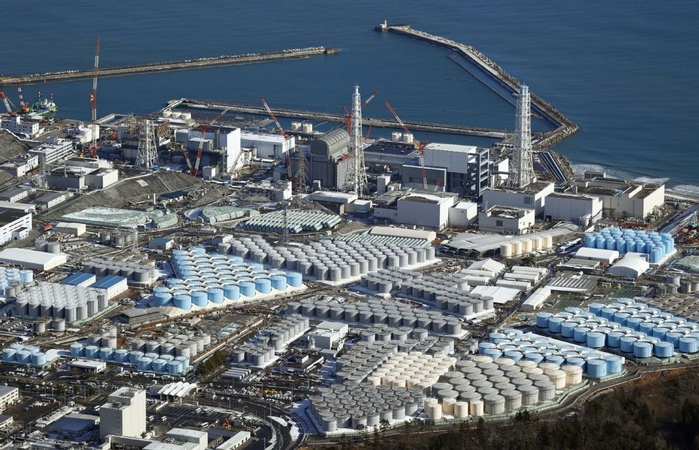
Since the 2011 meltdown triggered by a massive earthquake and tsunami, there are now about 1.25 million metric tons of wastewater stored in more than 1,000 tanks at the plant site. The storage capacity is expected to run out next year as the water continues to accumulate at a rate of about 170 tons a day.

Japan claimed that the water will be repurified and diluted to meet the regulatory limits for radioactivity level. But even a powerful filtering system cannot remove tritium, the least radioactive of all radioactive elements, raising safety concerns among environmental activists and neighboring countries.

Earlier in the day, Moon also expressed his deep concerns over the issue during a conversation with Japan’s new ambassador here, Koichi Aiboshi, following a ceremony to receive his credentials at Cheong Wa Dae.

“South Korea, as the closest country that shares the sea with Japan, has great concerns over Japan’s decision,” Moon was quoted as saying by his spokesperson, asking the top envoy to convey the message to the Tokyo government.

It is rare for the president to mention such a thorny diplomatic issue during a courtesy call.

According to a senior Cheong Wa Dae official, the presidential office’s legal team has already started the review process to explore taking it to the international court to stop the disposal.

Both South Korea and Japan are members of the International Tribunal for the Law of the Sea, an intergovernmental organization created by the mandate of the Third United Nations Conference on the Law of the Sea.

Experts have said launching the legal challenge could be one of the possible countermeasures, considering it would be more difficult to stop the discharge once it starts from 2023 as planned.

South Korea’s arguments will likely take aim at Tokyo’s insufficient feasibility study on the environmental impact and its passive attitude in sharing related information, including detailed action plans for the release.

The government also plans to seek to join an international inspection team that is planned to be set up by the International Atomic Energy Agency for a thorough review of Japan’s disposal plan.

The latest dispute comes at a time when Seoul-Tokyo relations, long strained over wartime history and trade, have plummeted to one of the lowest ebbs.

Despite a flurry of reconciliatory overtures from South Korea to mend ties over the past months, there has been no official response from Japan, with Seoul’s top envoys facing almost open hostility from local authorities.

Korea’s top envoy to Japan, Kang Chang-il, who took office in February, has not yet met with Japanese Prime Minister Yoshihide Suga or Foreign Minister Toshimitsu Motegi. His predecessor Nam Gwan-pyo met with then Foreign Minister Taro Kono just four days after his arrival.

The cold reception is widely seen as an act of retaliation after a series of court rulings were made here in favor of Korean victims of Japanese atrocities during its 1910-1945 colonial rule.

Phnom Penh placed in two-week lockdown #SootinClaimon.Com

#SootinClaimon.Com : ขอบคุณแหล่งข้อมูล : หนังสือพิมพ์ The Nation.

https://www.nationthailand.com/ann/30404902

Phnom Penh placed in two-week lockdown

Apr 15. 2021Prime Minister Hun Sen (Photo: Hean Rangsey)Prime Minister Hun Sen (Photo: Hean Rangsey)

By The Phnom Penh Post/ANN

The government has decided to place Phnom Penh in lockdown for two weeks, effective April 14 midnight through April 28, as Cambodia continues to grapple with the ongoing community outbreak of Covid-19, which has seen no sign of subsiding.

According to a directive signed by Prime Minister Hun Sen late on April 14, the lockdown also covers Takmao – the Kandal provincial town – which he said was interconnected.

During the lockdown, residents are not allowed to leave their homes except when shopping for food and other necessities, in which case only two family members are permitted and at no more than three times per week.

Exemption is also granted to those who need to commute to work or go about their business as long as they have a permit from employers or the relevant authorities.

Residents are allowed to leave their area for medical reasons or other emergencies, in which case no more than four persons is permitted.

Also exempted are diplomats, staff members of embassies, missions, foreign NGOs, organisations under the UN umbrella and international finance institutions.

People can still leave their area to show up for sample collection for Covid-19 testing and for vaccination against the disease.

Those whose professions are determined as serving public interests such as journalists can also travel while performing their duties with a letter from their employers clarifying as such and as permitted by the authorities.

Individuals can still do sport activities or exercise outside their residence with no more than two persons allowed.

Travelling to and from airports for scheduled flights is permissable as long as health measures are strictly followed.

Essential businesses such as pharmacies, food-processing enterprises, slaughterhouses, supermarkets, marts, restaurants and gas stations, among others, are also allowed to operate so far as Covid-19 preventive measures are observed. Businesses that provide services or products online are also exempted.

Gatherings are prohibited except among family members in the same home, funeral rites as permitted by the authorities and sample collections for Covid-19 testing by health workers. 

The lockdown came just a day after the Phnom Penh municipality extended the capital’s nighttime curfew for another two weeks through April 28 in a bid to contain the outbreak, which has seen a number of public and privately-owned markets temporarily shut.

On April 14 alone, the Ministry of Health reported the country’s 36th Covid-19 fatality and 177 new infections linked to the February 20 community outbreak, bringing the Kingdom’s third cluster tally to a whopping 4,337 cases in less than two months.

As of April 14, Cambodia had recorded a total of 4,874 Covid-19 cases with 2,544 receiving ongoing treatment and 36 confirmed deaths. The deceased patients include one Korean, one French and two Chinese nationals, with the rest being Cambodian.

Malaysian writer Ling Low shortlisted for Commonwealth Short Story Prize 2021 #SootinClaimon.Com

#SootinClaimon.Com : ขอบคุณแหล่งข้อมูล : หนังสือพิมพ์ The Nation.

https://www.nationthailand.com/ann/30404881

Malaysian writer Ling Low shortlisted for Commonwealth Short Story Prize 2021

Apr 14. 2021Low's short story 'Weeds' - surrounding the pandemic and societal class - has been shortlisted for the Commonwealth Short Story Prize 2021. Photo: Hezrai GuanLow’s short story ‘Weeds’ – surrounding the pandemic and societal class – has been shortlisted for the Commonwealth Short Story Prize 2021. Photo: Hezrai Guan

By The Star/ANN

The shortlist for this year’s Commonwealth Short Story Prize has been announced, and a writer from Malaysia has made the cut.

Ling Low’s Weeds, a story which centres on a retired, wealthy old man who chafes at the idea of being constrained indoors, was written during the first movement control order (MCO) in Malaysia last year.

“In Weeds, the old man finds himself envying the gardeners at his condominium because they are allowed to be outside. He grows increasingly obsessed with watching them, ” says Low, 34.

She notes that there are many foreign workers who fill essential jobs in the city, from security guards to cleaners, gardeners and construction workers.

“I feel that they are often treated as disposable labour, and are expected to be invisible and voiceless. In Weeds, the old man is isolated and in many ways quite self-absorbed. He doesn’t really see the people around him. That changes in the course of the story. By the end, the gardeners are no longer invisible to him – instead, he finds his own sense of himself blurring at the edges, ” she says.

The Commonwealth Short Story Prize is administered by the Commonwealth Foundation, through its cultural initiative Commonwealth Writers.

The prize is awarded for the best piece of unpublished short fiction (2,000-5,000 words).

This year’s shortlist, comprising 25 stories, was selected from a total of 6,423 submissions from 50 Commonwealth countries.

“I was stunned when I got the email saying I had been shortlisted. I have followed the prize for several years and I know it gets a huge number of entries. It is humbling and rewarding to know that my short story was read by jury members around the world, and that together they found it meaningful enough to include it on the shortlist, ” says Low.

Weeds, along with the other shortlisted stories, will be published in adda, the online magazine of Commonwealth Writers, which features new writing from around the world.

Low had short stories previously published by Buku Fixi in various anthologies, including KL Noir Blue and Little Basket: New Malaysian Writing 2016.

She was a runner-up for the DK Dutt Memorial Award For Literary Excellence in 2016.

“My development as a writer owes a lot to the local writing and publishing community, as well as to good friends who have read my work over the years and given me feedback, ” she says.

Low, who also writes and directs short films, and has been working on and off on a novel, says she finds the short story form very challenging, but loves working in this format.

“In real life, we are often only afforded glimpses into each other’s lives. Similarly, the short story form can plunge us deeply into a moment, but then it passes. In my writing, I try to create a world that is vivid enough that you feel the characters will continue to live after the story ends. In Weeds, I was pleased that I could convey the sense of a situation escalating slowly but palpably, in a short space of time, ” she says.

The Commonwealth Short Story Prize is in its 10th edition this year.

The five regional winners (Asia, Africa, Canada and Europe, Caribbean, and the Pacific) will be announced on May 12, and the overall winner on June 30.

Regional winners will receive £2,500 (RM14,200) and the overall winner, £5,000 (RM28,400).

The 2021 judging panel is chaired by South African writer Zoë Wicomb.

The other panellists are Nigerian writer A. Igoni Barrett; Bangladeshi writer, translator and editor Khademul Islam; British poet and fiction writer Keith Jarrett; Jamaican environmental activist, award-winning writer and 2012 Caribbean regional winner Diana McCaulay and award-winning author and 2016 Pacific regional winner Tina Makereti from New Zealand.

Greenpeace: Japan must reverse decision #SootinClaimon.Com

#SootinClaimon.Com : ขอบคุณแหล่งข้อมูล : หนังสือพิมพ์ The Nation.

https://www.nationthailand.com/ann/30404880

Greenpeace: Japan must reverse decision

Apr 14. 2021

By China Daily/ANN

The decision of the Japanese government on Tuesday to proceed with plans for discharging radioactive water into the Pacific Ocean is a direct threat to the marine environment, public health and fisheries, and violates the human rights of people in Japan as well as other countries.

In total, 1.25 million cubic meters of highly contaminated water from the disabled Fukushima Daiichi nuclear power plant is currently stored in tanks. Nearly 800,000 cubic meters still contains high levels of radioactive strontium-90 and iodine-129 and other radionuclides. This is because the technology used — the ALPS system — failed to reduce radioactive elements as claimed by the plant owner, Tokyo Electric Power Company.

It’s unclear whether they will be successful in doing so over the coming years.

The government’s decision means that over the next two years or more, TEPCO will also prepare engineering work to allow for the discharge of the water into the Pacific Ocean. It then needs to be approved by the national nuclear regulator.

We know from the 2011 nuclear disaster at Fukushima Daiichi, caused by a tsunami triggered by an earthquake, that once radioactive waste from the plant is discharged, it disperses through ocean currents and contaminates not just the vast Pacific Ocean but also the East Sea and the East China Sea.

Different types of radioactive materials concentrate or bio-accumulate in marine life, including seaweed and fish and shellfish. A percentage of radioactive tritium becomes organically bound and can affect cell DNA, which is something the Japanese government does not want to talk about.

It deliberately ignores science. This means the environment, the fishing communities and the public in the Democratic People’s Republic of Korea, the Republic of Korea and China will be exposed to contamination that could easily be avoided if the Japanese government were to opt for long-term storage.

The decision by the Japanese government does not solve the problem at Fukushima. Every day the amount of contaminated water increases by about 150 cubic meters — over the next 10 years another 456,250 tons of water is expected to be accumulated in addition to the 1.25 million tons already in the tanks today.

The reason radioactive water exists at Fukushima is due largely to ground water becoming contaminated by coming into contact with contaminants from the hundreds of tons of molten reactor fuel in reactor units 1, 2 and 3. The Japanese government has no solution for this problem. The current decommissioning plan, it claims, will be completed by 2041-51, which is is delusional fantasy.

Greenpeace commissioned an engineering assessment that warned that the current plan is not workable and a new approach was needed. The impact of the Fukushima Daiichi nuclear accident continues and will continue to do so for generations.

The Japanese government does not want to admit this because it is still trying to restart many nuclear reactors, despite the opposition of the Japanese people. Being seen to solve the nuclear problem at Fukushima, but not actually dealing with them, is what is driving the Yoshihide Suga administration’s policy — including the decision to discharge radioactive water into the Pacific.

In addition to the requirements under the UN International Maritime Organization, Japan is also required to comply with international law that prohibits a country from causing significant trans-boundary environmental harm, both to the territory of other states and to areas beyond its national jurisdiction.

Before discharging any contaminated materials into the ocean, Japan is required to conduct an environment impact assessment under Article 206 of United Nations Convention on the Law of the Sea. International radiation protection principles require that a decision that could lead to an increase in radioactivity in the environment must be justified, and if there is a viable alternative, in this case long-term storage, it cannot be justified.

The claim that storage space is running out at the nuclear site is dishonest, because TEPCO admitted in 2019 that land was available and the Japanese government’s own panel of experts confirmed that storage would be possible in the nearby districts around the plant. They have now ruled it out because it would take time. Which is no justification for contaminating the marine environment.

The decision of the Suga administration poses a direct threat to the marine environment, including that of the adjacent waters of the China and the Korean peninsular. As such, Japan is in breach of its obligations as defined under international environmental law and UNCLOS. And consequently, countries have the legal right to oppose the discharge of radioactive water from the Fukushima Daiichi nuclear plant.

At a time when the world’s oceans are under so many threats, including from climate emergency, biodiversity loss and plastic pollution — it is wrongful of the Japanese government to think it is acceptable to dump nuclear waste into the Pacific. Greenpeace has campaigned to protect the oceans from radioactive contamination since the 1970s, and one thing I have learnt over my 30 years with Greenpeace is that positive change is possible.

It is not inevitable that Tokyo’s decision to discharge radioactive water will actually be effected —– but it will require strong efforts from citizens and governments to overturn it. Greenpeace will continue to work with local citizens and fishing communities in Fukushima, wider Japan, as well as in the Asia-Pacific region to prevent the radioactive water to pollute our common marine environment.

[India] Sputnik-V vaccine granted permission by National Regulator for restricted use in emergency situations #SootinClaimon.Com

#SootinClaimon.Com : ขอบคุณแหล่งข้อมูล : หนังสือพิมพ์ The Nation.

https://www.nationthailand.com/ann/30404879

[India] Sputnik-V vaccine granted permission by National Regulator for restricted use in emergency situations

Apr 14. 2021(Image: Twitter/@ShivAroor) (Image: Twitter/@ShivAroor)

By The Statesman/ANN

M/s Dr Reddy’s Laboratories Ltd. (M/s DRL) had applied for the grant of permission to import and market Gam-COVID-Vac combined vector vaccine, popularly called Sputnik-V, developed by M/s Gamaleya Institute, Russia for Emergency Use Authorization.

The Gam-COVID-Vac combined vector vaccine (Component I & Component II) has been developed by National Research Center for Epidemiology and Microbiology of the Ministry of Health of the Russian Federation, Moscow, Russia and is approved in 30 countries across the world.

M/s DRL has collaborated with the National Research Center for Epidemiology and Microbiology of the Ministry of Health of the Russian Federation for obtaining regulatory approval for import for marketing in India. The interim results of Safety immunogenicity and efficacy from the Russian Phase III clinical trial have been published in Lancet journal.

M/s DRL was permitted to conduct a Phase-II/III clinical trial in the country. The firm has submitted interim data from the ongoing Phase-II/III clinical trial in the country. The data from the clinical trial is being continuously assessed by the CDSCO in consultation with the Subject Expert Committee (SEC) as a rapid regulatory response. The SEC consists of domain knowledge experts from the fields of pulmonology, immunology, microbiology, pharmacology, paediatrics, internal medicine, etc.

The SEC deliberated on various critical areas for consideration including safety, immunogenicity, efficacy data from overseas clinical studies, indication, age group, dosing schedule, precautions, storage, warnings, adverse effects of special interest, risk-benefit evaluation, proposed factsheet, PI, SmPCetc. The approval of the vaccine in Russia along with its conditions/restrictions was also reviewed by the SEC. The SEC noted that the safety & immunogenicity data presented by the firm from the Indian study is comparable with that of the Phase III clinical trial interim data from Russia.

After detailed deliberation, the SEC recommended for grant of permission for restricted use in emergency situations subject to various regulatory provisions.

The vaccine is indicated for active immunization to prevent COVID-19 disease in individuals  ≥ 18 years of age. The vaccine should be administered intramuscularly in two doses of 0.5 ml each with an interval of 21 days. (Day 0: Component I & Day 21: Component II). The vaccine has to be stored at -18°C. The vaccine comprises of two components I & II, which are not interchangeable. After careful consideration, the recommendations of the SEC have been accepted by the Drugs Control General (India). M/s DRL will import the vaccine for use in the country.

Downtown Tokyo bustles on after hours amid priority measures #SootinClaimon.Com

#SootinClaimon.Com : ขอบคุณแหล่งข้อมูล : หนังสือพิมพ์ The Nation.

https://www.nationthailand.com/ann/30404878

Downtown Tokyo bustles on after hours amid priority measures

Apr 14. 2021A throng of pedestrians crowd the scramble intersection in front of Shibuya Station on Monday night. (The Yomiuri Shimbun)
A throng of pedestrians crowd the scramble intersection in front of Shibuya Station on Monday night. (The Yomiuri Shimbun)

By The Japan News/ANN

Emergency-level priority measures to prevent the spread of novel coronavirus infections went into effect in Tokyo on Monday, requiring restaurants and bars to shorten their business hours to 8 p.m. until May 11. Amid another uptick in new infections, the metropolitan government has urged people to postpone travel and refrain from going out and about in the capital.

After the priority measures went into effect in Tokyo’s 23 wards and the six cities of Hachioji, Tachikawa, Musashino, Fuchu, Chofu, and Machida, the iconic scramble crossing in front of Shibuya Station was still crowded with mask-wearing pedestrians on Monday night.

“A lot of people were going out even during the state of emergency, so I honestly don’t know what’s supposed to be different [under the priority measures],” said a university student living in Shibuya Ward who was meeting two friends in front of the Hachiko statue. “But I think they decided to do it because they can’t issue another state of emergency, right after the last one ended. Most of my classes have been online the past year, so it’s been hard to make new friends. We’re just going to go have a quick drink today,” he added, as the group headed off toward a restaurant.

An office worker from Setagaya Ward who was on her way home from work expressed puzzlement: “If restaurants shorten their hours again, there will be fewer places to eat. I feel that Tokyoites have become more desensitized to the coronavirus than people in other parts of Japan; no matter how much they tell us to prevent the spread of infections, I don’t think it will have much effect. The only thing we can do is to look out for ourselves,” she said.

According to a Yomiuri Shimbun review of data from Agoop Corp., an IT company affiliated with Softbank, since the state of emergency ended, the average daily foot traffic on Sundays around Shibuya and Shinjuku stations increased by more than 10% compared to March 21, the last Sunday with the declaration in effect. On March 28, the first Sunday after the state of emergency ended, the number of people around Ginza Station increased by 26.8% and by 19% at Ueno Station.

When the state of emergency ended, restaurants were asked to close by 9 p.m. instead of 8 p.m., resulting in a significant increase in the number of people observed out at night in this hourlong window. Foot traffic between 8 p.m. and 9 p.m. on April 11 increased by 68.6% at Ginza Station, by 55.1% at Shibuya Station, and by 40.8% at Shinjuku Station.

The number of new COVID-19 cases in Tokyo has been on the rise and exceeded the 500 mark on April 7 for the first time in nearly two months. Tokyo logged 306 new infections on Monday, 57 more than the previous week.

At a press conference, Gov. Yuriko Koike called for even more telework and postponement of travel during the upcoming holiday season while priority measures remain in effect until May 11, saying, “The most important task now is to curb the flow of people more thoroughly than before.”

China firmly opposes ‘new rules’ for US contacts with Taiwan #SootinClaimon.Com

#SootinClaimon.Com : ขอบคุณแหล่งข้อมูล : หนังสือพิมพ์ The Nation.

https://www.nationthailand.com/ann/30404877

China firmly opposes ‘new rules’ for US contacts with Taiwan

Apr 14. 2021

By China Daily/ANN

BEIJING – China firmly opposes the so-called new rules for US government contacts with Taiwan and has lodged solemn representations with the United States, Chinese Foreign Ministry spokesperson Zhao Lijian said at a daily news briefing here on Tuesday.

The US State Department on April 9 unveiled new rules for US government contacts with Taiwan in a statement, saying that the Biden administration intends to “liberalize” the rules to reflect the “deepening unofficial relationship” between the United States and Taiwan. “These new guidelines will continue the US government’s longstanding practice of providing clarity throughout the US executive branch of how to implement our ‘one-China’ policy,” the department said.

In response, spokesperson Zhao Lijian said the one-China principle is the political foundation of China-US relations. The Joint Communique on the Establishment of Diplomatic Relations between China and the United States clearly states that the US people will maintain cultural, commercial and other unofficial relations with Taiwan people, and it has been the prerequisite for the development of China-US relations over the past 40-odd years, he said.

Zhao said the so-called new rules for US government contacts with Taiwan openly encourage the US government to engage in cooperation with Taiwan, which seriously violates the one-China principle and the three China-US joint communiques, the serious political commitment made by the United States on the Taiwan question and sent the wrong signals to separatist forces seeking “Taiwan independence.”

Noting that the Taiwan question concerns China’s sovereignty, territorial integrity and core interests, Zhao urged the United States to recognize the situation, strictly abide by the one-China principle and the three China-US joint communiques, immediately stop any form of official exchanges with Taiwan, handle Taiwan-related issues carefully and properly, and refrain from sending any wrong signals to  separatist forces seeking “Taiwan independence” to avoid subversive damage to China-US relations and peace and stability in the Taiwan Straits.

Korea condemns Japan’s decision to release water from Fukushima #SootinClaimon.Com

#SootinClaimon.Com : ขอบคุณแหล่งข้อมูล : หนังสือพิมพ์ The Nation.

https://www.nationthailand.com/ann/30404876

Korea condemns Japan’s decision to release water from Fukushima

Apr 14. 2021Koo Yoon-cheol, head of the Office for Government Policy Coordination, announces the South Korean government‘s official response to the Japanese government’s decision to release wastewater from the Fukushima nuclear station after finishing a vice ministerial meeting on the issue Tuesday. Japanese Prime Minister Yoshihide Suga announced hours earlier that Japan will start releasing wastewater from Fukushima in the next two years, as the move is “unavoidable in order to achieve Fukushima’s recovery.” (Yonhap)Koo Yoon-cheol, head of the Office for Government Policy Coordination, announces the South Korean government‘s official response to the Japanese government’s decision to release wastewater from the Fukushima nuclear station after finishing a vice ministerial meeting on the issue Tuesday. Japanese Prime Minister Yoshihide Suga announced hours earlier that Japan will start releasing wastewater from Fukushima in the next two years, as the move is “unavoidable in order to achieve Fukushima’s recovery.” (Yonhap)

By Ko Jun-tae
The Korea Herald/ANN

Seoul should seriously consider legal options in response, environmental groups say

South Korea on Tuesday strongly condemned Japan’s decision to release more than 1 million tons of contaminated water from the destroyed Fukushima nuclear power plant, saying the radioactive water threatens the safety of neighboring countries and their marine environments.

The government expressed strong regret over the Japanese government’s “unilateral” choice to release the radioactive water, saying the decision was made without discussions or negotiations with Korea.

“This decision from the Japanese government is outright unacceptable,” said Koo Yoon-cheol, head of the Office for Government Policy Coordination, in a press briefing Tuesday.

“The National Assembly, civic groups, local government and councils are all against the decision, and fisheries workers, experts and public opinion within Japan have also been against the move.”

Hours earlier, Japanese Prime Minister Yoshihide Suga announced that Japan would start releasing wastewater from Fukushima in the next two years, saying the move was “unavoidable in order to achieve Fukushima’s recovery.”

A huge earthquake and tsunami in March 2011 ripped through northeastern Japan and caused the meltdown of three nuclear reactors at the Fukushima nuclear station. It was the world’s worst nuclear disaster since Chernobyl.

The Japanese government plans to dilute the contaminated water before releasing it so that some harmful substances can be reduced to allowable levels. The dilution process won’t remove tritium from the water but could reduce other radionuclides to safe levels, it said.

Releasing all of the contaminated water is expected to take decades once the process starts in 2023. Around 1.25 million tons of radioactive water has accumulated so far, and around 170 additional tons builds up every day.

In response to the announcement, the Korean government held an emergency vice-ministerial meeting at the Seoul Government Complex to discuss the country’s response.

While briefing reporters on the results of the meeting, Koo said the government would officially deliver its concerns to the Japanese government and express Koreans’ opposition to the plan, adding that the government would take the necessary measures to keep Koreans safe from radioactive water from the Fukushima plant.

The Korean government is responding by referring to the United Nations Convention on the Law of the Sea, under which countries are obligated to refrain from inflicting environmental damage on neighboring countries and must share details on how to minimize the damage if they do.

Koo said the government had continuously pushed for cooperation within the international community while strengthening safety management for fisheries imports and radioactive water.

Since September 2013 Korea has banned imports of fisheries products from eight Japanese prefectures adjacent to the Fukushima plant. The government has also run radioactive checks on other fisheries products from Japan, and has strengthened the monitoring of radiation levels in Korean seas.

The government has also made official comments in discussions with the International Atomic Energy Agency and the World Trade Organization on the danger of radioactive water from the Fukushima plant, and on the need to demand transparency and thorough checks on how Japan plans to dispose of the contaminated water.

“We will continue to thoroughly monitor the influx of radioactive materials into our oceans in preparation of the release,” Koo added. “The government will also strengthen inspection of all fisheries imports, including those from Japan.”

Yet seeking international cooperation could be difficult for Korea, as the United States has expressed support for Japan’s decision on the Fukushima wastewater.

“The United States is aware that the GOJ examined several options related to the management of the treated water currently being stored onsite at the Fukushima Dai-ichi site,” the US Department of State said in a press release Tuesday, referring to the government of Japan.

“In this unique and challenging situation, Japan has weighed the options and effects, has been transparent about its decision, and appears to have adopted an approach in accordance with globally accepted nuclear safety standards.”

The Japanese Embassy in Seoul said in a statement Tuesday afternoon that Tokyo will ensure that no environmental issues are caused to neighboring nations including Korea. The embassy vowed to transparently share any related information based on scientific evidence to ease Korea’s concerns.

“Preliminary analysis and simulations have indicated that radiation above acceptable levels has only been found in waters near the first reactor of the Fukushima nuclear station,” Japanese Ambassador Koichi Aiboshi wrote in the statement.

“The result indicates that releasing it in the sea will not negatively impact the marine environment of neighboring countries including Korea.”

But environmental groups condemned the Japanese government’s decision, saying the country had effectively announced its plans to commit “terrorism” by threatening the global marine environment and the livelihoods of neighboring countries and their people.

Greenpeace criticized the Japanese government for infringing on the human rights of those living in the Asia-Pacific region and inflicting “irrecoverable damage” on Korea and other nearby nations.

“Rather than using the best available technology to minimize radiation hazards by storing and processing the water over the long term, they have opted for the cheapest option, dumping the water into the Pacific Ocean,” said Kazue Suzuki, a climate and energy campaigner at Greenpeace Japan, in a press release Tuesday.

“The Cabinet’s decision failed to protect the environment and neglected the large-scale opposition and concerns of the local Fukushima residents, as well as the neighboring citizens around Japan.”

The United Nations had warned the Japanese government in June 2020 and again this past March to delay any decision on discharging the radioactive water into the sea until the COVID-19 pandemic is over and appropriate international discussions are held.

Local activist groups asked the Korean government to seriously consider its legal options in response to the “unjustified decision,” saying the process would harm the interests of Korea and its people.

“What Japan announced this morning is nothing less than an act of international terrorism,” said Im Sung-hee, a director with the local civic group Green Korea, in a phone interview with The Korea Herald.

“The South Korean government has repeatedly released statements and ‘expressed deep regrets,’ and that’s not enough. The government must be more active in seeking international cooperation and should review further legal options to prevent the crisis from happening two years from now.”

Korea’s Ministry of Foreign Affairs said in a meeting with reporters Tuesday afternoon that the country has been met with limited options in responding to Japan’s expected move on the contaminated water, as no thorough analysis was made available on the environmental impact of the wastewater from Fukushima.

“We have always maintained the stance that we should not make a decision on the effect of (the wastewater) on people’s health and marine environment before detailed analysis and reports are made,” the official said.

“There is a limit to what we can demand on things that were stored on Japanese soil and to be released in Japanese waters.”

While the ministry said it is reviewing its legal options on how to prevent Japan from starting the release in two years, the official said referring the case to international courts would be impossible at this point, as real damage must be made for the case to be actually processed.

Grab’s US listing plan casts spotlight on South-east Asian ecosystem #SootinClaimon.Com

#SootinClaimon.Com : ขอบคุณแหล่งข้อมูล : หนังสือพิมพ์ The Nation.

https://www.nationthailand.com/ann/30404875

Grab’s US listing plan casts spotlight on South-east Asian ecosystem

Apr 14. 2021Grab started out as MyTeksi to address the safety concerns of taxi commuters in Kuala Lumpur. PHOTO: ST FILEGrab started out as MyTeksi to address the safety concerns of taxi commuters in Kuala Lumpur. PHOTO: ST FILE

By Choo Yun Ting
The Straits Times/ANN

SINGAPORE – Singapore-headquartered super app Grab’s plans to go public in the United States, in what is the largest blank cheque company deal ever, is testament to the growth prospects of South-east Asia and Singapore’s start-up ecosystem, analysts and industry players said.

Grab, which started out as MyTeksi to address the safety concerns of taxi commuters in Kuala Lumpur, announced on Tuesday (April 13) its agreement with Altimeter Growth, a special purpose acquisition company (Spac) backed by Altimeter Capital, which will see the combined entity valued at around US$39.6 billion (S$53.2 billion).

Mr Rajive Keshup, investment director at Cathay Innovation, said the deal spotlights the South-east Asia ecosystem – a market not driven primarily by capital or stimulus bubbles, but by economic fundamentals, such as the growth of the middle class, consumption and discretionary spending.

Mr Chua Kee Lock, chief executive of Vertex Holdings and managing partner of Vertex Ventures South-east Asia and India, said Grab’s listing sends an important signal to investors and confirms the region’s potential as a viable and attractive market capable of supporting global-scale winners.

“Many global investors were concerned that the South-east Asia market lacks a track record of generating outsized exits compared with other markets,” he noted.

Vertex was Grab’s first institutional investor and supported the firm in its move from Malaysia to Singapore.

Other tech unicorns in the region, such as Traveloka, are also considering listing through blank cheque companies, riding the current Spac boom – more than 550 Spacs have filed to go public on US exchanges in the year to date, looking to raise a combined US$162 billion, according to Bloomberg.

Mr Keshup added that assuming successful outcomes for some of the first South-east Asian Spac outings, the listing vehicle could get leveraged more frequently as a potential alternative to late-stage growth funding or the traditional initial public offering process.

Experts said Grab’s public listing will mean that it has greater access to funding, with the ability to raise more capital via bonds or debt to finance its growth, on top of stock issuance.

DBS Group Research analyst Sachin Mittal noted that its additional funding could be channelled to the likes of Grab’s food delivery business, which is not yet profitable.

The additional capital could also support the growth of its fintech services, which will take time to scale across the region and would entail high customer acquisition costs, he added.

Vertex’s Mr Chua also noted: “By raising more capital, this would also contribute to Grab’s digital bank offering, which is a natural extension of Grab Financial Group.”

Grab’s consortium with Singtel was awarded a digital full bank licence in 2020, which will allow it to provide retail and corporate customer services such as opening accounts and deposits.