
Japan to suspend infrastructure support to Myanmar #SootinClaimon.Com

#SootinClaimon.Com : ขอบคุณแหล่งข้อมูล : หนังสือพิมพ์ The Nation.

https://www.nationthailand.com/ann/30404386

Japan to suspend infrastructure support to Myanmar

Apr 01. 2021(The Yomiuri Shimbun)(The Yomiuri Shimbun)

By The Japan News/ANN

Japan intends to suspend its infrastructure support to Myanmar, in response to the many deaths and injuries caused by security authorities’ crackdown on demonstrations there, according to government sources.

The Japanese government plans to reject new requests from the military for aid in developing infrastructure, and is considering suspending some ongoing projects as well. Through these measures, Tokyo aims to pressure Myanmar authorities to improve the situation, the sources said.

Japan is one of the world’s top supporters of Myanmar, with official development assistance totaling ¥189.3 billion in fiscal 2019. It has helped with the construction of large-scale infrastructure in Myanmar — including a railroad linking its largest city, Yangon, with the second-largest city, Mandalay — with yen loans of ¥142.2 billion.

Construction of a sewage system in Yangon is also underway, with a loan of ¥45.9 billion.

Japan plans to decide how to deal with each ongoing project, taking into account the impact on the people of Myanmar if support is suspended. It will also consider using the situation as a bargaining chip, for example, by continuing the assistance if Myanmar’s military makes efforts to improve the situation.

The Japanese government has been calling on the military through dialogue to stop the violence, but there has been no improvement.

“There is no doubt that the situation in Myanmar is worsening. We strongly call on Myanmar’s military to immediately stop the violence, release the detainees and restore the democratic system as soon as possible,” Foreign Minister Toshimitsu Motegi said at a meeting of the House of Councillors Foreign Affairs and Defense Committee.

The government plans to continue humanitarian assistance via international organizations, including the provision of medical equipment and food aid, as the need for assistance for refugees and evacuees is increasing due to the chaos caused by the military coup.

“We will take a comprehensive approach to future economic cooperation, judging what kind of response will be effective in calming the situation and restoring the democratic system in Myanmar,” Chief Cabinet Secretary Katsunobu Kato said at a press conference on Tuesday.

The government, however, is cautious about imposing sanctions on Myanmar’s military personnel, as has been done by the United States, Europe and other countries. Japan is the only country in the Group of Seven major nations that maintains a pipeline to the military, and intends to continue its efforts to reach out to the military.

Aung San Suu Kyi in good health: lawyer after video call #SootinClaimon.Com

#SootinClaimon.Com : ขอบคุณแหล่งข้อมูล : หนังสือพิมพ์ The Nation.

https://www.nationthailand.com/ann/30404385

Aung San Suu Kyi in good health: lawyer after video call

Apr 01. 2021Daw Aung San Suu Kyi seen in 2020. Daw Aung San Suu Kyi seen in 2020.

By Eleven Media/ANN

Attorney Daw Min Min Soe says that she was able to virtually meet with the State Counsellor via videoconferencing on March 31st around 11:30 am. 

This video call was done at a police station in Zabu Thiri Township, Nay Pyi Taw and was the first time that Daw Aung San Su Kyi was able to meet with a lawyer from her defense team.  

“She is healthy. Amay (Mother) looks healthy and her skin complexion looks good. She was talking to me with a smile. She wishes everyone good health;  she says that she is thankful for everyone,” says Attorney Daw Min Min Soe. 

Daw Min Min Soe added that Daw Aung San Suu Kyi consents to having defense attorneys and that she has requested the authorities to allow her to meet with her lawyers in person.

Although there are seven attorneys involved in the State Counsellor’s defense, only the two younger attorneys, U Yu Ya Chit and Daw Min Min Soe, have received the power of attorney. 

As more charges have been added against the State Counsellor, Daw Aung San Suu Kyi is concerned that the two younger attorneys might not be able to handle her defense, says Daw Min Min Soe.

“She asked whether the two of us are okay because the charges are being piled on. So I told her that we, as part of Sayar U Khin Maung Zaw’s group had applied for power for her to see. She did say those submissions but she wasn’t able to know what the party (NLD) had arranged so she picked the two of us. She asked who else we wanted our the team and so I recommended U Khin Maung Zaw, Daw San Marlar Nyunt, U Kyi Win, U Aung Kyaw Soe, U Yu Ya Chit and myself for the team. I also asked her to approve prior applicants so she allowed it. She even looked to the side to speak (to someone) that she allows attorney power to all of these people and for it to be recorded,” said Daw Min Min Soe.

The State Counsellor is currently being charged with 4 articles at Zabu Thiri Township’s Court. These charges include the Natural Disaster Law Article 25, Export Import Law Article 8, Communication Law Article 67, and Article 505 (B).

South Asia set to bounce back but faces fragile recovery: World Bank #SootinClaimon.Com

#SootinClaimon.Com : ขอบคุณแหล่งข้อมูล : หนังสือพิมพ์ The Nation.

https://www.nationthailand.com/ann/30404384

South Asia set to bounce back but faces fragile recovery: World Bank

Apr 01. 2021Star file photoStar file photo

By The Daily Star/ANN

South Asia’s prospect for an economic rebound is firming up as the area’s growth is set to increase by 7.2 per cent in 2021 and 4.4 per cent in 2022, World Bank said in its twice-a-year-regional update today.

The region’s growth will climb up from historic lows in 2020 and will be on a path to recovery in the next two years, it said.

But growth is uneven and economic activity well below pre-Covid-19 estimates, according to the latest report ‘South Asia Economic Focus South Asia Vaccinates’.

“We are encouraged to see clear signs of an economic rebound in South Asia, but the pandemic is not yet under control and the recovery remains fragile, calling for vigilance,” said Hartwig Schafer, World Bank’s vice president for South Asia.

“Going forward, South Asian countries need to ramp up their vaccination programmes and invest their scarce resources wisely to set a foundation for a more inclusive and resilient future.”

Many businesses need to make up for lost revenue and millions of workers, most of them in the informal sector, still reel from job losses, falling incomes, worsening inequalities, and human capital deficits, the global lender said.

The report showed that the region is set to regain its historical growth rate by 2022.

Electricity consumption and mobility data is a clear indication of recovering economic activity.

India, which comprises the bulk of the region’s economy, is expected to grow more than 10 per cent in the fiscal year 2021-22—a substantial upward revision of 4.7 percentage points from January 2021 forecasts. 

The outlook for Bangladesh, Nepal, and Pakistan has also been revised upward, supported by better than expected remittance inflows.

Bangladesh’s gross domestic product (GDP) is expected to increase by 3.6 per cent in 2021, Nepal’s GDP is projected to grow by 2.7 per cent in the fiscal year 2021-22 and recover to 5.1 per cent by 2023, Pakistan’s growth is expected to reach 1.3 per cent in 2021, slightly above previous projections. 

The improved economic outlook reflects South Asian countries’ efforts to keep their Covid-19 caseload under control and swiftly roll out vaccine campaigns.

Governments’ decisions to transition from widespread lockdowns to more targeted interventions, accommodating monetary policies and fiscal stimuli—through targeted cash transfers and employment compensation programmes—have also propped up recovery, the report notes. 

While laying bare South Asia’s deep-seated inequalities and vulnerabilities, the pandemic provides an opportunity to chart a path toward a more equitable and robust recovery.

To that end, the report recommended that governments develop universal social insurance to protect informal workers, increase regional cooperation and lift customs restrictions on key staples to prevent sudden spikes in food prices. 

South Asia, which grapples with high stunting rates among children and accounts for more than half of the world’s student dropouts due to Covid-19, needs to ramp up investments in human capital to help new generations grow up healthy and become productive workers.

Noting that South Asia’s public spending on healthcare is the lowest in the world, the report also suggested that countries further invest in preventive care, finance health research, and scale up their health infrastructure, including for mass and quick production of vaccines. 

“The health and economic benefits from vaccinations greatly exceed the costs involved in purchasing and distributing vaccines for all South Asian countries,” said Hans Timmer, World Bank’s chief economist for South Asia. 

“South Asia has stepped up to vaccinate its people, but its healthcare capacity is limited as the region only spends 2 per cent of its GDP on healthcare, lagging any other region. The main challenge ahead is to reprioritise limited resources and mobilise more revenue to reach the entire population and achieve full recovery.”

The World Bank, one of the largest sources of funding and knowledge for developing countries, is taking broad, fast action to help developing countries respond to the health, social and economic impacts of coronavirus.

This includes $12 billion to help low- and middle-income countries purchase and distribute Covid-19 vaccines, tests, and treatments, and strengthen vaccination systems.

The financing builds on the broader World Bank Group Covid-19 response, which is helping more than 100 countries strengthen health systems, support the poorest households, and create supportive conditions to maintain livelihoods and jobs for those hit hardest.

Report forecasts rosy economic prospects for ASEAN+3 region #SootinClaimon.Com

#SootinClaimon.Com : ขอบคุณแหล่งข้อมูล : หนังสือพิมพ์ The Nation.

https://www.nationthailand.com/ann/30404383

Report forecasts rosy economic prospects for ASEAN+3 region

Apr 01. 2021Glenn van Zutphen, AMRO Group Head and Lead Specialist Li Lian Ong, AMRO Economist and AREO Lead Author Marthe Hinojales, AMRO Economist and AREO Lead Author Anne Oeking, and AMRO Director Toshinori Doi gather on the virtual meeting for the report. — Photo courtesy of ARMOGlenn van Zutphen, AMRO Group Head and Lead Specialist Li Lian Ong, AMRO Economist and AREO Lead Author Marthe Hinojales, AMRO Economist and AREO Lead Author Anne Oeking, and AMRO Director Toshinori Doi gather on the virtual meeting for the report. — Photo courtesy of ARMO

By Viet Nam News/ANN

SINGAPORE — ASEAN and some of the bloc’s closest trading partners have been forecast to enjoy an economic expansion of 6.7 per cent this year and 4.9 per cent in 2022.

The ASEAN+3 Macroeconomic Research Office (AMRO) released the forecast on the ASEAN+3 region, which includes the 10 ASEAN nations and China, South Korea and Japan, in its annual flagship report, the ‘ASEAN+3 Regional Economic Outlook’ yesterday.

According to the report, ASEAN+3 economies have proven to be resilient in the face of the COVID-19 pandemic, but are not out of the woods yet.

It said the region, home to 30 per cent of the world’s population, accounts for only 3 per cent of the total number of confirmed COVID-19 cases globally. However, until herd immunity is achieved through widespread vaccinations, localised containment of the virus may continue to be necessary. 

AMRO Chief Economist Hoe Ee Khor said: “As governments become more experienced at handling infections, targeted measures that are decisive, effective, and proactive will allow economies to minimise further loss of lives while enabling economic activity to continue.”

The report said the road to recovery was filled with challenges, but also presented opportunities. The pandemic has impacted the region unevenly, and recovery across sectors and economies remains fragile.

Some segments look set to rebound quickly, with the turnaround in manufacturing and exports and the adoption of new technologies, while others will remain under pressure and must adapt.

According to the report, employment prospects would also differ, with workers in some in-person service industries and those employed by smaller businesses and in the informal sector the most vulnerable.

It also said the financial sector appeared to be on a dual-track. Financial markets have soared since the first quarter of 2020, on the back of unprecedented policy stimuli and the successful development of vaccines. At the same time, the pandemic has weakened public and private sector balance sheets.

Unprecedented policy support has come at the cost of higher public debt, while shocks to household and business incomes have affected debt-servicing capacity and increased the credit risks to banks.

Macro-financial policymaking would have to shift from protecting lives and livelihoods to safeguarding recovery. The combination of monetary, fiscal, and financial measures was swift, sizeable, and sweeping in 2020. With the economic turnaround, policymakers have begun to plan for a transition from these extraordinary crisis actions. 

Li Lian Ong, Group Head of Financial and Regional Surveillance, said: “Recovery is underway but is by no means assured. So, it is more important than ever to make sure that the momentum does not falter.”

 The pandemic exposed the vulnerability of global value chains (GVCs), which posed significant problems when lockdowns first occurred, but then facilitated a rapid regional turnaround when economic activity resumed, the report said.

AMRO Chief Economist Hoe Ee Khor stated: “We don’t think GVCs are going to be reconfigured away from Asia anytime soon” in response to the intensifying debate about major reconfigurations of GVCs, adding: “Asia is still one of the fastest-growing regions in the world, and we know that proximity to high-quality infrastructure, skilled labour, and customers with purchasing power all matter for GVCs.”

The report considered a silver lining has been digitalisation in the ASEAN+3 region.

Consequently, the region has a tremendous opportunity to upgrade and fortify its role in GVCs, and champion not only greater openness but also strengthen its competitiveness in the Fourth Industrial Revolution. Full deployment of new technologies will require both hard and soft infrastructure, which calls for strong bilateral and multilateral co-operation, mentioned the report.

AMRO is an international organization established to contribute towards securing the macroeconomic and financial stability of the ASEAN+3 region. AMRO’s mandate is to conduct macroeconomic surveillance, support the implementation of the regional financial arrangement, the Chiang Mai Initiative Multilateralisation (CMIM), and provide technical assistance to the members. — VNS

Baekhyun gifts fans with R&B-packed ‘Bambi’ #SootinClaimon.Com

#SootinClaimon.Com : ขอบคุณแหล่งข้อมูล : หนังสือพิมพ์ The Nation.

https://www.nationthailand.com/ann/30404345

Baekhyun gifts fans with R&B-packed ‘Bambi’

Mar 31. 2021Baekhyun Baekhyun “Bambi” teaser image (S.M. Entertainment)

By Choi Ji-won
The Korea Herald/ANN

Artist getting ready for military enlistment next month.

Baekhyun of boy band EXO is dropping a new solo album, “Bambi,” which is packed with relaxed yet emotional R&B chords.

The artist attended a press conference Tuesday ahead of the album’s release later that day. Fellow EXO member Xiumin was master of ceremonies at the event, which was livestreamed online due to coronavirus concerns.

According to Baekhyun, the title track is a fairytale-like song that tells a mature love story through groovy R&B sounds.

“‘Bambi’ really resembles me, so much that I feel like it was made for me. It incorporates the range of sounds and rhythms that I’m comfortable with, so the recording was done really easily. Also, I found the hook really addictive and thought ‘this is mine’ the instant I heard it,” Baekhyun said.

The title, which recalls the famous cartoon deer, has two meanings.

“‘Bambi’ refers to both the deer character and ‘night rain’ (in Korean). I tell the story of ‘Bambi’ in lyrics, and it’s interesting how the song can portray the different charms of the two elements. I tried to alter my pronunciation or tones when I spoke the word while singing to differentiate the sound according to the different meanings.”

Along with “Bambi,” the six-track R&B album also includes “Love Scene,” “All I Got,” “Privacy,” “Cry for Love” and the prereleased single “Amusement Park.”

Baekhyun speaks during a “Bambi” press conference Tuesday. (S.M. Entertainment)Baekhyun speaks during a “Bambi” press conference Tuesday. (S.M. Entertainment)
Baekhyun speaks during a “Bambi” press conference Tuesday. (S.M. Entertainment)

“R&B has a very large spectrum in sound. It was a genre that I wasn’t so good at, but recently many people have told me that I’ve really carved out my own genre with it,” he said.

Baekhyun, who turned 30 in Korean age this year, said the new album was stable and relaxed compared with his past music.

“I think with ‘Bambi,’ I’m turning into an adult from a boy. It shows the more matured Baekhyun,” he said. “If the previous album had been about evolving, with this album, I tried to make those changes into mine. The album also emphasizes my vocals more, with less movements in the choreography compared to ‘Candy’ but portraying a larger vocal range.”

Since he made his solo debut in July 2019 with “City Lights,” the EXO band member has succeeded in beginning a new chapter of his career. With his album “Delight,” released last year, Baekhyun became the first South Korean artist in almost two decades — since legendary singer Seo Taiji — to have all his records, both as a soloist and as a member of a group, sell over a million copies. “Bambi” had sold 833,392 copies as of Monday, marking a presales record for Baekhyun, according to S.M. Entertainment.

“Becoming a million-seller with ‘Delight’ was an unimaginable feat, and I felt like all the hard work paid off. I know that it was possible not because I was talented, but thanks to the time I had spent honing myself with EXO and the endless love and support from EXO-Ls (EXO’s fandom).”

Baekhyun (S.M. Entertainment)Baekhyun (S.M. Entertainment)
Baekhyun (S.M. Entertainment)
As he prepares to enlist in the military next month, Baekhyun said his new album is a gift for his fans before he leaves.

“I really ground myself into the album, but I feel like I’ve already been returned a gift from fans,” he said. “I received a huge love over the decade and my 20s were full of joy thanks to my fans. I really pushed myself because I felt like I wouldn’t be able to express how much I loved them if I didn’t. I hope they could wait for me listening to the songs.”

Baekhyun said he hopes to produce more relaxing music compared with his past work since 2012, when he made his debut with EXO.

“While the songs released in my 20s had been full of smashing sounds, I wanted to make more easy-listening and comforting music. But it’s actually the hardest part and I’ve turned 30 working on that. I hope that I can become an artist who makes music that can sensitively deliver the emotions.”

[Myanmar] The Brotherhood Alliance of EAOs Warns Military to Stop Shooting at Peaceful Protestors and to Find an Immediate Political Solution #SootinClaimon.Com

#SootinClaimon.Com : ขอบคุณแหล่งข้อมูล : หนังสือพิมพ์ The Nation.

https://www.nationthailand.com/ann/30404340

[Myanmar] The Brotherhood Alliance of EAOs Warns Military to Stop Shooting at Peaceful Protestors and to Find an Immediate Political Solution

Mar 31. 2021

By Eleven Media/ANN

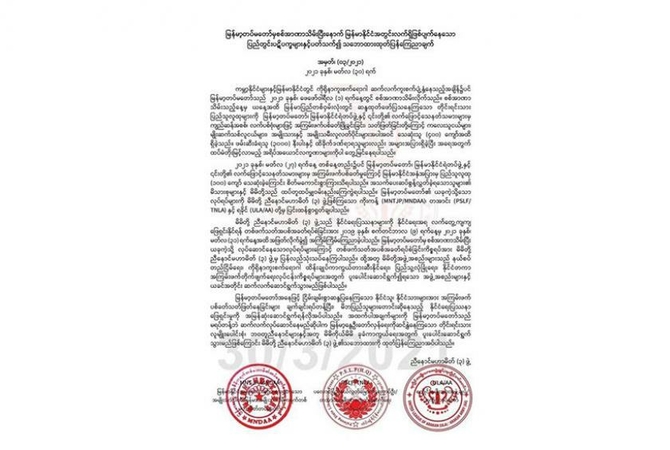
The Brotherhood Alliance of Arakan Army (AA), Ta’ang National Liberation Army (TNLA), and Myanmar National Democratic Alliance Army (MNDAA) released a statement on March 30th, calling on the military (Tatmadaw) to immediately stop shooting at peaceful protests and to quickly find a solution to the current political crisis. 

The statement outlines that since February 1st, police forces and military forces have been using live ammunition and hand grenades against protesting citizens. The three groups send its condolences to the families of over 400 protestors who have died in this crisis. 

Additionally, the statement outlines that over 3,000 people have been detained while large numbers of people have been injured: these figures are likely to grow.  

As such, the Brotherhood Alliance strongly condemns the actions of the Tatmadaw and is reassessing its current ceasefire arrangements. 

The Brotherhood Alliance calls on the Tatmadaw (military) to immediately stop shooting at peaceful protestors and to quickly find a solution to this current political crisis. 

If this Tatmadaw (military) fails to do so, the Brotherhood Alliances says that it will help citizens with their defensive resistance.

๋[Japan] Hoteliers, hit hard by coronavirus, adapt to survive #SootinClaimon.Com

#SootinClaimon.Com : ขอบคุณแหล่งข้อมูล : หนังสือพิมพ์ The Nation.

https://www.nationthailand.com/ann/30404339

๋[Japan] Hoteliers, hit hard by coronavirus, adapt to survive

Mar 31. 2021A shoeless guest stays at the Keio Presso Inn in Chuo Ward, Tokyo. (The Yomiuri Shimbun)A shoeless guest stays at the Keio Presso Inn in Chuo Ward, Tokyo. (The Yomiuri Shimbun)

By The Japan News/ANN

The pandemic has packed a punch, and the hospitality industry is hurting more than most. Seeking to staunch their financial wounds, a stream of hoteliers has been turning to unconventional business models such as long-term stays — and in many cases, even checking out of the traditional hotel sector entirely, converting guest rooms into condos — as part of a larger paradigm shift that is quickly becoming the industry’s new normal.

■ ‘Live’ and ‘Work’

The Imperial Hotel, Tokyo, in Chiyoda Ward, Tokyo began accepting reservations on Feb. 1 for a special 30-night extended stay. Priced at ¥360,000, the campaign offered a nearly 80% discount off the standard room charge. All 99 rooms made available for the package were booked within the day.

The hotel said it expects the rooms to be used as second homes for the wealthy or as remote offices for teleworking corporate executives. Although there will be fewer visits from housekeeping under the plan, guests will be assigned a personal valet during their stay, and have access to swimming pool, saunas, fitness center, and other hotel facilities, the same as other guests.

A popular practice in Europe and North America, long-term hotel stays have been offered by a select handful of realtors in Japan, where such rooms are commonly called “serviced apartments.”

While these arrangements typically require renters to sign a lease agreement, the Imperial Hotel plan saves guests the hassle by capping the duration of stays at a month, which skirts the cut-off stipulated by the Hotel Business Law.

Hotel New Otani, one of Japan’s great luxury triumvirate alongside the Imperial Hotel and Hotel Okura, also began offering a similar long-stay plan last year.

Some within the industry have expressed hesitation about the trend. Slash prices once, no matter how temporarily, and it becomes hard to justify the old price bracket when guest footfall returns to normal. Concerns that the deep discounts might end up tarnishing meticulously polished brand images is another part of the calculus.

Then again, as one hotelier put it, “Someone who can afford to drop several hundred thousand yen on a room is probably already going to be among our regular clientele.”

So far, the service seems to have paid off, and been received favorably by guests.

Mariko Ishii, a hospital executive who booked an extended-stay service at Keio Presso Inn Nihonbashi Kayabacho, in Tokyo, said with a smile: “I don’t need to clean the room and can concentrate on my work. I feel safe here, too, from a security perspective.”

The hotel has even replaced the carpet in its long-stay rooms, so guests can comfortably walk around barefoot.

■ From hospitality to realty

As the pandemic drags on, other operators are hedging their bets and drastically retooling their business models.

Takuto Holdings Co., a prominent real estate agent based in Osaka, has been converting seven of the 12 hospitality-industry properties in its portfolio into condos.

In March, The Sankei Building Co. remodeled two of its hotels, including one in Akihabara, Tokyo, into office buildings.

Kyoto, home to many hotels and ryokan inns, set up a subsidy system last September to support such moves. The city will cover up to ¥3 million for renovations when remodeling a lodging into a residential complex.

About 60 companies, including hotels, are said to have applied for the subsidy.

■ Excessive investment

The situation is especially dire for hotels and inns, as many were opened in anticipation of special demand for the Tokyo Olympics and Paralympics.

According to the Health, Labor and Welfare Ministry, as of March 2020, there were 88,983 accommodation facilities in Japan, up about 13% from five years ago, and some areas are said to be oversupplied. More than 2.5 million people were expected to stay at hotels during the Games, but it was recently decided that spectators from overseas would not be allowed into Japan.

Data compiled by Teikoku Databank Ltd. showed there had been 1,210 corporate bankruptcies triggered by the pandemic as of Friday, of which 84 were hotels and inns. Hotels were the third-most-battered industry, after restaurants and construction.

A number of well-established hotels have also been closing — the Kirishima Kokusai Hotel in Kirishima, Kagoshima Prefecture, will close in May and the Hotel Grand Palace in Tokyo’s Kudan district at the end of June. They apparently found it difficult to adapt their operations, due to their location in tourist areas and aging facilities.

WHO: Animal-to-human virus transmission most likely #SootinClaimon.Com

#SootinClaimon.Com : ขอบคุณแหล่งข้อมูล : หนังสือพิมพ์ The Nation.

https://www.nationthailand.com/ann/30404338

WHO: Animal-to-human virus transmission most likely

Mar 31. 2021Peter Ben Embarek, WHO International Team Lead of the WHO-convened Global Study of the Origins of COVID-19 attends a news conference in Geneva, Switzerland, in this Feb 12, 2021 file photo. [Photo/Agencies] Peter Ben Embarek, WHO International Team Lead of the WHO-convened Global Study of the Origins of COVID-19 attends a news conference in Geneva, Switzerland, in this Feb 12, 2021 file photo. [Photo/Agencies]
By CHEN WEIHUA
CHINA DAILY/ANN

The virus that caused the COVID-19 pandemic is “extremely unlikely” to have originated in a lab, but most likely jumped from an animal to humans, according to a World Health Organization report released on Tuesday by a joint international and Chinese team probing the virus’ origins.

The 120-page report said the virus most probably jumped from an animal, potentially a bat or pangolin, to an unknown intermediate animal host and then to humans. However, the path of transmission is still not known.

“There is no record of viruses closely related to SARS-CoV-2 in any laboratory before December 2019, or genomes that in combination could provide a SARS-CoV-2 genome,” the report said.

“In view of the above, a laboratory origin of the pandemic was considered to be extremely unlikely.”

The report said that the two most likely scenarios to explain the emergence of COVID-19 both involve the transmission of the virus from animals to humans.

“So far, we have not been able to document any substantial transmission of SARS coronavirus in the months preceding the outbreak in December,” Thea Fisher, a member of the international team, said at a news conference on the report on Tuesday.

Peter Ben Embarek, a Danish food safety and animal disease scientist who heads the international team, said the joint team looked into all scenarios.

“We try to stay with the arguments we have, the hard facts we have,” he said.

A diagram from the report by the WHO-China joint study team shows the possible transmission routes of SARS-CoV-2 to humans.

He called it “a huge report” with a lot of new knowledge, data and information, and added that information will continue to come out after the initial studies.

He also praised the good collaboration between the Chinese and international experts.

“I think the size of the report, and the amount of material and results and analysis and data in the report, speaks for itself in terms of how the collaboration went,” he said.

“There would never be anything like that if we did not have a very strong, good collaboration with our colleagues in China,” Embarek added.

The report was written by a joint international team made up of 17 international experts and 17 Chinese experts under a mandate from the World Health Assembly, the decision-making body of the WHO. The United Nations Food and Agriculture Organization participated as an observer.

The team conducted a joint study from Jan 14 to Feb 10 in Wuhan, Hubei province, following initial online meetings, according to the report.

Peter Daszak, a member of the international team, tweeted, “I do hope people actually read the huge amount of new data in the report!”

Mutations could render Covid vax ineffective in a year: Experts #SootinClaimon.Com

#SootinClaimon.Com : ขอบคุณแหล่งข้อมูล : หนังสือพิมพ์ The Nation.

https://www.nationthailand.com/ann/30404337

Mutations could render Covid vax ineffective in a year: Experts

Mar 31. 2021

By The Statesman/ANN

Mutations could render current Covid-19 vaccines ineffective in a year or less, according to two-thirds of 77 epidemiologists, virologists and infectious disease specialists from 28 countries surveyed by People’s Vaccine Alliance.

The results published on Tuesday deliver a stark warning of the risk the world is taking by failing to ensure all countries have sufficient vaccines to protect people from Covid-19.

Of those surveyed, almost a third gave a timeframe of nine months or less.

Fewer than one in eight said they believed that mutations would never render the current vaccines ineffective.

The overwhelming majority – 88 per cent — said that persistent low vaccine coverage in many countries would make it more likely for vaccine resistant mutations to appear.

The People’s Vaccine Alliance, a coalition of over 50 organisations including African Alliance, Oxfam and UNAIDS, warned that at the current rate it was likely that only 10 per cent of people in the majority of poor countries will be vaccinated in the next year.

Nearly three-quarters of those surveyed – who included epidemiologists, virologists and infectious disease specialists from institutions including Johns Hopkins, Yale, Imperial College, London School of Hygiene and Tropical Medicine, Cambridge University, the University of Edinburgh and The University of Cape Town — said that open sharing of technology and intellectual property could increase global vaccine coverage.

“The more the virus circulates, the more likely it is that mutations and variants will emerge, which could make our current vaccines ineffective. At the same time, poor countries are being left behind without vaccines and basic medical supplies like oxygen,” Devi Sridhar, Professor of Global Public Health at the University of Edinburgh in Britain, said in a statement.

“As we’ve learned, viruses don’t care about borders. We have to vaccinate as many people as possible, everywhere in the world, as quickly as possible. Why wait and watch instead of getting ahead of this?”

While he didn’t specify a timeframe, Gregg Gonsalves, Associate Professor of Epidemiology at Yale University, echoed the urgency to vaccinate globally.

“With millions of people around the world infected with this virus, new mutations arise every day. Sometimes they find a niche that makes them more fit than their predecessors,” Gonsalves said.

“These lucky variants could transmit more efficiently and potentially evade immune responses to previous strains. Unless we vaccinate the world, we leave the playing field open to more and more mutations, which could churn out variants that could evade our current vaccines and require booster shots to deal with them.”

The survey shows that it is imperative for the safety of all citizens in all countries that people in developing countries are vaccinated as soon as possible. Failure to tackle global vaccine inequality heightens the risk of further mutations.

Despite this imperative, rich country defence of the monopolies of pharmaceutical giants mean that global supplies are being artificially rationed, with a handful of companies deciding who lives and who dies.

Earlier this month, rich countries blocked a proposal to waive intellectual property rights for Covid-19 vaccines.

The People’s Vaccine Alliance is urging them to reconsider when talks resume at the World Trade Organisation in April.

The alliance is also calling for all pharmaceutical corporations working on Covid-19 vaccines to openly share their technology and intellectual property through the World Health Organization Covid-19 Technology Access Pool, in order to speed up and ramp up the production and rollout of vaccines to all countries.

Asean finance ministers agree to roll out Covid-19 vaccination widely: DPM Heng #SootinClaimon.Com

#SootinClaimon.Com : ขอบคุณแหล่งข้อมูล : หนังสือพิมพ์ The Nation.

https://www.nationthailand.com/ann/30404336

Asean finance ministers agree to roll out Covid-19 vaccination widely: DPM Heng

Mar 31. 2021Finance Minister Heng Swee Keat (bottom row, centre) met his Asean counterparts and central bank governors through virtual meetings hosted by Brunei. PHOTO: HENG SWEE KEAT/FACEBOOKFinance Minister Heng Swee Keat (bottom row, centre) met his Asean counterparts and central bank governors through virtual meetings hosted by Brunei. PHOTO: HENG SWEE KEAT/FACEBOOK

By Calvin Yang
The Straits Times/ANN

SINGAPORE – Asean finance ministers have agreed to redouble efforts to roll out vaccination widely in order for their borders to reopen safely.

To grow their economies, the ministers agreed to strengthen their digital connectivity, especially for cross-border payments, said Finance Minister Heng Swee Keat on Tuesday (March 30).

He said this after the 7th Asean Finance Ministers’ and Central Bank Governors’ Meeting.

“Many also highlighted how we can build back differently, with a greater emphasis on sustainability and resilience.”

Mr Heng met his Asean counterparts and central bank governors through virtual meetings hosted by Brunei, the current Asean chair, on Tuesday.

The last time the ministers met physically was in Chiang Rai in 2019.

The ministers had a full day of discussions on how they can collectively recover from the Covid-19 pandemic, be better prepared for future crises and prosper together as a region, said Mr Heng, who is also Deputy Prime Minister, in a Facebook post.

“While we miss the face-to-face interactions of physical meetings, the virtual meetings were very engaging,” he noted.

Also present at one of the meetings were the International Monetary Fund, the World Bank, regional multilateral development banks like the Asian Development Bank and the Asian Infrastructure Investment Bank, and the Asean+3 Macroeconomic Research Office.

Mr Heng said: “As the global order becomes more uncertain, Asean must remain united, work together and collectively chart our way forward.

“We will need to maintain Asean centrality, as we work with partners around the world. In this way, we can build a brighter, greener and more resilient future.”