South Korea to brief firms on ‘Netflix Law’ #SootinClaimon.Com

#SootinClaimon.Com : ขอบคุณแหล่งข้อมูล : หนังสือพิมพ์ The Nation.

https://www.nationthailand.com/ann/30403422

South Korea to brief firms on ‘Netflix Law’

Mar 08. 2021The Ministry of Science and ICT's office in Sejong, about 120 kilometers south of Seoul. (Ministry of Science and ICT)The Ministry of Science and ICT’s office in Sejong, about 120 kilometers south of Seoul. (Ministry of Science and ICT)

By Shim Woo-hyun

The South Korean government will discuss with providers of online services to set up detailed guidelines for the country’s “Netflix Law,” industry sources said Sunday.

The Ministry of Science and ICT will hold a meeting this week with officials from Google, Facebook, Netflix, Naver, Kakao and Wavve.

The companies are expected to use the session to clarify terms in the revised Telecommunications Business Act, which could potentially disrupt their business activities in the country.

Dubbed the “Netflix law,” the law became effective Dec. 10, allowing the government to ask large online content providers to take measures to provide stable services in the country. It also stipulates that foreign providers should have local representatives and be equipped with proper payment systems.

The new law applies to online companies that account for 1 percent or more of the country’s average daily data traffic in the last three months of a year, or firms with more than 1 million daily users.

The regulation, however, has been accused of ambiguity.

In December, the Korea Internet Corporations Association, which represents major local tech companies, raised questions regarding the credibility of the internet traffic data the government uses to determine which companies are subject to the law. The association argued that the Electronics and Telecommunications Research Institute’s data, which summarizes data collected from local telecommunications providers, could be biased in favor of local telecommunications firms.

The participants of the meeting are expected to discuss specifics regarding payment systems that the law requires internet providers to support.

An ICT Ministry official said it will gather feedback from the participating companies as well as opinions from experts in the industry and academic circles to ensure the proper application of the law for the mutual benefit of customers and businesses.

Shopee launches coding competition to grow region’s tech talent #SootinClaimon.Com

#SootinClaimon.Com : ขอบคุณแหล่งข้อมูล : หนังสือพิมพ์ The Nation.

https://www.nationthailand.com/ann/30403398

Shopee launches coding competition to grow region’s tech talent

Mar 07. 2021The Shopee Code League is organised by the e-commerce platform Shopee.ST PHOTO: GAVIN FOOThe Shopee Code League is organised by the e-commerce platform Shopee.ST PHOTO: GAVIN FOO

By The Straits Times

SINGAPORE – A coding competition and series of workshops for students and adults in the region was launched to nurture tech talent amid the acceleration of digital transformation due to Covid-19.

The Shopee Code League, organised by the e-commerce platform Shopee, is a virtual event comprising three programming challenges in areas like data analytics and data science.

There will also be online training workshops on these topics for selected participants.

The first challenge was launched on Saturday (March 6), with the remaining two to be launched on March 13 and 20.

This year, over 15,000 people from countries such as Singapore, China, Indonesia, Malaysia and the Philippines aged between nine and 51 are taking part in the annual challenge, which is being held for the second time.

Speaking at the launch event held over Zoom on Saturday, Minister for Education Lawrence Wong said the large number of participants reflects a keen interest in coding in the region.

The minister noted that the Covid-19 pandemic rapidly accelerated technological trends over the past year.

“For decades, we’ve talked about the importance of technology. Companies invested in equipment for virtual meetings, we were all looking forward to the promise of telemedicine and remote learning, but not much happened,” he said.

“Then, when Covid-19 struck, last year, in a matter of weeks, everything moved online and it completely changed the way we live, work, study and play.”

This change is here to stay, Mr Wong said, noting that tech was once a narrow industry consisting of hardware and software companies but has now become ubiquitous in all industries and facets of life.

He encouraged the participants to focus on fundamentals which do not change, rather than specific programming languages which see their popularity rise and fall.

He added the solutions to real-world problems cannot be solved by software alone and will require collaboration between disciplines as he encouraged the participants to network and share knowledge.

Shopee’s regional head of people, Ms Agatha Soh, said the competition aims to give participants the opportunity to work on real data sets and challenges in the Internet industry.

She said: “Through the Shopee Code League, we hope to spark greater awareness and interest in these specialisations by bringing tech communities closer through problem solving and knowledge sharing.”

At stake in the competition are cash prizes of between $500 and $3,000 and some participants might also be offered jobs or internships at Shopee.

Rohingya Crisis: US, Australia, Japan to keep supporting Bangladesh #SootinClaimon.Com

#SootinClaimon.Com : ขอบคุณแหล่งข้อมูล : หนังสือพิมพ์ The Nation.

https://www.nationthailand.com/ann/30403394

Rohingya Crisis: US, Australia, Japan to keep supporting Bangladesh

Mar 07. 2021

By The Daily Star

The US pledged continued support to the Rohingyas and their host communities in Bangladesh and called for the Myanmar military to restore power to the democratically elected government and refrain from further violence.

“The international community has not forgotten the refugees or host communities supporting the Rohingya refugees,” US Ambassador Earl R Miller said.

He made the statement after a visit to Rohingya camps in Cox’s Bazar from March 3-4. Australian High Commissioner Jeremy Bruer and Japanese Ambassador Ito Naoki were also in the delegation that visited the camps.

The delegation met government officials and international agencies assisting host communities and Rohingya refugees in Cox’s Bazar. They reiterated their unwavering support for Bangladesh’s refugee response, according to a statement issued by the US embassy in Dhaka yesterday.

It also visited a disaster preparedness project, food programmes, a learning centre, a health facility, and spoke with community health volunteers about their role in the Covid-19 response in the refugee camps and host communities.

The latest visit marks a year since the first cases of coronavirus were reported in Bangladesh. It was the first visit since the October 2020 Rohingya donor conference, which raised nearly $600 million in additional relief funds for Rohingya refugees and host communities.

Since the outbreak of violence in Myanmar in 2017, Australia has provided over $240 million, Japan has contributed $140 million, and the US responded with an assistance of $1.2 billion in humanitarian assistance to Rohingya and host communities in Cox’s Bazar.

“We continue to work with international organisations to encourage Myanmar to create the conditions that allow for the voluntary, safe, dignified, and sustainable return of refugees,” said Miller.

“We strongly support all those calling on the Myanmar military to restore power to the democratically elected government, release all those who have been unjustly detained, and cease attacks on journalists, activists, and others.

“The military must exercise maximum restraint and refrain from additional violence.”

Australian High Commissioner Bruer said Covid-19 created many new challenges in Cox’s Bazar.

“With case numbers steadying and with the vaccine in sight, it is as important as ever, for us to work together with the Bangladesh authorities to ensure humanitarian partners can deliver the much-needed assistance to both Rohingya and Host communities,” said the high commissioner.

Japanese Ambassador Ito said the aim of the visit was to further promote support for Bangladesh and to strengthen cooperation with international organisations and NGOs.

“We strongly hope that, as the coronavirus situation has been improving, comprehensive service delivery including education will restart soon,” the ambassador said.

11 ‘Myanmar cops’ crossed over to India’s Mizoram since military coup: official #SootinClaimon.Com

#SootinClaimon.Com : ขอบคุณแหล่งข้อมูล : หนังสือพิมพ์ The Nation.

https://www.nationthailand.com/ann/30403393

11 ‘Myanmar cops’ crossed over to India’s Mizoram since military coup: official

Mar 07. 2021

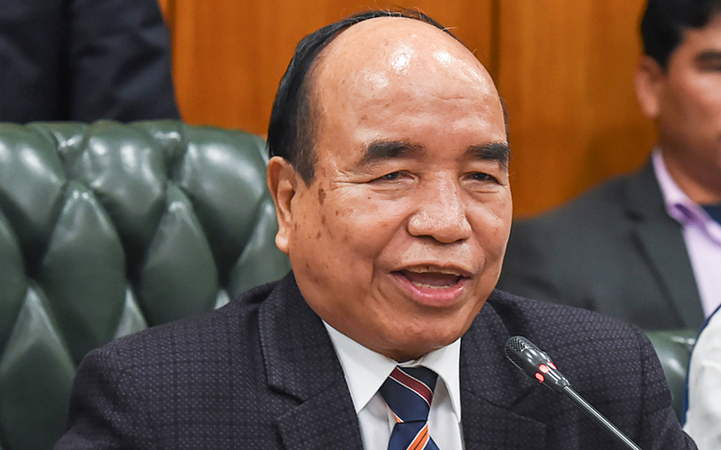
Zoramthanga

Zoramthanga

By The Daily Star

Eleven people stated to be policemen of Myanmar have crossed over to bordering northeastern Indian state of Mizoram since the military coup in the neighbouring country, a senior Indian official said today.

The figure of refugees from Myanmar could increase from 16 people at present as many people are attempting to sneak into Mizoram through the porous border, a Mizoram Home Department official said on condition of anonymity.

The 16 people include three women and as many children, our New Delhi correspondent reports, quoting the official.

The official said the Mizoram authorities on Thursday informed the Indian government about the situation and possible influx of more refugees from Myanmar.

“Of the 16 foreign nationals, 11 including a woman claimed they were police personnel of Myanmar. They possessed Myanmar citizen identity cards but it is hard to verify whether they belong to the police force or not,” the official said.

The Mizoram government also sought financial assistance from the Centre to deal with a possible refugee crisis, he said.

Chief Minister Zoramthanga said his government will provide relief to the people of Myanmar who took refuge in the state because of the present political situation in that country.

Two of the “policemen” have fled and crossed the border along with their wives and children, he said.

Mizoram is home to thousands of Myanmar”s Chin community people who share the same culture and ancestry as the Mizos of Mizoram.

The military junta in Myanmar took over the government on February 1 but it appears that people started fleeing the country only after the authorities began to use force to quell pro-democracy protests late that month, an official said.

Four people who are currently staying in Champhai district were the first to reach Mizoram on February 28. The other 12 crossed the border and took refuge in the state later. They are now sheltered in Serchhip and Hnahthial districts.

Six districts of Mizoram — Champhai, Lawngtlai, Hnahthial, Siaha, Serchhip and Saitual — share a 510km long porous border with Myanmar.

Assam Rifles Deputy Inspector General Digvijay Singh on Thursday said that the force was directed not to allow any illegal entry from the neighbouring country.

Myanmar forces make night raids after breaking up protests #SootinClaimon.Com

#SootinClaimon.Com : ขอบคุณแหล่งข้อมูล : หนังสือพิมพ์ The Nation.

https://www.nationthailand.com/ann/30403392

Myanmar forces make night raids after breaking up protests

Mar 07. 2021Pictures of victims of the crackdown on anti-coup protesters are put up on the statue of General Aung San, national hero and father of civilian leader Aung San Suu Kyi, during a memorial service in Naypyidaw, March 6, 2021.
PHOTO: EPA-EFEPictures of victims of the crackdown on anti-coup protesters are put up on the statue of General Aung San, national hero and father of civilian leader Aung San Suu Kyi, during a memorial service in Naypyidaw, March 6, 2021. PHOTO: EPA-EFE

By The Straits Times

YANGON (REUTERS) – Myanmar security forces fired gunshots as they carried out overnight raids in the main city Yangon after breaking up the latest protests against last month’s coup with teargas and stun grenades.

The South-east Asian country has been plunged into turmoil since the military overthrew and detained elected leader Aung San Suu Kyi on Feb 1. Daily demonstrations and strikes have choked business and paralysed administration.

There were sporadic protests across Myanmar on Saturday and local media reported that police fired tear gas shells and stun grenades to break up a protest in the Sanchaung district of Yangon, the country’s biggest city. There were no reports of casualties.

Late at night, residents said soldiers and police moved into several districts of Yangon, firing shots.

They arrested at least three people in the Kyauktada Township, residents there said.

They did not know the reason for the arrests.

“They are asking to take out my father and brother. Is no one going to help us? Don’t you even touch my father and brother. Take us too if you want to take them,” one woman screamed as two of them, an actor and his son, were led off.

Soldiers also came looking for a lawyer who worked for Suu Kyi’s National League for Democracy (NLD), but were unable to find him, a member of the now dissolved parliament, Sithu Maung, said in a Facebook post.

Reuters was unable to reach police for comment.

A junta spokesman did not answer calls requesting comment.

Arrests and dead

Well over 1,500 people have been arrested under the junta, according to the Assistance Association for Political Prisoners advocacy group. This association and the United Nations say that more than 50 protesters have been killed.

Myanmar authorities said on Saturday they had exhumed the body of 19-year-old Kyal Sin, who has become an icon of the protest movement after she was shot dead in the city of Mandalay on Wednesday wearing a T-shirt that read “Everything will be OK”.

State-run MRTV said a surgical investigation showed she could not have been killed by police because the wrong sort of projectile was found in her head and she had been shot from behind, whereas police were in front.

Photographs on the day showed her head turned away from security forces moments before she was killed. Opponents of the coup accused authorities of an attempted cover-up.

The killings have drawn anger in the West and have also been condemned by most democracies in Asia. The United States and some other Western countries have imposed limited sanctions on the junta. China, meanwhile, has said the priority should be stability and that other countries should not interfere.

Protesters demand the release of Suu Kyi and the respect of November’s election, which her party won in landslide, but which the army rejected. The army has said it will hold democratic elections at an unspecified date.

Israeli-Canadian lobbyist Ari Ben-Menashe, hired by Myanmar’s junta, told Reuters the generals are keen to leave politics and seek to improve relations with the United States and distance themselves from China.

He said Suu Kyi had grown too close to China for the generals’ liking.

“There’s a real push to move towards the West and the United States as opposed to trying to get closer to the Chinese,” Ben-Menashe said. “They want to get out of politics completely… but it’s a process.”

Ben-Menashe said he also had been tasked with seeking Arab support for a plan to repatriate Rohingya refugees, hundreds of thousands of whom were driven from Myanmar in 2017 in an army crackdown after rebel attacks.

Junta leader and army chief Min Aung Hlaing had been under Western sanctions even before the coup for his role in the operation, which UN investigators said had been carried out with “genocidal intent”.

[Singapore] Maritime sector to receive $20 billion in investments by 2024, new jobs to be created #SootinClaimon.Com

#SootinClaimon.Com : ขอบคุณแหล่งข้อมูล : หนังสือพิมพ์ The Nation.

https://www.nationthailand.com/ann/30403367

[Singapore] Maritime sector to receive $20 billion in investments by 2024, new jobs to be created

Mar 06. 2021The Tuas Port project, when fully operational, will be as large as two Ang Mo Kios. PHOTO: ST FILEThe Tuas Port project, when fully operational, will be as large as two Ang Mo Kios. PHOTO: ST FILE

By Fabian Koh
The Straits Times/ANN

SINGAPORE – Singapore’s maritime sector can expect $20 billion in investments from industry players by 2024. This will create more jobs here, said Senior Minister of State for Transport Chee Hong Tat on Friday (March 5).

The number of maritime tech start-ups will also more than triple from 30 to 100 by 2025, while a new programme will be launched to develop leaders with knowledge of key maritime issues and strong business networks.

Speaking in Parliament during the debate on the budget of the Ministry of Transport, Mr Chee said: “We aim to bring in $20 billion in total business spending commitments from maritime companies from 2020 to 2024, and create more jobs and opportunities for our people.”

These will be in areas including maritime law and arbitration, ship management and marine insurance.

He outlined three targets for the local maritime ecosystem to strive towards – to be integrated, innovative and inclusive.

The maritime sector here did well last year, handling 36.9 million twenty-foot equivalent units (TEUs), and growing in scale and diversity, said Mr Chee.

“We attracted 11 new shipping groups to Singapore, and worked with eight maritime companies to expand their operations here,” he said.

To build on the momentum and seize new opportunities to stay ahead of the competition, the maritime sector here has to become an integrated ecosystem.

Providing an update on the mega Tuas Port project, Mr Chee said: “We are on track to complete the first phase of land reclamation works by end of this year.”

The Tuas Port project will bring together port operator PSA’s operations in Pasir Panjang, Keppel and Brani, and when fully operational, will be as large as two Ang Mo Kios.

It will be able to handle up to 65 million TEUs a year, 50 per cent more than Singapore’s current capacity.

The facility will be fully automated, with features such as automated cranes and driverless vehicles.

“These will more than double our labour productivity at Tuas, compared to our City Terminals, and create many skilled jobs for Singaporeans in the port sector. It will also be a greener port, with a 50 per cent reduction in carbon emissions intensity,” he said.

The concept of integration will also extend beyond the port, to key sectors like advanced manufacturing, cold chain and logistics, said Mr Chee.

This will form a Tuas Port ecosystem where containers can be moved directly between ships and factories, without additional delays or handling costs.

“We are also enhancing digital integration to facilitate data exchange, helping companies to enjoy greater convenience, reduce costs and save time,” he added.

The Government plans to develop the Tuas South region for industrial use over the next two decades, and will continue to explore viable transport options for workers there, and also work with the Ministry of National Development to increase public housing options in the west, he said.

Mr Chee told the House that the maritime sector has to be innovative. The Government will work with small and medium-sized enterprises (SMEs) to push research efforts and scale up their operations.

“We will increase the cap of co-funding support for maritime technology SMEs, from 50 per cent currently to 70 per cent, and encourage industry players to share expertise and resources to co-develop scalable solutions. Eligible projects by industry consortiums will also receive up to 70 per cent co-funding support,” he said.

The Maritime and Port Authority will top up $15 million to the Maritime Innovation and Technology Fund, bringing the total funds available for maritime research and development, as well as product development, to $100 million.

“We aim to more than triple the number of maritime tech start-ups supported under the Pier71 funding programme, from 30 to 100 by 2025,” said Mr Chee.

“Our goal is to be the top maritime start-up hub in the world, the Silicon Valley for maritime technology.”

Mr Chee also said that the maritime sector should be inclusive, and create a diverse range of jobs for people with different backgrounds and skill sets.

“We want to attract and train more Singaporeans to take on seafaring and shore-based jobs,” he said.

Moving forward, there will also be opportunities in the sector in areas such as environmental sustainability, systems engineering, cyber security and data analytics.

A new programme will also be launched to groom future leaders for the maritime sector here, said Mr Chee.

“We are starting a new Maritime Leadership Programme to train up to 30 local maritime managers for the first two runs, to hone their leadership skills, build global perspectives on key maritime issues, and strengthen their business networks locally and abroad,” he said.

Messages of gratitude highlight disaster memorial in Japan #SootinClaimon.Com

#SootinClaimon.Com : ขอบคุณแหล่งข้อมูล : หนังสือพิมพ์ The Nation.

https://www.nationthailand.com/ann/30403366

Messages of gratitude highlight disaster memorial in Japan

Mar 06. 2021LED light bulbs form messages in front of a former Kesennuma Koyo High School building in Kesennuma, Miyagi Prefecture, on March 2. (The Yomiuri Shimbun)
LED light bulbs form messages in front of a former Kesennuma Koyo High School building in Kesennuma, Miyagi Prefecture, on March 2. (The Yomiuri Shimbun)

By The Japan News/ANN

KESENNUMA, Miyagi — LED lights flashing messages, including “Thank you,” are the highlight of an ongoing display in Kesennuma, Miyagi Prefecture, ahead of the 10th anniversary of the Great East Japan Earthquake.

The glowing messages appear on a fence in front of a building that is part of the Ruins of the Great East Japan Earthquake Kesennuma City Memorial Museum, a structure connected to a building that was actually destroyed in the disaster.

The building was formerly part of Kesennuma Koyo High School and now stands in ruins as a remembrance of the disaster.

About 1,500 plastic bottles containing LED bulbs are used to form the characters. The messages include a phrase reading “10 years since that day. Thank you.”

Local elementary school students and others used oil paint pens to inscribe messages on the surface of each of the plastic bottles. “Thank you very much for the massive amount of support,” one of them read.

During the disaster, a 12-meter tsunami inundated the school, the flooding reaching the fourth floor.

About 170 students fled to high ground nearby, and 45 teachers and other school officials took refuge on the rooftop when tsunami hit the building. They were all safe.

Said Katsumi Sato, 53, head of the memorial museum: “We must never forget the help that all of the people gave us.”

The LED lighting can be viewed for about four hours after sunset during the event, set to continue through April 4.

Korea to further ease social distancing as vaccines roll out #SootinClaimon.Com

#SootinClaimon.Com : ขอบคุณแหล่งข้อมูล : หนังสือพิมพ์ The Nation.

https://www.nationthailand.com/ann/30403365

Korea to further ease social distancing as vaccines roll out

Mar 06. 2021COVID-19 vaccinations kicked off on Feb. 26 in South Korea. The photo shows one of the vaccination sites in Seoul. (Kim Arin/The Korea Herald)COVID-19 vaccinations kicked off on Feb. 26 in South Korea. The photo shows one of the vaccination sites in Seoul. (Kim Arin/The Korea Herald)

By Kim Arin
The Korea Herald/ANN

Plan for new scheme aims to open up economy, while making it harder for people to gather

South Korea is looking to revise its social distancing scheme to allow the economy to stay open at higher number of newly diagnosed patients, while restricting individual behaviors more strictly.

The Ministry of Health and Welfare said Friday that the easing was warranted as the country is now capable of handling a much greater number of patients than it was in November, when the current guidelines came into effect. No timetable for the revision has been announced so far.

“The five-tiered reopening system that is in place currently is far too stringent, and does not reflect improved capacity of hospitals and contact tracing programs,” the ministry said.

It added that these changes would relieve the burden for more sectors of the economy.

“It’s about leaving the compliance with safety measures up to the people, rather than forcing those restrictions unfairly on businesses,” the ministry said.

Under the updated system, the threshold for even “coronavirus-risky” businesses and other establishments to remain open is raised to a weekly average of 1,550 new cases per day — or 3 cases for every 100,000 people.

At this point, nightclubs and certain types of bars would be subject to partial closures. Food outlets such as cafes and restaurants can offer delivery and takeout services only past 9 p.m. Other businesses can operate more-or-less normally as long as precautions are observed, such as wearing face masks and collecting names and contact information of visitors.

So there is more leniency for businesses, but for individuals, social distancing requirements are harsher.

When there is a weekly average of around 360 cases a day, all gatherings of a private nature larger than eight people are prohibited. Long-distance travel, indoor workouts and in-person meetings involving drinking are “strongly discouraged.”

And when the daily case count reaches 780, gatherings of five or more are banned. Outings for nonessential purposes are to be avoided past 9 p.m.

Should the number over 1,550, no more than two people will be allowed to congregate at a time after 6 p.m.

How these rules apply may vary per municipality, depending on the local seven-day case rate for 100,000 people. Previously, social distancing mandates were usually implemented nationally.

For instance, in Seoul metropolitan region, an average of 181 or more daily cases would call for ban on gatherings of more than eight people; 389 or more, four people; and 778 people or more, four people during daytime and two people in evenings.

The region-by-region approach might be “too complex,” however, according to Dr. Jun Byung-yool, who led the Korea Centers for Disease Control and Prevention in 2011-2013.

“A lot of people commute in and out of Seoul every day, and if the rules are not consistent they’re bound to create confusion. It will be hard for people to keep up,” he said. But he agreed some distinction was needed between capital area, which has been the main area of viral spread since summer last year, and the rest of the country.

Other experts voiced concerns about restrictions being lifted as vaccinations are just beginning.

Preventive medicine professor Dr. Jung Jae-hoon of Gachon University said that now was “not the time” for releasing restrictions any further than they are.

“Despite over two months of more intensive social distancing, we couldn’t get the baseline of new infections down lower than it is now,” he said. “The tide can turn quickly in the next few weeks, and if we don’t do enough to quell the spread of infections, another surge may well happen.”

Still, expanding the gatherings ban — “which proved to be most effective in helping Korea get past its winter wave of infections” — was a meaningful step, he said.

The easing might be “a necessary evil” to save the economy, but it should wait while vulnerable populations are being vaccinated, said Dr. Paik Soon-young, a virologist at Catholic University of Korea.

“Seeing that businesses are being compensated poorly, it’s not fair to have them bear the brunt without adequate support,” he said. “But COVID-19 restrictions shouldn’t be lifted prematurely at least until vaccinations of at-risk groups are complete, which won’t be before June at the earliest.”

He pointed out vaccinations were “getting off to a slow start” in Korea, although it’s had its success in terms of pandemic containment so far. The first batch of vaccines — 1.5 million doses of AstraZeneca’s and 117,000 doses of Pfizer’s — had arrived last week, but it was uncertain when the country would be getting the next shipment, as many countries including Korea have suffered delays.

“Like I’ve said, we are in a race against time. Korea needs to vaccinate faster to counter the new, vaccine-resistant variants and the ever-present threat of a new flare-up,” he said. “In the meantime, the efforts to curb the transmissions need to be maintained.”

The ministry said it would be finalizing the details of the scheme in the next couple of weeks.

Korea announced 398 cases and eight deaths on Friday. To date COVID-19 has sickened a total of 91,638 and killed 1,627 here.

[Myanmar] Man shot dead near Mya Ye Nanda Housing in Mandalay #SootinClaimon.Com

#SootinClaimon.Com : ขอบคุณแหล่งข้อมูล : หนังสือพิมพ์ The Nation.

https://www.nationthailand.com/ann/30403364

[Myanmar] Man shot dead near Mya Ye Nanda Housing in Mandalay

Mar 06. 2021

By Eleven Media

A man was shot dead near Mya Ye Nanda Housing in Mandalay at about 12pm today.

Security forces including police opened fire to disperse the protest column of engineers gathered near the housing in Chanmyathazi Township and they fired again on 49th and 114th Streets. And the man was shot dead.  

“He was not a protester. He didn’t confront them either. This happened only after the dispersal due to gunfire. He helped clean the road. Despite no one on the road, he was shot in the neck and died,” a local witness said.

His name was Zaw Myo, aged 27, running a furniture-making business.

Legislature to deliberate on HK election improvements #SootinClaimon.Com

#SootinClaimon.Com : ขอบคุณแหล่งข้อมูล : หนังสือพิมพ์ The Nation.

https://www.nationthailand.com/ann/30403363

Legislature to deliberate on HK election improvements

Mar 06. 2021

By China Daily/ANN

A draft decision on improving Hong Kong’s electoral system was submitted to the National People’s Congress, China’s top legislature, on Friday for deliberation.

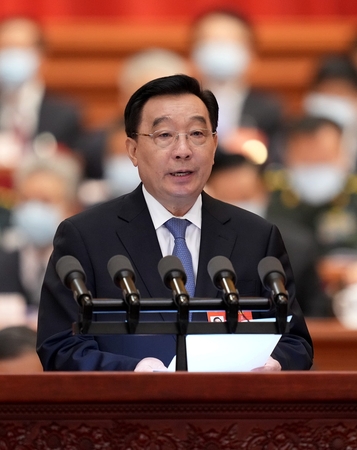
Wang Chen, vice-chairman of the NPC Standing Committee, delivered a speech explaining the draft decision at the opening meeting of the fourth session of the 13th NPC.

Stressing the necessity and importance of improving the electoral system, Wang said the rioting and turbulence that occurred in the Hong Kong Special Administrative Region revealed that its existing electoral system has clear loopholes and deficiencies, which anti-China and destabilizing elements took advantage of in an attempt to take into their hands the power to administer Hong Kong.

Necessary measures must be taken to improve the electoral system and remove existing institutional risks to ensure the administration of Hong Kong by Hong Kong people with patriots as the main body, Wang said.

Hong Kong’s electoral system, including the methods for the selection of the chief executive and for the formation of the Legislative Council, must strictly follow and fully reflect the political principle and criterion of the administration of Hong Kong by Hong Kong people with patriots as the main body and provide institutional safeguards for that purpose, he said.

Explaining the overarching approach for improving the electoral system, Wang said the overall design of the system will be centered around the reformation and greater empowerment of Hong Kong’s Election Committee.

The size, composition and formation method of the Election Committee will be adjusted and improved. The chief executive will continue to be elected by the Election Committee. The Election Committee will be entrusted with the new function of electing a relatively large share of Legislative Council members and directly participating in the nomination of all candidates for it, he said.

A qualification review mechanism will be established throughout the entire electoral process, he added.

In order to maintain the continuity and stability of relevant systems in Hong Kong, the revisions to be made in improving the electoral system may be limited to Annex I and Annex II to the Basic Law, without revising its main body, Wang said.

A two-step approach of “decision plus amendment” will be adopted, Wang said, adding that the NPC will make a decision in accordance with relevant laws in the first step, while in the second step, the NPC Standing Committee will amend Annex I and Annex II to Hong Kong’s Basic Law in accordance with relevant laws and the NPC decision.

Xinhua