Job losses due to pandemic exceed 90,000 in Japan #SootinClaimon.Com

#SootinClaimon.Com : ขอบคุณแหล่งข้อมูล : หนังสือพิมพ์ The Nation.

https://www.nationthailand.com/ann/30403239

Job losses due to pandemic exceed 90,000 in Japan

Mar 03. 2021

By The Japan News/ANN

More than 90,000 employees have been fired or had their labor contracts terminated due to the spread of the coronavirus, the Health, Labor and Welfare Ministry revealed Monday.

The number of such workers, including estimations, rose to 90,185 as of Feb. 26, the ministry announced. The number has increased by 10,000 in about two months since the figure exceeded 80,000 in early January. The situation was particularly serious in areas where a second state of emergency had been declared.

As of Feb. 19, the most recent date available for detailed analysis, the figures were 19,071 in the manufacturing industry, 11,773 in the restaurant industry, 11,655 in the retail industry and 10,753 in the accommodations industry. By prefecture, Tokyo had the highest number with 20,623, followed by Osaka with 7,598, Aichi with 4,842 and Kanagawa with 4,265. By employment status, 42,160 non-regular workers lost their jobs between May 25 last year and Feb. 19.

Expectations are that some companies will downsize their workforces in March, the end of the business year for many Japanese firms, and more workers, especially non-regular employees, may lose their jobs or not have their contracts renewed.

BTS again tops Billboard’s Artist 100 chart, sets record as group act #SootinClaimon.Com

#SootinClaimon.Com : ขอบคุณแหล่งข้อมูล : หนังสือพิมพ์ The Nation.

https://www.nationthailand.com/ann/30403238

BTS again tops Billboard’s Artist 100 chart, sets record as group act

Mar 03. 2021This photo, provided by Big Hit Entertainment on Feb. 24, 2021, shows BTS on a set for This photo, provided by Big Hit Entertainment on Feb. 24, 2021, shows BTS on a set for “MTV Unplugged.” (Big Hit Entertainment)

By The Korea Herald/ANN

Global superstar BTS has set another record, this time by claiming No. 1 on the Billboard’s Artist 100 chart for a 16th week, the most for a group act.

The seven-piece act ranked No. 1, up four notches from the previous week, on the metric that measures artists’ popularity across album and track sales, radio airplay and streaming as well as social media performance.

It marks a record for a duo or group act. Overall, BTS has now topped the chart the most after Taylor Swift, Drake and The Weeknd.

Billboard attributed the weekly jump to the popularity of a new edition of the BTS album “BE.” BTS soared from No. 74 to No. 7 on the main album chart following the release of the “Essential Edition” in February.

“BE” was originally released last November as the “Deluxe Edition,” and the new edition came out on Feb. 19 carrying the same eight tracks as the original version, such as “Life Goes On,” “Blue & Grey,” “Stay” and the prereleased hit “Dynamite,” with some different features.

According to the Nielsen Music data quoted by a Billboard article, the “BE” album sold 28,000 copies from Feb. 19-25 in the first week after the release of the new edition, up 888 percent from the previous week.

The album debuted at No. 1 on the Billboard’s main albums chart upon the release of the November version, while the lead track “Life Goes On” became the first song sung in Korean to top the main singles chart. The album has since stayed on the chart for more than 13 weeks. (Yonhap)

China billionaire tally tops 1,000 as global count hits record high #SootinClaimon.Com

#SootinClaimon.Com : ขอบคุณแหล่งข้อมูล : หนังสือพิมพ์ The Nation.

https://www.nationthailand.com/ann/30403237

China billionaire tally tops 1,000 as global count hits record high

Mar 03. 2021This combo photo shows China's four richest persons. From left: Zhong Shanshan, founder of Nongfu Spring, Tencent CEO Pony Ma Huateng, Pinduoduo CEO Huang Zheng and Jack Ma, founder of Alibaba. This combo photo shows China’s four richest persons. From left: Zhong Shanshan, founder of Nongfu Spring, Tencent CEO Pony Ma Huateng, Pinduoduo CEO Huang Zheng and Jack Ma, founder of Alibaba.

By China Daily/ANN

The number of billionaires in the world increased by 412, taking the total to a record high of 3,228, according the latest Hurun Global Rich List.

China added 259 new billionaires, becoming the first country in the world to top 1,000 “known” dollar billionaires with 1,058, more than the combined total of the next three countries, which are the United States, India and Germany.

“Despite the disruption caused by COVID-19, this year has seen the biggest wealth increase of the last decade,” Hurun Report chairman and chief researcher Rupert Hoogewerf said. A stock markets boom, and flurry of new listings have minted eight new dollar billionaires a week for the past year.

The wealth of Tesla founder Elon Musk added a record US$151 billion to US$197 billion, with Musk becoming the richest man in the world for the first time.

Amazon’s founder Jeff Bezos, last year’s richest man, ranked second with US$189 billion, followed by “Luxury King” LVMH CEO Bernard Arnault (US$114 billion) and Bill Gates (US$110 billion).

In the last five years, China has added 490 billionaires, compared with 160 in the US.

Zhong Shanshan, 67, founder of Chinese bottled water giant Nongfu Spring, became the first Chinese to break into the Hurun Global Rich List top 10 with a personal fortune of US$85 billion, ranking seventh in the world and first in China.

Tencent CEO Pony Ma Huateng’s wealth rose US$30 billion to US$74 billion, keeping him at second place in China, followed by e-commerce platform Pinduoduo CEO Huang Zheng (US$69 billion) and Alibaba’s founder Jack Ma (US$55 billion).

Beijing was the billionaire capital of the world with 145 billionaires living there. Shanghai overtook New York for second place, with 113 billionaires. Six of the top 10 cities with the most billionaires were in China.

Coronavirus drove up billionaires from healthcare and retail fastest, the report said, adding electric vehicles, e-commerce, blockchain and biotech became the fastest-growing industries of the past year.

Singapore developer asks for trading suspension as it deals with queries over Myanmar project #SootinClaimon.Com

#SootinClaimon.Com : ขอบคุณแหล่งข้อมูล : หนังสือพิมพ์ The Nation.

https://www.nationthailand.com/ann/30403236

Singapore developer asks for trading suspension as it deals with queries over Myanmar project

Mar 03. 2021Emerging Towns & Cities Singapore, through a subsidiary, paid US$24.9 million for a 49 per cent stake in the Golden City project. PHOTO: CEDAREmerging Towns & Cities Singapore, through a subsidiary, paid US$24.9 million for a 49 per cent stake in the Golden City project. PHOTO: CEDAR

By Ann Williams
The Straits Times/ANN

SINGAPORE – Emerging Towns & Cities Singapore (ETC) on Tuesday night (March 2) requested that trading in its shares be suspended while the property developer conducts an independent review of its contracts with Myanmar government ministries and departments.

ETC is among companies being called out by activists over its links to the Myanmar military, which seized power from the country’s elected government in a Feb 1 coup.

The Singapore Exchange last week issued a list of queries to the company, which is developing a commercial and residential project in Myanmar called Golden City being built on land leased from the Myanmar army. In its report, rights group Justice for Myanmar said Golden City “channels millions of dollars” to the army.

ETC, through a subsidiary, paid US$24.9 million for a 49 per cent stake in the Golden City project. The development has a total tenure of 70 years, including extensions, after which the entire project transfers to the lessor – the army’s office of the quartermaster general.

“The board is mindful of the safety of its employees, especially its staff in Myanmar, and is committed to provide more clarity on the unsubstantiated and unverified allegation against the company,” ETC said in Tuesday’s bourse filing.

Accordingly, ETC said, it intends to engage with an independent professional to review material contractual payments to the Myanmar government and fund-raising proceeds from recent years “in order to provide assurance to all stakeholders regarding the group’s dealings”.

The company will make the relevant announcement as and when there are any material developments, it said.

ETC also noted that the request for voluntary suspension “should not be taken to imply that there has been any wrongdoing on the part of the company”, but is to ensure information which would be important to shareholders is made available to ensure orderly trading in the company’s securities.

Trading in shares of the Catalist-listed company were halted on Friday. The stock closed on Thursday at 3.4 cents.

Indonesia pressures Myanmar junta to respect popular will, open dialogue #SootinClaimon.Com

#SootinClaimon.Com : ขอบคุณแหล่งข้อมูล : หนังสือพิมพ์ The Nation.

https://www.nationthailand.com/ann/30403235

Indonesia pressures Myanmar junta to respect popular will, open dialogue

Mar 03. 2021Foreign Minister Retno LP Marsudi meets with U Wunna Maung Lwin (right), whom Myanmar’s military junta has declared foreign minister, in a three-way meeting with Thai Foreign Minister Don Pramudwinai (center) at Don Muang Airport in Bangkok, Thailand, on Feb. 24. (Courtesy of/Foreign Ministry)Foreign Minister Retno LP Marsudi meets with U Wunna Maung Lwin (right), whom Myanmar’s military junta has declared foreign minister, in a three-way meeting with Thai Foreign Minister Don Pramudwinai (center) at Don Muang Airport in Bangkok, Thailand, on Feb. 24. (Courtesy of/Foreign Ministry)

By Dian Septiari
The Jakarta Post/ANN

Indonesia stepped up pressure on Myanmar’s coup leaders on Tuesday to respect ASEAN principles and the will of the people of Myanmar, as the bloc appealed for open dialogue among all parties concerned during an eagerly anticipated regional meeting.

Myanmar’s military, the Tatmadaw, overthrew the country’s democratically elected civilian government last month, detaining leader Aung San Suu Kyi and members of her National League for Democracy (NLD) over unfounded claims of election fraud.

Suu Kyi has since been charged with several criminal offenses that many observers consider politically motivated.

At the informal ASEAN ministerial meeting, which saw member states’ foreign ministers and the bloc’s secretary-general address Myanmar junta representative Wunna Maung Lwin, Indonesia reiterated its deep concern about the escalating conflict and called for Myanmar’s security forces to exercise restraint as waves of demonstrations continued on Tuesday despite police killings of protestors over the weekend.

At least 18 people were killed on Sunday, according to the United Nations, while more than 1,000 people are believed to have been detained, according to the independent Assistance Association for Political Prisoners.

Speaking to the press after the meeting, Foreign Minister Retno LP Marsudi called for unimpeded humanitarian access to all people in need and the release of political prisoners. She urged the junta to restore democracy and normalcy in the interests of the people of Myanmar.

“Democracy guarantees freedom of opinion. Democracy advocates communication and dialogue,” she said, while keeping the door open for ASEAN to play a bigger role through humanitarian efforts.

The existing ASEAN ad hoc task force for the Rakhine crisis in Myanmar, she said, could be strengthened and even expanded to provide pandemic assistance.

“Internal direct communication among stakeholders in Myanmar is always the best option. However, Indonesia is certain that ASEAN stands ready to play its role when required,” the minister said.

With opinions within the bloc split on whether ASEAN’s involvement in the crisis would violate its principle of noninterference, Retno insisted that the principle be treated with the same commitment as the other values enshrined in the ASEAN Charter. 

“Respecting the principle of noninterference is a must. I am sure that not a single ASEAN country has the intention of violating this principle. At the same time, upholding and implementing the values of democracy, respect for human rights, good governance, the rule of law and constitutional government are equally important,” she said.

She warned that if ASEAN failed to respect the charter, the organization would not be able to serve its people and the ASEAN community building project would be threatened.

In a statement issued late on Tuesday, ASEAN chair Brunei noted that the foreign ministers had expressed their concerns about the situation in Myanmar and had called on all parties to refrain from further violence.

“We expressed ASEAN’s readiness to assist Myanmar in a positive, peaceful and constructive manner,” read the statement, which also mentioned calls for the release of political detainees and for the UN Secretary-General’s special envoy to engage with the parties in question.

Experts have also piled on the pressure as ASEAN seeks to step up to the challenge of mediating the political crisis.

Lina Alexandra, a senior researcher at the Centre for Strategic and International Studies’ (CSIS) Department of International Relations, said that ASEAN could not claim it was a people-oriented organization if people’s security was currently under threat in Myanmar.

“The international community is watching – and not just for Myanmar […]. You cannot guarantee your legitimacy by killing your own people, and that also goes for the reputation of ASEAN itself,” she told The Jakarta Post.

She said the situation in Myanmar could prompt ASEAN member states to begin thinking about mechanisms that could address such issues, as the group’s ability to deal with the crisis was limited by its own charter.

“When this document was agreed upon, there were many compromises, and it was far from what was originally planned. If we wanted to punish [Myanmar], we wouldn’t have the means to do it,” Lina said on Tuesday.

“And if we don’t address it now, there could be a dual government on the horizon, so who would be sitting [on behalf of Myanmar] at the summit?”

The political crisis in Myanmar is a serious test for ASEAN, particularly as the bloc is expected to act “cohesively, in solidarity and with great credibility” amid major power competition, said Dewi Fortuna Anwar, a research professor at the Indonesian Institute of Sciences’ Center for Political Studies (P2P-LIPI).

“ASEAN’s role vis-a-vis external powers is very dependent on its ability to maintain relations among its members,” she told the Post on Tuesday.


Laos eyes graduation from Least Developed Country status in 2026 #SootinClaimon.Com

#SootinClaimon.Com : ขอบคุณแหล่งข้อมูล : หนังสือพิมพ์ The Nation.

https://www.nationthailand.com/ann/30403199

Laos eyes graduation from Least Developed Country status in 2026

Mar 02. 2021

Minister of Foreign Affairs, Mr Saleumxay Kommasith

Minister of Foreign Affairs, Mr Saleumxay Kommasith

By Phetphoxay Sengpaseuth
Vientiane Times/ANN

The government will step up human resource development and cooperation with development partners to ensure Laos is able to graduate from the Least Developed Country Category.

There will be an extended preparatory period towards Laos’ assumed graduation from this category in 2026. 

Minister of Foreign Affairs, Mr Saleumxay Kommasith, said that during a recent triennial review of Least Developed Countries (LDCs), Laos was recommended for graduation with an extended 5-year preparatory period, effectively setting graduation in 2026.

This would occur following a positive and continued trajectory throughout the time period leading up to graduation under the United Nations Committee for Development Policy.

Graduation from LDC status has been a long term objective of the Lao government since 2000, through strong commitment and consistent progress in implementing National Socio-economic Development Plans.

Laos’ removal from the LDC list is not an end in itself and does not imply that no poverty remains but indicates the hard earned achievements of the government in many priority areas, Mr Saleumxay said.

The decision by the United Nations Committee for Development Policy paves the way for a smooth preparatory period before Laosis officially removed from the list of LDCs, he added.

This year, the Committee considered the impact of Covid-19 on development progress, which in turn played a role in the decision to recommend an extended preparatory period before graduation itself would take place.

However, given the current circumstances of the Covid-19 pandemic, concerns persist because the data assessed by the review meeting did not fully cover the impacts of the pandemic.

Against this backdrop, continued support and assistance from the international community is as much necessary as before the review, especially in the crucial transition period.

UN Resident Coordinator to the Lao PDR, Ms Sara Sekkenes, said “Graduating from the group of Least Developed Countries has been a development goal for Laos for many years, one that has been emphasised in the country’s national socio-economic development plans and policy priorities.”

“Therefore, it is very welcome to see the country’s consistent progress across a broad range of indicators, despite the many development challenges faced, including the setbacks presented by the Covid-19 outbreak but, nevertheless, leading to the United Nations Committee for Development Policy recommendation that it graduate.”

The United Nations Committee for Development Policy, a subsidiary body of the UN Economic and Social Council, reviews the LDC category every three years and recommends to the Council and the UN General Assembly which countries should be included into, or graduated from the list.

There are currently 46 nations on the list of Least Developed Countries.

Reviews are based on quantitative criteria – Gross National Income per capita, Human Assets Index and Economic and Environmental Vulnerability Index – as well as country-specific additional information.

China says military development poses no threat to any country #SootinClaimon.Com

#SootinClaimon.Com : ขอบคุณแหล่งข้อมูล : หนังสือพิมพ์ The Nation.

https://www.nationthailand.com/ann/30403198

China says military development poses no threat to any country

Mar 02. 2021This file photo taken in April 2018 shows a Chinese PLA navy fleet. (PHOTO / VCG)This file photo taken in April 2018 shows a Chinese PLA navy fleet. (PHOTO / VCG)

By China Daily/ANN

BEIJING – Never seeking hegemony, expansion or spheres of influence remains the distinctive feature of China’s national defense in the new era, said a spokesperson with China’s Ministry of National Defense on Monday.

The spokesperson made the remarks when countering allegations that China is altering its national defense policy by continuously building up its military and taking a tougher stance when handling disputes with neighboring countries.

The spokesperson noted that China is developing its national defense and military with the sole aim of safeguarding its sovereignty, security and development interests. It does not target or pose a threat to any other country.

China strictly adheres to a national defense policy that is defensive in nature, which is determined by its socialist system, dedication to peaceful development, foreign policy and cultural traditions, said the spokesperson, adding that China has never started a war or occupied a single piece of foreign land since the founding of the New China.

In recent years, China’s military has engaged in cooperation with foreign counterparts and contributed greatly to world peace and stability. History has and will continue to prove that the Chinese military is a staunch force in maintaining world peace, said the spokesperson.

South China Sea

China firmly opposes any country creating tension and increasing its military presence in the South China Sea under the pretext of “freedom of navigation,” the defense ministry said.

The ministry made the remarks when asked to comment on the French Navy’s recent dispatch of warships on a “freedom of navigation” mission in the South China Sea and the British Navy’s upcoming operation in the region.

At present, the situation in the South China Sea is generally stable, and regional countries are working to build the South China Sea into a sea of peace, friendship and cooperation, said the ministry.

The ministry said China’s will and determination to maintain peace and stability in the South China Sea are rock solid, adding that China firmly opposes any country interfering in regional affairs under the pretext of “freedom of navigation” and damaging the common interests of regional countries.

The ministry called on relevant countries to make constructive contributions to peace and stability in the South China Sea, and refrain from making trouble and provoking tensions in the region.

Sino-US Military Ties

The defense ministry also expressed the hope for steadily advancing the relationship between the militaries of China and the United States.

The China-US relationship has reached an important juncture where cooperation would benefit both sides and confrontation would hurt both, the ministry said in response to media queries.

The military relationship between the two countries is an essential part of bilateral ties, the ministry said, adding that maintaining its stable and healthy development has become a prevailing trend as well as the responsibility of defense authorities of both sides.

The ministry said it hopes the US side would work with China to strengthen communication, expand pragmatic cooperation, and properly handle their differences in the spirit of non-conflict, non-confrontation, mutual respect and win-win cooperation.

Diaoyu Islands

Also on Monday, the Information Office of the defense ministry said it is legitimate and indisputable for Chinese official vessels to carry out law enforcement activities in the waters near the Diaoyu Islands.

The remarks came in response to Japanese media’s concern over activities by Chinese official vessels near the Diaoyu Islands.

The Diaoyu Island and its affiliated islands are an inherent part of China’s territory, which is solidly grounded in history and law, the office said, noting that Chinese official vessels have legitimate and indisputable rights to carry out law enforcement activities in China’s territorial waters.

Such law enforcement activities will continue as regular moves, the office added.

As an important neighbor of China, Japan is expected to work with China to strengthen mutually-beneficial cooperation and deliver more benefits to both countries and peoples, and adhere to a guiding principle that the two countries are partners rather than threats to each other, the office said.

Moon says South Korea ready for talks with Japan to mend ties #SootinClaimon.Com

#SootinClaimon.Com : ขอบคุณแหล่งข้อมูล : หนังสือพิมพ์ The Nation.

https://www.nationthailand.com/ann/30403197

Moon says South Korea ready for talks with Japan to mend ties

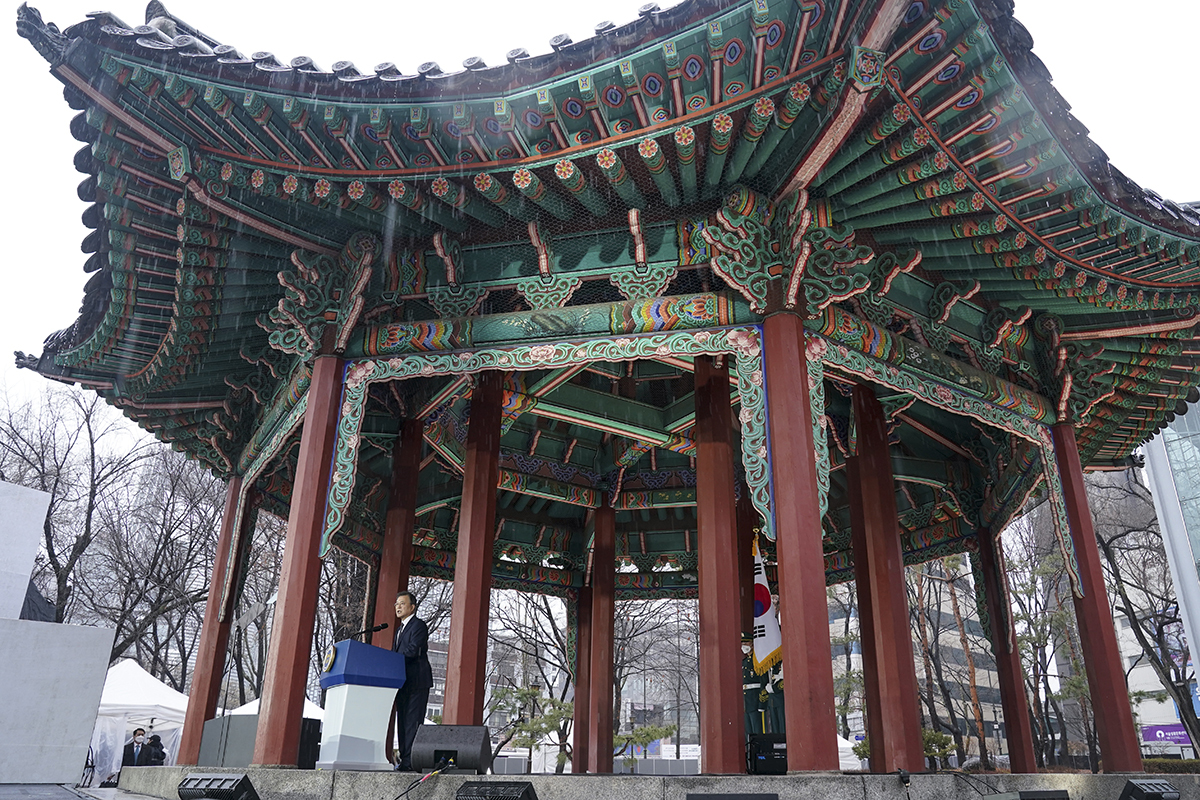
Mar 02. 2021President Moon Jae-in and first lady Kim Jung-sook wave the Korean flag at a ceremony marking the 102nd anniversary of the March 1 Independence Movement in Seoul on Monday. (Cheong Wa Dae)President Moon Jae-in and first lady Kim Jung-sook wave the Korean flag at a ceremony marking the 102nd anniversary of the March 1 Independence Movement in Seoul on Monday. (Cheong Wa Dae)
By Lee Ji-yoon
The Korea Herald/ANN

Tokyo has not responded to Seoul’s conciliatory overtures for months

President Moon Jae-in on Monday reaffirmed his willingness to mend ties with Japan long strained over wartime history and trade, saying issues of the past should not drag down the forward-looking cooperation between the two neighbors.

“Our government is ready to sit down and have talks with the Japanese government anytime,” he said in his speech at a ceremony marking the 102nd anniversary of the March 1 Independence Movement.

“I am confident that if we put our heads together in the spirit of trying to understand each other’s perspectives, we will also be able to wisely resolve issues of the past.”

Moon reiterated the Korean government’s long-held “victim-centered” approach in dealing with historic issues, pledging efforts to recover the honor and dignity of the survivors.

But he stressed issues of the past should be addressed separately from future-oriented development of the bilateral relations. Unlike previous years, he didn’t comment on specific issues like Japan’s wartime sexual slavery of Korean women.

“The only obstacle we have to overcome is that, sometimes, issues of the past cannot be separated from those of the future but are intermingled with each other. This has impeded forward-looking development,” he said.

“We should learn a lesson by squarely facing the past. It is by no means shameful to learn a lesson from past wrongs, but it is rather a way to gain respect from the international community.” 

Moon’s March 1 speech, commemorating the months of popular uprising against Japan’s colonial rule (1910-45), which started in Seoul on March 1, 1919, usually involved a harsh criticism of Japan’s atrocities and its mishandling of outstanding issues such as the “comfort women” issue and its claims to Dokdo islets.

This year, the president toned down his criticism overall and focused on dialogue and cooperation in what appears to be part of Seoul’s budding efforts to improve the bilateral ties that have been at one of the lowest ebbs over the past years. 

President Moon Jae-in delivers his speech at a ceremony marking the 102nd anniversary of the March 1 Independence Movement in Seoul on Monday. (Cheong Wa Dae)President Moon Jae-in delivers his speech at a ceremony marking the 102nd anniversary of the March 1 Independence Movement in Seoul on Monday. (Cheong Wa Dae)
President Moon Jae-in delivers his speech at a ceremony marking the 102nd anniversary of the March 1 Independence Movement in Seoul on Monday. (Cheong Wa Dae)

Despite Japan’s claims that the historic issues, including apology and compensation for victims, have already been resolved under a 2015 deal signed by the two countries, Korea has maintained its principles that the government cannot intervene in the legal fights of individuals.

A series of sensitive court rulings in favor of Korean victims of forced labor and sex slavery have led to vehement protests by the Japanese government, further chilling the decades-old rivalry that has since spilled over into the economy and security realms more recently. 

With the US under a new president upping pressure on the Asian allies to tighten ties in the face of an assertive China and a defiant North Korea, Moon has sent a flurry of conciliatory gestures toward Japan but his Japanese counterpart has yet responded to the overtures.

On Monday, Moon noted again that bilateral cooperation will not only benefit the two countries but also facilitate stability and prosperity in Northeast Asia and the trilateral Korea-US-Japan partnership.

“There has never been a time when cooperation among neighboring countries has been as vital as it is now,” he said, suggesting Japan join a Seoul-led cooperative body dealing with COVID-19 and other health crises that was launched last year along with the US, China, Russia and Mongolia.

Along with the joint efforts to fight the coronavirus, he also pinpointed the upcoming Tokyo Olympics as a crucial opportunity to pave the way to restarting peace talks on the Korean Peninsula between Korea and Japan, the two Koreas and North Korea and the US, pledging Seoul’s full support for its success.

Moon had earlier made similar proposals to North Korea as a way of resuming the stalled inter-Korean talks.

Japanese media also paid keen attention to Moon’s conciliatory overtures, reporting his remarks as breaking news earlier in the day. But they cautioned about pinning excessive expectations on what they criticized as a lack of new or concrete steps to ease simmering tensions.

Myanmar’s coup risks cooling off investment from Japan #SootinClaimon.Com

#SootinClaimon.Com : ขอบคุณแหล่งข้อมูล : หนังสือพิมพ์ The Nation.

https://www.nationthailand.com/ann/30403196

Myanmar’s coup risks cooling off investment from Japan

Mar 02. 2021Officials celebrate the opening of the Yangon Stock Exchange building in December 2015. (The Yomiuri Shimbun)Officials celebrate the opening of the Yangon Stock Exchange building in December 2015. (The Yomiuri Shimbun)

By The Japan News/ANN

Concern continues to grow among Japanese businesses about Myanmar, where the military staged a coup in February, as the Japanese government and private sector had been supporting the growth of the country’s stock exchange and insurance market.

If the military’s influence on the economy increases further, it could lead to a decline in foreign investment and businesses expanding in Myanmar.

■ Considering steps

“If the military oppresses the people, we will have to consider whether we should continue our support,” Japan Exchange Group, Inc. (JPX) CEO Akira Kiyota said at a press conference on Feb. 22. “There is a possibility that we may be forced to come to some conclusions.”

The Yangon Stock Exchange is operated as a joint venture between Myanmar and Japan, funded by JPX and Daiwa Institute of Research Ltd., in addition to local banks. The exchange started trading in March 2016.

Myanmar is home to more than 50 million people, providing the potential for a large-scale economy, so the Japanese side expected that the financing needs of companies there would increase in the future.

“The Yangon Stock Exchange project was a symbol of the trust between Japan and Myanmar,” said Seiichiro Sato, chief researcher at Daiwa Institute of Research, who has had experience working in Yangon.

Japan’s Financial Services Agency has been working with the insurance industry and the Japan International Cooperation Agency to develop the insurance market.

Myanmar opened the insurance market to the private sector in 2012. Riding this wave of liberalization, Japan has been cooperating in the development of the Insurance Business Law and rules for the approval of insurance products in Myanmar.

Myanmar is prone to natural disasters such as floods and cyclones, and the number of people who own automobiles is increasing, so interest in insurance is high. Major Japanese insurance companies are also expanding into the country.

■ Still developing

However, the securities trading and insurance markets are still in the process of developing. At present, six companies are listed on the Yangon Stock Exchange, including banks, a telecommunications company, and an industrial park operator. There are few options for investors. In order to revitalize the market, the ban on trading of listed shares by foreign investors was lifted in March last year.

At present, the insurance market is mainly an insurance business for overseas companies operating in the region, according to a major Japanese insurance company, and has not yet spread to the general public. The challenge is to increase the number of agents and improve the sales network.

A person involved with a Japanese company said: “If Japan pulls out now, Chinese companies will take their place. It will be difficult to do business after the influence of Chinese companies has increased.”

■ Suspending operations

The operations of some of the Japanese companies that have been doing business in Myanmar have been affected.

In the Thilawa Special Economic Zone on the outskirts of Yangon, about 70 of the 82 Japanese and other foreign companies that had been operating before the coup are continuing to operate, according to Sumitomo Corp.

On Feb. 22, when a large-scale, nationwide strike took place, operations were halted at many companies.

Toyota Motor Corp. has postponed the start of operations at its new plant, which had been scheduled to open at the end of last month.

Due to the spread of the novel coronavirus, All Nippon Airways Co., which has routes between Japan and Myanmar, had planned to operate two flights a week before the coup, but was only able to operate flights last month on Feb. 19 and 26.

According to the Japan External Trade Organization, more than 400 Japanese companies have set up operations in Myanmar and are members of the Japanese Chamber of Commerce and Industry in Myanmar.

“The companies are trying to maintain their operations,” the director of JETRO’s Yangon office said, “while considering the impact of the demonstrations and the safety of their employees.”

Asean must help bring Myanmar back to normalcy, says Hisham #SootinClaimon.Com

#SootinClaimon.Com : ขอบคุณแหล่งข้อมูล : หนังสือพิมพ์ The Nation.

https://www.nationthailand.com/ann/30403195

Asean must help bring Myanmar back to normalcy, says Hisham

Mar 02. 2021Foreign Minister Datuk Seri Hishammuddin Hussein. - BernamaForeign Minister Datuk Seri Hishammuddin Hussein. – Bernama

By The Star/ANN

KUALA LUMPUR: Asean must play a more proactive role to contribute to Myanmar’s return to normalcy, says Foreign Minister Datuk Seri Hishammuddin Hussein.

He said it was crucial that Asean leads a sincere discussion and constructively engage with Myanmar and all stakeholders to show the regional grouping was united and effective in addressing the expectations of its external partners, and in avoiding unnecessary unilateral responses that might affect the region unfavourably.

“Two-way engagements are therefore pivotal in this regard, ” he said in a statement following his official visit to Brunei, where he had an audience with Brunei Ruler Sultan Hassanal Bolkiah and met with Brunei’s Foreign Minister II Datuk Seri Setia Awang Erywan Mohd Yusof yesterday.

Hishammuddin said the military takeover in Myanmar was a setback to all the efforts made over the last decade towards achieving inclusive democratic transition, unity and economic progress in the country.

“We encourage the Myanmar authorities to uphold and respect democratic institutions and processes, the rule of law, human rights and fundamental freedoms, including the right to peaceful assembly and freedom of expression.

“All relevant parties must exercise utmost restraint from the use of violence that could affect the safety of members of the public and further escalate the situation in the country, ” he said.

Hishammuddin also pledged Malaysia’s support towards the convening of an Informal Asean Ministers’ Meeting this week to discuss this matter further.

Myanmar’s military launched a coup on the morning of Feb 1, hours before Parliament was set to sit, and detained State Counsellor Aung San Suu Kyi, President Win Myint and other senior members of the National League for Democracy (NLD).

The junta also declared a one-year emergency and vowed to “take action” against alleged voter fraud during the Nov 8 general election last year, which the NLD party won.

On Feb 5, Prime Minister Tan Sri Muhyiddin Yassin and Indonesia’s President Joko Widodo jointly called for Asean to convene a special meeting to discuss the political situation in Myanmar, following the coup. — Bernama