12-year-old US resident identified as suspect of terror threat against Incheon airport
Feb 27. 2021This file photo shows two airport security guards walking a corridor inside Incheon International Airport, west of Seoul. (Yonhap)
By The Korea Herald/ANN
INCHEON — A 12-year-old YouTuber living in the United States has been identified as the alleged culprit of a terror threat against Incheon International Airport on the national holiday next week, officials said Friday.
The teenage boy, who was born in South Korea and is residing in the US, is accused of having uploaded a YouTube video that warns of an attack at the Incheon airport, west of Seoul, at 11 a.m. on the March 1 Independence Movement Day, according to the Incheon International Airport Police Corps.
The 10-second-long video, uploaded Sunday, has since changed its content to a message that Osama Bin Laden, the late leader of Al Qaeda and the mastermind of the September 11 terrorist attacks, should not be blamed
The airport police launched an investigation into the online content after being tipped off about the clip on Tuesday.
With the cooperation of Google, the parent company of YouTube, the police confirmed that the video was uploaded in the US and tracked down the suspect based on his login history.
Investigators said they have shut down the boy’s YouTube channel and are considering charging him with violation of the Aviation Security Act.
The police said they will beef up security at the airport for a while as a precautionary measure, although there is scant possibility of terrorist attacks.
“It seems difficult to find ways to question the YouTuber who uploaded the video after gaining cooperation from the foreign authorities,” the police said. (Yonhap)
Contact tracing process shortened with almost 90% of Singapore residents using TraceTogether
Feb 27. 2021About 4.7 million residents have the TraceTogether app or have collected the TraceTogether tokens. ST PHOTO: GAVIN FOO
By Cara Wong The Straits Times/ANN
SINGAPORE – Close to nine in 10 eligible residents here have joined the Government’s digital contact tracing programme, despite a recent public backlash over privacy and trust issues.
About 4.7 million residents have the TraceTogether app or have collected the TraceTogether tokens, and this has allowed the authorities to shave days off the contact tracing process, said Minister-in-charge of the Smart Nation initiative Vivian Balakrishnan in Parliament on Friday (Feb 26).
With both the TraceTogether and SafeEntry programmes, the authorities now take 1½ days or less to identify and quarantine close contacts of Covid-19 patients, down from the previous average of four days, said Dr Balakrishnan.
This update comes on the heels of a public outcry earlier this year, when it was revealed that TraceTogether data could be used for criminal investigations, despite earlier assurances that the data would be used solely for contact tracing.
The backlash prompted the Government to enact extra laws to restrict the use of TraceTogether data to investigating serious crimes only, and Dr Balakrishnan said in Parliament that he “deeply regrets” the mistake on TraceTogether data.
In Parliament on Friday, Dr Balakrishnan said many of the tech solutions deployed during the crisis, like TraceTogether and SafeEntry, were built by engineers in weeks or even days.
The Government also came up with information portals like MaskGoWhere, SupportGoWhere and FluGoWhere, to disseminate information such as where to get masks and the Public Health Preparedness Clinics residents can visit to treat their respiratory symptoms.
To help businesses, the authorities also created more than 700,000 manpower and workplace applications through the GoBusiness portal, disseminating information such as safe management guidelines.
“The Government was therefore able to continue serving people, providing services online, even during the circuit breaker, and thereby cushioning the social and economic impact of the crisis,” said Dr Balakrishnan.
Describing the pandemic as a good “stress test” for the Smart Nation initiative, Dr Balakrishnan added that the nation’s achievements were made possible only because of a “relentless recruitment” of talent and in-house engineering capabilities before the crisis hit.
He added that technology will continue to be critical in allowing the safe resumption of daily activities, and the authorities will continue to invest in tech talent and the latest technologies.
“We must now double down on building up our people, building up our capabilities and our agility using the latest cutting-edge technologies,” he said.
Feb 27. 2021Photo taken on Feb 26, 2021 shows a community vaccination center in Hong Kong. [Photo/Xinhua]
By China Daily/ANN
HONG KONG – Hong Kong started the COVID-19 vaccine rollout on Friday for priority groups, including medical workers and the aged, a week after the arrival of the first batch of mainland-made doses.
The vaccine was given at five community vaccination centers and 18 general out-patient clinics, where people waited in long queues to get their first shots. As far, all 70,000 booking slots available for the next two weeks have been taken up.
Tung Chee-hwa, vice-chairman of the National Committee of the Chinese People’s Political Consultative Conference, received the first jab at the vaccination station set at Hong Kong Central Library. After getting vaccinated, Tung gave a thumbs-up and said he felt “very good.”
The vaccination will protect the receivers, their families and Hong Kong, he said, urging every Hong Kong resident to get the vaccine at an early date in joint efforts to defeat COVID-19.
The vaccine administered in Hong Kong was produced by Sinovac Biotech, which has been widely used across the world. The first one million doses arrived in Hong Kong on Feb. 19, the earliest vaccine delivered here.
The Hong Kong Special Administrative Region government has altogether procured 22.5 million doses of vaccine from three different producers for its free inoculation program expected to cover the entire population. One million doses of the Fosun Pharma/BioNTech vaccine are expected to be shipped to Hong Kong soon.
“The vaccination process is short and I don’t feel uncomfortable,” said a resident surnamed Cheung, who was also given the priority as a cross-border truck driver. The man will receive the second shot 28 days later.
Another resident surnamed Lau, in his 70s, came to the Kwun Chung Sports Center to get vaccinated with two family members. He believed the Sinovac vaccine is safe and hoped the vaccination program will help resume cross-border traveling so that he can visit his mainland friends.
“The vaccine supply is sufficient and I hope the public can get the vaccine to protect both themselves and others,” Patrick Nip, secretary for the civil service of the HKSAR government said, adding that the online booking system will reopen on March 1 with three more vaccination centers set up.
The government has earmarked over 8.4 billion Hong Kong dollars ($1.08 billion) for the free vaccination of the majority of the population this year.
UK investors keen to participate in renewable energy in Vietnam
Feb 26. 2021A wind farm in Bình Thuận Province. Investors from the UK were showing significant interest in investing in renewable energy projects in Việt Nam, especially off-shore wind power. — VNA/VNS Photo Mạnh Linh
By Viet Nam News/ANN
HÀ NỘI — Investors from the UK were showing significant interest in investing in renewable energy projects in Việt Nam, especially wind power, expecting the Vietnamese Government to introduce long-term support policies as well as simplification of procedures for project implementation.
British Ambassador to Việt Nam Gareth Ward said at the UK – Việt Nam Renewable Energy Dialogue on Wednesday that clean energy was becoming a global trend, adding that every US$1 investment in clean energy would help generate from $3-8.
The Vietnamese Government in 2015 approved the renewable energy development strategy to 2030 with a vision to 2050 which aimed to increase the percentage of renewable power from 35 per cent in 2015 to 38 per cent in 2020 and 43 per cent in 2050.
The Government also introduced incentive policies to encourage the development of wind power, biomass energy, energy from waste and solar power.
Hoàng Tiến Dũng, Director of the Ministry of Industry and Trade’s Electricity and Renewable Energy Authority, said developing renewable energy was important in the context that sources for hydropower were being exhausted, thermopower was limited due to commitments to global climate change and gas-fired power had high production costs.
According to the draft national power development planning for 2021-30 period with a vision to 2045, Việt Nam had large potential for renewable energy development which was estimated to amount up to 855GW, mostly solar power (434GW), and wind power (375GW). The potential for off-shore wind power was estimated at 158GW.
Off-shore power was attracting increasing interest from foreign organisations and investors, Nguyễn Ninh Hải, Head of the Renewable Energy Department under the Electricity and Renewable Energy Authority, said.
Hải said that as off-shore wind power was a new thing to Việt Nam, the Ministry of Industry and Trade was cooperating with some research organisations to have a comprehensive evaluation about the off-shore wind power development potental in the country.
Bùi Vĩnh Thắng, director of Mainstream Renewable Power Việt Nam, said that the Government’s planning and policies played a very important role for renewable energy investors, especially in wind power and off-shore wind power.
Benjamin Dubas, a representative from Lightsource BP, said that renewable energy investors expected the transparency and stability of policies in the long term to invest in Việt Nam, especially feed-in tariffs (FIT).
According to Dũng, FIT pricing was applied to accelerate investment in renewable energy in the first stage in Việt Nam but this mechanism would not be maintained for a long period and be replaced by competitive bidding when the technology development helped push down prices of solar and wind power.
He added that the national power development planning which was being completed would give priority to renewable energy on the basis of ensuring balance of power sources and the power transmission between regions.
The ministry expected to continue receiving support from the UK in renewable energy, especially off-shore wind power which the UK had experience in and Việt Nam had large potential.
By the end of 2020, the total renewable energy output accounted for around 25 per cent of the total output worth 69,000MW of the Việt Nam’s power system. There were 148 solar power projects with a total capacity of more than 8,800MW, 100,000 rooftop solar power projects with a total capacity of 9,300MW, and 11 wind power projects with a total capacity of 511MW. — VNS
South Korea officially starts COVID-19 vaccination
Feb 26. 2021Kim Yoon-tae, a doctor at a children’s hospital, receives a COVID-19 vaccination at a public health center in Mapo, western Seoul, Friday as President Moon Jae-in and Korea Disease Control and Prevention Agency Commissioner Jeong Eun-kyeong watch the process. (Yonhap)
By Ko Jun-tae The Korea Herald/ANN
The first COVID-19 vaccination in South Korea has taken place, as the country kicked off its first-ever nationwide immunization campaign during a virus pandemic.
At 9 a.m. Friday, COVID-19 vaccines made by AstraZeneca started to be distributed at 1,915 public health center and nursing homes across the country. The vaccines were contract manufactured by SK Bioscience at its factory in Andong, North Gyeongsang Province.
Health officials had announced that more than 5,000 nursing home residents and workers younger than 65 would be receiving the AstraZeneca vaccines Friday morning, all at the same time.
President Moon Jae-in asked medical workers to carry out inoculations quickly and safely during his visit to a public health center in Mapo District, western Seoul, with Korea Disease Control and Prevention Agency Director Jeong Eun-kyeong.
Unlike some countries, Korea did not designate the first person to receive a COVID-19 vaccine. Individual public health centers throughout the country designated their own first vaccine receivers.
But, a 61-year-old nursing home worker at a public health center in Nowon District, northern Seoul, ended up being the first person to receive a COVID-19 vaccine as she received her shot at 8:45 a.m., 15 minutes before the officially designated time to start administering the vaccine.
“I have been anxious about COVID-19 for the past year but after taking [the vaccine] I feel much better. I also thank the government, district office and the public health center for their efforts,” the worker said. “I didn’t see any difference from taking other types of vaccines.”
Close to 94 percent of the 289,480 people designated to receive the inoculations agreed to be vaccinated, and 5,266 residents and workers at 213 nursing homes were scheduled to take their first shots on Friday.
Those receiving the vaccines had to register at a designated public health center and consult with medical professionals to be determine whether they were healthy enough to take the vaccine.
People who were unable to come to designated centers themselves, such as nursing homes residents, were visited by vaccination teams of doctors, nurses and assistants dispatched to administer the shots.
After receiving a jab, people are asked to stay at the public health center for 30 minutes to be monitored for any adverse symptoms. A team of doctors and nurses were on standby at vaccination sites to respond to any hazardous medical conditions.
Health officials advised people to keep an eye out for side effects even after the 30 minutes of monitoring.
The KDCA said people can experience pain and swelling on the arm where the vaccine was administered, along with a fever, chills, tiredness and a headache for three days after being given the vaccine, all of which can happen naturally as bodies create immunity against COVID-19 with the vaccine’s help.
The agency advised people to apply a cool washcloth over the pain area and take over-the-counter antipyretics or painkillers if needed after taking the vaccine.
If patients develop a rash, have difficulty breathing or a swollen tongue accompanied by dizziness, the disease control agency advised they should report to a nearby emergency room immediately.
The government has said a benefit of up to 430 million won ($383,739) will be provided to those who become severely disabled or die from taking a COVID-19 vaccine. Health authorities promised the government will provide compensation for serious side effects after taking scheduled shots, including the cost for hospital stays and treatments.
The nationwide initiative comes a full year and 37 days after the country identified its first COVID-19 case on Jan. 20, 2020.
More than 1 million doses of the AstraZeneca vaccine are expected to be sent to at least 1,900 public health center and nursing homes through Sunday.
Some 3,900 doses that were supposed to go to Jeju Island were exposed to unsafe temperatures on the way and had to be withdrawn. The doses were not discarded, but another shipment set off following the incident and Jeju Island was able to get its quota of vaccines in time.
AstraZeneca’s vaccine is more convenient for mass inoculation as its storage temperature requirement of between 2 and 8 degrees Celsius is much easier to maintain than the vaccine by Pfizer, which needs to be stored in temperatures as low as negative 80 degrees Celsius.
Public health center employees in Gwangju check the delivered batches of COVID-19 vaccines from AstraZeneca on Thursday. (Gwangju City Buk-gu)
Public health center employees in Gwangju check the delivered batches of COVID-19 vaccines from AstraZeneca on Thursday. (Gwangju City Buk-gu)
Health officials said another vaccination scheme will start Saturday for the first group of around 55,000 medical workers at hospitals for virus patients. These workers will be receiving vaccines from Pfizer, which were provided as part of the World Health Organization’s global vaccine COVAX Facility project.
Some 300 healthcare workers treating COVID-19 patients in the greater Seoul region will be administered the first dose of the Pfizer vaccine at a state-run vaccination center run by the National Medical Center in central Seoul.
The doses from Pfizer will be given out at four other state-run facilities. Authorities are working to build 120 vaccination facilities throughout the country utilizing general hospitals, gymnasiums and state-run sites.
The government plans to complete the first round of inoculation for more than 70 percent of the population by September and achieve herd immunity by November to overcome the COVID-19 pandemic.
So far, the government has secured COVID-19 vaccines for 79 million people under COVAX and separate deals with foreign drug makers.
The COVID-19 vaccination scheme comes as the country continues to fight the third virus wave to date. Korea on Friday added 406 new cases – 382 locally transmitted and 24 imported from overseas – raising the accumulated total to 88,922.
The country also reported four more COVID-19 deaths, raising the total number of deaths from the virus to 1,585. By Thursday’s end, the number of COVID-19 patients in serious condition stayed unchanged at 144.
Health authorities on Friday decided to extend its current social distancing guidelines for two additional weeks until March 14 while keeping the ban on gatherings of five or more people in place. At the moment, Seoul, Incheon and Gyeonggi Province are under Level 2 rules while other areas are under Level 1.5 rules.
“Although another uptick in virus cases that we worried of happening after the Lunar New Year holiday did not occur, we still have not reached stability,” Prime Minister Chung Sye-kyun said in a meeting Friday. “Sporadic cluster infections are breaking out continuously.”
Experiment tests guiding people by drone in Tokyo’s Shinjuku area
Feb 26. 2021A drone flies near the Tokyo Metropolitan Government Office in Shinjuku Ward on Wednesday. (The Yomiuri Shimbun)
By The Japan News/ANN
The use of a drone to help guide people who have trouble returning home after a disaster was tested Wednesday in Tokyo’s Shinjuku area, in a joint trial involving members of the business community, academia and a local government.
The experiment was planned by Sompo Japan Insurance Inc., which has its head office in Shinjuku, and Kogakuin University, which has a campus there. The Shinjuku Ward government and other organizations were also involved.
The experiment was conducted on the premise that an earthquake had occurred measuring upper 5 on the Japanese seismic intensity scale of 7.
A drone flies near the Tokyo Metropolitan Government Office in Shinjuku Ward on Wednesday.
The drone was remotely operated from the university’s campus. It took off from Shinjuku Central Park, and made such announcements over its speaker as “If you have nowhere to go, please stay where you are.”
Footage taken from the sky was sent to staff at the university and the Shinjuku Ward Office.
Shinjuku is lined with high-rise buildings and has busy shopping districts, so many people are likely to be in the streets after a large-scale disaster occurs. Footage recorded from the sky will be used to ascertain the situation.
Masahiro Murakami, a professor of urban disaster prevention at Kogakuin University’s school of architecture, was one of those participating in the project. “We want to create a system in which local organizations can share information and disperse evacuees when a disaster occurs,” Murakami said.
Singapore not expected to move out of phase 3 any time soon: Janil
Feb 26. 2021Senior Minister of State for Health Janil Puthucheary noted that the coronavirus situation in Singapore and around the world remains dynamic. ST PHOTO: KELVIN CHNG
By Linette Lai The Straits Times/ANN
SINGAPORE – Singapore is not expected to move out of phase three of its reopening any time soon, said Senior Minister of State for Health Janil Puthucheary on Thursday (Feb 25).
Phase three is a “new normal” which will last until there is evidence vaccines are effective in preventing future outbreaks, he added. In addition, a substantial proportion of the population must be vaccinated and the rest of the world must have the coronavirus under control.
He noted that the coronavirus situation here and around the world remains dynamic.
The authorities are awaiting more evidence that the vaccines approved for use here – which have been shown to protect against the virus – will also prevent viral transmission.
“We are also closely monitoring their effectiveness against new viral variants,” Dr Janil said. “Meanwhile, our best strategy is to continue to be disciplined about safe management measures, and achieve a high level of vaccination within our population to boost our collective immunity.”
He was responding to Mr Yip Hon Weng (Yio Chu Kang), who had asked about Singapore’s plans to ease out of phase three, as well as the criteria that must be fulfilled for restrictions to be lifted.
Dr Janil noted that even within phase three, Singapore had tightened safe management measures following an increase in unlinked cases and community cases.
It will continue to find ways to allow its economy and society to further reopen in a safe way, he said. “But given the dynamic situation here and around the world, we will need to adjust our safe management measures from time to time.”
Mr Yip then asked if the arrival of China’s Sinovac vaccine will push forward Singapore’s vaccination timeline, assuming the vaccine is approved for use.
Dr Janil replied that the vaccine timeline is dependent on several factors, the most important of which is the country’s ability to ramp up the capacity and capability of vaccination centres. Other factors include Singaporeans’ willingness to get vaccinated, as well as vaccine supply.
“The approval or licensure of one given vaccine is not a rate-limiting step in that process,” he said.
Workers’ Party MP Jamus Lim (Sengkang GRC) then asked if the Health Ministry could share details of how it plans to deal with outbreaks of more virulent strains of the virus.
Dr Janil said there are general fundamentals in Singapore’s approach to preventing outbreaks and dealing with them when they occur. These include safe distancing measures, contact tracing and quarantine.
“When it comes to the specifics of a given viral variant, these are now in a hypothetical space,” he added. “The key point would be that we take reference from technical and professional advice.”
Feb 26. 2021Employees put finishing touches to a vehicle at Tesla’s gigafactory in Shanghai on Nov 20. [Photo/Xinhua]
By WANG YING China Daily/ANN
New energy vehicle output will account for 35 percent of Shanghai’s auto manufacturing industry and reach 350 billion yuan ($54 billion) by 2025, said a five-year action plan for the sector that was unveiled recently.
Shanghai will look to expand the annual production capacity of green cars to more than 1.2 million units by 2025 and raise the output value to 350 billion yuan, or more than 35 percent of the city’s car industry value, Qiu Wenjin, deputy head of the Shanghai Municipal Development and Reform Commission said on Thursday while releasing the new energy vehicle industry development plan for the 14th Five-Year Plan period (2021-25).
“Apart from expanding the industry scale, we should make breakthroughs in core technologies, acquire leadership in research and development of key components and manufacturing, make breakthroughs in connected vehicles and intelligent technologies, and establish a complete supply chain,” said Qiu.
The action plan specifies 19 key tasks in five key areas, including industrial capability enhancement, creation of an ecosystem, establishment of a green transportation energy system, development of “new infrastructure” facilities and integration of related systems and mechanisms.
Thanks to the municipal government’s consistent and supportive policies for new energy vehicles, several residents have started choosing green vehicles.
More than 120,000 new energy vehicles were sold across the city last year, compared with 70,000 units in 2019. In January alone, sales of new energy cars exceeded 20,000 units, with the sales continuing to rise, said Qiu.
“After making consistent efforts in developing new energy vehicles, Shanghai has not only formed a complete new energy vehicle industry chain, but also has effectively promoted the use of green cars in the city,” said Zhang Jianming, deputy director of the Shanghai Municipal Commission of Economy and Information.
In 2020, 2.65 million units of automobiles were manufactured in Shanghai, and their auto industrial production value reached 673.5 billion yuan, up 9.3 percent on a yearly basis.
The city’s new energy vehicle output rose by 190 percent on a yearly basis to 238,600 units, while output value soared 170 percent to 66.4 billion yuan.
“Green vehicles have played a significant role in stabilizing automobile industry development,” said Zhang.
Shanghai leads all Chinese municipal cities and provinces in new energy vehicles. By the end of last year, nearly 424,000 green vehicles were in operation in the city.
S. Korea prepares for vaccine shots as 1st batch of 1.5m doses begins to ship
Feb 25. 2021A truck carrying vials of AstraZeneca’s vaccine departs from a cold chain logistics warehouse in Icheon, 80 km southeast of Seoul. under the strict guard of the Army and police on Thursday. (Yonhap)
By The Korea Herald/ANN
Trucks and ships carrying the first batch of some 1.5 million doses of coronavirus vaccines headed across the country Thursday, marking the start of the long-awaited vaccination program in South Korea, where COVID-19 cases are nearing 90,000 since the first confirmed case in January last year.
The nationwide distribution of the AstraZeneca vaccine for some 750,000 people, mostly health care workers and patients at nursing homes, came as the country is set to kick off the free inoculation campaign Friday.
The vaccine doses were produced at a local plant by SK Bioscience Co. under a manufacturing partnership deal with British-Swedish pharmaceutical giant AstraZeneca.
The sealed one-ton truck, escorted by the police and military vehicles and personnel, first left a cold chain logistics warehouse in Icheon, 80 kilometers southeast of Seoul, around 5:50 a.m.
The first shipment for a total of 55 container trucks was delayed for around two hours at the site due to extra caution about maintaining storage temperatures, health authorities said.
A total of 1.57 million doses of vaccines under AstraZeneca’s full two-dose regimen will be delivered to a total of 1,900 long-term care hospitals and public health centers across the country for the next five days.
The first batch of AstraZeneca’s vaccine is enough to provide jabs to 785,000 people, which is 35,000 higher than the previous estimate.
The AstraZeneca vaccine is deemed more convenient for mass inoculations as its storage temperature is 2 to 8 C, compared with the vaccine by US pharmaceutical giant Pfizer Inc. that requires ultra-cold chain storage.
According to health authorities, a total of 289,271 people, or 93.6 percent of the patients and people working at facilities including sanatoriums, nursing facilities and rehabilitation facilities will receive the first shot.
Meanwhile, Pfizer’s vaccine will be offered to medical staff members starting Saturday. South Korea hopes to attain herd immunity by November after inoculating 70 percent of its population by September.
On Thursday, the country reported 396 more virus cases, raising the total caseload to 88,516. Thursday’s daily caseload marks a slight drop from 440 posted the previous day. The figures hovered above 600 last week before falling below 500 over the weekend and under 400 earlier this week on fewer tests. (Yonhap)
By MAZWIN NIK ANIS and JOSEPH KAOS JR The Star/ANN
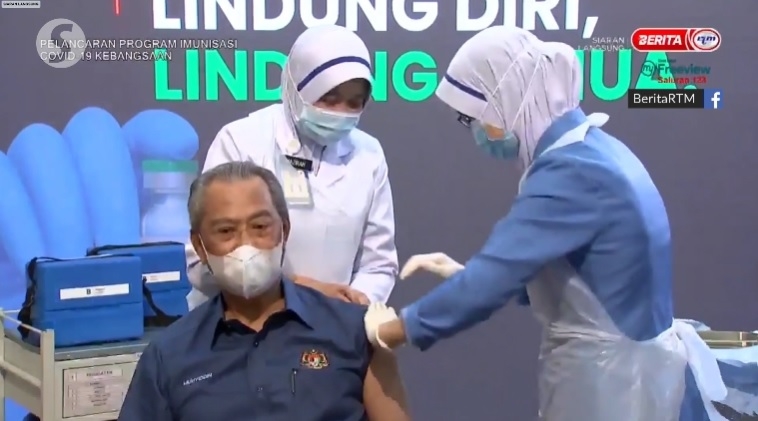
PUTRAJAYA: Fresh from receiving the first dose of the Covid-19 vaccine, Prime Minister Tan Sri Muhyiddin Yassin described the process as painless and likened it to “any normal injection”.
“I didn’t feel anything. I had asked (the nurse) to wait but the next thing I knew it was over. You can also ask Tan Sri (Health director-general Tan Sri Dr Noor Hisham Abdullah).
“So, don’t worry, come forward anytime (and get vaccinated), ” he said when asked about his experience.
The Prime Minister kicked off the National Covid-19 Immunisation Programme by being the first person in the country to get the vaccine.
The programme began two days ahead of the initial schedule of Feb 26.
He received his first dose at the Precinct 11 health clinic after chairing the weekly Cabinet meeting yesterday, and his second dose is scheduled for March 17.
Expressing confidence that the vaccine is safe and effective, Muhyiddin has called on all Malaysians and others residing in the country to get themselves vaccinated against Covid-19.
Getting vaccinated, he said, would help break the chain of infection.
The Prime Minister urged the public to be confident of the vaccination programme, as it’s vital to putting a stop to the pandemic in the country.
“I call on everyone to support this effort so that Malaysia will be free of Covid-19 soon, ” he said.
He reiterated the government’s decision that vaccination would be free for all in Malaysia, including foreigners, stressing that the public should register via the MySejahtera app for their turn to be vaccinated.
Aside from the Prime Minister, Dr Noor Hisham and four other staff members of the Health Ministry received the vaccine.
The first batch of 312,390 doses of the Pfizer-BioNTech vaccine arrived on Sunday, and is expected to be administered to 271,802 frontliners, 57.3% of whom comprise medical personnel while the rest will be non-medical frontliners.
 This file photo shows two airport security guards walking a corridor inside Incheon International Airport, west of Seoul. (Yonhap)
 About 4.7 million residents have the TraceTogether app or have collected the TraceTogether tokens. ST PHOTO: GAVIN FOO
![Photo taken on Feb 26, 2021 shows a community vaccination center in Hong Kong. [Photo/Xinhua]](https://media.nationthailand.com/images/news/2021/02/27/30403098/800_9b02756f74c7a5a.jpeg?v=1614394512) Photo taken on Feb 26, 2021 shows a community vaccination center in Hong Kong. [Photo/Xinhua]
Photo taken on Feb 26, 2021 shows a community vaccination center in Hong Kong. [Photo/Xinhua] A wind farm in Bình Thuận Province. Investors from the UK were showing significant interest in investing in renewable energy projects in Việt Nam, especially off-shore wind power. — VNA/VNS Photo Mạnh Linh
 Kim Yoon-tae, a doctor at a children’s hospital, receives a COVID-19 vaccination at a public health center in Mapo, western Seoul, Friday as President Moon Jae-in and Korea Disease Control and Prevention Agency Commissioner Jeong Eun-kyeong watch the process. (Yonhap)
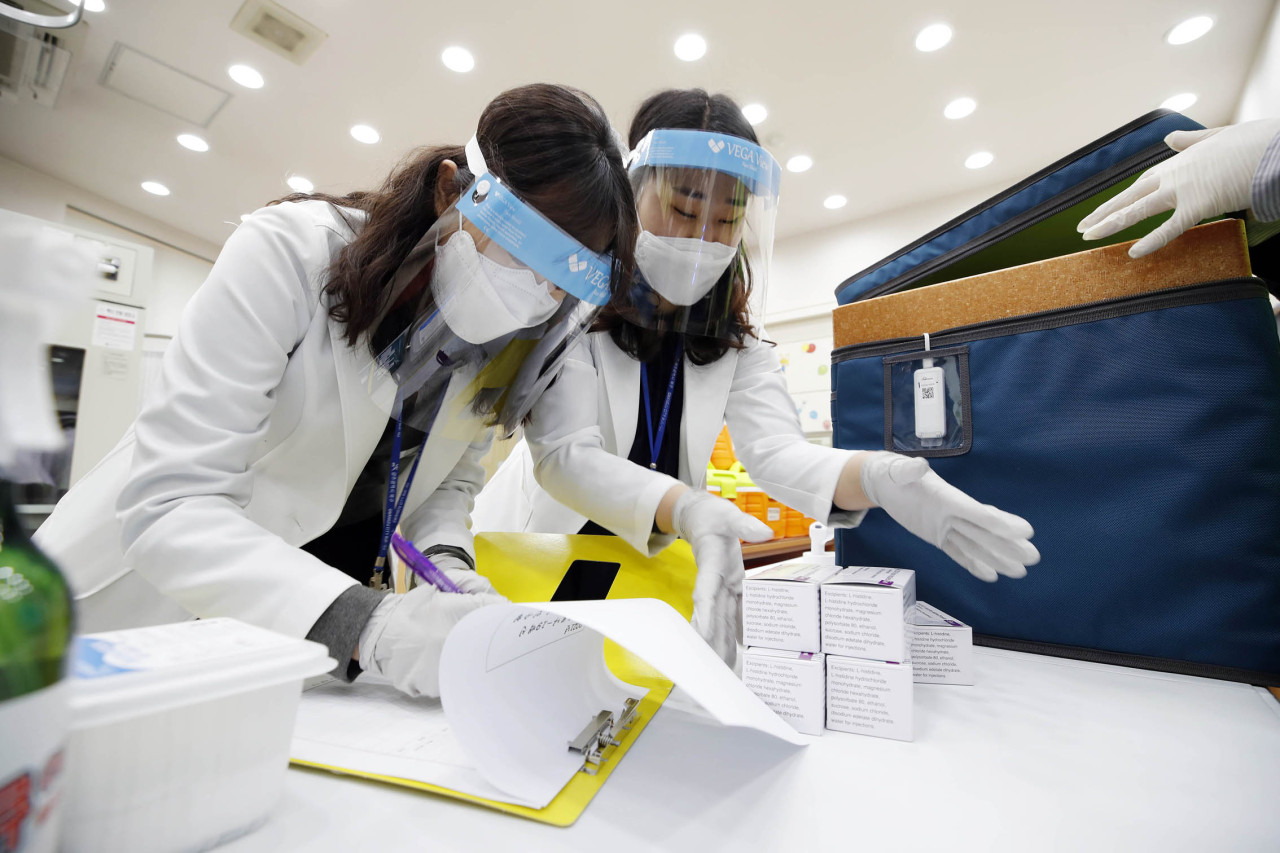 Public health center employees in Gwangju check the delivered batches of COVID-19 vaccines from AstraZeneca on Thursday. (Gwangju City Buk-gu)
 A drone flies near the Tokyo Metropolitan Government Office in Shinjuku Ward on Wednesday. (The Yomiuri Shimbun)
 Senior Minister of State for Health Janil Puthucheary noted that the coronavirus situation in Singapore and around the world remains dynamic. ST PHOTO: KELVIN CHNG
![Employees put finishing touches to a vehicle at Tesla's gigafactory in Shanghai on Nov 20. [Photo/Xinhua]](https://media.nationthailand.com/images/news/2021/02/26/30403076/800_e31b699fee7b295.jpeg?v=1614306925) Employees put finishing touches to a vehicle at Tesla’s gigafactory in Shanghai on Nov 20. [Photo/Xinhua]
Employees put finishing touches to a vehicle at Tesla’s gigafactory in Shanghai on Nov 20. [Photo/Xinhua] A truck carrying vials of AstraZeneca’s vaccine departs from a cold chain logistics warehouse in Icheon, 80 km southeast of Seoul. under the strict guard of the Army and police on Thursday. (Yonhap)