Over 3,000 Myanmar migrant workers stage a protest in Mahachai
Jan 07. 2021
By YIN MYO THU Eleven Media/ANN
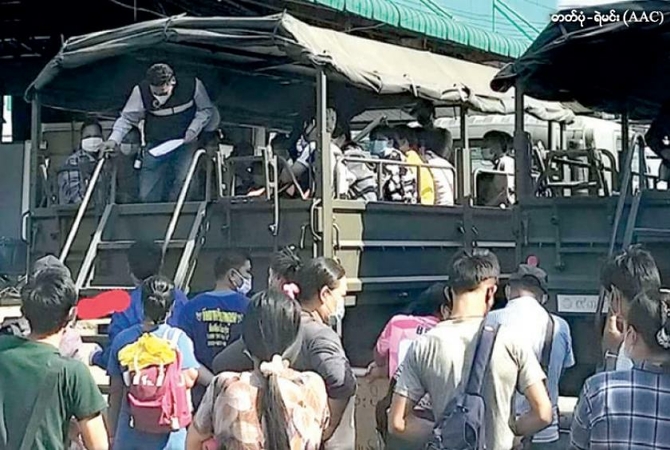
More than 3,000 Myanmar migrant workers in Mahachai are staging a protest as over 30 Myanmar workers being infected with COVID-19 are discharged from hospital, said Khaing Gyi, Chairman of Aid Alliance Committee (AAC).
Thai authorities placed a 14-day lockdown in Mahachai as the COVID-19 is spread around again in Samut Sakhon Province since December 17.
The protest occurred as the authorities instructed over 30 Myanmar migrant workers, who are still infected with the COVID1-9 virus, to discharge from the hospital on January 4 and took them to stay inside the compound which has been placed on lockdown.
“The patients being sent back to the compound are women who have children. So aren’t the women having medical treatment? If the children are in emergency state, how they will do. So Myanmar migrant workers stage a protest against Thai authorities for sending back the patients,” said Khaing Gyi.
More than 3,500 Myanmar migrant workers and over 1,000 Thai citizens are joined the protest.
Officials from Myanmar embassy, Thai authorities and workers are negotiating.
The workers asked for the confirmed patients to have medical treatment in separate place.
According to Public Health Ministry of Thailand, more than 1,700 Myanmar migrant workers in Mahachai are being infected with the virus.
A 68-year old woman from the Central Shrimp Market in Mahachai went ill on December 13 and tested positive. Thai authorities conducted swab test in the area.
The COVID-19 outbreak was occurred in Mahachai, Samut Sakhon Province, where Myanmar migrant workers mostly live.
Most of people lived in Mahachai are Myanmar migrant workers and only ten per cent of population are Thai citizens.
Myanmar Ministry of Foreign Affairs announced more than 4,000 Myanmar workers are stranded in the province.
Aid groups helping Myanmar migrant workers said Myanmar migrant workers are being discriminated in Thailand and some have been expelled from their job.
According to Bangkok Post, the outbreak started from Maha Chaing is reached to Phuket, Korat, Samut Prakan, Nakhon Pathom, Ratcha Buri, Suphan Buri and Bangkok.
Thai authorities will conduct COVID-19 test COVID-19 test especially in warehouses, ports and harbours where fish are sold and bought in some provinces nearby of Samut Sakhon Province, where migrant workers are working.
Japan mulling suspending entry for all foreign business travelers
Jan 07. 2021Few people are seen at the international arrival lobby of Haneda Airport on Dec. 28 after the entry of foreign visitors was suspended in principle. (The Yomiuri Shimbun)
By The Japan News/ANN
The government is considering suspending an agreement to permit the entry of business travelers from countries including China and South Korea amid a global surge in coronavirus cases.
Currently, business travelers from 11 countries and regions are among those who are permitted to enter Japan as part of a special measure.
The suspension, which is expected to run concurrently with the planned state of emergency, would effectively prohibit the entry of foreign visitors from all over the world.
However, depending on the results of consultations with partner countries and other factors, there is a possibility that the special measure permitting entry for business travelers would continue to be applied in some cases.
The government suspended the entry of foreign visitors from all over the world on Dec. 28, in principle, with the exception of the 11 economies with which Japan had reached agreements on business travel.
At a press conference on Monday, Prime Minister Yoshihide Suga indicated the entry of business travelers from the 11 countries and regions could also be suspended if cases of a coronavirus variant had been confirmed.
Some government officials are calling for tougher measures as 36,647 visitors from the 11 countries and regions were granted entry in November, accounting for more than half of the month’s 50,994 arrivals, according to preliminary figures.
MANILA, Philippines — The Philippines is negotiating with seven vaccine manufacturers to procure at least 148 million doses as it seeks to inoculate close to two-thirds of its population this year, according to the head of the country’s national vaccination program and chief implementer of the National Task Force Against COVID-19.
Speaking at the Laging Handa briefing on Wednesday, Carlito Galvez Jr. said the government was hoping to close deals with Novavax, Pfizer and Johnson & Johnson of the United States, United Kingdom’s AstraZeneca, China’s Sinovac Biotech and Russia’s Gamaleya Institute.
“Based on our current negotiations, we will be able to purchase at least 148 million doses from more or less seven manufacturers. However, it will be dependent on the global supply,” he said.
“The government will have a portfolio of vaccines,” he said. “This means we will get vaccines from different manufactures. This is to ensure that we we will have vaccines for everyone, particularly this year 2021.”
Full subsidy
Galvez said the Philippines also would receive fully subsidized doses for around 23 million Filipinos through the Covax Facility, which is aimed at working with vaccine manufacturers to provide equitable access to all countries to safe and effective vaccines, once these are licensed and approved.
Covax is led jointly by the World Health Organization (WHO), the Oslo-based Coalition for Epidemic Preparedness Innovations and the Geneva-based Gavi, the Vaccine Alliance.
Galvez said the Philippines and Colombia would be the first two countries to take part in the solidarity trial of the WHO for COVID-19 vaccine candidates set also for this month.
He said as many as 15,000 volunteers from Metro Manila would participate in the clinical trial, which would be implemented by the Department of Science and Technology and the Philippine General Hospital.
“This is so that we can have a full evaluation of the safety and efficacy of the candidate vaccine,” he said.
The former military chief of staff did not disclose the candidate vaccines that would be used in the trial.
The Philippines had earlier targeted 80 million doses and though it has been talking with vaccine-makers for months, the country had secured only 2.6 million, from AstraZeneca, paid for by a private sector group, which will give half of the shots to their employees.
Priority recipients
On Wednesday, AstraZeneca applied for an emergency use authorization for its vaccine in the Philippines.
Galvez said the priority recipients of the vaccines have already been designated—health-care workers, vulnerable indigent senior citizens, [residents of] poor communities, uniformed personnel, teachers and school workers, government workers, overseas Filipino workers and other essential workers.
A “whole-of-nation” approach will also be undertaken to involve local governments and the private sector in the vaccination program.
He said the local governments would help in identifying the priority vaccine recipients, while the private sector would provide technical and financial support for storage and deployment.
Even though the government- provided vaccines are going to be free, people will have to volunteer to be inoculated and local governments have to convince their constituents to have themselves inoculated.
Trust level
In San Juan City, Mayor Francis Zamora said the important thing was to “increase the trust level” of residents on vaccines.
“Right now, we understand that there is still some skepticism surrounding COVID-19 vaccines because these are newly developed,” he said.
At least 4,109 of an estimated 122,000 San Juan residents had signed up for vaccination as of Tuesday afternoon, just a day after the city government announced opened the registration.
Zamora was hopeful that more of his constituents would sign up for an orderly and fast roll out of vaccines, and that the city would be able to ease the vaccination process as early as April.
He said the city would prioritize the inoculation of health workers and front-liners to be vaccinated first, followed by indigent senior citizens and other residents who registered.
The city council last year passed Ordinance No. 75 allocating P50 million for vaccine procurement.
According to Zamora, the money was “more than enough” because the national government would also be giving funds to local governments for their vaccine needs.
He said he preferred a vaccine with a high efficacy rate, made by a company that had a “good reputation” and met the standards set by local and international agencies.
AirAsia completes deal to reduce stake in India JV
Jan 06. 2021AirAsia Group president (airlines) Bo Lingam (file pic) said: “This transaction is in line with our initiatives towards reducing cash utilisation for the group and will allow us to use cash to grow market share in our core markets in Asean, particularly in Malaysia, Thailand, Indonesia and the Philippines as well as for our future expansion into Cambodia, Myanmar and Vietnam.”
By The Star/ANN
PETALING JAYA: AirAsia Group Bhd has completed the disposal of 32.67% of its stake in AirAsia (India) Ltd (AAI) to Tata Sons Private Ltd (TSL) for US$37.66mil cash.
The transaction, which was completed on Dec 31,2020, reduced AirAsia Group’s interest in AAI to 16.33%, which it held through its wholly owned subsidiary AirAsia Investment Ltd (AAIL).
AAI is a joint venture (JV) between TSL and AirAsia Group.
AirAsia Group president (airlines) Bo Lingam said: “This transaction is in line with our initiatives towards reducing cash utilisation for the group and will allow us to use cash to grow market share in our core markets in Asean, particularly in Malaysia, Thailand, Indonesia and the Philippines as well as for our future expansion into Cambodia, Myanmar and Vietnam.”
According to Bo, AirAsia Group has been reviewing its forward business strategy regularly, including its investment in AAI.
“This transaction will ensure strict cost containment for AirAsia Group in the short term, and strengthen our presence in Asean, while continuing our market dominance for travel from Asean to India and North Asia, ” he explained.
“India will remain an important market for AirAsia. TSL has been an excellent partner and we look forward to continue working closely together in other areas of growth.”
Headquartered in Bengaluru, AAI flies to 19 domestic destinations across India with 30 Airbus A320 aircraft.
The reduction of AirAsia Group’s stake in AAI had been viewed positively by analysts, as the transaction would raise the much-needed cash for the low-cost carrier.
MIDF Research said the deal would help improve AirAsia Group’s dire cash position, and highlighted that the group cash balances stood at RM618.2mil based on the latest third quarter results.
The research unit said with a monthly burn rate aound RM200mil during the nine months under review, any additional cash generated would be a boon to the group.
TA Securities Research was also positive on the deal, saying the decision would raise some cash for the group and reduce its liabilities on aircraft leases.
More than 300,000 Singaporeans have used SingapoRediscovers vouchers, with $35.9m in bookings made
Jan 06. 2021During the December school holidays, many reportedly could not use their tickets, as time slots for the attraction were fully booked. PHOTO: ST FILE
By Jessie Lim The Straits Times/ANN
SINGAPORE – More than 300,000 Singaporeans have used their SingapoRediscovers vouchers to book hotels, attractions and tours since redemptions began on Dec 1.
As at Jan 1, the bookings amount to $35.9 million in vouchers and payments, the Singapore Tourism Board (STB) said on Tuesday (Jan 5).
The vouchers can be spent on more than 440 products available across the five authorised booking platforms: Changi Recommends, GlobalTix, Traveloka, Trip.com and Klook.
“We are heartened by the interest that Singaporeans have shown in the SingapoRediscovers vouchers,” said the STB. It added that it would continue to work with the tourism sector to roll out more such deals.
As part of the STB’s outreach efforts, it deployed ambassadors at 53 community centres and clubs islandwide to help those with queries on the vouchers. The ambassadors have assisted close to 63,000 Singaporeans as at Jan 1.
Encouraging Singaporeans to make full use of their vouchers over the next six months, the STB reminded them to book time slots for attractions and tours beforehand.
“This is to ensure they are able to visit and rediscover Singapore at their preferred time,” it said.
During the December school holidays, many reportedly could not use the tickets they bought, as the time slots for the attraction were fully booked.
Some of the attractions that were fully booked for the first week of January included the S.E.A. Aquarium and HeadRock VR.
While various attractions have introduced time slots to avoid overcrowding, not all Singaporeans were aware of this requirement.
Several visitors to Sentosa such as Ms Grace Briones, 40, were denied entry because they had shown up without booking a time slot.
“You assume it’s completed because you get a confirmation email but that’s just half of the booking process,” said the marketing manager who had purchased tickets for Universal Studios Singapore last Monday but did not book a slot.
If customers do not book a time slot, they may be able to change the date of their visit or get a refund.
However, this depends on the terms and conditions of individual attractions and their arrangements with the booking platforms.
To ensure customers book a time slot, some platforms have issued reminders.
Since early December, booking platform Klook has required customers to check a box when making payment for a ticket to acknowledge that they are aware of the need to book a time slot.
Traveloka also said last Wednesday that it will be adding additional information to remind customers to book a time slot when they purchase the Sentosa FunPass via its website.
Telecom firms see limited impact from NYSE delisting
Jan 06. 2021People talk on their cellphones at the booth of China Mobile during an expo in Beijing. [Photo/Agencies]
By MA SI/ZHOU LANXU China Daily/ANN
The planned delisting of three Chinese telecom companies by the New York Stock Exchange under a US government order will have a limited impact on their operations, but will harm global investor confidence in the United States as an important financial hub, officials and analysts said.
The comments came after the NYSE said on its official website on Thursday that to comply with a US government order, it planned to commence proceedings to delist China Telecom Corp Ltd, China Mobile Ltd and China Unicom (Hong Kong) Ltd.
Foreign Ministry spokeswoman Hua Chunying said on Monday that some political forces in the US have continued to suppress US-listed foreign companies for no reason.
The Chinese government will take necessary measures to resolutely safeguard the legitimate rights and interests of Chinese companies, Hua said.
The delisting of three Chinese companies under a US government order disregarded related companies’ actual conditions and global investors’ legitimate rights and interests and severely disrupted market order, a spokesperson for the China Securities Regulatory Commission said on Sunday.
Having issued American Depositary Receipts and being listed on the NYSE for nearly or over two decades, the three Chinese firms have complied with the rules and regulations of the US securities market, and are widely acknowledged by investors worldwide, the spokesperson said.
Some US politicians, at the cost of damaging the global status of their own capital market, have recently made moves to suppress US-listed foreign companies. These moves showed the randomness, arbitrariness and uncertainty of the country’s rules and regulations, and were therefore unwise, said the spokesperson.
China Telecom, China Mobile and China Unicom said in separate comments on Monday morning that they regret the NYSE decision to delist their securities, and said that they have complied strictly with laws and regulations as well as regulatory requirements of their listing venues.
Highlighting that they have not yet received written notices from the NYSE to delist their ADRs, the three companies said that they will promptly conduct investigations and analysis and strengthen their communication and liaison with the regulatory authorities of their listing venues, to protect their lawful rights and that of holders of their securities.
The NYSE’s decision and actions could increase volatility in the trading volumes and affect the prices of their securities, they said.
Fu Liang, an independent telecom analyst who has been following the telecom sector for more than a decade, said the likely delistings will not have a big impact on the three companies’ operations and development.
“China Mobile, China Telecom and China Unicom have large user bases, stable operations, and significant influence on the global telecommunications service industry. ADRs only account for a very small proportion of their total shares, and they have ample resources to raise enough money for their businesses,” Fu said.
Dong Dengxin, director of the Finance and Securities Institute, which is part of the Wuhan University of Science and Technology in Hubei province, said the US government is politicizing its capital markets in the hope of containing the rise of Chinese technology companies.
But such a practice would be detrimental to the international status of the US capital market, and harm the image of the US government in many countries, including its European allies, Dong said.
Japanese government aims to minimize impact on society
Jan 06. 2021An entertainment district in Osaka is seen on Nov. 27. Some dining establishments closed early in response to requests to shorten business hours. (Yomiuri Shimbun file photo)
By The Japan News/ANN
The government is planning to declare another state of emergency with requests more limited in scope compared to the declaration in April last year in order to minimize the impact on the economy.
This time, the government is expected to mainly ask restaurants to shorten their business hours. It is expected to avoid imposing restrictions on education, such as requesting all schools to close as it did in February last year.
Prime Minister Yoshihide Suga said at a press conference Monday: “Details will be finalized as swiftly as possible to effectively reduce the risk of infection at dining establishments,” indicating such businesses would be the focus of restrictions under consideration.
In April last year, the central government asked dining establishments to continue business operations as usual, but the Tokyo metropolitan government and other local governments asked such businesses to shorten operating hours and limit the serving of alcohol.
The central government is expected to ask restaurants to shorten their business hours this time based on the judgment that “dining establishments are sources of infection,” according to a government official.
The government is intent on minimizing the impact on economic activities. By the time the state of emergency had been lifted at the end of May last year, the virus crisis had delivered a considerable blow to the economy. The worst decline in real gross domestic product in the postwar period was marked in the 2020 April-June quarter.
In April, the government called for companies to reduce the number of workers commuting to offices by at least 70%. It is expected to continue urging companies to expand the rollout of telework but is still considering whether to set a reduction target.
The government is not expected to call for the temporary closure of concert halls, live music venues and other facilities, as seen during the last state of emergency. However, detailed requirements will be announced.
Requests for all elementary, junior high and high schools to close at the end of February last year caused disruption for families and teaching staff. While many municipalities closed schools during the last state of emergency, this time, the government is expected to exclude restrictions on education activities.
The Common Test for University Admissions will be held on Jan. 16 and 17 as scheduled.
Education minister Koichi Hagiuda said at a press conference on Tuesday that school closures should be avoided because such measures are typically reserved for when social and economic activities are halted.
Hagiuda added that fewer cases of COVID-19 have been reported in children, and that children and young adults become less seriously ill when infected.
The ministry will notify municipal governments of measures that need to be implemented at public schools depending on local situations.
Regarding the first Common Test for University Admissions, which has replaced the National Center Test for University Admissions, experts have said the examinations pose lower infection risks compared to other events, according to Hagiuda.
Seoul demands release of S. Korean tanker seized by Iran, sends military
Jan 06. 2021This closed-circuit TV image shows South Korean oil tanker MT Hankuk Chemi arriving in an Iranian port after it was seized by Iranian troops on Monday. An Iranian speedboat is seen in the red circle. (Yonhap)
By Ahn Sung-mi The Korea Herald/ANN
Seoul is scrambling to respond to the seizure of a South Korea-flagged tanker by Iran, sending a Navy unit to the Strait of Hormuz and summoning Tehran’s envoy to Seoul demanding the immediate release of the vessel and its crew.
South Korea’s Foreign Ministry is to dispatch a delegation to Iran soon for talks to free the tanker and its sailors, while First Vice Foreign Minister Choi Jong-kun is planning to visit Tehran early next week.
Cheong Wa Dae’s National Security Council on Tuesday also held a meeting with related ministries to discuss the measures.
The country’s anti-piracy Cheonghae Unit, which was operating in waters near Oman, was dispatched to the strait upon news of the seizure and arrived in the area early in the day, according to the Defense Ministry.
The unit, aboard the 4,400-ton Choi Young naval destroyer, is to closely monitor the situation in cooperation with multinational naval forces operating in nearby waters, and will also protect other Korean ships in the area.
It is less likely for the troops, whose mission is to protect South Korean vessels and sailors, to take any military action, as Seoul officials seek a diplomatic solution to the incident.
On Monday, Iran’s Islamic Revolution Guards Corps captured the oil tanker, the MT Hankuk Chemi, and detained its crew, citing “environmental and chemical pollution concerns.” The tanker was carrying 7,200 tons of petrochemicals from Jubail, Saudi Arabia to the United Arab Emirates when it was intercepted by the Iranian forces. The vessel has been held at an Iranian port for examination, though the operator of the tanker denied that it polluted the water.
The vessel’s 20 crew members — 11 from Myanmar, five Koreans, two Indonesians and two Vietnamese — are safe, Seoul’s Foreign Ministry said, and demanded their immediate release by Tehran.
Foreign Minister Kang Kyung-wha said Tuesday that Seoul is making diplomatic efforts to ensure the swift release of the vessel and its crew.
“We have been working to figure out the situation through the Iranian Embassy in South Korea and the South Korean Embassy in Iran and continuing to make efforts to resolve the situation,” Kang told reporters.
When asked whether the seizure reflected Tehran’s frustration over Korean banks’ decision to freeze billions of dollars in Iranian money due to US sanctions, Kang said it was not the right time to discuss the matter and that the “first priority” was to verify the facts and ensure the safety of the crew.
Koh Kyung-sok, director-general of the Foreign Ministry’s African and Middle Eastern affairs, met with Iranian Ambassador Saeed Badamchi Shabestari in the afternoon to lodge a protest over the seizure, and called for the prompt release of the vessel and its crew.
Before the meeting, the Iranian envoy told reporters that the sailors remain safe.
The Foreign Ministry said a delegation, led by Koh, will be dispatched to Iran as soon as possible to resolve the matter through bilateral negotiations with Iran.
Vice Minister Choi is set to leave to Tehran on Sunday for a three-day trip, and is expected to discuss issues regarding the vessel seizure, the Iranian asset tied up in Korea and other matters of mutual interest.
Washington has joined Seoul’s calls for Iran to “immediately release” the tanker and accused Tehran of threatening freedom of navigation for economic sanctions relief.
“The regime continues to threaten navigational rights and freedoms in the Persian Gulf as part of a clear attempt to extort the international community into relieving the pressure of sanctions,” a State Department spokesperson said, according to Reuters. “We join the Republic of Korea’s call for Iran to immediately release the tanker.”
The Iranian government, however, said the tanker’s seizure was over a “purely technical issue and due to the polluting the sea,” and that it would be dealt with in the framework of the law.
The seizure comes as Tehran is pressuring Korea to release $7 billion in Iranian money from oil sales kept in Korean banks due to sanctions reimposed by the Donald Trump administration in 2018 against Iran, after Washington’s unilateral decision to withdraw from the 2015 nuclear accord.
The latest standoff also coincided with escalating tensions between Washington and Tehran, with Sunday marking the one-year anniversary of the US killing of Qassem Soleimani, Iran’s top military general.
Tehran on Monday announced it would resume enriching uranium to 20 percent, marking its most significant breach of a 2015 nuclear deal with six major world powers. The move appeared to pressure Washington, which is in the final days of the Trump administration ahead of the inauguration of President-elect Joe Biden, who said he is willing to reenter the nuclear accord.
In response to escalating tension in the region, the US reversed its decision Sunday and ordered the nuclear-powered aircraft carrier USS Nimitz to remain in the Middle East in the wake of “recent threats” from Iranian officials.
Laotian Expert outlines opportunities, challenges of railway and expressway
Jan 05. 2021
By Vientiane Times
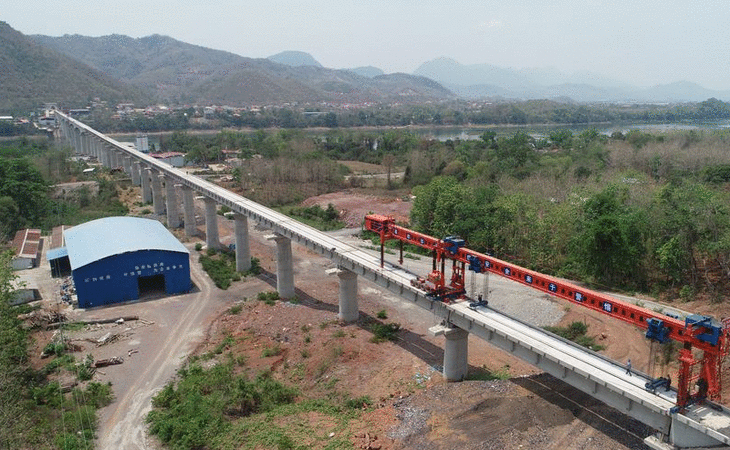
Despite the huge opportunities presented by the Laos-China railway and Vientiane-Boten expressway, Laos needs to address the challenges they pose in order to reap the full benefits they offer.
Acting President of the Lao National Economic Research Institute, Dr Sathabandith Insyxiengmay, told Vientiane Times last week that the railway and expressway are part of China’s Belt and Road Initiative and in line with the Lao government’s strategy to convert the country from being landlocked to a land link within the region.
“The question ‘What will Laos gain from the railway and expressway’ is not relevant at present. The key question to be asked now is ‘how and what can we do to benefit from the railway and expressway’,” he said.
Dr Sathabandith said all forms of investment involve a certain amount of risk and the possible loss of anticipated benefits. The railway and expressway will have a significant impact on the economy and will provide huge momentum in strengthening Laos’ connectivity with the rest of the region.
First of all, these two routes give people the option to travel conveniently and comfortably, and to save time and money.
Secondly, the railway and expressway will enable faster movement of people and workers. People will no longer have to worry about travelling long distances but can travel and do business in other areas without concern for time constraints.
Thirdly, investors can more easily operate businesses in other areas because they can reach other towns and cities in a few hours. This will lead to the improvement of services and facilities in towns situated along the railway and expressway.
Fourthly, these routes will create purchasing power synergy. Two or more towns will be connected so that people in one can spend their money in another area easily.
For instance, it’s now possible to travel from Vientiane to Vangvieng in just 90 minutes, significantly less than the three hours it took previously. The new routes will boost productivity, leading to economies of scale.
Fifth, the railway and expressway will expedite the growth of urban areas as development is closely linked to population size.
However, there are considerations that need to be addressed in order to reap more benefit from infrastructure developments.
Firstly, it will be necessary to build roads that link the railway with production sites so that goods can easily be transported.
Secondly, logistics and cross-border services must be integrated to facilitate the transport of goods by rail. In the first nine months of 2020, trade between China and Thailand was valued at US$66.4 billion, according to a report by Xinhua.
If China and Asean countries conduct trade using the railway passing through Laos, there will be more benefits for Laos.
Thirdly, the development of smart cities is critical to attract more trade and investment and build larger populations as a way of increasing purchasing power.
Fourth, it will be important to create interesting cities and improve facilities to draw more foreign visitors to Laos. If cities have nothing to offer, then people will just pass through them.
Oxford Economics projects Indonesia’s GDP to grow 6% in 2021
Jan 05. 2021
By The Jakarta Post
Indonesia’s economic growth is expected to rebound this year after it fell in 2020 into its first recession since the 1998 Asian financial crisis, but the coronavirus pandemic will continue to dampen economic activities, according to the reports of several international organizations.
According to the latest economic outlook from Oxford Economics commissioned by the Institute of Chartered Accountants in England and Wales (ICAEW), the country’s gross domestic product (GDP) is forecast to shrink 2.2 percent in 2020 and rebound to 6.0 percent growth in 2021, driven by increases in consumer and infrastructure spending.
“Retail sales and industry production are relatively stable in Indonesia compared to Southeast Asian peer countries,” the ICAEW said in a statement on Dec. 28. It added, however, that Indonesia’s economic recovery remained uncertain, as social mobility and retail sales were still weak compared to pre-pandemic levels, while imports fell significantly last year.
Indonesia plunged into its first recession in two decades in the third quarter of 2020 as the government struggled to contain the coronavirus outbreak and the attendant economic fallout.
The government has further downgraded its 2020 GDP forecast to a contraction of between 1.7 percent and 2.2 percent amid the continuing rise in COVID-19 cases, as well as from the tighter restrictions during the year-end holiday season that are expected to hit consumption.
The government made concerted efforts to ban crowd-pulling events from Dec. 18 to Jan. 8, including New Year’s Eve celebrations, in a bid to prevent a post-holiday spike in coronavirus infections.
“We expect household spending to contract by 3.6 percent to 2.6 percent due to the increase in COVID-19 cases in December that prompted tighter restrictions,” Finance Minister Sri Mulyani Indrawati said during a recent virtual press briefing, adding that she expected the economy to grow 5 percent in 2021.
As regards the region, the ICAEW has forecast that Southeast Asia’s GDP will contract 4.1 percent in 2020 before expanding 6.2 percent in 2021 as a result of the low base effect, coupled with fiscal and monetary support. It has warned that growth might be constrained by further social distancing measures, but countries that are able to roll out vaccines quickly could continue to ease restrictions.
“While uncertainties remain and most economies will take time to recoup lost output, risks have become more balanced with recent positive news on vaccines and regional growth prospects for Southeast Asia in the medium to long term are optimistic,” it stated.
Earlier reports from other international institutions projected a stronger Indonesian economy in 2021, with the World Bank forecasting 4.4 percent growth and the Asian Development Bank (ADB) forecasting 4.5 percent growth.
“[Indonesia’s] Growth in 2021 is projected to rebound, partly driven by a base effect and assuming that consumer confidence improves and household income is supported by a stronger labor market and adequate social assistance,” the World Bank said in its December 2020 Indonesia Economic Prospects (IEP).
“Public health remains a top priority to allow the economy to stay open and to move towards a safe full reopening,” said the IEP, and that continued improvement in testing and contact tracing, as well as preparations to procure and widely administer effective vaccines were the keys to recovery.
The bank warned that the possibility of a surge in virus cases could trigger tighter mobility restrictions in the country, and that slower-than-expected progress in the availability of an effective and safe vaccine “would weaken consumer and business confidence and dampen economic activity longer than expected”.
Furthermore, weaker global demand and slower recovery among advanced economies would weaken trade and commodity prices, which might impact the Indonesian economy, it added.

 Few people are seen at the international arrival lobby of Haneda Airport on Dec. 28 after the entry of foreign visitors was suspended in principle. (The Yomiuri Shimbun)
 AirAsia Group president (airlines) Bo Lingam (file pic) said: “This transaction is in line with our initiatives towards reducing cash utilisation for the group and will allow us to use cash to grow market share in our core markets in Asean, particularly in Malaysia, Thailand, Indonesia and the Philippines as well as for our future expansion into Cambodia, Myanmar and Vietnam.”
 During the December school holidays, many reportedly could not use their tickets, as time slots for the attraction were fully booked. PHOTO: ST FILE
![People talk on their cellphones at the booth of China Mobile during an expo in Beijing. [Photo/Agencies]](https://media.nationthailand.com/images/news/2021/01/06/30400759/800_999d3d6361f5fd4.jpeg?v=1609900156) People talk on their cellphones at the booth of China Mobile during an expo in Beijing. [Photo/Agencies]
People talk on their cellphones at the booth of China Mobile during an expo in Beijing. [Photo/Agencies] An entertainment district in Osaka is seen on Nov. 27. Some dining establishments closed early in response to requests to shorten business hours. (Yomiuri Shimbun file photo)
 This closed-circuit TV image shows South Korean oil tanker MT Hankuk Chemi arriving in an Iranian port after it was seized by Iranian troops on Monday. An Iranian speedboat is seen in the red circle. (Yonhap)