
SIA cabin crew to wear N95 masks, protective overalls on flights from London amid concerns over new Covid-19 strain #SootinClaimon.Com

#SootinClaimon.Com : ขอบคุณแหล่งข้อมูล : หนังสือพิมพ์ The Nation.

SIA cabin crew to wear N95 masks, protective overalls on flights from London amid concerns over new Covid-19 strain

Dec 26. 2020SIA said that it already has a series of precautions to protect its crew and reduce the risk of Covid-19 transmission. PHOTO: ST FILE
SIA said that it already has a series of precautions to protect its crew and reduce the risk of Covid-19 transmission. PHOTO: ST FILE

By Toh Ting Wei
The Straits Times/ANN

SINGAPORE – All Singapore Airlines (SIA) cabin crew members working on flights from London will now have to wear N95 masks and protective overalls amid growing concerns about the new strain of the Covid-19 virus in the city.

They will also have to take Covid-19 swab tests after their return. They will not be allowed to resume work on other flights until they get a negative result, in line with the usual practice when flying to areas with higher risks of Covid-19 infections.

SIA is currently operating two direct flights daily from London’s Heathrow Airport on most days. The flights are about 13 hours long.

The additional requirements for protective equipment for flights from London kicked in on Wednesday (Dec 23), SIA said in response to queries on Thursday. Prior to this, cabin crew had already been wearing goggles, gloves and surgical masks for all flights.

Reports about a new strain of the coronavirus that is 70 per cent more infectious surfaced last week.

On Tuesday, Singapore joined more than 40 other countries in tightening restrictions on travellers arriving from the United Kingdom. The Ministry of Health had said that all long-term pass holders and short-term visitors with travel history to Britain within the last 14 days will not be allowed to enter or transit through Singapore.

Returning Singaporeans and permanent residents will have to be tested on arrival, and again towards the end of their 14-day stay-home notice period at dedicated facilities.

SIA also said on Thursday that it already has a series of precautions to protect its crew and reduce the risk of Covid-19 transmission.

For long-haul flights where the crew will have to stay over in the destination country, SIA has been chartering a dedicated bus for crew to be transported to and from the hotels, which are located away from city centres.

“All crew are required to stay in their hotel rooms during the layover period, and they need to wear devices that track their location to ensure that they comply with this regulation,” said SIA.

The crew members must also take their temperature regularly and closely monitor their health throughout their duty period.

To protect crew and other passengers on flights, if anyone – passenger or crew member – were to report feeling unwell, the person would be moved to a dedicated quarantine area within the plane, SIA added.

The unwell person would be attended to by a cabin crew dressed in full personal protective gear, and would be checked by medical authorities upon the plane’s landing.

Abe apologizes for dinner spending scandal #SootinClaimon.Com

#SootinClaimon.Com : ขอบคุณแหล่งข้อมูล : หนังสือพิมพ์ The Nation.

Abe apologizes for dinner spending scandal

Dec 26. 2020Former Prime Minister Shinzo Abe speaks at a press conference at the Diet Building on Thursday. (The Yomiuri Shimbun)Former Prime Minister Shinzo Abe speaks at a press conference at the Diet Building on Thursday. (The Yomiuri Shimbun)

By The Japan News/ANN

Former Prime Minister Shinzo Abe apologized Thursday after his state-paid first secretary was given a summary indictment regarding irregularities on political fund reports over dinners held prior to cherry blossom-viewing parties.

“Even though [the irregularities] occurred without my knowledge, I am keenly aware of my moral responsibility,” Abe said at a press conference at the Diet building on Thursday. “I deeply regret it and offer my sincerest apologies to the people.”

The Tokyo District Public Prosecutors Office’s special investigation squad filed the summary indictment against the secretary, Hiroyuki Haikawa, on the same day over a suspected violation of the Political Funds Control Law. Abe, a member of the ruling Liberal Democratic Party, was not indicted due to insufficient evidence.

In a Diet session during his time as prime minister, Abe repeatedly denied the fact that his political support group covered some of the expenses of the dinner events. However, at the press conference on Thursday, he admitted that the group had paid a portion of the expenses and that it later revised its political fund reports.

Regarding his past remarks in the Diet, Abe also apologized for the discrepancy in some of his answers given at the time.

“This has undermined the public’s trust in politics. I would like to express my deepest apologies to the people and to all Diet members of the ruling and opposition parties,” Abe said.

When asked about whether he intends to resign from politics, Abe denied the possibility, saying: “I am well aware that I have an extremely heavy political responsibility. I want to fulfill my duties by returning to my original political goals and doing my best.”

On Friday, Abe explained the matter and fielded questions from ruling and opposition party members at sessions of the committees on rules and administration of both Diet chambers. He corrected past remarks made in the Diet and offered his apologies.

According to the House of Representatives’ Research Bureau, Abe made remarks, such as “My office isn’t involved in this matter,” “There are no receipts” and “[My support group] did not make up for the shortfall [when costs exceeded what dinner guests had paid],” 118 times from November 2019 to March 2020 when answering questions posed by lawmakers in the Diet.

■ Payments made ‘out of pocket’

At the press conference Thursday, Abe explained that the shortfall for the expenses of the dinner events was covered by his own money allotted for his personal expenses that he had entrusted to his office.

“As a number of invoices for expenses, including food and transportation, come to my office every day, I have the office handle the payments,” Abe said. “The payments were made from money withdrawn from my personal account that I had entrusted to the office.”

S. Korea’s virus cases hit all-time high despite tougher distancing rules #SootinClaimon.Com

#SootinClaimon.Com : ขอบคุณแหล่งข้อมูล : หนังสือพิมพ์ The Nation.

S. Korea’s virus cases hit all-time high despite tougher distancing rules

Dec 26. 2020People wait in a long line around a large Christmas tree to get tested for COVID-19 at a screening center in Seongnam, just south of Seoul, on Christmas Eve on Thursday. (Yonhap)People wait in a long line around a large Christmas tree to get tested for COVID-19 at a screening center in Seongnam, just south of Seoul, on Christmas Eve on Thursday. (Yonhap)

By THE NATION

South Korea’s daily new coronavirus cases hit a new record high on Friday, despite the most stringent social distancing rules to contain the winter wave of the virus.

South Korea reported 1,241 more COVID-19 cases, including 1,216 local infections, raising the total caseload to 54,770, according to the Korea Disease Control and Prevention Agency (KDCA).

The tally marked a hike from 985 on Thursday, according the public health agency.

The hike is mainly blamed on 288 new cases at Dongbu Detention Center in eastern Seoul in one of the largest cluster infections in South Korea.

The second mass outbreak at the detention center raised the total number of infections linked to the facility nationwide to 514, the justice ministry said.

South Korea has banned gatherings of five or more people across the country in the most stringent social distancing rules meant to contain the spread of the virus.

Yoon Tae-ho, a senior official at the Ministry of Health and Welfare, asked people to cancel gatherings and stay at home, saying tougher social distancing rules and antivirus measures could reduce the number of infections in the new year.

The government warned that violators of the social distancing rules will face a fine of up to 3 million won ($2,700).

The government also shut down ski resorts and popular venues for watching the sunrise on New Year’s Day to slow the spread of the virus during the Christmas and New Year’s holiday season.

On Friday, Prime Minister Chung Sye-kyun called on health authorities and local governments to respond “strictly” to violations of social distancing rules, noting some restaurants and bars entertained guests after 9 p.m. after locking their doors and switching off signs.

“The vast majority of the nation is faithfully adhering to the government’s antivirus measures despite the inconvenience and pain they entail, but if a few cheat for their own gains, it is difficult to expect results from participating in the antivirus measures,” Chung said during a government COVID-19 pandemic response meeting.

South Korea has been applying Level 2.5 social distancing rules, the second highest of the five-tier system, in the greater Seoul area, home to half of its 51.6 million population, and Level 2 rules in the rest of the country.

Health authorities have said they are aiming to contain the current wave of the pandemic without raising virus curbs to Level 3 on concerns over the impact on the economy.

The authorities plan to decide Sunday on whether to raise the country’s social distancing guidelines to the highest Level 3, Yoon said.

Of the newly identified local infections, 550 cases were reported in Seoul and 257 cases in Gyeonggi Province that surrounds the capital. Incheon, west of Seoul, reported 55 more cases.

Other municipalities reported new infections, with South Chungcheong Province adding 79 cases and North Gyeongsang Province reporting 67 new cases.

South Korea reported 17 additional deaths from COVID-19, raising the death toll to 773. The fatality rate was 1.41 percent.

The number of seriously or critically ill COVID-19 patients reached 311, compared with 291 from the previous day.

The public health agency said the total number of people released from quarantine after making full recoveries stood at 38,048, up 623 from the previous day.

Meanwhile, South Korea reported 25 imported cases, increasing the total to 5,425.

Of the newly imported cases, 15 were South Koreans and 10 were foreigners. They came from the United States, the Philippines, Uzbekistan, Indonesia, Russia, Kazakhstan, Poland, Finland, Democratic Republic of Congo and Niger.

Beijing’s new cases test city’s antivirus measures #SootinClaimon.Com

#SootinClaimon.Com : ขอบคุณแหล่งข้อมูล : หนังสือพิมพ์ The Nation.

Beijing’s new cases test city’s antivirus measures

Dec 26. 2020Medical workers conduct nucleic acid tests in Xicheng district, Beijing, on Thursday. Beijing faces a major test of COVID-19 control after new cases have occurred in several districts. WU XIAOHUI/CHINA DAILYMedical workers conduct nucleic acid tests in Xicheng district, Beijing, on Thursday. Beijing faces a major test of COVID-19 control after new cases have occurred in several districts. WU XIAOHUI/CHINA DAILY

By DU JUAN and ZHANG XIAOMIN
CHINA DAILY/ANN

Beijing is facing a major test of its COVID-19 prevention and control as new cases have occurred recently in several districts, a senior city official said on Friday.

The municipal government suggests local residents spend the New Year’s and Spring Festival holidays in the city to reduce the risk of infection, said Chen Bei, deputy secretary-general of the Beijing municipal government. Spring Festival is in mid-February this year.

“Citizens should not leave the city if not necessary,” she said. “Large-scale events should not be held.”

Zhu Sheng, deputy administrator of Chaoyang district, said officials received a report on Thursday morning that an Asiana Airlines employee who lived and worked in the Maizidian Street area in Chaoyang tested positive for COVID-19 after traveling to South Korea from Beijing on Tuesday.

The South Korean government confirmed that the employee was asymptomatic as of Thursday night.

The living space and workplace of the employee was disinfected immediately and 43 close contacts were placed under medical observation, Zhu said.

By 4 pm on Friday, 4,345 test samples had been collected and all 1,684 results that had been processed were negative.

To help curb the outbreak in Dalian, the National Health Commission has sent a working group to the Liaoning province port, the commission said Friday.

Dalian reported seven new confirmed cases and one asymptomatic infection on Thursday. One confirmed patient was previously asymptomatic, the local health commission said.

As of Thursday, the city had reported 19 confirmed COVID-19 cases and 20 asymptomatic infections since new infections emerged on Dec 15.

With the national postgraduate entrance exams starting on Saturday, all Chinese cities, particularly cities like Beijing and Dalian that have reported new cases of the virus, are making every effort to ensure exams are conducted in a safe and smooth manner.

The candidates are required to present negative nucleic acid tests done within seven days before taking the exams.

Wen Zhihao, 21, a student who planned to take the exam in Beijing, said that he trusts the city’s prevention and control measures and that the new cases had not affected his mood at all.

Zhao Yang, director of Dalian’s education bureau, said designated exam rooms and hotels have been prepared to host candidates from the city’s five closed-off neighborhoods from Friday morning to Monday. The test-takers will stay at the hotels during the exam period.

Expenses will be covered by the Dalian Jinpu New Area, where the neighborhoods, test-taking facilities and hotels are located.

“Fortunately, Dalian has made adjustments very quickly. We were worrying that my sister might miss the exam since she could not leave the area to get to her original testing center in downtown Dalian,” said Qiu Tiantian, whose 24-year-old sister is a candidate for the exams.

Wu Zunyou, chief epidemiologist at the Chinese Center for Disease Control and Prevention, said it’s normal for China to have recently had new COVID-19 cases in some places given that the pandemic is still growing worldwide, adding that rising cases are a reminder to stick to prevention and control measures to avoid risks.

Wu told China Central Television on Thursday that many of the positive test results that have been reported in China recently have been asymptomatic patients, indicating that risks have been discovered before they spread widely thanks to multiple measures, including testing.

Malaysia remains steadfast in championing regional trade #SootinClaimon.Com

#SootinClaimon.Com : ขอบคุณแหล่งข้อมูล : หนังสือพิมพ์ The Nation.

Malaysia remains steadfast in championing regional trade

Dec 25. 2020“As a grouping whose economies constitute about 60% of the global economy, Apec assumes a central role in spearheading post-pandemic economic recovery, ” Prime Minister Tan Sri Muhyiddin Yassin (pic), the host of this year’s Apec meetings, said in his opening remarks.“As a grouping whose economies constitute about 60% of the global economy, Apec assumes a central role in spearheading post-pandemic economic recovery, ” Prime Minister Tan Sri Muhyiddin Yassin (pic), the host of this year’s Apec meetings, said in his opening remarks.
By The Star/ANN

KUALA LUMPUR: The year 2020 is supposed to be an ambitious year for regional trade pacts.

However, progress has been hampered as the world scrambles to mitigate the challenges brought about by the Covid-19 pandemic.

The deadly virus – which had allegedly originated from an exotic meat market in Wuhan, China, and detected in Malaysia as early as in January this year – has severely damaged the global economy, and the country was not spared from its repercussions.

Like many other countries, Malaysia has resorted to taking drastic actions, including implementing international border closure and restricting interstate travels to curb the spread of Covid-19, which the World Health Organisation (WHO) had declared as a global pandemic on March 11,2020.

However, amidst the backdrop of the pandemic, Malaysia has proven its capabilities by successfully conducting and concluding its year-long Asia-Pacific Economic Cooperation (Apec) chairmanship with a strong pledge towards free, open and non-discriminatory trade and investment.

The leaders of the 21 Apec member economies vowed to strengthen cooperation during and after the Covid-19 pandemic, as they gathered online on Nov 21 for the first-ever fully virtual 27th Apec Economic Leaders Meeting (AELM).

“As a grouping whose economies constitute about 60% of the global economy, Apec assumes a central role in spearheading post-pandemic economic recovery, ” Prime Minister Tan Sri Muhyiddin Yassin, the host of this year’s Apec meetings, said in his opening remarks.

Among the leaders at this year’s AELM were the US President Donald Trump and Chinese President Xi Jinping.

Both leaders agreed to set aside their differences and recognise the importance of a free, open, fair, non-discriminatory, transparent and predictable trade and investment environment to drive economic recovery in such a challenging time.

Two years ago, Apec leaders failed to agree on a joint statement for the first time in its history amidst a trade row between Washington and Beijing, while in 2019, the AELM meeting scheduled in Chile was cancelled due to anti-government protests across the South American cities.

In a declaration issued after the virtually-held meeting in Kuala Lumpur, Apec leaders stated their commitment to combatting and mitigating the impacts of Covid-19 and improving the narrative of trade and investment.

They had also committed to implement inclusive economic participation through digital economy and technology, driving innovative and inclusive sustainability, as well as strengthening stakeholder engagement during “one of the most challenging health and economic crises of our times”. — Bernama

Mental, physical strain growing among teleworking employees in Japan #SootinClaimon.Com

#SootinClaimon.Com : ขอบคุณแหล่งข้อมูล : หนังสือพิมพ์ The Nation.

Mental, physical strain growing among teleworking employees in Japan

Dec 25. 2020

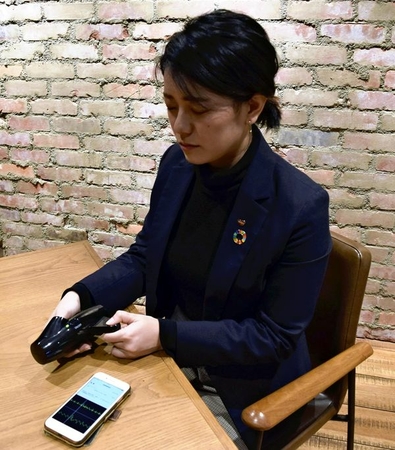
A Nissin Foods Holdings Co. employee uses a device that measures stress levels in two minutes. (The Yomiuri Shimbun)

A Nissin Foods Holdings Co. employee uses a device that measures stress levels in two minutes. (The Yomiuri Shimbun)

By The Japan News/ANN

Telework has been welcomed as a flexible way to do one’s job anywhere and at any time, but an increasing number of remote workers are suffering from stress due to a lack of communication with others or difficulty distinguishing between work and private time.

How can mental and physical disorders related to teleworking, which has spread rapidly due to the coronavirus pandemic, be prevented?

Peacemind Inc., a human resources consulting company based in Tokyo, has been receiving an increasing number of inquiries about mental and physical problems caused by prolonged teleworking. One person said: “I feel depressed because I stay home all the time. I don’t feel like eating and I’ve lost weight.” Another said, “I can’t stop crying during work these days.”

According to Peacemind, in the early days after people began to refrain from commuting because of the spread of the virus, many people expressed confusion in their inquiries about working from home, or a fear of infection. From early August on, however, they began to talk about different issues.

Their problems are believed to have been caused by stress related to teleworking. People usually work on computers alone at home, and report their work or receive instructions mainly through email and social media. Unlike working at an office, it can be difficult to determine when to talk with their bosses. People began to feel pressured or anxious when work did not progress as a result of these factors.

“People communicate through casual conversation at an office. It’s important when teleworking to create opportunities to talk regularly to reduce anxiety or irritation,” said Hidehiko Takeda, a clinical psychologist at Peacemind.

According to a survey conducted in September on people in charge of corporate general affairs around the country by Gekkan Soumu Inc. — a Tokyo-based firm that publishes a magazine for corporate employees — 73.3% of 255 respondents said they found it difficult to provide mental care to teleworking staff.

“The biggest challenge of teleworking is that you can’t see each other’s faces. It’s necessary to consider how companies can visualize the situation and health condition of employees,” said Kenichi Toyoda, editor in chief of the Gekkan Soumu magazine.

Some companies are taking measures to prevent stress related to teleworking.

Nissin Foods Holdings Co. established a team in August to prevent depression linked to remote work. About 1,360 group company employees who work from home are asked to use a device that measures their stress levels, so problems can be dealt with even before they become aware of them.

Depending on the measurements, employees receive online interviews or are encouraged to participate in a program to improve the quality of their sleep, for example. 

“Stress can accumulate before you’re aware of it. I thought unsolicited help was necessary to prevent employees from suffering from stress,” said Yasuhisa Miura, deputy manager of Nissin Foods’ business administration office and a member of the team. The company is considering expanding the system throughout the entire group.

More S’poreans may have to be vaccinated as more contagious Covid-19 strains detected: Public health school dean #SootinClaimon.Com

#SootinClaimon.Com : ขอบคุณแหล่งข้อมูล : หนังสือพิมพ์ The Nation.

More S’poreans may have to be vaccinated as more contagious Covid-19 strains detected: Public health school dean

Dec 25. 2020Current research indicates that new strains will not affect the effectiveness of vaccines. PHOTO: ST FILECurrent research indicates that new strains will not affect the effectiveness of vaccines. PHOTO: ST FILE

By Goh Yan Han
The Straits Times/ANN

SINGAPORE – With the discovery of new, more contagious strains of the Covid-19 virus in Britain and South Africa, it may now be important for more Singaporeans to get vaccinated against the coronavirus, said a health expert here.

Professor Teo Yik Ying, dean of the Saw Swee Hock School of Public Health at the National University of Singapore, said on Thursday (Dec 24): “This is the only way we can continue to ensure that the community as a whole is protected.”

This means that instead of aiming to get 80 per cent of the population here to be vaccinated against Covid-19, “we may be now looking at 90 per cent or even higher”, said Prof Teo, who was speaking in a video interview with The Straits Times on its daily online talk show The Big Story.

The Health Ministry’s chief health scientist Professor Tan Chorh Chuan previously told ST that at least 80 per cent of Singapore’s population would have to be vaccinated in order to achieve herd immunity against Covid-19.

The new B117 strain of Covid-19 circulating in Britain has been reported to be more contagious, but has not shown signs of being more lethal or severe.

Singapore recorded its first case of this strain on Wednesday – a 17-year-old Singaporean girl who had returned home from Britain.

Prof Teo said on Thursday that current research indicates that new strains will not affect the effectiveness of vaccines, though a better understanding of the new strains is needed before determining the likely impact and making appropriate policy decisions.

“Governments are concerned (about the new strains) because of the impact that they have in managing the spread of Covid-19 in the community, and also any potential impact on vaccine effectiveness and quality control measures,” said Prof Teo.

“But for individuals like you and me, as long as we continue to diligently practise the necessary safe management measures, there is no need to be overly concerned with this new mutations,” he added, referring to the new strains.

Present research also indicates that the new strains are transmitted between people in the same way as the older strains, though it is more contagious, as an infected person with the new variant may have a higher viral load in his upper respiratory tract, said Prof Teo.

This is why existing measures like wearing a mask properly and maintaining the necessary social distance, if followed, can still minimise the chance of an infected person passing on the virus to someone who is healthy, he said.

Prof Teo also advised that during the year-end festive period, Singaporeans should continue to follow safe distancing rules and measures to keep themselves, as well as their family and friends, safe from the coronavirus.

Anti-monopoly probe launched against Alibaba #SootinClaimon.Com

#SootinClaimon.Com : ขอบคุณแหล่งข้อมูล : หนังสือพิมพ์ The Nation.

Anti-monopoly probe launched against Alibaba

Dec 25. 2020Logos of Ant Group and Alibaba are pictured at the headquarters of Ant Group, an affiliate of Alibaba, in Hangzhou, Zhejiang province, Oct 29, 2020. [Photo/Agencies]Logos of Ant Group and Alibaba are pictured at the headquarters of Ant Group, an affiliate of Alibaba, in Hangzhou, Zhejiang province, Oct 29, 2020. [Photo/Agencies]

By He Wei
China Daily/ANN

Authorities aim to better regulate online economy, guide its healthy development

Chinese authorities have officially opened an anti-monopoly probe into e-commerce giant Alibaba Group and will summon its affiliate Ant Group for a meeting about financial regulations, the latest moves to strengthen antitrust practices and prevention of the “disorderly expansion of capital”.

The State Administration for Market Regulation has launched an investigation into Alibaba for alleged monopolistic conduct, including implementing an “exclusive dealing agreement”, Xinhua News Agency reported on Thursday.

The issue largely refers to the company’s practice of forcing merchants to choose either Alibaba’s platform or its rival site to sell their products instead of being eligible to work with both, potentially crowding out competitors.

In a statement on Thursday, Alibaba said it will actively cooperate with the investigation, and the operation of the company’s businesses currently remain normal.

Meanwhile, financial regulators, including the central bank and the banking and securities watchdogs, will summon Alibaba’s financial technology arm Ant to a meeting to regulate the operation and development of its financial business, the People’s Bank of China said on Thursday.

Ant said it had received the notice of the meeting and pledged to “seriously study and strictly comply with all regulatory requirements and make full efforts to fulfill all related work”.

Alibaba’s Hong Kong-listed stocks plunged 8.13 percent on Thursday.

Overshadowed by the Alibaba investigation, other internet majors such as Tencent, JD and Meituan all saw their shares tumble on the same day.

With market resources concentrating on leading companies, certain “risks and hidden dangers” have surfaced in the development of the online economy, according to a commentary in People’s Daily on Thursday.

“Anti-monopolism is an international practice, which is conducive to protecting fair competition and innovation in the market and safeguarding consumer rights,” the newspaper said, adding that the investigation does not imply a change of attitude toward encouraging and supporting the online economy.

“Rather, it’s precisely for the purpose of better regulating and developing the online economy, and guiding and promoting its healthy development with the hope that it stands to make a bigger contribution to China’s high-quality economic development.”

The overriding goal of anti-monopolism is not aimed at “clamping down on one internet giant and fostering the other”, but rather safeguarding the interests of small and medium-sized businesses that bank on these internet platforms, said Xue Jun, a professor of law at Peking University and director of the university’s E-Commerce Law Research Center.

“Through the series of actions, we really need to hear the voices of smaller merchants, who essentially form the backbone of the stability of the economy and people’s livelihoods,” he said.

Ant’s massive initial public offering was suspended in early November just days before its widely anticipated dual listing in Hong Kong and Shanghai.

Regulators have tightened their supervision of internet companies and meanwhile curbed their allegedly monopolistic behavior by regulating online financial services to rein in potential risks.

Chinese authorities vowed at last week’s Central Economic Work Conference to intensify anti-monopoly supervision and prevent “disorderly capital expansion”.

In the latest development, digital lenders including Ant-operated Huabei and Tencent-backed WeBank announced a reduction of their maximum quota for loans extended via online channels, in response to heavier scrutiny from financial regulators and new provisions unveiled earlier.

“By and large, Chinese regulators are pro-innovation,” said Chen Guoli, a professor of strategy at the INSEAD business school in Singapore.

“But the government is also striking a delicate balance between innovation and risk. When it comes to the financial system, it is extremely careful about systemic risk.”

Chen said there has been debate whether Ant is a financial firm or a high-tech firm. If Ant Group belongs to the financial industry, the compliance and disclosure requirements are different.

Given its main sources of revenue, “the government is currently inclined to think Ant is a financial company”, Chen added.

More Koreans giving up looking for jobs #SootinClaimon.Com

#SootinClaimon.Com : ขอบคุณแหล่งข้อมูล : หนังสือพิมพ์ The Nation.

More Koreans giving up looking for jobs

Dec 25. 2020Organizers of a job fair in Iksan, North Jeolla Province, pose on Oct. 22. (Iksan City)Organizers of a job fair in Iksan, North Jeolla Province, pose on Oct. 22. (Iksan City)
By Kim Yon-se
The Korea Herald/ANN

Tally for female discouraged workers hits record-high

SEJONG — A growing number of South Koreans have abandoned looking for jobs as the pandemic worsens a hiring market that was already tightening for several years.

According to a survey on the working age population — those aged 15 or over — by Statistics Korea, the number of discouraged workers stood at 534,000 in December 2019, the month before the novel coronavirus first arrived in Korea.

The tally counts people who had looked unsuccessfully for a job in the previous year but not in the month immediately preceding the survey.

Since the first case was reported here on Jan. 20, the tally of discouraged workers has showed a general increase, though there were some ups and downs from month to month.

Compared to December 2019, the tally for November 2020 grew 97,000 to reach 631,000.

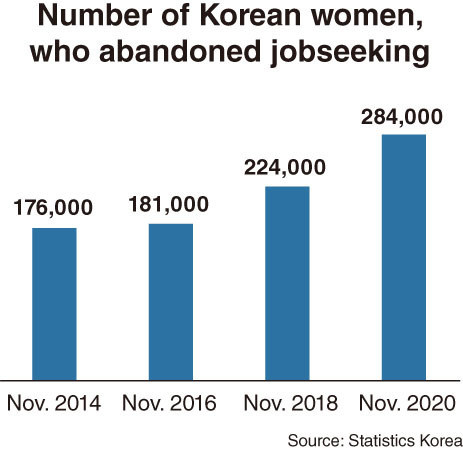
(Graphic by Kim Sun-young/The Korea Herald)(Graphic by Kim Sun-young/The Korea Herald)
(Graphic by Kim Sun-young/The Korea Herald)

Further, the number of women who gave up looking for jobs hit an all-time high of 284,000 (tied with the figure for September 2020) last month, up 54,000 compared to December 2019.

Male discouraged workers increased by 43,000 (14.1 percent) to 347,000 over the same period.

Some research analysts say that the climbing number of discouraged workers cannot wholly be attributed to the COVID-19 pandemic. An analyst compared the latest data with the figure for April 2017, a month before the Moon Jae-in administration took office.

Compared to April 2017, the tally of people giving up job-seeking activities surged 51.4 percent (214,000) — 47.6 percent for men and 56 percent for women.

According the Supplementary Index III for Employment, held by Statistics Korea, the tally for de facto unemployed reached 3.9 million as of November 2020. This indicates that 13 percent of the economically active population, 30 million, were unemployed or underemployed.

Index III counts underemployed people among the de facto unemployed. This category includes those who work fewer than 36 hours a week and want to work more, as well as seasonal workers who are out of work for part of the year.

Given 3.29 million for the category in April 2017, the number of de facto unemployment has increased by 610,000 during President Moon’s term.

The government is still promoting and publicizing jobless figures – but uses a more conservative method to calculate them.

Under this approach, the nation’s “official” unemployment was 3.4 percent in November, with only 967,000 unemployed.

For those aged between 15-29, the jobless rate stood at 8.1 percent last month when calculated by the government’s preferred method, with the number of unemployed at 331,000.

In contrast, the Index III figure came to 1.16 million for that age group, with a de facto jobless rate of 24.4 percent.

In April 2017 unemployment benefit payments totaled 444.9 billion won ($401.7 million), according to the Korea Employment Information Service. But the figure had shot up to 1.01 trillion won by October 2020.

Vietnam becomes fastest growing nation brand #SootinClaimon.Com

#SootinClaimon.Com : ขอบคุณแหล่งข้อมูล : หนังสือพิมพ์ The Nation.

Vietnam becomes fastest growing nation brand

Dec 24. 2020Việt Nam's brand value skyrocketed by 29 per cent to US$319 billion this year. — Photo baotintuc.vnViệt Nam’s brand value skyrocketed by 29 per cent to US$319 billion this year. — Photo baotintuc.vn 

By Viet Nam News/ANN

HÀ NỘI — Việt Nam has become the fastest growing national brand in Brand Finance’s ranking this year, with its brand value skyrocketing by 29 per cent to US$319 billion.

The country climbed nine places from last year to 33rd in the Nation Brands 2020 list of the world’s 100 most valuable brands compiled by the UK independent branded business valuation and strategy consultancy.

According to Brand Finance, Việt Nam, which has recorded staggeringly low COVID-19 cases and deaths, has emerged as one of the top locations within the Southeast Asian region for manufacturing and has become an increasingly attractive destination for investors, particularly from the US, that are looking to relocate their China operations following the fallout from the US-China trade war. Recent trade deals with the EU are further supporting the growth of the nation.

“Emerging as a Southeast Asian haven for manufacturing, Việt Nam defies the global trend, with its brand value up an impressive 29 per cent,” Brand Finance noted.

Brand Finance measures the value of national brands based on three pillars: goods and services, investment, and society.

According to Brand Finance, the 100 most valuable nation brands in the world have suffered monumental losses to their brand value because of the COVID-19 pandemic, amounting to $13.1 trillion.

This year has put the nations of the world to the test – from the economic impacts of COVID-19 on nations’ GDP forecasts, inflation rates, and general economic uncertainty, to diminished long-term prospects. Brand Finance estimates that the total brand value of the top 100 nation brands dropped from $98 trillion in 2019 to $84.9 trillion in 2020, with almost every nation feeling a significant impact of the health crisis on their respective economies.

David Haigh, CEO of Brand Finance, said the downward trend of nearly all the world’s most valuable nation brands was unsurprising, given the year we were currently experiencing. With COVID-19 contributing to the recent rise of protectionism, we may see a reversal of the economic growth brought about by globalisation. Having said that, optimism had certainly prevailed, with forecasts looking less dire than initially predicted, and with the announcement of a working vaccine beginning to be rolled out, the future was certainly looking brighter. — VNS