Sri Lanka, India and Maldives agree to strengthen cooperation in dealing with maritime challenges #SootinClaimon.Com

#SootinClaimon.Com : ขอบคุณแหล่งข้อมูล : หนังสือพิมพ์ The Nation.

Sri Lanka, India and Maldives agree to strengthen cooperation in dealing with maritime challenges (nationthailand.com)

Sri Lanka, India and Maldives agree to strengthen cooperation in dealing with maritime challenges

Dec 06. 2020

By The Island

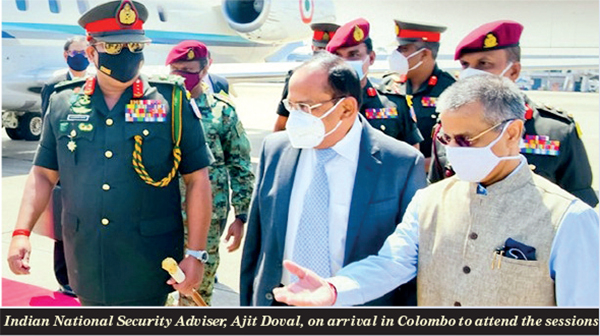
Agreement was reached on further strengthening cooperation in dealing with maritime challenges in the Indian ocean and ensure peace and security in the region for common benefit, at the trilateral 4th National Security Adviser level meeting on ‘Maritime Security Cooperation’, which concluded at the Colombo Hotel Taj Samudra on Saturday (28).

The sessions were held with the participation of Ajit Doval, National Security Adviser of India, Ms. Mariya Didi, Minister of Defence of Maldives and Maj. Gen. (retd) Kamal Gunaratne, Secretary to the Ministry of Defence.

Minister of Foreign Affairs, Dinesh Gunawardena, was the chief guest at the inauguration.

The High Commissioner of India, Ambassador for the Maldives, Foreign Ministry Secretary Admiral (retd) Prof. Jayanath Colombage, Lieutenant General Shavendra Silva, Chief of Defence Staff, Commander of the Army and Head of the National Operations Centre for Prevention of COVID 19 Outbreak, Navy and Air Force Commanders, Inspector General of Police, Director-General of Sri Lanka Coast Guard, senior officials of Sri Lankan Foreign and Defence Ministries and senior military officers were among the attendees.

Several experts in the field of maritime defence from India, Maldives and Sri Lanka, together with observers from Mauritius and Seychelles, India and the Maldives were represented during the sessions at Senior Officials’ level.

The forum, fourth in sequence, took stock of the current maritime security environment in the region and the existing cooperation in the areas of Maritime Domain Awareness, Humanitarian Assistance and Disaster Relief, Joint Exercises, Capacity Building, Maritime Security and Threats, Marine Pollution and Maritime Underwater Heritage, Covid-19 challenges, etc. They agreed to further strengthen cooperation in dealing with these challenges to ensure peace and security in the region for common benefit, a joint media statement issued by the Defence Ministry said.

Defence Secretary Kamal Gunaratne, delivering the welcome address, underlined the momentous importance of dialogue at trilateral level on a regular basis. The Minister of Foreign Affairs made the keynote address before the sessions began deliberations. Lalith Weeratunga, Advisor to the President made the closing remarks.

In view of COVID-19, the dialogue was conducted adhering to strict health guidelines using ‘Air Bubble’ concept for the visiting delegations, the statement noted.

Sri Lanka, India and Maldives launched the Trilateral NSA level Meeting on Maritime Security Cooperation in 2011 and three meetings had been held so far. The last meeting was held in March 2014 in New Delhi. The past deliberations and outcomes have helped the three countries in improving close coordination in maritime security of the region. These were supplemented by Deputy NSA level meetings for sustained engagements and implementation of the discussions at the NSA level meetings.

The three countries also exchanged views on common security threats and agreed to broad base cooperation by expanding the scope to improve intelligence sharing and include issues like terrorism, radicalization, extremism, drugs, arms and human trafficking, money laundering, cyber security and effect of climate change on maritime environment, the statement further said.

The Heads of Delegations agreed to meet regularly to share, discuss and ensure timely implementation of decisions taken at the Meeting. They also decided to hold Deputy NSA level working group meetings biannually for cooperation at operational level, it added.

Korea’s exports of COVID-19 diagnostic reagents notch W2.5tr #SootinClaimon.Com

#SootinClaimon.Com : ขอบคุณแหล่งข้อมูล : หนังสือพิมพ์ The Nation.

Korea’s exports of COVID-19 diagnostic reagents notch W2.5tr (nationthailand.com)

Korea’s exports of COVID-19 diagnostic reagents notch W2.5tr

Dec 05. 2020Exports of Korean COVID-19 diagnostic reagents raked in 2.5 trillion won ($2.3 billion) by end-November. (Yonhap)Exports of Korean COVID-19 diagnostic reagents raked in 2.5 trillion won ($2.3 billion) by end-November. (Yonhap) 

By Lim Jeong-yeo
The Korea Herald/ANN

South Korea has a new export item. COVID-19 diagnostic reagents notched a 2.5 trillion won ($2.3 billion) performance up to end-November.

Diagnostic reagents are among the most fundamental components of diagnostic testing assays. Simply put, it is critical to have a well-functioning reagent to accurately discern a COVID-19 infection.

According to the Ministry of Food and Drug Safety and the Korea Customs Service on Friday, Korea had exported enough COVID-19 diagnostic reagents to cover 496.8 million people across 170 nations by end-November this year.

The number of nations seeking to import Korean diagnostic reagent products has increased incrementally since March.

India, Germany, the Netherlands, Italy and the US combined accounted for more than 50 percent of all COVID-19 diagnostic reagent exports. India accounted for 15.6 percent, Germany 13.2 percent, the Netherlands 9.6 percent, Italy 7.8 percent and the US 5.2 percent.

This is a new category of exports for Korea, and proof that the nation’s successful pandemic containment efforts are being reflected in global demand, the Drug Ministry declared.

Further boosting the industrywide morale, on Wednesday Korea’s infectious disease diagnostics procedure was adopted as the international standard, now known as ISO 17822 or “In vitro diagnostic test systems — Nucleic acid amplification-based examination procedures for detection and identification of microbial pathogens — Laboratory quality practice guide.”

Currently, 221 COVID-19 diagnostic reagents are approved for export from Korea. Of those, DNA diagnostic reagents accounted for 105, antigen reagents 44 and antibody reagents 72.

DNA diagnostic assays, also referred to as real-time polymerase chain reaction tests and molecular diagnostics, have the upper hand in accuracy.

Antigen and antibody reagents, while they produce faster test results, are only effective if the infection has progressed somewhat. This is because the tests determine whether the body has formed antigens or antibodies against the intruding virus. Accuracy is limited in the very early phases of infection.

For domestic use, Korea currently has enough diagnostic reagents to test 830,000 people. Considering the country tests an average of 20,000 people per day, the secured stock is sufficient to last over a month, the authorities said.

The daily maximum output of COVID-19 diagnostic reagents for domestic use is enough for 590,000 people. So far, Korea has conducted more than 3.13 million tests. The nation’s population is roughly 51 million.

Singapore to have 4 digital banks, with Grab-Singtel and Sea getting digital full bank licences #SootinClaimon.Com

#SootinClaimon.Com : ขอบคุณแหล่งข้อมูล : หนังสือพิมพ์ The Nation.

Singapore to have 4 digital banks, with Grab-Singtel and Sea getting digital full bank licences (nationthailand.com)

Singapore to have 4 digital banks, with Grab-Singtel and Sea getting digital full bank licences

Dec 05. 2020Digital banks will not have a physical presence and all banking services will be done online.Digital banks will not have a physical presence and all banking services will be done online. 

By Prisca Ang
The Straits Times/ANN

SINGAPORE – The Monetary Authority of Singapore (MAS) said on Friday (Dec 4) it will award digital full bank licences to the Grab-Singtel consortium and tech giant Sea, in a first for the city-state and a highly anticipated move that aims to liberalise the financial industry.

Like traditional banks, these players will provide retail customers with services such as opening accounts, deposits as well as issuing debit and credit cards.

However, digital banks will not have a physical presence and all banking services will be done online.

This is different from traditional banks – such as DBS, OCBC and United Overseas Bank – which offer some banking services via the Internet or mobile apps.

Digital full banks can also serve corporate customers.

Singapore’s central bank will also grant digital wholesale bank licences to Ant Group as well as a consortium comprising Greenland Financial Holdings, Linklogis Hong Kong and Beijing Co-operative Equity Investment Fund Management.

Greenland Financial is the investment arm of Chinese real estate developer and state-owned enterprise Greenland Group, while Linklogis Hong Kong is a supply chain financing firm. 

Digital wholesale banks can serve corporates and small and medium-sized enterprises.

MAS said in a statement on Friday that the successful applicants must meet all relevant prudential requirements and licensing preconditions before MAS grants them their banking licences.

The four successful applicants beat 10 other contenders, such as Razer Youth Bank; and a consortium led by Osim founder Ron Sim’s V3 Group and EZ-Link.

They are expected to start business from early 2022.

MAS chief Ravi Menon said the central bank applied a “rigorous, merit-based process to select a strong slate of digital banks”.

“We expect them to thrive alongside the incumbent banks and raise the industry’s bar in delivering quality financial services, particularly for currently underserved businesses and individuals. They will further strengthen Singapore’s financial sector for the digital economy of the future,” he said.

MAS said that it set stringent expectations across the assessment criteria in the selection process. 

It said: “The two selected digital full bank (DFB) applicants were clearly stronger than the other eligible DFB applicants.

“As for the digital wholesale banks (DWBs), the two selected applicants met MAS’ expectations and were assessed to be demonstrably stronger across the criteria notwithstanding the general high quality of the eligible applicants.” 

MAS added that it will review whether to grant more DWB licences in the future as the licences are being introduced as a pilot. 

Ant Group, which will be issued a DWB licence, said it is grateful for the opportunity to further contribute to accelerating digital financial innovation and inclusion in Singapore and the region.

“We look forward to building stronger and deeper collaborations with all participants in the financial services industry in Singapore, as we work together to make financial services more accessible for SMEs while supporting local talent development in the process,” it said. 

Mr Anthony Tan, group chief executive and co-founder of Grab, said: “We are honoured to have this opportunity to build Singapore’s next-generation digital bank, and open up access to easy-to-understand and relevant financial services.”

Likewise, Mr Yuen Kuan Moon, group chief executive officer-designate of Singtel, said that with Singtel and Grab’s combined digital expertise and customer knowledge, the consortium is well-placed to improve banking services for consumers and enterprises. 

Mr Forrest Li, chairman and group chief executive officer of Sea, said: “As a proudly home-grown company, we look forward to further contributing to the long-term development of our nation’s digital economy, creating more employment opportunities in Singapore, and empowering our whole community to thrive in the digital era.” 

The tech giant owns e-commerce platform Shopee, game developer Garena and digital payments arm SeaMoney.

Incumbent players also welcomed the announcement. 

DBS Singapore country head Shee Tse Koon said: “We congratulate the successful applicants and welcome them to our world, where digital banking is already a reality…  We believe that the new entrants will spur us all on to do better and we will continue to focus on making banking more intuitive and invisible so that our customers can live more and bank less.”

UOB chief executive Wee Ee Cheong said: “Their presence will add to the healthy competition, especially in the area of digital innovations, for the benefit of Singapore’s consumers and businesses.”

He added: “Keeping the customer at the heart of all we do will ensure the continued success of our industry. This we believe should be the focus of innovation: addressing the diverse personal and business banking needs of our community.”

Mr Sunny Quek, OCBC’s head of consumer financial services Singapore, said: “Digital banks are expected to add some colour to the financial space but they face an already hyper-competitive environment.” 

He added that OCBC has embraced digitalisation early, in areas such as instant account opening, contactless payments and personalised recommendations based on data analytics. 

Although it was unsuccessful in its application, Razer Fintech congratulated the licence awardees. 

Chief executive Lee Li Meng said: “While we were hopeful to be able to start our journey here in Singapore, our strategy of extending the Razer Fintech business into digital banking remains unchanged.”

Singapore is not alone in its digital banking push.

Hong Kong issued four more virtual bank licences in May last year, bringing the total number of such licences to eight. The winners included Ant SME Services, a unit of Ant Group, and a Xiaomi-AMTD Group venture called Insight Fintech HK.

Countries such as the Philippines, China, Japan and South Korea also have virtual banks.

Twenty-one applications were submitted for digital bank licences in Singapore, with MAS saying it could award up to five. Of these, 14 met the eligibility criteria, MAS said in June without releasing the names of the contenders.

The following is a list of applicants, including the new licence holders and contenders which had made their bid public.

Digital full bank licences:

– Tech giant Sea, which owns e-commerce platform Shopee, game developer Garena and digital payments arm SeaMoney

– Grab and Singtel submitted a joint application. Grab will hold a 60 per cent stake with the telco giant holding the remaining 40 per cent in the consortium.

– Razer Youth Bank. Gaming firm Razer’s application was through a consortium that includes Sheng Siong Holdings, tech firm LinkSure Global, automotive marketplace Carro, insurer FWD and Insignia Ventures Partners. Razer Fintech owns 60 per cent of the consortium.

– Beyond consortium, led by Osim founder Ron Sim’s V3 Group and payments company EZ-Link. It also includes Temasek unit Heliconia, property developer Far East Organization and the Singapore Business Federation.

Digital wholesale bank licences:

– Alibaba-backed Ant Group, formerly known as Ant Financial 

– A consortium comprising Hong Kong financial services group AMTD, peer-to-peer lending platform Funding Societies, Singapore utilities provider SP Group, and Xiaomi Finance

– A consortium led by mainboard-listed wealth management firm iFast Corporation, with two Chinese partners, digital bank operator Yillion Group and fintech company Hande Group

– ByteDance Technology, which owns video-sharing app TikTok

– A consortium comprising Hong Kong-listed supply chain finance company Sheng Ye Capital, financial conglomerate Phillip Capital and artificial intelligence firm Advance.AI. All three members are owned or led by Singaporeans.
Tokyo maintains highest virus alert; Experts express concerns #SootinClaimon.Com

#SootinClaimon.Com : ขอบคุณแหล่งข้อมูล : หนังสือพิมพ์ The Nation.

Tokyo maintains highest virus alert; Experts express concerns (nationthailand.com)

Tokyo maintains highest virus alert; Experts express concerns

Dec 05. 2020

By The Yomiuri Shimbun
The Japan News/ANN

The Tokyo metropolitan government kept its alert posture for the spread of the novel coronavirus in the capital at the highest level of its four-tiered assessment on Thursday, while the alert level for the medical care system stayed at the second-highest level.

The metropolitan government held a monitoring meeting with experts to discuss the spread of the virus in the capital.

According to the metropolitan government, the seven-day average number of new infections in Tokyo through Thursday was a record 466.4, up about 60 from the previous week. The number of people with unknown infection routes also increased, reflecting the continuously tough situation.

Meanwhile, the number of seriously ill patients decreased to 54 on Thursday from 70 marked on Nov. 30, the highest since the state of emergency was lifted in May.

Based on these factors, meeting participants concluded that the medical care system was not yet on the verge of a crisis. However, some experts expressed strong concerns that it is becoming difficult to provide ordinary medical treatments while taking care of novel coronavirus patients at the same time, because there have been negative effects on medical institutions, such as the postponement of planned surgeries.

It was reported at the meeting that the metropolitan government requested medical institutions to raise the number of beds it keeps for seriously ill patients from 150 to 200.

Hong Kong raises fines for COVID-19 violations to HK$5,000 #SootinClaimon.Com

#SootinClaimon.Com : ขอบคุณแหล่งข้อมูล : หนังสือพิมพ์ The Nation.

Hong Kong raises fines for COVID-19 violations to HK$5,000 (nationthailand.com)

Hong Kong raises fines for COVID-19 violations to HK$5,000

Dec 05. 2020

By Wang Zhan
China Daily/ANN

HONG KONG – The Hong Kong government announced on Friday that fixed-penalty fines for people who breach anti-COVID-19 rules would be increased from HK$2,000 to HK$5,000, effective Dec 11.

In a statement issued on Friday evening, a spokesman for the Food and Health Bureau said the increase is needed to create a deterrence effect.

“Faced with the epidemic surge, apart from tightening various infection control measures, it is imperative to increase the relevant penalties in order to create the necessary deterrence effect and ensure strict compliance with relevant requirements,” the spokesman said.

Anyone who violates the public gathering ban, fails to wear a mask in public venues or fails to comply with the requirement of compulsory testing is subject to the penalty.

The maximum penalties for violators who are convicted in court will be increased to HK$10,000.

Curtailed celebration

Meanwhile, the city will cancel its annual New Year countdown fireworks display and Chinese Lunar New Year parade due to the COVID-19 pandemic, said the event organizer the Hong Kong Tourism Board (HKTB) on Friday.

The annual fireworks display scheduled at midnight of Dec 31 is canceled this year to uphold the social distancing measures, the HKTB said.

Meanwhile, no parade will be held during the Chinese Lunar New Year as overseas performing groups are unable to join the event due to lasting travel restrictions.

The HKTB said it’s mulling a hybrid online/offline event to celebrate the annual event. 

With Xinhua inputs

Vaccine to be ready within weeks, decision on price after talk with states: PM Modi in all party meet #SootinClaimon.Com

#SootinClaimon.Com : ขอบคุณแหล่งข้อมูล : หนังสือพิมพ์ The Nation.

Vaccine to be ready within weeks, decision on price after talk with states: PM Modi in all party meet (nationthailand.com)

Vaccine to be ready within weeks, decision on price after talk with states: PM Modi in all party meet

Dec 05. 2020(Image: Twitter/@narendramodi)(Image: Twitter/@narendramodi) 

By The Statesman/ANN

Prime Minister Narendra Modi said that Indian scientists are very confident about Covid-19 vaccine which would be ‘ready in a few weeks’ asserting that India’s vaccination plan would begin as soon as scientists give a go-ahead in the virtual all-party meet on Friday.

PM Modi during the meeting which has been attended by about 12 leaders from various political parties said, “Experts expect that the vaccine will be ready within next few weeks itself. Once scientists approve it, the nation-wide Vaccination drive will be started in India.”

“Our scientists are very confident of succeeding in their endeavour of making COVID-19 vaccine. The world is keeping a watch on the cheapest and safe vaccine.” he further added.

In the virtual meeting with the leaders on the Covid-19 situation and the vaccine situation, PM Modi said that centre is ‘in talk’ with the states on distribution and pricing as he underlined that public health will be top priority.

He said, “The vaccine distribution and administration is given to a national experts group. Advice will be taken from them on a comprehensive and real-time manner. India has the facilities needed to manufacture the vaccine at a large scale. In fact, our preparation is better than most others,”

“Centre is in talks with state governments over the price of vaccine and decision regarding it will be taken keeping public health as topmost priority.” he added.

Nearly eight vaccines are at different stages of trial and the manufacturing of the vaccines assured in India and three vaccines from India are also at different stages of trial said PM Modi in this meeting.He also said that frontline workers and elderly people with serious aliments will be the first ones to get the vaccination.

The 12 leaders included Leader of Opposition in Rajya Sabha Ghulam Nabi Azad of Congress Party, Sudip Bandyopadhyay of TMC and Sharad Pawar of the NCP are attending the meeting.  Congress leader in Lok Sabha Adhir Ranjan Chaudhary is also attending the meeting.

Apart from PM Modi, Union Defence Minister Rajnath Singh, Home Minister Amit Shah, Health Minister Harsh Vardhan were also present at the meeting.

Prime Minister Modi a few days visited India’s top vaccine hubs to review the development of the coronavirus vaccine and the manufacturing process. He went to Serum Institute of India in Pune,  Zydus Camila in Ahmedabad and Bharat Biotech in Hyderabad.

India, in the last 24 hours recorded 36,595 fresh Covid-19 cases taking the country’s coronavirus tally to 95,71,559.

Singapore contributes US$5 million to ensure lower-income nations get Covid-19 vaccine access #SootinClaimon.Com

#SootinClaimon.Com : ขอบคุณแหล่งข้อมูล : หนังสือพิมพ์ The Nation.

Singapore contributes US$5 million to ensure lower-income nations get Covid-19 vaccine access (nationthailand.com)

Singapore contributes US$5 million to ensure lower-income nations get Covid-19 vaccine access

Dec 04. 2020

By Ng Keng Gene
The Straits Times/ANN

SINGAPORE – The Republic will contribute US$5 million (S$6.6 million) to a global initiative to ensure sufficient production of Covid-19 vaccines and access for poorer nations.

The Advance Market Commitment (AMC) is a mechanism under the Covid-19 Vaccine Global Access (Covax) Facility. It aims to incentivise manufacturers to produce sufficient quantities of Covid-19 vaccines, and to ensure access for developing countries.

In a statement, the Health and Foreign Affairs Ministries said this “will help support 92 low- and lower-middle-income countries’ access to Covid-19 vaccines through the Covax Facility”.

AMC-eligible countries include several Asean countries, as well as small states globally, they noted.

The Covax Facility is a global risk-sharing mechanism which seeks to procure, equitably allocate and deliver 2 billion doses of Covid-19 vaccines by the end of 2021.

It does this through supporting the research, development and manufacturing of a wide range of vaccine candidates, and negotiating their pricing.

As of Nov 25, Singapore is one of 97 self-financing participants in the facility.

The facility’s implementing partners are the World Health Organisation, Gavi, the Vaccine Alliance, and the Coalition for Epidemic Preparedness Innovations.

Singapore also co-chairs the Friends of the Covax Facility group with Switzerland to support the work of the facility.

The two ministries said that pandemic has had a significant impact on public health, society and the economy both at home and abroad.

“The virus does not respect borders, and no one is safe until everyone is safe,” they said, adding that “the successful development of safe and efficacious vaccines is a critical step towards overcoming the pandemic”.

Theyadded: “Singapore will continue to work closely with our international partners, in particular, the United Nations, the World Health Organisation, Gavi, the Vaccine Alliance, and the Coalition for Epidemic Preparedness Innovations to advance vaccine multilateralism and forge a global response to this pandemic.”

Surge in critical coronavirus cases puts pressure on Japan medical system #SootinClaimon.Com

#SootinClaimon.Com : ขอบคุณแหล่งข้อมูล : หนังสือพิมพ์ The Nation.

Surge in critical coronavirus cases puts pressure on Japan medical system (nationthailand.com)

Surge in critical coronavirus cases puts pressure on Japan medical system

Dec 04. 2020Medical staff treats a critically ill patient at the Yokohama City University Medical Center on Monday. (Courtesy of Prof. Ichiro Takeuchi)Medical staff treats a critically ill patient at the Yokohama City University Medical Center on Monday. (Courtesy of Prof. Ichiro Takeuchi) 

By Yukiko Takanashi, Manami Nishida and Yoko Kawasaki
Yomiuri Shimbun/The Japan News/ANN

The so-called “third wave” of the coronavirus pandemic has produced a surge in the number of critical cases, with the total nearing 500 nationwide as of Wednesday.

The pace of increase in infections overall has surpassed that of the spring and summer, putting mounting pressure on frontline medical facilities.

In Osaka Prefecture, the number of seriously ill patients increased nearly fivefold in the past month alone, and 58.1% of hospital beds reserved for such patients are filled.

A center set up in the prefectural office in late November, when the surge started, to coordinate the flow of patients to hospitals said the phone has been ringing off the hook and about 15 doctors and other medical personnel have been working late into the night handling cases. “How long is it going to go on like this?” said an exhauted-looking official.

The situation is much the same in other areas. The occupancy rates of hospital beds for critical patients is 50% in Tokyo, 30% in Kanagawa Prefecture, 24.8% in Aichi Prefecture and 28.3% in Hyogo Prefecture — numbers that are two or three times those just a month before.

As an indicator of the severity of the crunch, both Tokyo and Osaka have reached Stage 4 (50% or above), the worst level of the infection situation.

In summer, it was mainly young people who were being infected, but now cases have also surged among the elderly and those with preexisting medical conditions, who are more prone to develop serious symptoms.

That has led to the surge in critically ill patients, putting pressure on frontline medical facilities. According to statistics compiled by the Tokyo metropolitan government, 31 of 34 deaths reported in November were people aged 60 and over, while 30 had preexisting conditions.

“The timing when patients develop serious symptoms is quite fast,” Akifumi Imamura, director at the Tokyo Metropolitan Cancer and Infectious Diseases Center Komagome Hospital and a member of the government’s coronavirus task force, told a press conference after a Nov. 25 meeting.

“If the number continues to increase at this rate, local areas where the medical infrastructure is weaker will be severely impacted.”

Frontline medical workers are clearly seeing distinctive characteristics of the third wave.

“There seems to be no end in sight to the number of patients who become seriously ill and have to be transferred to advanced medical institutions,” said Michihiko Tajiri, director of the Kanagawa Cardiovascular and Respiratory Center in Yokohama.

The center mainly took in patients with mid-level symptoms, the elderly and those with preexisting conditions. As of Wednesday, 28 of 33 beds set aside for coronavirus patients were occupied — 22 with patients 65 and older. In November, 12 of 60 inpatients became seriously ill and were transferred to another hospital. With hospital beds filling up in Yokohama, a number of patients have had to transferred to hospitals outside of the city.

The situation is stretching the usual medical care system to the brink. Until now, it was common for people aged 65 and over and those with preexisting conditions to be hospitalized, even if they had no symptoms. With the rapid surge in cases, the Health, Labor and Welfare Ministry sent a notice dated Nov. 22 to prefectural governments to allow patients with mild symptoms, for whom hospitalization is deemed unnecessary by a doctor, to stay in lodging facilities provided by local governments or to recuperate at home.

In response, local governments have begun reviewing their criteria for hospitalization. For example, Kanagawa Prefecture is considering a policy of quantifying the patient’s condition and assigning a score to determine if they meet the criteria for hospitalization.

“If the situation is left unaddressed, it will hinder our ability to treat usual emergency patients such as heart attacks or victims of traffic accidents,” said Ichiro Takeuchi, a professor of emergency medicine at Yokohama City University. “We have to take measures that let us provide medical care for both coronavirus and usual patients.”

Sino-Russian pipeline expands gas supply area #SootinClaimon.Com

#SootinClaimon.Com : ขอบคุณแหล่งข้อมูล : หนังสือพิมพ์ The Nation.

Sino-Russian pipeline expands gas supply area (nationthailand.com)

Sino-Russian pipeline expands gas supply area

Dec 04. 2020A technician checks a gas pipeline in Yongqing county, Hebei province. [Photo/Xinhua]A technician checks a gas pipeline in Yongqing county, Hebei province. [Photo/Xinhua] 

By ZHENG XIN
China Daily/ANN

Operations began on the central part of the China-Russia East natural gas pipeline from Thursday, allowing clean energy from Russia to be transmitted to the Beijing-Tianjin-Hebei region in northern China.

Stretching from Changling county in Jilin province to Yongqing county in Hebei province, the pipeline is part of the 5,111-kilometer China-Russia East natural gas pipeline that covers nine provinces, municipalities and autonomous regions in China from Heihe of Heilongjiang province to Shanghai.

The China-Russia East natural gas pipeline is the third trans-border natural gas pipeline after the China-Central Asia gas pipeline and the China-Myanmar gas pipeline, the biggest investment by China National Petroleum Corp in Myanmar as well as the first large-scale oil and gas pipeline facility across the entire country.

Analysts said the pipeline will help meet gas demand in the Beijing-Tianjin-Hebei region during the heating season, which is mostly reliant on pipeline imports.

Li Ziyue, an analyst with BloombergNEF, said the Beijing-Tianjin-Hebei region relies on pipeline imports from the Shaanxi-Beijing natural gas pipeline and Yulin-Jinan natural gas pipeline, and is complemented by LNG imports from four terminals.

“This is the region with most natural gas consumption, with the highest priority in terms of gas supply,” she said. “The central portion will ensure supply security in the area.”

The 1,110-kilometre pipeline aims to improve air quality in the region, where about a quarter of China’s steel-making capacity is located, by adding 27 million cubic meters of gas every day, China Oil&Gas Piping Network Corp said in a statement on Thursday.

The pipeline also connects the existing gas pipelines in northeastern and northern China, as well as the gas storage facilities in Dalian, Liaoning province, and Tangshan in Hebei province, while promoting economic development alongside the areas, it said.

The northern portion of the China-Russia East natural gas pipeline, from Heihe, Heilongjiang province to Changling, Jilin province was put into operation last year and has transmitted nearly 4 billion cubic meters of natural gas so far, according to pipeline operator PipeChina.

China began construction on the southern portion of the China-Russia East pipeline in July, extending the route to Shanghai. It is expected to be put into operation in 2025 and will transmit 1.89 billion cu m of natural gas from Russia every year to the Yangtze River Delta region.

Vietnam condemns China, Taiwan’s illegal acts in the South China Sea: Foreign ministry #SootinClaimon.Com

#SootinClaimon.Com : ขอบคุณแหล่งข้อมูล : หนังสือพิมพ์ The Nation.

Vietnam condemns China, Taiwan’s illegal acts in the South China Sea: Foreign ministry (nationthailand.com)

Vietnam condemns China, Taiwan’s illegal acts in the South China Sea: Foreign ministry

Dec 04. 2020Spokesperson for the foreign ministry Lê Thị Thu Hằng answered reporters' questions during a press briefing in Hà Nội on Thursday. — VNA/VNS Photo Văn ĐiệpSpokesperson for the foreign ministry Lê Thị Thu Hằng answered reporters’ questions during a press briefing in Hà Nội on Thursday. — VNA/VNS Photo Văn Điệp 

By Viet Nam News/ANN

HÀ NỘI — Việt Nam on Thursday condemned China and Taiwan’s recent illegal excursion, including operating tourist cruises and organising live fire drills, into its rightful waters and sovereignty in the South China Sea.

Spokesperson for the foreign ministry Lê Thị Thu Hằng during a press briefing in Hà Nội said that Chinese Taipei’s holding of military live ammunition exercises around the Ba Bình (Taiping) island on November 24 as part of Việt Nam’s Trường Sa (Spratly) archipelago constituted a “grave violation of Vietnamese territory, sovereign rights.”

She added that the act jeopardised peace, security, stability, safety of navigation, and further complicates matters in the South China Sea (known in Việt Nam as the East Sea).

“Việt Nam strongly opposes such action and demands that Taiwan ceases the undertaking of the illegal exercise, and to refrain from similar acts in the future,” Hằng said.

The Vietnamese foreign ministry’s spokesperson also criticised the latest moves by China, including Hainan island’s recent announcement to in December resume cruise routes to the so-called Xisha island, the Chinese name for Việt Nam’s Hoàng Sa (Paracel) archipelago, the control of which was violently seized by China during the 70s, along with the Chinese navy’s receiving of the hospital ship Nanyi-13 on Chữ Thập (Fiery Cross) reef in Việt Nam’s Trường Sa archipelago.

“As we have stated on many occasions, all activities conducted in the two archipelagos Trường Sa and Hoàng Sa without Việt Nam’s permission are encroaching on Việt Nam’s sovereignty and infringing on international law, and are completely null and void,” spokeswoman Hằng said.

Việt Nam asks that China respect Việt Nam’s sovereignty over the two island chains, put an end to actions that threaten to escalate tensions in the region, go against the Declaration of Conduct in the South China Sea (DOC) and undermine efforts to maintain a peaceful, stable, and cooperative environment in the South China Sea.

These actions are not facilitating the ongoing talks on the Code of Conduct (COC) in the South China Sea and not conducive to Việt Nam-China’s relations, Hằng added.

The Vietnamese diplomat also asserted that Việt Nam has sufficient legal basis and historical evidence to affirm its sovereignty over Hoàng Sa and Trường Sa archipelagos pursuant with international law. — VNS