Asia’s Great Rivers including Mekong : Climate crisis, pollution put billions at risk #ศาสตร์เกษตรดินปุ๋ย

#ศาสตร์เกษตรดินปุ๋ย : ขอบคุณแหล่งข้อมูล : หนังสือพิมพ์ The Nation

https://www.nationthailand.com/ann/30380376?utm_source=category&utm_medium=internal_referral

Asia’s Great Rivers including Mekong : Climate crisis, pollution put billions at risk

Jan 10. 2020
Running from Afghanistan to Myanmar, the HKH region takes in the Tibetan Plateau, and the Himalaya, Hindu Kush, and Karakoram mountain ranges. Functioning as a vast water tower, some of the world's largest and most important rivers, including the Brahmaputra, Yangtze, Mekong and Indus, begin here. (Photo: iStock)

Running from Afghanistan to Myanmar, the HKH region takes in the Tibetan Plateau, and the Himalaya, Hindu Kush, and Karakoram mountain ranges. Functioning as a vast water tower, some of the world’s largest and most important rivers, including the Brahmaputra, Yangtze, Mekong and Indus, begin here. (Photo: iStock)
By The Statesman /ANN

‘This is the climate crisis you haven’t heard of,’ ICIMOD’s Philippus Wester explains, adding that alongside glacier melt, there will be increased risk of floods, droughts, landslides and avalanches.

The year is 2100. The glaciers of the Hindu Kush-Himalayan region — the world’s “Third Pole” — are vanishing as the planet warms, the ice that once fed the great rivers of Asia is all but lost, and with it much of the water needed to nurture and grow a continent.

Further stressed by extreme heatwaves, erratic monsoons, and pollution, the waterways are in crisis and the lives of hundreds of millions hang in the balance. Access to clean water, now more precious than oil, is a preserve of the rich and has become a resource so valuable that people — and nations — are willing to fight for it.

This apocalyptic vision is the continent’s future if nothing is done to limit global warming, scientists and environmentalists warn.“If urgent climate action is not taken rapidly, starting today, and current emission trends continue unabated, it is starting to look conceivable that this will entail grave threats to all of humanity as we know it,” says David Molden, director general of the International Centre for Integrated Mountain Development (ICIMOD).

The 2015 Paris agreement saw nations commit to limiting global warming to two degrees Celsius above pre-industrial levels as a way of curbing the worst impacts of global warming.

A lower cap of 1.5C was set, only as a goal for nations to work towards. But this year’s Hindu Kush-Himalaya (HKH) Assessment Report says unless it is met — two-thirds of the region’s glaciers will be lost by the end of the century.

Running from Afghanistan to Myanmar, the HKH region takes in the Tibetan Plateau, and the Himalaya, Hindu Kush, and Karakoram mountain ranges. Functioning as a vast water tower, some of the world’s largest and most important rivers, including the Brahmaputra, Yangtze, Mekong and Indus, begin here.

Its health is inextricably linked to that of the continent: Some 1.65 billion people directly rely on these waters — for their lives and livelihoods.

But tens of millions more rely on the agriculture, hydropower, and industries the rivers fuel.

“This is the climate crisis you haven’t heard of,” ICIMOD’s Philippus Wester explains, adding that alongside glacier melt, there will be increased risk of floods, droughts, landslides and avalanches.

But many in Asia are already living this dystopian future.

In the southern Indian city of Chennai, 2019 brought a drought so severe reservoirs ran dry. Residents were forced to queue for water from government tanks or pay black-market prices. In some cases, desperation led to violence.

Northern India was lashed by flooding as the Brahmaputra and Ganges rivers burst their banks, with more than 100 reported dead and many more displaced. In Pakistan, thousands of glacial lakes have formed, with its mountain people facing the threat of at least 30 bursting.

In parts of China, villagers must choose between paying a premium for bottles or risking their health with the potentially contaminated stream or river water.

More than half the world’s population lives in Asia, but there is less fresh water available per person there than on any continent, according to the UN, often leaving the most vulnerable at risk.

“Climate change is rapidly diminishing our access to clean water, which will have a devastating impact on human health, access to food, and sanitation, radically reshaping communities and cities,” Philip Alston, UN Special Rapporteur on extreme poverty and human rights, tells AFP.

“As always, the poorest people are and will be the most affected.”

Asia’s rivers feed the continent’s breadbaskets and rice bowls — the Indus, Yangtze, and Yellow basins rely heavily on meltwater to irrigate agriculture that helps sustain not only those that live there, but national economies too.

Any change — either the initial surge of meltwater — or the later drastic decline in river flow could cause catastrophic food shortages, with Molden warning the worst-case scenario, if nothing is done to combat global warming, would be “starvation and conflict”.

Despite proclamations that we are in “the Asian Century”, there are fears lack of proper planning for the coming water crisis may stifle the economic dreams of a rapidly growing region.

Debra Tan, director of the NGO China Water Risk, adds: “Asia faces a triple threat in terms of water because 1) some parts — including China and India — have very limited water resources to develop, 2) climate change exacerbates scarcity, and 3) our cities and populations are clustered along vulnerable rivers.” Every key industry on the continent — from electronics and automobiles to clothing and agriculture — requires water but few use the resource judiciously.

Irrigation methods are often inefficient and crops grown can be water-intensive, while many industries still discharge untreated water in the rivers with few facilities for recycling.

Tan insists: “If the risks are not managed well, they will not only have detrimental consequences to billions of livelihoods but also to trillions of dollars of economic growth.”

Mass migration away from most affected areas will put intense pressure on other towns and cities. This may exacerbate tensions in a conflict-prone area — both within and between countries, Wester says.

In a 2008 report, Goldman Sachs hailed water as the “the petroleum for the next century”, underlining fears its scarcity will lead to unrest.

Internet suspension, indefinitely violation of telecom rules: India’s Supreme Court #ศาสตร์เกษตรดินปุ๋ย

#ศาสตร์เกษตรดินปุ๋ย : ขอบคุณแหล่งข้อมูล : หนังสือพิมพ์ The Nation

https://www.nationthailand.com/ann/30380374?utm_source=category&utm_medium=internal_referral

Internet suspension, indefinitely violation of telecom rules: India’s Supreme Court

Jan 10. 2020
By The Statesman/ANN
Supreme Court, while hearing petitions on curbs in Jammu and Kashmir including internet ban, says internet is a tool of freedom of speech.

While delivering the verdict on unprecedented lockdown in the union territory of Jammu and Kashmir, the apex court has said that all orders of suspension of telecom services and those related to Section 144 of CrPC must be reviewed by the concerned authority within seven days. It added that all future orders must be reviewed in a timely manner. The court also said that Section 144 of CrPC is a remedial and preventive measure and must be subject to the test of proportionality and used only if there is a likelihood of violence and danger to public safety.

“All orders suspending such services must be published so that those affected can challenge if necessary. All orders are to be also put in the public domain which can then be challenged in a court of law. Internet suspension without any particular duration and indefinitely is a violation of telecom rules,” the SC bench observed. It also directed the government to produce all orders by which Section 144 is invoked.

“Disagreement does not justify destabilization. The power under Section 144 of CrPC cannot be used as a curb on the legitimate expression of democratic rights. No doubt that the freedom of press is a right is a part of right under 19(1)(a) and is required in every modern democracy,” the bench said. The Supreme Court bench also said: “The complete curb of the internet must be considered by the state only as an extraordinary measure. Any order that has been passed to restrict/suspend internet services shall be subject to judicial scrutiny.”

We consider the restriction on fundamental rights cannot be in the exercise of arbitrary powers, Justice Ramana said. The test of proportionality needs to be satisfied. This freedom can only be restricted after relevant factors are considered and only if there is no other option, he added.

The importance of the internet cannot be underestimated and the internet as a tool should be distinguished from the Freedom of Expression through the internet, the apex court said. Internet is a major means of information, therefore the Freedom of Expression through the internet is part of Article 19(1)(a) and restrictions on it should be in accordance with restrictions to this right, the court observed.

“Kashmir has seen a lot of violence. We will try our best to balance the human rights and freedoms with the issue of security,” says Supreme Court.

Justice Ramana began reading out a passage from the classic ‘Tale of two cities’ before pronouncing the judgment. She also said that the court will not delve into the political intent behind the orders. The bench also observed that liberty and security are always at loggerheads and that it is the court’s job to ensure that the citizens are provided their rights.

Supreme Court, while hearing petitions on curbs in Jammu and Kashmir including internet ban, says internet is a tool of freedom of speech. “Freedom of speech and expression includes right to internet within Article 19,” says Justice NV Ramana.

the Centre had justified the restrictions citing national security and said that these were temporary measures in view of the prevailing situation in the region which was facing the brunt of cross-border terror. The Centre had argued that not a single person was killed after the August 5 decision due to the steps taken by the government. The government claimed that for many years, terrorists had been entering from across the border and civilians were being held captive by local militants and separatist organisations.

India has become the first democratic country to snap internet services for more than 160 days in a state. The step has attracted criticism from the international community as it is seen as a violation of human rights. In 2011, the United Nations had declared that disconnecting people from the internet is a human rights violation and against international law. However, the government maintains its stand that it is a preventative measure.

High voter turnout anticipated as voters head to polls with sense of ‘national doom’ #ศาสตร์เกษตรดินปุ๋ย

#ศาสตร์เกษตรดินปุ๋ย : ขอบคุณแหล่งข้อมูล : หนังสือพิมพ์ The Nation

https://www.nationthailand.com/ann/30380373?utm_source=category&utm_medium=internal_referral

High voter turnout anticipated as voters head to polls with sense of ‘national doom’

Jan 10. 2020
Two supporters hold signs that read “go home to vote” and “for Taiwan” at a rally in Taipei on Thursday. (CNA)

Two supporters hold signs that read “go home to vote” and “for Taiwan” at a rally in Taipei on Thursday. (CNA)
By The China Post/ANN

TAIPEI (The China Post/ANN) — An estimated 19 million Taiwanese will head to the polls tomorrow with a sense of desperation not seen before.

In the previous presidential election in 2016, voter turnout hit a new low at 66.27 percent, according to data compiled by the Central News Agency (CNA).

In fact, voter turnout has been in decline since it hit a record high at 82.69 percent in 2000, when, for the first time, Democratic Progressive Party (DPP) candidates had a winning chance against the nationalist Kuomintang (KMT).

DPP won by a mere 2.5 percent margin, leading to the country’s first power turnover.

This year, experts expect turnout to peak once again.

What’s driving the voters is a sense of urgency, an “now or never” kind of mindset.

The term “sense of national doom” has been circulating on social media for months now, especially among the younger generations and Tsai Ing-wen’s (蔡英文) supporters.

It shows fear incited by Hong Kong unrest and perhaps fueled by Tsai whose momentum is built largely upon her promise to resist China and protect Taiwan’s democracy.

Repeatedly seen in this election is the slogan “your vote is the one vote short”. It can be seen on more traditional pamphlets but more often on social media posts.

Many Facebook users added a special frame to their profile which reads “I’m going home to vote. What about you?”

Han’s supporters worry economic recession

The sense of urgency isn’t unique to Tsai’s voter base.

On the other end of the political spectrum, supporters of Tsai’s biggest rival Han Kuo-yu (韓國瑜) from the Kuomintang (KMT) have also shown a high dose of anxiety.

A survey conducted by READr, an online research and news publication found that Han’s supporters are most concerned about economic growth.

Tsai’s pension and labor reform infuriated many, in particular, members of the military who felt they were cheated by the government after putting their lives on the line during the Chinese Civil War.

Many of Han’s supporters worry that Tsai’s hard stance against China will continue to jeopardize the cross-strait relationship and economic growth.

Follow Mimi Hsin Hsuan Sun on Twitter: https://twitter.com/mimihhsun

MOFA urges Taiwanese in Iraq, parts of Iran to leave immediately #ศาสตร์เกษตรดินปุ๋ย

#ศาสตร์เกษตรดินปุ๋ย : ขอบคุณแหล่งข้อมูล : หนังสือพิมพ์ The Nation

https://www.nationthailand.com/ann/30380371?utm_source=category&utm_medium=internal_referral

MOFA urges Taiwanese in Iraq, parts of Iran to leave immediately

Jan 10. 2020
MOFA spokeswoman Joanne Ou (CNA file photo)

MOFA spokeswoman Joanne Ou (CNA file photo)
By The China Post/ANN

TAIPEI (CNA) — Taiwan’s government has advised its nationals to avoid traveling to Iraq and some parts of Iran and urged Taiwanese who are already in those areas to leave immediately, as tension between Iran and the United States escalate.

In a statement posted late Wednesday on the website of the Ministry of Foreign Affairs (MOFA) Bureau of Consular Affairs, the bureau said it maintains a red travel alert, the highest level of its four-tier travel warning system, to Iraq and the Iranian provinces of Sistan and Baluchestan, Khorasan, Khuzestan and Ilam.

Although the red travel alert has been in place for some time due to terrorist activities and widespread violence, the Bureau of Consular Affairs has added the attacks between Iran and the U.S. as another reason for maintaining the travel alert level.

Tehran fired at least two waves of missiles at two Iraqi military bases hosting U.S. troops Wednesday in retaliation for a Jan. 3 U.S. drone strike in Baghdad that killed Iranian Revolutionary Guard Commander Qassim Suleimani.

Meanwhile, the Bureau of Consular Affairs put the rest of Iran on an orange travel alert, the second-highest alert in its warning system, signaling that Taiwanese nationals should avoid unnecessary travel to the country.

She said Taiwanese in Iran are currently all safe and that the Commercial Office of Taipei in Dubai, which also oversees Taiwan’s affairs with Iran, is closely monitoring the situation and ready to assist its nationals if the need arises.

Philippines loves Trump the most among 33 countries surveyed #ศาสตร์เกษตรดินปุ๋ย

#ศาสตร์เกษตรดินปุ๋ย : ขอบคุณแหล่งข้อมูล : หนังสือพิมพ์ The Nation

https://www.nationthailand.com/ann/30380365?utm_source=category&utm_medium=internal_referral

Philippines loves Trump the most among 33 countries surveyed

Jan 10. 2020

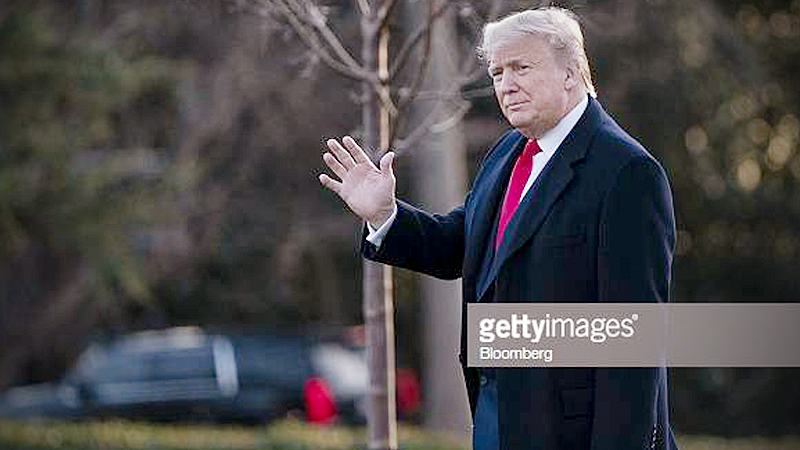
Photo: Alex Edelman/Bloomberg via Getty Images

Photo: Alex Edelman/Bloomberg via Getty Images

By Philippine Daily Inquirer
Asia News Network
Manila

The Philippines has the most confidence in US President Donald Trump among 33 countries worldwide, a survey by the Pew Research Centre shows.


At least 77 per cent of respondents in the Philippines said they had confidence Trump would do the right thing on world affairs. Only 19 per cent said otherwise.

Trump’s high rating seemed to overlook the former businessman’s stringent immigration policies that included ending what Trump had said was “chain migration”, or the practice of Filipino immigrants in the US petitioning their relatives in the Philippines to become US immigrants, too.

Trump upended decades of US immigration policy by declaring a merit-based entry for immigrants in the US, putting an end to the practice of immigrants, including those from the Philippines, of bringing relatives with them to the US through petitions.

Estimates had placed the number of Filipinos awaiting approval of petitions by relatives in the US at 200,000. Trump had effectively shut the door to these people.

According to the survey results, Trump was seen in a positive light by 69 and 78 per cent of Filipinos in his first two years in office.

This was, however, significantly lower than the rating of former US President Barack Obama — 84, 89 and 94 per cent from 2013 to 2015.

Among world leaders, Trump had the most positive review from Filipinos. Trailing him were France’s centrist Emmanuel Macron (62 per cent), Russia’s Vladimir Putin (61 per cent), Germany’s Angela Merkel and China’s Xi Jinping (both 58 per cent).

Among all nationalities surveyed by Pew, 64 per cent expressed no confidence in Trump’s handling of international affairs. Only 29 per cent felt confident Trump knew what he was doing on the world stage.

Also, the Pew survey results showed that the Philippines was the second country with the most favourable view of the US — 80 per cent, behind Israel’s 83 per cent.

The Philippines’ favourable view of Trump comes as no surprise given Trump’s earlier praise for President Rodrigo Duterte’s handling of the drug war.

The survey was conducted in 33 countries from May 18 to October 2, 2019.

It was launched months before Trump ordered the killing of Iran’s General Qasem Soleimani which drew negative reactions worldwide and has increased tension between Iran and the US.

South Korea’s population declines in December #ศาสตร์เกษตรดินปุ๋ย

#ศาสตร์เกษตรดินปุ๋ย : ขอบคุณแหล่งข้อมูล : หนังสือพิมพ์ The Nation

https://www.nationthailand.com/ann/30380165?utm_source=category&utm_medium=internal_referral

South Korea’s population declines in December

Jan 05. 2020
This photo shows a street in Myeong-dong, downtown Seoul last summer. The capital, alongside several other metropolitan cities, initiated the decrease in South Korea’s population in December 2019. (Yonhap)

This photo shows a street in Myeong-dong, downtown Seoul last summer. The capital, alongside several other metropolitan cities, initiated the decrease in South Korea’s population in December 2019. (Yonhap)
By The Korea Herald/ANN

SEJONG — State demographic data for last month indicates that South Korea is on the threshold of the era of population decline.

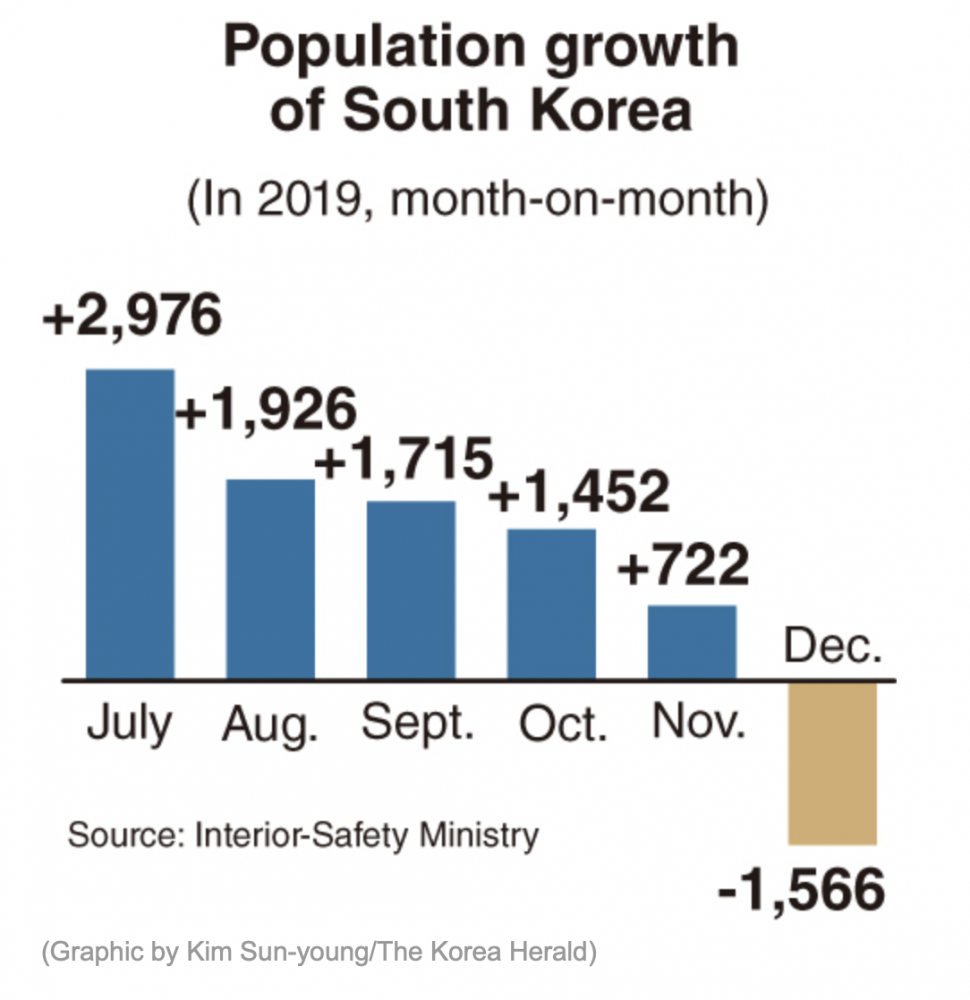
According to the Ministry of Interior and Safety, the nation’s population fell by 1,566 to record 51.849 million as of December, compared to the previous month’s figure of 51.851 million.

This marked the first time in more than 10 years since April 2009 (when it posted minus 2,716) that the monthly figure fell. While the drop in April 2009 was a sporadic occurrence, the figure in December 2019 signals a continuous drop in the coming years and decades.

The forecast among some analysts on a gradual drop in the future comes from the fact that men’s population has declined for the first time in history in 2019 on a yearly basis since the government started compiling the data.

The number of male population fell by 1,313 in 2019, compared to a year earlier. In particular, the monthly figure fell for the fifth consecutive month — minus 261 in August, minus 354 in September, minus 844 in October, minus 575 in November and minus 1,788 in December.Though the steady increase in women’s population had continued to offset the men’s figure, the number of females has also tilted toward a slowdown in growth on a monthly basis — 2,069 in September, 2,296 in October, 1,297 in November and only 222 in December.

The women’s population has yet to post a minus figure even when the negative growth for entire population was reported twice previously — in April 2009 and in March 2008 — over the past decade. The two cases were led by a decrease in the number of men.

Concerning seven major cities — Seoul, Busan, Incheon, Daegu, Daejeon, Gwangju and Ulsan — the number of male residents fell in all of the cities in December, and the female population fell in six areas excepting for Incheon.

Daegu toppled the list as the figure tallied minus 3,550 (minus 2,032 for men and minus 1,518 for women), followed by Seoul with minus 3,470 (minus 2,577 and minus 893), Busan with minus 2,880 (minus 1,748 and minus 1,132), Gwangju with minus 2,447 (minus 1,428 and minus1,019) and Daejeon with minus 2,085 (minus 1,000 and minus 1,085).

The heavy drop in Seoul and six other metropolitan cities was attributable to some citizens’ rush to new residential towns in Gyeonggi Province and Sejong, an administrative-oriented city fostered in 2012.

Gyeonggi (the nation’s No. 1 in population) and Sejong saw the number of registered residents climb 11,489 (5,424 for men 6,065 for women) and 1,928 (929 and 999), respectively, last month.

Nonetheless, the symptoms of a nationwide decline involving provincial areas have already surfaced in the wake of continuously sliding marriage rates and the world’s lowest fertility rates.

Ministry data showed that the number of childbirths stayed at 24,254 (12,422 boys and 11,832 girls) in December, compared to 37,028 (18,986 and 18,042) five years earlier in 2014.

“The number of births began being outstripped by the number of deaths in the nation,” said a demographic research fellow. “The year 2020 may mark the first time that the population will decrease on a yearly basis.”

Meanwhile, the December 2019 figure aggravated worries over the current “aged society,” based on the standards set by the United Nations.

The number of people aged 65 or over, called seniors, in Korea exceeded the 8 million mark for the first time to reach 8.02 million as of last month, who take up 15.5 percent of the population.

South Korea, which was classified as an aging society in 2000, in which the proportion of seniors topped 7 percent, and classified as aged society in 2017 with their percentage topping 14 percent.

The average age of Koreans has come to 42.6 (41.5 for men and 43.8 for women). This is quite older than 40 (38.9 and 41.2) in December 2014 and 37.5 (36.4 and 38.7) in December 2009.

Last month, the number of people aged below 9 (4.16 million) was less than half of those aged between 50-59 (8.66 million) or only two-thirds of those between 60-69 (6.31 million).

By Kim Yon-se (kys@heraldcorp.com)

http://www.koreaherald.com/view.php?ud=20200105000056

Xi highlights Yellow River development #ศาสตร์เกษตรดินปุ๋ย

#ศาสตร์เกษตรดินปุ๋ย : ขอบคุณแหล่งข้อมูล : หนังสือพิมพ์ The Nation

https://www.nationthailand.com/ann/30380162?utm_source=category&utm_medium=internal_referral

Xi highlights Yellow River development

Jan 05. 2020
The Xiaolangdi Dam on the Yellow River is seen in this file photo taken on July 5, 2018. [Photo/sipaphoto.com]

The Xiaolangdi Dam on the Yellow River is seen in this file photo taken on July 5, 2018. [Photo/sipaphoto.com]
By China Daily/ANN

President Xi Jinping on Friday underscored the importance of heightened efforts in ecological protection and pursuing high-quality development in the Yellow River Basin.

Xi, who is also general secretary of the Communist Party of China Central Committee and chairman of the Central Military Commission, made the remarks as he presided over the sixth meeting of the Central Committee for Financial and Economic Affairs. He heads the committee.

It is important to follow the principles of ecological protection and high-quality development in compiling a plan for the river basin’s development, and then ensure its implementation, a statement released after the meeting said.

It also called for efforts to follow an ecology-first policy, including green development, and to enable the transformation from too much intervention and overexploitation to natural restoration and recuperation.

The meeting underlined the significance of water conservation, and listed measures to curb unreasonable water consumption. Water utilization must be transformed from inefficiency to more economical methods, the meeting decided.

Different areas must give play to their comparative strengths and develop sectors such as grain production, other agriculture, industry and commerce based on natural conditions, the statement said.

The meeting also laid great emphasis on solving the major issues in the river basin area, saying that projects such as water source conservation, mitigation of soil erosion, comprehensive treatment of air pollution and treatment of polluted soil must move forward.

Pollution control in the Yellow River Basin must be stepped up, with greater water conservation efforts to replenish the water volume in the river, the statement said.

It also urged efforts to push forward the development of city clusters, including Lanzhou and Xining, and to enable the coordinated development of cities in the middle reaches of the Yellow River.

The leading role of key cities, including Xi’an and Zhengzhou, must be strengthened, the statement said, adding that city clusters in the Shandong Peninsula must play a pioneering role.

To force adjustments in industrial structure, the statement said, water should be used as an evaluation standard for land use and industrial production volume.

A project dealing with the protection of cultural heritage along the river will be implemented, and a Yellow River culture and tourism belt with international influence will be developed, the statement said.

The Yellow River Basin, which has a watershed of more than 752,000 square kilometers and covers nine provincial areas, sustains a population of 420 million people, or 30.3 percent of the nation’s total, and a GDP of 2.39 trillion yuan ($343 billion), or 26.5 percent of the national total, as of the end of 2018.

Xi has always attached great importance to the ecological protection of the Yellow River Basin.

He presided over a symposium in Zhengzhou in September during which the region’s ecological protection and high-quality development was placed on par with other national strategies, such as the Yangtze River Economic Belt and the Guangdong-Hong Kong-Macao Greater Bay Area.

The meeting on Friday also included the discussion of issues involved in promoting the development of a double-city economic circle in Chongqing and Chengdu — both key cities in Southwest China.

It was decided that the leading role of Chengdu and Chongqing must be emphasized so that the area can be developed into an important economic hub and a center for scientific and technological innovation.

South Korean Finance minister urges financial firms to focus on risk this year #ศาสตร์เกษตรดินปุ๋ย

#ศาสตร์เกษตรดินปุ๋ย : ขอบคุณแหล่งข้อมูล : หนังสือพิมพ์ The Nation

https://www.nationthailand.com/ann/30380096?utm_source=category&utm_medium=internal_referral

South Korean Finance minister urges financial firms to focus on risk this year

Jan 03. 2020
Finance Minister Hong Nam-ki (Yonhap)

Finance Minister Hong Nam-ki (Yonhap)
By The Korea Herald/ANN

Finance Minister Hong Nam-ki on Friday called for banks and other financial firms to improve their risk management processes and channel more funds into the real economy.

Hong made the remarks at a meeting for the new year with heads of economic and financial institutions, including Bank of Korea Gov. Lee Ju-yeol and Finance Services Commission Chairman Eun Sung-soo.

“The trend of an economic recovery is anticipated for this year, but we must remain vigilant due to uncertainties over the global economy and risk factors at home,” Hong told the meeting.

“In particular, risk management is very important for the financial sector,” Hong said.

Hong also urged the financial industry to play a role of “auxiliary troops” for the nation’s economy to see a rebound this year.

“I expect funds to be channeled into more productive sectors this year,” Hong said.

Hit by a lengthy US-China trade war and a cyclical slump in the memory chip sector, Korea is poised to report its weakest annual growth in a decade last year.

The economy is expected to grow 2.4 percent this year, following last year’s estimated 2 percent expansion, on the back of an anticipated recovery in the memory chip sector and a series of policy measures.

The nation’s financial industry should embrace innovation to counter its slowing growth, Hong said. (Yonhap)

Tokyo prosecutors search Ghosn’s home #ศาสตร์เกษตรดินปุ๋ย

#ศาสตร์เกษตรดินปุ๋ย : ขอบคุณแหล่งข้อมูล : หนังสือพิมพ์ The Nation

https://www.nationthailand.com/ann/30380068?utm_source=category&utm_medium=internal_referral

Tokyo prosecutors search Ghosn’s home

Jan 02. 2020
The Yomiuri Shimbun
Prosecutors enter the residence
of former Nissan Motor Co. Chairman Carlos Ghosn in Minato Ward, Tokyo, on Thursday afternoon.

The Yomiuri Shimbun Prosecutors enter the residence of former Nissan Motor Co. Chairman Carlos Ghosn in Minato Ward, Tokyo, on Thursday afternoon.
By The Japan News-The Yomiuri Shimbun/ANN

The special investigation squad of the Tokyo District Public Prosecutors Office began searching the home of former Nissan Motor Co. Chairman Carlos Ghosn on Thursday afternoon.

They were trying to determine how and why he fled the country.

Located in Minato Ward, Tokyo, the property was designated by the Tokyo District Court as Ghosn’s residence while he was out on bail.

https://the-japan-news.com/news/article/0006263571?fp=2b35d08b24e96686a8198bf4427ac9c2

Moon cites prosecution reform, fair society as top policy agenda in 2020 #ศาสตร์เกษตรดินปุ๋ย

#ศาสตร์เกษตรดินปุ๋ย : ขอบคุณแหล่งข้อมูล : หนังสือพิมพ์ The Nation

https://www.nationthailand.com/ann/30380054?utm_source=category&utm_medium=internal_referral

Moon cites prosecution reform, fair society as top policy agenda in 2020

Jan 02. 2020
President Moon Jae-in (Yonhap), says no powerful institution can exist above the people.

President Moon Jae-in (Yonhap), says no powerful institution can exist above the people.
By The Korea Herald/ANN

President Moon Jae-in made a commitment Thursday to complete prosecution reform and other measures aimed at promoting social justice this year, addressing a meeting with business leaders and representatives from various fields.

He vowed “clear change” for South Korea on the basis of what he says is a number of achievements made during his presidency that began in May 2017.

“‘The reform of powerful institutions’ and ‘fair society reform’ are the beginning (of the process),” he said during the event held at the Korea Chamber of Commerce and Industry headquarters in Seoul.

In South Korea, usually four state organizations — the prosecution, police, state intelligence agency and national tax service — are called powerful institutions.

In particular, reforming the prosecution service, said to have excessive power and authority, is one of the hottest topics.

“No powerful institution can exist above the people,” Moon stressed.

Only when everyone is actually equal and fair by law, “social trust” can be formed, which will serve as the basis for “co-prosperity and national unity,” he said.

“I won’t stop legal and systemic reform until powerful institutions gain the trust of the people,” he added.

He urged them to take the initiative for self-reform on their own, stating, “As the president elected by the people, I will exert all of my authority in accordance with the Constitution.”

Apparently mindful of criticism and skepticism over his reform drive, Moon said, “It’s very hard to change the big frame of state affairs, but it is a way (we) must go.”

He assured the people of an unrelenting push to enhance fairness in the country, calling it a driving force behind innovation and growth.

“We still have a long way to go for ‘fair society reform'” to meet the standards of the people, but the government will attain it at any cost, he said.

On the Korean Peninsula issue, Moon pledged efforts to “widen room to maneuver” in inter-Korean relations. (Yonhap)

http://www.koreaherald.com/view.php?ud=20200102000537