BOK chief sees modest economic recovery in 2020 #ศาสตร์เกษตรดินปุ๋ย

#ศาสตร์เกษตรดินปุ๋ย : ขอบคุณแหล่งข้อมูล : หนังสือพิมพ์ The Nation

https://www.nationthailand.com/ann/30380053?utm_source=category&utm_medium=internal_referral

BOK chief sees modest economic recovery in 2020

Jan 02. 2020
Bank of Korea Gov. Lee Ju-yeol says that a sharp increase is unlikely due to global economic uncertainties. Photo credit:Yonhap

Bank of Korea Gov. Lee Ju-yeol says that a sharp increase is unlikely due to global economic uncertainties. Photo credit:Yonhap
By The Korea Herald/ANN

South Korea’s economy is expected to experience a modest recovery this year, helped by the easing of trade tensions between the United States and China and rising global demand, the country’s central bank chief said Thursday.

“I anticipate that growth and inflation could rebound this year, compared with last year,” Bank of Korea Gov. Lee Ju-yeol told reporters, while adding that a sharp increase is unlikely due to global economic uncertainties.

Hit by a lengthy US-China trade war and a cyclical slump in the memory chip sector, Asia’s fourth-largest economy is poised to report its weakest annual growth in a decade last year.

The economy is expected to grow 2.4 percent this year, following last year’s estimated 2 percent expansion, on the back of an anticipated recovery in the memory chip sector and a series of policy measures.

Although global growth is expected to improve at a moderate pace, there still remain uncertainties regarding the persistence of trade protectionism and geopolitical risks, Lee said.

Asked whether the economy could meet the growth target, Lee replied that, “It is difficult to gauge because indices in December last year are important.”

The BOK slashed the policy rate twice last year — from 1.75 percent to 1.50 percent in July and to 1.25 percent October, matching the all-time low that was previously seen in 2016.

Many analysts have expected the BOK to further cut the rate this year.

Lee also repeated that the BOK’s monetary policy for this year will remain accommodative. The BOK will maintain its accommodative monetary policy stance, while judging whether to adjust the degree of monetary policy accommodation in overall consideration of developments in macroeconomic and financial stability conditions, Lee said. (Yonhap)

http://www.koreaherald.com/view.php?ud=20200102000389

US flies surveillance aircraft after NK warns of ‘new strategic weapon’ #ศาสตร์เกษตรดินปุ๋ย

#ศาสตร์เกษตรดินปุ๋ย : ขอบคุณแหล่งข้อมูล : หนังสือพิมพ์ The Nation

https://www.nationthailand.com/ann/30380052?utm_source=category&utm_medium=internal_referral

US flies surveillance aircraft after NK warns of ‘new strategic weapon’

Jan 02. 2020
Global Hawk (US Air Force)

Global Hawk (US Air Force)
By The Korea Herald/ANN

The United States again flew a surveillance aircraft over the Korean Peninsula, an aviation tracker said Thursday, amid simmering tensions over possible provocative acts by North Korea after it warned of a “new strategic weapon.”

An RC-135W Rivet Joint of the US Air Force carried out operations over South Korea at 31,000 feet, Aircraft Spots tweeted without specifying the exact time of the operation.

This type of aircraft has been spotted conducting missions above the peninsula over the past several days in a row, along with several other surveillance aircraft such as EP-3E and RC-135S aircraft, according to the aviation tracker.

The flight came after North Korean leader Kim Jong-un said Pyongyang no longer feels bound by the self-imposed moratorium on nuclear and long-range missile tests and that the world would witness a new strategic weapon “in the near future,” according to the North’s Korean Central News Agency on Wednesday.

The communist country has not conducted such tests since November 2017 when Kim announced a halt to all its nuclear and intercontinental ballistic missile tests, which Trump has touted as one of his key diplomatic achievements.

As its denuclearization negotiations with Washington have made little progress, however, Pyongyang has warned of taking a new way other than dialogue, and Kim said his country “will shift to a shocking actual action.”

Experts say the North’s “strategic weapon” may mean an ICBM capable of carrying multiple warheads or a submarine-launched ballistic missile. (Yonhap)

http://www.koreaherald.com/view.php?ud=20200102000170

UP’s Kanpur touches zero degrees while Delhi gets cold wave relief till Jan 4 #ศาสตร์เกษตรดินปุ๋ย

#ศาสตร์เกษตรดินปุ๋ย : ขอบคุณแหล่งข้อมูล : หนังสือพิมพ์ The Nation

https://www.nationthailand.com/ann/30380035?utm_source=category&utm_medium=internal_referral

UP’s Kanpur touches zero degrees while Delhi gets cold wave relief till Jan 4

Jan 01. 2020
By The Statesman,ANN
Severe cold wave continued unabated in Uttar Pradesh with the minimum temperature in Kanpur touching zero degrees Celsius and state capital Lucknow recording 0.7 degrees Celsius on Monday, the meteorological department said. Meanwhile, the air quality of the neighbouring Delhi improved significantly from ‘severe’ to ‘very poor’ category on Tuesday.


Delhi recorded the coldest day on Monday in last 119 years for the month of December with the day temperature recording 9.4 degrees Celsius, the India Meteorological Department said.

The IMD on Tuesday said that the Delhi temperatures are expected to rise in coming days and cold wave will subside till January 4. Delhi’s maximum temperature was recorded at 11 degrees Celsius and minimum temperature was recorded at 3 degrees Celsius.

UP’s Bahraich recorded a low of 0.2 degrees Celsius, Jhansi recorded a minimum temperature of 1.8 degrees Celsius, followed by Barabanki at 1.6 degrees Celsius) and Furstaganj in Amethi district at 1.4 degrees Celsius.

Fatehpur recorded a low of 2.2 degrees Celsius, Sutanpur 2.4 degrees Celsius, Bareilly 2.5 degrees Celsius, Churk in Sonbhadra 2.6 degrees Celsius and Banda 3.0 degrees Celsius.

Delhi’s overall Air Quality Index (AQI) crossed 300 on Tuesday morning which falls in the ‘very poor’ category, as against 440 on Monday.

An AQI between 0-50 is considered ‘good’, 51-100 is ‘satisfactory’, 101-200 ‘moderate’, 201-300 ‘poor’, 301-400 ‘very poor’ and 401-500 as ‘severe’. An AQI above 500 falls in the ‘severe plus’ category.

Air quality levels further deteriorated in Anand Vihar, recording pollution levels at 412, making it fall in ‘severe’ category. In Ghaziabad, air quality index was 348, and in Noida it was 427.

According to System of Air Quality and Weather Forecasting and Research (SAFAR), “A fresh water disturbance is very likely to affect the region by December 31 and improve surface wind speeds and ventilation. Improvement in AQI towards higher end or the ‘very poor’ category is expected. Further improvement, to the middle of the ‘very poor’ category, is expected by January 1, 2020”.

They further advised everyone to reduce heavy exertion. People with heart or lung disease, adults and children should avoid longer or heavy exertion.

The AQI of Delhi had touched 494 in November this year, making it the highest level since it touched 497 in November 2016. In comparison, the highest AQI recorded in 2018 was 450 in December.

As Delhi residents shivered in the cold, the IMD said that the city’s mean maximum temperature in December has dipped below 20 degrees Celsius only four times in past 118 years – in 1919, 1929, and 1961 with the last in 1997.

Tesla to provide movies, online games in its cars #ศาสตร์เกษตรดินปุ๋ย

#ศาสตร์เกษตรดินปุ๋ย : ขอบคุณแหล่งข้อมูล : หนังสือพิมพ์ The Nation

https://www.nationthailand.com/ann/30380033?utm_source=category&utm_medium=internal_referral

Tesla to provide movies, online games in its cars

Jan 01. 2020
A Tesla Model 3 sedan is displayed during an auto expo in Beijing. [Photo provided to China Daily]

A Tesla Model 3 sedan is displayed during an auto expo in Beijing. [Photo provided to China Daily]
By China Daily/ANN

US electric carmaker Tesla Inc will offer local movies and game services in its vehicles in China, Cankaoxiaoxi, a Chinese newspaper run by Xinhua News Agency, reported on Monday.

Tesla has signed agreements with Youku and Bilibili to offer online videos, and Tencent to provide games, including online mahjong and two poker games, to offer such services on its vehicles, according to Cankaoxiaoxi, citing Reuters.

The company will offer these services so that buyers spend more time in the car and enjoy the experience, said the newspaper citing an analysis report.

Tesla, however, said the movies and games will not play while the vehicle is in motion due to safety concerns.

Recently, Tesla has demonstrated its new entertainment function that will be pushed to owners via OTA (aerial download technology) at a digital creativity festival held by Tencent. Moreover, air quality and weather forecast information will also be increased. The new system is expected to be rolled out to Chinese customers in the first quarter of next year.

Previously, some reports claimed that Tesla could lower price for its Shanghai-made Model 3 by 20 percent or even more in 2020. The company denied the news.

China’s service sector to grow as workforce drops, study says #ศาสตร์เกษตรดินปุ๋ย

#ศาสตร์เกษตรดินปุ๋ย : ขอบคุณแหล่งข้อมูล : หนังสือพิมพ์ The Nation

https://www.nationthailand.com/ann/30380032?utm_source=category&utm_medium=internal_referral

China’s service sector to grow as workforce drops, study says

Jan 01. 2020
Candidates look at employment opportunities at a job fair in Nanjing, Jiangsu province. [Photo by Liu Jianhua/For China Daily]

Candidates look at employment opportunities at a job fair in Nanjing, Jiangsu province. [Photo by Liu Jianhua/For China Daily]
By China Daily/ANN

The size of China’s labor force is projected to see a continuous decrease, according to a green book released by the Institute of Population and Labor Economics of the Chinese Academy of Social Sciences on Monday. A green book is a type of academic study.

The workforce-people between 15 and 64 years old-will decline to around 970 million in 2025, 30 million fewer than at the end of 2020, the study projects.

Despite the drop, the study said workers will remain in short supply as the job landscape continues to change during the next decade.

In one trend, the service industry will continue to expand, providing more jobs, while those engaged in agriculture will continue to decrease.

The study said that by 2050, the workforce will have continued to drop nationally, while the flow of workers among such sectors as agriculture, manufacturing and services will intensify. Farmworkers are expected to continue to flow into the services sector.

In the near future, the job market will stay in relative balance in workforce supply and demand, according to projections for the 14th Five-Year Plan (2021-25), the study said. However, by 2030, the situation will have changed due to such factors as a slowdown in economic development.

The number of people who lose their jobs is expected to rise starting in 2030, as new technological and economic trends deepen, according to the study’s projections.

A slowing of economic development will create challenges for employment, said Lai Desheng, a professor in the department of social and ecological civilization at the Party School of the Central Committee of the Communist Party of China. Lai spoke at a news conference for the green book’s release.

“High technology such as artificial intelligence and computing sciences and also the international commerce landscape will greatly influence employment,” he said. “Employment is not merely a social issue but is also key to the nation’s economy.”

Feng Xiliang, director of the School of Labor and Economics at the Capital University of Economics, said at the news conference that high-quality employment is a long-term target as the nation’s economic development goes through a transformation.

The demand for employees “changes with the emergence of new industries and professions”, he said, citing the example of food delivery workers, who have more flexible work hours and higher wages than most migrant workers. “It’s really important in order to improve working conditions to encourage more people to take jobs in new industries,” Feng said.

President Xi delivers 2020 New Year speech #ศาสตร์เกษตรดินปุ๋ย

#ศาสตร์เกษตรดินปุ๋ย : ขอบคุณแหล่งข้อมูล : หนังสือพิมพ์ The Nation

https://www.nationthailand.com/ann/30380031?utm_source=category&utm_medium=internal_referral

President Xi delivers 2020 New Year speech

Jan 01. 2020
President Xi Jinping delivers a New Year address to extend New Year greetings to all Chinese, and best wishes to friends all over the world, in Beijing, Dec 31, 2019. [Photo/Xinhua]

President Xi Jinping delivers a New Year address to extend New Year greetings to all Chinese, and best wishes to friends all over the world, in Beijing, Dec 31, 2019. [Photo/Xinhua]
By China Daily/ANN

BEIJING – President Xi Jinping on Tuesday delivered a New Year speech in Beijing to ring in 2020, pledging to achieve the first centenary goal of building a moderately prosperous society in all respects in the “milestone” year.

“Let’s seize the day and live it to the full,” Xi said.

Here are some highlights:

On GDP

China’s gross domestic product (GDP) is expected to near 100 trillion yuan ($14.37 trillion) in 2019.

China’s per capita gross domestic product (GDP) is expected to reach $10,000 in 2019.

On poverty relief

Around 340 poor counties across China will get rid of poverty and more than 10 million people will be lifted out of poverty by the end of 2019.

A victory will be secured in the battle against poverty in 2020.

All rural residents living below the current poverty line will be lifted out of poverty and poverty will be eliminated in all poor counties in 2020.

On cutting taxes, fees

China has cut over 2 trillion yuan (around $287 billion) of taxes and fees in 2019.

On diplomatic relations

China continues to embrace the world in 2019, and the number of countries China has established diplomatic relations with has reached 180.

On Hong Kong

Xi extended best wishes to Hong Kong and Hong Kong compatriots.

“The situation in Hong Kong has been everybody’s concern over the past few months,” said Xi.

“Without a harmonious and stable environment, how can there be a home where people can live and work happily!” Xi said. “We sincerely hope for the best for Hong Kong and Hong Kong compatriots.”

A prosperous and stable Hong Kong is the aspiration of Hong Kong compatriots, as well as the expectation of the people of the motherland, he said.

China’s manufacturing PMI remains stable in December #ศาสตร์เกษตรดินปุ๋ย

#ศาสตร์เกษตรดินปุ๋ย : ขอบคุณแหล่งข้อมูล : หนังสือพิมพ์ The Nation

https://www.nationthailand.com/ann/30380030?utm_source=category&utm_medium=internal_referral

China’s manufacturing PMI remains stable in December

Jan 01. 2020
Employees assemble vehicles at an automobile plant in Weifang, Shandong province. [Photo by Wang Jilin/for China Daily]

Employees assemble vehicles at an automobile plant in Weifang, Shandong province. [Photo by Wang Jilin/for China Daily]
By China Daily/ANN

BEIJING – The purchasing managers’ index (PMI) for China’s manufacturing sector stood at 50.2 in December, unchanged from November, the National Bureau of Statistics (NBS) said Tuesday.

A reading above 50 indicates expansion, while a reading below it reflects contraction.

This marks the second straight month of expansion, partly buoyed by booming supply and demand as well as increasing export orders, said NBS senior statistician Zhao Qinghe.

On a month-on-month basis, the sub-index for production gained 0.6 points to 53.2 in December, signaling faster expansion, while that for new orders fell slightly to 51.2.

Imports and exports were improving in December, said Zhao, as the sub-index for new export orders gained 1.5 points to 50.3, the first expansion since June 2018. The sub-index for imports climbed 0.1 point month on month to 49.9.

The PMI of mid-sized enterprises went up 1.9 points from the previous month to 51.4, while that of big enterprises fell slightly to 50.6.

In December, PMI of high-tech manufacturing, equipment manufacturing and consumer goods all rose for the third straight month, showing accelerated transformation and upgrades, said Zhao.

Meanwhile, the PMI for China’s non-manufacturing sector edged down to 53.5 in December, the NBS data showed.

The sub-reading for the service sector’s business expectations fell to 59.1, still in the expansion zone, showing that non-manufacturing enterprises remained optimistic about future market prospects, Zhao said.

The readings showed signs of stabilizing in the economy, thanks to the effects of its counter-cyclical adjustment efforts, though the approaching Spring Festival put a dent in the construction and wholesale sectors.

Wen Tao, an analyst with the China Logistics Information Center, attributed December’s stable manufacturing PMI to higher market demand unleashed by the coming holidays and a bigger contribution of new engines of the economy.

Data for the whole year showed that China has maintained a relatively sound economic development in 2019, Wen noted, adding that the country has greater economic resilience and capacities to fend off risks to ensure a steady economic growth in the following year.

As prospects remain unclear in 2020, continued efforts should be made to reinforce the foundation of economic development, said Zhang Liqun, a researcher with the Development Research Center of the State Council.

Tuesday’s data also showed China’s composite PMI slid slightly to 53.4, but was 0.3 points higher than this year’s average, indicating steady expansion in the production of China’s companies.

Malaysia introduces 6-per-cent tax on services from Google, FB and Airbnb #ศาสตร์เกษตรดินปุ๋ย

#ศาสตร์เกษตรดินปุ๋ย : ขอบคุณแหล่งข้อมูล : หนังสือพิมพ์ The Nation

https://www.nationthailand.com/ann/30379997?utm_source=category&utm_medium=internal_referral

Malaysia introduces 6-per-cent tax on services from Google, FB and Airbnb

Dec 30. 2019
 Dr Yeah Kim Leng

Dr Yeah Kim Leng
By The Star Online
PETALING JAYA

With the new digital tax coming into effect on Wednesday, consumers in Malaysia could be facing an increase in prices for a number of overseas-based digital services.

For instance, a college student who buys computer software priced RM260 (Bt1,900) online may have to pay an extra RM15 in digital tax.

And an entertainment streaming subscription of RM40 a month may cost another RM28 a year.

The digital tax was announced as part of the budgetin 2019, which outlined that a 6-per-cent service tax would be imposed on foreign digital services – including software, music, video and digital advertising – effective the first day of January in 2020.

A Customs Department spokesman said at least 126 foreign digital service providers had registered for the tax in Malaysia as of December 20, among them Netflix, Spotify, Google and Airbnb, he said.

“As of now, we do not know how many foreign companies are eligible, so the implementation of the tax will be based on the soft approach. “This means we will provide notices inviting such companies to register for the tax, should the company reach the threshold, ” the spokesman said in a message.

He said that the tax collected from the companies would then be remitted to the Customs Department. Economist Professor Dr Yeah Kim Leng said the digital tax would “level the playing field” between local and foreign digital service companies.

“Digital players based in Malaysia are already paying or collecting the 6-per-cent Sales and Services Tax (SST) from customers.

“With the digital tax kicking in next year, foreign service providers will be covered. Some players like Airbnb are already implementing the tax for the government, ” he said.

Brynner Chiam, director at tax advisory company Axcelasia Taxand, however, said the impact was not likely to be significant. “This is because Malaysian households tend to spend less on digital services in comparison to tangible goods,” he said. “Another factor is that the adoption of e-commerce among Malaysian consumers is relatively low at 51.2 per cent, ” he said, referring to a 2018 survey by the Malaysian Communications and Multimedia Commission.

The digital tax legislation, which was gazetted in July this year, will affect overseas-based companies which offer digital services, including online licensing of software, mobile applications and video games, online platforms which sell products and services and digital content services.

Under the new law, tax defaulters can face a fine of up to RM50,000 and/or imprisonment of up to three years if found guilty.

Google Malaysia recently said a 6-per-cent digital tax would take effect on its G-suite services.

Facebook also said it would be charging the 6-per-cent digital tax for its advertisements in Malaysia, while PlayStation Store said it would apply the tax on purchasable items and subscriptions on their platform. Other companies, such as Netflix and Spotify, have yet to announce whether they will absorb the tax or charge it to their users.

Foreign companies who provide digital services have been allowed to register with the Customs Department since October 1.

Registration for foreign service providers is mandatory if its annual turnover from digital services exceeds RM500,000.

Other countries which also impose the digital service tax include Australia (10 per cent), Norway (25 per cent) and South Korea (10 per cent).

All eyes on Pyongyang as Kim opens key party meeting #ศาสตร์เกษตรดินปุ๋ย

#ศาสตร์เกษตรดินปุ๋ย : ขอบคุณแหล่งข้อมูล : หนังสือพิมพ์ The Nation

https://www.nationthailand.com/ann/30379981?utm_source=category&utm_medium=internal_referral

All eyes on Pyongyang as Kim opens key party meeting

Dec 29. 2019
Image taken from Pyongyang’s KCNA`s website shows North Korean leader Kim Jong-un speaking during the fifth Plenary Meeting of the seventh Central Committee of the Workers` Party of Korea on Saturday. (Yonhap)

Image taken from Pyongyang’s KCNA`s website shows North Korean leader Kim Jong-un speaking during the fifth Plenary Meeting of the seventh Central Committee of the Workers` Party of Korea on Saturday. (Yonhap)
By The Korea Herald/ANN

North Korean leader Kim Jong-un chaired the first part of a key ruling party meeting in Pyongyang on Saturday, amid speculation that the communist state may proclaim a “new path” in the face of stalled disarmament talks with the United States.

Attended by key party and military officers, the fifth plenary session of the seventh Central Committee of the Workers’ Party discussed “details regarding building of the state and its defense,” the North’s official Korean Central News Agency said.

“In response to changed situation at home and abroad, we intend to enhance our strategic position and empower the state, while engaging in a policy of struggle to further the building of socialism,” the state-run media outlet said.

The KCNA referred to Saturday’s session as “the first day” and said the session would be “continued.” No further details about the meeting’s outcome were provided.

Not since 1990, when a meeting of the committee extended for five days, has one of its meetings lasted longer than a day.

“The extended meeting is to demonstrate Kim’s comprehensive engagement in every affair of the state,” Shin Beom-chul, a senior fellow at the Asan Institute for Policy Studies in Seoul, told The Korea Herald.

Required to be convened at least once annually, the plenary meeting of the North’s highest decision-making body has served to unveil Kim’s major policy initiatives.

It comes as Washington maintains its stony silence on Pyongyang’s demands for relief from biting UN sanctions by the year-end deadline that Kim set.

The hermit state has warned that it will pursue a “new path” if the US continues to hold to the crippling sanctions, and Kim has urged the US to offer concessions since the Hanoi summit in February ended with no agreement.

At a subsequent meeting in April this year, Kim said he would not succumb to the US sanctions.

At an earlier meeting in April 2018, Kim and his party had adopted a unanimous resolution to demolish the now-defunct Punggye-ri nuclear test site and to halt intercontinental ballistic missile tests.

Some observers say the North’s new path could be lifting that moratorium and resuming weapons development.

Urging the US to offer concessions to resolve their differences in the denuclearization talks, the North spoke of a “Christmas gift,” widely interpreted as a hint at some kind of weapons testing.

In the run-up to the holiday, Washington flew a series of surveillance aircraft over the Korean Peninsula in case of a missile launch, but Pyongyang let Christmas pass without any provocation.

Cheong Seong-chang, director of the Center for North Korean Studies at the Sejong Institute, said the fact that the ongoing party meeting is not a single-day event signals that North Korea has important issues on the table.

“Given that the meeting goes on for two days unlike previous ones, Kim and his officers appear to have a lot to talk about Pyongyang’s policies on Seoul, Beijing, Moscow and Washington, as well as its economic agendas,” according to Cheong.

Holding up Pyongyang’s hard line against Washington and the regime’s nuclear deterrence program may have been discussed, he said.

Kim Dong-yup, a professor at Kyungnam University’s Far East Institute in Seoul, said even if the North decides to resume its weapons program, it will still put the economy high on its national agenda.

“I am not saying national defense is no longer important here. But it’s more that North Korea now sees it as a means to shore up its economy and prosperity, beyond the regime’s survival.”

South Korea: Feud for helm of Hanjin Group intensifies #ศาสตร์เกษตรดินปุ๋ย

#ศาสตร์เกษตรดินปุ๋ย : ขอบคุณแหล่งข้อมูล : หนังสือพิมพ์ The Nation

https://www.nationthailand.com/ann/30379980?utm_source=category&utm_medium=internal_referral

South Korea: Feud for helm of Hanjin Group intensifies

Dec 29. 2019
Cho Hyun-ah, the former vice president of Korean Air (left) and Cho Won-tae, Hanjin Group's chairman. (Yonhap)

Cho Hyun-ah, the former vice president of Korean Air (left) and Cho Won-tae, Hanjin Group’s chairman. (Yonhap)
By The Korea Herald/ANN

The family feud for the helm of Hanjin Group, the South Korean conglomerate that owns flag carrier Korean Air, appears to be intensifying as the chairman reportedly kicked up a storm at his mother’s house on Christmas.

On Sunday, media outlets here reported that group Chairman Cho Won-tae visited the home of his mother, Lee Myung-hee, in the Jongno area of Seoul on Wednesday with his family. There, he reportedly broke a window and items in the house.

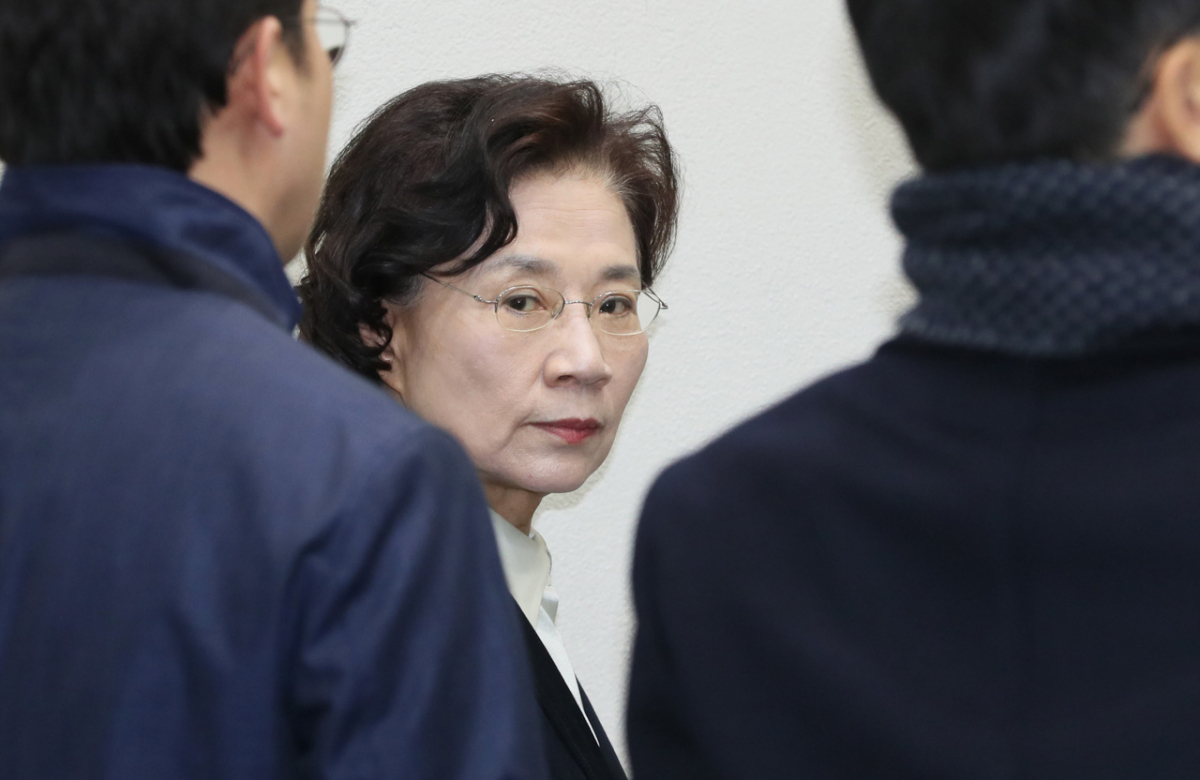
Lee Myung-hee (Yonhap)

Lee Myung-hee (Yonhap)

The incident reportedly occurred because his mother sided with his older sister, Cho Hyun-ah, in the siblings’ dispute over the management of the company. Lee reportedly took pictures of the damage and a wound to her arm, and showed them to the company’s top management officials while asking for protection.

Cho Won-tae, 44, was appointed as chairman of Hanjin Group’s holding company Hanjin KAL in April, when his father died from a chronic disease. He is also the president and CEO of Korean Air, the group’s main cash cow.

Amid rumors that the two siblings are at odds over the succession, Cho Hyun-ah, the former vice president of Korean Air, issued a statement last week via a law firm to express a complaint against her brother.

In the statement, Cho Hyun-ah said her brother had failed to heed the late chairman’s instructions to ensure the “harmonious, joint management” of the company with other family members and that he had been “insincere” in family discussions.

Cho Hyun-ah, the infamous “nut rage” heiress, has been standing back from management since last year, after a series of power abuse scandals involving her and her younger sister, Cho Hyun-min.

While she was expected to take charge of the KAL Hotel Network, she was again left out in the latest executive reshuffle last month.

The family dispute is likely to continue as Hanjin KAL’s general stockholders meeting is slated for March, when stockholders are to decide whether Cho Won-tae will serve another term as executive director. His current tenure is expected to end March 23.

As of Dec. 23, the Cho family currently holds a 24.79 percent stake in Hanjin KAL. Cho Won-tae holds 6.52 percent, Cho Hyun-ah 6.49 percent, Cho Hyun-min 6.47 percent and Lee Myung-hee 5.31 percent.