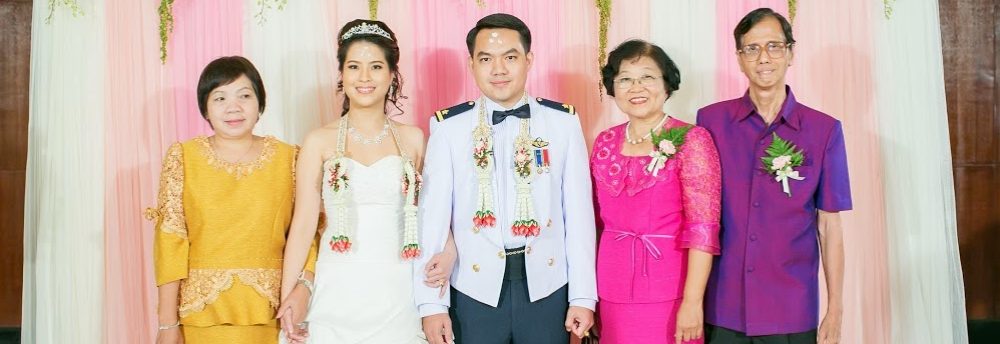
The opening ceremony for the Network of ASEAN Plus Three Culture Cities was held on Oct 25 in Yangzhou, East China’s Jiangsu province. [Photo provided to Chinaculture.org]
By Zhu Linyong
China Daily
59 Viewed
The launch ceremony for the ASEAN plus China, Japan and ROK Culture Cities Network was held on Oct.25 in Yangzhou, East China’s Jiangsu province.
The event drew about 200 attendees, including Li Jinzao, vice minister of China’s Ministry of Culture and Tourism, representatives of the Culture Cities of East Asia from China, Japan and Republic of Korea, and cultural officials of the ASEAN Cities of Culture from ASEAN countries, officials from the Trilateral Cooperation Secretariat and the ASEAN China Center, as well as diplomats from these countries’ embassies in China.
“Developing a Network of ASEAN Plus Three Culture Cities is an important part of the 21st ASEAN plus China, Japan and ROK Summit in cultural exchanges. It is a further step to strengthen exchange and cooperation among culture cities in China, Japan, South Korea and ASEAN countries,” said Vice Minister Li Jinzao.
“It is also a crucial measure to help tap into the potential for long-term partnerships between China, Japan, South Korea and the ASEAN countries, and to promote regional cooperation in cultural fields.”
Li hoped that the Culture Cities of East Asia and the ASEAN Cities of Culture will take this opportunity to work out more sustainable and fruitful exchanges and cooperation.
Representatives of the Culture Cities of East Asia and the ASEAN Cities of Culture all spoke highly of the establishment of the Network of ASEAN Plus China, Japan and ROK Culture Cities.
They hoped that through the newly-launched platform, exchanges and dialogues will increase and cooperation will be strengthened among these countries.
The ASEAN Plus China, Japan and ROK Culture Cities Network is one of the ensuing moves to implement proposals made by Chinese Premier Li Keqiang at the 21st ASEAN Plus China, Japan and ROK Summit.
It is widely believed that network’s launch is a critical move to enhance the branding of the Culture Cities of East Asia and to round out the Alliance of the East Asian Cultural Cities.
The launching ceremony coincided with the Mayors’ Forum of the Culture Cities from China, Japan, South Korea and ASEAN countries, which concluded with the announcement of the ASEAN Plus China, Japan and ROK Culture Cities Yangzhou Initiative.
Travellers who visit the Unesco World Heritage town of Luang Prabang in Laos can immerse themselves in the local culture and customs at a Buddhist Learning Centre located at the foot of Mount Phousi.
The centre, recently launched by Amantaka Resort, is designed to educate guests on the practices and principals of Buddhism, the main religion in Laos.
As part of the experience, abbot Sengdao Santikaro offers daily private teachings for guests, taking them through the five principals of good living. Each session explores how meditation enables guests to recharge, switch off and be present.
In addition, a senior monk will give personalised tours of Wat Siphoutthabath, giving visitors an authentic glimpse into his world.
Travellers can take part in many other spiritual festivals in Luang Prabang.
The Light Festival, which honours the spirit of the river, takes place annually between Oct 12 and 14. During this time, temples are decorated with colourful candles, garlands and paper stars, but the highlight is the boat parade that makes its way around the town towards the Mekong River.
Throughout March, the Boun Mahasat festival is celebrated in temples across Laos.
Besides going on a spiritual journey, there are a lot of other stuff to check out.
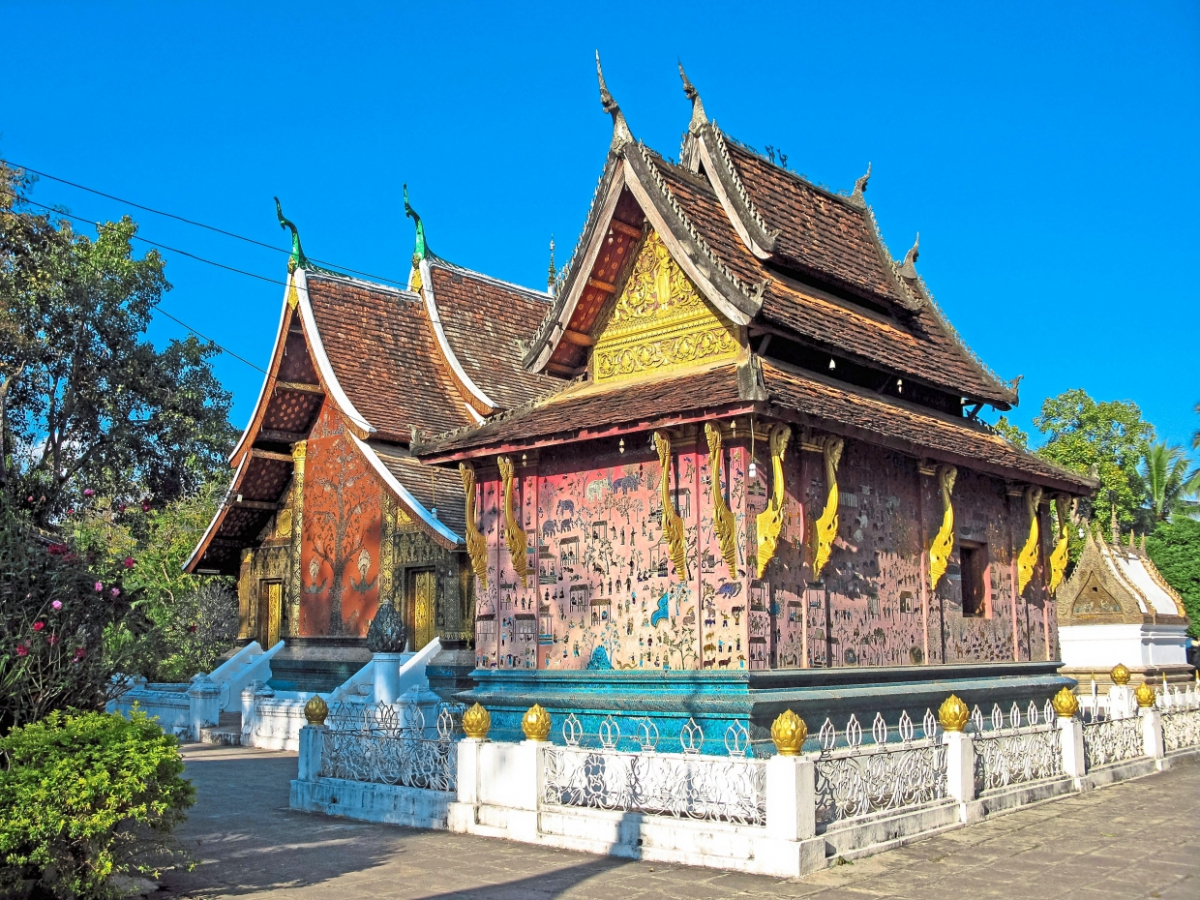
Wat Xieng Thong Temple in Luang Prabhang is famous for its glass mosaic decorated walls.
Architectural wonders
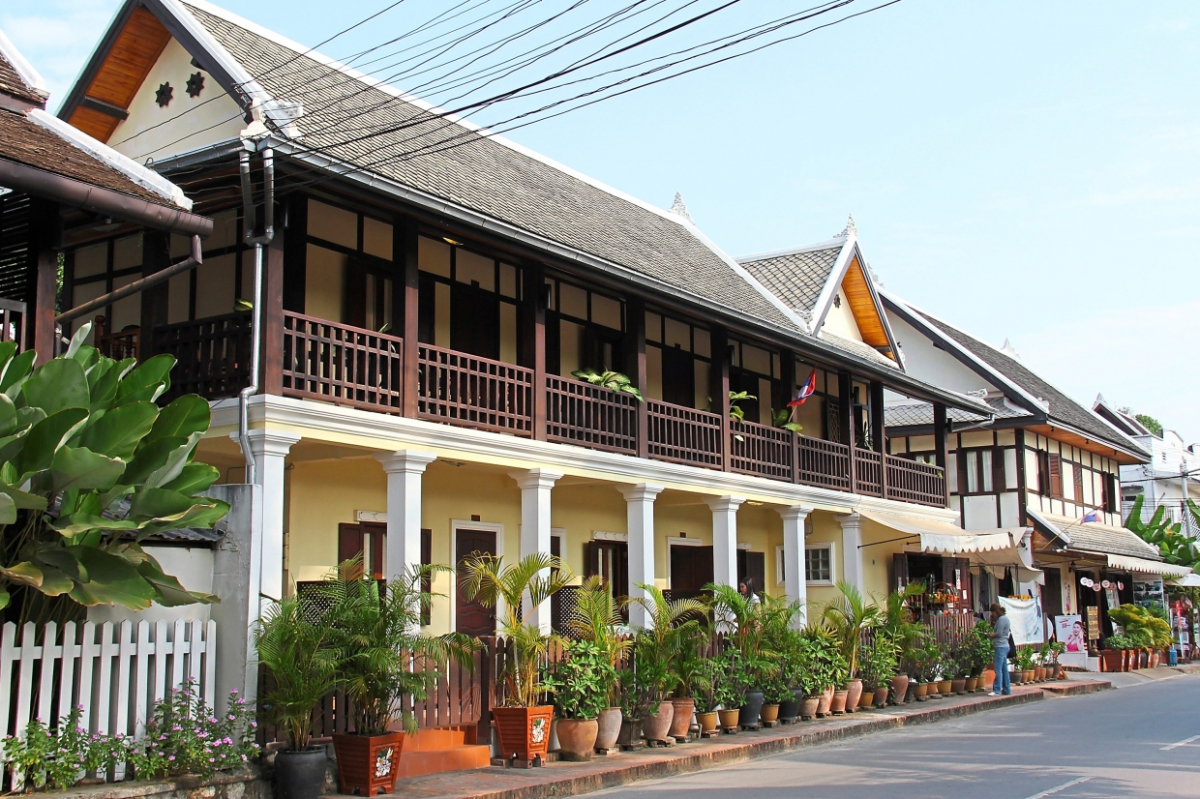
The city has an eclectic mix of old temples and French colonial buildings.
Even travellers who might not be into spiritual stuff might be keen to visit architectural wonders such as Wat Xieng Thong with its magnificent glass mosaic walls. There is also the former Royal Palace, now used as a national museum.
It was built in the Laotian and French style. In its gardens is Haw Pha Bang, a royal temple which houses the country’s most revered Phra Bang Buddha statue.
Shopping galore
Shop at the open markets for pretty souvenirs, clothing, accessories and more. There are also quaint boutiques featuring local designers.
Fusion and local cuisine
Wine and dine at cafes, bars and restaurants offering Laotian and fusion cuisine.
Luang Prabang is an amalgamation of traditional temples and French colonial buildings.
Go on a hike
Hike up Mount Phousi in the late afternoon where you can get a breathtaking 360° view of the entire city with its temples, river and mountains in the distance.
This is especially beautiful during sunset. Halfway up the hill is Wat Tham Phousi with a reclining Buddha and also a Buddha statue in a grotto, while at the summit is Wat Chomsi, a golden Buddhist shrine.
About 30km from Luang Prabang, there is also the picturesque three-tiered Kuangsi Waterfall.
Ayodhya sets World Record as 5 lakh 51 thousand diyas lit to celebrate Deepawali
Oct 27. 2019
Assistant Minister and Deputy Speaker of the parliament of the Republic of Fiji Veena Kumar Bhatnagar was the chief guest. (Image: Twitter@BJP4Karnataka)
By The Statesmen
67 Viewed
The temple town of Ayodhya in the state of Uttar Pradesh on Saturday stamped its name in the book of the world records as over 5 lakh 51 thousand earthen lamps or diyas were lit on the banks of the river Saryu and other places as part of the Grand Diwali celebrations at Ayodhya, say the reports.
In fact, this is the third consecutive year that Deepotsav has been celebrated on such a massive scale in Ayodhya, fondly also called Ramnagari. The Uttar Pradesh government has given Ayodhya Deepotsav the status of a State Fair and the whole management and expenses are borne by the state government.
Last year, more than 3 lakh earthen lamps were lit on the banks of Saryu river. Prominent among those present on the occasion were State Governor Anandiben Patel, various Ministers of Central and State Government and other dignitaries. Assistant Minister and Deputy Speaker of the parliament of the Republic of Fiji Veena Kumar Bhatnagar was the chief guest.
Speaking on the occasion Chief Minister Yogi Adityanath said that India, under the leadership of Prime Minister Narendra Modi, has taken Indian culture and values to the entire world. He said that his government is establishing “Ramrajya” where the government’s welfare schemes are being implemented among the people without any discrimination on the basis of caste, creed and religion.
Veena Kumar Bhatnagar said that the relations between India and Fiji are very strong and deep-rooted.
Earlier, Yogi Adityanath inaugurated and dedicated several developmental projects worth Rs 226 crores for Ayodhya.
‘Taiwan LGBT Pride’ attracts record-breaking 200,000 participants
Oct 27. 2019
週六「2019台灣同志遊行」吸引超過二十萬人一同共襄盛舉| The 2019 Taiwan LGBT Pride, organized by Marriage Equality Coalition Taiwan, attracted more than 200,000 visitors from around the world. (Courtesy of Marriage Equality Coalition Taiwan)
By The China Post staff with CNA
66 Viewed
“Taiwan LGBT Pride” (台灣同志遊行) attracted more than 200,000 participants on Saturday, calling for the public to embrace the lesbian, gay, bisexual and transgender community, especially now that same-sex marriage has been legalized in Taiwan.
More than 200 groups were in attendance this year. (Courtesy of Marriage Equality Coalition Taiwan)
Themed “Together, Make Taiwan Better,” the event has successfully set a new record for the annual Taipei extravaganza that started in 2003 with a few hundred participants. It has since become the largest of its kind in Asia.
The marchers departed early in the afternoon from Taipei City Hall Plaza and walked in a very light mood to Ketagalan Boulevard in front of the Presidential Office, brandishing rainbow flags and sporting flamboyant costumes.
Among the marchers, hundreds of staff from 37 companies, such as Google, GAP, Unilever and Citibank, to name just a few, and foreign trade representative offices, including the United States, Australia, the European Union, the United Kingdom, France and Belgium, joined the revellers.
The event was organized by the Marriage Equality Coalition Taiwan, the official platform advocating for the passage of marriage equality bills in the Civil Code in 2016. The coalition is comprised of five LGBTQ+ and gender organizations – Awakening Foundation, GagaOOLala, Taiwan LGBT Family Rights Advocacy, The Lobby Alliance for LGBT Human Rights and Taiwan Tongzhi Hotline Association.
Taiwan’s parliament (Legislative Yuan) passed the Enforcement Act of Judicial Yuan Interpretation No. 748 May 17 to allow two people of the same gender aged 18 or older to register a marriage. The act took effect May 24, making Taiwan the first country in Asia to legalize same-sex marriage.
People dressed in rainbow colors for the occasion. (Courtesy of Marriage Equality Coalition Taiwan)
But Cheng Chi-wei (鄭智偉), a representative of the Taiwan Tongzhi Hotline Association, told CNA that Taiwan still needs to move forward on the issue of transnational same-sex marriage because, at the moment, Taiwan’s law does not permit same-sex marriage if at least one partner is from a country where such unions are not legal.
For instance, a Taiwan national can’t have same-sex marriages with people from Japan, South Korea, Thailand, Singapore, Malaysia, India, and other areas of Asia, according to pioneering gay rights activist Chi Chia-wei (祁家威).
Chi, who attended the parade, said that allowing same-sex marriage with people from those countries is the “last mile” on the road to marriage equality in Taiwan.
Participants pose for a photograph on a road painted in rainbow colors in Shi-men Ting. (IG:penyogaster)
The Taiwan LGBT Pride Parade was first launched in 2003 and has grown from only a few hundred participants to over 130,000 last year. The event carries a new theme every year, ranging from anti-discrimination to calling for the legalization of same-sex marriage.
According to the Ministry of the Interior statistics, a total of 2,155 same-sex marriages were registered in Taiwan as of the end of September, of which 1,461 pairs were women and 694 were men.
Traditional Chinese medicine, practised for thousands of years, is having trouble maintaining traction in many parts of the country, said the president of a TCM hospital in Henan province.
“I have visited many counties across the country and found many of them do not have a single TCM hospital,” said Pang Guoming of Kaifeng Hospital of TCM in Kaifeng. “In some counties, TCM hospitals use the old buildings of other hospitals, which have moved to bigger and new buildings.
“TCM is a unique health resource for China, and more effort should be made to promote it so it plays a bigger part in universal healthcare.”
The development of TCM is expected to accelerate, with a guideline recently approved by the top leadership aimed at promoting innovation and the passing on of TCM knowledge.
Equal importance should be given to the development of TCM and Western medicine to promote their complementary nature, said the guideline, which was released and approved in July. More efforts should be made to improve the TCM service system, promote high-quality development of the TCM industry and boost TCM talent building, it said.
“Release of the guideline has highlighted the importance of developing TCM in the context of the government’s ‘healthy China’ strategy,” said Pang, who is also a deputy to the National People’s Congress.
There were more than 60,000 TCM hospitals and clinics in China by the end of last year providing 1.2 million beds, an increase of nearly 100,000 beds compared with the previous year, according to the National Health Commission.
TCM hospitals and clinics in China provided nearly 1.1 billion patient services last year, a rise of 5.2 per cent compared with 2017, it said. However, modern hospitals provide the majority of services, with total patient services provided by hospitals and clinics-including modern medicine and TCM hospitals and clinics-reaching 7.5 billion in the first 11 months of last year, a year-on-year rise of 3.2 per cent.
“Compared with how modern medicine is regarded, many local authorities still have not given enough importance to TCM development.
“Meanwhile, many people tend to evaluate empirical TCM with standards meant for modern medicine, which is also a major obstacle to TCM development and recognition,” Pang said.
TCM can work together with Western medicine to contribute to prevention and control, Pang said, adding that TCM remedies and treatments can be innovated even more broadly.
A widely known example is Tu Youyou, who won the 2015 Nobel Prize in physiology or medicine for the discovery of the chemical compound artemisinin. Tu and her Chinese colleagues gained the insight that led to their discovery while reading a TCM prescription book that was more than 1,600 years old. Artemisinin-based combination therapies have been recommended by the World Health Organization as the priority drug for the treatment of malaria, which causes more than 400,000 deaths worldwide every year.
Ma Jianzhong, chairman of the World Federation of Chinese Medicine Societies, said in addition to innovation in TCM theory, technological innovation is necessary to spur the development of TCM.
“TCM technologies must borrow modern technology so that it can play a better role in treatment,” Ma said.
S. Korea could hold talks with Japan next month on trade row
Oct 27. 2019
Minister of Trade, Industry and Energy Sung Yun-mo
By Yonhap
The Korea Herald
60 Viewed
South Korea and Japan could sit down for a second round of talks next month in a move to work out their differences over Tokyo’s export restrictions, a top official has said. Sung Yun-mo, minister of trade, industry and energy, made the comments in a recent brief comment to Yonhap News Agency on Thursday. Sung did not provide a specific time frame.
The talks are part of a dispute settlement process under rules of the World Trade Organization.
Earlier this month, the two neighbors failed to reach an agreement in their first talks in Geneva in connection with Seoul’s complaint with the global trade body over Tokyo’s export restrictions.
In July, Tokyo imposed tighter regulations on exports to Seoul of three materials — resist, etching gas and fluorinated polyimide — that are critical for the production of semiconductors and flexible displays. Japan later removed South Korea from its list of trusted trading partners
South Korea views the Japanese moves as retaliation against last year’s South Korean Supreme Court rulings ordering Japanese firms to compensate South Korean victims of forced labor during Japan’s 1910-45 colonial rule of the Korean Peninsula.
Japan has claimed that the regulations were necessary because South Korea operates a lax control system on the trade of sensitive goods.
On Thursday, South Korean Prime Minister Lee Nak-yon held talks with Prime Minister Shinzo Abe in Tokyo for 21 minutes, and the two agreed on the need to address the problem of strained bilateral relations.
Lee also handed over a letter from South Korean President Moon Jae-in to Abe, in which Moon expressed hope for an early resolution. Lee was in Tokyo for the formal enthronement ceremony of Japanese Emperor Naruhito.
The trade dispute has spilled into other spheres of bilateral relations, with South Korea deciding in August to terminate a military intelligence-sharing pact with Japan. The pact is set to expire on Nov. 23.
Vietnamese agencies support families of potential lorry victims
Oct 27. 2019
Police officers escort the lorry in which 39 dead bodies were discovered. — AFP Photo
By Vietnam News
70 Viewed
Worried families who fear their loved ones were aboard the deadly Essex lorry can contact special hotlines to provide information to the authorities, the Việt Nam’s Ministry of Foreign Affairs said on Friday.
The grim discovery of 39 dead bodies inside the truck was made on Wednesday in Essex, England. At first, police in the UK said the nationality of those killed was Chinese, but now a number of concerned families in Việt Nam fear their relatives may have been among the dead.
One 26-year-old from Hà Tĩnh Province, Phạm Thị Trà My, is reported to have sent a text message to her mother not long before she died.
Now the Ministry of Foreign Affairs has told the Embassy of Việt Nam in the UK to work closely with the UK police to define the victims’ nationalities.
The embassy said it is working closely with British agencies to speed upthe investigation process.
The Consular Department under the ministry has been assigned as a contact to co-ordinate with relevant agencies and local authorities to provide information to assist in the victim identification process.
To receive assistance in relation to the case, people can contact the Embassy of Việt Nam in the UK via its hotline for assisting overseas Vietnamese at +44 7713 181501 or Việt Nam’s general citizen protection hotline at +84981 8484 84
Barely getting any attention in the national media is the report about the grisly death of 39 people (8 women and 31 men), believed to be Chinese nationals, who appear to have been trapped inside a refrigerated trailer truck in an industrial zone in Essex, England. This has been a trending topic on Chinese social media since Oct. 22 when the frozen bodies were found by the Essex police. The initial reports, viewed by 800 million people and commented upon by 40,000 netizens, attest to the global
The full picture of what happened is not yet available. But the details provided by daily police reports reveal a familiar pattern of human smuggling usually associated with desperate migrants fleeing from poverty-stricken and war-torn societies in the Middle East and North Africa. Prosperous and economically resurgent China, which yearly sends out millions of cash-laden tourists to various parts of the world, is scarcely known nowadays as a source of economic refugees.
As one netizen wryly notes, echoing a common one-dimensional belief in China’s progress: “Life in China is quite good now. Why are people still choosing to be smuggled? Do they think everything is free in other countries?” Indeed, the last time something like this happened was 19 years ago, when 58 Chinese nationals died from suffocation inside a container van in the port of Dover, also in the United Kingdom. The Dover-to-Calais route, across the English Channel, links the British Isles to France and the rest of Europe, and is a favoured route among travellers.
One cannot know how many attempts at human trafficking, employing long-haul cargo trucks and sealed container vans, have been successfully carried out in the last two decades. This latest incident shows that other more circuitous routes are now being used for the same purpose. Tracking data from a GPS device mounted on the rented refrigerated van, in which the 39 victims were trapped, indicate that the route taken was the sea crossing between Bruges in Belgium and Essex County in Southeast England. Essex is only about 40 miles from London.
The same GPS tracking information shows that the trailer made two trips between the United Kingdom and Europe, using the same route, from Oct. 16 to Oct. 22, the day the cargo of 39 human beings was illegally shipped to England. The question that is baffling investigators is whether the first trip was a dress rehearsal for the second, or was carrying another batch of illegal migrants.
Whoever is behind this heinous business clearly has the capability to tap services in at least four countries: Britain, Ireland, Belgium and France. Consider this: The trailer was rented from a trailer rental company based in Ireland. It was picked up by a truck driver from Northern Ireland and transported from Dublin (Ireland) to North Wales (United Kingdom), and from there to Europe (possibly Dunkirk in Northern France). From Dunkirk, it passed through Lille, another city in Northern France, before proceeding to nearby Bruges in the Flemish region of Belgium. The migrants may have been picked up and loaded into the trailer van somewhere in France or Belgium.
On its return trip, the trailer shipped out of Zeebrugge in Belgium on Tuesday afternoon, Oct. 22, and arrived shortly after midnight in the port of Purfleet in Essex, England. After clearing customs and immigration, the driver brought the trailer containing his human cargo to the nearby Waterglade Industrial Park, where the journey was supposed to culminate. It was there that the 39 dead bodies were discovered a few hours later.
The 25-year-old driver of the cab, a freelance haulier, has been arrested and placed in custody. Chances are he may know only so much, given the typically compartmentalized nature of such operations. A human trafficking syndicate with an elaborate network of brokers and facilitators appears to be behind this scheme.
The breaking news on this tragedy—a macabre metaphor for globalization and its discontents—adds a new twist to this incident. Even as almost all of China has been glued to social media for the latest developments on these so-called “lorry deaths,” an anxious family in Vietnam gets a text from daughter Pham who, on Oct. 3, left for England via China and France.
The heartbreaking message read: “I’m sorry Dad and Mom. The way I went overseas was not successful. Mom, I love Dad and you so much. I’m dying because I can’t breathe. Mom, I am so sorry, Mom.” This was received at 4:28 a.m. Oct. 23, Vietnamese time (or 10:28 p.m. Oct. 22, British time), when the trailer van must have been at sea, on its way to England.
The family, according to Pham’s brother, had paid $38,000 for the trip that was supposed to bring her to Britain. The money may have been sourced from pooled savings or from the sale of property or, worse, from loan sharks. What it suggests is that it is not sheer poverty, so much as the quest for a better life, that drives this form of migration. Vietnam is not yet like China, but it is surely one of the better-performing economies in our region.
Global communication has brought the stark reality of gross inequality — across the world and within countries — to the consciousness of anyone who surfs the internet. That would include, most of all, the world’s young people and the stagnant middle class. What is upon us is not just a new version of the “revolution of rising expectations” of an earlier era. What we are dealing with here is a mood or sensibility that is fueled by a strange blend of anticipation, of faith amid uncertainty, and of recklessness compounded by resentment. It is what drives this generation to protest or to flee.
Palace: Duterte to attend Asean Summit in Bangkok but with ‘spacing’
Oct 26. 2019
Palace: Duterte to attend Asean Summit in Bangkok but with ‘spacing’
Oct 26. 2019
Philippine Daily Inquirer file photo
By By: Nestor Corrales
INQUIRER.net 86 Viewed
MANILA, Philippines — Despite the “unbearable pain” felt by President Rodrigo Duterte that led to his premature homecoming from Japan, the Chief Executive would still attend the forthcoming Asean Summit in Thailand.
President spokesman Salvador Panelo issued this assurance Friday albeit with a suggestion that Duterte might implement “spacing” in his attendance to the summit’s “too punishing” schedule.
The 35th Association of Southeast Asian Nations (Asean) Summit will be held in Bangkok from November 2 to 4.
Duterte has complained of “unbearable pain” in his spine while in Japan for the enthronement of Emperor Naruhito, days after he fell off a motorcycle Thursday last week, sustaining bruises and scratches.
Doctors advised Duterte to minimize physical activities, according to Panelo. But Duterte will “definitely” attend the Asean Summit in Bangkok, he said.
“Tuloy pa rin iyon, walang magbabago doon. Pero iyong spacing medyo babaguhin na natin kasi nga punishing masyado eh,” Panelo said in a Palace briefing.
(That will push through, nothing there will change. But we will somewhat change the spacing because the schedule is too punishing).
“Iyong activity niya tuloy pa rin pero i-minimize mo iyong physical activity mo. Saka siguro, iyong mga events niya, iyong space, i-space niya dahil masyadong punishing ang schedule,” he added.
(His activities will continue but his physical activities will be minimized. Also maybe, his events, the space, he will space it because the schedule is too punishing).
Panelo said the President was advised to not stand or walk too long.
“Actually, ang ano sa kanya, hinay-hinay ka lang dahil hindi ka naman na spring chicken. ‘Wag kang masyadong matagal iyong duration ng standing mo saka walking,” he said.
(Actually, what was advised to him was take things slowly because he is not a spring chicken anymore. He should not stand and walk too long).
Is spite of issues on his health, Panelo said the President is okay.
“[H]e is in good health, we don’t have to worry about that,” he insisted.
During the 33rd Asean Summit in Singapore on November 2018, Duterte had skipped some events as he took “power naps” because he needed to recharge.
Violence begets violence as more protests hits Hong Kong on the weekend.
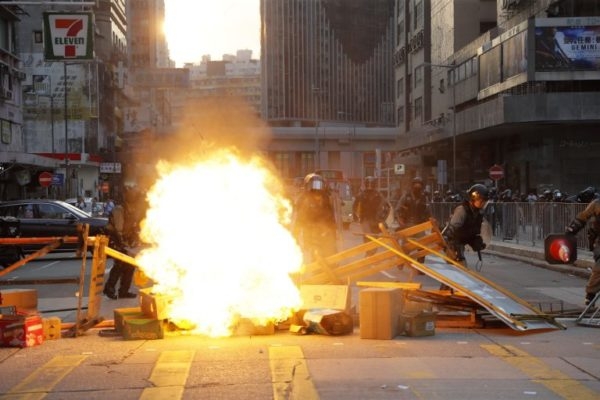
An illegal protest rally through Hong Kong’s Tsim Sha Tsui spiraled into chaos on Sunday, as protesters began to engage in acts of vandalism and arson even as the police warned of a response.
Signs of trouble began to emerge towards the end of the march near the West Kowloon terminus in a now familiar pattern. Protesters were seen spraying over the MTR logo with black paint, building barricades and digging up bricks from the ground.
At Tsim Sha Tsui Police Station, demonstrators tossed multiple rounds of Molotov cocktails at the station and police responded with multiple volleys of tear gas from the upper floors of the building while warning protesters over a loudspeaker to stop. Two hoses were constantly spraying water to douse the flames.
A similar scene played out at the Mong Kok police station, prompting officers inside to raise an orange flag signaling to protesters to disperse or be fired upon.
In more violence, petrol bombs were thrown into the exit of Yau Ma Tei MTR station as well as the Mong Kok MTR station, while branches of Best Mart 360 and Yoshinoya were attacked by protesters. A protester was seen using an electric chainsaw to cut down a CCTV camera, before setting it on fire.
Meanwhile, a Bank of China outlet was fire-bombed at Canton Road, while one of its ATMs was vandalized in Yau Ma Tei. Roadblocks were set up on Mong Kok Road and Tong Mi Road, with steel fences, road signs and trash bins, which were then set on fire, causing traffic disruptions.
There were unconfirmed reports of shots being heard and protesters in Yau Ma Tei said tear gas had been fired. Local media reports said that a water cannon firing blue dye was used on Nathan Road.
The organizers of the demonstration went ahead with the march through Tsim Sha Tsui despite a ban on the procession by the authorities, with the territory’s train operator bracing for chaos.
Molotov Cocktails Tossed at Tsim Sha Tsui Police Station
Police had banned the march in the city’s Kowloon district, citing concerns over public safety, and a court on Saturday said the destination of the march – the main railway interchange with mainland China – could be attacked and vandalized.
The planned route for the march, aimed at opposing a law banning face masks that was introduced on Oct. 5, was from Tsim Sha Tsui to the express rail terminus in West Kowloon.
Members of the Civil Human Rights Front, which was behind million-strong and two-million-strong protests in June, had vowed to carry on marching in their personal capacity despite the ban.
The protesters, numbering in the tens of thousands, stretch banners reading “Free Hong Kong” across the ground, while other posters read “Hongkongers Resist”. Graffiti on one wall read, “Better Dead than Red”.
Hong Kong leader Carrie Lam on Sunday pledged to find other ways to assuage concerns about police conduct during the protests if an official probe into key incidents during the turmoil failed to do the job.
Mrs. Lam said the Independent Police Complaints Council (IPCC) would focus on controversial episodes during the escalating protests, including an attack by alleged gangsters on protesters in Yuen Long and a police charge at Prince Edward station.
However, Mrs. Lam did not outline her plans if the police watchdog’s investigation, the findings of which are to be made public by the end of this year, does not pacify angry residents.
Both Critics And Supporters Say Carrie Lam Failed to Inspire
“We sincerely hope to show the public the truth about these incidents,” she said.
“But if the report of the independent IPCC, when it is delivered, still fails to quell the controversies with a lot of doubts in society, at that time I believe the chief executive and the (Hong Kong) government will definitely think of another way to make a sufficient response to the public,” she said.
Security was tightened ahead of the anti-government march, with some public facilities shuttering as pro-democracy leaders called on citizens to join the protest in spite of the risk of arrest.
“Carrie Lam is not listening to us at all. This may work in China but not in Hong Kong,” Cheung, a 33-year-old woman wearing a face mask and black T-shirt, symbols of the democracy movement, told Reuters. She declined to give her first name.
“You can’t ask a city that already has freedom to walk backward. You can’t close the door and keep everyone inside. You can’t do this in an international city,” she said, adding she was not afraid of being arrested.
Chinese Tourists Heckled in Tsim Sha Tsui
The police issued a warning to protesters in a statement.
“At around 1.30 p.m., some protesters gathering at Tsim Sha Tsui are blocking the carriageways on Nathan Road near Salisbury Road, and are committing the offense of ‘Participating in an unauthorized assembly’,” the statement said.
“Police appeal to members of the public to leave immediately. Due to the obstruction of traffic, drivers are advised to stay tuned to the latest traffic arrangement,” it said.
In a separate statement issued in the late afternoon, the police said it would conduct dispersal and arrest operations soon, dubbing the protesters’ rioters.
At the city’s high-speed rail station in Kowloon, several areas were closed and only passengers with tickets were permitted entry. All food and beverage outlets were also closed.
Members of the group are also asking for reform of the police force, which has come under fire for alleged brutality and a lack of accountability.
Protesters Running from Tear Gas Fired in Tsim Sha Tsui
In anticipation of chaos breaking out after the march, as has been seen before after peaceful rallies, the city’s train operator shut down the Austin and Tsim Sha Tsui stations from midday on Sunday.
Other stations or exits might also be closed without prior notice.
Train services were scheduled to end at 10 p.m. as MTR continues to repair the damages to its facilities. The Airport Express — which runs between Hong Kong Station and the airport — will be the only exception and will run till 1 p.m.
According to the MTR website, Mong Kok, East Tsim Sha Tsui, Yau Ma Tei, Prince Edward, Austin and Tsim Sha Tsui stations were closed and trains would not stop at those stations.
Train stations have been a common target of protesters who believe MTR Corporation is pro-China.
The unrest in Hong Kong is approaching five months as protesters press the government to give in to their five demands, including amnesty for those arrested and an independent probe into alleged police brutality.
A prayer sit-in on Saturday evening drew hundreds of people to the central business district, while on Friday, protesters formed a human chain along with the metro network. Many donned masks in defiance of a ban on covering faces at public rallies.
Prominent human rights activist Jimmy Sham was attacked by hammer-wielding men last week in the gritty Mong Kok district in Kowloon. Pro-democracy lawmakers said the attack was designed to intimidate protesters and incite violence.
Mr. Sham heads the CHRF. On Saturday, Mr. Sham issued a public “Letter to Hong Kong”.
Hong Kong Democracy Activist Injured in Knife Attack
“I have been attacked twice within 45 days. In fact, my family and friends have been harassed by different forces as well. I cannot compare my wounds with those who suffer from police violence and torture.
The pains of my injuries are far less than that of seeing our authority falling. Today, one of us was assaulted severely in Tai Po. I really wish such a terrible attack no longer happens,” wrote Mr. Sham.
He said the Civil Human Rights Front upholds the principle of peaceful, rational and nonviolent resistance. However, he said the organization’s commitment to organizing peaceful, rational and non-violent rallies and assemblies has been repeatedly objected by the police commissioner of Hong Kong.
“The government doesn’t tolerate dissenting opinion and isn’t capable to solve the social problems. Rather, it only attempts to silence people who address the problem. It only shows that the government is deceiving itself,” wrote Mr. Sham.
He said the CHRF appealed against the police objection to the proposed rally on Sunday, but although his colleagues tried their best to explain the importance of holding the rally the appeal board, it was rejected.
“Therefore, what we can do is to stand with each other, and face the inevitable fear and challenges tomorrow,” he wrote.
“I am moved by the human chain action last night. I received a photo from my friend. The photo portraits a protestors’ banner saying, ‘we are all Jimmy Sham’. I would like to express my gratitude to everyone. I am moved by your bravery and efforts that make me experience a sense of belonging: We are all Hongkongers,” Mr. Sham wrote.
Mr. Sham wrote that he would like to ask two favors of Hong Kongers.
“First of all, let us connect with and protect each other. Do not label anyone by ethnicity in the movement. I believe that, everyone who joins this path to democracy are our brothers and sisters, regardless of nationality, language, color and race.
“Second, please take care of yourself. Go home safely. I send my wish to everyone who take a risk and gives themselves for Hong Kong, and my colleague as well as senior fellows who take an act of civil disobedience tomorrow,” wrote Mr. Sham.
He concluded his letter with “Peace be with you. I love you all.”
Later in the day, the CHRF issued a statement saying that Mr. Sham had left Kwong Wah Hospital.
“He has to continue to receive medical treatment and physical therapy. Thus he will not attend any public events in the coming days. Jimmy expresses his gratitude to everyone who concerns his condition,” the statement said.
![The opening ceremony for the Network of ASEAN Plus Three Culture Cities was held on Oct 25 in Yangzhou, East China’s Jiangsu province. [Photo provided to Chinaculture.org]](https://media.nationthailand.com/images/news/2019/10/27/30377784/800_a2270293868ca51.jpeg?v=1572147731)