Samsung Galaxy Fold available again in Korea, soon in Japan, China

ศาสตร์เกษตรดินปุ๋ย : ขอบคุณแหล่งข้อมูล : หนังสือพิมพ์ The Nation

https://www.nationthailand.com/ann/30377372

Samsung Galaxy Fold available again in Korea, soon in Japan, China

Oct 13. 2019
(Yonhap)

(Yonhap)
By The Korea Herald/ANN

369 Viewed

The third batch of Samsung Galaxy Fold smartphones were set to be released in the Korean market Monday, drawing attention to the total volume of available units.

Samsung was to begin taking orders for the foldable gadget on its homepage as well as some e-commerce platforms like 11st, eBay and Coupang at midnight on Sunday, according to the tech giant.

The exact volume of the third batch has not been revealed, but industry officials estimate around 10,000 units would be rolled out.

According to market forecasts, Samsung has released around 20,000 Galaxy Folds so far for the Korean market alone through the first and second rounds of preorder-based sales in September. Despite the high price tag of 2.39 million won ($2,020), the available units sold out in just a few minutes for the two previous batches.

Now the third session is drawing public attention to the strictly controlled volume of limited-edition phones.

“It seems like Samsung is exploiting the value of rarity,” said an industry official. “Because of the limited volume, the phone’s value has been raised incredibly.”

The official predicted that Samsung Display has prepared a total of 100,000 foldable AMOLED display panels for the Fold, including a portion set aside for potential replacements for defective ones.

After being sold out not only in Korea but also in the United States, United Kingdom, Germany, Singapore and France, Samsung plans to debut the foldable device in challenging markets like Japan, Poland, Mexico and Switzerland later this month.

For the Japanese market, the Galaxy Fold will not have the Samsung logo on the hinge of the in-folding device, a strategy Samsung is employing in the market dominated by American rival Apple. The Fold’s Japan launch is slated for Oct. 25.

Samsung will also venture into the Chinese market again with the Fold on Nov. 1, which will see it compete against Huawei’s foldable Mate X.

The Korean company has suffered slumps in China sales in recent years, accounting for less than 1 percent in market share.

By Song Su-hyun(song@heraldcorp.com)http://www.koreaherald.com/view.php?ud=20191013000149

BTS writes history with Arab fans at Riyadh concert

ศาสตร์เกษตรดินปุ๋ย : ขอบคุณแหล่งข้อมูล : หนังสือพิมพ์ The Nation

https://www.nationthailand.com/ann/30377371

BTS writes history with Arab fans at Riyadh concert

Oct 13. 2019
BTS performs to their mega-hit song “Boy With Luv” at the concert. (Big Hit Entertainment)

BTS performs to their mega-hit song “Boy With Luv” at the concert. (Big Hit Entertainment)
By The Korea Herald/ANN

388 Viewed

RIYADH – For BTS and the 30,000 screaming Arab fans who filled King Fahd International Stadium in Riyadh, Saudi Arabia, on Friday evening, it was a night to remember.

The pack-filled King Fahd International Stadium in Riyadh glows in purple. (Big Hit Entertainment)

The pack-filled King Fahd International Stadium in Riyadh glows in purple. (Big Hit Entertainment)

“We’d never thought we would perform here. Thanks to all the people, to all the ARMYs (BTS’ fandom) who made this possible. There is a beautiful full moon up in the sky. Remind of us, remind of tonight,” band leader RM called out to the crowd.

Indeed, BTS’ Saudi Arabian leg of its ongoing “Love Yourself: Speak Yourself” world tour was a new experience for the group.

While BTS is no stranger to stadia, given its past concerts in London’s Wembley Stadium and California’s Rose Bowl Stadium, the K-pop juggernaut’s performance in the ultra-conservative kingdom has been veiled in mystery, with questions about how it might differ from the act’s previous shows.

As expected, the weather was extremely dry and hot. Female fans were mostly shrouded in abaya, a body-covering black dress that Saudi women wear in public, and Azan, the Islamic call to prayer, went on and off around the stadium prior to the event. It was all quite different from your typical buildup to a K-pop concert.

But other things seemed more familiar: some 100 fans greeting the act at the airport, the ear-shattering screams, enthusiastic singalongs and thousands of dazzling ARMY bomb light sticks at the venue, all of which were a sign to how much fans here have waited for the K-pop phenomenon to come. Signaling the start of the nearly three-hour set was the electrifying first note of party anthem “Dionysus” that blared through the stadium. Fireworks followed, and as two gigantic silver-metallic panthers that had been guarding the stage slowly rose the seven polished men of BTS appeared behind them.

Back from their headline-making five-week vacation, the group’s stage presence was a spectacle. In front of a backdrop of Roman pillars, the singers ruled the stage with nonstop energy, jumping from chair to chair and showcasing their tight performance atop a Last Supper-inspired marble table that moved around the stage.

After ending their lung-busting first song, BTS immediately launched into another pulsating banger, “Not Today,” with the same level of energy.

Moments later, the members finally took a close look at their adoring fans, who responded with such volume that nearly rattled the venue with capacity of almost 70,000.

“Hello, we are BTS. Welcome to BTS World Tour: Love Yourself, Speak Yourself, in Riyadh, Saudi Arabia!” exclaimed RM to the exhilarated crowd. Other members followed suit, with Jimin shouting out, “We’re finally having a stadium tour here,” and Jin belting out, “Unbelievable. Riyadh, can you hear me?”

In an attempt to connect with fans in their mother tongue, V said, “Look at this! BTS and ARMY, we made this. Ahbak (‘I love you’ in Arabic). You made this concert. Thank you ARMYs.”

J-Hope also thanked fans in Arabic for making the event happen.

It was a truly surreal moment. In the lead-up to the concert, BTS’ decision to play in the kingdom had sparked controversies as a result of Saudi Arabia’s poor human rights record, all the more after other international artists faced criticism for performing in the country in recent months.

Women have only been allowed to enter King Fahd Stadium since 2017. And both the band and its fans seemed to weigh on the significance of their long-awaited encounter.

“We know that you always give us so much love and support even we live a thousand miles away. Tonight is the festival for ARMYs for sincerely waiting for us,” said RM.

Smoothly moving onto next song “Wings,” he announced, “Now it’s time to fly around the stadium!”

The rest of the show was an ebb and flow through BTS’ seven-year career. Running at full throttle, the band went onto serve up its quintessential hits like “Boy with Luv,” “Idol,” “Fake Love,” “MIC Drop,” “Dope,” “Baepsae,” and “Fire,” coupled with extravagant light displays, fireworks and explosive energy.

Audience members, regardless of gender or age, staff and even security personnel held up their cellphones to record the act’s head-turning performance, especially during the bombastic “Idol.” The Riyadh show also featured some slight modifications in consideration of local sentiment, such as “non-revealing outfits and the absence of choreographies that show the singers’ abdominal muscles,” according to an official from BTS’ agency Big Hit Entertainment.

Highlights included solo performances from each member. J-Hope rapped to “Just Dance” and Jungkook crooned while harnessed onto a zipline.

Jimin emerged from a plastic bubble-cocoon during his sensual “Serendipity,” RM boasted his leadership by making the crowd chant “sarang,” the Korean word for love, for his rap solo “Love,” while V’s mesmerizing “Singularity” began with the singer rising up from a suspended bed while wearing a wine-colored robe. Suga softened fans’ hearts with his mellow rap in “Seesaw,” while Jin did the remaining job of melting them with his emotional “Epiphany.”

The event also had a birthday surprise for Jimin, during which the members celebrated their bandmate’s birthday by singing a birthday song in Arabic.

“I had forgotten it was my birthday. Thank you for the wishes, and I’m so glad that I could celebrate with the fans and the members,” Jimin replied, jumping around the stage with joy.

As the show came to its close, the boys reunited on the stage to share their feelings. V went first.

“So many fans are here. I can’t believe that we could have filled this stadium. I hope to come back here again. I’ll go back home with happiness thanks to you guys. See you next time,” he said.

Suga picked up from him and said, “It’s our first time here in Saudi, and I was very surprised by how much you guys have enjoyed our show. Shall we come back again, like seriously?”

“As we’ve worked hard, we could have finally come to Saudi,” Jungkook added. “Tonight was a blast thanks to ARMYs. I hope you guys also felt happiness from this show. Please keep supporting and loving us.”

BTS performs at King Fahd International Stadium in Riyadh on Friday. (Big Hit Entertainment)

BTS performs at King Fahd International Stadium in Riyadh on Friday. (Big Hit Entertainment)

Jin drew out laughter by kindly yet jokingly requesting the event’s translator to “include their emotions to the translation,” and Jimin, with his eyes twinkling with potential tears, said, “Every moment has been a happiness. Today, we’ve once again realized that there are so many people who support us in this world. We won‘t forget to work harder to reciprocate. With all my heart, love you.”

J-Hope took his turn: “I missed this scream, this atmosphere. We’ve been very nervous, but also very happy to have finally met you in a long time. I’m your amal (‘hope’ in Arabic). Shukran!”

At RM’s orchestration, the venue lit up with a beautiful wave of cellphone lights. BTS wrapped up a memorable night with encore tracks “So What,” “Make it Right” and “Mikrokosmos.”

There were no more mysteries left. The night with BTS was awe-inspiring and the fans overflowed with love. Overall, it was a testament to BTS’ perpetual global popularity that has already dominated one of the most conservative countries in the world.

“What is important here is that the universal charm and message of BTS’ music have been constantly accepted by, and speaking to a completely different Islamic culture. There have been some K-pop events held in Islamic regions in the past, but I think the heat and attention on BTS’ Riyadh show are something very unique,” culture critic and the author of book “BTS — The Review: A Comprehensive Look at the Music of BTS” Kim Young-dae told The Korea Herald.

“Through this concert, BTS’ music and message will be able to deliver some positive messages to Islamic countries. I think the show has a historic meaning in that beyond its successful result, it has the possibility to serve as a momentum for the continuous BTS phenomenon. Furthermore, it might provoke further global interest in K-pop and its culture, providing opportunities for other groups.”

BTS is set to wrap up its world tour with concerts in Seoul from Oct. 26-29.

By Hong Dam-young (lotus@heraldcorp.com)http://www.koreaherald.com/view.php?ud=20191013000127
Hokuriku Shinkansen train depot flooded

ศาสตร์เกษตรดินปุ๋ย : ขอบคุณแหล่งข้อมูล : หนังสือพิมพ์ The Nation

https://www.nationthailand.com/ann/30377369

Hokuriku Shinkansen train depot flooded

Oct 13. 2019
The Yomiuri Shimbun
Shinkansen trains are seen flooded due to heavy rains by Typhoon No. 19 in Nagano, on Sunday.

The Yomiuri Shimbun Shinkansen trains are seen flooded due to heavy rains by Typhoon No. 19 in Nagano, on Sunday.
By The Japan News/ANN

1,072 Viewed

East Japan Railway Co. (JR East) said Sunday that its Shinkansen train depot in Nagano was flooded after a dike of the Chikuma River burst in the Hoyasu district in Nagano.

The company said it has heard that train cars of the Hokuriku Shinkansen line were inundated by flood waters in the aftermath of powerful Typhoon No. 19.

As an evacuation order has been issued in the district, JR East officials were unable to approach the train depot center. Thus, there is no way to specifically assess the situation.

Services on the Hokuriku Shinkansen line were scheduled to resume around noon Sunday, but JR East said it is unknown now when that will take effect.

According to a Yomiuri Shimbun tally, as of 1 p.m. on Sunday, Typhoon No. 19 had claimed the lives of 16 people in Tochigi, Gunma, Kanagawa, Iwate, Miyagi, Fukushima, Saitama and Chiba prefectures, with 20 people missing.

The Yomiuri Shimbun A crane twisted by a strong wind is seen on a rooftop of a building under construction in Shibuya Ward, Tokyo, on Saturday.

The Yomiuri Shimbun A crane twisted by a strong wind is seen on a rooftop of a building under construction in Shibuya Ward, Tokyo, on Saturday.

On his first day in Kathmandu, Xi announces Rs 56 billion in economic assistance over the next two y

ศาสตร์เกษตรดินปุ๋ย : ขอบคุณแหล่งข้อมูล : หนังสือพิมพ์ The Nation

https://www.nationthailand.com/ann/30377359

On his first day in Kathmandu, Xi announces Rs 56 billion in economic assistance over the next two y

Oct 13. 2019
By The Kathmandu Post

383 Viewed

The Chinese president also announced that China would conduct the detailed project report for the long-awaited Kathmandu-Kerung cross-border railway.

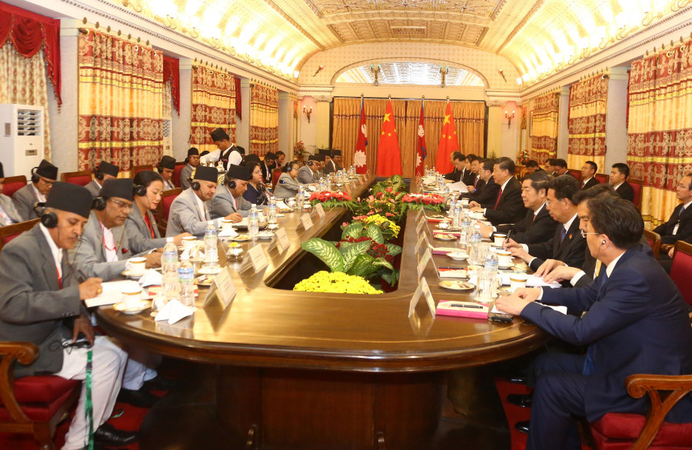
Chinese President Xi Jinping arrived in Kathmandu on a two-day state visit on Saturday, in what Foreign Minister Pradeep Gyawali described as a “big diplomatic success” of the KP Sharma Oli administration.

“The Chinese president’s visit is quite important,” Gyawali told the Post. “While development cooperation and partnership are on the agenda, our key focus is deepening our friendship with China.”

About an hour after landing at Tribhuvan International Airport at 4:46 pm, Xi started his official engagements, beginning with delegation-level talks with President Bidya Devi Bhandari.

“In an atmosphere of utmost cordiality and friendship, President Bhandari and President of the People’s Republic of China, Xi Jinping, held bilateral talks at Office of the President,” tweeted the Ministry of Foreign Affairs.

“I am impressed with the way I was cordially welcomed and received at the airport today,” the Chinese President told his Nepali counterpart during the meeting, according to a Foreign Ministry official who was present at the delegation-level talks. “That was memorable and showed how the Nepali people love the Chinese people.”

Xi further said that China always stands for Nepal’s development and praised Nepal for also standing by the one-China policy.

During the meeting with Bhandari, Xi announced that China will provide Rs 56 billion in aid for Nepal over the next two years, according to a Nepali official who was present at the meeting.

“This Chinese aid will be provided for 2020-22 as economic assistance to Nepal,” the official told the Post on condition of anonymity.

Later on Saturday evening, at a banquet hosted by Bhandari, Xi further announced that China would conduct the detailed project report for the trans-Himalayan railway that will connect Kathmandu with China. The preparation of a DPR was for the 72-kilometre rail line between Kerung and Kathmandu was high on the agenda. China will conduct the DPR within two years, said Xi. Details will be made public on Sunday.

Xi, while referring to the announcement of conducting the DPR of the rail project, said that Nepal will no longer remain landlocked, it will now be a land-linked country.

Addressing the banquet at the Soaltee Crowne Plaza, Xi also said that China would extend all possible cooperation to make Visit Nepal 2020 a success.

On Sunday, Xi will hold delegation-level talks with Prime Minister KP Sharma Oli and the two countries will sign around a dozen and a half agreements and memoranda of understanding on various areas, ranging from infrastructure, connectivity, education, people-to-people relations, trade, commerce, energy, and cross-border transmission lines.

In what political analysts are calling the arrival of a new geopolitical actor in Kathmandu, China is likely to generously loosen its purse strings.

Officials said agreements and memoranda of understanding worth over $5 billion are expected to be signed on Sunday.

If final negotiations yield positive results, agreements and understandings to be signed on Sunday are expected to be worth between $8 billion and $10 billion in projects identified under the Belt and Road Initiative (BRI), according to top government officials involved in the negotiations.

China will be offering grants as well as soft loans for various projects under the BRI and other non-BRI projects too, including upgrading the Kodari Highway, the only highway that links China with Nepal. Nepal has proposed expanding the Kodari Highway from Miteri Bridge to Dhulikhel under a Chinese grant, according to officials.

Two stalled hydropower projects—the 762MW Tamor and 1,200MW Budhi Gandaki—are likely to be revived with Chinese investment. On Friday, a meeting of the Investment Board Nepal awarded the survey licence to Nepal’s Hydroelectricity Investment and Development Company and its Chinese joint venture, Power Construction of China Limited, to carry out survey works to develop the project, which would need an investment of $1.3 billion. Negotiations are also ongoing for the Kimathanaka-Arun hydropower project, which will have an installed capacity of 1,020 megawatts.

Agreements for the establishment of the Madan Bhandari Science and Technology University in Chitlang, Makwanpur, which is expected to cost Rs 43 billion; construction of at least three north-south corridors—Koshi, Karnali and Gandaki—that will link the Indian and Chinese borders; construction of the six-kilometre Tokha-Chahare tunnel; a road up to Rasuwagadhi via Betrawati in Nuwakot; and the Kimathanka-Hile road section will also be signed.

Other projects under the same package include upgrading the Kimathanka and Korala border points, setting up an Ayurvedic medicine plant in Nepal, and cooperating in the energy sector with the construction of a 400kV transmission line.

“We are currently working to sign agreements and MoUs for around 17 projects, but back-channel negotiations to reach an agreement on the exact number are ongoing with the Chinese side,” said Foreign Minister Gyawali.

A key announcement that everyone is looking forward to is the much-talked-about “surprise” announced by the Chinese before Xi’s visit.

“We are not sure whether there will be a separate ‘surprise package’ to Nepal as the Chinese side has not disclosed anything yet,” said another official who was part of the delegation-level talks requesting anonymity because he was not allowed to speak to the media.

A joint communiqué will be released at the end of the visit.

Singapore leads East Asian surge in global economic competitiveness

ศาสตร์เกษตรดินปุ๋ย : ขอบคุณแหล่งข้อมูล : หนังสือพิมพ์ The Nation

https://www.nationthailand.com/ann/30377358

Singapore leads East Asian surge in global economic competitiveness

Oct 13. 2019
By Asia News Network
Phnom Penh

334 Viewed

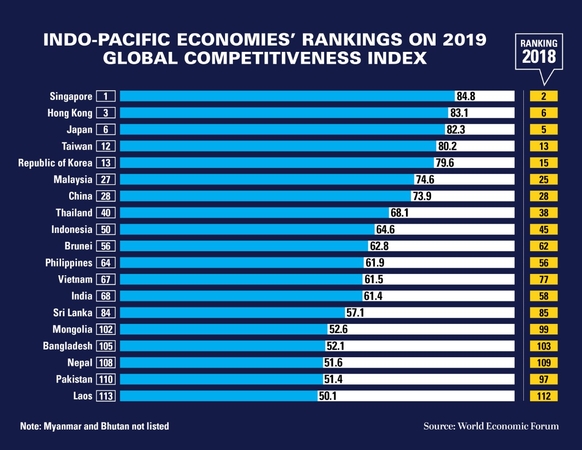
The economies of East Asia and the Pacific as a region outperformed other regions of the world with the highest media score, led by Singapore which was elevated to the world’s most competitive economy, according to the World Economic Forum’s 2019 Report.

The annual competitiveness index, which calibrated drivers of productivity and long-term growth in its 40th annual assessment, saw eight of the 19 listed economies in the Indo-Pacific region improve their rankings. The world’s second-largest economy – China – held on to the 28th position.

Meanwhile, a peek below the surface of the rankings shows a wide gap between the highest-performing East Asian and Pacific countries and the lowest. The gap is wider than the comparable data for Europe and North America.

Thanks to an improvement in its overall score, combined with a diminished performance by the United States, Singapore has overtaken the US as the world’s most competitive economy.

The WEF particularly highlighted Singapore’s financial system, market efficiency and macro-economic stability. The country, however, scored less impressively when it came to markers like freedom of the press — it ranks 124th — and sustainability.

Rising four places since last year’s report, Hong Kong SAR ranked third overall, behind Singapore and the United States. Hong Kong features in the top 10 on eight pillars — a new record. In addition, Hong Kong ranks first on four pillars, the most for any economy. But the ongoing protests – now in its fourth month – are likely to dampen these impressive gains.

Japan ranked sixth in the overall rankings this year, down a notch from 2018. Despite the slight drop in the overall score, the economy’s performance across the 12 pillars the WEF grades on remained almost unchanged. The WEF listed Japan’s technological capacity as one of its major boons, calling it “one of the most technology-savvy nations in the world”. In terms of areas where Japan could improve, the WEF suggested that Japan should look to tackle rigidities that existed within its labour market, which are currently holding it back.

Taiwan rose one spot to finish this year’s ranking at 12th. Taiwan also has the distinction of being one of four economies to score above 80 in the innovation capability rankings, on par with Germany, the United States, and Switzerland.

South Korea rose two spots to 13th. It features in the top 10 in five competitiveness pillars, and leads the world in ICT adoption. The report particularly highlights Korea’s achievements in fibre optics and internet penetration. “The country boasts the most optical fibre connections per capita in the world [31.9 subscription per 100 people] and 96 per cent of the population uses the internet on a regular basis.” Areas where Korea showed less promise included market inefficiency, partly due to lack of domestic competition, and high trade barriers. Another area holding South Korea back is its labour market, a category in which the country ranks low at the bottom. The WEF writes of Korea’s job system as one that “is characterised by a rigid, de facto two-tier system of ‘insiders’ who enjoy permanent contracts and generous benefits, and precarious ‘outsiders’”.

Vietnam stands out globally as the most improved economy, according to the report. The country rose 10 spots to finish 67th in this year’s rankings. Two countries which, in comparison with Vietnam’s success, illustrate the sheer disparity in Asia’s most competitive economies are Cambodia (up four spots to 106th) and Lao PDR (down one spot to 113th), both of which the WEF describes as having “significant competitiveness deficits”.

As far as the wider Asian region goes, another country showing good improvement is Sri Lanka, which the WEF highlighted as South Asia’s most improved economy, coming in at 84th this year. There was no mention of the impacts of the deadly Easter bombings on the country. Nepal rose one spot to 108, but that isn’t much reason to celebrate. The country has one of the least competitive economies in South Asia, only coming out ahead of Pakistan. Overall, the WEF took issue with Nepal’s economy in terms of innovation capability, information, communication and technology adoption, product market development, judicial independence and the government’s long-term vision.

China ranks 28th this year, unchanged from 2018, and remains the best performer among the BRICS economies: 15 places ahead of the Russian Federation, 32 places ahead of South Africa, and some 40 places ahead of both India and Brazil. China benefits from the sheer size of its market and macroeconomic stability.

But, the report warns, as the shadow of the Great Recession approaches, with a looming global economic slowdown, emerging economies like China are at risk of suffering from a slowdown or stagnation.

One particular bright spot the WEF chose to highlight in the case of China was its promising overtures for greater environmental sustainability, including greater investment in renewable energy. The country has invested $132 billion in clean energy technologies so far, with much more expected.

Malaysia, which once again took the second spot in Asean for the third year in a row, however fell two spots to 27th.

Thailand, which ranks third in Asean, fell two places to 40th in part because it did not keep pace with the other economies that showed improvement. Coming in fourth was Indonesia, which ranked 50th this year, down five places from 2018. The WEF, however, was quick to point out that Indonesia’s performance remained essentially unchanged from the previous year. A large part of Indonesia’s strength comes from the sheer size of its economy, as the largest in Southeast Asia, but the country also scored high when it came to macroeconomic stability and business dynamism.

Also seeing a dip in its ranking this year was the Philippines, ranked fifth among Asean nations. The Philippines dropped eight places compared to last year, coming in at 64th.

India dropped 10 places to rank 68th. The drop, the WEF clarified, was only partly the consequence of a relatively small decline in score. More significant was the surge of several countries previously ranked close to India.

India ranks beyond 100 on five of the pillars but features in the top 50 in four pillars. However, it did relatively well in terms of its scores on macroeconomic stability and market size. India also performed well when it came to innovation, well ahead of most emerging economies and on par with several advanced economies.

Another weak point for India is the labour market, which the WEF points out is characterised by a lack of protection for worker rights, insufficiently developed active labour market policies and critically low participation of women.

One bright spot for India, as with China, has to do with the country’s efforts to boost environmental sustainability. Like China, India is making big investments in the field of renewable energy.

Bangladesh fell two places this year to 102nd. Its relative lack of competitiveness is owed partly to weakening macroeconomic stability, deterioration of labour market conditions, lack of ICT adoption and inadequate progress in infrastructure, according to the report. The country’s lack of preparedness when it came to fourth Industrial Revolution technologies was a particularly weak point. Among other South Asian economies, Pakistan slipped three spots this year to rank 110th out of 140 countries. The country scored towards the bottom when it came to infrastructure, macroeconomic stability, market products and labour system, but had some relative bright spots when it came to market size and business dynamism.

HK on verge of chaos due to ‘One Country, Two Systems’, Taiwan rejects it: President Tsai

ศาสตร์เกษตรดินปุ๋ย : ขอบคุณแหล่งข้อมูล : หนังสือพิมพ์ The Nation

https://www.nationthailand.com/ann/30377332

HK on verge of chaos due to ‘One Country, Two Systems’, Taiwan rejects it: President Tsai

Oct 12. 2019
By Asia News Network

129 Viewed

“The overwhelming consensus among Taiwan’s 23 million people is our rejection of ‘one country, two systems,’ regardless of party affiliation or political position,” the President said in her National Day address.

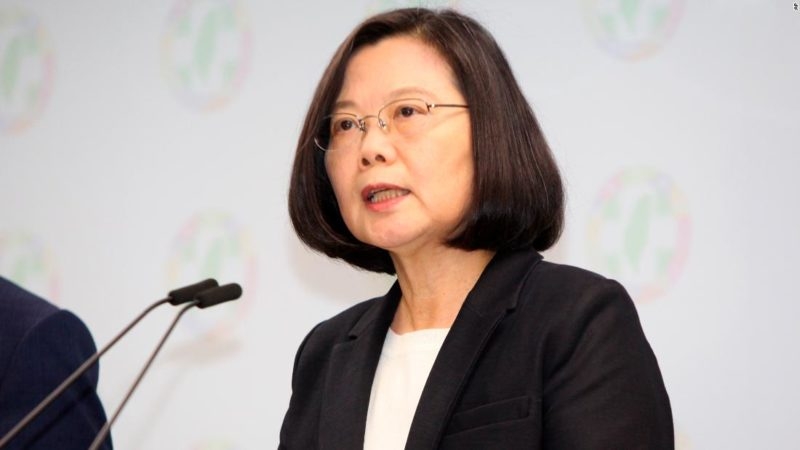
President Tsai Ing-wen rejected the “one country, two systems” model proposed by Beijing as the future path of cross-Taiwan Strait relations during her National Day address to the nation on Thursday.

“The overwhelming consensus among Taiwan’s 23 million people is our rejection of ‘one country, two systems,’ regardless of party affiliation or political position,” Tsai said at the Double Ten celebration, which commemorates the start of the Xinhai Revolution on Oct. 10, 1911 that led to the founding of the Republic of China.

She said that there would be no space for the ROC’s existence if that framework were to be imposed in Taiwan, citing the violence in Hong Kong as an example.

“Hong Kong is on the verge of chaos due to the failure of one country, two systems,” she said.

She said that as Taiwan’s president, standing up to protect Taiwan’s national sovereignty is not a provocation to China but a fundamental responsibility, and she urged the public to stand with her in defending freedom and democracy.

“One country, two systems” is a framework formulated by Beijing, the principle of which is that special administrative regions such as Hong Kong and Macao can retain their own economic and administrative systems under one country — China.

The framework has been proposed to Taiwan by Beijing and mentioned multiple times in key speeches by Chinese leadership, most recently in the national address of Chinese President Xi Jinping on Oct. 1, the National Day of the People’s Republic of China.

In that speech, Xi reaffirmed the “one country, two systems” policy for Hong Kong, Macao and Taiwan and vowed that China will continue its struggle for the full “reunification” of the country, a statement directed at Taiwan.

Taiwanese people, however, refuse to accept the proposal. In a survey conducted in July by the Mainland Affairs Council (MAC), the cabinet-level agency that handles Taiwan’s relations with China, 88.7 percent of the 1,095 respondents rejected it.

Tsai, of the pro-independence Democratic Progressive Party (DPP), said the term “Republic of China (Taiwan)” is an overwhelming consensus of Taiwanese society and not the exclusive property of any particular political party.

She urged Taiwanese society to unite and find the greatest common denominator through dialogue, to ensure that the peaceful and stable cross-strait status quo will not be unilaterally altered by China.

She also outlined her future goals for Taiwan, which are to ensure unity and to defend sovereignty, to bolster the economy and to engage with the world and overcome challenges.

Ethiopia’s pacifist PM Abiy Ahmed wins Nobel Peace Prize

ศาสตร์เกษตรดินปุ๋ย : ขอบคุณแหล่งข้อมูล : หนังสือพิมพ์ The Nation

https://www.nationthailand.com/ann/30377325

Ethiopia’s pacifist PM Abiy Ahmed wins Nobel Peace Prize

Oct 11. 2019
Ethiopia's Prime Minister Abiy Ahmed has been awarded the 2019 Nobel Peace Prize. Photo: Getty Images

Ethiopia’s Prime Minister Abiy Ahmed has been awarded the 2019 Nobel Peace Prize. Photo: Getty Images
By The Washington Post
Addis Ababa, Ethiopia

231 Viewed

Ethiopian Prime minister Abiy Ahmed won the Nobel Peace Prize on Friday for his dogged pursuit of democratic reforms and regional peacemaking efforts.

Ahmed was awarded the prize “for his efforts to achieve peace and international cooperation and in particular for his decisive initiative to resolve the border conflict with neighbouring Eritrea”, said Berit Reiss-Andersen, the chair of the Nobel Committee, which decides the winner.

The 43-year-old former intelligence officer has ushered in an era of hope for peace and greater freedoms in Africa’s second-most populous country, which has long been governed by authoritarian regimes. Upon taking office in April 2018, Abiy initiated the release of thousands of political prisoners, unbanned various political organisations, prosecuted former officials accused of torture and vowed to move Ethiopia toward its first free, multiparty elections in 2020.

Abiy has also made bold foreign policy moves, including overtures to his counterpart in Eritrea, which seceded from Ethiopia in 1993 after decades of bloody war, formally ending a tense military standoff that had lasted 20 years. In neighbouring Sudan and South Sudan, both beset by civil conflict, Abiy personally spearheaded rounds of talks between opposing sides, re-establishing Ethiopia’s potential as a regional power broker.

Abiy’s recognition by the Norway-based Nobel Committee was reminiscent of President Barack Obama’s 10 years earlier. Like Obama at the time, Abiy is near the beginning of his term and has not yet fully implemented the broad reforms and peace deals he has set out to accomplish. But his initial decisions in office have prompted an outpouring of hope that those stated objectives will be achieved.

Ethiopia remains one of the world’s most insecure countries, with more than 3 million people displaced from their homes and more than a thousand killed in 2018, mostly due to ethnic strife. The country’s economy is dangerously weak, and tens of thousands of Ethiopians have become refugees in search of less dire conditions. Abiy’s proposed reforms are also seen by some in Ethiopia as likely to exacerbate ethnic tensions, and he has already survived one assassination attempt.

Jokowi orders crackdown on ‘terror network’ behind attack on minister

ศาสตร์เกษตรดินปุ๋ย : ขอบคุณแหล่งข้อมูล : หนังสือพิมพ์ The Nation

https://www.nationthailand.com/ann/30377317

Jokowi orders crackdown on ‘terror network’ behind attack on minister

Oct 11. 2019
Indonesian President Joko Widodo says he has ordered the National Police and State Intelligence Agency chiefs to coordinate with the military to “investigate and take stern measures against the perpetrator and the network behind the incident”. Photo: Getty Images

Indonesian President Joko Widodo says he has ordered the National Police and State Intelligence Agency chiefs to coordinate with the military to “investigate and take stern measures against the perpetrator and the network behind the incident”. Photo: Getty Images
By The Jakarta Post
Asia News Network

402 Viewed

Indonesian President Joko “Jokowi” Widodo has instructed security authorities to take stern action and hunt down the “terrorist network” behind Thursday’s attack on Coordinating Political, Legal and Security Affairs Minister Wiranto.

Jokowi visited Wiranto at the Gatot Subroto Army Hospital (RSPAD) in Central Jakarta, where the senior minister was being treated for two abdominal stab wounds sustained in the assault.

The president said he had ordered National Police chief General Tito Karnavian and State Intelligence Agency (BIN) chief Budi Gunawan to coordinate with the Indonesian Military [TNI] to “investigate and take stern measures against the perpetrator and the network behind the incident”.

“Pak Wiranto is now conscious but in the process of surgery,” Jokowi said at around 5.30pm on Thursday. “Now the most important thing is for [authorities] to hunt down the [terrorist] network.”

Wiranto was attacked with a bladed weapon during a working visit to Pandeglang, Banten, allegedly by a man identified by police as SA aka Abu Rara.

Jokowi said he had immediately instructed his staff to send a helicopter to transport Wiranto, who had initially been treated at the emergency unit of the Berkah Pandeglang hospital, to the RSPAD.

Abu Rara, who was arrested alongside his wife identified by the initials FA, had been exposed to radical teachings that authorities said had led him to launch the attack against the chief security minister.

Budi said the alleged perpetrator was affiliated with the Islamic State-linked homegrown militant group Jamaah Ansharut Daulah (JAD).

Budi said Abu Rara had initially been a member of the JAD cell in Kediri, East Java, and authorities had detected his move to Bogor in West Java and later to Menes in Pandeglang to remarry after he got divorced from his first wife.

The suspect had reportedly been under the BIN’s watch and monitored as he was reportedly hoarding bladed weapons, such as knives.

When asked how the attack could still happen despite the monitoring, Budi said that JAD worked in cells comprising both lone wolves and small groups. “There are so many cells, so we also call on the public to help us monitor the cells,” he said after visiting Wiranto.

Prior to Thursday’s attack, Wiranto was among four state officials reportedly targeted in an assassination plot planned to take place amid post-election protests that turned into riots in the capital in late May.

In his statement, Jokowi also called on the public to stand together to fight against terrorism and radicalism. “Only through a joint effort can we get rid of them from our beloved nation,” he said.

Yoshino, 2 others win Nobel Prize in Chemistry

ศาสตร์เกษตรดินปุ๋ย : ขอบคุณแหล่งข้อมูล : หนังสือพิมพ์ The Nation

https://www.nationthailand.com/ann/30377273

Yoshino, 2 others win Nobel Prize in Chemistry

Oct 10. 2019
By The Japan News/ANN

389 Viewed

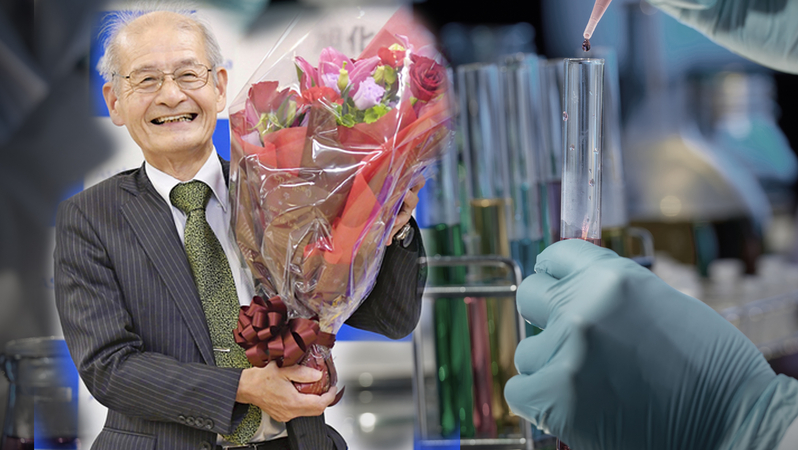
TOKYO – Chemist Akira Yoshino shared this year’s Nobel Prize in Chemistry with scientists John Goodenough and Stanley Whittingham for the development of lithium-ion batteries, the Royal Swedish Academy of Sciences said Wednesday.

Yoshino, 71, an honorary fellow at Asahi Kasei Corp., is the eighth Japanese scientist to receive a chemistry Nobel.

A prize of 9 million Swedish kronor (about ¥97 million) will be shared among the three winners.

The award ceremony for this year’s Nobel Prizes will be held in Stockholm on Dec. 10, the anniversary of the death of Alfred Nobel.

The previous time a Japanese won a Nobel in chemistry was in 2010, when Akira Suzuki, professor emeritus at Hokkaido University, and Ei-ichi Negishi, distinguished professor of Purdue University in the United States, shared the prestigious prize.

Yoshino was born in Suita, Osaka Prefecture, in 1948. After graduating from Kyoto University’s graduate school as an engineering student in 1972, he entered Asahi Kasei the same year. He served in such positions as chief of the firm’s ion secondary battery business group and head of the cell material business development office.

In 1985, Yoshino developed a method using a carbon compound as a material for negative electrodes, leading to the completion of the lithium-ion cell.

Lithium-ion batteries are an essential source of power for portable information technology devices such as mobile phones and laptop computers. In the future, they may be more widely used to power electric cars and aid in the fight against global warming, according to observers.

Goodenough was born in 1922 and is affiliated with the University of Texas at Austin. Whittingham was born in 1941 and is affiliated with Binghamton University of the State University of New York.

Japan to expand export controls to prevent leak of cutting-edge AI, biotech

ศาสตร์เกษตรดินปุ๋ย : ขอบคุณแหล่งข้อมูล : หนังสือพิมพ์ The Nation

https://www.nationthailand.com/ann/30377263

Japan to expand export controls to prevent leak of cutting-edge AI, biotech

Oct 10. 2019
By The Japan News/ANN

182 Viewed

The government is looking at making artificial intelligence, biotechnology and other technologies subject to export controls as early as fiscal 2020.

Japan plans to strengthen export controls to prevent advanced technologies from getting into the hands of foreign countries, it has been learned.

The government will review the implementation of the Foreign Exchange and Foreign Trade Law as early as fiscal 2020 to make artificial intelligence (AI), biotechnology and other technologies subject to export controls, according to informed sources. The United States has been strengthening export controls on advanced technologies with China in mind, and Japan is facing the need to take corresponding measures to ensure national security.

Japan has so far used the law to restrict exports to specific countries of products that can be converted to military use like radars, machine tools and certain materials. The measure accords with the international trade control framework and is not unique to Japan.

However, the advanced technologies and expertise used to create finished products are outside the scope of the export restrictions despite posing security risks.

Taking aim at China, the United States has already announced a plan to apply export controls to 14 high-tech fields including AI, robots and biotechnology. It is aiming to create guidelines related to accepting funds and human resources to prevent the leak of advanced technologies from companies and universities. The United States and some European countries have expressed concern about technology leaking from Japanese companies and universities. In response, the Japanese government decided to impose its own restrictions based on the US restrictions.

Specifically, the government will create guidelines calling for companies to better manage internal information to prevent engineers from taking key technologies to external entities. The government will also encourage universities to voluntarily create guidelines aimed at ending the acceptance of human resources and money from countries to which technologies could leak.

In recent years, weapons with parts made in Japan have been found in the Middle East and other regions. The government will also propose reviewing the Immigration Control and Refugee Recognition Law to stop the entry of foreigners aiming to steal Japanese technologies.