China viewed mostly unfavourably in Western Europe and Asia Pacific: survey

ศาสตร์เกษตรดินปุ๋ย : ขอบคุณแหล่งข้อมูล : หนังสือพิมพ์ The Nation

https://www.nationthailand.com/ann/30377004

China viewed mostly unfavourably in Western Europe and Asia Pacific: survey

Oct 03. 2019
File photo Oct 1/A formation honoring the motherland parades during the mass pageantry. [XU JINGXING / CHINA DAILY]

File photo Oct 1/A formation honoring the motherland parades during the mass pageantry. [XU JINGXING / CHINA DAILY]
By The Straits Times
Asia News Network

1,247 Viewed

Public opinion on China has turned negative across most of Western Europe and the Asia Pacific, according to a new global survey by the non-partisan Pew Research Centre.

In the United States and Canada, where negative views of China predominate, the rating reflects the largest year-on-year change, the survey released on Monday (September 30) showed.

But public opinion on China remains positive in Russia and Ukraine and across most of the Middle East, Latin America and sub-Saharan Africa, ranging from 46 per cent in South Africa to 70 per cent in Nigeria.

In Western Europe, negative views of China ranged from 53 per cent in Spain to 70 per cent in Sweden.

“The share of people who evaluate China positively has also dropped by double-digits in nearly half of the Western European countries surveyed, including Sweden (down 17 percentage points), the Netherlands (minus 11) and the UK ( minus 11),” Pew Research said.

Only in Greece and Italy had opinion improved. And Central and Eastern Europeans were more divided in their assessments.

About 60 per cent in the US and 70 per cent in Canada have negative views, the survey showed In both countries, this was the highest unfavourable opinion in Pew Research’s polling history, it said.

In Canada, unfavourable opinion increased 22 points in the wake of the high-profile arrest in Canada in December 2018 of Meng Wanzhou, chief financial officer and daughter of the founder of Chinese tech giant Huawei, whom the US is trying to get extradited.

In Asia-Pacific, public opinion has also turned negative among countries closer to China. “China… receives unfavourable marks from most of its neighbours in the Asia-Pacific region,” Pew Research said.

In that region, the survey covered five countries — Japan, South Korea, Australia, Indonesia and the Philippines.

In Japan, 85 per cent said they had an unfavourable opinion of China — the most negative among all countries surveyed.

But more than half (63 per cent) in South Korea also viewed China negatively. In Australia, the figure was 57 per cent, and in the Philippines, 54 per cent.

Favourable views of China in Indonesia dipped from 73 per cent in 2002 to 36 per cent in 2019.

Based on those numbers, Pew Research concluded that public opinion is now “hovering at or near historic lows in each of the countries surveyed” in the Asia Pacific.

Survey results were based on telephone and face-to-face interviews.

In general, however, younger people tended to have a more positive stance toward China across most of the countries surveyed, Pew Research said. “In 20 countries, adults aged 18 to 29 have more favourable views than those aged 50 and older,” it said.

In Brazil for example, 67 per cent of younger adults had a favourable view of China, while just 40 per cent of older adults shared that opinion. Large age gaps also exist in Lithuania, Mexico, Indonesia, Australia, Poland and Ukraine.

In many countries though, people 50 and older were also less likely to offer any opinion. About a third or more of older adults in Indonesia, Ukraine, Argentina, Mexico, Tunisia and Brazil gave no opinion.

In the case of the US, the findings are consistent with a survey released in August which found that more Americans were seeing China as a threat. At 60 per cent, unfavourable opinions of China were at a 14-year high — and up 47 per cent from 2018.

In that survey, amid the ongoing China-US trade war and with China officially identified as a strategic threat to the US, the number of Americans seeing China as a threat doubled from 2007.

The new survey was released on the eve of China’s October 1 celebration of the founding of the People’s Republic. Chinese Vice-Premier Liu He will lead a delegation to Washington D.C. for a 13th round of high-level economic and trade consultations in the week following October 1, an official said in Beijing on Sunday.


https://www.straitstimes.com/world/united-states/views-on-china-turn-negative-in-asia-pacific-w-europe

Vientiane to host Mekong mayors’ tourism summit

ศาสตร์เกษตรดินปุ๋ย : ขอบคุณแหล่งข้อมูล : หนังสือพิมพ์ The Nation

https://www.nationthailand.com/ann/30376984

Vientiane to host Mekong mayors’ tourism summit

Oct 02. 2019
By Vientiane Times
Asia News Network

315 Viewed

Vientiane will host the Lower Mekong Tourism Cities’ Mayors Summit from October 12-15 to promote tourism and cultural cooperation between cities in Cambodia, Laos, Myanmar, Thailand and Vietnam.

The director of Vientiane’s Department of Information, Culture and Tourism, Vilayvone Chanthalaty, addressed a press conference last week about the meeting.

The mayors or vice mayors of Ho Chi Minh City in Vietnam, Phnom Penh in Cambodia, Yangon in Myanmar, Bangkok in Thailand, and Vientiane, will lead delegations at the summit.

Vilayvone said improvement of tourism products and services and enhancing the cities’ appeal in order to attract more visitors from the region and from around the world would be the main focus of the summit.

The event coincides with the end of Buddhist Lent and the Vientiane Boat Racing Festival so that meeting participants can observe these longstanding traditions and celebrations.

More than 2.7 million Lao and foreign tourists visited Vientiane last year, with historical and cultural sites and events being the main draw.

Prince Harry lashes out as UK press as wife Meghan sues tabloid for publishing private letter

ศาสตร์เกษตรดินปุ๋ย : ขอบคุณแหล่งข้อมูล : หนังสือพิมพ์ The Nation

https://www.nationthailand.com/ann/30376981

Prince Harry lashes out as UK press as wife Meghan sues tabloid for publishing private letter

Oct 02. 2019
By The Washington Post

315 Viewed

Meghan, the Duchess of Sussex, launched legal action against the Mail on Sunday newspaper as her husband, Prince Harry, blasted the British tabloid press on Tuesday for behaviour he said “destroys lives”.

The duchess, who is being represented by the law firm Schillings, filed a claim in London’s High Court against the paper and Associated Newspapers, its parent company, following an allegation that the newspaper “unlawfully” printed a private letter.

In a lengthy statement published on Tuesday evening, Prince Harry said his wife had become “one of the latest victims” of the British tabloid press that “wages campaigns against individuals with no thought to the consequences”.

He said that his “deepest fear is history repeating itself”.

Referring to his late mother, Princess Diana, Harry said, “I lost my mother and now I watch my wife falling victim to the same powerful forces.”

Princess Diana was one of the most photographed women in the world before she died in a car crash in a Paris tunnel in 1997. At the time of the accident, her car was being pursued by photographers.

Harry said the couple was taking legal action after a “ruthless campaign” in the press, which he described as “bullying”.

“There comes a point when the only thing to do is to stand up to this behaviour, because it destroys people and destroys lives. Put simply, it is bullying, which scares and silences people. We all know this isn’t acceptable, at any level. We won’t and can’t believe in a world where there is no accountability for this,” he said.

A Mail on Sunday spokesman said: “The Mail on Sunday stands by the story it published and will be defending this case vigorously. Specifically, we categorically deny that the Duchess’s letter was edited in any way that changed its meaning.”

The spokesman said the article in question was published on February 10 and included an interview with Meghan’s father, Thomas Markle, and extracts from a handwritten letter he received from his daughter after her wedding.

This is not the first time that Prince Harry has lashed out at the British press. Shortly after he and Meghan began dating, the prince issued an unusually blunt statement in which he condemned the media and social media trolls for their “racial undertones” and “outright sexism”.

He also successfully sued a photo agency that flew a helicopter over his country home in Oxfordshire, taking photos that he charged “very seriously undermined the safety and security” of his family.

Harry said on Tuesday that the coverage had “escalated over the past year”, during Meghan’s pregnancy and since the birth of their son, Archie.

The royals said that their particular legal action related to the contents of a private letter published “unlawfully in an intentionally destructive manner to manipulate you, the reader, and further the divisive agenda of the media group in question”.

“In addition to their unlawful publication of this private document, they purposely misled you by strategically omitting select paragraphs, specific sentences, and even singular words to mask the lies they had perpetuated for over a year,” Harry said.

He said there is a “human cost to this relentless propaganda, specifically when it is knowingly false and malicious, and though we have continued to put on a brave face — as so many of you can relate to — I cannot begin to describe how painful it has been.”

Harry said that the “positive coverage” of the couple over the past week — they have been on a tour of southern Africa — highlights the “double standards of this specific press pack that has vilified her almost daily for the past nine months; they have been able to create lie after lie at her expense simply because she has not been visible while on maternity leave”.

“She is the same woman she was a year ago on our wedding day, just as she is the same woman you’ve seen on this Africa tour,” he said.

He said that for “select media this is a game, and one that we have been unwilling to play from the start. I have been a silent witness to her private suffering for too long”.

The looming climate crisis: Where is our Greta Thunberg?

ศาสตร์เกษตรดินปุ๋ย : ขอบคุณแหล่งข้อมูล : หนังสือพิมพ์ The Nation

https://www.nationthailand.com/ann/30376963

The looming climate crisis: Where is our Greta Thunberg?

Oct 02. 2019
By Daily Star

164 Viewed

The level of change in the climate that humans have already caused can no longer be labelled an innocuous “climate change” but rather a pernicious “climate crisis”.

The Inter-governmental Panel on Climate Change (IPCC) has issued its latest warning saying that the world’s oceans are rising twice as fast as they did in the last century due to fast-disappearing ice-sheets in the Antarctic and Greenland. The IPCC predicts that as much as two-thirds of the permafrost could be gone before the end of the current century, further exacerbating carbon dioxide emissions as humongous amounts of CO2 trapped in the permafrost would be released in the process. In other words, all the apprehensions about climate change are much more menacing than anticipated earlier, making for huge shifts in climate patterns that will wreak havoc on the coastal cities and habitations around the world. On the one hand, rising sea levels will inundate low-lying coastal areas and, on the other hand, all the entrapped heat in the oceans will give rise to far more destructive cyclones more frequently. The world as we knew it in the pre-industrial era is gone for ever.

This new reckoning is bound to cause major setbacks in countries like ours and should surely cause major headaches to socio-economic planners.

Bangladesh sits at the head of the funnel that directs all the atmospheric turbulence above the Indian Ocean to the narrow mouth of the Bay of Bengal, putting us at the receiving end of this huge climate crisis. But do we see anyone blowing the whistles on this one? The government seems complacent with the high growth rates the nation has achieved in recent years but all such growth prospects will be in serious jeopardy if we fail to address the climate crisis on a war footing.

15-year old Swedish climate activist Greta Thunberg stunned the world leaders last week at the UN General Assembly with her in-your-face proclamations on how climate change, nay, climate crisis, has robbed our children of their right to a prosperous future in a world sinking in its oceans and churning in its storms. That the world must rise in a body to counter the effects of anthropogenic global warming and arrest the rising global temperatures and devote resources to “carbon sequestering” is causing world leaders to cringe in their seats. Many world leaders are taking bold steps and major economic measures to counter climate change and many more are rising to the challenge being prodded by a fearless teenager from Sweden who dared to cross the Atlantic in a solar powered boat instead of taking a carbon-gushing plane ride to attend the UNGA meeting in New York. IPCC (Intergovernmental Panel on Climate Change)—the global compact of climate Tsars—has been working on creating awareness and pushing for remedial actions on climate change for nearly three decades now but the world needed the prodding of a sharp-tongued and fiercely committed Greta Thunberg to jolt world leaders into fervent action on the impending climate crisis.

Bangladesh is a poster-child for climate change that brings to fore all the disastrously harmful effects of global warming; in all climate conferences Bangladesh is at the dead centre of discussions on how to mitigate the effects of and adapt to climate change but not much planning and activity is visible yet on the home front. Rather we had been in the news for all the wrong reasons, when Green Climate Fund resources were plundered by a government-sanctioned private bank that almost went belly up last year.

Sweden is a country with a large coastline where the effects of global warming is causing rapidly changing shorelines as the sea creeps inward relentlessly. Of course, Sweden has reasons to be highly concerned but it is a thinly-populated country with a high per capita income. It has the wherewithal and landmass to put up with climate change. That this nation of only 10 million has produced a Greta Thunberg to ring the carillon bell on climate change makes our lack of action in this area all the more poignant.

Bangladesh may not have as large a coastline as Sweden but our fragile coastline hosting the largest mangrove forest of the world and a population 17 times larger than Sweden’s at the mercy of the elements make it imperative that someone as fearless and as passionate as Greta comes forward to bell the cat on climate crisis before we become climate fodder. There is certainly no dearth of derring-do teenagers here as evidenced by the traffic revolt of the teens earlier this year. The clock is ticking for a climate uprising. Is anyone listening?

IndiGo flight makes emergency landing after ‘technical glitch’; Goa minister says engine on fire

ศาสตร์เกษตรดินปุ๋ย : ขอบคุณแหล่งข้อมูล : หนังสือพิมพ์ The Nation

https://www.nationthailand.com/ann/30376917

IndiGo flight makes emergency landing after ‘technical glitch’; Goa minister says engine on fire

Sep 30. 2019
IndiGo flight. (File Photo: IANS)

IndiGo flight. (File Photo: IANS)
By The Statesman/ANN

488 Viewed

An IndiGo flight to Delhi had to return to the Goa airport and make an emergency landing after its engine developed “some technical issues” mid-air, the airline said on Monday.

IndiGo flight 6E-336, operating from Goa to Delhi on September 29 returned to Goa due to “technical issues in engine”, the airline said in a statement.

Goa Power Minister Nilesh Cabral, who was among the passengers on flight 6E-336 which took off from the coastal state on Sunday, told PTI that the aircraft’s engine caught fire following which the plane had to return to the airport.

However, the airline has strongly refuted the occurrence of any fire in the engine of the flight.

“We strongly refute the occurrence of any fire in the engine of flight 6E-336 from Goa to Delhi on Sept 29. However, the cause of the incident is not known yet and is currently under investigation,” an IndiGo statement read.

“As per the laid down Standard Operating Procedures, our pilot landed the aircraft in Goa for inspection. All the passengers were accommodated on other flights to Delhi,” a spokesperson of the airline said.

Meanwhile, the Directorate General of Civil Aviation (DGCA) has started an investigation into the incident.

https://www.thestatesman.com/india/indigo-flight-emergency-landing-technical-glitch-goa-minister-engine-fire-1502805189.html

Saudi Arabia considering long-term investments worth $100 billion in India

ศาสตร์เกษตรดินปุ๋ย : ขอบคุณแหล่งข้อมูล : หนังสือพิมพ์ The Nation

https://www.nationthailand.com/ann/30376885

Saudi Arabia considering long-term investments worth $100 billion in India

Sep 30. 2019
The envoy said the vision 2030 of Crown Prince Mohammed bin Salman will also result in significant expansion of business between India and Saudi Arabia in diverse sectors. (File Photo: IANS)

The envoy said the vision 2030 of Crown Prince Mohammed bin Salman will also result in significant expansion of business between India and Saudi Arabia in diverse sectors. (File Photo: IANS)
By The Statesman/ANN

451 Viewed

Under vision 2030, Saudi Arabia plans to diversify its economy while reducing its economic dependence on petroleum products.

Saudi Arabia, the world’s biggest oil exporter, is looking at investing $100 billion in India in areas of petrochemicals, infrastructure and mining among others, considering the country’s growth potential.

Saudi Ambassador Dr Saud bin Mohammed Al Sati has said India is an attractive investment destination for Saudi Arabia and it is eyeing long-term partnerships with New Delhi in key sectors such as oil, gas and mining.

“Saudi Arabia is looking at making investments in India potentially worth $100 billion in the areas of energy, refining, petrochemicals, infrastructure, agriculture, minerals and mining,” Al Sati told PTI in an interview.

He said Saudi Arabia’s biggest oil giant Aramco’s proposed partnership with Reliance Industries Ltd reflected the strategic nature of the growing energy ties between the two countries.

The envoy said investing in India’s value chain from oil supply, marketing, refining to petrochemicals and lubricants is a key part of Aramco’s global downstream strategy.

“In this backdrop, Saudi Aramco’s proposed investments in India’s energy sector such as the $44 billion West Coast refinery and petrochemical project in Maharashtra and long term partnership with Reliance represent strategic milestones in our bilateral relationship,” he said.

The envoy said the vision 2030 of Crown Prince Mohammed bin Salman will also result in significant expansion of business between India and Saudi Arabia in diverse sectors.

Under vision 2030, Saudi Arabia plans to diversify its economy while reducing its economic dependence on petroleum products.

Saudi Arabia is a key pillar of India’s energy security, being a source of 17 per cent or more of crude oil and 32 per cent of LPG requirements of India.

The envoy said more than 40 opportunities for joint collaboration and investments across various sectors have been identified between India and Saudi Arabia in 2019, adding the current bilateral trade of $34 billion will undoubtedly continue to increase.

“There is huge untapped potential available in merchandise trade, particularly in non-oil trade and we are enhancing cooperation in economic, commercial, investment, cultural and technological fields,” the envoy said.

Asked about Saudi Arabia’s plan to issue initial public offering of Aramco’s stock, being seen as world’s largest IPO, he said it will open up the company to the wider world.

“Consistent with the vision 2030 goals, Saudi Aramco is pursuing new opportunities toward creating a world leading downstream sector in Saudi Arabia,” he said.

On future energy ties with India, he said the bilateral energy ties have grown beyond the supply of crude oil, refined products and LPG to a more comprehensive partnership that focusses on investments and joint ventures in petrochemical complexes and cooperation in exploration.

“India’s invitation to Saudi Arabia to invest in its strategic petroleum reserve reflects the trust and goodwill the two countries share,” he said.

Talking about ”Vision 2030”, Al Sati said Saudi Arabia is working towards transforming its economy and looking at a post-oil age of world-class technological research, start-up and entrepreneurial vigour.

“The entire development strategy of the kingdom rests on three pillars – to build a vibrant society, a thriving economy and an ambitious nation,” he said.

“The World Bank too has ranked the kingdom as the fourth largest reformer within G20. The number of foreign investment licenses granted in Saudi Arabia in the first quarter of 2018 increased by 130 per cent,” he said.

The envoy also talked about Saudi Arabia’s new residency permit scheme for qualified international expatriates.

“This move is expected to attract leading global innovators and investors to live and work in Saudi Arabia, and help drive the private sector growth needed to realise the goals set out in Saudi Vision 2030,” he said.

Asked whether Saudi Arabia will increase oil supply to India to address the shortfall due to curb on import of oil from Iran, the envoy said his country is committed to India’s energy security and will meet any shortfall that may arise due to disruptions from other sources.

“As one of the world’s leading energy producers, the kingdom will continue working constructively with other producers within and outside OPEC to maintain market stability, thus protecting all the interests of producers and consumers alike,” he said.

No, Indonesian students are not taking to the streets only to fight sex ban

ศาสตร์เกษตรดินปุ๋ย : ขอบคุณแหล่งข้อมูล : หนังสือพิมพ์ The Nation

https://www.nationthailand.com/ann/30376884

No, Indonesian students are not taking to the streets only to fight sex ban

Sep 30. 2019
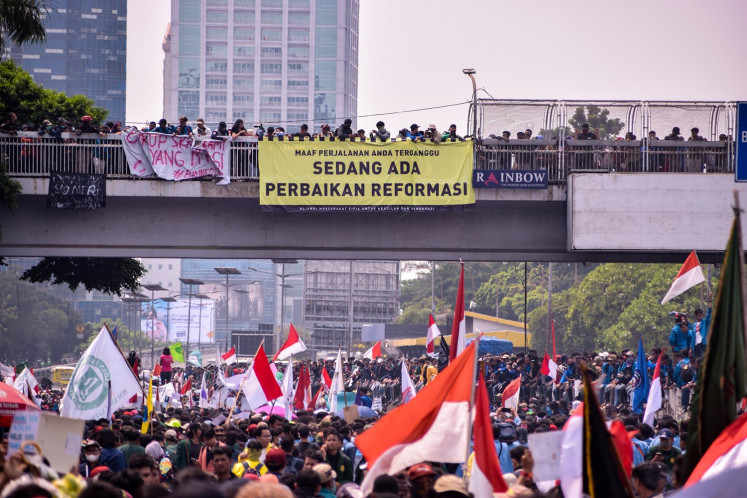
Students from various campuses in Yogyakarta protest on Sept. 23 to voice concerns about several bills and the fate of the Corruption Eradication Commission. The rally was known as #GejayanMemanggil (GejayanCalling). (JP/Tarko Sudiarno)

Students from various campuses in Yogyakarta protest on Sept. 23 to voice concerns about several bills and the fate of the Corruption Eradication Commission. The rally was known as #GejayanMemanggil (GejayanCalling). (JP/Tarko Sudiarno)
By Devina Heriyanto
The Jakarta Post/ANN

544 Viewed

In the past few days, Indonesia has been witnessing its largest student movement since that of 1998, which brought down then-president Soeharto. The student protests made headlines not only in the national media, but also in international news outlets.

Many Indonesian readers of foreign media outlets, however, expressed their exasperation over the titles of the articles in various news outlets, which often focused only on the fact that the contentious Criminal Code (RKUHP) bill could criminalize premarital sex. The BBCDeutsche WelleThe Japan TimesAl JazeeraReutersThe Sydney Morning Herald and CNN are among the outlets publishing articles implying that Indonesians were only protesting about a “sex before marriage” bill as the BBC put it, or a “sex ban law” as The Japan Timescalled it.

Not just sex

The revision of the RKUHP is only one among several problematic bills the students are protesting against and the criminalization of pre- and extramarital sex is the least of several concerns regarding the bill.

The students have seven demands in total encompassing several issues. Political scientist Amalinda Savirani from Gadjah Mada University said despite some criticisms of the movement’s many demands, the varied nature of those demands could help the movement gain followers and momentum.

Here are the seven demands:

– Reject Criminal Code bill, mineral mining bill, land bill, correctional procedures bill and labor bill; revoke KPK Law and Natural Resources Law; pass sexual violence bill and domestic workers bill.

– Remove problematic KPK leaders picked by House of Representatives.

– Ban Indonesian Military (TNI) and National Police personnel from holding civilian offices.

– End militarism in Papua and other regions and immediately free Papuan political prisoners.

– End prosecution of activists.

– End burning of forests in Kalimantan and Sumatra and punish corporations responsible for fires and revoke their permits.

– Resolve human rights violations and put human rights violators on trial, including those at the highest levels of government; immediately restore rights of victims.

The RKUHP contains several contentious articles, not just the article on criminalizing extramarital sex. If passed, the new Criminal Code can makecrimes out of freedom of speech, lesbian, gay, bisexual and transgender (LGBT) rights, sexual reproduction rights and even homelessness. Several articles regulate against “attacking the dignity” of the president or vice president and publishing or broadcasting materials that contain “insults against the legitimate government”.

The repeal of the newly passed Corruption Eradication Commission (KPK) Law also tops the priority list. Before it was passed, activists and experts had criticized the bill and urged President Joko “Jokowi” Widodo to intervene and save the antigraft body. The new KPK Law strips the KPK off of its independence through the establishment of a supervisory body and the conversion of the KPK into a government agency.

The protesters also demand that the House pass the sexual violence bill, which has been deliberated over since 2016. Many lawmakers are against the bill, calling it “liberal” and arguing that the bill would legalize zina (extramarital sex).

Problematic KPK leaders

On Sept. 12, the House elected five KPK leaders out of the 10 candidates shortlisted by a selection committee. The selection of the new KPK commissioners, who are to begin their work in December, has been controversial from the start, with activists calling the selection committee biased. Some of the candidates are also deemed “problematic”, including Insp. Gen. Firli Bahuri from the National Police, who was voted in as the KPK’s new chairman.

Not long after his inauguration in September 2018, KPK received a complaint regarding Firli. He had been meeting with West Nusa Tenggara Governor M. Zainul Majdi, also known as Tuan Guru Bajang, who was then being questioned as a witness in a corruption case pertaining to the divestment of gold and copper mining company PT Newmont Nusa Tenggara.


Keeping military and police out of civilian posts

The overstaffing of the TNI has led to a demand that the government allow military personnel to hold civilian jobs. This raises fear that Indonesia would again have a dwifungsi (dual function) military, which helped Soeharto maintain his power during the New Order.

The current 2004 Military Law does not have a provision that allows military personnel to hold civilian jobs.

Students protest against the planned revisions to the Criminal Code and the revision of the Corruption Eradication Commission Law in front of the House of Representatives in Senayan, Jakarta, on Sept. 24, the biggest student movement since 1998.

Students protest against the planned revisions to the Criminal Code and the revision of the Corruption Eradication Commission Law in front of the House of Representatives in Senayan, Jakarta, on Sept. 24, the biggest student movement since 1998.

Students protest against the planned revisions to the Criminal Code and the revision of the Corruption Eradication Commission Law in front of the House of Representatives in Senayan, Jakarta, on Sept. 24, the biggest student movement since 1998. (JP/Anggie Angela)

End militarism in Papua

The military has maintained a strong presence in Papua because of the number of separatist groups in the two Papuan provinces. Recently, an investigation revealed that military activity in Nduga regency in Papua led to several human rights violations.

A racially tinged incident in Surabaya in August, which led to weeks of unrest in the Papuan provinces, has brought back the issue to public attention.

End prosecution of activists

The students in Yogyakarta, in their press release and standpoint document, said they were aware of prosecutions of corruption and democracy activists. Indonesia Corruption Watch release a report in April 2019 that from 1996 to the time of the report release there had been 91 cases of assaults against and prosecution of 115 anticorruption activists.

On forest fires

For months, some provinces on Sumatra and in Kalimantan have been battling forest fires, which resulted in smog and decreasing air quality. The National Police have named 249 people and six companies suspects of starting the forest fires.

On human rights violations

During the campaign period before he was elected for the first time, Jokowi promised to resolve past human rights violations in Indonesia. Activists have since slammed Jokowi for his mere lip service to or outright silence over some human rights violations, both in the past or under his administration. Taking part in the student protest in Jakarta on Sept. 24 was Maria Catarina Sumarsih, the mother of Atma Jaya University student BR “Wawan” Norma Irmawan, who was shot and killed during prodemocracy protests in what became known as the 1998 Semanggi Tragedy.

Sumarsih has been attending a human rights event called the “Kamisan” on every Thursday for hundreds of times to demand closure for her son’s murder, but up until now the government has not found the killer.

Threat to delist Chinese companies in US panned

ศาสตร์เกษตรดินปุ๋ย : ขอบคุณแหล่งข้อมูล : หนังสือพิมพ์ The Nation

https://www.nationthailand.com/ann/30376883

Threat to delist Chinese companies in US panned

Sep 30. 2019
File photo: the national flags of China and the US. [Photo/IC]

File photo: the national flags of China and the US. [Photo/IC]
By ZHOU LANXU and WANG YU
China Daily/ANN

524 Viewed

If measures reportedly being considered by US officials to delist Chinese equities from exchanges in the United States were to take effect, they would likely have limited impact on Chinese investments but deal a heavy blow to investor confidence in financial markets in the US, experts said.

The US government is not contemplating blocking Chinese companies from listing shares in the US “at this time”, Monica Crowley, spokeswoman for the US Treasury, told Bloomberg over the weekend, in response to media reports that Washington is considering removing Chinese companies from US stock exchanges.

The reports came as Chinese Vice-Premier Liu He is about to lead China’s negotiating group to the 13th round of China-US high-level economic and trade consultations. The meeting will be held in Washington in the week after the National Day holiday, which ends on Oct 7, the Ministry of Commerce said on Sunday.

Bob McCooey, chairman of Nasdaq Asia-Pacific, said on Sina Weibo on Sunday that the US exchange, where many Chinese technology firms such as Baidu and JD are listed, will always “be supportive of Chinese issuers” as part of its commitment to providing non-discriminatory access to all eligible companies.

The possibility of such measures being imposed in the future could not be totally ruled out, despite the denial by the US Treasury, because of the US administration’s earlier swings in the protracted trade dispute with China, said Xue Yi, a professor of finance at the University of International Business and Economics in Beijing.

“But such measures, if taken, would have only limited impact on Chinese firms and markets. I don’t think it would make any economic sense for the US side,” Xue said.

Chinese companies listed in the US — which are the outstanding performers in the country’s fast-growing economy — would be welcomed by other bourses if they were forced to delist from US exchanges, Xue said.

“They may choose to relist on Shanghai’s newly launched sci-tech innovation board, called the STAR Market, where they may raise more money than in the US, as domestic investors are generally more enthusiastic about their prospects. This would be a good chance for the STAR Market to jazz up its global influence,” Xue said.

Delisting Chinese firms would not only pose barriers for US investors to optimize their portfolios but drastically undermine the reputation of the US as a champion of a free and open financial market, Xue said.

“If the US stock exchanges excluded Chinese companies, it would mean the exchanges could also exclude companies from other economies,” he said, which would divert them from the US.

Bloomberg also reported on Friday that the US administration is considering blocking US government pension funds from investing in the Chinese market, as well as placing investment limits on Chinese companies included in stock indexes managed by US firms, Bloomberg reported on Friday.

The report rattled US investors ahead of the resumption of trade talk between the world’s two largest economies. The S&P 500 Index started to plunge after the report and ended 0.53 percent lower, at 2961.79, on Friday.

“Possible investment limits from the US administration will not change the trend of capital inflow into the China’s A-share market,” said Dong Dengxin, director of the Finance and Securities Institute at Wuhan University of Science and Technology.

The growing potential and low valuation of Chinese equities, coupled with the country’s commitment to financial opening-up, have made Chinese equities increasingly attractive for worldwide money managers, Dong said.

The impact on sentiment may lead to short-term market fluctuations but can hardly hurt the long-term upward trend of the A-share market, as foreign money has never been, and is not likely to be, the main drive of any bull run in the domestic market, said Zhao Xu­dong, an independent market analyst.

Hong Kong police fire tear gas at protesters marching ahead of China’s 70th birthday bash

ศาสตร์เกษตรดินปุ๋ย : ขอบคุณแหล่งข้อมูล : หนังสือพิมพ์ The Nation

https://www.nationthailand.com/ann/30376882

Hong Kong police fire tear gas at protesters marching ahead of China’s 70th birthday bash

Sep 30. 2019
Protesters set a fire road block to slow police advancement at Wan Chai on Sept 29, 2019.ST PHOTO: CHONG JUN LIANG

Protesters set a fire road block to slow police advancement at Wan Chai on Sept 29, 2019.ST PHOTO: CHONG JUN LIANG
By Elizabeth Law
The Straits Times/ANN

9 Viewed

HONG KONG – Hong Kong police fired tear gas and pepper spray in clashes with protesters on Sunday (Sept 29) as democracy campaigners stepped up their rallies ahead of China’s 70th national day on Tuesday and the city’s leader prepared to make a visit to Beijing for the celebrations.

In the second day of violence this weekend, police fired tear gas at protesters near the upscale Pacific Place mall in Admiralty, in the central business district, and earlier at the Causeway Bay shopping district where the march to the government headquarters began.

The Sogo department store and World Trade Centre shopping malls in Causeway Bay were closed ahead of the march. Organisers had not sought police permission for Sunday’s procession.

Clashes occurred in Causeway Bay, when police fired tear gas to disperse protesters who had thrown bottles and other objects towards them. Some of the protesters were arrested.

The protesters later regrouped and continued on the march to the government complex, located 2.4km away. Many held up umbrellas against the muggy heat as they shouted slogans such as “five demands, not one less”.

Running battles also took place near Pacific Place, with police retreating after firing tear gas. That allowed the protesters to continue on their march westward, with some occupying Harcourt Road, a major highway in Admiralty.

But tensions escalated after protesters tossed Molotov cocktails into the government complex and lobbed rocks and bricks at its windows.

Their actions sent the riot police rushing out of the building to fire tear gas and water cannons, causing mass chaos as protesters ran, though some were pinned to the ground and detained by police.

Within minutes, the road was cleared of protesters, and littered with umbrellas, traffic cones, plastic bottles and even shoes that protesters had abandoned.

Mr Tom Chan, who only had a surgical mask, said he had turned up dressed for a normal protest because he “didn’t think the police would come down so hard”.

“It’s supposed to be a peaceful march. If the government had tried to meet the people’s demands, or even deal with the underlying social issues, we wouldn’t be in this state,” he told The Straits Times.

Some 30 of those arrested were later frogmarched into the government compound where dozens of police vehicles had been waiting.

The street battle was witnessed by dozens of people standing at an overhead bridge leading to the Pacific Place mall, many holding up their mobile phones.


Medics raised their hands at the police to indicate that they are not protesters on Sept 29, 2019. ST PHOTO: CHONG JUN LIANG  


After the chaos, the police were seen arguing with a group calling itself “Protect Our Children” that had wanted to stop the police from making further arrests. Some of the officers were heard retorting back: “If you don’t want them to be arrested then tell them not to throw bricks in the first place.”

As night fell, running street battles continued with police pushing protesters back towards Causeway Bay, the starting point of the march.

Demonstrators left a trail of rubbish fires and barricades in their wake in an attempt to slow the police advance. All along the way, residents shouted abuse at officers.


Protesters set fire to an entrance of Admiralty Station. ST PHOTO: CHONG JUN LIANG  


CARRIE LAM TO LEAVE FOR BEIJING

In a surprise announcement on Sunday, the government said Chief Executive Carrie Lam, who has faced the brunt of the protesters’ ire, will leave for Beijing on Monday to celebrate the 70th anniversary of the China’s founding. She will return to Hong Kong on Tuesday night.

Mrs Lam had sent out invitations “requesting the pleasure of your company” at a flag-raising ceremony and National Day reception at the Convention and Exhibition Centre in Wan Chai.

The reason for the change in plan was not clarified but the government said Chief Secretary for Administration Matthew Cheung Kin Chung would take her place.

GLOBAL MARCH

Sunday’s rally against the government was part of planned global protests Hong Kong’s pro-democracy movement have called a “Global Anti-Totalitarianism March”. Following a call on the Internet, solidarity marches are taking place in at least 64 cities around the world, in countries including the United States, Japan and Malaysia.

In Australia, more than 1,000 black-clad protesters turned up for a rally in central Sydney, some carrying yellow umbrellas and signs reading “Save Hong Kong”. It was one of the city’s largest solidarity marches since the pro-democracy protests began in March, Agence France-Presse reported.

The Singapore Police Force issued a statement last Saturday saying it will not grant any permit for assemblies that advocate the political causes of other countries.

Meanwhile, pro-Beijing supporters in Hong Kong countered Sunday’s planned protests with their own rally near Victoria Harbour, where they sang the Chinese national anthem and waved the national flag, AP reported.


Pro-China supporters hold up Chinese national flags as they face Victoria Harbour during a rally in Hong Kong, on Sept 29, 2019. PHOTO: REUTERS


On Saturday night, an approved evening rally to mark the fifth anniversary of the Umbrella Movement, which called for universal suffrage, was cut short after small groups of protesters threw Molotov cocktails, bricks and rocks at government buildings. Police responded with tear gas and water cannon, spraying protesters with a blue dye.

NO SIGNS OF SLOWING DOWN

Into its 17th weekend, the protests which escalated in June over a now-suspended extradition Bill show no signs of slowing down, with demonstrators now calling for electoral reforms, amid other demands.

In response to calls for universal suffrage at Saturday’s rally, the government said the “one person, one vote” principle for selecting the Chief Executive and electing all members of the Legislative Council is “enshrined as an ultimate aim in the Basic Law” of the territory.

“To achieve this aim, the community needs to engage in dialogues, premised on the legal basis and under a peaceful atmosphere with mutual trust, with a view to narrowing differences and attaining a consensus agreeable to all sides,” it said in a statement.

Besides universal suffrage, the other four key demands of protesters are: complete withdrawal of the extradition Bill; the release of all protesters arrested; removing the label of protests as “riots”; and an independent judge-led inquiry into allegations of police brutality.

Malaysia will not pay to return illegally imported waste, says Yeo

ศาสตร์เกษตรดินปุ๋ย : ขอบคุณแหล่งข้อมูล : หนังสือพิมพ์ The Nation

https://www.nationthailand.com/ann/30376861

Malaysia will not pay to return illegally imported waste, says Yeo

Sep 28. 2019
Yeo Bee Yin

Yeo Bee Yin
By The Star/ANN

408 Viewed

GEORGE TOWN (Bernama): The federal government will not spend a single sen to send illegal waste-filled containers back to the countries of origin, says Energy, Science, Technology, Environment and Climate Change Minister Yeo Bee Yin (pic).

She said the ministry has been working closely with the Penang government and has contacted the respective embassies to return the waste to the companies and countries in charge.

“It’s not just about the cost; it’s about dignity. Why do they send things to us and we still need to pay them to send it back?

“The senders responsible for it should pay the fine for importing illegal waste until they have collected back their waste,” she told reporters after officiating the eighth edition of the Penang International Green Conference and Exhibition (PGIGCE) 2019 together with Chief Minister Chow Kon Yeow here Saturday (Sept 28).

She said representatives from the United Kingdom arrived in Penang a few days ago to identify the owners of 42 out of 265 40-foot containers filled with plastic waste found abandoned at the North Butterworth Container Terminal (NBCT) since January this year.

“Identifying the senders is not an issue, but the procedure itself would take some time,” she said.

On another subject, Yeo said the federal government would provide any necessary support for the Penang government in mitigating rising sea levels due to climate change.

She said the state government already has plans for making Penang a climate-resilient state.

“As the federal government, we fully support whatever planning that comes with climate resilience or carbon reduction, one way or another,” she said.

Earlier, in her opening speech, Yeo announced that the federal government has provided incentives to Penang to catalyse the use of renewable energy in Malaysia and attract more students pursuing Science, Technology, Engineering and Mathematics (STEM) education.

The incentives include rolling out four sets of solar panels installed in three schools in the state and one entity of choice by the Seberang Perai City Council (MBSP), as well as an allocation of RM500,000 to Tech Dome Penang to offer free admission to students.

With the theme “Penang Green and Smart City”, the three-day event featured 70 exhibition booths, making it the largest PGIGCE yet. – Bernama

Read more at https://www.thestar.com.my/news/nation/2019/09/28/malaysia-will-not-pay-to-return-illegally-imported-waste-says-yeo#6pQfvbGXdpM3zOmg.99