From trash to treasure: circular economy brings hope

ศาสตร์เกษตรดินปุ๋ย : ขอบคุณแหล่งข้อมูล : หนังสือพิมพ์ The Nation

https://www.nationthailand.com/ann/30376239

From trash to treasure: circular economy brings hope

Sep 16. 2019
A 'No plastic bag day' campaign at a Saigon Co.op shop. The circular economy provides a golden opportunity for businesses. — VNS Photo

A ‘No plastic bag day’ campaign at a Saigon Co.op shop. The circular economy provides a golden opportunity for businesses. — VNS Photo
By VIET NAM NEWS
ASIA NEWS NETWORK
HANOI

118 Viewed

Tran Thị Bình, 60, who lives in Hanoi, has no idea about the circular economy but now brings her canvas bag along when she shops instead of taking plastic bags home from the supermarket.

Vu Lan Anh, 35, from HCM City, likes to use glass juice bottles as flower vases. She is also willing to pay a slightly higher price for a recycled product to protect the environment.

Consciously or unconsciously, these examples show that the application of circular principles and their behaviours present golden opportunities for businesses.

The circular economy, or simply circularity, is a global trend, driven by scarcity of resources. It is an economic system of closed loops in which raw materials, components and products are put in use for longer, thus improving the productivity of resources.

Under this concept, all “waste” should become “food” for another production process, which is in direct contrast to the traditional linear production model of “take, make, dispose”.

It’s clear that as the global population grows, urban societies will consume more resources per capita, putting more pressure on the planet.

The circular model can stop unnecessary exploitation of resources and this concept is appealing as it not only makes our current way of life more sustainable but also presents opportunities for businesses.

Experts are talking about a US$4.5 trillion opportunity by 2030 and $25 trillion by 2050 that the circular economy can offer, according to the “Waste to Wealth” research carried out by The Accenture Strategy in 2015.

And the world seems to be moving towards a circular economy.

Many companies, in one way or another, are introducing zero-waste goals and are building business strategies to transition to circularity.

Last year, a platform for accelerating the circular economy (PACE) was launched at the World Economic Forum 2018 with the participation of more than 50 government and business leaders. This is a private-public collaboration mechanism which seeks to scale up circular economy innovations. PACE members include global corporations like Coca-Cola, Ikea, Unilever, Philips, Alphabet Inc and HP.

In Vietnam, the circular economy is a rather new concept. The first movers are big or foreign-invested companies.

According to Patrick Chung, general director of Lee & Man Vietnam, sustainable development is a policy encouraged by the government but is not mandatory. The implementation depends only on the ability and orientation of the company and the dedication of the management board.

“However, it is also difficult for companies to pursue this goal,” Chung told Vietnam News. “Companies must consider many aspects such as finance, resources and vision, and they must invest time, efforts and resources into non-financial goals related to environment and society. This obviously partly reduces the company’s profit. Without trade-offs, companies cannot pursue a true sustainable development goal.”

Some insist it is cheaper to make products using recycled materials.

At Lee & Man – an FDI paper manufacturer – more than 95 per cent of inputs are from recycled materials. Chung said on average, paper can be recycled up to six times before becoming unusable. Therefore, not taking advantage of this resource is wasteful and puts more pressure on the environment.

In the paper industry, solid waste such as metal and plastic are processed while recycling paper can be re-supplied to other manufacturing industries, Chung said. Non-reusable waste will be incinerated at the factory and the ashes purchased by cement companies to produce cement or other companies to produce unburnt bricks.

To follow this model, the company has invested millions of dollars in waste treatment.

Could Vietnamese companies, most of which are micro, small and medium-sized enterprises (MSMEs), afford circularity?

“It’s not necessary to be cost-intensive. The circular economy can be a smart business model,” Constant Van Aerschot, Director Asia Pacific at the World Business Council for Sustainable Development, said.

On the sidelines of the national conference on sustainable development in Hanoi last week, Aerschot said SMEs can become suppliers to big companies. If SMEs can find a solution that helps big companies become more circular, the circular economy is also an opportunity for them.

“Any circular model that helps big companies is also good for small ones,” he said, noting that leasing or taking back products for reproduction are models that are not very costly and small companies can take advantage of.

Bui Thi Loan, Sustainability Manager at Heineken Brewery Vietnam, said Heineken had stopped most printing and now leases external printing services.

Loan suggested companies re-assess the life cycle of their products to find points that can be improved to bring the most value. But this process needs a roadmap and specific goals “because it’s impossible to do all things at the same time”.

Now, most companies are in the early stages of understanding what the circular economy means and thinking about reducing waste or making sure that products are recycled.

Sustainable development has moved to the ideology targeted at designing material cycles that can continue running for a very long time and products are designed in such a way that they can be recycled or are made of recycled materials.

Many businesses in Vietnam have launched campaigns to reduce waste and encourage a green lifestyle. But as a representative of Unilever Vietnam said, they are actions of responsible companies and there should be a private-public partnership mechanism to do it on a larger scale and the Government should play a role in this regard.

Consumers, as well as Vietnamese customers, today pay more attention to the environment. They are even willing to pay more for a product with a positive impact on the environment. This is an opportunity but also a challenge for companies to take action towards sustainable development.

ANN/Online lending’s ugly side: Debt-shaming

ศาสตร์เกษตรดินปุ๋ย : ขอบคุณแหล่งข้อมูล : หนังสือพิมพ์ The Nation

https://www.nationthailand.com/ann/30376207

ANN/Online lending’s ugly side: Debt-shaming

Sep 15. 2019
Photo credit: Money Max

Photo credit: Money Max
By PHILIPPINE DAILY INQUIRER/ANN

403 Viewed

MANILA, Philippines — Their debts were small, but the price they paid was scandalously steep.

The first time “Roger” heard from his college friend after all these years, he was shocked. She didn’t ask how he was, what his kids were doing, or how he was enjoying a life so different from their college days.

What she wanted to know was why he gave her number to an online lending company that was hounding him at that time. The company told her that he was in debt and needed to pay up.

Roger took out a loan using the company’s app back in May, after seeing an ad on Facebook. His payment had been overdue for a week when the company contacted his college friend.

But in fact he didn’t give the company her number. The company tapped his contact list, then messaged his college friend to get him to make good on his debt.

The company also called his wife and threatened to report him to his boss so he would lose his job.

Roger, 26, has since paid back the loan. And he vowed to never use the app again.

When he took out the loan, Roger was working two jobs. He was doing online work at night and was behind on his internet bills, which was why he used the app.

Reviews on the app store about the company’s reputation were mixed, but he didn’t think there would be a problem. He was only borrowing P3,000, after all.

“You borrowed a small amount, and then they’ll embarrass you like that. I already paid for it. I’m earning again. But the people they called will never forget about it,” he told the Inquirer.

Roger is not alone. The National Privacy Commission (NPC) has reported receiving 921 formal complaints since July 2018 about online lending companies who publicly shame borrowers to get them to pay up.

The complainants did not include Roger. He had never heard of the NPC before, so he reported his experience to the Department of Trade and Industry, which, he said, did nothing about it.

Three companies are facing cases filed by the NPC for violating the Data Privacy Act of 2012. These are Fynamics Lending Inc. (operator of the PondoPeso app), Unipeso Lending Co. (CashLending app) and Fcash Global Lending Inc. (Fast Cash app).

Privacy Commissioner Raymund Enriquez Liboro earlier released copies of the investigators’ fact-finding reports, which recommended criminal prosecution of the board members of the three companies.

“The investigation determined that their business practice specifically targets the privacy of persons, practically making a profit out of people’s fear of losing face and dignity. These unethical practices simply have no place in a civilized society and must stop,” Liboro then said.

The NPC is focusing on these three firms because they accounted for 61 percent of the complaints. The investigation of other companies is ongoing.

The three companies had yet to respond to Inquirer’s request for comment as of this writing.

The issue here is not necessarily how the companies make a profit, but the manner with which they get borrowers with overdue payments to settle their debts—a strategy that involves threats and harassment through texts, phone calls, or online messages.

According to the NPC’s fact-finding report, these companies use the contact lists of their users in disclosing the unpaid debts to family members, friends and coworkers.

The companies also have access to the users’ data, including their pictures and location.

‘Dirty secrets’

In an affidavit sent to the NPC, one complainant said Fast Cash threatened to post her selfies on Facebook. Another said the CashLending app changed her profile picture on Facebook to an obscene picture.

A Facebook post, written in Filipino and reported by yet another complainant in an affidavit, quoted a threat thus: “Why did you change your profile and name? Maybe it’s because you don’t want to be embarrassed? Don’t you want everyone to know about your dirty secrets?”

None of these would have happened unless the users gave permission to these apps. But many users backed into a corner by circumstance didn’t have a choice. Roger, for one, said he could not use the app unless he agreed that the company could access his contacts.

There are varied permissions a user can give to a specific app. In the Google Play Store, for example, there are three categories that are grouped based on the level of risk associated to that permission.

Of these three, there is what Google calls the “dangerous permission,” which, if granted, would allow the app to send SMS messages, access personal information and take pictures, among other functions.

But the NPC argued that although the users gave their approval, the lack of easily understandable and clear information, among other factors, meant that it was not a “valid” consent.

“For consent to be considered valid, it should be informed consent, where the information provided is accessible, clear and easily understood. Bundled consent does not meet the criteria for specific consent,” the NPC said.

Airtight case

The companies and their respective directors have up to this week to respond to the charges filed by the NPC, Liboro said.

Lacking any response, the NPC said it would make a final decision based on available evidence and information against the three companies, all of which were incorporated in 2018.

The NPC has an “airtight” case, Liboro said. Among the charges filed against the companies are noncompliance with the legal requirements of processing personal data, as well as malicious and unauthorized disclosure.

Their operators may face imprisonment of up to seven years and fines of not more than P5 million under the Data Privacy Act of 2012.

The three companies are registered in the Securities and Exchange Commission. According to Lito Villanueva, chair of the industry group FinTech Alliance, there are now more than 100 online lending companies in the country that offer services either through mobile apps or on the internet.

Online lending’s ugly side: Debt-shaming

“The investigation determined that their business practice specifically targets the privacy of persons, practically making a profit out of people’s fear of losing face and dignity. These unethical practices simply have no place in a civilized society and must stop”

‘Bad eggs’

“The difficulty there is we don’t even know how many among them are legitimate,” Villanueva said in a phone interview last week, noting that there must be a way to remove the “bad eggs.”

FinTech Alliance has more than 30 member companies, including big players such as PayMaya and Home Credit. Villanueva said the group accounted for over 90 percent of FinTech-initiated transactions, including lending and payments.

“Some people might think that data privacy is just about giving permission for your data to be accessed. But data privacy is much more than that. We should also think of where these data will be used and how that will affect you,” said Anthony Co, data privacy officer of Home Credit.

“On a more practical note, it is also important to remind the public to be careful of what apps they download on their phones, or (about) opening any suspicious emails, as you might be giving them access to your personal information, such as your phone numbers or even your bank details,” he added.

Consumers who want to file formal complaints in the NPC can email complaints@privacy.gov.ph, or send their queries to info@privacy.gov.ph. More information about privacy rights are available on the commission’s official website, privacy.gov.ph.

‘We know your ugly face’

Until the government makes a definitive decision, the three companies facing legal action in the NPC can continue to operate—and borrowers who underestimate the risks remain vulnerable to the shaming strategy.

And the companies’ threats are not veiled or subtle, according to the complainants’ statements.

“Before you sue us, we already [sent] a text blast to all of your contacts,” a text message to a complainant against PondoPeso read.

“We know your home address, your office and even your ugly face,” it said.

And more: “Good luck with your privacy law.”

https://newsinfo.inquirer.net/1164837/online-lendings-ugly-side-debt-shaming

ANN/Japan’s immigration facilities struggle with hunger strikes

ศาสตร์เกษตรดินปุ๋ย : ขอบคุณแหล่งข้อมูล : หนังสือพิมพ์ The Nation

https://www.nationthailand.com/ann/30376206

ANN/Japan’s immigration facilities struggle with hunger strikes

Sep 15. 2019
By YOMUIRI SHIMBUN/ANN

565 Viewed


Immigration facilities have been dealing with a spate of hunger strikes by foreigners who are to be deported for being in the country illegally and other reasons.

The detainees’ goal appears to be temporary release for poor health that would allow them to live outside the facility.

Some detainees have recovered while on temporary release, then returned to detention facilities and resumed their hunger strikes.

Prolonged periods of detention lies behind this issue. Immigration authorities are struggling to deal with detainees on hunger strikes.

The man is being detained at the Higashi-Nihon Immigration Center in Ushiku, Ibaraki Prefecture, where about 300 foreigners were being detained as of Aug. 7.

The man began his hunger strike on July 20. His weight has fallen from 83 kilograms to 75 kilograms. His cheeks were hollow and he said he has to get around using a wheelchair because of his poor health.

The man came to Japan in the early 1990s, according to a group that assists detainees. He married a Japanese woman and has a son, but is awaiting deportation after being convicted of a drug-related crime. He has not been granted temporary release even once since being detained.

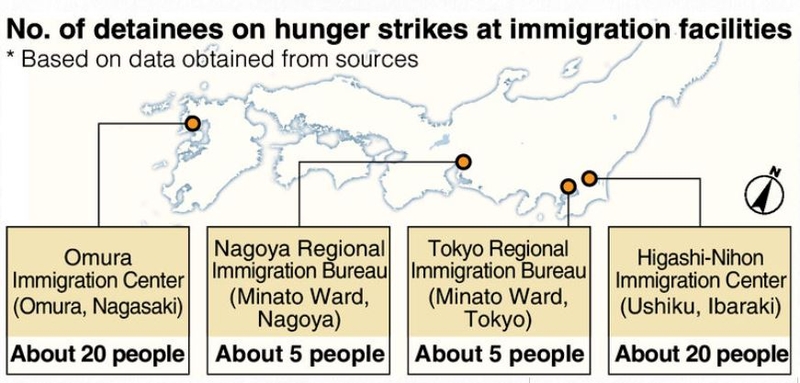
Sources said that as of Sept. 10, about 50 detainees were on hunger strikes at four of the 17 immigration facilities nationwide.

Several inmates in Ushiku began hunger strikes around May. At the peak in late July, about 70 people were on hunger strikes, but the number has now declined to about 20 people.

About 20 detainees are also on hunger strikes at the Omura Immigration Center in Omura, Nagasaki Prefecture. The facility holds about 100 people.

A Nigerian man in his 40s died at this facility in June after exhibiting what are thought to have been symptoms of cibophobia (fear of eating) after a hunger strike.

No solution in sight

There have been hunger strikes by detainees in the past, but these were mostly done to protest poor treatment at the facilities and were settled over a period of time. The recent hunger strikes are of a different sort.

The Immigration Services Agency grants temporary release to detainees whose health deteriorates to a point that makes it difficult to keep them at the facilities.

This release comes with restrictions, such as prohibitions against working and limitations on their scope of activities.

“Detainees are going on hunger strike one after another now because they think if they do they’ll get temporary release. We don’t see any prospect of resolving the situation,” a senior agency official said.

Detainees whose health deteriorates often reject intravenous drips or other recommended treatments.

Since May, about 30 people have been temporarily released from immigration facilities around the country due to poor health caused by hunger strikes.

These releases are usually for two weeks, and if their physical condition improves they are detained again. Some detainees have resumed their hunger strikes after reentering the facility.

Long-term detention

Extended stays in detention are why so many detainees are conducting hunger strikes.

As of the end of last year, 1,246 people were being detained at immigration facilities. Of these, 491 people had been detained for at least one year.

The facilities are intended to be temporary, with detainees being returned to their countries as soon as they accept deportation. However, detention can become prolonged if a person refuses deportation. In some cases the home country refuses to accept them.

Foreigners who have violated the Immigration Control and Refugee Recognition Law, such as for illegal stays or entry, can be granted special residence permits by the Justice Ministry that allow them to stay for humanitarian reasons if they have family in Japan. Last year 1,371 people were granted such permits.

“Many long-term detainees have families in Japan, are unable to return to their countries due to conflict or other reasons, or have other circumstances. People who have lived in Japan for a long time and are thought to only be able to live here should receive more flexible dispensation, including provisional release,” said Matsuo Tamaki, a sociology professor at Utsunomiya University who has been involved in issues surrounding the detention of foreigners.

However, some long-term detainees have been involved in serious crimes such as robberies and drug-related incidents.

Foreigners on temporary release have been involved in cases involving drugs, bodily harm and theft. Last year, 108 such people were arrested.

“We pay attention to humanitarian concerns as much as possible, but it’s difficult to grant temporary release or special residence permits to foreigners who have committed crimes that cause serious damage, such as drug trafficking,” a senior agency official said.

https://the-japan-news.com/news/article/0006007342

ANN/US businesses upbeat about tariff overtures – China Daily

ศาสตร์เกษตรดินปุ๋ย : ขอบคุณแหล่งข้อมูล : หนังสือพิมพ์ The Nation

https://www.nationthailand.com/ann/30376205

ANN/US businesses upbeat about tariff overtures – China Daily

Sep 15. 2019
By CHINA DAILY/ANN

558 Viewed

Moves expected to set stage for ‘earnest discussions’ on trade in coming week

Leading US business groups said they expect that the latest goodwill gestures of the US and Chinese governments will usher in “productive” talks and put an end to the tariff increases that have led to their protracted trade war.

Plans were announced on Wednesday by the US leader to delay a tariff increase on $250 billion worth of Chinese imports planned for Oct 1 for two weeks, until Oct 15. China also said earlier in the day that it was exempting 16 types of US products from duties.

On Friday in Beijing, the Customs Tariff Commission of the State Council said it will exclude some agricultural products like soybeans and pork from the additional tariffs on US goods, Xinhua News Agency reported official sources as saying.

Also, Reuters reported that Chinese firms bought at least 10 boatloads of US soybeans, the country’s most significant purchases since June.


“We hope this (US) announcement, combined with other confidence-building measures from both governments, will create the conditions necessary for productive trade negotiations and end the cycle of tit-for-tat retaliatory actions,” the Washington-based US-China Business Council said on Thursday.

On Thursday afternoon, the US leader told reporters he doesn’t want an interim deal, adding that he would rather get the whole deal done.

Also on Thursday in Beijing, Vice-Premier Liu He said in a meeting with USCBC Chairman Evan Greenberg that the entire world looks forward to seeing progress in trade consultations between China and the United States.

The USCBC represents about 200 US companies that do business with China, including some of the world’s best-known brands.


Liu said that working groups from the two nations will meet next week and have “earnest discussions” on the trade balance, market access, protection of investors and other issues of common concern, according to Xinhua.

Greenberg said the US business sector does not want to see a rise in tariffs, and hopes that the two countries will solve their differences through consultations and bring bilateral trade back to normal.

USCBC President Craig Allen said, “Tariffs are a tax on our businesses and consumers — the impact on supply chains and company confidence is clearly hurting the economy.” Unilateral imposition of tariffs makes US companies less competitive in the global arena, he added.

“We urge both sides to work toward eliminating tariffs, realize the concrete progress that is possible today, and build momentum for longer-term negotiations on the most challenging issues,” Allen said.


Jennifer Safavian, executive vice-president of government affairs at the Retail Industry Leaders Association, said leading US retailers are hopeful the president’s gesture of goodwill in delaying the tariff increases will lead to productive talks between the two countries next month.

“A resolution is sorely needed that puts an end to the tariff increases,” she said.

RILA, based in Arlington, Virginia, near Washington, represents more than 200 retailers, product manufacturers and service suppliers, which together account for more than $1.5 trillion in annual sales, millions of US jobs and more than 100,000 stores.

“Consumer confidence is the one pillar of strength in the US economy, and the president’s tariff strategy is threatening that, as higher prices will be imposed on consumer goods with increased tariffs,” Safavian said. “Negotiating a path forward that puts an end to the erratic tariff increases and provides some dose of certainty to businesses should be the goal for the October trade discussions.”

The International Monetary Fund said on Thursday that the rising trade and geopolitical tensions have increased uncertainty, taking a toll on business confidence, investment and global trade.

“Our latest estimate is that … the US-China tariffs, including those implemented and announced, could potentially reduce the level of global GDP by 0.8 percent in 2020, with additional losses in future years,” IMF spokesman Gerry Rice said.

Gary Shapiro, president and CEO of the Consumer Technology Association, also based in Arlington, said in a statement Wednesday that increasing tariffs are giving the stock market whiplash, and consumers are getting worried — last month consumer sentiment dropped almost 10 percentage points.

http://www.chinadaily.com.cn/a/201909/14/WS5d7bca46a310cf3e3556b651.html

ANN/Haze in Singapore: Pollution index enters unhealthy range across island, with the west recording

ศาสตร์เกษตรดินปุ๋ย : ขอบคุณแหล่งข้อมูล : หนังสือพิมพ์ The Nation

https://www.nationthailand.com/ann/30376204

ANN/Haze in Singapore: Pollution index enters unhealthy range across island, with the west recording

Sep 15. 2019
At 8am on Sept 15, the 24-hour PSI readings ranged between 107 in the east and 124 in the west, with western Singapore recording the highest reading.ST PHOTO: ONG WEE JIN

At 8am on Sept 15, the 24-hour PSI readings ranged between 107 in the east and 124 in the west, with western Singapore recording the highest reading.ST PHOTO: ONG WEE JIN
By STRAITS TIMES/ANN

889 Viewed

The air quality in Singapore worsened on Sunday (Sept 15) morning as Pollutant Standards Index (PSI) readings crossed the unhealthy level in all parts of the island.

SINGAPORE – The air quality in Singapore worsened on Sunday (Sept 15) morning as Pollutant Standards Index (PSI) readings crossed the unhealthy level in all parts of the island.

The 24-hour PSI reading for the north, south, east, central and west entered the unhealthy range at 1am.

At 8am, the 24-hour PSI reading ranged between 107 in the east and 124 in western Singapore. At 11am, the reading was between 108 and 121.

A PSI reading of 101 to 200 is in the unhealthy range, for which the National Environment Agency (NEA) advises the public to cut down on outdoor activities.

A PSI reading of zero to 50 indicates that the air quality is good, while a reading of 51 to 100 is in the “moderate” range. The air quality is considered to be “very unhealthy” when the PSI ranges from 201 to 300, and it is “hazardous” when the reading goes above 300.

The PSI crossed the “unhealthy” level on Saturday for the first time since 2016 when western Singapore showed a reading of 103 at 4pm.

Meanwhile, PM2.5 concentration readings, which the NEA says are a better indication of current air quality, were at normal levels in all parts of Singapore on Sunday.

At 8am, the one-hour PM2.5 reading ranged between 26 micrograms per cubic metre in the east and 37, with the highest reading recorded in the central part of the island. At 10am, it ranged between 29 and 47.

There are four bands on the PM2.5 concentration scale: 0 to 55 for normal, 56 to 150 for elevated, 151 to 250 for high, and very high for readings above 250.

The NEA said the deteriorating air quality is due to winds blowing more smoke haze from Sumatra, which is south of Singapore.

More than 300,000ha of land in Indonesia have been ravaged by fire from January to last month.

For the next few days, dry weather can be expected in Singapore and over central and southern Sumatra, and the NEA warned that the PSI may enter the mid-section of the unhealthy range if denser haze is blown in.

Minister for the Environment and Water Resources Masagos Zulkifli said in a Facebook post on Saturday evening that Singapore is ready to help “suppress fires on the ground”.

He wrote: “Singapore has offered technical firefighting assistance to Indonesia and is prepared to deploy them if requested by Indonesia.”

The NEA said in a Facebook post on Sunday that poor visibility does not mean that the air is more polluted.

Participants of the Yellow Ribbon Prison Run 2019 on Sept 15, 2019. ST PHOTO: LIM YAOHUI

Participants of the Yellow Ribbon Prison Run 2019 on Sept 15, 2019. ST PHOTO: LIM YAOHUI

It wrote: “A significant factor of visibility is the amount of water vapour in the air. Water droplets scatter light, resulting in lower visibility. Also, certain air pollutant particles attract water molecules, which results in larger particles that scatter more light. This means that on days with smoke haze and high humidity or rain, visibility can be much lower.”

It added that the burning smell from the haze is due the complex mixture of gases generated by forest and peat fires in the region.

In a statement on its Facebook page posted on Sunday, the Ministry of Health (MOH) said that it was aware of reports that N95 masks were sold out at some retail stores.

“We would like to assure the public that there are sufficient stocks in the warehouses and government stockpiles. We are working with the retailers to move available stocks to the retail shops, and stocks will be available progressively from today,” it added.

Despite the haze, some outdoor activities continued as planned on Sunday.

Organisers of the Yellow Ribbon Prison Run, which is scheduled from 6am to 1pm, said on the event’s website and Facebook page that the run will still take place.

Likewise, POSB bank said on Facebook that it would proceed with events in the POSB PAssion Run for Kids. The first two event categories, a 10km and 5km run, kicked off at 6.30am and 7am respectively, while the last event, a 3.5km non-competitive Family Walk, started at 9.30am.

Both organisers said that the events would still be held, as PM2.5 readings were in the normal range.

Meanwhile, organisers of the Formula One Singapore Airlines Singapore Grand Prix, which takes place next weekend, said the event’s contingency plan includes the possibility of haze.

In response to queries, a spokesman from Formula One organisers Singapore GP said: “In the event that the haze causes visibility, public health or operational issues, Singapore GP would work closely with the relevant agencies before making any collective decisions regarding the event.”

https://www.straitstimes.com/singapore/environment/haze-in-spore-air-quality-enters-unhealthy-range-across-island-with-8am-psi

Vietnam digs in on South China Sea oil and gas projects amid Chinese pressure

ศาสตร์เกษตรดินปุ๋ย : ขอบคุณแหล่งข้อมูล : หนังสือพิมพ์ The Nation

https://www.nationthailand.com/ann/30376201

Vietnam digs in on South China Sea oil and gas projects amid Chinese pressure

Sep 14. 2019
Photo credit:Wikipedia

Photo credit:Wikipedia
By The Straits Times/ANN

341 Viewed

BANGKOK – Vietnam, locked in one of its most protracted test of wills with China of late, is trying to allay fears that yet another foreign joint venture energy project in the South China Sea may be canned due to pressure from Beijing.

The question over American firm ExxonMobil’s involvement in the Ca Voi Xanh, or Blue Whale, gas field project off central Vietnam arose as a Chinese survey ship remained in Vietnam’s exclusive economic zone this week, the third such encroachment over the past two months.

On Friday afternoon (Sept 13), Chinese government-owned Haiyang Dizhi 8 was anchored about 360km from the southern Vietnamese city of Vung Tau, according to information from vessel tracking website Marine Traffic.


Under escort by the Chinese coast guard, it has surveyed the area, triggering a demand from Hanoi for Beijing to immediately remove its vessels.

Vietnamese Foreign Ministry spokesman Le Thi Thu Hang, in a media briefing on Thursday, condemned China’s actions as illegal, saying that the waters in question “lies entirely within the sovereignty and jurisdiction of Vietnam”. Replying to a query, she added that the Blue Whale project was continuing as planned.

The project consists of an offshore platform, a pipeline, a gas treatment plant on the mainland as well as pipelines linking third-party plants to generate power. Singapore’s Sembcorp Industries is among the firms involved in a gas-fired power plant in the central Quang Ngai province linked to the project.

When fully up and running, the Blue Whale project is expected to provide US$20 billion (S$30.3 billion) in revenue for Hanoi and supply enough power to cover 10 per cent of Vietnam’s current demand.

China claims almost the entire oil-rich South China Sea through a vaguely defined “nine-dash line”, which overlaps the claims of the Philippines, Vietnam, Malaysia, Brunei, as well as Taiwan.

To bolster its position, it has reclaimed and militarised disputed islands in South China Sea, while engaging in an over decade-long discussion with Asean to draw up a code of conduct to manage territorial disputes.

Beijing has repeatedly tried to block companies from non-littoral states from taking part in oil exploration, and proposed that the final Code of Conduct include a clause which states that marine economic activity “shall not be conducted in cooperation with companies from countries outside the region”.

In 2017, Hanoi scrapped an oil drilling project licensed to state-owned PetroVietnam, Spain’s Repsol and United Arab Emirates’ Mubadala Development, under Chinese pressure. Less than a year later in 2018, Vietnam cancelled another project licensed to Repsol about 400km from its southern coast over the same concerns.

This year, oil drilling activities that Hanoi licensed to Russia’s state-owned Rosneft 370km south-east of Vietnam again triggered opposition from Beijing, which sent Haiyang Dizhi 8 with escorts to Vanguard Bank on the western edge of Spratly Islands. Vietnam opted to extend the oil rig’s operation.

Dwarfed by China’s naval prowess, Vietnam has opted to flex its diplomatic muscles instead. At the July meeting between Asean’s and China’s foreign ministers in Bangkok, Vietnam’s Foreign Minister Pham Binh Minh called out China’s actions for eroding trust and causing instability.

During the visit by Malaysian Prime Minister Mahathir Mohamed to Hanoi in August, both countries issued a joint statement that, among other things, “expressed serious concerns over recent developments in the South China Sea”.

Vietnam, along with the other Asean states, took part in the inaugural Asean-US Maritime Exercise this monthheld mostly in waters off Vietnam’s southernmost Ca Mau province. The drills helped Asean’s navies search and seize suspicious boats.

VN central bank makes first key rate cut since 2017

ศาสตร์เกษตรดินปุ๋ย : ขอบคุณแหล่งข้อมูล : หนังสือพิมพ์ The Nation

https://www.nationthailand.com/ann/30376200

VN central bank makes first key rate cut since 2017

Sep 14. 2019
The State Bank of Việt Nam's headquarters in Hà Nội. Many key interest rates will be reduced from September 16. Photo SBV

The State Bank of Việt Nam’s headquarters in Hà Nội. Many key interest rates will be reduced from September 16. Photo SBV
By Viet Nan News/ANN

353 Viewed

HÀ NỘI The State Bank of Việt Nam (SBV) on Friday announced it would cut several key interest rates by 0.25 percentage points, starting from September 16, to support economic growth.

The rate cuts were the first by the SBV since October 2017.

Accordingly, the annual refinancing rate and rediscount rate will be lowered from 6.25 per cent to 6 per cent, and from 4.25 per cent to 4 per cent, respectively

The annual overnight electronic interbank rate and rate of loans to offset capital shortage in clearance between the central bank and domestic banks will be also cut to 7 per cent.

The interest rate of bids of valuable papers through the open market operations will be reduced from 4.75 per cent to 4.5 per cent annually.

According to the SBV, it previously took monetary policy measures to stabilise interest rates in the context of rising interest rates in the international market, which contributed to macroeconomic stability and support growth at reasonable levels.

However, it has now decided to make the new move as the global economy has become more volatile and less favourable, while central banks of many countries, including the US Federal Reserve (Fed) and the European Central Bank (ECB), have cut their key interest rates.

The cut is made in the context that in the domestic market, the macroeconomy continues to be stable, inflation was under control, and the monetary and foreign exchange markets were stable, the SBV said in the statement.

Experts have also agreed with the central bank’s move.

Banking and finance expert Cấn Văn Lực told Việt Nam News that the cut at this moment was suitable, especially in the context that the economy was slowing and central banks in many countries have cut interest rates.

“It is estimated that some 40 countries worldwide have so far this year cut interest rates. After making a rate cut for the first time in more than a decade in July, the Fed is likely to cut the rates a second time at its meeting later this month,” Lực said.

Lực said the cut would not put pressure on the country’s inflation and the exchange rate as the inflation was low and the exchange rate was relatively stable.

Data from the General Statistics Office showed that the country’s inflation cooled to 2.57 per cent in August 2019, down from 3.52 per cent in August 2018. The rate was the lowest rise for the past three years. In 2019, inflation is projected to average at 2.9 per cent, buoyed by weak transport inflation due to a drop in average oil prices in the year.

The exchange rate was also nearly steady, with the US dollar listed at commercial banks to inch up by only some VNĐ10 for buying and VNĐ30 for selling against the end of 2018. The central bank’s USD/VNĐ daily reference exchange rate also rose slightly by 1.28 per cent against end-2018.

According to Lực, the new rate cut will also help interest rates listed at commercial banks to cool in the context that some banks have increased their deposit rates to 8.55 per cent per year.

The central bank’s key rate cut is considered a reference for the market to follow suit. It would also be an effective measure to support liquidity for commercial banks, helping them cut input costs so as to ensure the stability of lending interest rates. VNS


Read more at http://vietnamnews.vn/economy/535383/vn-central-bank-makes-first-key-rate-cut-since-2017.html#FBR4AV0FbyB2u49B.99

OPINION : Jakarta needs tough air pollution control; are we ready?

ศาสตร์เกษตรดินปุ๋ย : ขอบคุณแหล่งข้อมูล : หนังสือพิมพ์ The Nation

https://www.nationthailand.com/ann/30376199

OPINION : Jakarta needs tough air pollution control; are we ready?

Sep 14. 2019
Smog blankets Jakarta’s skyscrapers on Monday, August 19, 2019. Air pollution in the city is among the worst in the world. (JP/Donny Fernando)

Smog blankets Jakarta’s skyscrapers on Monday, August 19, 2019. Air pollution in the city is among the worst in the world. (JP/Donny Fernando)
By The Jakarta Post/ANN

222 Viewed

On  Monday, the Jakarta administration started to enforce the expansion of the odd-even license plate policy from only nine to 25 roads for private cars and other four- or more-wheeled vehicles in response to a lawsuit against the governors of Jakarta, Banten and West Java as well as against President Joko “Jokowi” Widodo and several ministers, who are being blamed for the poor air quality in the capital.

As a city with one of the worst air-pollution problems in the world, Jakarta and its satellite cities need tougher policies on air-pollution control, particularly to reduce emissions from the transportation sector, whose contribution to air pollution in urban areas amounts to about 70 to 80 percent, surveys show.

Therefore, traffic restrictions such as the odd-even policy should not only target cars but also motorcycles to significantly cut emissions, because motorcycles account for 75 percent of all vehicles, while cars only account for 23 percent, according to the Greater Jakarta Transportation Agency.

Jakarta is among Indonesia’s first cities to have introduced a bylaw on air pollution. The 2005 bylaw was introduced a year after the opening of the first corridor of the Transjakarta busway or bus rapid transit (BRT), now the backbone of the capital’s transportation service along with the rail-based commuter line service.

The bylaw and the BRT initiated by then-governor Sutiyoso were considered the most important steps toward improving air quality in Jakarta, which in 2005 was the world’s third-worst after Mexico City and Bangkok. They also show that from the beginning, policymakers were aware that efforts to ease traffic congestion were an integral part of improving air quality.

Progress in public transportation deserves appreciation as city-owned bus management PT TransJakarta reportedly operates about 2,200 buses, compared with fewer than 500 city buses in 2005. Meanwhile, PT Kereta Commuter Indonesia, a subsidiary of state-owned railway operator PT KAI, transports about 1 million passengers per day in Greater Jakarta now, double the number in 2005.

Unfortunately, the success story in public transportation has not been followed by a significant reduction in vehicular emissions, because the administration has failed to enforce the air pollution control bylaw. It is 15 years since the bylaw was introduced, and the city has been led by five governors since then, including Governor Anies Baswedan.

Meanwhile, many motorists are still reluctant to shift to public transportation. Instead, they rely on private vehicles, mostly motorcycles, purchased through easily available loans.

The bylaw actually mandates the city administration to enforce regular checks on vehicular emissions. It also requires the use of natural gas for vehicles operated by the administration and public transportation. It further requires the government to provide vehicles with more environmentally friendly fuels.

In addition, the city also has Bylaw No. 5/2014 on transportation, which is another strong legal basis to improve the city’s air quality. The bylaw stipulates traffic restrictions, which could be in the form of electronic road pricing (ERP), the odd-even policy, three-in-one policy or others.

The odd-even policy was introduced for the first time by then-governor Basuki Tjahaja Purnama in May 2016 to replace the three-in-one policy — because the city was not ready to enforce the ERP as a result of a failure in the tender process for the infrastructure. Meanwhile, Anies believed the odd-even policy to be an effective way to force motorists to shift to public transportation.

AirVisual recorded Jakarta’s air quality as the worst in the world on Aug. 3 with an Air Quality Index (AQI) level of 174. On Monday, Jakarta’s AQI level was recorded at 135, or the world’s third-worst after Beijing and Tashkent, Uzbekistan. Meanwhile, Jakarta’s AQI level improved to 95, or at 12th position at 3:53 p.m. on Friday.

While Jakarta’s air quality is fluctuating, there is still a long way to go until we get Jakarta’s blue skies. Therefore, the lawsuit being heard at the Central Jakarta District Court will hopefully result in forcing the city administration and the other defendants to enforce the regulations.

The city’s plan to enforce mandatory emissions checks for all vehicles in Jakarta in early 2020 will require sufficient workshops and other emissions-check facilities.

The court also needs to ensure that the government will expand the gas network in the city to facilitate more compressed natural gas (CNG) stations. Meanwhile, the transportation sector should only use environmentally friendly fuels.

However, eventually, a strong commitment by the people is the key to significant improvement of the city’s air quality, because any policies on air-pollution control demand trade-offs from residents and commuters. For example, we will have to give up the convenience of riding private vehicles, pay more for environmentally friendly fuels and regularly check our vehicles to meet the emissions standards.

The court may hand down a strong ruling leading to tough enforcement of air-pollution control as demanded by the plaintiffs. So are we ready to shoulder the costs needed to significantly clean up the city’s air?

The greater our commitment, the cleaner Jakarta’s air will be.


https://www.thejakartapost.com/academia/2019/09/14/jakarta-needs-tough-air-pollution-control-are-we-ready.html?utm_campaign=os&utm_source=mobile&utm_medium=ios

Indonesia seals off plantations operated by 29 firms over fires, including Singapore, Malaysian comp

ศาสตร์เกษตรดินปุ๋ย : ขอบคุณแหล่งข้อมูล : หนังสือพิมพ์ The Nation

https://www.nationthailand.com/ann/30376198

Indonesia seals off plantations operated by 29 firms over fires, including Singapore, Malaysian comp

Sep 14. 2019
By The Straits Times/ANN
263 Viewed

JAKARTA/KUALA LUMPUR – Indonesia has sealed off plantations operated by 29 companies, including four subsidiaries of Malaysian groups and one Singaporean firm, after fires were detected in their concessions, the government said on Friday (Sept 13).

The legal measures against allegedly errant companies have been underway since last month.

Environment and forestry minister Siti Nurbaya Bakar said on Friday the government will prosecute a number of these companies as a deterrent to setting fires. Indonesia is struggling to curb spreading fires in Sumatra and Kalimantan and has faced criticism from Malaysia.


Ms Siti named the Singapore-affiliated company as Hutan Ketapang Industri, a West Kalimantan province-based rubber plantation subsidiary of another Indonesian company Sungai Menang, which is a wholly owned subsidiary of Indonesia’s Sampoerna Agro. Singapore-based Sampoerna Agri Resources Pte Ltd owns two-thirds of Sampoerna Agro.

Sampoerna Agro was founded by the family of Indonesian billionaire Putera Sampoerna.

The four firms affiliated with Malaysian corporate groups operate in West Kalimantan and Riau provinces. Ms Siti named the companies as Sime Indo Agro (a unit of Sime Darby Plantation), Sukses Karya Sawit (a unit of IOI Corporation) and Rafi Kamajaya Abadi (a unit of TDM Bhd). The last one, operating in Riau, is Adei Plantation and Industry (a unit of Kuala Lumpur Kepong Group).

Ms Siti made her remarks in a media briefing after a three-hour coordination meeting in Jakarta that was chaired by Coordinating Minister of Political, Legal and Security Affairs Wiranto.

“We give no compromise to those that burn and cause fire,” retired general Wiranto said in the same media briefing. “Our approach is, enforce the law hard and firm to create deterrent effect.”

In response, Sime Darby Plantation (SDP) said on Friday that there had not been any action taken by the Indonesian authorities to seal off the operations of Sime Indo Agro (PT SIA).

SDP also said it was assisted by its Indonesian subsidiary in continually monitoring all its operation sites throughout the year, and that a recent fire that broke out on Sept 3 outside of PT SIA’s operational area was in fact on land occupied by local communities. The fire was contained and the incident clarified to visiting authorities from the Indonesian Ministry of Environment and Forestry.

IOI Corporation also issued a statement late on Friday that its subsidiary had not received any official notification on the matter.

“PT SKS has been on high alert and has put in place measures to deal with the dry weather and the risk of fire,” it said.

“We were able to quickly extinguish several small fires that have occurred over the last couple of months and have assisted other companies and villagers to respond to fires on our neighbouring lands.”

Freeport’s copper export quota triples to 700,000 tons

ศาสตร์เกษตรดินปุ๋ย : ขอบคุณแหล่งข้อมูล : หนังสือพิมพ์ The Nation

https://www.nationthailand.com/ann/30376194

Freeport’s copper export quota triples to 700,000 tons

Sep 14. 2019
By The Jakarta Post

397 Viewed

The Energy and Mineral Resources Ministry decided this month to increase mining company Freeport Indonesia’s copper concentrate export quota to 700,000 wet metric tons (wmt), a more than threefold increase on the previous quota of 198,282 wmt.

The ministry’s minerals director Yunus Saefulhak told reporters in Jakarta on Friday that the decision was a result of successful optimization schemes at the company’s Grasberg copper and gold mine in Papua province.

“Some studies were conducted and we found that it is still possible to optimize and exploit available means of production,” he said.

He added that the increased copper export quota did not change the company’s overall copper production target of 1.3 million wmt for this year.

The higher quota is a revision of Freeport’s one-year copper export license that was renewed in March.