Korea, Japan, China vow cultural cooperation despite diplomatic spat

ศาสตร์เกษตรดินปุ๋ย : ขอบคุณแหล่งข้อมูล : หนังสือพิมพ์ The Nation

https://www.nationthailand.com/ann/30375668

Korea, Japan, China vow cultural cooperation despite diplomatic spat

Sep 01. 2019
By Korea Herald/ANN

261 Viewed

Despite diplomatic and trade tension between Korea and Japan, the two countries, along with China, laid the groundwork Friday for cultural cooperation over the next 10 years.

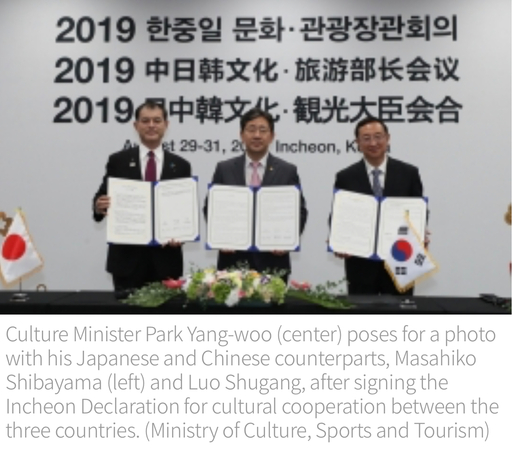
Culture Minister Park Yang-woo and his counterparts Masahiko Shibayama and Luo Shugang signed the Incheon Declaration containing the 10-year vision during the 11th annual meeting of cultural ministers of the three countries in Incheon.

The declaration stated that the conference — first held in China in 2007 — has contributed to promoting cultural diversity of each country based on mutual trust, respect and benefits. It vowed to push ahead with new ways to cooperate in the cultural sector, particularly youth exchanges and issues like climate change and aging societies.

The three countries also vowed to push for joint cultural programs on the sidelines of international sporting event — as they did at the 2018 PyeongChang Winter Olympics — particularly for the 2020 Tokyo Summer Games and 2022 Beijing Winter Games.

In addition, they agreed to cooperate for the protection of cultural heritage, the development of content that fuses tourism and culture, and the protection of copyrights.“I sincerely hope that the three nations — through cultural cooperation — can jointly respond to various issues and challenges, raising our capacity to accept other cultures, which will ultimately lead to joint prosperity of the three cultures, along with peace and co-existence of East Asian community,” Park said during his opening speech.

The meeting came as Seoul and Tokyo are locked in a diplomatic and trade row, which has led to their worst relations in years.

Following Japan’s restrictions of exports to Korea of materials critical to making chips and displays last month, Seoul has terminated their bilateral General Security of Military Information Agreement.

Japan has also removed Korea from its whitelist of trusted trade partners. The souring relationship has even led to a nationwide boycott of Japanese products and tourism. Tourism ministers of the three countries — Park, Luo and Keiichi Ishii from Japan — held a separate meeting later in the day, and adopted a joint statementvowing joint efforts for peace, stability and prosperity in the East Asian region.

The three ministers also agreed to create an environment for “Tourism for All,” and cooperate for sustainable growth of tourism industry.

http://m.koreaherald.com/view.php?ud=20190830000542

Thai man preserves and promotes ethnic script

ศาสตร์เกษตรดินปุ๋ย : ขอบคุณแหล่งข้อมูล : หนังสือพิมพ์ The Nation

https://www.nationthailand.com/ann/30375667

Thai man preserves and promotes ethnic script

Sep 01. 2019
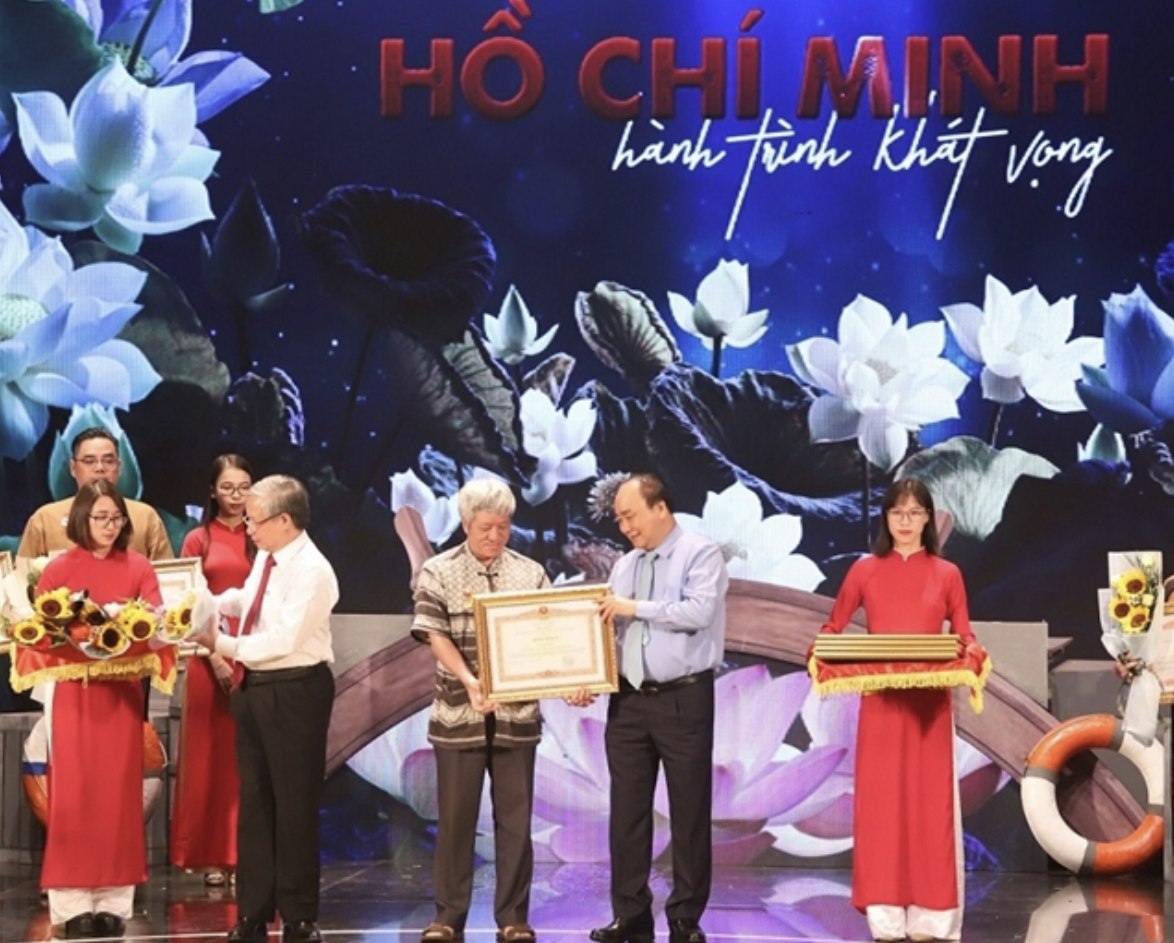
SAVING CULTURE: Sầm Văn Bình was in Hà Nội recently to attend an exchange programme to honour role models from across the country in studying and following the ideology, morality and lifestyle of late President Hồ Chí Minh. VNS Photo Thanh Hùng

SAVING CULTURE: Sầm Văn Bình was in Hà Nội recently to attend an exchange programme to honour role models from across the country in studying and following the ideology, morality and lifestyle of late President Hồ Chí Minh. VNS Photo Thanh Hùng
By Viet Nam News/ANN

557 Viewed

Sầm Văn Bình was proud to be one of the attendees at an event held in Hà Nội recently to honour role models from across the country who study and follow the ideology, morality and lifestyle of President Hồ Chí Minh.

COGNISED: Sầm Văn Bình (third from right) receives a certification from Prime Minister Nguyễn Xuân Phúc at a programme in Hà Nội recently. VNS Photo Thanh Hùng Read more at http://vietnamnews.vn/sunday/features/534799/thai-man-preserves-and-promotes-ethnic-script.html#vok5D0WytP2oMfmh.99

COGNISED: Sầm Văn Bình (third from right) receives a certification from Prime Minister Nguyễn Xuân Phúc at a programme in Hà Nội recently. VNS Photo Thanh Hùng Read more at http://vietnamnews.vn/sunday/features/534799/thai-man-preserves-and-promotes-ethnic-script.html#vok5D0WytP2oMfmh.99

He is from the Thai ethnic group, and lives in Yên Luốm Village in the central province of Nghệ An.

“It is a rare chance for me to meet many people from across the nation,” he said. “Everyone has made great efforts but the common feature is that all things are based on President Hồ Chí Minh’s thoughts, morality and lifestyle. I’m very happy.”

Binh has spent many years collecting Thai manuscripts to preserve and develop the written language. Most significantly is that many Thai people in the province can now read and write in their own script which they speak every day.

Although he graduated from Maritime University in 1987 he was unable to find a suitable job. He returned home to find work.

He often saw old documents but was unable to read them. He was concerned that the script was almost forgotten.

This prompted him to begin collecting and learning the script to understand more about the customs and habits of his ethnic group.

An opportunity arose when the district built a library under a national programme. He came across an old book entitled Luật Tục Thái Việt Nam (The Law and Custom of the Ethnic Thai in Việt Nam).

“I remembered that there were some old books in my district so I asked to borrow them,” he said.

He began to study the spelling and grammar of the Thai script, which was not difficult as he already spoke the language.

However it took about three months to read and write the script fluently.

“The more I researched the script the more beautiful and valuable things I saw,” he said. “In the integration, if people do not preserve the traditional culture it will disappear.”

Although he has been collecting and preserving the script for over 20 years, he never thought he’d be able to write a dictionary until Thai writer Quán Vi Miên – a member of the Việt Nam Writers Association – encouraged him.

However, he is not a linguistic researcher so he didn’t know how to compile a dictionary.

He started work on the outline for the dictionary. The structure of the first consonants of the old Thai and Latin scripts is quite different so he contacted overseas Vietnamese Châu Kim Quới in Thailand and met him at a seminar in Chiang Mai in 2009.

Quới introduced him to reference a book entitled Southwestern Tai Dialects by William J. Gedney from the Center for South and Southeast Asian Studies at the University of Michigan.

He also got support from Tạ Văn Thông from the Việt Nam Academy of Social Sciences.

“It’s good to have a dictionary for the Thai script,” Thông said.

“If a language is passed down orally it will be lost.

“Many ethnic minority groups in Việt Nam are at risk of losing their language, causing their culture and traditional customs to disappear.

“The preservation of Thai script will promote solidarity in the group.”

For ten years, Bình worked on the Thái – Việt (Romanised Thai – Vietnamese) Dictionary with 14,000 entries. It has 845 pages and about 500 copies were published by the Nghệ An Publishing House in 2018.

There are four main Thai dialects in Việt Nam including Thai Sơn La; Thai Tay Thanh; Thai Lai Tay and Thai Lai Pao.

The dictionary is the first document to systematise Thai Lai Tay. This kind of script is used mainly in Nghệ An and the central province of Thanh Hóa.

Lai Tay is distinct from others. But Lai Tay is written up to down and read from right to left.

From 2011 to 2017, Bình researched Lai Tay in Nghệ An. He received a Special Prize in the provincial Science and Technology Renovation Competition.

His research has helped more than 500 people learn the script in seven districts of the province. Most learners are young students aged from 15 to 18.

The Thai classes had 90 learners, with the youngest 13 and the oldest 45.

Many people see Thai script as important in understanding their culture and customs.

From 2012, newspapers and magazines including Nghệ An’s Weekend newspaper have published articles in Thai script.

“I will focus on literature and art of my ethnic group,” Bình said. “I hope my work will preserve and promote Thai culture, making its contribution to national cultural development.”

“The provincial Department of Culture, Sports and Tourism is preparing a dossier to propose recognising the Thai Lai Tay script as a national intangible heritage,” Bình said. VNS

Moon set for trips to Thailand, Myanmar, Laos

ศาสตร์เกษตรดินปุ๋ย : ขอบคุณแหล่งข้อมูล : หนังสือพิมพ์ The Nation

https://www.nationthailand.com/ann/30375666

Moon set for trips to Thailand, Myanmar, Laos

Sep 01. 2019
By Korea Herald/ANN

80 Viewed

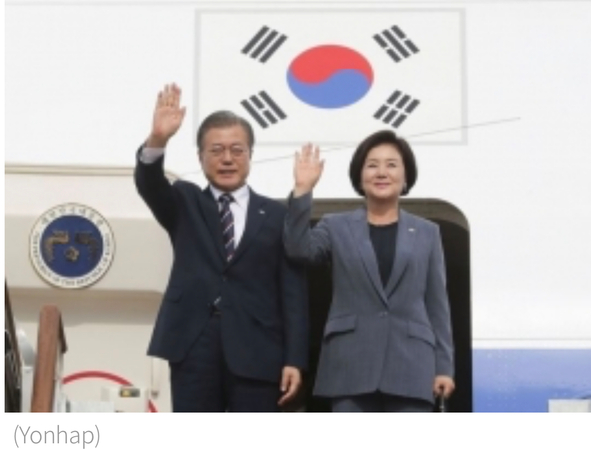
South Korean President Moon Jae-in will open a busy tour of Thailand, Myanmar and Laos on Sunday, another key diplomatic undertaking in his campaign to broaden and deepen Seoul’s partnerships with the Southeast Asian bloc.The trip will make him the first South Korean leader to visit Thailand and Myanmar in seven years and the first-ever South Korean leader to visit Laos.

With the upcoming six-day journey, Moon will fulfill his promise to visit all the 10 member states of the Association of Southeast Asian Nations (ASEAN) during his presidency under his administration’s New Southern Policy drive.

In Bangkok, his first destination, Moon is scheduled to hold summit talks with Prime Minister Prayuth Chan-ocha on Monday.

Traditionally, the two sides have maintained close cooperation on economy, society, culture, national defense and arms development.

Seoul is now seeking to expand bilateral ties to science-technology and cutting-edge businesses, as Thailand has the second-biggest economy in the region after Indonesia.

The Thai government is pushing for the “Thailand 4.0” project aimed at accelerating the growth of innovative, high-tech industries at home. It’s working hard to draw massive global investment in the Eastern Economic Corridor (EEC), the three-province advanced development zone near the capital.

Thailand holds this year’s rotating presidency of the ASEAN.

“With the two-way trade volume with our country totaling around $14 billion, (the two sides) have great potential for the expansion of economic cooperation going forward,” Joo Hyung-chul, a Cheong Wa Dae adviser for economic affairs, told reporters.

Moon plans to participate in a Bangkok event Monday, called the “Fourth Industrial Revolution Showcase,” and present a vision for bilateral partnerships on digital life, bio-health, smart factory and future vehicles, Joo added. The president will deliver a keynote speech at a related business forum.

On Wednesday, he will head to Myanmar for meetings with its state councilor and Nobel Peace Prize laureate Aung San Suu Kyi and President Win Myint.

Myanmar, rich in natural resources and geographically important, is a latecomer in terms of market opening, which means a lot of opportunities for South Korean companies. More than 200 South Korean firms are doing businesses there.

During Moon’s state visit to the nation, the Myanmar government is expected to launch the “Korea Desk” office to help South Korean businesses resolve administrative difficulties.

Moon will attend a groundbreaking ceremony for the South Korea-Myanmar Economic Cooperation Industrial Complex situated north of Yangon.

Starting on Thursday, the president will make a state visit to Laos, where he will meet with President Bounnhang Vorachith and Prime Minister Thongloun Sisoulith.

Among the main issues to be discussed are partnerships on hydroelectric power, ICT and farm villages. Laos is nicknamed the “battery of Southeast Asia” for abundant water resources from the Mekong River. Moon’s trips to the three key partners for the New Southern Policy are expected to “serve as a chance to solidify the base to cooperate for the success of the South Korea-ASEAN special summit and the first South Korea-Mekong summit to take place in Busan in November,” Park Chul-min, presidential secretary for foreign policy, said.

The special summit will be held from Nov. 25-26 to celebrate the 30th anniversary of South Korea and ASEAN establishing their formal dialogue.

The following day, Moon will host a separate summit there with his counterparts from five ASEAN countries located around the Mekong River — Cambodia, Myanmar, Laos, Vietnam and Thailand. (Yonhap)

News analysis Beijing’s Hong Kong strategy – more arrests, no concessions – may prolong unrest

ศาสตร์เกษตรดินปุ๋ย : ขอบคุณแหล่งข้อมูล : หนังสือพิมพ์ The Nation

https://www.nationthailand.com/ann/30375665

News analysis Beijing’s Hong Kong strategy – more arrests, no concessions – may prolong unrest

Sep 01. 2019
(Credit:The Straits Times )

(Credit:The Straits Times )
By The Staits Times/ANN

108 Viewed

HONG KONG • The arrests on Friday of prominent pro-democracy lawmakers and activists in Hong Kong reflect a tactical escalation by China’s leaders to curb the recent street violence, but which could prolong the protests for many months.

The authorities in Beijing, along with the Hong Kong government that answers to them, have decided on a policy of stepped-up arrests of demonstrators, who would be publicly labelled the most radical of the activists, according to Hong Kong Cabinet members and leaders of the local pro-Beijing establishment.

These local political figures emphasised that China wants the Hong Kong police to carry out the arrests – not Chinese soldiers, whose intervention in the city’s affairs would be unprecedented.

Beijing has also ruled out making concessions to the demonstrators, they said. With protest leaders also vowing not to back down, officials acknowledged the price of the strategy could be months of acrimony.

“I hope we can start the process of reconciliation before the end of the year,” Mr Ronny Tong, a member of Hong Kong’s Executive Council, or Cabinet, said in an interview.

Beijing and Hong Kong officials are betting that the protests will gradually die down as the police detain the most hardline demonstrators, and that public opinion will turn more decisively against the use of violence, said Professor Lau Siukai, a long-time adviser to the Chinese government on Hong Kong policy.

The Hong Kong police said on Friday that they had arrested more than 900 people this summer in connection with the protests.

The police, who have been accused by demonstrators and international rights groups of using excessive force, have “not used their capacity to suppress the protests” until very recently, said Prof Lau, who ran the city’s policy planning agency for a decade until 2012.

With broad backing from mainland China, “the mood of the police was lifted up and they became even more ferocious in putting down the protests”, said Prof Lau, who is now vice-chairman of the Chinese Association of Hong Kong and Macau Studies, a semi-official advisory body set up by Beijing.

With Chinese President Xi Jinping dealing with a trade war with the United States, a strategy of attrition in Hong Kong could be seen as preferable to a rash approach that might risk spiralling into a major crisis.

But it is far from clear how much success the authorities will have.

The handful of pro-democracy activists and lawmakers who were arrested on Friday have relatively moderate reputations.

Demonstrators have contended that at least some of the violence attributed to them may have been instigated by undercover police agents.

Protesters also suspect the authorities of involvement in a spate of attacks on pro-democracy activists by men armed with sticks, baseball bats and even meat cleavers.

Similar incidents in Hong Kong over the years have been linked to organised crime groups, which have a history of ties to Beijing.

The mutual distrust has become so great that not only are the authorities and pro-democracy activists not holding talks, but the informal contacts that once existed between the government and the older generation of activists – who, themselves, are mistrusted by many of the younger protesters – have also essentially come to a halt.

Each side has worried that any effort to quietly negotiate a deal would be torpedoed by leaks, embarrassing anyone who might try to strike a compromise. From the government’s point of view, those fears were realised when Mrs Carrie Lam, the Chief Executive, met local young people this past week, only for a recording to be leaked to Apple Daily, a pro-democracy outlet.

The Chinese military’s police conducted large exercises just across the border from Hong Kong last month as a show of force. But those exercises were aimed at showing that China is prepared for any contingency, and were not a preamble to any plan for actual deployment in Hong Kong, Prof Lau and others familiar with the exercises said.

Mr Martin Lee, a veteran pro-democracy campaigner and founder of the Hong Kong Democratic Party, said that Beijing did not want anything to mar its Oct 1 celebration of the 70th anniversary of the founding of the People’s Republic of China.

Beijing “won’t allow bloodshed to happen in Hong Kong before then – after Oct 1, beginning on the 2nd, I don’t know,” Mr Lee said.


https://www.straitstimes.com/asia/east-asia/beijings-strategy-more-arrests-no-concessions-may-prolong-unrest

Police fire water cannons, tear gas after Hong Kong protesters occupy major roads despite warning

ศาสตร์เกษตรดินปุ๋ย : ขอบคุณแหล่งข้อมูล : หนังสือพิมพ์ The Nation

https://www.nationthailand.com/ann/30375664

Police fire water cannons, tear gas after Hong Kong protesters occupy major roads despite warning

Aug 31. 2019
(Photo credit:Hong Kong Free Press

(Photo credit:Hong Kong Free Press
By The Straits Times/ANN

267 Viewed

HONG KONG –  Parts of Hong Kong on Saturday (Aug 31) again descended into chaos as police fired water cannons and rounds of tear gas during pitched street battles after protesters defied a ban and took to the streets, occupying major roads in several areas.

Hundreds had surrounded the government headquarters and the legislature in Admiralty, pelting eggs at officers who stood guard behind giant water barriers. Some started breaking the glass of a security booth as others tried to pry open metal gates leading into the building.

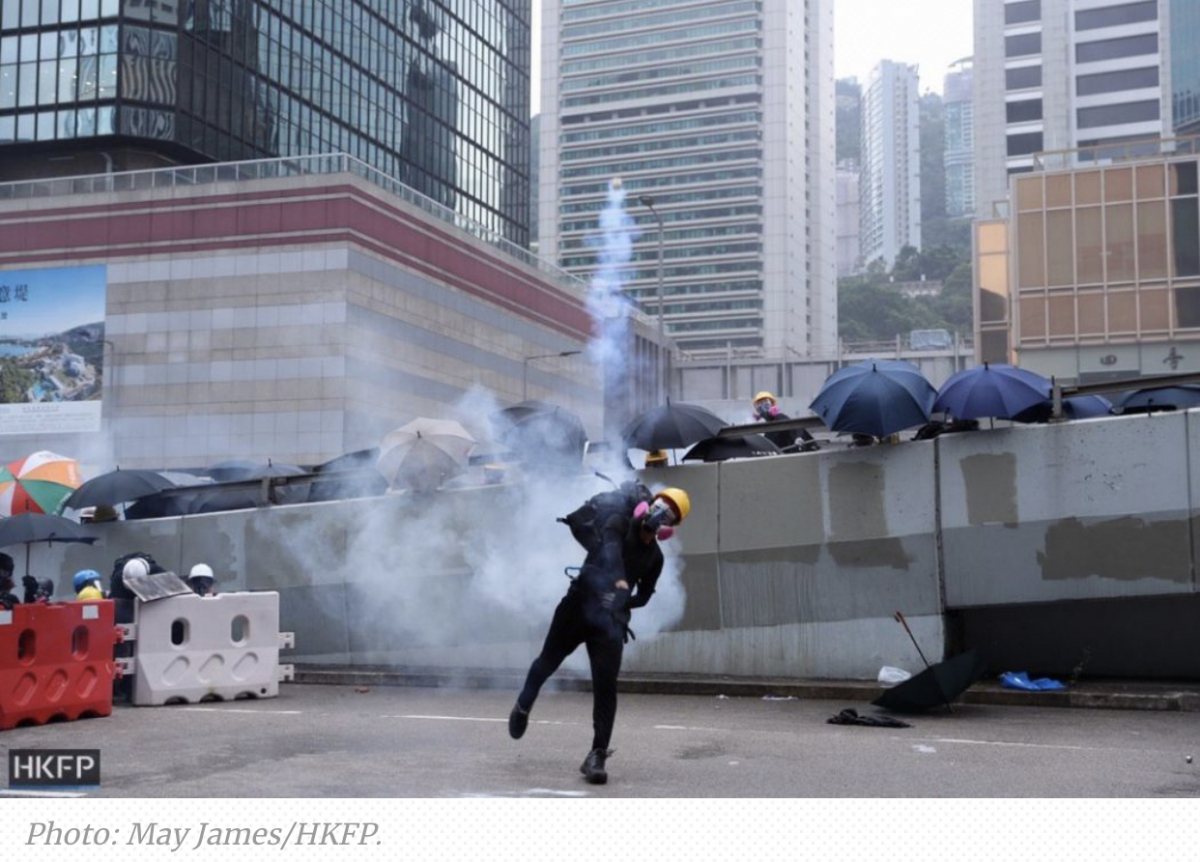
Shortly before 5.20pm, police had used pepper spray on protesters who threw eggs at officers before officers on elevated platforms fired several rounds of tear gas. This pushed protesters back onto Harcourt Road, a main thoroughfare in the area, where they regrouped behind plastic barricades

They later started small fires close to the police officers, who responded by volleying more rounds of tear smoke and deployed the water cannon which shot streams of water, several rounds containing a blue dye.

Overhead, at least two helicopters with Government Flying Service livery hovered as protesters shone powerful laser beams at the aircraft.

Protesters also flung flaming projectiles into the compound of the People’s Liberation Army garrison, right next to government headquarters. As riot police marched down Harcourt Road to  disperse the crowd, a group threw Molotov cocktails at them from a flyover.
 

(Photo Credit:Hong Kong Free Press)

(Photo Credit:Hong Kong Free Press)

By about 7pm, most had left Admiralty and regrouped in Wan Chai, close to police headquarters, where they piled various objects, forming a giant barricade on Hennessy Road which they torched. Protesters also added a metal bleacher to the pile, believed to have been appropriated from the nearby Southorn Playground.

Covering at least three lanes of Hennessy Road, thick black smoke billowed as protesters continued tossing various objects into the raging flames. Firefighters later showed up to put out the blaze, clearing the way for riot police.

As police pushed protesters down Hennessy Road, some threw petrol bombs at officers to impede their advance, to which police responded with tear gas and bursts of water from the cannons.

Close to 9pm, a small group of protesters barricaded parts of Nathan Road in Tsim Sha Tsui, the popular tourist district on the other side of Victoria Harbour, bringing traffic to a virtual standstill. Shops quickly pulled down their shutters, while curious passersby continued walking around and taking pictures.

Protesters later moved northwards to Mong Kok and Kwun Tong, prompting riot police to chase protesters into the Mong Kok metro station. The rail operator said trains would not be stopping at affected stations.

Earlier in the day, demonstrators flooded roads in the popular Causeway Bay shopping district, the civic district in Admiralty, Wan Chai and the Central business district, as police issued several warnings for the crowd to disperse.

Armed with umbrellas against the muggy weather, tens of thousands marched on the roads with no clear destination, shouting slogans including “fight for freedom, stand with Hong Kong”. Small pockets of protesters have been building makeshift barricades in parts of the city, a bid to disrupt traffic, before quickly dispersing.

Police had on Thursday rejected the application for a march to Beijing’s liaison office in the city, citing safety reasons, but tens of thousands have gone ahead and taken to the streets, the 13th consecutive weekend of demonstrations since mass protests against a controversial extradition Bill escalated in June.

Security in the city has been ramped up this weekend, with huge water-filled barricades set up around the buildings next to Beijing’s liaison office in Sai Ying Pun and other government buildings – a previous target of some hardcore protesters. Roads in the area have been blocked to cut off access to the office.

The police’s new anti-riot water cannons, which were deployed for the first time in Tsuen Wan last Sunday, were also spotted in the area.

Subway operator MTR said trains would not stop at Sai Ying Pun station from 1.30pm, while sections of roads on Hong Kong Island had been closed, with tram services suspended.

Chief transport officer Lai Chui-ying said the exit of the Cross Harbour Tunnel had been temporarily blocked at police request. She said Des Voeux Road West was blocked by large water-filled barriers in both directions, although the Transport Department had not been notified of this in advance. Bus routes have been diverted, RTHK said.

In an alert to residents in the city, police on Saturday morning warned the public of “severe disruptions” ahead of a “public event this afternoon”.

Fresh calls on Saturday morning circulating via messaging app Telegram urged netizens to assemble in Causeway Bay at 2pm.

This follows calls circulated on social media on Friday for people to join a Christian gathering at Wan Chai and to march to Central and Upper Albert Road, where Chief Executive Carrie Lam’s official residence is located. The group was thwarted by armed police who stopped them from accessing the road.

By 1pm, thousands have gathered at Southorn Playground in Wan Chai chanting “Hong Kong, gah yau”, or “Hong Kong, keep it up”, as they started marching despite police warnings against unauthorised protests.

Police issued a warning to a group occupying part of Hennessy Road, asking them to leave immediately.

A local who only wanted to be known as Mr K. Fung, told The Straits Times that he was there to help out in whatever way he could, be it to direct traffic or to help when the triads come and bother people.

The 39-year-old odd-job labourer stressed that the government has “gotten it wrong if it thinks this is an issue that concerns the younger people”.

“This (political crisis) concerns all of us in Hong Kong,” he said.

Asked if he was afraid of getting arrested, Mr Fung said in Hong Kong there are now two things that people fear: triads and some police.


https://www.straitstimes.com/asia/east-asia/defiant-hong-kong-protesters-expected-to-go-ahead-with-demonstrations-despite-police
New policies to deepen Lingang opening-up

ศาสตร์เกษตรดินปุ๋ย : ขอบคุณแหล่งข้อมูล : หนังสือพิมพ์ The Nation

https://www.nationthailand.com/ann/30375657

New policies to deepen Lingang opening-up

Aug 31. 2019
An aerial view of the Lingang Special Area of the China (Shanghai) Pilot Free Trade Zone in Shanghai. [Photo by Gao Erqiang / China Daily]

An aerial view of the Lingang Special Area of the China (Shanghai) Pilot Free Trade Zone in Shanghai. [Photo by Gao Erqiang / China Daily]
By China Daily
Asia News Network

251 Viewed

Efforts geared to attract more talent from home and abroad, say experts

The municipal government of Shanghai announced 50 measures for the newly added Lingang Special Area of the China (Shanghai) Pilot Free Trade Zone on Friday to make it an influential and competitive special economic zone in the world.

The measures cover eight major areas including relaxed regional administrative authority, talents, fiscal and finance, land use, industrial development, housing, transportation and infrastructure.

Yuan Baiwei, inspector of the Shanghai Municipal Finance Bureau, said that the municipal government will launch a development fund within the year to support the strategic industries in Lingang. The fund will provide more than 100 billion yuan ($140 billion) of fiscal support in five years to nurture research and development, technology renovation and new products.

There will also be special tax arrangements in Lingang, pending final approval from the Ministry of Finance, said Yuan.

Lingang Special Area was launched on Aug 20, with a startup area of 119.5 square kilometers. Ma Chunlei, director of the Shanghai Municipal Development and Reform Commission, said that the 50 measures have been introduced to stabilize companies’ expectations on policies so that they can make long-term plans in Lingang.

Talent policies are the highlight of the newly released measures, targeting professionals from home and abroad. Specifically, talents, who have worked in Lingang for certain years and promise to continue working in the area for at least two more years after obtaining Shanghai residential licences, can be granted Shanghai household registration within five years, instead of seven years previously. For the key talents in strategic industries, the period can be further shortened to three years.

Overseas students who work in Lingang can apply for the type B overseas residence permit with a maximum validity of 10 years. No work permit will be needed for such cases. While overseas students were previously required to have at least two years of working experience in other markets before they landed a job in Shanghai, they can now work in Lingang right after graduation.

“Based on the basic rule of further opening-up, the newly introduced talent policies in Lingang have made a large number of breakthroughs. The ultimate goal is to let talents enjoy the services of the city as soon as possible,” said Yu Chengbin, deputy head of the Shanghai Municipal Human Resources and Social Security Bureau.

Sany Heavy Machinery has been operating in Lingang for 10 years. During the first half of this year, the company’s total output increased 9 percent year-on-year to over 5 billion yuan. The company’s chairman Yu Hongfu said that Lingang’s inclusion into the Shanghai FTZ will increase Sany’s competitiveness in the global market.

“With the detailed policies of the Lingang Special Area released, the company will be substantially more attractive to overseas talents and experts, which will in turn make our products better known in the international market,” he said.

National Day celebrations kick off in Putrajaya

ศาสตร์เกษตรดินปุ๋ย : ขอบคุณแหล่งข้อมูล : หนังสือพิมพ์ The Nation

https://www.nationthailand.com/ann/30375650

National Day celebrations kick off in Putrajaya

Aug 31. 2019
Photo by The Star

Photo by The Star
By The Star
Asia News Network

138 Viewed

PUTRAJAYA: The 62nd National Day celebrations kicked off in grand fashion, with tens of thousands of Malaysians gathered around Persiaran Perdana here to witness the annual parade on Saturday (Aug 31).

The Yang di-Pertuan Agong Al-Sultan Abdullah Ri’ayatuddin Al-Mustafa Billah Shah and the Raja Permaisuri Agong Tunku Azizah Aminah Maimunah Iskandariah arrived at the venue at 8am.

Their arrival was greeted by Prime Minister Tun Dr Mahathir Mohamad and wife Tun Dr Siti Hasmah Mohd Ali, before the royal couple were led to the main stage.

This is the first year Sultan Abdullah is attending the Merdeka celebrations as king, following his appointment as the 16th Yang di-Pertuan Agong on Jan 31.

Earlier, Dr Mahathir’s arrival at 7.50am was greeted with rousing applause.

The 94-year-old delighted the crowd as he was seen driving a maroon Proton Saga to the main stage.

Also among the VIP list were Deputy Prime Minister Datuk Seri Dr Wan Azizah Wan Ismail, Multimedia and Communications Minister Gobind Singh Deo, other Cabinet ministers as well as foreign dignitaries.

People came as early as 6am to the administrative capital in view of the anticipated road closures and traffic congestion.

For two years in a row, the National Day celebrations have been organised at Putrajaya, away from the usual location of Dataran Merdeka in Kuala Lumpur.

After the historic change of government in May 2018, the Pakatan Harapan administration decided to host the Merdeka Day parade in Putrajaya.

The theme of this year’s celebration is “Sayangi Malaysiaku: Malaysia Bersih”.

DOF chief: China respects PH sovereignty on Pogos

ศาสตร์เกษตรดินปุ๋ย : ขอบคุณแหล่งข้อมูล : หนังสือพิมพ์ The Nation

https://www.nationthailand.com/ann/30375649

DOF chief: China respects PH sovereignty on Pogos

Aug 31. 2019
By Philippine Daily Inquirer
Asia News Network

132 Viewed

The country’s online gaming industry found some relief on Friday after Chinese leader Xi Jinping made no specific request to President Duterte to ban the controversial but booming industry, according to Secretary Carlos Dominguez III of the Department of Finance (DOF).

The Chinese leader, however, also made known to Mr. Duterte his resistance to gambling as it involved Chinese nationals, a position articulated earlier by the Chinese Foreign Ministry and also affirmed by  Duterte’s spokesperson and by Dominguez himself on Friday.

A DOF statement quoted Dominguez as saying that “China respected the Philippines’ sovereignty over the government’s policy on gambling during President Rodrigo R. Duterte and Chinese President Xi Jinping’s meeting in Beijing.”

The finance secretary, who accompanied the President in the two-and-a-half hour bilateral meeting on Thursday, also said “the Chinese leader did not ask or request the Philippine Chief Executive to ban offshore gaming operations, which mostly employ Chinese nationals.”

On the other hand, Dominguez also noted, “He [Mr. Xi] applauded the moratorium on new licensees in the Philippines.” The finance chief said this was in response to the Philippines’ move to stop accrediting new Philippine gaming offshore operators (Pogos).

“President Xi basically said that gambling is totally banned in China except in Macau where they tolerate gambling,” Dominguez also said.

‘What we will lose’

He said he “believes President Xi’s statement regarding Pogo during his meeting with President Duterte was just ‘a comment,’ noting the Chinese leader knows and respects the Philippines’ sovereignty.”

Duterte “took note of President Xi’s comment,” he added.

Speaking to reporters after the bilateral meeting in Beijing, presidential spokesperson Salvador Panelo said “President Xi expressed appreciation for what we did in suspending new (Pogo) applicants.”

“But he said they will appreciate more if Pogo will be eliminated or stopped,” Panelo said.

“The President has not said anything about it, but I suppose he will have to study [it],” Panelo said. “We have to look into what we will lose if we stop online gaming. Will it affect the [national] budget? You must remember revenues are coming in [from Pogos]. They have to consult with the finance department [regarding] its effects.”

Strict rules, regulations

“Right now, what we can do is to be very strict on [Pogos], following rules and regulations, and the law. That’s what we can do,” Panelo also said.

On April 20, Chinese Foreign Ministry spokesperson Geng Shuang said Beijing welcomed Manila’s suspension of the issuance of new licenses for Pogos and “we hope the Philippines will go further and ban all online gambling.”

Sovereign decisions

Philippine Ambassador to China Jose Santiago Sta. Romana on Thursday maintained that China could not order the Philippine government to shut down online gaming companies catering to Chinese citizens.

“They cannot dictate on us. Those are sovereign decisions. That is where we stand,” Sta. Romana said hours before the meeting between the two leaders.

Economic Planning Secretary Ernesto Pernia earlier said the online gaming industry should be carefully studied before the government decides its fate, describing the issue as “fluid.”

Multibillion-peso take

Bangko Sentral ng Pilipinas Governor Benjamin Diokno said he is “open minded” about the offshore gaming operations in the country.

The Philippine Gaming and Amusement Corp. estimated that licensing fees and royalties from Pogos would hit P8 billion this year, up 33 percent from P6 billion last year.

This is on top of the P12 billion contribution to the national government since the formerly unregulated industry was legalized three years ago.

The Bureau of the Internal Revenue is also estimating around P24 billion in withholding taxes coming from the foreign nationals working in the Pogo industry.

Hin Nam No moves closer to becoming world heritage site

ศาสตร์เกษตรดินปุ๋ย : ขอบคุณแหล่งข้อมูล : หนังสือพิมพ์ The Nation

https://www.nationthailand.com/ann/30375648

Hin Nam No moves closer to becoming world heritage site

Aug 31. 2019
By Vientiane Times
Asia News Network

139 Viewed

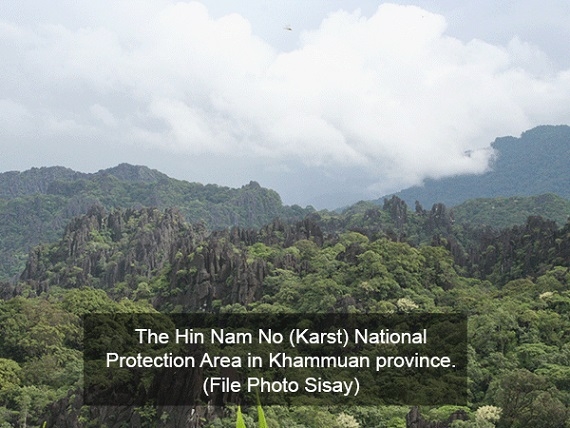
Laos is speeding up the preparation of documents to request listing of the Hin Nam No (Karst) National Protection Area in Bualapha district, Khammuan province, as a UNESCO World Heritage Site.

The 8th national steering committee meeting concerning the application was convened in Vientiane on Thursday, chaired by Minister of Information, Culture and Tourism Prof. Dr Bosengkham Vongdara.

The meeting reported on the preparations being made to submit an application to UNESCO, and was attended by a delegation from Vietnam.

The ministry is preparing documents in cooperation with the Vietnamese government to record the Hin Nam No National Protection Area as a transboundary World Heritage Site together with Vietnam’s Phong Nha-Ke Bang National Park.

The governments of Laos and Vietnam will work together to achieve their target to list the Hin Nam No National Protection Area as Laos’ first natural World Heritage Site and the first transboundary World Heritage Site in the region.

The meeting was an indication that Hin Nam No and its proposed UNESCO listing is a matter of national pride for Laos.

This was the first time that delegates from Vietnam had been invited to attend a meeting of the Lao national steering committee on world heritage.

The proposed transboundary World Heritage Site comprising the Hin Nam No National Protection Area and the Phong Nha-Ke Bang National Park is seen as an important legacy of the longstanding friendship between Laos and Vietnam.

The Ministry of Information, Culture and Tourism indicated that preparations for the submission of the application for world heritage listing are well under way and has the support of all stakeholders and the entire country.

Being the home and custodian of a new world heritage site that includes both Hin Nam No and Phong Nha-Ke Bang would mean that Laos is becoming part of a global community of countries that protects nature’s heritage and values for all mankind. Furthermore, Laos would be the first country in South-East Asia to have created a transboundary world heritage site together with a neighbouring country, according to the Ministry of Information, Culture and Tourism.

Laos currently has three World Heritage Sites. The Plain of Jars was listed by UNESCO last month, while the old town of Luang Prabang was inscribed in 1995, followed by Vat Phou Champassak in 2001.

HK tourist arrivals fall 4.8% as social unrest lingers

ศาสตร์เกษตรดินปุ๋ย : ขอบคุณแหล่งข้อมูล : หนังสือพิมพ์ The Nation

https://www.nationthailand.com/ann/30375647

HK tourist arrivals fall 4.8% as social unrest lingers

Aug 31. 2019

Tourists watch the view from the Peak in Hong Kong, Jan 6, 2017. (LI PENG / XINHUA)

Tourists watch the view from the Peak in Hong Kong, Jan 6, 2017. (LI PENG / XINHUA)
By China Daily
Asia News Network

220 Viewed

Hong Kong’s total tourist arrivals dipped nearly 5 percent in July whereas mainland visitor numbers decreased more than 242,000 in the same period as overseas travelers avoid the city due to protracted social unrest.

The Hong Kong Tourism Board said on Friday that more than 5.19 million overseas tourists traveled to the SAR last month, a decrease of 4.8 percent compared with a year ago. Of the total visitor arrivals, more than 4.16 million came from the Chinese mainland, falling 5.5 percent or 242,000 from the previous year.

Tourist arrivals from South Korea registered the biggest decline, plunging 20.8 percent from a year ago. This was followed by Russia (a drop 16.5 percent) and Taiwan (a decline of 11.8 percent).

However, visitors from Macao rose 32.6 percent last month, followed by those from the Philippines (11.7 percent).