HK Int’l airport cancels outbound flights

ศาสตร์เกษตรดินปุ๋ย : ขอบคุณแหล่งข้อมูล : หนังสือพิมพ์ The Nation

https://www.nationthailand.com/ann/30374630

HK Int’l airport cancels outbound flights

Aug 12. 2019
By The China Post

438 Viewed

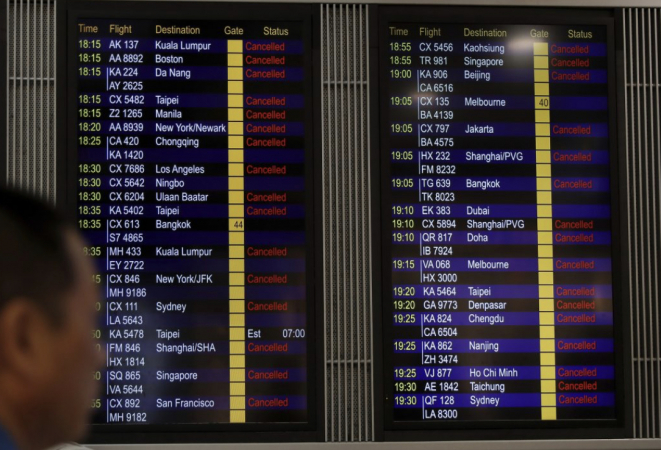
TAIPEI (The China Post) – Hong Kong International Airport canceled all flights out of Hong Kong for the rest of the day after thousands of anti-government protesters descended on the airport.

Demonstrators donned eye patches at Lantau Island hub, one of the world’s busiest international airports, in anger after a girl was allegedly hit with a police beanbag.

Airport chiefs said inbound flights already in the air would be allowed to land, but any flights which had not departed would be delayed.

This is the fourth straight day of protests as anti-government demonstrations have continued to escalate.

Protesting flash mobs cause chaos in Hong Kong

ศาสตร์เกษตรดินปุ๋ย : ขอบคุณแหล่งข้อมูล : หนังสือพิมพ์ The Nation

https://www.nationthailand.com/ann/30374626

Protesting flash mobs cause chaos in Hong Kong

Aug 12. 2019
Traffic cones are left by protesters to block the entrance to Cross-Harbour Tunnel in Kowloon, Hong Kong during illegal processions, Aug 10, 2019. (Photo: China Daily)

Traffic cones are left by protesters to block the entrance to Cross-Harbour Tunnel in Kowloon, Hong Kong during illegal processions, Aug 10, 2019. (Photo: China Daily)
By CHINA DAILY
ASIA NEWS NETWORK

249 Viewed

Hong Kong, once widely known for its bustling and orderly streets, experienced new chaos as anti-government protesters used a new tactic and launched waves of guerrilla-style attacks using flash mobs in different locations over the weekend.

After police earlier beefed up actions against the protestors, the black-clad protesters seemed to adopt another tactic to avoid confrontations with police. They switched locations quickly after erecting barricades on the roads to block traffic and vandalise public properties, including metal railings, drain covers and pavements. On Saturday alone, they mounted attacks on at least seven locations south from Tai Po to Hung Hom.

The protesters swiftly moved from place to place, staying about half an hour at every stop. They provoked police with insulting language and laser pointers, but quickly retreated once riot police formed cordons.

After having a taste of victory on Saturday, the protestors continued with the tactic on Sunday by constantly stirring up trouble in at least five sites on Hong Kong Island and Kowloon West.

Some people in Hong Kong have expressed impatience with the sustained disruptions since mid-June, as their jobs and daily lives are affected.

Leung, who manages Yuen Kee Restaurant on Hennessy Road in Causeway Bay, said business was down by at least 30 per cent since mid-June. The restaurant had to close when the protesters started showing up in the district, Leung said.

Trapped in a restaurant in Causeway Bay for nearly two hours during a standoff between police and protestors, a man surnamed Wai said people’s lives had been seriously affected by the protests.

When the radicals blocked the Hung Hom Cross-Harbour Tunnel on Saturday, the fifth time in a week, a staff member blasted the protesters for having impeded her work and urged them to leave the city if they really felt so dissatisfied.

“If you [the protesters] are so dissatisfied [with Hong Kong], then you should emigrate to whichever country you like. Why do you still stay here?” the woman said.

Affected by the protesters’ rally in Tai Po on Saturday, many shops closed for the day, with bus services also suspended for hours.

A local resident surnamed Chan said he was quite angry about the inconveniences caused. Questioning the goals of such disturbing actions, Chan warned that that there will be only a “lose-lose situation” if it continued.

Compared with previous protests, this weekend’s movements appeared to be more unscripted, or even aimless. Protesters frequently stopped ongoing actions to discuss the next step. Many of them seemed to have no idea of what they were going to do but appeared to follow whoever led the way. This made it very difficult for the news media to report the events.

Employees of a street food shop near Causeway Bay declined to comment on the protest while they pulled down the store’s shutters when protestors entered the neighbourhood. They told China Daily that they didn’t want to give interviews because they were afraid of vindictive consequences.

During the operation on Saturday, HKSAR police arrested 16 people for unlawful assembly, possession of offensive weapons, assaulting a police officer and obstructing a police officer in the execution of duties.

To date, a total of nine police officers have suffered eye injuries as hundreds of protesters aimed laser pointers at them. Among them, three were hurt on Saturday.

Versace issues apology for design listing Macao, HK as separate countries

ศาสตร์เกษตรดินปุ๋ย : ขอบคุณแหล่งข้อมูล : หนังสือพิมพ์ The Nation

https://www.nationthailand.com/ann/30374624

Versace issues apology for design listing Macao, HK as separate countries

Aug 12. 2019
Photo taken on May 19, 2019 is a Versace store in Beijing. (Photo/IC)

Photo taken on May 19, 2019 is a Versace store in Beijing. (Photo/IC)
By CHINA DAILY
ASIA NEWS NETWORK

472 Viewed

Italian fashion brand Versace apologised on social media platforms on Sunday after Chinese netizens criticised it for selling clothes that misrepresented Hong Kong and Macao, both special administrative regions of China, as separate countries.

The controversy started when images of a Versace T-shirt and hoodie with a printed design showing Hong Kong and Macao as separate countries began to circulate on Sina Weibo micro blogs over the weekend. The design – a list of cities and countries – listed Beijing and Shanghai as part of China but not the two SARs.

The fashion house first apologised on early Sunday morning on its official Sina Weibo account, which has around 850,000 followers, saying it was sorry for the design mistakes and had removed and destroyed all the offending clothes from its official retail channels since July 24.

“It was our negligence, and we are deeply sorry for the ramifications we caused,” it said, adding that “we love China and have resolute respect for its territorial and national sovereignty.”

By Sunday afternoon, the Sina Weibo hashtag of the incident had received more than 510 million views on the platform. The apology was also one of the most searched topics of the day on Chinese search engine Baidu, with more than 6.3 million searches.

Donatella Versace, chief creative officer for the brand, said in an online statement in English and Chinese posted on Versace’s Facebook, Instagram and Twitter accounts on Sunday afternoon that she wanted to “personally apologise for such inaccuracy and for any distress that it might have caused”.

“I am deeply sorry for the unfortunate recent error that was made by our company,” she said. “Never have I wanted to disrespect China’s national sovereignty.”

Versace has more than 5.3 million followers on Facebook, 4.7 million on Twitter and 19 million on Instagram.

The “find a store” section of Versace’s official website lists Hong Kong, Taiwan and Macao as separate entities to China, under an Asia-Pacific tag.

The studio of top Chinese actress Yang Mi, who has 104.9 million followers on Sina Weibo, said on its Sina Weibo micro blog that Yang terminated a contract signed with Versace in June on Sunday. She was Versace’s first Chinese brand ambassador.

“Our company and Ms Yang found online that some clothing designed by Versace was suspected of damaging China’s national sovereignty and territorial integrity,” the studio said in an online statement. “We, as a company of the People’s Republic of China, and Yang, being a citizen of the People’s Republic of China, are deeply offended.

“National sovereignty and territorial integrity are sacred and cannot be violated under any circumstances. It is the duty of all Chinese citizens to uphold the one-China principle and adamantly safeguard national unification.”

Although Versace has pulled the T-shirt and hoodie from its official retail platforms, they can still be found on fashion e-commerce platforms. Cettire, one such platform, is selling a black Versace hoodie with the misprinted design at a discounted price of $400 (Bt12,300), down from $500 (Bt15,380).

Versace is the latest foreign fashion brand to spark fury in China over its marketing.

In November, Dolce & Gabbana published a series of video advertisements showing a female Chinese model struggling to eat Italian food with chopsticks while a male narrator belittled her effort. The videos were regarded as sexist, condescending and stereotypical at home and abroad, and sparked a boycott of its products.

In 2017, model Gigi Hadid was removed from a Victoria’s Secret fashion show in Shanghai after she caused offense by impersonating the Buddha and mocking Asians in an Instagram video.

A warmer – and dryer – world

ศาสตร์เกษตรดินปุ๋ย : ขอบคุณแหล่งข้อมูล : หนังสือพิมพ์ The Nation

https://www.nationthailand.com/ann/30374622

A warmer – and dryer – world

Aug 12. 2019
By THE STAR
ASIA NEWS NETWORK
PETALING JAYA

250 Viewed

Major cities in Malaysia are seeing more days where the temperature hits at least 32 degrees Celsius compared to 10 years ago.

Kuala Lumpur, a city that’s home to almost two million people call home, can expect 270 days in a year when the mercury reaches that level.

A decade ago, Kuala Lumpur would experience such heat about 260 days a year.

The contrast is even more striking when compared to data – published in a recent New York Times (NYT) article “How Much Hotter Is Your Hometown Than When You Were Born?” – that goes back almost 20 years when there were only 243 such days.

The data was published by the NYT with analysis provided by the Climate Impact Lab, a group of researchers from various institutes in the United States.

Projections by the researchers also show that in Kuala Lumpur, the number of days on which the temperature could be expected to reach at least 32 degrees C would shoot up to 333 days – almost an entire year – about 50 years from now.

This future projection is based on the assumption that countries, including Malaysia, would take steps to reduce their greenhouse gas emissions in line with the original Paris Agreement signed in 2016.

Genting Highlands, a vacation staple for Malaysians seeking to enjoy the cool weather, has also seen the number of days with warm temperatures nearly doubling in 10 years. In 2009, the resort saw only about seven days where the mercury hit at least 32 degrees C but now, 13 days are expected to have such warm weather.

The data also showed that today, Ipoh has 222 days with temperatures above 32 degrees C in a year, up from 212 days 10 years ago.

George Town, a Unesco heritage enclave popular with foreign tourists, now experiences such temperatures for at least 251 days a year compared to 247 days a decade ago.

Across the South China Sea, Kuching can expect 144 days of such hot weather, an increase from only 131 days, and Kota Kinabalu, an additional 17 days.

According to data in the NYT article, most places in the world could see many more warmer days as the world heats up due to human-induced climate change.

Experts are warning that more “hotter” days in Malaysian cities will affect the supply and consumption of water among residents.

Already, unplanned water cuts due to, among other causes, the lack of raw water in Peninsular Malaysia last year far outnumbered scheduled water cuts.

“Climate change is already affecting Malaysia and rainfall is beginning to drop in certain areas, putting pressure on our water supplies.

“We need to treat water as the precious resource it is,” said National Water Services Commission chairman Charles Santiago. Malaysians, he added, needed to ramp up efforts to conserve water and an attitude change would probably be the best defence against decreasing water supply due to climate change and global warming.

Last month, the Water, Land and Natural Resources Ministry announced that it had commissioned a nationwide audit on the water industry in anticipation of the longer droughts the nation was expected to face due to climate change, pointing to the recent shortage that is affecting 180 million people in Chennai, India, as an example.

Convenience stores tipped as the next big thing in franchising

ศาสตร์เกษตรดินปุ๋ย : ขอบคุณแหล่งข้อมูล : หนังสือพิมพ์ The Nation

https://www.nationthailand.com/ann/30374619

Convenience stores tipped as the next big thing in franchising

Aug 12. 2019
At a Co.op Food franchisee in HCM City. Viet Nam offers huge opportunities for convenience store franchisers. (Photo courtesy of Saigon Co.op)

At a Co.op Food franchisee in HCM City. Viet Nam offers huge opportunities for convenience store franchisers. (Photo courtesy of Saigon Co.op)
By VIET NAM NEWS
ASIA NEWS NETWORK
HCM CITY

288 Viewed

After food and beverage and other sectors, convenience stores franchisers are now eyeing the huge Vietnamese market.

According to experts, Vietnam has all the requisite elements for the retail and franchising industry to grow, among them a large consumer base, rapidly rising incomes and a generation of young and educated professionals.

Speaking at a seminar on “Building an International Franchise Model” held in HCM City last week, Yun Ju Young, managing director of GS25 Vietnam, said the country is among the fastest growing retail markets in Asia, with convenience stores recording strong growth in recent years.

The South Korean convenience store chain GS25 has around 14,000 stores in its home market, 80 per cent of which are franchised.

“There is a high convenience store density in Korea. So we have to look for business opportunities in new markets like Vietnam.”

Vietnam, with a population of nearly 100 million, has around 2,000 stores, meaning there is still great potential for growth, he said.

Vietnam also has policies facilitating foreign investment.

In Korea, convenience stores are not allowed to open within 15 metres of another, but in Vietnam there is no such restriction, he said.

“GS25 estimates the opportunity in the Vietnamese market to be 50 times higher than in South Korea.”

According to analysts, convenience store franchises will be a new profitable business model because costs are lower than in other sectors while management is easier.

Yun said other convenience store chain franchises from Japan, Taiwan and other countries also want to enter the Vietnamese market.

In addition to foreign franchisers, Vietnamese retailers have also stepped up their franchising efforts.

Saigon Co.op for instance is franchising its Co.op Food convenience store in HCM City and other cities and provinces and targets opening 100 new stores this year.

Nguyen Phi Van, founder and chairwoman of Retail & Franchise Asia, said Vietnam is rated highly by the International Franchise Association as a franchise market.

For the next three years it would continue to attract international brands, especially from its region, she said.

However, many franchises did not succeed and pulled out of the Vietnamese market since they ran their business following the traditional model without applying digital technology, she said.

Retail franchises can no longer follow the traditional model, she stressed.

In advanced countries, they apply artificial intelligence and virtual reality in franchising and are very successful, and businesses in Vietnam cannot ignore this trend, she said.

Experts said franchisees need to change their mindset because some local businesses still consider franchises as a way to make money quickly by using other people’s brands.

This is a completely wrong approach and risks creating a crisis for the franchise systems, they warned.

Lekima wreaks havoc as it moves north

ศาสตร์เกษตรดินปุ๋ย : ขอบคุณแหล่งข้อมูล : หนังสือพิมพ์ The Nation

https://www.nationthailand.com/ann/30374617

Lekima wreaks havoc as it moves north

Aug 12. 2019
Rescuers help stranded villagers in Shayan village, Wuxiang town, Jinzhou district, Ningbo city, Zhejiang province, August 10, 2019. [Photo by Mou Xuangang/For chinadaily.com.cn]

Rescuers help stranded villagers in Shayan village, Wuxiang town, Jinzhou district, Ningbo city, Zhejiang province, August 10, 2019. [Photo by Mou Xuangang/For chinadaily.com.cn]
By China Daily/ANN

152 Viewed

Typhoon Lekima, which made landfall in Zhejiang province on Saturday, leaving 32 people dead and 16 missing, is moving northward, local authorities said on Sunday.

Lekima has affected 6.51 million people, with nearly 1.5 million of them relocated to safer places in Shanghai and the provinces of Zhejiang, Jiangsu, Anhui, Shandong and Fujian as of 5 pm on Sunday, the Ministry of Emergency Management said.


Rescuers carry an elderly woman to safety after she was stranded in a vehicle in a flooded street in Binzhou, Shandong province, on Sunday. [Photo/Xinhua]

Rescuers carry an elderly woman to safety after she was stranded in a vehicle in a flooded street in Binzhou, Shandong province, on Sunday. [Photo/Xinhua]

The typhoon damaged more than 265,500 hectares of crops and 35,000 houses, it said.

More than 30,000 firefighters in Zhejiang, Shanghai and Jiangsu have assisted in the rescue and relocation of 6,257 people in distress, the ministry said.

According to local authorities in Zhejiang, more than 5.35 million people in the province were affected, with 185,000 hectares of crops damaged. Economic losses are estimated at 15.75 billion yuan ($2.23 billion).

Most of the deaths occurred in Yongjia county, which is administered by Wenzhou, where torrential downpours caused a landslide that blocked a river to form a lake. When the barrier burst, floodwaters swept people away.

Nearly 1.2 million people have been evacuated as rescue work continues, local authorities said.

The Red Cross Society of China said on Sunday that it has launched an emergency response program for regions of eastern China hit by the typhoon.

The Chinese Red Cross Foundation has allocated 1 million yuan for the affected regions, the foundation said in a statement.

The money will go to relief programs, including family packages for at least 3,000 households, each of which will include living necessities for a three-member family for a week, the statement said.

Lekima, the strongest typhoon so far this year in the northwestern Pacific Ocean, rolled inland around 1:45 am on Saturday in Wenling, Zhejiang, packing winds of up to 187 kilometers per hour along with heavy rain, the National Meteorological Center said.

According to the center, it was the third-strongest typhoon to land in eastern China since 1949. The strongest was Wanda in 1956; the second-strongest was Saomai in 2006.

The center said that in the next three days Lekima will move northward and gradually weaken, but it will continue to bring powerful winds and heavy rain to northern and eastern China.

As of 10 am on Sunday, the Zhejiang provincial ocean forecasting and monitoring center had canceled its warnings for sea areas and said fishing boats could return to their business.

Operations at the airports and railway schedules within the Yangtze River Delta region returned to normal gradually on Sunday as the typhoon moved northward.

A gauge on the 125th floor of the Shanghai Tower, the world’s second-tallest and China’s tallest skyscraper, fluctuated 50 centimeters on Saturday as the building flexed in the storm. The gauge for the 632-meter-tall building in the Lujiazui Financial District can move a maximum of 2 meters during high winds, according to the information department of the building.

The Shanghai Disney Resort, which was closed on Saturday, resumed business on Sunday.He Lifu, a forecaster at the National Meteorological Center, said that over the next three days Lekima will continue to affect Shandong, Jiangsu, Anhui and Shanghai with strong winds and heavy rain.

The typhoon landed in Shandong around 8:50 pm on Sunday. It had been preceded by torrential rains. Precipitation in Weifang and Linyi was measured at 407 millimeters in places on Saturday.

Shouguang, a vegetable growing center in Shandong, was severely hit by the rain, with many greenhouses submerged on Sunday.

As Lekima moves north, Liaoning and Hebei provinces are expected to experience heavy rains on Monday. The storm will extend to Jilin province and the Inner Mongolia autonomous region on Tuesday, the center said.

Ma Zhenhuan, Zhao Ruixue, Zhou Wenting and Wu Yong contributed to this story.

http://www.chinadaily.com.cn/a/201908/12/WS5d509ab6a310cf3e35565132_5.html

Far-flung grievances stir when Jakarta is inconvenienced

ศาสตร์เกษตรดินปุ๋ย : ขอบคุณแหล่งข้อมูล : หนังสือพิมพ์ The Nation

https://www.nationthailand.com/ann/30374610

Far-flung grievances stir when Jakarta is inconvenienced

Aug 11. 2019
By Ati Nurbaiti
The Jakarta Post

198 Viewed

The power blackout on August 4 in Greater Jakarta and parts of West Java was said to be the worst in many years. Family and friends’ Sunday gatherings were still cheerful but hot as houses lost their air-cons.

The MRT – the new pride of President Joko “Jokowi” Widodo and Jakartans – seemed to blush in shame as the power back-up turned out to be for the stations and not yet for the rail service itself, so passengers had to be evacuated.

Gone was all the talk of the digital revolution and the cashless world as people suddenly found they had to rummage for cash for transactions.

We’re still waiting to learn what happened. Speculation ranges from inadequate back-up and slow contingency measures to allegations of sabotage and even whether a single fallen tree upset the whole network.

Amid lambasting of the state electricity company PLN were the mirthless smirks from outside Java. “Putri Riau” (Riau daughter) tweeted, “Friends in Java, did the power go out again? We get that daily, you know. If development cannot be disbursed equally, well at least the blackouts can.”

Blackouts have been part of life for way too long in mineral-rich Riau, Aceh, Papua and East Kalimantan, and so are other inconveniences rare in the capital, such as disrupted fuel supply.

Another injustice in luar Jawa (“outside Java”, the centre of everything) is the annual haze from forest fires that killed around 20 people in 2015, not to mention an estimated 100,000 premature deaths, according to one study, and the closing of schools in neighbouring Malaysia and Singapore, where residents are bracing for life in foul-smelling smog again. Recently six provinces in Indonesia have declared an emergency, anticipating worsening haze.

What is stunning is not only the fires themselves – it’s the wilful neglect of politicians even regarding the health of fellow citizens, let alone neighbours. For over a decade, lawmakers in Jakarta, never choked by the haze, refused to pass a law making a 2002 Asean agreement binding for Indonesia, to enable neighbours rush to help each other to stop fires if requested.

The law on transboundary haze was finally passed in 2014. The next year. President Susilo Bambang Yudhoyono repeated apologies already expressed in 2013 for the forest fires, and politicians rebuked him.

Chauvinistic nationalism against smaller neighbours is the only clear explanation to such disregard of the potentially lethal exposure of the smog particularly to children.

The blackout has reminded us not only of our precarious reliance on Indonesia’s coal-dominated power generation despite lofty pledges to go green.

The fuming against the ruling PLN reminds us of such chronically ignored inconveniences outside Java, which lack comparable headlines.

Extreme, intergenerational injustices perceived in one part of a country – termed “internal colonialism” by sociologists since the 1960s – helped explain pent-up anger in places from far away Northern Ireland, host of the armed movement against London, to resource-rich but poor areas back home.

Some of Indonesia’s areas rich in oil, gas and gold remain comparatively poor regarding nutrition, education, income and employment, leading to the stigma of being less capable citizens. Jakarta stands accused of sucking up too much of local revenue.

Then politicians add the toxic mix of ethnic and religious sentiment and things like “national interest”, loyalty to the “motherland”, a single “national identity”. And often this ends in war.

A rebellion in Aceh led to at least three generations experiencing violent conflict against Jakarta’s troops – and the devastating earthquake and tsunami of December 2004 was the windfall leading to the international Helsinki peace agreement 14 years ago on August 15.

But it’s hard for some citizens to be happy for Acehnese – even less so for Timorese who are to mark the 20th anniversary of their August 30, 1999, referendum that led to their independence. As the people in Aceh and free Timor Leste celebrate their courage of resistance, and commemorate the sacrifice of too many of their brethren, some Indonesians still snigger “enjoy your independence/autonomy, poverty, corruption and infighting”, thinking they must be regretting separation from Jakarta.

The regional autonomy law was an historic breakthrough ending 32 years of centralistic rule, but far from enough.

President Jokowi came to power promising to address such regional injustices by “building from villages”, spending lavishly on infrastructure to improve nation-wide land, sea and air connectivity apart from chronic potholed roads.

Lawmakers in 2014 passed the Village Law, and researchers remind us that it’s not all about the village funds – it’s supposed to be another breakthrough to ensure villagers really have a say in decisions affecting their lives.

Addressing regional disparity is part of our ongoing, back and forth, project of democracy. This is home – it needs constant repairs though many disagree how to go about it.

And because politics will always thrive on manipulation of sentiments and grievances, the ordinary citizen of the majority population could try better empathising with “outer Java”.

This would require the ability of those in Java’s cities, mainly urbanites in the capital and surrounding areas, to at least be exposed to grievances beyond Java.

Certainly, this boils down to the capital-based media trying harder to cover far-flung areas, though facing low profit and tight competition.

A Philippines’ fellow journalist who was reporting from Mindanao in the rebellious south several years ago said one factor of the protracted conflict was that most coverage came from Manila-based media, with journalists parachuting in and out of the area populated by the nation’s Muslim minority.

That sounds so much like Indonesia’s problem. Lack of understanding and bias of journalists of the majority ethnic and religious groups perpetuate ignorance and stigma against people in remote areas. Despite all odds we in the media must try harder to expose voices, experiences and discomforts of far-flung citizens, including their daily blackouts.

This article is part of a new series of the Asian Editors Circle, a weekly commentary by editors from the Asia News Network (ANN). The ANN is an alliance of 24 news media titles across the region. Ati Nurbaiti is deputy editor of the Jakarta Post’s Opinion Desk.

Spirited steps of summer

ศาสตร์เกษตรดินปุ๋ย : ขอบคุณแหล่งข้อมูล : หนังสือพิมพ์ The Nation

https://www.nationthailand.com/ann/30374603

Spirited steps of summer

Aug 11. 2019
The Yomiuri Shimbun

The Yomiuri Shimbun
By The Japan News/ANN

243 Viewed

Dynamic dancers clad in colorful outfits perform as they make their way down the streets of Kochi, where the 66th Yosakoi Festival opened Friday. Over 200 dance squads with 18,000 members from inside and outside of Kochi Prefecture are taking part in the four-day festival, which climaxes on Monday when the grand prize is awarded.

Korean won tipped to face further decline after 5% dip

ศาสตร์เกษตรดินปุ๋ย : ขอบคุณแหล่งข้อมูล : หนังสือพิมพ์ The Nation

https://www.nationthailand.com/ann/30374599

Korean won tipped to face further decline after 5% dip

Aug 11. 2019
Yonhap

Yonhap
By The Korea Herald/ANN

691 Viewed

South Korea’s local currency has dropped by one of the fastest rates in the world against the US dollar but may further decline on apparently growing demand for safer assets, data showed Sunday.

The Korean won closed at 1,214.90 won against the greenback Thursday, down 5 percent from 1,154.70 won a month earlier, according to the Bank of Korea (BOK).

The sharp decline was largely attributed to the escalating trade tension between the world’s two largest economies — the United States and China — that may put additional downward pressure on South Korean exports.

The country’s outbound shipments have dropped for eight consecutive months since Dec. They are widely expected to continue shrinking amid the US-China trade dispute, as well as Seoul’s own trade spat with Japan.

Tokyo began imposing tougher export restrictions last month on three key materials used to produce semiconductors and display panels, both key export items of South Korea that together account for more than one-quarter of all its exports.

As an apparent result, the value of the Korean won dropped by the third-fastest rate among the currencies of the 10 largest developing countries, including China, India, Russia and Argentina, over the past month.

“The won-dollar exchange rate dropped significantly on a less-than-anticipated easing stance of the US Fed and the escalation of the US-China trade dispute,” a BOK official said, while speaking on condition of anonymity.

The US Fed slashed its key rate last month, marking the first rate cut in a decade, but said the rate reduction did not signal the start of a long series of rate cuts, disappointing many who had expected a more aggressive effort from the US Fed to support the world’s largest economy.

The won may lose further ground down the road amid an apparent sign of market preference for hard currencies and safer assets that include gold, analysts noted.

“(The won-dollar exchange rate) will likely remain range-bound for the time being but may quickly slide in case of another event,” Min Kyong-won, an analyst at Woori Bank, said, adding the rate may drop to as low as 1,245.00 won per dollar.

A Seoul National University professor warned a further decline of the won may create a vicious cycle that triggers a massive outflow of foreign capital.

“The real problem starts when an economic slowdown and drop in the exchange rate take place simultaneously when the investor sentiment is worsened by slowing growth, leading to a decline in the value of the local currency that may prompt foreign investors to pull out their investment due to fears of currency loss, which in turn creates concerns of capital flight, leading to a further decline of the won’s value,” said professor Kim So-young.

As of end-June, outstanding foreign currency deposits at five major banks here came to $37.9 billion, up from $33.4 billion at end-April and indicating a clear demand for the hard currency.

Last week, foreign exchange deposits jumped more than $820 million from a week earlier, according to the banks.

Amid the growing demand for safer assets, the price of gold traded on the KRX has reached record highs for six consecutive sessions since Aug. 2, closing at 59,550 won ($49.13) per gram on Friday, according to the KRX. (Yonhap)

http://www.koreaherald.com/view.php?ud=20190811000042

Trump: Kim Jong-un wants to resume nuclear talks after Seoul-Washington joint exercise

ศาสตร์เกษตรดินปุ๋ย : ขอบคุณแหล่งข้อมูล : หนังสือพิมพ์ The Nation

https://www.nationthailand.com/ann/30374597

Trump: Kim Jong-un wants to resume nuclear talks after Seoul-Washington joint exercise

Aug 11. 2019
Yonhap

Yonhap
By The Korea Herald/ANN

244 Viewed

US President Donald Trump said Saturday that North Korean leader Kim Jong-un expressed his will to restart negotiations on its nuclear program with the United States “as soon as” the joint military exercise between Seoul and Washington is over.

The North Korean leader also pledged to stop missile launches when the combined exercise ends, according to the president.

“In a letter to me sent by Kim Jong-un, he stated, very nicely, that he would like to meet and start negotiations as soon as the joint US/South Korea joint exercise are over,” Trump said on Twitter.

On Friday, the president told reporters that he had received another “very beautiful” letter from Kim the previous day, in which the leader expressed his displeasure with the allied exercises.

South Korea and the US are scheduled to stage their Combined Command Post Training over 10 days starting Sunday, following four days of “crisis management staff training” that began Monday.

Trump then tweeted that he looks forward to seeing Kim “in the not too distant future,” noting that a nuclear-free North Korea will become “one of the most successful countries in the world.”

During their surprise meeting in the inter-Korean border village of Panmunjom at the end of June, Trump and Kim agreed to resume their nuclear negotiations, which have been stalled since the no-deal Hanoi summit in Feb.

Despite Washington’s proposal for working-level talks, however, North Korea has threatened to seek “a new way” if South Korea and the US go ahead with their combined military exercise and has intensified its display of weapons in recent weeks by test-firing newly developed short-range ballistic missiles.

Noting that it was “a long letter, much of it complaining about the ridiculous and expensive exercises,” Trump said that it was also “a small apology for testing the short range missiles, and that this testing would stop when the exercises end.”

In the latest test, North Korea fired two projectiles believed to be short-range ballistic missiles into the East Sea early Saturday, according to South Korea’s Joint Chiefs of Staff.

Noting that those tests appear to be a show of force against the joint training and that there seems to be a high chance of additional launches, the military said it is closely monitoring the situation and maintains staunch readiness.

The allies have said their computer-based exercise aims to better prepare for the transfer of wartime operational control (OPCON) from Washington to Seoul and to enhance their military readiness, but the North has repeatedly demanded its immediate halt, calling it a rehearsal for invasion.

Speaking to the reporters on Friday, Trump said he has “never” liked the combined exercise either, and he reiterated that in the current phase of peace efforts North Korea has only conducted short-range missile tests and has not tested nuclear devices. (Yonhap)

http://www.koreaherald.com/view.php?ud=20190811000022