Expert virologist Dr Yong Poovorawan explained on his Facebook page on Wednesday why the Omicron variant would reduce the severity of the disease.
Yong gave five reasons:
1. The number of infections in children have increased. Most infected children had mild or no symptoms. The severity of the disease will increase according to the patient’s age.
2. Most adults including elders had been administered vaccines.
3. The Omicron variant causes less severe symptoms than Delta according to research especially in South Africa.
4. The research also showed Omicron is usually found in the upper airways than in the lungs.
5. According to Charles Darwin’s theory, living things will adapt to survive. The virus will adapt itself but patients will build immunity. The virus will not cause too much damage though it will be able to live on.
As an example, Yong wrote, several pandemics were severe at first but then became endemic.
Yong said the number of patients has increased to more than a million per day while the death rate has decreased heavily when compared to the past. Most patients were asymptomatic and may not have been tested.
He speculated that the number of patients would be much more than the World Health Organisation reported and the disease would be less severe after people achieved immunity from infection or vaccines.
Yong added that WHO will stop counting the number of patients and only patients with symptoms will be tested because RT-PCR test prices are quite high.
Thailand is facing its biggest wave of Covid-19 in two years as cases surge into the tens of thousands after the holiday break. However, there is no need to panic, says Vichaiyut Hospital respiratory specialist Dr Manoon Leechawengongs.
In a Tuesday Facebook post, Manoon said the Omicron variant is more transmissible with a reduced incubation period. The new virus strain also causes milder symptoms and is more like a normal cold, he added.
It easily infects the upper respiratory tract but rarely leads to dangerous lung infections.
The Omicron surge will likely result in widespread infection of both the vaccinated and unvaccinated, leading to herd immunity that brings the pandemic to end, Manoon said.
Booster jabs may be unnecessary in the future because Omicron infection will work as a live attenuated vaccine that boosts the immunity more effectively than any vaccine, he added.
Expert virologist Dr Yong Poovorawan has warned that Thailand could lose the race to administer enough booster shots to protect its population from Omicron.
The new variant is more contagious and more resistant to vaccines than previous Covid-19 strains, confirmed Dr Yong in a Facebook post, citing data in the month since the new variant emerged.
Two jabs were not enough to protect against Omicron and a booster was needed to reduce severity of the disease, he added.
However, the good news is that Omicron causes less severe disease than other variants, according to data from South Africa, the UK, and Denmark.
While cases are rising fast, the number of Omicron patients being hospitalised is only one-third that of Delta cases. The number of Omicron fatalities is also significantly fewer than Delta fatalities.
Yong said that the Omicron variant likely affects the upper part of the respiratory system more than the lungs. Tests for Omicron should focus on saliva rather than nasal mucus, he added.
Yong said the Omicron variant is spreading rapidly in North America and Europe, where mostly mRNA vaccines have been administered.
The World Health Organisation (WHO) says Omicron is quickly becoming the dominant variant in countries all around the globe. However, fatalities have dipped sharply compared to virus waves last year.
Yong noted that Omicron’s rapid spread in North America and Europe is coinciding with winter and the annual flu season. However, the new variant is also spreading quickly in summertime Australia. Meanwhile, other southern hemisphere countries including Chile and Indonesia have seen relatively few cases, suggesting that weather is not a significant factor, Yong said.
He warned that Thailand must learn from other countries and apply effective prevention measures, adding that the country might not be able to administer as much vaccine as developed nations.
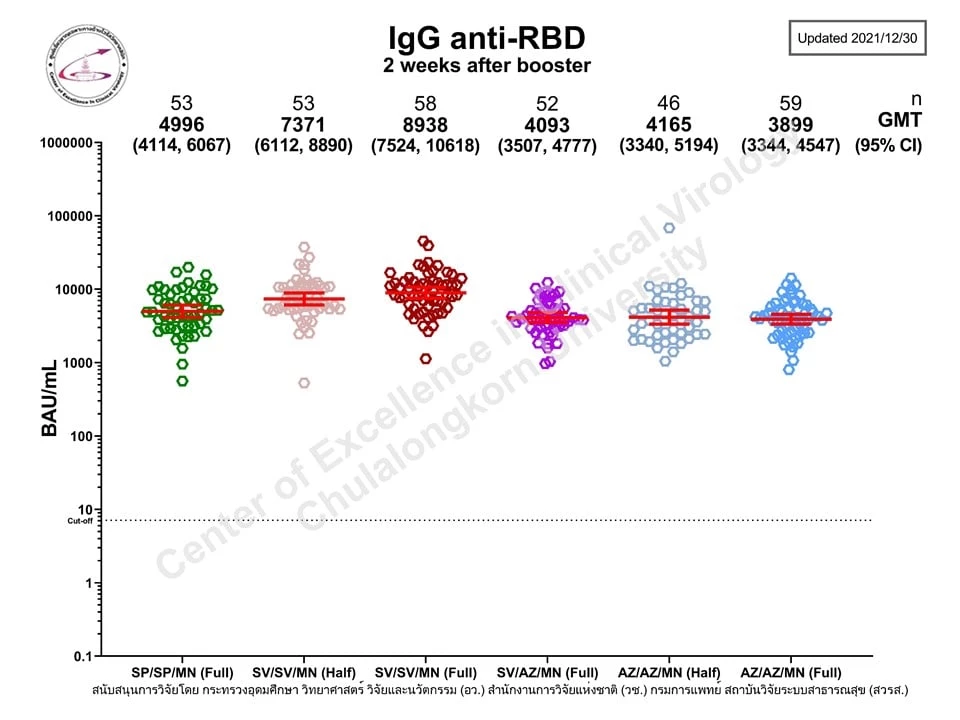
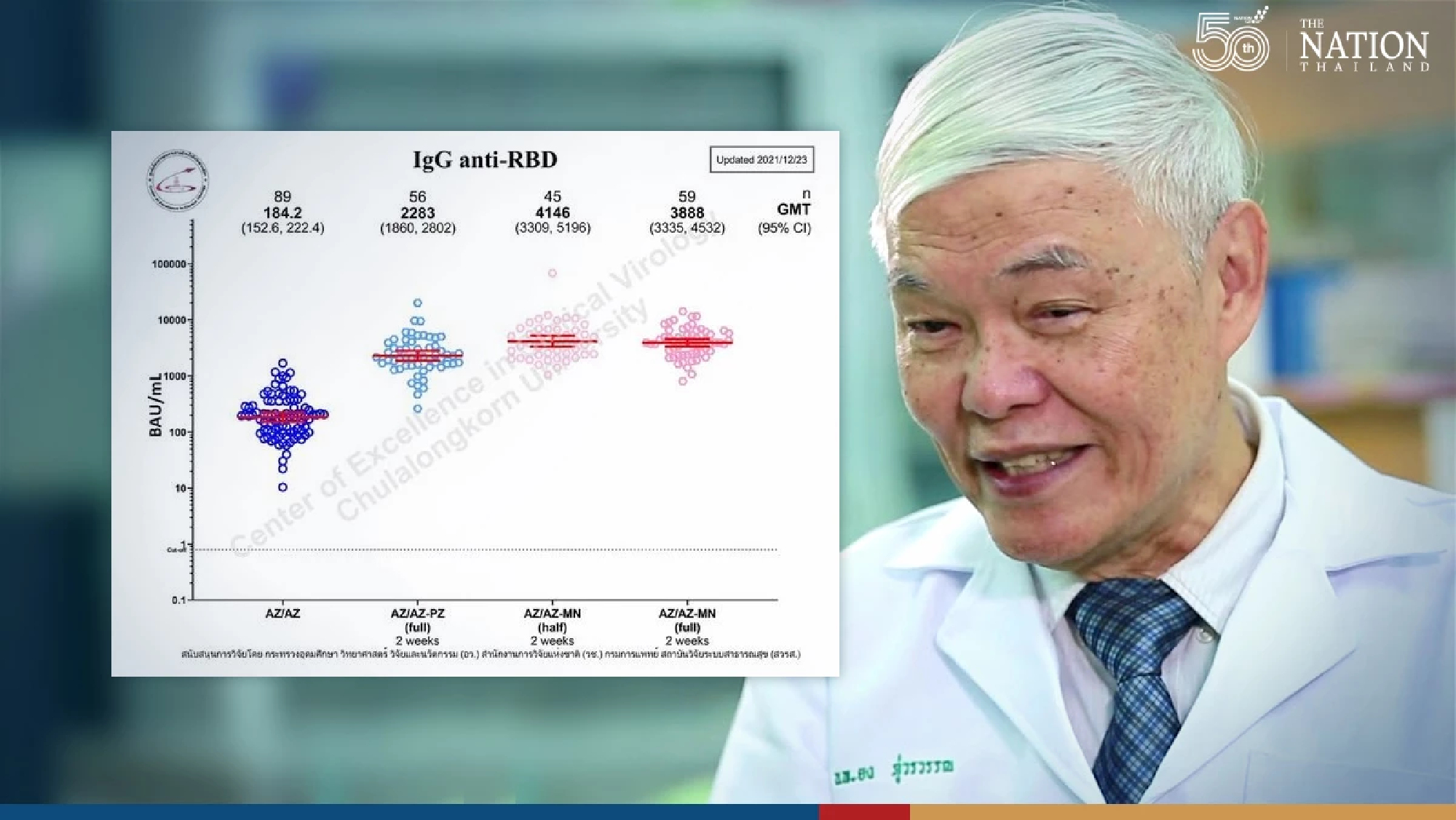
An mRNA booster after two jabs of inactivated or viral vector Covid-19 vaccines can provide high immunity against the virus, expert virologist Dr Yong Poovorawan said in a Facebook post on Sunday.
Yong was citing a study conducted by Chulalongkorn University’s the Centre of Excellence. He said the survey was conducted on people aged 18 and above who had received two jabs of Sinopharm, Sinovac or AstraZeneca vaccines or a Sinovac-AstraZeneca cocktail and had received a Pfizer or Moderna booster.
“People in the US and Britain were given a half dose of the Moderna vaccine to reduce side-effects such as pain at the jab site, fatigue, headache, nausea, diarrhoea or swollen lymph nodes,” he said, citing the US Centres for Disease Control and Prevention.
Yong said antibody tests indicate that all vaccines provide high immunity against Covid-19.
“A half dose of Moderna gives the same immunity as a full dose,” he said.
He said the centre is also gathering data of people who have received either three Pfizer shots or three AstraZeneca shots, adding that it will take some time to gather data of people who have received three Moderna jabs.
“This study will help Thailand to effectively manage the vaccination rollout,” he added.
In a Facebook post on Tuesday, Dr Teerawat Hemachuta, head of Chulalongkorn University’s Information Centre for Emerging Infectious Diseases, declared that nearly everybody will pick up an Omicron infection.
The reasons behind this declaration are:
• The efficacy of vaccines will drop by 40 per cent after three months, even with the most effective ones like Pfizer and Moderna.
• Those who are yet to be vaccinated will be prime candidates for infection.
• Without booster shots, cases can suddenly surge from 10,000 to 100,000 to even 1 million. This will include people who have not been vaccinated or the vulnerable.
• Symptoms will be mild for people who have been vaccinated or have been infected by the novel coronavirus before, except those in vulnerable groups.
The Omicron Covid-19 variant has arrived in Thailand and is spreading, expert virologist Dr Yong Poovorawan said in a Facebook post on Sunday.
He explained that the biggest concern was travellers testing negative during the incubation period and being allowed in under the Test & Go scheme.
Dr Yong also said it was difficult to pinpoint the origin of Omicron infections in Thailand because many events are being held that may have triggered transmissions.
“The wave of Omicron infections in Thailand is not beyond our expectation because it can be transmitted quickly, even among people who have received two jabs,” he said.
“Hence, people should strictly adhere to measures to contain the spread of the virus.”
He also admitted that he was concerned that people travelling over the New Year break would cause Omicron to spread further.
Public Health Minister Anutin Charnvirakul said on Friday that 205 Omicron cases have been confirmed in many provinces, including Chiang Mai and Songkhla.
Expert virologist Dr Yong Poovorawan on Saturday posted a list of questions and answers related to the Omicron variant of Covid-19.
• Is it very transmissible?
Yes. For example, if one person infected by the original Covid-19 virus sits among seven people, one or two will be infected.
If a person infected by the Delta variant sits among 10 people, six or seven will be infected.
If one person infected by the Omicron variant sits among 11 people, 10 will be infected.
• Can Omicron skip the immunity provided by the vaccine?
Two doses of any Covid-19 vaccine provide little or no protection. People should get a third jab to protect themselves. Those who have received a booster a long while ago may be at risk because immunity provided by the vaccine can drop over time and people who have been infected before can be infected again.
Vaccines, however, reduce the severity of symptoms.
Studies show that the Omicron variant is far less severe than the Delta variant. The number of hospitalisations from the variant in South Africa, where it was discovered, is 70 per cent fewer than from the Delta variant.
However, hospitalised patients did develop symptoms as severe as with the Delta variant.
Studies in the UK revealed that the number of hospitalisations from Omicron was 15 to 20 per cent less than the Delta variant, while they were two-thirds less in Scotland.
Yong advised people to get their shots to build up their immunity to reduce the severity of the disease. He said people should get a booster three months after their last jab because Omicron will soon replace the Delta variant.
In a Facebook post on Thursday, expert virologist Dr Yong Poovorawan said people need at least three doses of the Covid-19 vaccine to protect themselves from the Omicron variant.
He said the booster dose should be AstraZeneca or the mRNA Pfizer or Moderna vaccines, as they will increase people’s immunity, especially if they have had two jabs of the inactivated Sinovac or Sinopharm vaccines.
He added that people who have received two Sinovac shots and followed up with an AstraZeneca, Pfizer or Moderna booster will have the same immunity as people who have received two jabs of AstraZeneca and then a third shot of either Pfizer or Moderna.
He added that even half a dose of Moderna provides enough immunity.
However, the virologist said this was a basic study and that we need to wait for the results of a study into neutralising antibodies that work against Omicron and Delta.
Yong added that people in the US and UK were being given half a dose of Moderna if their first two doses were AstraZeneca.
He added that the results of a study into the booster dose for people who received a combination of Sinovac and AstraZeneca will be available next year.
These studies are necessary to work out which vaccine formula is most effective, he added.
A third dose of AstraZenecas Covid-19 vaccine significantly boosted neutralizing antibodies against omicron, according to lab studies at the University of Oxford.
The vaccine, created by Astra and Oxford, saw antibodies increase to similar levels as those after two doses against the delta variant with a booster shot, the drug company said Thursday. A third dose also produced higher levels of neutralizing antibodies than those found in individuals who had recovered naturally from the alpha, beta and delta strains.
The results are largely good news for the vaccine, which has been sidelined in the West as a booster after messenger RNA vaccines were shown to be more effective in various trials. The study looked at 41 people who had been given a third dose.
Omicron’s rapid spread and its ability to initially reduce antibody protection in many vaccines led many countries to launch accelerated booster campaigns. The U.K. alone reported more than 100,000 new covid cases Wednesday for the first time, heaping pressure on Prime Minister Boris Johnson, who has resisted imposing further restrictions before Christmas.
However, early studies out of South Africa, Scotland and England show the highly mutated omicron variant appears less likely to land patients in the hospital than delta. The findings raise hopes there will be fewer cases of severe disease, yet omicron’s greater infectiousness means it could still severely affect health services, fueling the need for boosters.
“It is very encouraging to see that current vaccines have the potential to protect against omicron following a third dose booster,” said John Bell, a professor of medicine at Oxford and one of the study investigators. “These results support the use of third dose boosters as part of national vaccine strategies, especially to limit the spread of variants of concern, including omicron.”
Neutralizing antibodies against omicron were 3.6-fold lower 28 days after a booster Astra shot compared with the levels seen from three shots against delta, according to a preprint of the study. Exactly the same reduction was seen from the Pfizer Inc. vaccine compared with delta in the study.
The results come after Pfizer and Moderna released studies on how their vaccines stand up against omicron in recent weeks. Initial lab tests from Pfizer and partner BioNTech showed a third dose of their Covid-19 vaccine may be needed to neutralize omicron after researchers observed a 25-fold reduction in neutralizing antibodies that fight the variant from two doses.
Moderna also found a booster dose increased antibody levels against omicron.
Novavax said Wednesday that its vaccine generates an effective immune response against the variant, but added it could be necessary to develop an omicron-targeted vaccine.
Data from another lab study showed two doses Astra’s retained some protection against omicron, although a 36-fold decrease in antibody levels was observed from the original virus strain.
Separately, Astra published more results on the impact of omicron on its Covid-19 antibody drug Thursday after the company said last week the therapy retained neutralizing activity against the variant in lab testing.
Tests using a live version of the virus conducted by University College Oxford and Washington University School of Medicine in St. Louis found neutralizing antibody levels were similar to individuals who had been previously infected with Covid-19.
The omicron variant is heightening risks for this little-talked-about demographic: pregnant women.
Left out of early vaccine trials and faced with confusing messages and misinformation on the dangers to their unborn children, a disproportionately large number of pregnant women have steered clear of Covid shots. About 75% of expectant mothers in the U.K. and about 65% in the U.S. remain unvaccinated, making them among the groups most at risk of getting infected and being exposed to severe forms of the disease as the fast-spreading omicron strain sweeps across the globe.
At least 17 pregnant women and four babies have died from Covid-19 in England between May and October, figures published last week show. Over that period, 98% of pregnant women admitted to intensive care were unvaccinated. Also, since July, one in five Covid patients receiving treatment in England through a special lung-bypass machine was an unvaccinated expectant mother.
“The uptake of vaccination in pregnant women is depressingly low and significant numbers of women have come to serious harm as a result of this,” Chris Whitty, the U.K.’s chief medical adviser, told lawmakers Dec. 16. “Pregnancy’s a period of vulnerability. We really should have made that point even clearer earlier on.”
Information on this group remains sparse across much of Europe. While real-world data over the spring and summer showed the shots are safe and effective for them, the absence of pregnant women in early vaccine tests resulted in hesitancy that’s hard to shake off.
Take Antonia, for instance. The London lawyer, who’s seven months pregnant, got her first jab before she was pregnant but struggled over her second, post-pregnancy inoculation. Vaccine centers didn’t have reassuring answers to her questions, and she got the shot with a lot of trepidation.
“I was so nervous I booked the vaccination so many times and canceled it,” said Antonia, 38, who’s having her second child and didn’t want to reveal her last name. “I just thought ‘it’s not my life here, it’s somebody else’s life I’m making decisions about.'”
Vaccine hesitancy compounds the immuno-compromised state brought on in pregnant women by their bodies’ efforts to grow the foetus. The risk of severe Covid-19 is particularly acute in the third trimester and increases the prospect of premature and still birth. It also raises the possibility of long-term health issues for the expectant mother.
Many maternal-care specialists saw this coming, said Pat O’Brien, vice president of the Royal College of Obstetricians and Gynaecologists.
“We were worried from day one that it might be worse in pregnant women than other people because other respiratory viruses have been, like SARS and flu,” said O’Brien. “We must learn the lesson that pregnant women should be included when it’s safe to do so at an early stage in all new drug and vaccine trials.”
At least one drugmaker tried. In February, Pfizer initiated a mid-stage trial in pregnant women before moving to advanced-stage testing in June. But low enrollment and the ethical dilemma of giving placebos to expectant mothers when vaccines were already recommended saw the trial halted with less than 10% of its target 4,000 volunteers.
While the company still plans to publish the data, the low participation may limit any takeaways.
“I think this has opened the eyes and the potential for regulators and manufacturers to initiate pregnancy studies earlier,” said Alejandra Gurtman, vice president of vaccine research and development at Pfizer.
The problem is deciding when it’s alright to include pregnant women. Vaccines must be shown to be safe in the general population before authorities can expose unborn children.
“If we weren’t in such a pandemic ‘all-out’ mode, we probably could have started a trial early on in pregnant women,” Peter Marks, head of the U.S. Food and Drug Administration’s vaccine program, said in a Bloomberg interview. “If I were drawing this up from scratch again, probably within a few months after we had safety data flowing in from the phase 3 clinical trials we probably could have initiated a trial in pregnant women.”
Some of the reticence stems from history. Although not a vaccine, in the 1950s a drug called thalidomide was prescribed for early-pregnancy nausea. It severely impacted limb development in children and affected more than 10,000 babies, half of whom died.
A lack of information on the vaccine’s safety in the first trimester and a surfeit of misinformation on social media, especially on the impact vaccines could have on a growing baby and on fertility, haven’t helped. Over the summer, a “news” item went so far as to suggest vaccines provoked miscarriages.
Laura Magee, an obstetric physician in the U.K., said the similarity between a protein in placental development and the spike protein on the virus raised concerns antibodies from the vaccine could attack the placenta, though studies have shown this isn’t the case.
“There’s no basis whatsoever for any concern that the antibodies that you make as a result of accepting the vaccination will interfere with placental development,” she said.
Clinical trials have also shown that the shots had no impact on fertility. The same is true for birth outcomes, stillbirths or low birth-weights, data from the U.K. Health Security Agency showed.
Such assurances have failed to make a big difference, suggesting the need for better communication and an earlier involvement of expecting mothers.
The U.K. drugs regulator says it’s looking into “how developers of new medicines and vaccines could improve inclusion of pregnant women in studies.” One way would be to start trials when early tests have established safety and advanced trials are underway, as Pfizer did with adolescents.
For Ruth Faden, a bioethicist at Johns Hopkins who’s involved in the working group PREVENT — which drafted guidance on vaccines in epidemics and pregnant women in 2019 — Covid-19 shows why some serious rethinking is critical.
“The experience of this pandemic, which has gone so wrong for pregnant women, I’m hopeful is enough to at least in the epidemic-vaccine space result in some changes going forward,” she said.











 SootinClaimon.Com