BOT’s move to rein in rising baht not working: experts #SootinClaimon.Com

#SootinClaimon.Com : ขอบคุณแหล่งข้อมูล : หนังสือพิมพ์ The Nation.

BOT’s move to rein in rising baht not working: experts (nationthailand.com)

BOT’s move to rein in rising baht not working: experts

EconNov 21. 2020Kobsidthi Silpachai, Kasikornbank’s head of capital markets research, says monetary policy will not be effective in curbing the baht’s rise.Kobsidthi Silpachai, Kasikornbank’s head of capital markets research, says monetary policy will not be effective in curbing the baht’s rise. 

By The Nation

Analysts are sceptical about the central bank’s latest measures to curb the rising baht, despite praise for the move from business quarters.

The Bank of Thailand (BOT) on Friday announced measures to encourage capital outflow in order to restrain rapid appreciation of the baht.

However, foreign funds continued to flow into the Thai stock exchange on Friday, with foreign investors making net buys of Bt2.38 billion. 

“It seems that the market is not reacting, the measures seem to be more of the same old thing,” Kobsidthi Silpachai, head of capital markets research at Kasikornbank, told The Nation.

Though the central bank was encouraging capital outflows, it had not imposed “scary” measures like Tobin tax [on currency conversions], he said.

Thus he was pessimistic the measures would slow down the baht’s rise.

“The fundamentals have not changed: our current account will remain in surplus,” he said.

While the new measures may address the “symptoms”, they would not cure the underlying cause of the strong baht – an imbalanced economy, he argued.

After years of relying on monetary measures, it was time to try fiscal measures like tax reform, he added.

He was also sceptical of the BOT’s recent move to loosen restrictions on foreign currency deposit accounts. Focusing on foreign capital flows might not be effective, as exporters need to convert their US dollar revenue to baht for working capital, he said.

The measure risked upsetting long-term inflation management by spurring outflow of capital and indirectly discouraging investment in Thailand, which would dampen future economic activity and inflation, he warned.

He suggested that if authorities really want the baht to weaken, they need to rebalance the economy. This is where tax reforms comes in, because high taxes, high household debt and a strong baht are all related.

“Excise tax on imported goods is high, suppressing imports and forcing the current account surplus even higher, which leads to a strong baht,” he said.

US President Donald Trump has proven that cutting taxes actually boosts tax revenue, because the tax base increases, Kobsidthi added.

Naris Sathapholdecha, executive director at TMB Analytics, shares a similar view, saying that foreign investors were undeterred by the latest measures as they still bought short-term bonds worth US$700 million in Friday’s intra-day trading.

He suggested that to rein in the baht, the central bank should reduce its issuance of short-term bonds. The BOT could also raise costs for foreign investors investing in Thai stocks and bonds by stipulating they must buy insurance against baht exchange rate risk.

He predicted a slight short-term weakening of the baht due to two factors outside Thailand. First, while the more trade-friendly Joe Biden had wo the US presidential election, his Democrat Party had not won a majority in the Senate. Second, a Covid-19 vaccine may not be available as soon as expected. Therefore, investors may sell Thai assets.

The baht would stay at around Bt30.50 per dollar and is unlikely to strengthen beyond Bt30, Naris added.

Meanwhile, Kriengkrai Thiennukul, vice chairman of the Federation of Thai Industries, expressed support for the BOT’s moves. 

“The action of the central bank will prevent a rapid rise beyond the Bt30/dollar level. Doing nothing would have seen the baht appreciate further, making Thai exports even less competitive,” he said.

The baht’s rise would also benefit Thai investors seeking to acquire businesses in Europe, where many companies are expected to go bankrupt amid the second wave of Covid-19. But foreign businesses could yield high returns when the pandemic eases. 

He also predicted the baht would remain strong for the  foreseeable future since the Biden presidency will inject more money into US economy.

BTS ‘must meet 3 conditions’ to win Green Line contract renewal #SootinClaimon.Com

#SootinClaimon.Com : ขอบคุณแหล่งข้อมูล : หนังสือพิมพ์ The Nation.

BTS ‘must meet 3 conditions’ to win Green Line contract renewal (nationthailand.com)

BTS ‘must meet 3 conditions’ to win Green Line contract renewal

EconNov 20. 2020

By The Nation

Democrat Party deputy leader Samart Ratchapolsitte said on Friday that the Transport Ministry is opposed to a move to extend the Bangkok Mass Transit System Plc (BTS)’s contract to run the Green Line because the fare is too expensive.

BTS has warned it will halt the Green Line extension service unless the Bangkok Metropolitan Administration (BMA) pays the Bt8 billion owed for operating costs.

The Interior Ministry on Tuesday proposed extending BTS’s current contract to run the Green line for another 30 years, until 2059.

Posting on Facebook, Samart said that to earn the contract extension, BTS would have to comply with three BMA conditions:

1. The maximum fare must not exceed Bt65, down from the previous maximum of Bt158.

2. BTS must bear the BMA’s debt of over Bt70 billion for the Green Line extension from Mo Chit to Khu Khot and Bearing to Samut Prakan.

3. BTS must share operating revenue from 2029 to 2059 worth over Bt200 billion with the BMA.

He added that the Green Line fare would be higher than the MRT Blue Line’s Bt42 maximum for two reasons.

First, the Green Line was mostly paid for by the BTS itself, while the Blue Line was paid for by the Mass Rapid Transit Authority of Thailand (MRTA), which then hired the Bangkok Expressway and Metro Plc (BEM) as operator.

Second, the BTS must share its revenue with BMA, while the BEM shares no revenue with the MRTA.

“Also, the BTS gains a return on its investment of 9.6 per cent, lower than BEM’s 9.75 per cent because the government’s joint investment with BTS was lower than with the BEM,” he said.

He added that it would be good news for commuters if the government could cut the fares for electric trains.

SET rises almost 1.5% with trades worth Bt90bn #SootinClaimon.Com

#SootinClaimon.Com : ขอบคุณแหล่งข้อมูล : หนังสือพิมพ์ The Nation.

SET rises almost 1.5% with trades worth Bt90bn (nationthailand.com)

SET rises almost 1.5% with trades worth Bt90bn

EconNov 20. 2020

By The Nation

The Stock Exchange of Thailand (SET) Index closed at 1,389.34 on Friday, up 19.92 points or 1.45 per cent. Total transactions amounted to Bt90.57 billion with an index high of 1,390.37 and a low of 1,368.20.

The day’s rise defied expectations, after a Krungsri Securities analyst predicted a drop from foreign investors making net sales for the first time in three days. Instead, foreign investors today made net buys of Bt2.38 billion.

The 10 stocks with the highest trade value today were KBANK, ADVANC, BBL, SCB, PTT, BANPU, CPF, TASCO, SCGP and AOT.

As of 5pm, the price of oil rose by US$0.02 or 0.05 per cent to $41.76 per barrel, while gold rose by $3.90 or 0.21 per cent, to $1,865.40 per ounce.

Other Asian indices were mixed:

Japan’s Nikkei Index closed at 25,527.37, down 106.97 points or 0.42 per cent.

China’s Shang Hai SE Composite Index closed at 3,377.73, up 14.64 points or 0.44 per cent, while Shenzhen SE Component Index closed at 13,852.42, up 74.97 points or 0.54 per cent.

Hong Kong’s Hang Seng Index closed at 26,451.54, up 94.57 points or 0.36 per cent.

South Korea’s KOSPI Index closed at 2,553.50, up 6.08 points or 0.24 per cent.

Taiwan’s TAIEX Index closed at 13,716.44, down 5.99 points or 0.044 per cent.

Industry Ministry joins forces with Japan to build a smart manufacturing sector #SootinClaimon.Com

#SootinClaimon.Com : ขอบคุณแหล่งข้อมูล : หนังสือพิมพ์ The Nation.

Industry Ministry joins forces with Japan to build a smart manufacturing sector (nationthailand.com)

Industry Ministry joins forces with Japan to build a smart manufacturing sector

EconNov 20. 2020

By The Nation

In line with Industry Minister Suriya Jungrungruangkit’s policy to enhance Thailand’s competitiveness by pushing its industrial sector into the digital age, the ministry has signed a collaborative deal with its Japanese counterpart and other relevant agencies that have expertise in electronics, said Nattapol Rangsitpol, director-general of the Industrial Promotion Department.

Since both Thailand and Japan have been suffering a shortage in specialised labour owing to a rapidly ageing population, a smart industry is required to build a future workforce.

Under the collaboration, personnel are being trained using Japan’s Kaizen method, which encourages participants to analyse problems and find solutions through the use of Internet of Things (IoT) tools.

The Smart Manufacturing project was scheduled to kick-off earlier this year with a trip to Japan for training, however, due to Covid-19, training sessions are being held virtually. Lessons are provided by two groups: master instructors who have expert knowledge and can pass it on to small businesses through a month-long course, and instructors, who know how to solve initial problems with IoT. The project began in April this year and will wrap up in March 2021.

Nattapol said the main principle of the smart manufacturing project is to train personnel to analyse and solve problems as well as look for development opportunities in the factory with IoT. For instance, manufacturing can be controlled in real-time once a tiny Raspberry Pi computer is connected to the machines and production monitored on a connected display. This way, the production department can immediately respond if there is a problem.

Such IoT systems in the manufacturing sector is not a large investment and can help drive Industry 4.0 in a concrete manner.

SMEs success lies in leveraging data, technology to ease Covid-19 pressures: Pata #SootinClaimon.Com

#SootinClaimon.Com : ขอบคุณแหล่งข้อมูล : หนังสือพิมพ์ The Nation.

SMEs success lies in leveraging data, technology to ease Covid-19 pressures: Pata (nationthailand.com)

SMEs success lies in leveraging data, technology to ease Covid-19 pressures: Pata

EconNov 20. 2020

By The Nation

A newly launched Pacific Asia Travel Association (Pata) report highlights the role of Online Travel Agents (OTA) globally and in the Asia Pacific on travel recovery for SME hospitality players.

Digitalisation and innovation are key for SMEs survival as the travel industry emerges from Covid-19’s impact, according to a report by Pata, conducted by Twenty31 Consulting Inc and supported by Agoda, unveiled at the World Travel Market recently.

Pata’s research report “The role of Online Travel Agencies in supporting Asia-Pacific SMEs in Recovery” aims to provide insights to benefit small and medium enterprises (SMEs) in the hospitality and tourism space that make up a large proportion of travel providers, as they pivot and adapt in the face of Covid-19.

With the pandemic dramatically changing how and where consumers travel, it is essential for hospitality businesses, especially SMEs, to adapt their operations to thrive within a digital global ecosystem, the report said.

The report highlights key areas where digital travel platforms and governments can support tourism SMEs in the Asia Pacific region.

SMEs are leveraging OTAs’ digital platforms to accelerate recovery. There is a shift in the dynamic of the relationship between SMEs and OTAs, with the latter being acknowledged and increasingly valued as a technology, data and marketing partner.

It is vital for SME hospitality providers to understand trends and reach new audiences during these times, the report said.

SMEs leveraging OTAs can reduce their top-down investment, especially around payments features, customer support as well as marketing efforts, the report said.

OTAs have also expanded opportunities for destination diversification, helping to drive tourism in second and third-tier cities, the report said.

“We have seen a real push for OTAs to do more than simply selling rooms. They are helping us with other services, and this is really helping us forecast our needs and drive more sales.” says a hospitality SME in Thailand.

The use of data insights will future proof SMEs as they navigate today’s ever-changing landscape of the travel and tourism industry.

OTAs are technology partners that are well-placed to help provide SMEs a comprehensive understanding of data insights to enhance their businesses, the report said.

Data insights can be used to optimise revenue through meta-search, machine learning, artificial intelligence, product diversification and platform centralisation.

“OTAs are now using AI tech to tailor offers to customers and that is going to be very interesting. This will likely allow SMEs to match our products and services with high-potential consumers and drive better ROI [return on investment],” says a hospitality SME in Singapore.

SMEs have called on governments to work with OTAs to boost post-Covid-19 travel recovery.

During this crucial recovery period, more private-public collaboration will boost travel confidence, where the local government can draw on the private sector’s commercial expertise to spot and create new opportunities to improve the industry, businesses and lives impacted by Covid-19, as well as stay relevant in the transforming economic environment, the report said.

“The government can do more to engage the private sector, especially around decision making and cooperative marketing,” said a tour operator SME in Indonesia.

The study also looks at the changing landscape of the travel and tourism industry and how OTAs have rapidly accelerated the growth in the region where APAC-based OTAs represent more than a third of global gross bookings.

“OTAs play a crucial role in the recovery process, where SMEs can leverage their data and digitise in order to adapt and build long-term resilience. We are optimistic that the industry will eventually recover with governments and private sectors coming together to ensure that no one gets left behind. We look forward to working with our partners, such as Agoda, as we continue to hear from SME operators and how we can advance the discussion around the future of travel and tourism in the Asia Pacific region, one that is sustainable and inclusive for all,” says Mario Hardy, CEO of Pata.

“Successful hoteliers use data and technology for price and marketing optimisation. Increasingly, many SME tourism enterprises find themselves on the wrong side of the tech moat — unable to do complex data analytics and global marketing in-house. This report shows how SMEs successfully leverage platforms like Agoda to enjoy the benefits of technology to reach laser-targeted audiences in the far corners of the world. Agoda also helps SME hotels participate in several government partnership programmes in Asia. SMEs are calling for further collaboration between governments and tech platforms to help revitalise the hard-hit tourism industry.” says Greg Wong, managing director of global affairs at Agoda.

The report is available on the Pata website at https://bit.ly/32BJo8K

BOT unveils new liberalisation measures in bid to control baht’s appreciation #SootinClaimon.Com

#SootinClaimon.Com : ขอบคุณแหล่งข้อมูล : หนังสือพิมพ์ The Nation.

BOT unveils new liberalisation measures in bid to control baht’s appreciation (nationthailand.com)

BOT unveils new liberalisation measures in bid to control baht’s appreciation

EconNov 20. 2020BOT assistant governor Vachira ArromdeeBOT assistant governor Vachira Arromdee 
By The Nation

The Bank of Thailand (BOT) on Friday liberalised Thai investments in foreign securities and the holding of foreign currencies in a bid to rein in the strengthening baht.

Under the new BOT measures, Thais are allowed to freely open foreign currency deposit accounts (FCD) and can freely make transactions between FCD accounts, BOT assistant governor Vachira Arromdee said on Friday. 
The measures will enable exporters to effectively manage liquidity and foreign exchange risk.

Vachira said that the US presidential election outcome and the progress of the Covid-19 vaccine development have strengthened confidence in the global economy. This has resulted in “renewed inflows into emerging market economies, including Thailand”. 

“The rapid appreciation of the baht may affect the fragile recovery of the Thai economy,” Vachira said. 

The BOT has closely monitored and intervened in the market as necessary to limit excessive currency volatility. In addition, to further mitigate pressures on the currency and to address structural issues in the Thai foreign exchange market, the BOT has come up with additional measures, Vachira said.

Residents are allowed to conduct FCD transactions electronically, which reduces transaction costs. FCD accounts may also be used for residents to diversify investment into assets denominated in foreign currencies, such as foreign equities and gold denominated in US dollar, the central bank said.

The BOT has relaxed regulations regarding investment in foreign securities. These include increasing investment limits and expanding eligible financial products, in order to expand investment options for residents and enhance portfolio diversification.

The investment limit for retail investors has been increased from $200,000 per year to $5 million per year. Also, there is no investment limit in foreign securities through local financial institutions such as brokerage firms and asset management companies.

There is also no investment limit in foreign assets for investors regulated under the Securities Exchange Commission (SEC).

Foreign securities such as Exchanged Traded Funds that track foreign securities can now be listed in Thailand.

Investors in Thai bonds will be subject to “Bond pre-date registration”. Pre-registration will upgrade the bond surveillance system, which will allow close monitoring of investor behaviour and thereby enable the implementation of targeted measures in a timely manner, the BOT said. This registration is in line with practices in South Korea, Malaysia and Taiwan, the central bank added.

The latest measures are a part of the comprehensive FX Ecosystem Development Plan that the Ministry of Finance, the SEC and the BOT are together advancing in order to address structural problems in the foreign exchange market in a sustainable manner, the central bank said.

Tech leads stock advance with lockdowns widening #SootinClaimon.Com

#SootinClaimon.Com : ขอบคุณแหล่งข้อมูล : หนังสือพิมพ์ The Nation.

Tech leads stock advance with lockdowns widening (nationthailand.com)

Tech leads stock advance with lockdowns widening

EconNov 20. 2020

By Bloomberg
Vildana Hajric

Tech shares led U.S. equity indexes higher, with the stay-home trade gaining appeal as investors considered the impact of tougher virus restrictions on economic growth along with the outlook for widespread vaccine distribution within months.

Advances for Microsoft, Amazon and Adobe lifted the Nasdaq 100. Tesla rose to a record as investors bet that the global car market will be dominated by electric cars in decades ahead. The S&P 500 index edged higher, but it underperformed the tech-heavy gauge as investors sought shares of companies poised to do well during lockdowns.

Treasury yields slipped, and the dollar dipped after U.S. weekly jobless claims came in higher than forecast. Gold dropped for a fourth day amid a drawdown in bullion-backed exchange-traded funds.

The bullish fever that lifted the MSCI World index to an all-time high Monday has softened, with virus cases surging in many parts of the world and public health facilities being pushed to the brink. New York City announced that it will close schools, and South Australia began one of the world’s toughest lockdowns, with even outdoor exercise and dog-walking banned. In Tokyo, the virus alert was raised to the highest levels as daily infections topped 500 for the first time.

It all means investors are grappling with how long and how severe the pandemic will be in the months ahead. There’s economic stress now as businesses struggle under lockdowns, but scientists are also rapidly advancing several vaccine candidates to get life back to normal.

“There’s the push-pull of short-term versus long-term and that’s what investors are looking at right now,” said Chris Gaffney, president of world markets at TIAA Bank. “There are some very serious risks in the short term, especially with the lockdowns.”

In a report published Thursday, the International Monetary Fund noted progress on a vaccine, but also said elevated asset prices point to a disconnect from the real economy and a potential threat to financial stability.

“While global economic activity has picked up since June, there are signs that the recovery may be losing momentum, and the crisis is likely to leave deep, unequal scars,” officials at the Washington-based fund said. “Uncertainty and risks are exceptionally high.”

In Europe, cyclical shares led stocks lower. Norwegian Air Shuttle plunged 16% after seeking protection from creditors amid the travel upheaval caused by the pandemic.

In other markets, the MSCI Asia Pacific index fell for the first time in 14 days, ending the longest winning run since 1988. Commodities dropped and Bitcoin steadied after surging past $18,000 on Wednesday.

Turkey’s lira strengthened after the country’s new central bank governor raised the benchmark interest rate.

These are the main moves in markets:

– – –

Stocks

– The S&P 500 index rose 0.4% at 4 p.m. New York time.

– The Stoxx Europe 600 index fell 0.8%.

– The MSCI Asia Pacific index declined 0.2%.

– The MSCI Emerging Market index dipped 0.5%.

Currencies

– The Bloomberg Dollar Spot index slumped 0.2%.

– The euro rose 0.2%, to $1.1877.

– The British pound was little changed at $1.3276.

– The Japanese yen was little changed at 103.77 per dollar.

Bonds

– The yield on 10-year Treasuries decreased two basis points, to 0.85%.

– Germany’s 10-year yield fell two basis points, to -0.57%.

– Britain’s 10-year yield declined one basis point, to 0.32%.

Commodities

– West Texas Intermediate crude rose 0.2%, to $41.92 a barrel

– Gold weakened 0.3%, to $1,866.69 an ounce.

Governments worldwide are losing $427 billion a year to tax havens. The U.S. alone loses $90 billion in tax revenue. #SootinClaimon.Com

#SootinClaimon.Com : ขอบคุณแหล่งข้อมูล : หนังสือพิมพ์ The Nation.

Governments worldwide are losing $427 billion a year to tax havens. The U.S. alone loses $90 billion in tax revenue. (nationthailand.com)

Governments worldwide are losing $427 billion a year to tax havens. The U.S. alone loses $90 billion in tax revenue.

EconNov 20. 2020

By The Washington Post
Jeanne Whalen

Governments around the world are losing $427 billion each year to tax avoidance and evasion as companies and wealthy individuals shift their money to tax havens, according to a comprehensive new report that urges an overhaul of the “broken” tax system.

The United States government is the single biggest loser in absolute terms, missing out on about $90 billion in tax revenue a year, according to the report, which offers the first detailed breakdown of losses at the country level.

Poorer countries, meanwhile, are losing a larger share of their total tax revenue to the abusive practices – about 5.8% vs. 2.5% in high-income countries, according to the report, which analyzed data from 2016 and 2017.

The missing tax revenue is particularly harmful during the coronavirus crisis, when many countries are struggling to combat infections and support ailing economies and workers, according to the report from the Tax Justice Network, the Global Alliance for Tax Justice and a trade-union group called Public Services International.

“With the coronavirus pandemic shining a harsh light on the grave cost of underfunded health and public services around the world . . . these figures represent a tragedy,” the authors wrote. “Tax abuse is depriving countries of billions and billions in urgently needed tax and holding us all back from building better, healthier, fairer societies.”

The lost money would be enough to pay the salaries of 34 million nurses a year, the researchers found.

Blame lies not only with multinational companies and wealthy individuals, but with high-income countries that have “stalled meaningful reform of the broken, international tax system and have actively hid the scale and extent of international tax abuse from their populations,” they said.

Alex Cobham, an economist and chief executive of the U.K.-based Tax Justice Network, said in an interview that global tax laws must be overhauled to stop companies from shifting profits to low-tax havens, to expose the size and provenance of the huge private fortunes held offshore, and to protect every country’s right to collect tax from the profit generated within its borders.

The paper is the first to make use of new data from the Organization for Economic Cooperation and Development, or OECD, showing how much profit and revenue multinational companies report in each country, how many employees and assets they have, and how much tax they pay.

The data allowed the researchers to pinpoint where companies are underreporting profit and underpaying taxes based on their real economic activity. The data are aggregated, meaning companies are lumped together in composite figures in each country, so individual corporate behavior isn’t discernible.

The report found that corporations are shifting $1.38 trillion worth of profit each year into tax havens that charge little-to-no tax, causing the governments where that profit is actually earned to miss out on $245 billion in annual revenue.

Using different data sets, the researchers found that countries are losing an additional $182 billion a year from wealthy individuals hiding their fortunes in tax havens.

Hiding income from the tax authorities is illegal, Cobham said. Companies often argue that their profit-shifting and tax-avoidance strategies adhere to the letter of the law, but sometimes wind up in disputes with the tax authorities, he said.

“Whether or not it crosses the line of criminality,” there is a stigma attached to it, he said. “Companies don’t want to publish country by country reporting because it shows profit-shifting . . . and they know the public at large thinks it’s not okay.”

The OECD has been leading multilateral negotiations aimed at updating the 3,000-odd bilateral treaties that regulate global taxation. A big goal of the drawn-out negotiations is to “prevent income from not being taxed anywhere,” said Reuven Avi-Yonah, a law professor and tax expert at the University of Michigan.

Fair-tax campaigners say legislation making its way through Congress would help crack down on tax evasion by putting an end to anonymous shell companies.

The measure, which could be rolled into an annual defense spending bill, would require companies established in the United States to disclose their real owners to the Treasury Department, making it harder for criminals to evade taxes or anonymously launder money.

Nearly 2 million corporations and limited-liability companies are registered each year in the United States, at the state level. Few states today require companies to disclose their true owners, with Delaware and a few others turning the registration of anonymous companies into big business.

This tolerance for corporate secrecy in the United States undermines the global fight against tax abuse, the new report says.

The researchers also point a finger at the U.K. and its tax-haven territories and crown dependencies, including Bermuda, Cayman, Jersey and the British Virgin Islands. This network is responsible for 37% of all losses governments suffer from corporate and private tax abuse, the report says.

When it comes to corporate tax avoidance, the Netherlands, Switzerland and Luxembourg are also big enablers, the researchers said.

Kimberly Clausing, an economics professor and tax expert at Reed College, said the new report helps flesh out the scale of the problem across countries and regions.

The researchers found that Africa loses about $25 billion a year, mostly from corporate tax abuse. That equals about 7% of the continent’s average tax revenue each year.

Europe loses $184 billion a year, more than half of which is from private tax evasion. The losses equal about 3.4% of the region’s average tax revenue.

Asia loses about $73 billion, or about 1.5% of the region’s annual tax revenue. North America loses $95 million, or about 2.3%.

SET offers opportunity for investment during short-term correction #SootinClaimon.Com

#SootinClaimon.Com : ขอบคุณแหล่งข้อมูล : หนังสือพิมพ์ The Nation.

SET offers opportunity for investment during short-term correction (nationthailand.com)

SET offers opportunity for investment during short-term correction

EconNov 20. 2020

By The Nation

The Stock Exchange of Thailand (SET) Index rose by 4.31 points, or 0.31 per cent, to 1,373.73 in the morning session on Friday.

An analyst at Krungsri Securities expected the index during the day to face short-term correction as foreign investors made net sales for the first time in three days.

“However, we don’t expect the index to fall below the support line between 1,330 and 1,340,” he said, adding that this is an opportunity for investors to increase investment.

He recommended that investors buy:

▪︎ KBANK, KTB, LH and SIRI that benefit from the ongoing Covid-19 vaccine development.

▪︎ AMATA, WHA, SAT, AH, and RCL that will benefit from the Regional Comprehensive Economic Partnership pact.

The SET Index closed at 1,369.42 on Thursday, up 4.83 points or 0.35 per cent. The volume of total transactions was Bt82 billion with an index high of 1,375.02 and a low of 1,362.41.

Royal Umbrella rice introduces recyclable bag that reduces global warming #SootinClaimon.Com

#SootinClaimon.Com : ขอบคุณแหล่งข้อมูล : หนังสือพิมพ์ The Nation.

Royal Umbrella rice introduces recyclable bag that reduces global warming (nationthailand.com)

Royal Umbrella rice introduces recyclable bag that reduces global warming

Nov 19. 2020

By The Nation

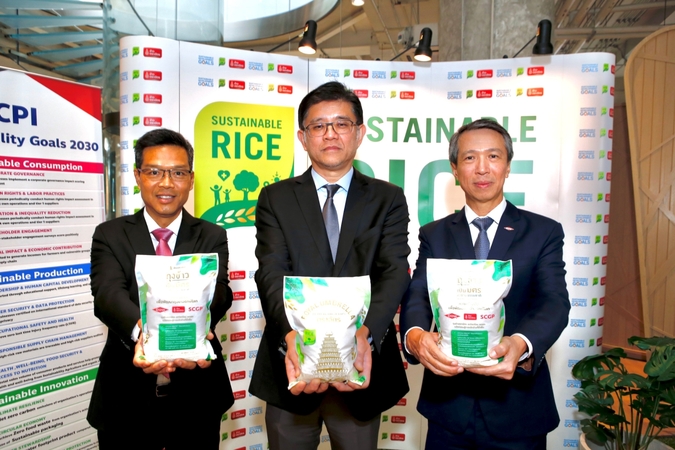
The Royal Umbrella rice brand owned by Charoen Pokphand Group (CP Group) is focusing on sustainability by introducing recyclable packaging. The bag is the fruit of work by materials science expert Dow Thailand Group and Prepack, Thailand’s leading flexible packaging producer under SCGP. It uses Dow’s sustainable packaging solution “Innate” to produce a strong but fully-recyclable rice bag that reduces CO2 emission by reducing plastic resin used and lowering energy in production. The new recyclable rice bag will be launched in Q1 of 2021 in response to consumer’s demand for environmental-friendliness and to address the CP Group’s sustainability goal to halt all use of non-recyclable packaging by 2025.