The National Economic and Social Development Council (NESDC) forecasts the Thai economy will grow by up to 4.5 per cent in 2021 after a projected contraction of 6 per cent this year.
The council forecasts the value of exports will fall 7.5 per cent this year. Spending on private consumption is expected to shrink 0.9 per cent and total investment to contract by 3.2 per cent.
However, the NESDC expects the Thai economy to grow at between 3.5 and 4.5 per cent in 2021, driven by rising domestic demand, recovery of the world economy and trade, and government budget spending and economic stimulus.
It predicts export values to rise by 4.2 per cent, private consumption spending by 2.4 per cent, and total investment by 6.6 per cent.
The Stock Exchange of Thailand (SET) Index closed at 1,351.06 on Monday, up 4.59 points or 0.34 per cent. The volume of total transactions was Bt78.50 billion with an index high of 1,365.87 and a low of 1,351.04.
In the morning session, an analyst at Krungsri Securities said he expected the day’s index to rise to between 1,355 and 1,360 points in response to news of Thailand signing the Regional Comprehensive Economic Partnership (RCEP) pact and subsequent rise in regional stock indices.
“Investors, however, should beware of market volatility from uncertainty over escalating Covid-19 cases and domestic political unrest,” he said, adding that pro-democracy protesters are planning to rally again this week.
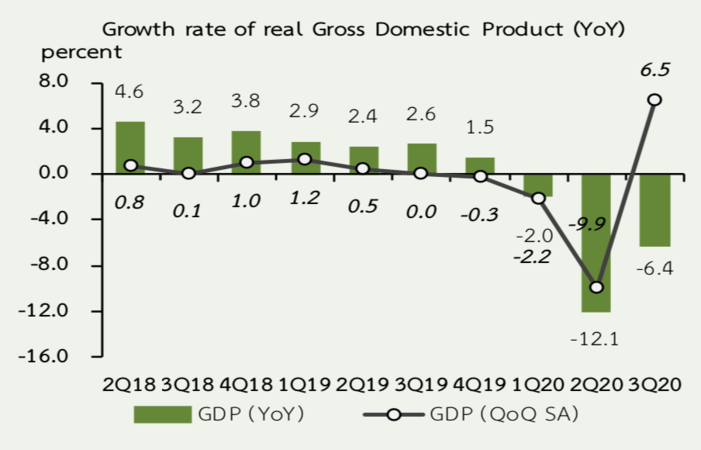
The SET rose more than 16 points in the morning session after the National Economic and Social Development Council (NESDC) revealed that Thailand’s gross domestic product (GDP) had contracted 6.4 per cent in the third quarter and 6.7 per cent in the first nine months. The NESDC expected Thailand’s GDP to contract 6.7 per cent this year from the initial expectation of minus 7.3 to minus 7.8 per cent.
The top 10 stocks with the highest trade value today were STGT, SCGP, MINT, KBANK, VGI, GULF, PTT, WHA, GPSC and ADVANC.
As of 4.30pm, the price of oil had risen by US$0.58 or 1.45 per cent to $40.71 per barrel, while gold rose by $5.70 or 0.30 per cent, to $1,891.90 per ounce.
Other Asian indices were on the rise:
Japan’s Nikkei Index closed at 25,906.93, up 521.06 points or 2.05 per cent.
China’s Shanghai SE Composite Index closed at 3,346.97, up 36.86 points or 1.11 per cent, while Shenzhen SE Component Index closed at 13,850.83, up 96.28 points or 0.70 per cent.
Hong Kong’s Hang Seng Index closed at 26,381.67, up 224.81 points or 0.86 per cent.
South Korea’s KOSPI Index closed at 2,543.03, up 49.16 points or 1.97 per cent.
Taiwan’s TAIEX Index closed at 13,551.83, up 278.50 points or 2.10 per cent.
Suwannee Jatsadasak, Bank of Thailand’s senior director, said the country’s banking system has remained resilient thanks to high levels of capital funds, loan-loss provisions and liquidity to support economic recovery from the fallout of Covid-19 crisis.
Debt-relief measures, coupled with revisions to rules on loan classification and provisions facilitating bank-loan expansion have alleviated the deterioration of bank-loan quality, she said on Monday.
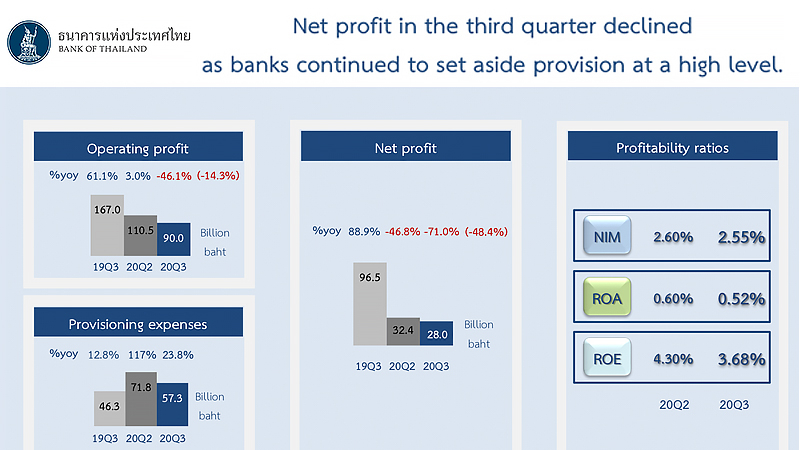
However, the banking system’s profitability has declined as banks continue to set aside high loan-loss provisions to cushion the adverse impact of Covid-19 on loan quality, she said.
Capital funds for the Thai banking system stood at Bt2.96 trillion, equivalent to capital adequacy (BIS) ratio of 19.8 per cent. Loan-loss provisions remained high at Bt782.5 billion with non-performing loan (NPL) coverage ratio of 149.7 per cent. Liquidity coverage ratio (LCR) registered at 184.9 per cent.
In the third quarter of this year, Thai banks’ overall loan growth stood at 4.6 per cent year-on-year, dropping slightly by 5 per cent from the previous quarter.
According to data available, corporate loans (64.6 per cent of total loans) expanded at 4.5 per cent year-on-year, but contracted quarter-on-quarter as some switched their funding source from bank loans to this issuance of bonds and equity.
Loans for small businesses showed a lower contraction, due mainly to the central bank’s soft-loans scheme and gradual recovery of the economy.
Consumer loans (35.4 per cent of total loans) grew at 4.8 per cent year-on-year, and increased quarter-on- quarter following the relaxation of lockdown measures. Mortgage lending, in particular, expanded consistent with an increase in demand for low-rise residential projects compared to the previous quarter.
Debt-relief measures, together with revisions to rules on loan classification and provisioning, have continued to alleviate banks’ loan-quality deterioration in the third quarter of 2020. The gross amount for outstanding NPLs (stage 3) stood at Bt513.9 billion, equivalent to 3.14 per cent of total loans, edging up slightly from 3.09 per cent in the previous quarter.
Meanwhile, the ratio of loans with a significant increase in credit risk (SICR or stage 2) to total loans stood at 7.03 per cent, down from 7.49 per cent in the previous quarter.
The banking system recorded net profit of Bt28 billion in the third quarter and Bt130.4 billion in the first nine months of 2020, a decline from last year owing to continued high-levels of provisioning expenses to cushion against the potential of further loan-quality deterioration.
As a result, the ratio of return on asset (ROA) dropped to 0.52 per cent from 0.60 per cent in the previous quarter. The ratio of net interest income to average interest-earning assets (Net Interest Margin: NIM) declined from 2.60 per cent to 2.55 per cent, largely due to a drop in interest income on loans.
Asset management companies are launching various types of mutual funds in the remainder of this year to meet investors’ needs during market volatility.
SCB Asset Management will this year launch up to six funds worth approximately Bt18 billion – two global equity funds and four complex return funds, said its head of Marketing Strategy and Investment Products Suparat Areewong.
“The global equity fund that focuses on foreign shares will help diversify risks and generate returns in the long term, while the complex return fund will help generate returns in line with the gold price and reduce risks of capital loss,” she said.
Krungthai Asset Management is planning to launch up to six funds worth approximately Bt15 billion this year, including four global fixed income funds and one Retirement Mutual Fund (RMF), said Chatchaphol Srivaleepan, executive vice president of Business Development.
“The global fixed income fund will help generate additional returns and is suitable for customers who can tolerate low and moderate risks, while the RMF focuses on China A-shares and is suitable for long-term investors,” he said, adding that RMF investments are tax deductible.
Kasikorn Asset Management has plans to launch three RMFs worth about Bt15 billion this year.
“The company launched the K-CHANGE-RMF on November 2-6, which focuses on global shares related to green trends, while the K-CHINA-RMF focusing on Chinese shares will be launched soon,” said Navin Intharasombat, first senior vice president for foreign investment management, adding that the K-USA-RMF for US shares is currently awaiting approval.
Tisco Asset Management is launching up to two RMFs worth about Bt2 billion and focused on foreign stock markets that are able to generate better returns than Thai stocks.
“Previously, the company launched four Super Savings Funds that invest in about Bt4 billion of Thai and Chinese shares, and one fund that focuses on stocks related to next-generation internet, such as cloud computing, big data and blockchain,” said Sarat Chatsuwan, director of marketing and investment adviser.
Meanwhile BBL Asset Management will introduce two funds worth about Bt25 billion after launching the Bualuang China A-Shares Equity RMF worth Bt5 billion at the beginning of November.
UOB Asset Management will soon establish two funds, the United China A-Shares Innovation Fund (UCI) and United Sustainable Equity Solution Fund (USUS).
The UCI fund will target China A-shares related to innovation, while the USUS fund will focus on Environmental, Social, and Governance (ESG) stocks.
Online merchants, YouTubers and even social-media influencers may have to start paying income tax after the finance minister announced his ministry targets at least Bt2 trillion in tax earnings from this group.
The Revenue Department plans to collect taxes from at least 500,000 online traders.
The Finance Ministry is also getting ready to propose amendments to the revenue code that cover online sales from overseas in the Senate next week once it collects comments from the House committee.
Ekniti Nitithanprapas, director-general of the Revenue Department, said on Monday that the law will require foreign businesses that use online platforms to provide commercial services in Thailand to register for the payment of value-added tax when their annual income exceeds Bt1.8 million. He said this will put local businesses at a fair footing and will also boost state earnings by at least Bt5 billion.
The Revenue Department will also expand the taxpayers’ base and cover more people, especially those who avoid filing tax returns. Thailand’s taxpayers’ base stands at 9.55 million people, but only 3 million actually pay taxes.
Many people have taken advantage of the Covid-19 crisis by earning extra income from selling products online, developing a YouTube channel or becoming social-media influences, and the ministry is planning to pull at least 500,000 of these people into the tax system next year.
Finance Minister Arkom Termpitthayaphaisit said recently that the Revenue Department should achieve its target of Bt2 trillion for the 2021 fiscal year despite the economic slowdown, as it has developed a new digital system which makes tax collection more efficient.
The Stock Exchange of Thailand (SET) Index rose by 16.51 points, or 1.23 per cent, to 1,362.98 in the morning session on Monday.
An analyst at Krungsri Securities expected the day’s index to rise to between 1,355 and 1,360 points in response to Thailand signing the Regional Comprehensive Economic Partnership (RCEP) agreement and the rise in regional stock indices.
The SET recently gained positive sentiment from the Office of the National Economic and Social Development Council (NESDC) revealing that Thailand’s third-quarter (Q3) gross domestic product (GDP) contracted 6.4 per cent, while the country’s first nine months GDP contracted 6.7 per cent.
The NESDC expected the country’s GDP to contract 6.7 per cent this year and grow 3.5 per cent to 4.5 per cent next year from government disbursement. The baht appreciated to 30.16 against the dollar.
“However, investors should beware of market volatility from uncertainty over the escalating Covid-19 outbreak and domestic political unrest,” he said, adding that pro-democracy protesters will hold an anti-government rally again this week.
He recommended that investors buy:
▪︎ KTC, AMANAH and THANI as Government Savings Bank will conclude partners to work on car registration loans this week.
▪︎ AMATA, WHA, SAT, AH, STGT, STA and RCL that benefit from the RCEP agreement.
The SET Index closed at 1,346.47 on Friday, up 10.16 points or 0.76 per cent. Total transactions amounted to Bt97.02 billion with an index high of 1,352.51 and a low of 1,327.73.
The price of gold rose by Bt150 per baht weight in morning trade on Monday, the Gold Traders Association reported.
As of 9.26am, the buying price of a gold bar was Bt27,000 per baht weight and selling price Bt27,100, while gold ornaments were priced at Bt26,514.84 and Bt27,600, respectively.
At close on Saturday, the buying price of a gold bar was Bt26,850 per baht weight and selling price Bt26,950, while gold ornaments were Bt26,363.24 and Bt27,450, respectively.
Spot gold price moved to US$1,898 (Bt57,211) per ounce in the morning after rising by US$12.9 to $1,886.2 per ounce at close on Friday due to the weakening dollar. However, the metal price in the previous week dropped sharply by 3.24 per cent.
Hong Kong gold price rose by HK$70 to $17,470 (Bt67,918) per tael this morning, the Chinese Gold and Silver Exchange Society reported.
The Export-Import Bank of Thailand (EXIM Thailand) forecasts Thai export growth as high as 4 per cent in 2021, as global trade and economy recovers from a low base of -10 per cent. However, export growth may not return to 2019 levels due to ongoing Covid-19 restrictions around the world, cautioned the bank’s president Pisit Serewiwattana.
The International Monetary Fund projects that less than one-third (60) of 195 economies around the globe will record 2021 GDP higher than or equal to that in 2019. Of those fast-recovering economies, nine are among Thailand’s top 20 export markets – China, Malaysia, Indonesia, Cambodia, Laos, Myanmar, Vietnam, South Korea and Taiwan. Major Thai exports to these markets include industrial products like plastic resin, refined oil, chemicals, cosmetics, soap and skincare products, and agricultural goods such as fresh fruits, rubber, sugar, tapioca products and beverages.
Pisit said the key factor propelling the Thai economy and exports in 2021 would be the ability of local businesses to adapt to the new, post-Covid operating conditions. These would be characterised by improving domestic and tourism demand driven by government stimulus.
The latest Thai export figures, for September, show a 3.9 per cent contraction – the lowest in five months. Thai exports in the first nine months of 2020 contracted by 7.3 per cent, lower than those of several peer countries including Japan, South Korea, Singapore and India.
Pisit predicted that Joe Biden’s election as US president would see an easing of the US-China trade war, promotion of clean energy, hikes for corporate and personal income tax, and a rise in the minimum wage. This should encourage more relocation of investment bases from the US.
EXIM Thailand is now aiming to become a “sustainable bank”, with a focus on responsible financial and business management, social and environmental risk management, organisation-wide risk management, and good governance for sustainable banking development. The bank is tasked with supporting exports and investment, particularly in new frontiers, to get Thailand out of the middle-income trap. It is also mandated to boost SMEs’ access to financing and knowledge via the bank’s EXIM Excellence Academy (EXAC). Recently, the bank developed the Thailand Export Readiness Assessment & Knowledge Management (TERAK) system to assess, analyse, process and prepare reports and offer support services to entrepreneurs. It also supports environmentally friendly and renewable energy projects for balanced and sustainable development. In the long term, the bank aims to help Thai entrepreneurs develop higher value-added and innovative products and adapt to the rapidly changing business environment, so that businesses can grow firmly and sustainably with long-term competitive advantages in the global market.
The need for remote work arrived quickly when Covid-19 triggered work-from-home orders virtually overnight.
The world has never experienced such a large-scale resourcing challenge.
The Covid-19 crisis forced many companies to review their business continuity plans and scramble to find ways to deploy and manage resources differently in light of government travel restrictions.
With the crisis ongoing, companies continue to seek ways of making their resource deployment more flexible to support operations with the least disruption possible.
Some companies were able to continue with minimal disruption thanks to the nature of their business and the technology they adopted.
But for many others, challenges in resource planning are unlikely to go away quickly. “New normal” resourcing planning will be part of their strategy for the foreseeable future.
Outside Thailand, many countries were experiencing demand for remote working options before the pandemic. Technology that enabled virtual connections and meetings meant geographical location was often less of an issue when it came to acquiring talent.
This trend in workforce planning and talent acquisition will most likely grow as technology rapidly improves and enables companies to become more connected and agile. New-generation workers are also more technologically savvy and require more balance and flexibility in their work locations.
The landscape is changing quickly under pressure from government regulations and restrictions in reaction to the pandemic. We are seeing remote work evolving into various scenarios, from virtual assignments and international remote work to domestic remote work, work from home and other similar arrangements. And these are still evolving as the world and companies continue to understand the impact of Covid-19 and what this means for their present and future planning.
Each company has different features, considerations, challenges and possible remote-working solutions to choose from.
A variety of stakeholders within the company will need to align and agree on shared goals to ensure that successful remote working can be achieved. For example, implementation of remote work can have an impact on various functions of the company – including global mobility, human resources, talent, immigration, corporate tax, finance, and operations, to name a few.
At the same time, remote work can trigger unintended legal/regulatory issues concerning corporate tax, permanent establishment, withholding tax, individual double tax, social security and employment.
Thailand, for example, has various laws and regulations surrounding immigration and work requirements as well as corporate and individual income tax obligations if working in Thailand or performing work for Thailand.
To legally work in Thailand, a foreigner needs to have the right visa and work permit. The concept of “work” is broadly defined under Thai regulations and often includes working on the computer at home or at a remote location without having to be a workplace or client site.
Under the Foreigner’s Working Management Emergency Decree BE2560 (2017) and Amendment BE2561 (2018) (“Foreign Working Law”) “work” is defined as engaging in an occupation regardless of whether or not there is an employer or wages or other form of compensation.
Therefore, to legally work remotely in Thailand, a foreigner is normally required to have a work permit. This may create challenges and issues for the individual and employer since generally a work permit application must be sponsored by a Thai entity.
The risk of working remotely without the right documents typically increases over time and can also trigger other employer issues such as corporate tax, permanent establishment issues and possibly violation of the Foreign Business Act (“FBA”) if the proper foreign business licence or certificate is not obtained.
The complex laws and regulations around mobile employees are not unique to Thailand. In Southeast Asia and beyond, each country has laws governing how foreign work is defined and regulated as well as having its own laws governing individual and foreign company regulations and tax obligations.
Meanwhile in many countries there is increasing connectedness between agencies such as tax and immigration. Information sharing between countries is also increasing quickly.
The risks of not complying with country regulations can vary from financial penalties, detention, deportation or other sanctions for both the individual and companies, not to mention reputational risk.
In Southeast Asia, some countries have very active monitoring processes as well as stiff financial and operational penalties for non-compliance. With the advent of Covid-19, many national regulatory agencies have issued new rules to keep up with these changes, and this is expected to continue as the situation unfolds.
It is more important than ever for employers to be on top of these changes and plan carefully with each of their relevant stakeholders to see how this will impact their current and future workforce and to minimise any risk and disruption to their operations.
Mark Kuratana is Global Employer Services leader for Thailand, Myanmar and Laos at
Gross Domestic Product in Q3/2020 decreased by 6.4%, recovering from a fall of 12.1% in Q2/2020, as a result of improvements in total exports of goods and services, private investment, and private final consumption expenditure. Meanwhile, government final consumption expenditure, and public investment both expanded continually, the National Economic and Social Development Council, the state-own think-tank said on Monday.
In terms of production, agricultural production fell by 0.9%, due mainly to the decline in main crops included paddy, rubber, and oil palms. The non-agricultural sector declined by 6.8%, improving from a fall of 12.9% in Q2/2020 as the government has eased the measures to prevent and control the spread of COVID-19. Furthermore, the economic stimulus measures also supported the recovery of manufacturing and service sectors, which fell by 5.3% and 7.3%, improving from falls of 14.6% and 12.2% in Q2/2020, respectively. The recovered service sector included wholesale and retail trade, accommodation and food service activities, and transportation and storage. Moreover, construction and information and communication expanded continually, the NESDC said.
In terms of expenditure, private final consumption expenditure fell by 0.6%. Moreover, gross fixed capital formation, and exports and imports of goods and services contracted by 2.4%, 23.5%, and 20.3%, respectively. However, government final consumption expenditure expanded by 3.4%. After seasonal adjustment, the Thai economy in Q3/2020 expanded by 6.5% (QoQ SA).
Private final consumption expenditure fell by 0.6%, recovering from a fall of 6.8% in Q2/2020. Non-durable and service items expanded by 2.7%, and 3.8%, respectively. However, durable and semi-durable items decreased by 19.3%, and 14.0%, respectively.
General government final consumption expenditure increased by 3.4%, continued to expand from a rise of 1.3% in Q2/2020. The expansion was mainly attributed to compensation of employees, with a 1.6% rise. Moreover, purchases of goods and services grew by 7.8%. In addition, social transfer in kind also expanded by 8.0%.
Gross fixed capital formation fell by 2.4%, compared to a fall of 8.0% in Q2/2020. Private investment decreased by 10.7%, compared to a 15.0% reduction in Q2/2020. Machinery items was a major contributing factor, with a reduction of 14.0%. Meanwhile, construction expanded slightly by 0.3%. Public investment significantly expanded by 18.5%, increasing from a rise of 12.5% in Q2/2020. The expansion was resulted from an 18.4% expansion in public machinery items as well as an 18.6% increase in public construction, driven mainly by the government construction.
Changes in inventories at current market prices in Q3/2020 decreased to the value of 120.6 billion baht. Reduction in stocks came mainly from rice, sugar, motor vehicles, preparation and spinning of textile fibers, and gold. Accumulation in stocks, meanwhile, included rubber, paddy, jewelry and related articles, computers and peripheral equipment, and refined petroleum products.
Goods and services balance at current market prices recorded a surplus of 257.2 billion baht, comprising a surplus of 397.5 billion baht in trade balance and a deficit of 140.3 billion baht in service balance.







 Pisit Serewiwattana
  Mark Kuratana