Though the Covid-19 outbreak has affected the five-year target to create 470,000 workers, it has given the government and private sector more time to make adjustments in line with the situation post-crisis.
Nayot Kurukitkoson, acting deputy director for the Eastern Economic Corridor (EEC), said the key to constructing a new economic base in Thailand is to first build a strong human-resource base.
The Eastern Economic Corridor Human Development Centre (EEC-HDC) has set up alliances for developing personnel for the 11 industries based in EEC. The new training programs will have better curriculum, better teachers and better tools and teaching materials that will meet the actual needs of the industry. Short courses will also be provided to develop people who have worked in a different field, lack experience or are unemployed.
Initially, courses in 11 fields will be provided, namely robotics; tourism; logistics; marine; aviation; railways; food, modern agriculture and biotechnology; smart electronics; digital; modern vehicles; and medical industry.
The private sector will provide Bt200 million to fund the setting up of network centres in the campuses of state universities.
The first robotics and automation centre called EEC Automation Park was recently set up at Burapha University in collaboration with Mitsubishi Electric.
Collaborations like this will be beneficial, Nayot said, because the private sector will invest in the latest technology and equipment, and students will be able to make the most of it. Besides, he said, the government will not have to find funding for such ventures.
Four centres will be launched next year and another five in 2022, which should help create 40,000 to 50,000 personnel yearly.
Flaws in the latest version of the Energy Ministry’s community power plant scheme must be ironed out before it is sent to Cabinet at the end of this year, say stakeholders.
New conditions for the much-delayed project were announced on October 9 after a two-week review. The scheme is meant to boost the grassroots economy that has been hit hard by Covid-19.
However, private sector sources voiced concern at the new plan to select operators via bidding for the rights to sell electricity at a feed-in tariff (FiT) of Bt3-5.3 per unit.
Renewable-energy sector sources are worried that the current FiT rate may affect the cost of electricity.
Companies have also urged the ministry to reconsider other dimensions of the scheme, including its environmental and economic impact, if it truly wants to drive the grassroots economy by generating income for communities.
The project’s targeted total capacity of 150 megawatts aims to generate at least Bt10 billion per year for local communities through the purchase of farmers’ energy crops.
But bid-winners will have to invest an estimated Bt100-120 million per megawatt to construct the biomass power plants.
“Most private companies will not bid for the scheme since they are worried about a repeat of the [Energy Ministry’s] 300MW small power plant hybrid project that dumped the average purchase price to Bt2.44 per unit,” said one private sector source. This had resulted in power-plant projects being delayed or aborted.
The source preferred a previous proposal to select project operators via a lottery method, after screening them to verify they were genuine farmers and power plant operators with agricultural land, to ensure the power plants would actually be built.
The lottery should be promoted as a competition to create benefits for the community, rather than focusing on the selling price. Meanwhile the same company should not be entitled to operate more than 3-5 power plants, in order to diversify investment of entrepreneurs and better distribute money into the economy.
On the ownership of power plants, the source said community enterprises should hold a 10 per cent stake to ensure community participation in operating the plants and in cultivation of energy crops. Under the current plan, the community does not need to hold any stake in the projects.
The National Energy Policy Council (NEPC) will consider the draft community power plant criteria later this month after more revisions by government agencies.
Under the current draft, half of the 150MW total capacity will be generated by biomass fuel, mainly fast-growing bamboo, etc. The remaining 75MW will be generated by biogas.
Plant operators have to engage in contracts with farmers but no longer require the participation of 200-household community enterprises. As such, the current plan does not clarify how the community will receive its aimed-for 10 per cent share of revenue from the scheme, said the source.
The Tourism Authority of Thailand (TAT) plans to boost foreign investment in real estate via its Elite Card long-stay visa programme, said governor Yuthasak Supasorn.
The TAT-owned Thailand Privilege Card, which runs the programme, aims to lure more investors with two stimulus schemes it will propose to the Centre for Economic Situation Administration (CESA).
The “Flex One” scheme will offer 5 to 20-year visas to foreigners who buy properties worth at least Bt10 million. The cards, worth Bt500,000 to Bt2 million, will be purchased by property developers and then passed on to foreign clients.
Meanwhile the “Flex Plus” scheme will offer a work permit to foreigners who invest at least US$1 million in Thailand. However, they must hold the top-tier Elite card costing a minimum Bt1 million and must invest the $1 million in the first year after visa approval.
If approved by CESA, the TAT will forward the programme to the Cabinet.
Yuthasak expects the schemes to be implemented next year, adding that they will inject about Bt20 billion in extra foreign investment if the TAT can sell 1,000 elite cards under the programme.
Thailand Privilege Card sells around 2,000 elite cards per year, he added.
Solar pushes aside coal as the cheapest fuel for power, IEA says
EconOct 13. 2020A solar panel farm in China. MUST CREDIT: Bloomerg photo by Qilai Shen
By Syndication Washington Post, Bloomberg · William Mathis, Jeremy Hodges · BUSINESS, SCIENCE-ENVIRONMENT
Renewables are set to overtake coal this decade as the world’s favorite fuel to generate electricity, the International Energy Agency says.
Solar photovoltaics are now cheaper than plants fired by coal and natural gas in most nations, the Paris-based researchers concludes in its annual report on global energy trends. Those cheaper costs along with government efforts to slash climate-damaging emissions will increasingly push coal off the grid and give renewables 80% of the market for new power generation by 2030, the IEA says.
The findings mark a profound shift away from fossil fuels in the world’s energy supply at a time when governments everywhere are looking for ways to rein in the greenhouse gases blamed for global warming. While hydroelectric plants will continue to be the biggest source of renewable power, solar is catching up quickly because the cost of manufacturing and installing panels has come down so much.
“I see solar becoming the new king of the world’s electricity markets,” Fatih Birol, executive director of the IEA, says in a statement with the report on Tuesday. “Based on today’s policy settings, it’s on track to set records for deployment every year after 2022.”
The IEA’s projections are based on what it calls the Stated Policies Scenario, which assumes covid-19 is gradually brought under control next year and the global economy returns to levels seen before the outbreak. The scenario includes announced policy intentions and targets that the IEA considers to be backed up by detailed measures for the plans to be enacted.
It also anticipates natural gas demand slowly easing in developed nations, especially Europe, and coal dropping everywhere. About 275 gigawatts of coal-fired capacity worldwide, 13% of the 2019 total, will be shut off by 2025, mostly in the U.S. and European Union. That will more than offset increases in coal demand in developing economies in Asia.
Coal’s share of the global power supply is set to fall to 28% in 2030 from 37% in 2019. By 2040, the fuel that once was a staple of utilities will fall below 20% for the first time since the industrial revolution, the IEA concludes. That decline could be even sharper if governments pick up the pace on decarbonization.
The assumptions require a massive investment in power grids, which need upgrades to absorb supply from more diverse sources that only work when the sun shines or the wind blows.
Investment to modernize, expand and digitize the grid will need to reach $460 billion in 2030, two thirds more than the cost last year. That spending will help roll out 2 million kilometers of new transmission lines and 14 million kilometers of distribution networks, 80% more than was added in the last 10 years, according to the IEA.
By Syndication Washington Post, Bloomberg · Eric Martin · BUSINESS, US-GLOBAL-MARKETS The International Monetary Fund warned that the world economy still faces an uneven recovery until the coronavirus is tamed even as it offered a less-dire view of this year’s recession following massive stimulus from central banks and governments.
The fund now forecasts world gross domestic product to shrink 4.4% this year, compared with the 5.2% drop seen in June, according to the latest World Economic Outlook released Tuesday. For 2021, the IMF sees growth of 5.2%, down from 5.4%. The report includes revisions to June’s forecasts and other historical data to reflect updated country weightings.
The contraction would still be the deepest since the Great Depression, with covid-19 having killed more than 1 million people and shut down large swaths of business. The report sets the tone for this week’s annual meetings of the IMF and World Bank — being held virtually, like April’s spring meetings, due to the pandemic — as global policy makers discuss how to avert a wave of debt defaults in poorer nations resulting from the virus’s impact.
“Recovery is not assured while the pandemic continues to spread,” chief economist Gita Gopinath wrote in the report. “Economies everywhere face difficult paths back to pre-pandemic activity levels.”
The impact of the downturn has been cushioned by policy initiatives, including a European pandemic-recovery package, and large-scale central bank asset purchases, the fund said. Such unprecedented support helped ease financial conditions since June in advanced economies and in most emerging and developing economies, the fund said.
Policymakers must avoid prematurely withdrawing support in order to avoid setbacks, Gopinath said. The forecasts assume monetary policy is maintained at current settings through 2025, helping to alleviate debt service burdens for many countries. Governments globally have implemented $6 trillion in direct tax and spending measures, according to the IMF.
The fund’s forecast is based on the expectation that social distancing will continue into next year but gradually fade over time as vaccine coverage expands. It also is premised upon local transmission of the virus being brought to low levels everywhere by the end of 2022.
The upward revision in the IMF’s 2020 growth forecast reflects in particular better-than-projected second-quarter growth in the U.S. and the euro area, a stronger-than-anticipated return to growth in China and signs of a more rapid recovery in the third quarter.
The U.S. economy is projected to contract 4.3% this year, compared with a previous 8% estimate, the most-improved forecast among major economies. That doesn’t factor in potential additional fiscal stimulus, though, as President Donald Trump and Democrats continue to wrangle over measures. Growth is pegged at 3.1% in 2021, down from a prior forecast of 4.5%.
The euro area is estimated to shrink 8.3% this year, compared with the previous 10.2% projection, before expanding 5.2% in 2021, down from 6%. Advanced economies overall are seen declining 5.8% in 2020, compared with 8.1% previously.
By contrast, the outlook for emerging markets, some with rising infections, has worsened slightly, with a 3.3% contraction anticipated for this year, compared with 3.1% previously.
China remains the lone major economy estimated to expand, with 1.9% projected growth this year and an 8.2% boom in 2021. India saw the steepest forecast reduction, with a 10.3% contraction seen for this year, compared with just 4.5% previously, after a larger-than expected second-quarter contraction.
Overall, the fund sees global output by the end of 2021 being 0.6% higher than at the end of 2019, before the pandemic, but that’s driven almost entirely by China. Most other nations, including the U.S., will need to wait until at least 2022 to see full recovery to pre-virus levels.
The subdued outlook for medium-term growth will be accompanied by a significant increase in sovereign debt — by about 20 percentage points in advanced economies to 125% of GDP by the end of 2021, and by more than 10 percentage points in emerging and developing economies to 65% of GDP, according to IMF estimates.
Thai Union expands adoption of sustainable feed for shrimp farms
Oct 12. 2020
By The Nation
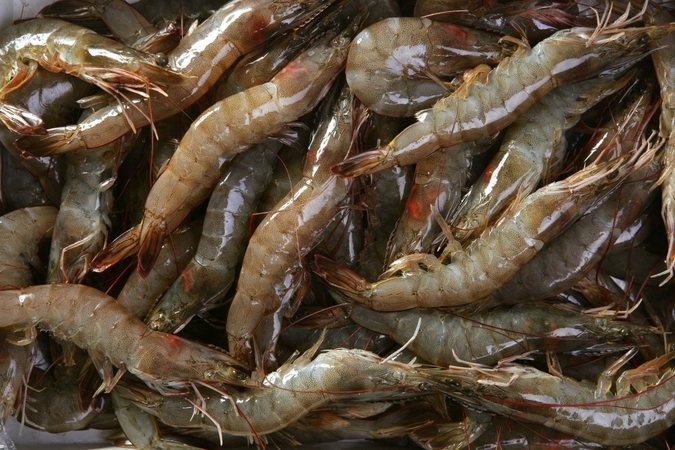
Thai Union Group, the world’s largest seafood company, and feed-ingredient giant Corbion have expanded adoption of AlgaPrime DHA, an omega-3 rich algae feed ingredient, in Thai Union shrimp feed following a successful large-scale trial in 2019.
Thai Union said the expanded partnership marks a pivotal moment for shrimp farmers and other seafood producers as it validates success in using alternative, sustainable feed ingredients at scale.
As one of the fastest growing species within the aquaculture industry, farmed shrimp currently account for 55 per cent of global shrimp production, presenting an unprecedented opportunity to drive sustainable growth.
Thai Union said the wider adoption of AlgaPrime DHA by Thai Union Feedmill Plc reflects a priority to utilise ingredients that are traceable, reliable and sustainably produced.
AIS signs 5G deal with Bangkadi Industrial Park in Pathum Thani
Oct 12. 2020AIS CEO Somchai Lertsutiwong, left, and Kobkarn Wattanavrangkul, chairperson of Bangkadi Industrial Park, pose after signing an MoU on providing 5G solutions to factories based at the park.
By The Nation
Advanced Info Service (AIS) has signed a memorandum of understanding (MoU) with Pathum Thani’s Bangkadi Industrial Park to provide 5G solutions.
This partnership reflects AIS’s commitment to bringing technological infrastructure to support the management of the Thai industrial sector, the company said.
The pact will help factories at the park keep abreast of changes and give them a competitive edge in manufacturing. It should also generate confidence among foreign investors, AIS said.
“We hope to build a robust digital infrastructure to benefit the country, especially in the industrial sector, which will serve as a crucial mechanism to revive Thailand,” Somchai Lertsutiwong, chief executive officer for AIS, said.
Flash Express gets Bt3-billion capital injection from new partners to tap e-commerce potenntial
Oct 12. 2020
By The Nation
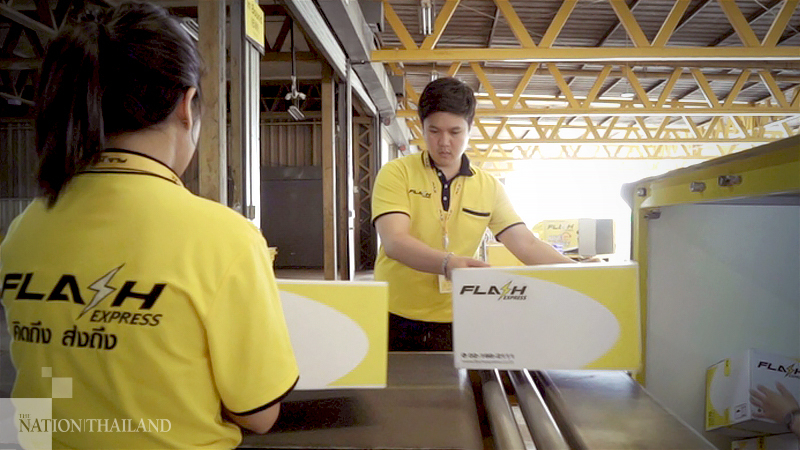
Flash Express, a full service provider of delivery and e-commerce in Thailand, has added over Bt3 billion in investment capital, backed by a group of business giants in Thailand to pave its way into Asean. It hopes to begin operations in three Asean countries within this year.
The investment capital injection is a result of Flash Express’s Series D fundraising round. Later, other Thai business groupings will prepare to announce an alliance with Flash Express, which at the moment is under negotiation and whose results will become clearer in the first quarter of 2021, the company said.
Komsan Lee, CEO of Thai full shipping service provider Flash Express, stated that Flash Express’s business has grown exponentially over the last two years and because of Covid-19, new business opportunities have fuelled growth in e-commerce, making shipping and delivery very popular in the market.
“Moreover, we’ve also opened more branches and have an average of 100 new hires each day. Thus, at the moment, we have more than 23,000 employees. Recently, business titans in Thailand, who appreciate the corporate potential of Flash Express, expressed interest and have decided to invest more than Bt3 billion, or around US$100 million with us,” he said.
“The main goal of this investment is combining the potential and strengths of each of our businesses to develop new business models that can support e-commerce expansion,” Lee added.
“This joint investment is in fact strategic expansion into new S-Curve businesses, namely energy and logistics as well as consumer products and finance to ultimately create market strength. We are also building and expanding into new businesses, whether it’s in the form of financial platforms or merging e-payment into the delivery system for a more complete e-commerce experience.”
He added that in the last quarter or 2020, the company is focusing on expansion into Asean Economic Community (AEC) countries by creating new delivery platforms that can connect the AEC and Thailand into one.
By Syndication Washington Post, Bloomberg · Kyunghee Park · BUSINESS, WORLD
Singapore Airlines said all seats on its Airbus SE A380 jetliner pop-up restaurants were reserved within 30 minutes of bookings opening Monday.
With flights largely grounded by the coronavirus pandemic, Singapore Airlines is trying novel ways to raise money, including using two of the superjumbos parked at Changi Airport as temporary eateries.
A meal in a suite costs S$642 ($474), while seats in business class are going for S$321, dropping to S$96.30 for premium economy and S$53.50 for economy. Customers can also pay with frequent-flyer miles.
After lunch on the initial dates of Saturday and Sunday, Oct. 24 and 25, sold out, Singapore Airlines said it will extend the offer for a further two days the following weekend and also add a dinner option on all four days.
About half the seats in each aircraft will be used for dining, in line with restaurant guidelines on group limits and distancing, the carrier said in a statement. In normal flying service, the carrier’s A380s can seat as many as 471 people, according to its website.
Singapore Airlines, which suffered a record S$1.12 billion ($827 million) net loss in the quarter through June and is laying off about 20% of its workforce, is also selling a range of first- and business-class meals and offering a service whereby a private chef reheats, plates and serves customers in their homes.
Meanwhile, demand is soaring for spots on two cruise ships that will start sailing from Singapore next month on round-trip journeys as the city-state aims to give residents an outlet for their wanderlust.
Operator Genting Cruise Lines has received more than 6,000 bookings in 5 days, while competitor Royal Caribbean International said bookings are up 500% compared with the past two weeks, reported the Straits Times. The boats will sail at a reduced capacity of 50% and the journeys are only open to residents of Singapore.
Ford shares surge on optimism about new bosses and models
CorporateOct 13. 2020Jim Hackett, former president and CEO of Ford., right, speaks as Jim Farley, current CEO, stands next to a 2020 Explorer SUV in Detroit, Mich., on Jan. 9, 2019. MUST CREDIT: Bloomberg photo by Jeff Kowalsky.
By Syndication Washington Post, Bloomberg · Keith Naughton · BUSINESS, US-GLOBAL-MARKETS, RETAIL
Shares of Ford surged on optimism about its new leadership and earnings potential from new models such as the Bronco sport-utility vehicle and a redesign of its top selling F-150 pickup truck.
The automaker’s stock rose on Monday after Benchmark analyst Michael P. Ward raised his earnings estimate for the company and upgraded his rating to buy from hold. His recommendation became just the fourth buy on Ford, compared with 13 holds and two sells.
“A new management team and better-than-expected third-quarter earnings provide a near-term catalyst for Ford,” Ward wrote in a note to investors. “Momentum from new products and the need to replenish depleted inventories of full-sized pickup trucks should accelerate the momentum into 2021.”
At the beginning of the month, former Chief Operating Officer Jim Farley replaced retiring Jim Hackett as CEO. Farley, an intense former Toyota executive who came to Ford in 2007, immediately named company veteran John Lawler chief financial officer, replacing former Amazon finance executive Tim Stone, whom Hacket hired last year. Stone is now CFO at software company ASAPP.
“Both Farley and Lawler, in our opinion, will be perceived as significant upgrades by the investment community,” Ward wrote. “The management changes, along with new product momentum and the benefits of cost improvement actions, in our opinion, are positive variables for the stock.”
Ward placed a $10 price target on Ford shares, which have fallen 55% since turnaround specialist Alan Mulally retired as CEO in 2014 but are up about 17% since Farley took the top job on Oct. 1.
Farley has said he plans to accelerate Ford’s turnaround even as the automaker forecasts its first annual loss in a decade. As he takes the wheel, his hand is strengthened by new models on the launching pad, including the redesigned F-150, Ford’s biggest money maker; an electric Mustang Mach-E and the revival of the rugged Bronco, which already has received more than 165,000 deposits of $100.


 TAT governor Yuthasak Supasorn
 A solar panel farm in China. MUST CREDIT: Bloomerg photo by Qilai Shen
 AIS CEO Somchai Lertsutiwong, left, and Kobkarn Wattanavrangkul, chairperson of Bangkadi Industrial Park, pose after signing an MoU on providing 5G solutions to factories based at the park.
 File photo/ superjumbo
 Jim Hackett, former president and CEO of Ford., right, speaks as Jim Farley, current CEO, stands next to a 2020 Explorer SUV in Detroit, Mich., on Jan. 9, 2019. MUST CREDIT: Bloomberg photo by Jeff Kowalsky.

