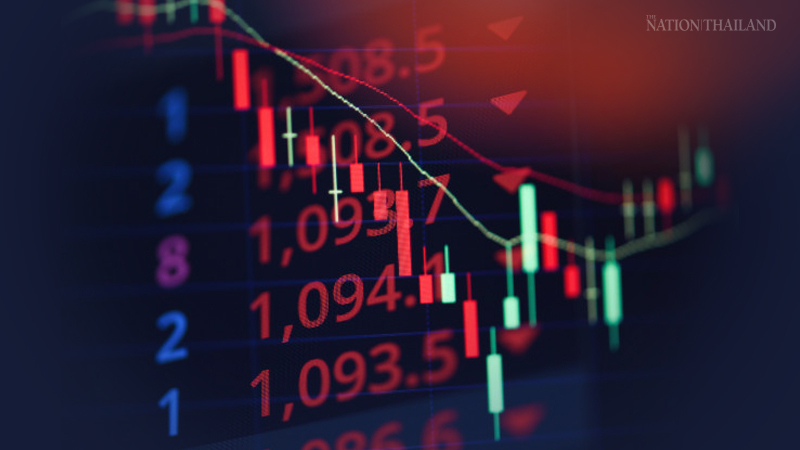
The Stock Exchange of Thailand (SET) Index closed at 1,250.15 on Tuesday, up 7.16 points or 0.58 per cent, while total transactions stood at Bt56.52 billion with an index high of 1,257.46 and a low of 1,249.14.
In the morning session, an analyst at Krungsri Securities said he expected the index to fluctuate between 1,235 and 1,250 due to mixed positive and negative sentiments.
He said the market gained positive sentiment from hopes of new economic stimulus measures and rising price of oil.
“After news that President Donald Trump was discharged on Tuesday morning, investors began hoping that he will urge Republican senators to approve the US$2.2-trillion stimulus bill,” he said.
“Meanwhile, Thailand’s Centre for Economic Situation Administration aims to discuss measures to stimulate expenditure during the latter part of this year.”
However, he said, uncertainty over commercial banks’ third-quarter performance and foreign investors’ mass sell-offs were still pressuring the index.
The top 10 stocks with the highest trade value on Tuesday were STGT, IVL, PTTEP, PTT, KBANK, SCC, PTTGC, AOT, TASCO and TOP.
As of 4.30pm, the price of oil rose by US$0.46 or 1.17 per cent to $39.68 per barrel, while gold dropped by $2.40 or 0.12 per cent, to $1,917.70 per ounce.
Other Asian indices were on the rise:
Japan’s Nikkei Index closed at 23,433.73, up 121.59 points or 0.52 per cent.
Hong Kong’s Hang Seng Index closed at 23,980.65, up 212.87 points or 0.90 per cent.
South Korea’s KOSPI Index closed at 2,365.90, up 7.90 points or 0.34 per cent.
Taiwan’s TAIEX Index closed at 12,704.23, up 155.95 points or 1.24 per cent.
China’s stock indices were closed for the Moon Festival.
EconOct 06. 2020Newly appointed Finance Minister Arkhom Termpittayapaisith
By The Nation
Newly appointed Finance Minister Arkhom Termpittayapaisith will take office on October 12, Prime Minister Prayut Chan-o-cha said on Tuesday.
He added that Arkhom will be sworn in before HM the King on October 11.
The premier said that Arkhom was the right person for the job in the current situation due to his rich background and knowledge.
Arkhom was previously transport minister in the post-coup Prayut Chan-o-cha government. Before that he was secretary-general of the National Economic and Social Development Board, a state think-tank now known as the National Economic and Social Development Council.
The appointment of Arkhomwas announced in the Royal Gazette on Monday. He succeeds Predee Daochai, who abruptly quit the post on September 2 after less than a month in office, citing health problems.
The Electricity Generating Authority of Thailand (Egat) has signed a memorandum of understanding (MoU) with Mitsubishi Motors to develop a business model for converting electric vehicle battery energy to home electrical system, aiming to expand electric charging stations across the country.
Egat and Mitsubishi Motors (Thailand) signed an MoU on energy conversion between electric vehicles (plug-in hybrid electric vehicle ( PHEV) with electrical systems and power control from the National Power System Control Centre.
Jiraporn Sirikham, Egat’s deputy governor for strategy, and Morikazu Chokki, president of Mitsubishi Motors (Thailand) Co Ltd, sign an MoU witnessed by executives from both agencies.
Jiraporn Sirikham, Egat’s deputy governor for strategy, said that this cooperation was another important step for Egat, which was ready to continue promoting new energy innovations for sustainable development in both economic, social and environmental aspects. He said Egat was committed to supporting the use of various types of electric vehicles, such as electric cars, in Thailand
The cooperation will be for three years.
For the conversion of energy between electric vehicles and electrical systems, it will be a study and test of power supply from Mitsubishi PHEV batteries to electrical systems such as houses or office buildings, using an inverter as a connection device between the electric vehicle and the electrical system. In the future, if there are more electric cars, such energy conversion could potentially support a virtual power plant innovation to help stabilise and strengthen the domestic power grid, the official said.
The price of gold was unchanged in morning trade on Tuesday, the Gold Traders Association reported.
As of 9.26am, the buying price of a gold bar was Bt28,200 per baht weight and selling price Bt28,300 while gold ornaments were priced at Bt27,697.32 and Bt28,800, respectively.
Gold price at close on Monday, when the association announced changes in the precious metal’s price four times — dropped by Bt150 per baht weight
The global market price moved to US$1,910 (Bt59,799.21) per ounce on Tuesday morning after the price rose by $12.5 to $1,920.1 per ounce at close on Monday from the weakening dollar and ongoing progress of US economic stimulus measures.
Hong Kong gold price rose by HK$190, opening at $17,690 (Bt71,463.46) per tael on Tuesday morning, the Chinese Gold and Silver Exchange Society reported.
The Stock Exchange of Thailand (SET) Index rose by 8.82 points, or 0.71 per cent, to 1,251.81 in the morning session on Tuesday.
An analyst at Krungsri Securities expected the index to fluctuate between 1,235 and 1,250 due to mixed positive and negative sentiments.
He said the market gained positive sentiment from hopes of new economic stimulus measures and the rising oil price.
“After the news that US President Donald Trump can leave the hospital on Tuesday morning has been reported, investors believe that he will urge Republican Senators to approve a US$2.2-trillion stimulus bill,” he explained.
“Meanwhile, the Centre for Economic Situation Administration aimed to discuss measures to stimulate expenditure during the latter part of this year.”
However, he said uncertainty over commercial banks’ third-quarter performance and foreign investors’ mass sell-offs of shares were still pressuring the index.
As an investment strategy, he recommended that investors buy:
▪︎ PTTEP, TOP and PTTGC that will benefit from the rising oil price.
▪︎ Banpu and AGE that benefit from rising coal price in response to China’s strong demand.
▪︎ PSL, TTA and RCL that benefit from the sharp rise in Baltic Dry Index.
The SET Index closed at 1,242.99 on Monday, up 5.45 points or 0.44 per cent. The volume of total transactions stood at Bt39.48 billion with an index high of 1,248.67 and a low of 1,239.06.
By The Washington Post · Hamza Shaban, Eva Dou · BUSINESS, US-GLOBAL-MARKETS WASHINGTON – U.S. stocks rose Monday after President Donald Trump’s doctors confirmed that he would leave Walter Reed National Military Medical Center later in the day, and despite contradictory messages about the severity of his coronavirus diagnosis.
Wall Street’s optimism also was heightened by the prospect of another round of massive economic relief from Congress as lawmakers and the White House continue negotiations with less than a month before Election Day.
The Dow Jones industrial average shot up 465.83 points, or 1.7%, to close at 28,148,64. The S&P 500 gained 60.18 points, or 1.8%, to end at 3,408.60 while the Nasdaq composite climbed 257.47 points, or 2.3%, to 11,332,49.
“Signaled improvements in President Trump’s health and increasing optimism around renewed stimulus talks are certainly driving the market rally today, and a widening lead of Biden in the polls is also helping to calm market jitters,” said Nicole Tanenbaum of Chequers Financial Management. But, as she and other analysts noted, volatility will continue as investors assess the president’s health, weigh the prospects of government stimulus and seek clarity about the Nov. 3 election.
September proved to be a tumultuous month of trading. Sentiment soured after a summer of explosive gains as economic data and high unemployment rates tempered recovery hopes. Analysts have cautioned that many of the stocks that catapulted the market to record-high levels rose too high and too fast, inviting a sell-off. And as the number of Americans who have died of covid-19 climbed past 200,000, the business community and the broader public were receiving mixed messaging from drugmakers and the Trump administration about the timeline for safe and viable vaccine.
But reignited stimulus talks have lifted investor confidence. On Friday, House Speaker Nancy Pelosi, D-Calif., suggested that Trump’s diagnosis could accelerate an agreement, which would potentially include government checks sent directly to households, funding for struggling cities and states, unemployment assistance and money for hard-pressed small businesses. Wavering economic data and large-scale corporate layoffs further underscore the pressure for Democrats and the White House to strike a deal, Tanenbaum said.
Kristina Hooper, chief global market strategist at Invesco, said she suspects Trump contracting covid-19, the illness caused by the novel coronavirus, could lead to broader adoption of masks as average Americans recognize that if the president of the United States can contract the virus, they can too. “More masks means less likelihood of the spread of covid-19, which should be a significant positive for the economy,” she said. “I also wouldn’t disagree with House Speaker Pelosi in her assessment that the president’s covid-19 diagnosis could spur Senate Republicans into recognizing how virulent the disease is, which could in turn prompt them to agree to a larger stimulus package.”
Still, the president’s illness and the infection of several U.S. senators adds yet another element of uncertainty to prolonged negotiations that have stalled before, and to the federal government’s broader response to the virus.
“While the backdrop is supportive for markets over the coming months, investors should brace themselves for near-term volatility given the uncertainty with upcoming U.S. elections and continued concerns around a delayed economic recovery should we see a second wave of the virus,” said Frank Panayotou, managing director at UBS Private Wealth Management.
At least 209,000 people have died in the U.S., and nearly 7.4 million cases have been recorded.
On Friday the Labor Department disclosed the U.S. economy added 661,000 jobs in September, registering the smallest monthly job gains since May, a signal that the broader recovery is slowing. Experts have pointed to the lackluster jobs data as evidence that direct government intervention is necessary to avoid more long-term economic damage. The jobs report, which showed that the unemployment rate has dropped to 7.9%, will be the last monthly summary before the Nov. 3 election.
As news headlines change and more “October surprises” emerge, sharp moves in the markets should be expected, said Michael Farr, president of wealth management firm Farr, Miller & Washington. He noted that this year has seen 42 days of significant market swings of 2% or more. “Don’t be surprised if we have more,” he said.
European and Asian markets, which also are tracking Trump’s health closely, ended in positive territory across the board.
Khoon Goh, head of Asia research at ANZ, said the initial “unknown unknowns” created a level of uncertainty “that previously no one really cared to think about,” he said. “It prompts investors to sell first and ask questions later.”
Stock markets slumped around the world on Friday, as Trump, 74, and a number of officials close to him tested positive for the virus. The news added uncertainty to the prospects of the U.S. economic recovery, and it called into question how much bandwidth the Trump administration would have to attend to other matters in coming weeks.
The markets appeared to take a measure of reassurance from images of Trump in a motorcade on Sunday, despite critics denouncing the photo opportunity for putting Secret Service officers at risk of infection.
In Asia, Hong Kong’s Hang Seng index added 1.3% on Monday, after posting its biggest weekly decline in six months last week. The Nikkei in Japan closed 1.2% higher.
Other factors buoying Asia markets on Monday included upbeat economic data out of Taiwan and South Korea, and hopes that the U.S. fiscal stimulus package would be passed, Goh said.
Australia’s ASX200 closed 2.6% higher, its best session since June, on investor hopes of more stimulus, including tax cuts, to be revealed in this week’s national budget.
Mainland Chinese stock markets remained closed for the country’s extended national day holiday.
European equities also were in the green on Monday, with London’s FTSE 100 and the Euro Stoxx 50 both up about 0.6% ad 0.8%, respectively.
#Stocks gain most in almost four weeks; yields rise/ Syndication Washington Post, Bloomberg
U.S. stocks closed at the highest levels of the day amid optimism that President Donald Trump will leave the hospital and that lawmakers will move closer to providing more stimulus. Treasury yields jumped, and the dollar weakened.
The S&P 500, Nasdaq composite and Dow Jones industrial average all rebounded from Friday’s swoon in the wake of Trump’s coronavirus disclosure. Regeneron Pharmaceuticals rallied after Trump was given an experimental antibody treatment made by the drugmaker. Energy, health care and technology shares were the biggest gainers in the S&P, pushing the benchmark index up by the most in almost four weeks.
“Fiscal stimulus continues to be a wild card for the market, and uncertainty around the health of the president certainly looms large,” said Chris Larkin, managing director of trading and investment product at E-Trade Financial. “So while there’s a lot of noise out there, experienced traders may find bullish opportunities.”
Trump said on Twitter that he would leave Walter Reed hospital Monday evening after being treated since Friday for covid-19, the illness caused by the novel coronavirus. With less than a month until Election Day, Trump’s hospitalization has jolted the presidential campaign, forcing him to scrap rallies and other events as polls show him trailing Democratic nominee Joe Biden nationally and in swing states.
On the stimulus front, Trump tweeted from the hospital that a deal needs to get done. House Speaker Nancy Pelosi, D-Calif., was optimistic on Friday that a bipartisan stimulus bill can be done.
“Absent of vaccine breakthrough, we’re in an economy that is modestly recovering from the lows of March and April, but it can only go so far,” said Tom Hainlin, national investment strategist at U.S. Bank Wealth Management’s Ascent Private Wealth Group. “Areas of the economy that are susceptible are still feeling the pain. That’s why we need so much stimulus from the Federal Reserve and Congress.”
Traders also pointed to polls suggesting a stronger lead for Biden and the possibility that a clear winner will emerge from the Nov. 3 election. U.S. markets have been nervous in recent weeks about a close election and the risk of a long and messy legal battle.
Elsewhere, consumer companies and banks led a broad advance among European stocks. Equities in Asia notched gains, while crude oil rebounded from a three-week low and gold advanced.
– – –
Here are some key events coming up:
– The Reserve Bank of Australia is forecast to keep interest rates and its three-year yield target unchanged at 0.25% on Tuesday
– Also on Tuesday, Fed Chair Jerome Powell and ECB Chief Economist Philip Lane deliver keynote addresses at the NABE conference
– On Wednesday, the minutes of the Sept. 15-16 meeting of the FOMC could be especially fruitful for Fed watchers, beginning with details of the debate on conditions necessary to trigger a rate increase
– The U.S. Vice Presidential debate takes place in Salt Lake City on Wednesday
– Although the final formal round of talks is over, the British government expects trade negotiations to continue up to the EU summit in mid-October.
– – –
These are the main moves in markets:
Stocks
– The S&P 500 index climbed 1.8%, to 3,408.56, as of 4:01 p.m. New York time, the highest in a month on the largest increase in almost four weeks.
– The Dow Jones industrial average surged 1.7%, to 28,148.18, the highest in more than a month on the biggest jump in almost 12 weeks.
– The Nasdaq composite index climbed 2.3%, to 11,332.48, the highest in more than a month on the largest increase in almost four weeks.
– The Nasdaq 100 index rose 2.3%, to 11,509.06, the biggest rise in more than a week.
– The Stoxx Europe 600 Index rose 0.8% to 365.63, the highest in more than two weeks, on the largest advance in a week.
– – –
Currencies
– The Bloomberg Dollar Spot index sank 0.4%, to 1,169.13, the lowest in more than two weeks on the biggest dip in more than five weeks.
– The Japanese yen depreciated 0.5%, to 105.77 per dollar, the weakest in more than three weeks on the largest decrease in five weeks.
– The euro climbed 0.6%, to $1.1783, the strongest in more than two weeks.
Bonds
– The yield on 10-year Treasuries climbed seven basis points, to 0.78%, the highest in almost four months on the largest surge in a month.
– The yield on 30-year Treasuries climbed nine basis points, to 1.58%, reaching the highest in almost four months on its sixth straight advance and the biggest surge in a month.
– Germany’s 10-year yield increased three basis points, to -0.51%, the highest in more than a week on the largest climb in more than three weeks.
– Britain’s 10-year yield rose four basis points, to 0.288%, the highest in almost five weeks.
Commodities
– West Texas Intermediate crude surged 6.2%, to $39.36 a barrel, the largest jump in 20 weeks.
– Gold strengthened 0.6%, to $1,911.48 an ounce, the highest in two weeks.
Central bank keeps an eye on debtors’ ability to repay as banks brace for NPLs
EconOct 06. 2020Chatchai Sirilai, president of the Government Housing Bank, said the bank will have to boost its reserves in line with rising bad debts.
By The Nation
The Bank of Thailand (BOT) is closely monitoring debtors’ ability to repay debts, while bankers are getting ready for rising bad debts.
Central bank officials will discuss debtors’ repayment abilities with banks, and have started off by meeting with Chatchai Sirilai, president of the Government Housing Bank (GHB).
Chatchai said that after the first phase of debt holiday expired recently, debtors owing a total of Bt180 billion have applied for an extension on the debt-repayment holiday. Meanwhile, debtors whose combined debt is worth Bt80 billion have resumed the payment of their mortgages.
He said GHB, Thailand’s largest mortgage lender, believes debts totalling about Bt9 billion may turn into bad debts, as people owing a total of Bt5 billion were unable to make payments, while those holding combined debts of Bt4 billion could make partial payments.
“While we may recover Bt4 billion, the debts worth Bt5 billion may eventually turn into bad debts,” he said.
In order to brace for rising non-performing loans (NPLs), GHB will increase its reserves to Bt5.3 billion, up from Bt3.5 billion set aside in August.
However, increasing reserves will adversely affect the bank’s profits this year, he said referring to the profit target of Bt13.5 billion set earlier.
The bank is optimistic it will meet the new lending target of Bt210 billion by yearend after its loans hit Bt156 billion at the end of September.
He said not everyone is affected by the Covid-19 outbreak, so the demand for mortgage remains.
Earlier, commercial banks said they expected an increase in NPLs, but said it will be manageable as this crisis was expected to be less severe than the 1997 Asian financial crisis.
Thailand’s choice of finance minister ‘inspires confidence’: banker
EconOct 06. 2020Newly appointed Finance Minister Arkhom Termpittayapaisith
By The Nation
The urgent task for newly appointed Finance Minister Arkhom Termpittayapaisith is to tackle the impact of Covid-19 on the Thai economy, a leading banker said on Monday.
Chongrak Rattanapien, senior executive vice president of Kasikornbank, said Arkhom must seek ways to move the economy forward, solve grassroots economic problems, and push for development of state infrastructure projects.
Chongrak is confident that the appointment of Arkhom, which was announced on Monday, will inspire confidence among investors and the general public.
Arkhom succeeds Predee Daochai, who abruptly quit the post on September 2 after less than a month in office, citing health problems.
Arkhom was previously transport minister under the post-coup Prayut Chan-o-cha government.
Before that he was secretary-general of the National Economic and Social Development Board, a state think-tank which is now known as the National Economic and Social Development Council.
Housing Business Association president Atip Bijanonda said Arkhom is a good fit for the job of steering the nation’s economy.
The new minister is approachable and accessible, which would ensure smooth collaboration between the public and private sectors, he said.
Reviving the Thai economy was a daunting task, since success depended not just on domestic factors but also on conditions abroad in Thailand’s major tourism and trade partners, said Atip.
He added that the property sector wants the new minister to focus on three tasks: urgently lifting the domestic economy in order to boost people’s purchasing power, accelerating investment in new state mega-projects, and opening up opportunities for all business sectors to participate in the process of economic problem solving.
Commercial banks’ third-quarter net profit is expected to slump year on year due to high reserves for doubtful debts and expenses, experts said on Monday.
Tanadech Rungsrithananon, senior director of research at UOB Kay Hian Securities, expects commercial banks’ third-quarter net profit to be Bt32 billion, down 42 per cent year on year, but up 4 per cent quarter on quarter due to a high reserve for doubtful debts and expenses.
Meanwhile, he expects banks’ net interest margin (NIM) to be at 2.8 per cent, down from 3.15 per cent in the same period of the previous year and 2.95 per cent in the second quarter of this year owing to interest rate adjustment. Banks’ NIM is expected to remain at a low level until next year.
Non-performing loans (NPL), he said, will be at 3.3 per cent, up from 3.1 per cent in the previous quarter due to the impact of Covid-19 on businesses that rely on foreign tourists, such as hotels and tourism agencies.
“We expect bank shares to drop and NPLs to rise further in the fourth quarter of this year once the government’s measures to help people expires,” he said.
He added that commercial banks’ net profit this year is expected to be at Bt140 billion, down 34 per cent from Bt201 billion in the previous year and the lowest in 10 years. However, net profits for banks are expected to rise 5 per cent year on year to Bt146 billion owing to high reserves for doubtful debts and expenses.
“However, it will take several years for banks’ net profits to rise to Bt200 billion like in previous years, and it actually depends on banks’ methods of controlling NPLs as well,” he added.
Meanwhile, Tanawat Ruenbanterng, an analyst at Tisco Securities expects banks’ third-quarter net profit to be at Bt31.23 billion, down 38.6 per cent from Bt50.82 billion in the same period of the previous year, but up 10.6 per cent from Bt28.24 billion in the second quarter.
He also expects the net profits of all banks, except Bangkok Bank and Kasikornbank to drop owing to high reserves for doubtful debts and a drop in NIM.
Tech firm links up with Oracle to provide cloud services to customers
Oct 05. 2020
By The Nation
A-HOST, a member of the Oracle Partner Network (OPN), has opened the A-HOST & Oracle Cloud Customer Centre in Bangkok to serve the needs of businesses wanting to adopt cloud services.
At the centre, A-HOST staff help customers get in touch with a team of Oracle Cloud experts to help solve their business and IT challenges.
The centre, located on the 21st floor of SM Tower in Phaholyothin Road, provides knowledge and services in all areas of the Oracle Cloud (IaaS, PaaS, SaaS) with a focus on Oracle Cloud services.
The 150-square metre facility boasts state-of-the-art design and comprises a training room, workshop and co-working space where design thinking sessions can be held.


 Newly appointed Finance Minister Arkhom Termpittayapaisith


 Chatchai Sirilai, president of the Government Housing Bank, said the bank will have to boost its reserves in line with rising bad debts.
 Newly appointed Finance Minister Arkhom Termpittayapaisith