Thai Vietjet offers special domestic rates for companies, govt agencies
Oct 05. 2020
By The Nation
Thai Vietjet has launched “corporate and government tickets” for companies and government agencies, offering special packages, including fixed fares with flexible dates.
The offer is not applicable on public holidays.
Passengers will have access to two fare options – Eco and Skyboss – which come with different benefits such as baggage allowance, seat selection and priority services.
The deal is available at all Thai Vietjet travel agencies and can be applied to flights from Suvarnabhumi to Chiang Mai, Chiang Rai, Phuket, Krabi, Udon Thani, Hat Yai , Khon Kaen, Nakhon Si Thammarat, Ubon Ratchathani and Surat Thani from November 4. The deal will be applicable to Phuket-Chiang Rai, Udon Thani-Chiang Rai and Chiang Rai-Hat Yai flights from November 1.
B Grimm teams up with provincial power agencies to pursue opportunities
CorporateOct 05. 2020From left: Khemarat Sartprecha, Sompong Preeprem, Harald Link, and Preeyanart Soontornwata
By The Nation
B Grimm Power Plc (BGRIM) has teamed up with the Provincial Electricity Authority (PEA) and subsidiary PEA ENCOM International (PEA ENCOM) to pursue new business opportunities.
The memorandum of understanding (MoU) between the three entities will see them collaborating financially and technically in new ventures.
The MoU was signed by B Grimm Group’s chairman Harald Link, BGRIM’s chief executive officer Preeyanart Soontornwata, PEA governor Sompong Preeprem and acting PEA ENCOM president Khemarat Sartprecha.
Link said the collaboration will be instrumental in expanding the customer base for small power producers and boost the efficiency of private power generation projects that produce electricity for their own use or directly supply power to buyers.
In another move to strengthen the BGRIM-PEA ENCOM tie-up, subsidiary B Grimm Power Service (Laem Chabang) transferred a 5 per cent stake to PEA ENCOM for Bt200 million.
The chairman said forming such alliances is key to driving a secure, sustainable growth for BGRIM over the long term and helps it realise its target to achieve a combined installed capacity of 7,000MW. This linkup will also generate profits and dividends for shareholders consistently, he said.
Electricity Generating Public Company (EGCO Group) kicked off operations at its 19.8-megawatt Gangdong fuel-cell power plant in South Korea on Thursday.
“The 19.8MW Gangdong power plant operated by Paju Energy Service, in which EGCO holds a 49 per cent stake while SK E&S holds the rest, commenced commercial operations on October 1,” said Thepparat Theppitak, EGCO Group’s president.
“The plant will sell electricity to the Korea Electric Power Corporation, the sole buyer of wholesale power generation in South Korea, through the Korea Power Exchange.
“The new power plant will continuously generate revenue for EGCO with its earnings to be realised in the fourth quarter of this year onwards,” Thepparat said.
“The power plant will also generate incremental revenue from selling thermal energy and also receive renewable credits in the form of renewable energy certificates in relation to its electricity generation output,” he added.
The Gangdong fuel cell power plant is located in Gangdong-gu in the South Korean capital Seoul.
Donki, or Don Quijote, a Japanese retail store chain, is joining hands with two partners — Sahapat and TOA Venture Holding — to open two more branches next year, aiming to achieve a total of 25 new branches in Thailand in the next five years.
“Donki (Thailand) Ltd, formerly Donki Thonglor, has recently signed an MoU with Sahapat Group and TOA Venture Holding for the cooperation to expand the company’s Donki retail stores that sell foods and consumer products imported from Japan,” said company president Yosuke Shimanuki. “We have also changed the company’s name and logo to emphasise the modernism with an aim to push Thailand to be the company’s manufacturing hub in Asia.”
The Donki chain in Thailand is 60 per cent owned by Donki (Thailand)’s parent Pan Pacific Retail Management (Thailand), while Saha Group owns 22 per cent and TOA Venture Holding owns 18 per cent.
“Currently our stores are responsible for less than 10 per cent of total retail market share, but we expect this number to increase in the near future, thanks to our unique products and experience in the field that will help create value to the brand,” said Shimanuki. “We will carefully select areas with high potential to open new stores, such as Phuket, Chiang Mai, Rayong and outer Bangkok.”
The company plans to open two new branches in 2021 and will open at least 20 stores by the end of 2025. “We estimate that 15 of these stores will be the new branch of ‘Don Don Donki’, while five branches will be under different names to introduce the company’s other products,” he added. “Throughout October, Donki is offering a 20 per cent discount on sushi and various food items to boosts sales via our food delivery service, which has become increasingly popular since the Covid-19 lockdown,” Shimanuki said.
The Stock Exchange of Thailand (SET) Index closed at 1,242.99 on Monday, up 5.45 points or 0.44 per cent. The volume of total transactions stood at Bt39.48 billion with an index high of 1,248.67 and a low of 1,239.06.
During the morning session, an analyst at Krungsri Securities said he expected the index to rebound to between 1,245 and 1,250 before falling in response to news that US President Donald Trump may be discharged on Monday after testing positive for Covid-19 last week.
However, he said falling price of oil, uncertainty over banks’ weak third-quarter performance due to high non-performing loans and foreign investors’ mass sell-offs will pressure the index.
The top 10 stocks with the highest trade value on Monday were STGT, TASCO, AOT, PTT, ADVANC, DELTA, CBG, BAM, PTTEP and IVL.
As of 4.30pm, the oil rose by US$0.96 or 2.59 per cent to $38.01 per barrel, while gold dropped by $3.10 or 0.16 per cent, to $1,904.50 per ounce.
Other Asian indices were also on the rise:
Japan’s Nikkei Index closed at 23,312.14, up 282.24 points or 1.23 per cent.
Hong Kong’s Hang Seng Index closed at 23,767.78, up 308.73 points or 1.32 per cent.
South Korea’s KOSPI Index closed at 2,358.00, up 30.11 points or 1.29 per cent.
Taiwan’s TAIEX Index closed at 12,548.28, up 32.67 points or 0.26 per cent.
China’s stock markets were closed for the Moon Festival.
EconOct 05. 2020New Finance Minister Arkhom Termpittayapaisith
By The Nation
Arkhom Termpittayapaisith was officially appointed Thailand’s new finance minister on Monday, tasked with rescuing the economy from an unprecedented downswing under the impact of Covid-19.
The appointment was announced in the Royal Gazette on Monday.
Arkom succeeds Predee Daochai, who abruptly quit the post on September 2 after less than a month in office.
Arkom was previously transport minister under the post-coup Prayut Chan-o-cha government.
Before that, he was secretary-general of the National Economic and Social Development Board, a state think-tank which is now known as the National Economic and Social Development Council.
The price of gold dropped by Bt100 per baht weight in morning trade on Monday, the Gold Traders Association reported.
As of 9.21am, the buying price of a gold bar was Bt28,250 per baht weight and selling price Bt28,350 while gold ornaments were priced at Bt27,742.80 and Bt28,850, respectively.
At close on Saturday, the buying price of a gold bar was Bt28,350 per baht weight and selling price Bt28,450 while gold ornaments were Bt27,833.76 and Bt28,950, respectively.
The global market price moved to US$1,899 (Bt59,794.92) per ounce on Monday morning after the price dropped by $8.7 to $1,907.8 per ounce at Friday’s close.
Gold price was pressured by the strengthening of the dollar, which made the price high for investors holding other currencies.
Hong Kong gold price opened at HK$17,570 (Bt71,378.66) per tael on Monday morning, the Chinese Gold and Silver Exchange Society reported.
The Stock Exchange of Thailand (SET) Index rose by 9.65 points, or 0.78 per cent, to 1,247.19 in the morning session on Monday.
An analyst at Krungsri Securities expected the index to rebound to between 1,245 and 1,250 before falling in response to the news that US President Donald Trump would be able to leave the hospital on Monday after testing positive for Covid-19 last week.
However, he said the falling oil price, uncertainty over banks’ weak third-quarter performance due to high non-performing loans, and foreign investors’ mass sell-offs of stocks will pressure the index.
As an investment strategy, he recommended that investors buy:
▪︎ Banpu and AGE that benefit from rising coal price in response to China’s strong demand.
▪︎ PSL, TTA and RCL that benefit from the sharp rise in Baltic Dry Index.
▪︎ Delta, Hana, KCE and SMT that benefit from the weakening baht.
The SET Index closed at 1,237.54 on Friday, down 10.05 points or 0.81 per cent. Total transactions amounted to Bt54.24 billion with an index high of 1,246.78 and a low of 1,231.11.
Migration, in reverse: Coronavirus forces migrant workers to return home
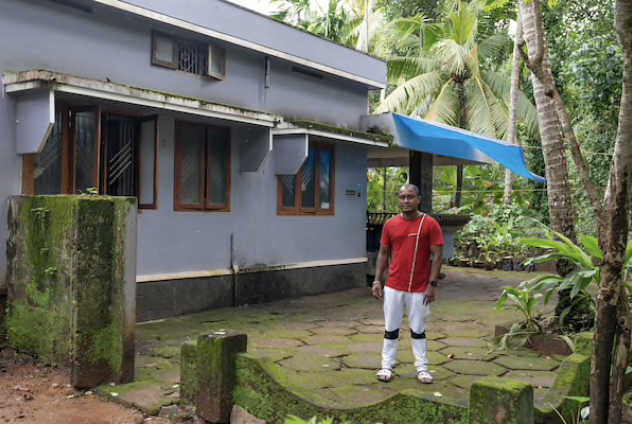
EconOct 05. 2020Ramakrishnan Athekkatil stands outside his spacious, two-story home in India, which he was able to build by leaving his home country and taking a job in the Persian Gulf. MUST CREDIT: photo for The Washington Post by Ashiq MK.
By The Washington Post · Joanna Slater, Kareem Fahim, Katie McQue · WORLD, ASIA-PACIFIC, MIDDLE-EAST In his long years away from his family, Ramakrishnan Athekkatil often imagined what it would be like to settle down back in India.
He never imagined he would return like this: laid off, in debt and pursued by a sickness racing around the globe.
Home was a small village ringed by coconut palms and paddy fields on India’s southwestern coast. His father, pushed by poverty, had been the first to leave for the Persian Gulf in search of work. Later Ramakrishnan, 47, and his four brothers all made the same voyage.
Pradeesh Athekkatil, the youngest of five brothers, had worked as a driver for a limousine company in the United Arab Emirates. He returned to India after not being paid for three months. MUST CREDIT: photo for The Washington Post by Ashiq MK.
“Ever since I was young, I wanted to go,” Ramakrishnan said. “I used to tell my father, ‘Just take me with you to the gulf.’ “
The family was part of a vast migration from South Asia to countries flush with wealth but short on labor. The migrants worked to raise gleaming cities in the desert, and built the schools, hospitals and power plants that helped transform collections of villages and port towns into modern Arab countries.
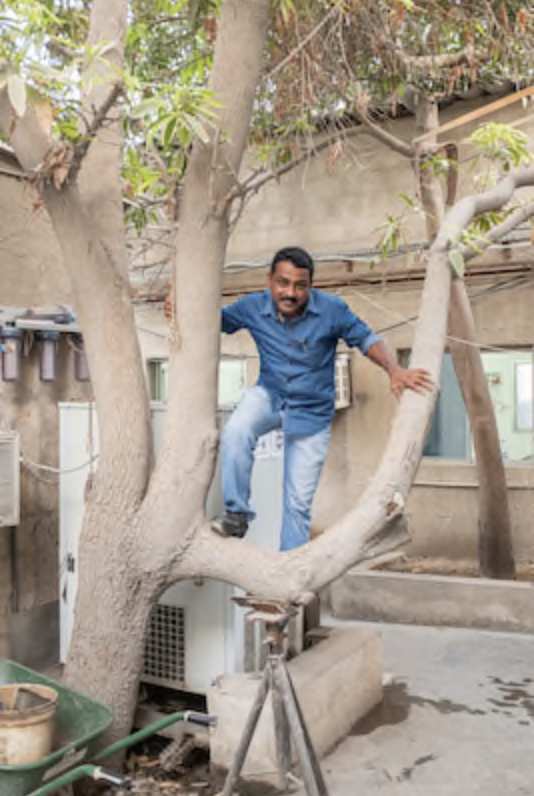
Unnikrishnan, the eldest of the Athekkatil brothers, climbs a mango tree behind the warehouse where he works in Dubai. His father Kumaran planted the seed for the tree after he arrived in the Persian Gulf in the 1980s. MUST CREDIT: photo for The Washington Post by Mohamed Somji. Photo by: Mohamed Somji — For The Washington Post
Now, one of the largest migration corridors in the world is flowing in reverse. The coronavirus pandemic and crashing oil prices have led to mass layoffs in gulf states, leaving foreign workers vulnerable and in some cases destitute. Out of money and fearing the virus, hundreds of thousands have returned home.
With a vaccine still months away and the number of coronavirus cases rising around the world, there is little prospect that anything will return to normal any time soon for the world’s 164 million migrant workers who cross borders.
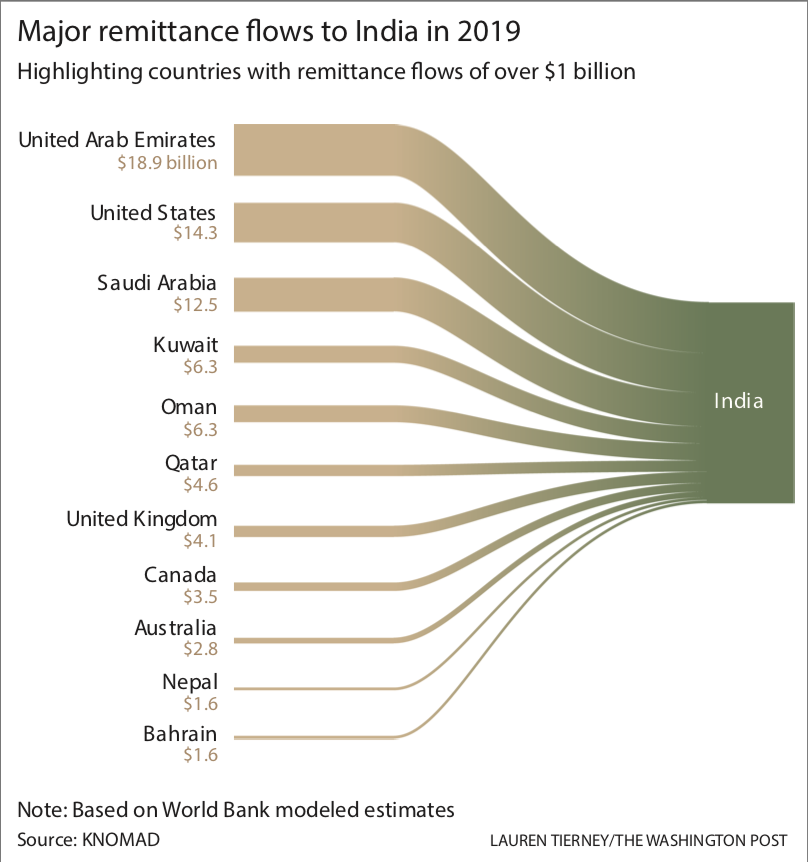
Chart of 2019 remittances to India Photo by: The Washington Post — The Washington Post
About one-third of them come from South Asia, and India is the single largest source of such migrant labor in the world.
Kerala, the small southern Indian state where the Athekkatils live, plays an outsize role in such flows. An estimated 2.5 million Keralites were working abroad before the arrival of the virus, the vast majority in the Persian Gulf. The pandemic is pushing them home in record numbers: As many as 500,000 migrants and their families are expected to return by the end of the year, the largest such exodus ever, experts say.
Nearly 400,000 people have already returned to the state from the gulf since May, according to data provided by the Kerala government agency responsible for overseas workers. At least half of the returnees said they were coming back because they had lost their jobs.
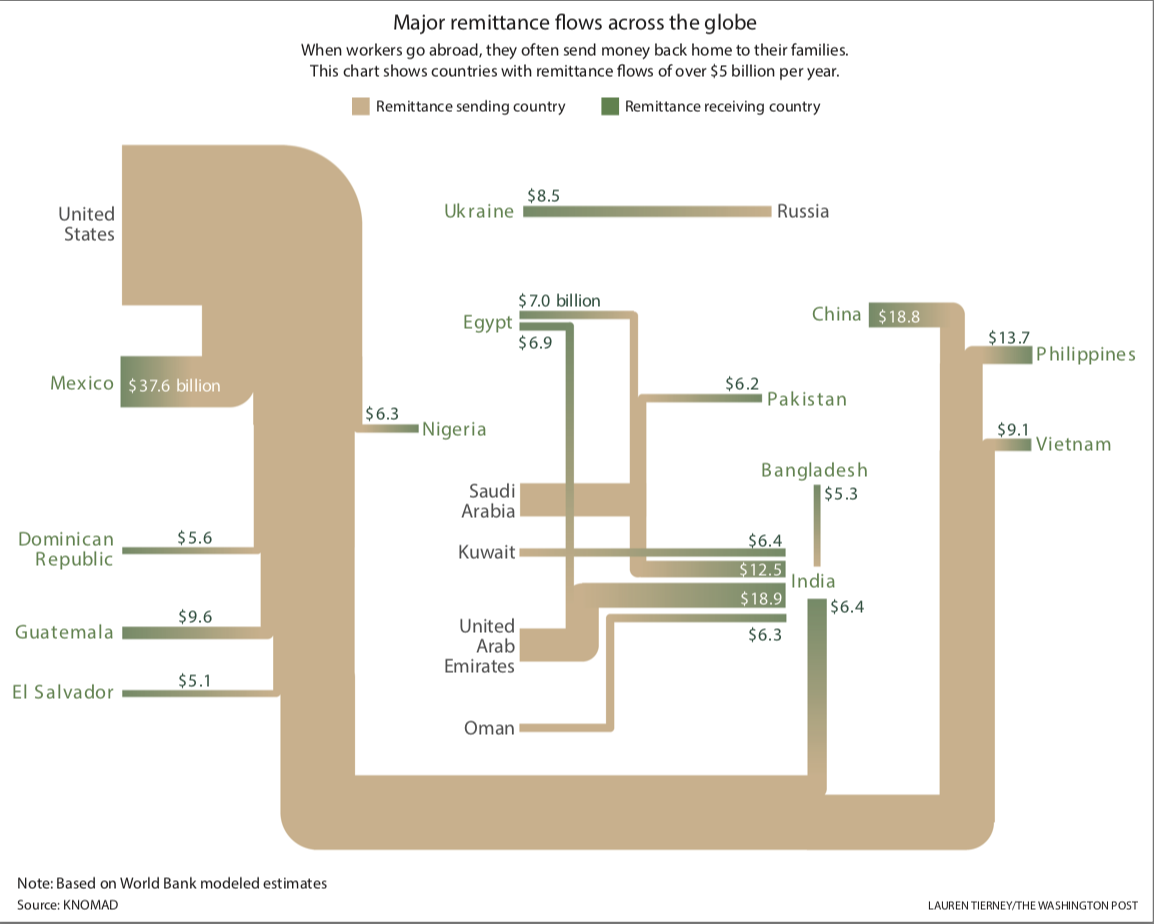
Flow chart of global remittances 2019 Photo by: The Washington Post — The Washington Post
Meanwhile, the pandemic has also prompted some countries in the region to accelerate plans to “nationalize” their workforces – in other words, to reduce their reliance on foreign migrants altogether.
The workers who came home are struggling. Indians who lost their jobs in the gulf are returning to an economy crippled by rising infections and by the aftermath of one of the world’s strictest lockdowns.
“You’re looking at devastation on both sides of the corridor,” said Shabarinath Nair, a regional migration specialist at the International Labor Organization.
The coronavirus crisis has upended many aspects of globalization previously taken for granted – in manufacturing, in education, in tourism – but one of its most dramatic impacts has been on migration. As country after country closed borders and banned flights, migrant workers around the globe faced chaos without precedent. Some began a desperate scramble to get home. Others were stranded and faced an equally desperate wait.
A survey of migrants from Central America and Mexico conducted by the International Organization for Migration found that half had lost their jobs in the pandemic. From Ukraine to Myanmar, Mozambique to Venezuela, migrant workers around the world retraced their steps by the millions.
Finding a way to revive the movement of workers without fueling new outbreaks will be crucial to fixing the global economy.
“If we are unable to relaunch migration and mobility safely – and universally – the world’s ability to recover from economic recession will be limited,” wrote Antonio Vitorino, the director general of the IOM.
– – –
When the pandemic hit, it left two of the Athekkatil brothers jobless and pushed two others into a state of deep uncertainty. With tears in his eyes, Ramakrishnan recalled how the newspaper company where he had worked since 1999 in the United Arab Emirates – rising from the printing plant to the bill collection department – sent him a letter saying he was being let go.
Pradeesh, 37, the youngest of the five, had worked as a driver for a limousine company doing airport pickups and drop-offs, also in the UAE. He said he wasn’t paid for three months and then the company asked drivers to go unpaid for another three months.
“There are only 365 days in a year,” Pradeesh said bitterly. Without jobs, the two brothers had no choice but to go home.
Migrant workers are not only critical to the countries where they work but also a vital source of income back home, sending money to pay for daily expenses, housing, education and medical care. Such remittances hit a record high of $554 billion in 2019.
This year, however, the World Bank expects remittances to fall by 20 percent, which would be the sharpest decline on record. For some countries, that drop will be a crushing blow. In Nepal, Honduras, Haiti, Lesotho and Tajikistan, for instance, remittances represent more than 20% of gross domestic product. Even for a large economy like India, remittances are important: Last year, they outstripped the total amount of foreign direct investment in the country.
In Kerala, the dependence on funds sent from abroad is a not-so-secret element of the state’s developmental success. One in every four households in the state includes a migrant who works abroad, according to a 2018 survey.
Kerala received about $15 billion in remittances last year, according to Dilip Ratha, the lead economist on migration and remittances at the World Bank. That’s more than a tenth of the state’s entire economic output. As remittances fall, so too will tax revenue, limiting the state government’s ability to help people during what is shaping up to be India’s worst recession in modern history.
The migration route from Kerala to the gulf, built upon centuries of trade with the Middle East, is so well established that is has absorbed successive generations of the same family, like the Athekkatils. Along curving roads in the northern part of the state, one can spot the “gulf houses” – a term for the sometimes comically large residences that well-paid migrants build back home in Kerala.
In normal times, tens of thousands of Keralites return each year, having saved enough money or because they’re ready to come home. After the 1991 Persian Gulf War and the 2008 financial crisis, migrants returned involuntarily, but on a smaller scale than what is unfolding now.
Those prior episodes demonstrate how wrenching the return can be, said Irudaya Rajan, a professor at the Center for Development Studies and an expert on migration from Kerala.
“They went to make money,” he said, “and now they’ve lost everything.”
– – –
For migrants and their families, there were drawbacks well before the pandemic. When the Athekkatil brothers talk about their father, Kumaran, it is with a sense of respect for his sacrifices in the gulf: the extreme heat, the long hours, the loneliness.
Kumaran left for the UAE in 1983. Unable to read or write, he had colleagues help him write letters. He would return home only once every three years, storing up his leave time so he could stay for two months. The ink pens and scented erasers he brought as gifts were the envy of his sons’ classmates.
But the time with his wife and children was scarce. “He was always crushed that he’d be leaving again soon,” said Unnikrishnan, 49, the eldest of the five brothers. “My father lived for his family, not for himself.”
When the brothers were small, they lived in a home with mud walls and a roof of thatched leaves, with every month an anxious wait for the arrival of the money from abroad that sustained 10 people in the extended family. Unnikrishnan said he couldn’t stand seeing his father bear the burden alone. He dropped out of school after the 10th grade.
In 1998, he became the first of the brothers to go to the gulf. He took up a job as an assistant at the same company where his father worked, Ghantoot General Mechanical Engineering, in an industrial zone of Dubai. Years before, his father had planted a mango seed from Kerala behind the warehouse. By the time Unnikrishnan arrived, the tree was bearing fruit.
One by one, the four other brothers – Ramakrishnan, Sethu, Rajesh and Pradeesh – all followed.
“I told everyone to stay here,” said their mother, Lakshmikutty, a slight woman in a red-and-white printed sari, sitting on her terrace on a recent afternoon. “But everyone wanted to go.”
Ramakrishnan was the most enthusiastic, having made up his mind early that he, too, would migrate to the gulf. “To make money, what else would it be?” he said with a laugh. His first job in Dubai was working the overnight shift at a newspaper printing plant, earning $136 a month in today’s dollars.
Over the years, Ramakrishnan moved from the printing press to delivering newspapers to collecting revenue for an English-language paper in the UAE. His salary increased to $1,600 a month. By earlier this year, however, it was obvious that business was soft as oil prices plunged and the UAE’s non-oil private sector contracted for the first time in over a decade. Then he began to read in the news about a strange new illness coming from China.
When the pandemic hit, its impact fell hardest on migrant workers. In Qatar and Saudi Arabia, the virus swept through labor camps and cramped apartments where foreign workers lived, trapped by poverty and lockdowns. Job losses exploded.
In the UAE, for the first time in recent memory, residents saw desperate migrants begging for food or money in the streets.
Others began bartering their possessions for groceries and other necessities on Facebook groups, or waiting in long lines for provisions offered by charities. Some say they are unable to pay for flights home or cannot bear the thought of leaving with little or nothing to give to their families.
Sethu, 43, the third of the Athekkatil brothers, works as a metal fabricator in Sharjah, one of the seven emirates that make up the UAE. He said he spent several months this spring confined to his shared room in a dormitory with other workers. There was no work and nowhere to go. Pradeesh and his colleagues struggled to make ends meet after their company abruptly stopped paying them.
Rejimon Kuttappan, a labor activist in Kerala who works with migrants in the gulf, said that starting in March, he began to receive call after call from workers reporting that companies were not paying them the money they were owed as they were laid off. They felt they had no recourse, Kuttappan said, and no option but to leave.
For decades, foreign workers in the gulf have accepted a state of enforced impermanence in exchange for higher salaries than they could earn at home. In the past, it was usually possible for migrants to stay for decades: Many raised families in the gulf, or spent careers there, squirreling away enough money to support a family, or even a clan, at home.
When jobs opened up, they recruited family and friends from back home to fill them, bringing growth and prosperity, over generations, to companies that would never bear their names.
But the ability to remain in the gulf was never certain.
“There is always an element of instability,” said Rima Kalush of Migrants-Rights.org, an advocacy organization. For migrants all over the Persian Gulf, she said, the pandemic has made it “more visceral that it’s not possible to have a future there, unless you are the elite of the elite.”
Proposals to “indigenize” the labor force in gulf states were hatched decades ago but are getting renewed attention during the pandemic. Last month, Saudi Arabia implemented a plan to reserve 70 percent of certain retail jobs for locals. In Kuwait, lawmakers have threatened to reduce the number of foreigners in the country to just 30 percent of the population, down from the current 70 percent. Experts believe the plan is impracticable and unlikely to materialize.
The pandemic vaporized the jobs of two of the Athekkatil brothers. The newspaper company where Ramakrishnan had worked since 1999 delayed paying him for three months, he said, and proposed that he take a steep pay cut until the economy improved.
“I was ready to do that,” he said.
More than anything, he wanted to keep paying down the loan he took out to build his house in Kerala, a spacious two-story home in a grove of coconut trees close to where he grew up. But on June 10, Ramakrishnan was terminated along with dozens of others, he said.
Pradeesh, the youngest brother, worked for a company called Al Muttahida Limousine, doing airport pickups and drop-offs for Emirates, Dubai’s state-owned airline. He said he received no salary from April to June, and in May the company asked employees to sign an addendum to their employment contract indicating that they had agreed to go unpaid.
Pradeesh said the company then asked drivers to agree to go unpaid for an additional three months. He refused. Representatives for Al Muttahida did not respond to requests for comment.
Rajesh, 40, the second-youngest brother, had already returned to Kerala last year because of a back injury and because he felt his salary was too low.
Sethu, the metal fabricator, spent months cooped up while his factory was shut. Work has since restarted, but he sees layoffs happening all around him and worries that some migrants are willing to work for cheaper salaries.
“I don’t know what will happen,” Sethu said.
Only Unnikrishnan’s job – as a clerk in GGME’s warehouse – seemed safe, partly because of his father’s legacy at the company. But even he was nervous about the future with business so slow.
Each night, he returns to the labor camp where the men sleep five to a room in bunk beds. He sends about $400 home to his family each month, and while he speaks to them every day, he won’t see them in person for another year.
After Ramakrishnan was laid off, he tried, without success, to find a different job. In late June, he boarded a flight sponsored by a television station in Kerala, just one of many private efforts to bring out-of-work migrants home for free. The Indian government also organized a massive airlift. One such flight returning from the gulf to Kerala ended in tragedy when the flight skidded off the runway, killing 20.
Ramakrishnan landed in the state’s capital, Thiruvananthapuram, then boarded a government bus heading north. At Kadalundi, a town on the Arabian Sea known for its bird sanctuary, the roads narrowed as he approached home.
The concrete track that leads to his house is only wide enough for a motorbike. The large, white two-story home with a red-tiled roof soon emerges from the trees. Downstairs a case holds trophies won by his 15-year-old daughter in classical-music competitions.
As Ramakrishnan began 28 days of home quarantine, he had no idea what would come next. He managed to pay the latest installment on his loan with the final payment from his employer but didn’t know where he would get the money for those that would follow. Even now, his mind is full of thoughts of going back to the gulf – anything to avoid the indignity of returning home with nothing.
When his father came home from the gulf and retired, he took to selling produce out of a small concrete shack nearby – a way to combat idleness rather than to earn a living. Now Ramakrishnan decided his only option was to reopen it as a tiny store where he could sell vegetables and rice on a quiet rural lane.
His two children are happy to have him home. “They don’t know what loans are, what life is,” he said with a laugh that barely covered the strain he feels. If he had an offer to work again in the gulf, he said, “definitely I would go.”
Global Power Synergy Public Company (GPSC), the power flagship of PTT Group, will start marketing activities for its battery products early next year, chief executive officer Chawalit Tippawanich said.
GPSC has signed a Bt1.1 billion contract with Japanese construction firm, Thai Takasago, to develop Thailand’s first semi solid lithium ion battery plant on a 12-rai plot in Map Ta Phut Industrial Estate.
The plant, with an initial total capacity of 30 megawatt hour (MWh), is due to commence operations by yearend.
GPSC aims to penetrate the high-end energy storage market in Thailand and Asean with plans to expand its production capacity to 100MWh to support future demands.
Chawalit said the equipment required has already been brought in, but will have to be installed by experts from Japan and US, who are still unable to come to Thailand due to restrictions put in place to curb transmission of Covid-19.
He said the company has petitioned for concerned agencies to relax the rules for these experts, and hopes the plant will go into operation by the end of this year as planned.
The CEO also added that once the plant produces its first lot of batteries, it will begin to ramp up its capacity to up to 100 MWh in line with the government’s policy of promoting next generation automobiles that use clean energy.


 From left: Khemarat Sartprecha, Sompong Preeprem, Harald Link, and Preeyanart Soontornwata



 New Finance Minister Arkhom Termpittayapaisith


 Ramakrishnan Athekkatil stands outside his spacious, two-story home in India, which he was able to build by leaving his home country and taking a job in the Persian Gulf. MUST CREDIT: photo for The Washington Post by Ashiq MK.
 CEO Chawalit Tippawanich

