By Syndication Washington Post, Bloomberg · Justin Carrigan · BUSINESS, WORLD, US-GLOBAL-MARKETS Markets face the prospect of additional turmoil this week after President Donald Trump’s hospitalization for coronavirus late Friday raised concerns over the president’s health and further roiled a Washington political landscape already riven by battles over fiscal stimulus and the Supreme Court.
Foreign-exchange markets were the first to open Monday, with attention focused on the outlook for havens such as the Japanese yen and riskier currencies like the Australian dollar. The yen, trading around 105.30 per dollar, held onto its gains from Friday in early Asia-Pacific trading, although with Sydney observing a holiday the market remained muted and liquidity appeared thin. The Australian dollar maintained the bulk of Friday’s decline and was quoted around 71.62 U.S. cents.
Market volatility jumped Friday as financial markets initially reacted to news of Trump’s diagnosis in a risk-averse manner. U.S. stock futures slid, Treasury rates fell and the yen advanced, although there was a reversal in these moves as the day wore on.
Speculation that Trump’s illness could help bridge the gap on stimulus talks ultimately helped to lift Treasury yields, while the S&P 500 index ended down less than 1% and the Bloomberg dollar index was little changed on the day, but all these markets closed before it was revealed that the president was headed to the Walter Reed National Military Medical Center for treatment.
“Risks will remain for global financial markets” and uncertainty over Trump’s health “adds a whole new level of complexity to the surroundings of financial market sentiment that were already far from clear,” said Jameel Ahmad, the director of investment strategy at Naga Group AG in London. “Should governments begin to announce new stimulus packages to reinvigorate economic momentum or hopeful news be delivered on the vaccine we are all waiting for, then the outlook for risk appetite becomes cautiously optimistic.”
Traders may obsess over Trump’s medical bulletins in coming days and the complexities that his illness brings to an already divisive presidential election campaign, but the ultimate impact on financial assets is not clear cut. Trump may be discharged from the hospital as soon as Monday as he recuperates from covid-19, one of his doctors said Sunday, though they revealed he’s been administered a medicine to control inflammation.
The spread of coronavirus among a number of Republican senators also adds potential complications for Congress, which is at the heart of America’s contentious Supreme Court nomination battle and would also need to legislate on any fresh stimulus even if Republicans and Democrats managed to come to terms on a deal. Despite that, there is increased optimism about the chance of stimulus and Trump himself tweeted Saturday from the hospital that the economy needs a deal, urging negotiators to “get it done.”
“There is an underlying belief that even if an agreement cannot be struck now, a package could be approved in the lame-duck session, and a larger effort next year” and “the configuration of political and economic considerations strongly points to more fiscal support,” said Marc Chandler, chief market strategist at Bannockburn Global in New York. “The relatively light economic calendar in the week ahead may not get in the way of a resumption underlying trend in risk assets higher,” he said.
With the situation in Washington in flux, markets may be wary without being panicked as trading in Asia gets underway Monday. Holidays in China may also dampen activity, while political developments from the Caucasus to the U.K. could stir movements in some individual currencies.
Britain’s pound held onto its advance from Friday and was quoted around $1.2934 after the U.K. and the European Union agreed to step up their negotiations over a post-Brexit trade accord. British Prime Minister Boris Johnson held a video call with European Commission President Ursula von der Leyen on Saturday in which both renewed their commitment to getting a deal. Meanwhile, ongoing hostilities between Azerbaijanis and Armenians and the involvement of both Russia and Turkey in the dispute are likely to keep a strong focus on the ruble and the lira.
The focus for most traders globally, though, will be squarely on Trump, his illness and the upcoming election battle.
“We have arrived in no man’s land,” wrote Andreas Rees, an economist at UniCredit Bank in Frankfurt. “Until someone has been sworn in on 20 January, there will be lots of uncertainty and volatility in financial markets.”
Thailand’s rice export this year is expected to drop from 7.5 million tonnes worth Bt130 billion last year to 5 million tonnes worth Bt115 billion, honorary president of the Thai Rice Exporters Association Chookiat Ophaswongse said.
He attributed the drop to the strengthening baht and low rice production.
The price of Thai white rice is currently around US$490 per tonne, compared to Vietnamese white rice at $460 per tonne, Indian at $370 per tonne and Myanmar at $420 per tonne.
White rice accounts for 50 per cent of Thailand’s total rice exports.
He said Malaysia has only purchased 40,000 tonnes of Thai white rice this year, compared to its usual 400,000 tonnes per year, adding that it has switched to rice from Vietnam, India and Myanmar instead.
Meanwhile, the Philippines has imported 1.8 million tonnes of rice this year, 1.7 million tonnes of which came from Vietnam and only around 60,000 tonnes came from Thailand. Previously, Thailand used to export around 500,000 tonnes of rice to the Philippines.
Separately, Thailand has exported 4 million tonnes of rice in the first nine months of this year, averaging at between 300,000 and 400,000 tonnes monthly. If it wants to achieve the goal of exporting 6.5 million tonnes this year, then it will have to sell at least 500,000 tonnes monthly, which he said is difficult to achieve.
The Government Housing Bank (GHB) will propose to the next finance minister schemes to support homebuyers affected by the Covid-19 crisis, a source said.
The government may need to provide a one percentage point interest rate subsidy, paid directly to homebuyers, he said. Many customers of the bank have been hit hard by the virus fallout. Many of them were laid off or their income decreased, especially those working in airlines and related tourism industries.
The mortgage rate is currently at about 6 per cent. The government could offer a one percentage point in financial relief for homebuyers, limiting the aid to homes priced at not more than Bt3 million, the source suggested.
Property developers, especially those involved in condominium residential projects, had earlier asked the government to increase the ownership limit for foreigners eligible to possess residential units from the current not exceeding 49 per cent of each project. Condominium developers are faced with oversupply problems.
Meanwhile, Chatchai Sirilai, president of Government Housing Bank, said that
despite the coronavirus outbreak, GHB’s new mortgage lending is expected to meet the target of Bt210 billion for the year, up 3 per cent over last year.
As of October 1, new lending rose to Bt156.7 billion.
Customers are taking advantage of the low interest-rate environment and some groups are not much affected by the virus outbreak.
Mortgage lending next year is projected to be about Bt215.6 billion, and Bt222.1 billion in 2022, he said. Outstanding loans at the end of August were at Bt1.273 trillion. Accumulated lending is projected to be Bt1.374 trillion in 2021 and Bt1.444 trillion in 2022.
The state-owned bank will transform itself into digital banking services by driving up to 80 per cent of total transactions to the virtual platform by 2022.
The bank, the largest mortgage lender, will also raise funds via a new batch of lottery-linked savings products at Bt 5,000 per unit.
Non-performing loans amount to Bt51.6 billion, accounting for 4 per cent of outstanding loans.
Prime Minister Prayut Chan-o-cha earlier said that he would appoint a new finance minister this month after incumbent Pridi Daochai resigned after less than a month in office.
The Bank of Thailand (BOT) is considering extending the debt moratorium for some business groups, such as those related to the tourism industry like hotels.
The move would be in line with the intent expressed by BOT Governor Veerathai Santiprabhob to extend the debt moratorium for another six months, which will be reviewed twice or extended until the end of 2021.
One of the BOT’s concerns is about the debt quality of financial institutions, as 12.5 million debtors are part of the debt restructuring project. Interest payments worth Bt7.2 trillion have been suspended until October.
The first round of the BOT’s debt restructuring process is still ongoing. There is still high uncertainty as many firms do not have a clear business plan.
“This is something I have talked to bank executives about. I have suggested that the banks contact customers, evaluate and conduct risk management for customers who are unable to create a business plan, then there must be a clear debt restructuring. We cannot use general measures since the effects are not the same,” said Veerathai.
The price of gold dropped by Bt100 per baht weight in morning trade on Saturday (October 3), the Gold Traders Association reported.
As of 9.16am, the buying price of a gold bar was Bt28,350 per baht weight and selling price Bt28,450, while gold ornaments were priced at Bt27,833.76 and Bt28,950, respectively.
At close on Friday, the buying price of a gold bar was Bt28,450 per baht weight and selling price Bt28,550, while gold ornaments were Bt27,939.88 and Bt29,050, respectively.
Comex (Commodity Exchange) gold price to be delivered in December dropped by US$8.7, or 0.45 per cent, closing at $1,907.6 (Bt60,218.79) per ounce on Friday. The metal price rose by 2.2 per cent this week.
Gold price closed in negative territory due to the strengthening dollar, which made the price high for investors holding other currencies.
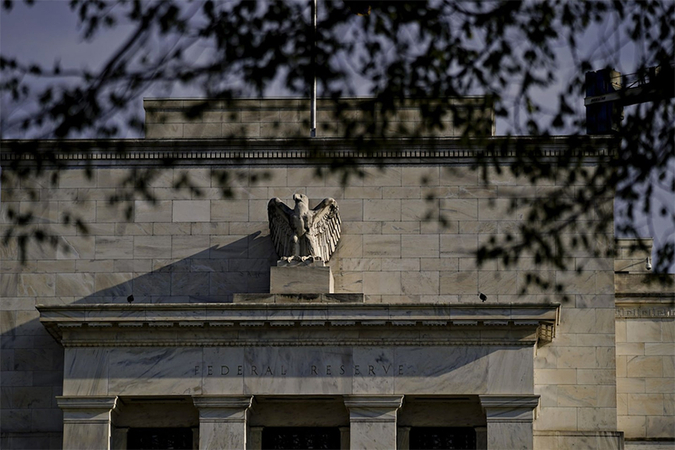
The Marriner S. Eocles Building houses the main offices of the Federal Reserve Board. (Andrew Harrer/ Bloomberg)
By The Washington Post · David J. Lynch
Even before the Federal Reserve said it would keep interest rates near zero for at least three more years, Dan Bienvenue knew he had a battle on his hands.
As chief investment officer of the nearly $400 billion California Public Employees’ Retirement System (CalPERS), which provides benefits for 2 million current and future retirees, Bienvenue must earn an annual return of at least 7%.
That’s not easy when the safe investments that pension funds usually rely on are paying less than 1%, a consequence of low interest rates.
CalPERS, the nation’s largest public pension plan, fell short of its goal in the fiscal year that ended June 30. Now, along with embracing riskier investments like private equity, Bienvenue is gambling on making low rates work for him, by borrowing billions of dollars in hopes of juicing the pension plan’s returns.
“We have to take more risk in some places,” he said. “…Systemically low interest rates, the net effect makes the challenge more difficult.”
CalPERS’ shift is just one example of how an era of persistently low interest rates has rippled across the economy, altering incentives while benefiting some groups and hurting others.
Consumers have snapped up 0% auto loans and mortgages at sub-3% rates. That’s helped the economy by driving sales of new homes and automobiles.
Depressed rates also have fueled a rise in corporate and government debt, aggravated trends toward greater inequality and left a wounded economy more dependent upon fiscal support from lawmakers at a time when Congress is intensely polarized.
Rates have been stuck at ultra-low levels for most of the past 12 years because of chronically weak demand in the U.S., Europe and Japan. The recovery from the 2008 financial crisis was the most anemic since World War II and – despite President Dopnald Trump’s claims to have produced the greatest economy in history – the U.S. economy grew at an average rate of just 2.5% from 2017 through the end of last year.
Aging populations, subpar productivity growth and a once-in-a-century global health scare led the Fed earlier this year to return its benchmark borrowing rate to near zero and to resume large-scale buying of corporate and government securities. Fed Chair Jerome Powell has said rates would remain near zero at least through 2023.
Once an emergency remedy for economic collapse, ultra-low rates now are a fixture of the U.S. landscape. It may be a decade, perhaps longer, before they return to the levels seen in the 1990′s and early 2000′s, economists said.
“Yes, this is a very striking environment compared to the preceding 150 to 200 years of the modern economy, with the possible exception of the Great Depression,” said Adam Posen, president of the Peterson Institute for International Economics.
Today’s low rates reflect a shift in the way the Federal Reserve thinks about the economy. After a review last year, top Fed officials concluded that the neutral interest rate – one that neither spurs economic activity nor cools rising prices – is lower than they had believed.
With rates expected to stay low, the Fed will have less ammunition to fight recessions. In March, when the coronavirus pandemic plunged the economy into a sudden freeze, the Fed could reduce its key lending rate by just 1.5 percentage points, far less than the roughly 5 point historical average, Lael Brainard, a Fed governor, noted in a recent speech.
The Fed’s limited firepower leaves Congress with more responsibility for propping up the economy. House Democrats and the Trump administration have been locked for weeks in fruitless talks over a new round of relief spending.
“The risk here is downward spiral,” Brainard said, warning that the economy could be trapped in a vicious cycle of low interest rates, muted inflation and weak growth.
Long-term trends such as disappointing productivity gains and limited labor force growth are sapping the economy’s potential. In July, the Congressional Budget Office said the U.S. economy could expand in the long-run at an average annual rate of just 1.8% – down from more than 4% in 2000.
“It’s like a case of sclerosis,” said Nathan Sheets, chief economist for PGIM Fixed Income. “It seems everything in the economic body is slowly down and is functioning at a somewhat more restrained rate than it did 15 years ago.”
By lowering its benchmark lending rate, the Fed has made it easier for companies to obtain credit for job-creating investments. Its purchases of treasury securities early in the crisis helped ease bottlenecks in the market for U.S. government debt.
But like a life-saving drug that carries dangerous side effects, the Fed’s low interest rate policy has complicated the job of managing the economy and raised risks to financial stability.
“There are real costs to keeping rates at zero for a prolonged period of time,” Robert Kaplan, president of the Federal Reserve Bank of Dallas said in a recent speech. “Keeping rates at zero can adversely impact savers, encourage excessive risk taking and create distortions in financial markets.”
In November, the Fed warned that a prolonged period of low interest rates could damage the profitability of banks and life insurers and force pension plans to take bigger risks. The result would be to increase “the vulnerability of the financial sector to subsequent shocks,” the Fed said.
“There are fundamental reasons we are where we are. But there are unintended consequences,” said Kathy Bostjancic, chief U.S. financial economist for Oxford Economics.
The banking industry is a good example of the relationship between economic weakness, low interest rates and financial stability.
Falling interest rates meant banks charged borrowers less for their loans. The spread between what banks earned by lending and what they paid depositors for their savings – the net interest margin – fell to its lowest mark since the government began keeping records in 1984, according to the Federal Deposit Insurance Corporation.
As a result, bank profits in the second quarter fell 70% from the previous three months. Bank stocks, measured by the KBW index, have recovered from the pandemic crash in March only half as much as the overall stock market.
Over the past two years, new deposits have far outpaced demand for loans, according to a Goldman Sachs analysis. That reflects both the Fed’s asset purchases, which have injected large amounts of cash into the financial system, and weak demand.
As banks parked much of that $3.2 trillion inflow in cash, which earned just one-tenth what they could make by lending the money to a good corporate credit risk, their profits have shrunk.
Banks have enough of a capital buffer to ride out a renewed economic downturn, the Fed said. But the risk is an economic relapse would cause large numbers of consumer and business loans to go bad, eroding industry reserves and causing banks to restrict new lending.
“Financial stability is a first-order concern for the Federal Reserve and, going forward, a first-order risk for the U.S. economy,” said Sheets, a former Treasury Department official.
The Fed’s cut in short-term interest rates does not directly lower public borrowing costs. But investors seeking guaranteed returns this year have been willing to finance the government’s nearly $3 trillion response to the economic spiral. On Tuesday, investors asked just 0.64% to lend the government money for 10 years, a 59-year low in public borrowing costs.
Before the financial crisis, the government paid 5%.
These low rates mean that as a share of the economy, interest on the federal debt costs taxpayers a bit less today than in 2008 – even though the public debt has grown to more than $20 trillion from less than $6 trillion over that period.
By depressing the returns on risk-free U.S. Treasury securities, low rates also have encouraged investors to buy stocks. Since December 16, 2008, when the Fed cut its benchmark lending rate to near zero for the first time, the Dow Jones Industrial Average, with dividends reinvested, has gained roughly 320%. That’s about five times what the iShares Core U.S. Aggregate Bond exchange-traded fund, a broad bond market proxy, returned over the same period.
The rise in stocks has benefited the already prosperous. The wealthiest 1% of Americans own more than $11 trillion of stocks and mutual fund shares, more than 70 times the total held by the poorest half of the country, according to the Federal Reserve.
The top 1% now owns 52% of the equity in the U.S. up from 42% when the Fed first dropped rates to zero. The bottom half of the country owns a slightly smaller share of all stocks than it did 12 years ago, according to Fed data. And small savers earn almost nothing from bank accounts or certificates of deposit.
Soaring stocks have led some analysts to warn of a financial bubble. Yet, the Fed really has no choice but to keep rates low. For all of its unintended consequences, easy credit represents the only escape from an era of disappointing growth.
“The policy has severe distributional consequences,” said Posen. “Small savers don’t do well. But these same small savers wouldn’t do well if central banks raised rates and more people were unemployed.”
Still, the low interest rate era is imperiling retirement security for millions of Americans, making it more expensive for public pensions to meet their promise of guaranteed income decades in the future. The problem is especially acute for funds like the Ohio Police and Fire Pension Fund, which continues to count on earning 8% annually. The fund declined an interview request.
The low rates era has pushed fund managers to shift more assets into “alternative investments,” riskier initiatives such as private equity, hedge funds and real estate. They promise higher returns than bonds, but carry larger risks as well.
At CalPERS, Bienvenue, who holds the chief investment officer title on an interim basis, is implementing a new strategy that aims for higher returns by using borrowed money and increasing investments in private equity deals, which could be harder to sell in a sudden downdraft than publicly-traded stocks.
The fund posted a 4.7% return for the fiscal year that ended June 30 and has averaged 6.3% over the past five years, short of what’s needed.
“Whether 7 is doable or not is an open question,” said Bienvenue. “Even with leverage and even with private assets, we acknowledge that’s a tall order.”
IP Key SEA has revealed that counterfeit pharmaceuticals pose the greatest potential harm to the health of consumers
Oct 02. 2020
By The Nation
Research shows that counterfeit medicine cannot cure illnesses and can cause more harm to your health. Counterfeit medicines have been in the market for a long time, and without sufficient awareness, consumption of these substances can lead to unexpected symptoms, permanent disabilities, and even loss of life.
The EU-funded project IP Key South-East Asia (SEA) believes that #YourHealthisPriceless. So today, we are launching an online campaign to raise awareness of the harms that counterfeit pharmaceutical and healthcare products can cause. The campaign is also a call for the public to share their experiences with counterfeit medicines on social media.
“#YourHealthIsPriceless campaign emphasizes the EU mission through IP Key SEA project in raising awareness on IP rights on social media. We also believe that the stories shared will help envisage the current situation and encourage customers to be fully aware of the product’s authenticity and buy from legitimate sources,” said Tiago Guerreiro, IP Key SEA Project Leader.
The threat to national public health
Counterfeit medicines are medicines that do not comply with intellectual property law. In the vast majority of cases (90%), they can be harmful to a patient’s health according to a study recently released by the European Union Intellectual Property Office (EUIPO) and the Organisation for Economic Cooperation and Development (OECD) on ‘Trade in Counterfeit Pharmaceutical Products’. The World Health Organization (WHO) also reported in the 2017 report ‘WHO Global Surveillance and Monitoring System for Substandard and Falsified Medical Products’ that an estimated number of children may die from pneumonia each year after consuming counterfeit medicines is between 72,000 and 169,000.
The products in the sector include antibiotics, painkillers, and medicines for diabetes, central nervous system, heart disease, cancer malaria, and HIV/AIDS, among others. The sector also covers lifestyle drugs and medicines for an esthetical purpose, ranging from beauty injections to skincare, although some of these products are classified as food supplements or cosmetics in some countries. Consumers can be tricked by logo and packaging of counterfeit products designed to imitate authentic ones, promotions and lower prices offered by unauthorized sellers, or popularity of certain products among peers. They may become vulnerable to the adverse effects that medicines from illegitimate sources bring to their health and the possible failure to treat or prevent diseases.
Although a global problem, the proliferation of counterfeit medicines in South-East Asia is a particularly serious concern. A 2019 study by the United Nations Office on Drugs and Crime (UNODC) on Transnational Organized Crime in South-East Asia identifies a number of SEA countries, including Thailand, where counterfeit pharmaceutical and healthcare products originate from. The country has also been identified as a significant transit point for such products, and a country usually linked to counterfeiting or diversion of medicines alongside the Philippines, Indonesia, and Vietnam during 2013-2017.
“The harmful effects of counterfeit pharmaceutical products bring intellectual property (IP) closer than ever to the course of our daily lives. They show that the strong enforcement of IP rights protection–including the protection of trade mark, patent, and industrial design–can greatly contribute to consumers’ well-being and public health”, shared Tiago Guerreiro.
The threat to international trade and legal supply chains
Cross-border trafficking of counterfeit pharmaceutical products occurs with more ease in the digital age, where e-commerce and logistics have increased access to. Globalization makes it possible for second-tier distributors to sell their fake products globally; that is, they do not have to be produced in the market of distribution as they can be shipped from anywhere.
Global trade in counterfeit pharmaceutical products accounts for EUR 11.87 billion, representing more than 3.3% of total global trade in the pharmaceutical sector, according to the 2016 OECD study. It remains to be a challenge for IP and government officials to detect fake products and enforce IPRs protection measures, hence the need for local consumers to be careful when being approached by unauthorized sellers.
“The EU is supporting Thailand and ASEAN regional approach and initiatives for combatting substandard and falsified medicines. Harmonized pan-ASEAN safety and control measures allowing easier identification of counterfeit medicines, and improving verification and controls at borders, as well as a system enabling patients to identify legally operating online pharmacies, would certainly help limiting the commerce of these dangerous products”, stated Laurent Laurdais, Counsellor at the EU Delegation to Thailand.
Purchase genuine products from verified or verified and legitimate distributors and join the campaign by sharing your experiences with counterfeit pharmaceutical products alongside a description, photo, or video, include the hashtag #YourHealthIsPriceless and mention @IPKey_EU Twitter account or IP Key Facebook page.
ABOUT IP KEY SOUTH-EAST ASIA:
#YourHealthisPriceless campaign is an initiative of the IP Key South-East Asia (IP Key SEA), a four-year EUR 7 million programme funded by the European Union and implemented by the EUIPO aimed at supporting IP rights protection and enforcement across Southeast Asia, with a view to creating the appropriate legal and economic environment conducive to trade and investment in the region. By contributing to the enhancement of IP frameworks and implementation of best practices, IP Key SEA aims to ensure a level playing field for both local enterprises and EU stakeholders. IP Key SEA is one of three EU-funded programmes dedicated to IP that are being implemented by the EUIPO, together with IP Key China and IP Key Latin America.
ABOUT THE EUIPO:
The European Union Intellectual Property Office (EUIPO) is an agency of the EU, based in Alicante, Spain. It manages the registration of the European Union trade mark (EUTM) and the Registered Community Design (RCD), both of which provide protection in all 28 EU member states, as well as carrying out cooperation activities with the national and regional intellectual property offices of the EU. Under the goals of its Strategic Plan 2020, the EUIPO, in cooperation with national and regional EU IP offices, aims to promote global cooperation on IP between EU partners, third countries and multilateral organisations.
Thai Airways International Pcl (THAI) is offering a new economy plus class for passengers’ “superior comfort and to promote social distancing practice” amid the outbreak situation.
Wiwat Piyawiroj, THAI executive vice president of Commercial, said they would be available for booking from now until December on flights from Bangkok to London and Bangkok to Frankfurt. The flights will start from October 25.
Wiwat added that the new economy-plus class is the first four rows of the economy seats, featuring spaced out seats (middle seats are left empty) and special services such as express check-in, extra luggage weight of 5kg, same in-flight meal as business class, and free use of THAI special lounge at Suvarnabhumi Airport (terms and conditions apply.)
“THAI has also employed strict health measures in flights and at boarding areas to ensure the safety of all passengers and staff from Covid-19,” added Wiwat.
To reserve a flight, visit thaiairways.com or call THAI Contact Center 0-2356-1111 (between 8am-8pm).
Debt-laden Thai Airways International (THAI) is aiming to franchise its dough-fritters operation as business soars at the snack stall it opened in Bangkok.
THAI began frying up the dough sticks, or “pa tong go”, in front of company headquarters on Silom Road last month, attracting long queues of customers from 5am every day.
To meet demand, staff have increased production from 200 to 1,000 portions per day and are generating revenue of about Bt10 million per month.
A portion of three fritters with condensed milk costs Bt30 – or an extra Bt20 with taro custard.
THAI acting president Chansin Treenuchagron said the company is now considering franchising the snack stall to meet demand.
The franchise plan is the latest effort to find new revenue sources after the THAI fleet was grounded by Covid-19 travel restrictions and the company began restructuring about Bt350 billion of debt last month.
The airline has also opened a restaurant at its head office on Vibhavadi Rangsit Road and opened its flight simulators to the public.
Meanwhile there are now seven outlets selling THAI’s dough fritters – five in Bangkok and two in Chiang Mai:
1. Puff and Pie outlet at Ortorkor Market in Bangkok every Friday, Saturday and Sunday
2. Puff and Pie outlet at THAI head office on Vibhavadi Rangsit Road in Bangkok every Monday, Wednesday, Thursday and Friday
3. Puff and Pie outlet at the Rak Khun Thao Fa building in Bangkok every day
4. THAI Catering restaurant at Bangkok’s Don Mueang Airport on Tuesdays and Thursdays
5. THAI headquarters on Silom Road Monday to Friday
6. Puff and Pie outlet on Phra Pokklao Road, Chiang Mai every Monday, Wednesday and Friday
7. Puff and Pie outlet on Suthep Road, Chiang Mai every Thursday
Energy company Banpu told the Securities and Exchange Commission on Friday that its subsidiary BKV Corporation has completed the acquisition of a US natural gas company for US$570 million.
BKV Corp was able to deduct $80.2 million, which accounted for the US company’s adjustment in income and other expenses since September 1, 2019, from the investment value and has paid a deposit of $170 million.
The remaining $319.8 million or Bt10.1 billion will be paid later this month.
This acquisition will help Banpu boost its natural gas production capacity in the US, while it will be able to realise cash flow from the US firm’s operation since September 1, 2019 immediately.
The acquired firm operates in the Barnett Shale area in Texas.