Attention Thai factory owners: Asia-Pacific’s first cobot expo boots up next month #ศาสตร์เกษตรดินปุ๋ย

#ศาสตร์เกษตรดินปุ๋ย : ขอบคุณแหล่งข้อมูล : หนังสือพิมพ์ The Nation.

Attention Thai factory owners: Asia-Pacific’s first cobot expo boots up next month

Sep 22. 2020
By The Nation

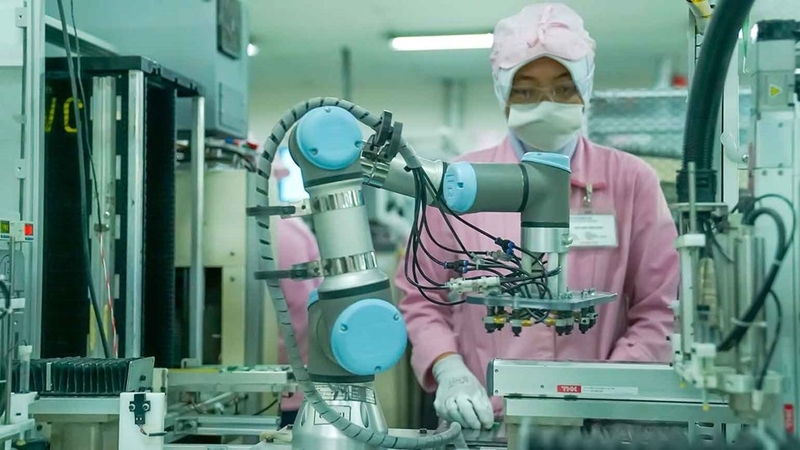
Universal Robots, the global leader in collaborative robots (cobots), on Tuesday announced Asia-Pacific’s first and largest virtual expo of collaborative robots. “WeAreCOBOTS APAC” will be held on October 6-8, from 9am to 5.30pm (GMT+7).

“WeAreCOBOTS APAC” presents an opportunity for practitioners and factory owners in Thailand to meet with automation industry leaders and cobot experts from different countries online.

Participants can attend cobot demonstrations by exhibitors, listen to enriching keynotes from industry experts on overcoming manufacturing challenges in Asia-Pacific, and find actionable answers on cobot applications in the live question-and-answer sessions. Registration is free at https://wearecobots.apac.vfairs.com/.

Experts from Asia-Pacific speaking in the event include Yeong Che Fai, director of DF Automation & Robotics, associate professor in Universiti Teknologi Malaysia, robotics visionary and inventor, and a winner of more than 50 national and international awards. Also appearing will be Amar Burud, senior manager in industrial engineering of Continental Corporation in India.

Topics presented by various experts include:

• Future-Proofing Assembly Processes With Human Robot Collaboration

• Joining the Fast Lane: Using Cobots to Achieve Automotive Manufacturing Excellence

• Continential’s Journey: Enabling Zero Downtime

• Optimising your collaborative robot deployment

For more details of the agenda, visit https://wearecobots.apac.vfairs.com/en/keynote-schedule.

The expo programme also features presentations and “live” demonstrations on cobot maintenance and programming, and many new ways cobots are quickly being deployed to address the Covid-19 crisis, including area-disinfection and the manufacturing of test kits.
SET slides over second Covid-19 wave, delay in US economic stimulus measures #ศาสตร์เกษตรดินปุ๋ย

#ศาสตร์เกษตรดินปุ๋ย : ขอบคุณแหล่งข้อมูล : หนังสือพิมพ์ The Nation.

SET slides over second Covid-19 wave, delay in US economic stimulus measures

EconSep 24. 2020

By The Nation

The Stock Exchange of Thailand (SET) Index fell by 5.70 points, or 0.45 per cent, to 1,258.31 in the morning session today (September 24).

An analyst at Krungsri Securities expected the index to fall to 1,250 points due to uncertainty after a number of countries moved to intensify lockdowns to contain the spread of Covid-19.

“On Wednesday night [September 23], the US Purchasing Managers’ Index dropped to its lowest in two months, while the Dow Jones Index fell more than 525 points due to uncertainty over a delay in the rollout of US economic stimulus measures,” he pointed out.

“The measures are under Congress consideration, while the market expects the rollout to be delayed until the end of the presidential election,” he added.

He recommended investors buy:

> Stocks whose third-quarter performance will improve, such as TU, Asian, Com7, CHG, PTG and PlanB.

> Stocks that benefit from the weakening baht, such as Delta, Hana, KCE and SMT.

The SET Index closed at 1,264.01 yesterday, down 3.62 points, or 0.29 per cent.

Total transactions amounted to Bt50.70 billion, with an index high of 1,272.59 points and a low of 1,260.64.

Uncertainty over economic recovery still affecting baht #ศาสตร์เกษตรดินปุ๋ย

#ศาสตร์เกษตรดินปุ๋ย : ขอบคุณแหล่งข้อมูล : หนังสือพิมพ์ The Nation.

Uncertainty over economic recovery still affecting baht

EconSep 24. 2020

By The Nation

The baht opened at 31.54 per US dollar this morning (September 24), weakening from 31.48 at close yesterday.

The baht this week will likely move between 31.45 and 31.60, said Krungthai market strategist Poon Panichpibool.

He said currency market uncertainty over an economic recovery amid a so-called second Covid-19 wave in Europe and the virus situation in the US are still affecting the baht.

“The market recently reduced investment in dollar-holding assets due to the US Federal Reserve’s gloomy economic recovery forecast, the slowdown in Europe and US service-sector recovery,” he said.

Poon said the European market expects the German IFO Business Climate Index to rise to 93.8 points as the country’s manufacturing sector continues to expand despite the Covid-19 situation.

“Meanwhile, US markets expect the number of initial jobless claims to drop to 850,000,” he said.

“However, if the economic data is worse than expected, the market may turn into a risk-off state, causing the dollar to strengthen further.”

Poon believes the baht will not weaken in line with the strengthening dollar because exporters aim to sell the US currency when the baht weakens below 31.50 per dollar.

Thai banking regulators probe suspicious transactions after global leaks #ศาสตร์เกษตรดินปุ๋ย

#ศาสตร์เกษตรดินปุ๋ย : ขอบคุณแหล่งข้อมูล : หนังสือพิมพ์ The Nation.

Thai banking regulators probe suspicious transactions after global leaks 

EconSep 24. 2020Jaturong Jantarangs, BOT assistant governorJaturong Jantarangs, BOT assistant governor 
By The Nation

The Bank of Thailand (BOT) said it was working with the Anti-Money Laundering Office to prevent money laundering by criminals and terrorists, after four Thai banks were named in global suspicious transaction reports leaked to the media.

The International Consortium of Investigative Journalists (ICIJ) published more than 2,000 leaked suspicious activity reports (SARs) that banks and financial institutions filed with the US Treasury’s Financial Crimes Enforcement Network (FinCen). They covered about US$2 trillion (Bt62.9 trillion) in potentially corrupt transactions. 

Among them were suspicious transactions worth $41 million via Kasikornbank, Bangkok Bank, Krungthai Bank and the Export-Import Bank of Thailand between 2000 to 2017.

Jaturong Jantarangs, BOT assistant governor, said that when financial institutions find suspicious transactions, they must report them to the Anti-Money Laundering Office (AMLO) for investigation.

However, not all suspicious transactions break laws, he added.

Information about the four Thai banks’ involvement in suspicious transactions came from the ICIJ, not from FinCEN, so regulators will have to investigate it first, he said.

Meanwhile Krungthai Bank president Payong Srivanich said his bank had not yet been contacted by regulators about the issue.

“We are ready to cooperate with global government agencies on investigations of the suspicious transactions, and we have long been cooperating with the central bank and AMLO,” he added.

Banking shares have fallen recently due mainly to the slow economic recovery and Covid-19 fallout. Yesterday, Kasikornbank shares fell 2.94 per cent, Bangkok Bank’s fell 1.79 per cent, Siam Commercial Bank’s dropped 0.39 per cent, Krungthai Bank’s fell 1.10 per cent and Krungsri Bank’s dropped 0.51 per cent.

Stocks tumble as Fed stresses need for stimulus #ศาสตร์เกษตรดินปุ๋ย

#ศาสตร์เกษตรดินปุ๋ย : ขอบคุณแหล่งข้อมูล : หนังสือพิมพ์ The Nation.

Stocks tumble as Fed stresses need for stimulus

EconSep 24. 2020

By Syndication Washington Post, Bloomberg · Rita Nazareth, Sarah Ponczek · BUSINESS 

Stocks slumped to an eight-week low amid warnings from Federal Reserve officials on the need for more stimulus to lift the world’s largest economy from a coronavirus-induced recession. The dollar rallied.

The S&P 500 closed near the threshold that many investors consider to be a market correction, while the Nasdaq 100 tumbled more than 3%, led by giants Apple Inc. and Amazon.com Inc. Fed Chairman Jerome Powell reiterated there’s a long way to go for the economic rebound, which will likely require more support. The need for further aid was also stressed by Vice Chairman Richard Clarida, Governor Randal Quarles and regional chiefs Charles Evans, Loretta Mester and Eric Rosengren.

The warnings come days after Congress all but ended its pursuit of a bipartisan spending bill to focus on replacing Ruth Bader Ginsburg on the Supreme Court. It’s another blow to investors who are also watching virus cases tick higher in the U.S. amid a resurgence in infections around the world. Traders are growing cautious about the strength of the economic recovery, with the chances for Congressional stimulus withering ahead of a contentious election battle. The benchmark gauge of U.S. equities is poised for its first monthly slide since March.

“Markets are digesting and grappling with this idea that the growth expectations that investors have might not materialize,” said Lauren Goodwin, economist and multi-asset portfolio strategist at New York Life Investments. “As the fiscal impulse in the U.S. starts to wane, some of these expectations for a slow and steady recovery are shaken.”

On corporate news, Tesla Inc. plunged after its “Battery Day” event fell short of expectations. Nike Inc. rallied on solid earnings, while GoodRx Holdings Inc. — which operates a telemedicine site and platform to track drug prices — surged in its trading debut.

Here are some of the main moves in markets:

Stocks

–The S&P 500 declined 2.4% at 4 p.m. EDT.

–The Stoxx Europe 600 Index rose 0.6%.

–The MSCI Asia Pacific Index fell 0.2%.

Currencies

–The Bloomberg Dollar Spot Index jumped 0.7%.

–The euro fell 0.4% to $1.1659.

–The Japanese yen depreciated 0.4% to 105.40 per dollar.

Bonds

–The yield on 10-year Treasurys was unchanged at 0.67%.

–Germany’s 10-year yield was unchanged at -0.51%.

–Britain’s 10-year yield increased two basis points to 0.218%.

Commodities

–West Texas Intermediate crude fell 0.7% to $39.52 a barrel.

–Gold depreciated 2.1% to $1,859.48 an ounce.

–Silver depreciated 7.3% to $22.62 per ounce.

Exports maintain recovery in August #ศาสตร์เกษตรดินปุ๋ย

#ศาสตร์เกษตรดินปุ๋ย : ขอบคุณแหล่งข้อมูล : หนังสือพิมพ์ The Nation.

Exports maintain recovery in August

EconSep 24. 2020

By The Nation

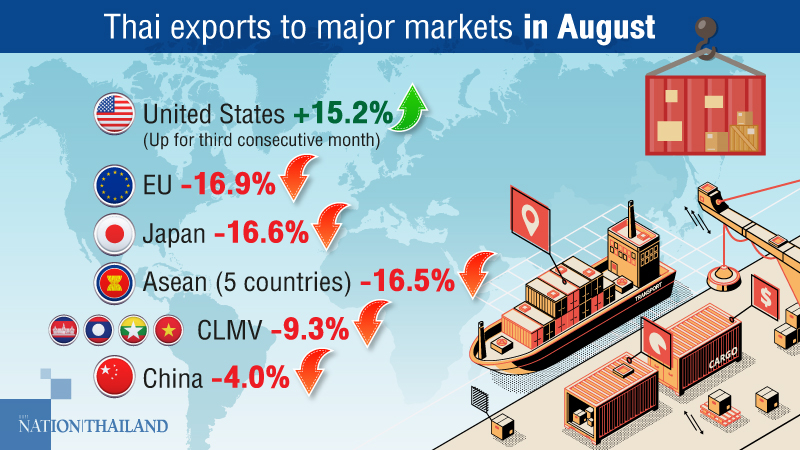
Thai exports fell by a smaller than expected 7.94 per cent to US$20.21 billion in August from a year earlier, the Commerce Ministry said on Wednesday.

Reuters had forecast a drop of 12.05 per cent, after July’s exports fell 11.37 per cent year on year. The August figures signal a recovery after exports hit a low point with a 23.17 per cent drop in June.

Imports in August fell 19.68 per cent for a trade surplus of US$4.34 billion.

From January to August 2020, exports dropped 7.75 per cent from the same period last year while imports fell 15.31 per cent.

The recovery in August was driven by shipments of food, household appliances and Covid-19 protection such as rubber gloves, the global market for which has grown 125.9 per cent in the past nine months.

The Commerce Ministry said trade and investment is beginning to show signs of recovery as some economies relax lockdown measures and pump in more stimulus.

The yearly drop in Thai exports would be limited to 5-8 per cent if exports stayed above $20 billion for the remaining four months of 2020, said Pimchanok Vonkorpon, director-general of Ministry’s Trade Policy and Strategy Office.

KTB in strong financial position, says bank president #ศาสตร์เกษตรดินปุ๋ย

#ศาสตร์เกษตรดินปุ๋ย : ขอบคุณแหล่งข้อมูล : หนังสือพิมพ์ The Nation.

KTB in strong financial position, says bank president

EconSep 24. 2020

By The Nation

Krungthai Bank (KTB)’s financial position remains strong and no capital increase would be necessary, KTB president Payong Srivanich said on Wednesday.

The bank retains healthy capital of 18.72 per cent, of which 14.86 per cent is Tier 1, and is capable of supporting a higher level of non-performing loans (NPLs), he added.

Meanwhile Krungthai’s investment plans this year remain on track, including Bt16 billion-Bt19 billion for IT development. So far, 60 per cent of the bank’s 2020 investment budget had been spent, including on upgrading the Krungthai NEXT app for full-scale digital banking with an open platform for other institutions to connect with.

Krungthai NEXT has logged more than 6 billion transactions since launching two years ago and projects a rise from 9 million to more than 12 million users by the end of 2021. It recorded an 80 per cent increase in users in March and April amid the Covid-19 crisis, resulting in a 60 per cent growth in mobile banking transactions from the same period last year – most of them money transfers of less than Bt1,000.

Meanwhile, Krungthai’s digital personal loan service, which is being tested in the central bank’s sandbox, will bring an alternative borrowing option for customers.

However, Krungthai sees a slowdown in loans in the third quarter amid a sluggish economic recovery. Therefore, banks must first provide assistance to customers with Bank of Thailand aid measures which will expire in October, said Krungthai. The bank is now considering a loan repayment extension plus additional measures to help customers through the crisis.

Pandemic knocks over 14% off value of Social Security Fund #ศาสตร์เกษตรดินปุ๋ย

#ศาสตร์เกษตรดินปุ๋ย : ขอบคุณแหล่งข้อมูล : หนังสือพิมพ์ The Nation.

Pandemic knocks over 14% off value of Social Security Fund

EconSep 24. 2020

By The Nation

The Covid-19 crisis has wiped more than 14 per cent off the value of the Social Security Fund (SSF)’s investment portfolio. The fund plays an important role in the Thai stock market, investing over Bt2 trillion in 69 companies.

However, since July its portfolio has dropped 14.9 per cent to Bt2.19 trillion, according to the fund’s latest financial report on Monday (September 21).

Meanwhile, the SFF is also being criticised by netizens for holding a large stake in Phuket’s Sri Panwa Hotel amid claims it encroaches on forest reserves, and public anger at hotel owner Vorasit Issara for criticising pro-democracy protesters.

On June 30, 68 per cent of the SFF was in government bonds and 12.09 per cent in Thai stocks. The fund has a policy to invest 80 per cent in safe-haven assets and 20 per cent in volatile assets.

The fund realised gains of Bt23 billion in the first half of this year – Bt21 billion from interest, debt instrument sales and asset borrowing fees, and Bt2.7 billion from dividends and equities and investment unit sales.

Of the SSF’s stock investment, 8.08 per cent is in PTT (worth Bt19.1 billion), 7.76 per cent in Siam Cement (Bt18.3 billion), 6.16 per cent in Advanced Info Services (Bt14.5 billion), 5.45 per cent in CP All (Bt12.9 billion) and 5.25 per cent in Airports of Thailand (Bt12.4 billion).

The fund also recently invested Bt5.57 billion in other five companies – Central Retail Corp, Srisawad Corp, CH-Karnchang, Amata Corp and CPN Retail Growth Leasehold REIT.

The SSF focuses on Thai holdings, investing just 3.28 per cent in foreign equities.

Passakorn Linmaneechote, deputy managing director of Kasikorn Securities, explained SSF’s investments had dropped partly because the fund had to sell assets to pay unemployment compensation to people who lost jobs during the pandemic.

It was also driven down because the price of Thai stocks was high compared to foreign stocks, he said.

He considers the fund’s 3 per cent foreign investment level to be low.

“If they want to increase investment in foreign assets, they have to set up a team to manage risks from foreign investment which may take a long time,” he said.

In Malaysia, some funds took five to 10 years to set up a team to monitor foreign investments, he added.

SET slides further after 2nd Europe lockdown, banking scandal, delayed US stimulus #ศาสตร์เกษตรดินปุ๋ย

#ศาสตร์เกษตรดินปุ๋ย : ขอบคุณแหล่งข้อมูล : หนังสือพิมพ์ The Nation.

SET slides further after 2nd Europe lockdown, banking scandal, delayed US stimulus

EconSep 23. 2020

By The Nation

The Stock Exchange of Thailand (SET) Index closed at 1,264.01 on Wednesday, down 3.62 points or 0.29 per cent. Total transactions amounted to Bt50.70 billion with an index high of 1,272.59 and a low of 1,260.64.

In the morning session, an analyst at Krungsri Securities expected the day’s index to fall between 1,260 and 1,270 points amid a second lockdown in European countries, allegations of illicit fund flows at global banks, and the delayed rollout of US economic stimulus, all of which are pressuring the index.

The 10 stocks with the highest trade value today were CPALL, STGT, PTT, KBANK, AOT, SAWAD, MINT, BBL, PTTGC and TASCO.

As of 4.30pm, the price of oil rose by US$0.12 or 0.30 per cent to $39.92 per barrel, while gold dropped by $16.40 or 0.86 per cent, to $1,891.20 per ounce.

Other Asian indices were mixed:

Japan’s Nikkei Index closed at 23,346.49, down 13.81 points or 0.059 per cent.

China’s Shang Hai SE Composite Index closed at 3,279.71, up 5.41 points or 0.17 per cent, while the Shenzhen SE Component Index closed at 13,110.07, up 86.64 points or 0.67 per cent.

Hong Kong’s Hang Seng Index closed at 23,742.51, up 25.66 points or 0.11 per cent.

South Korea’s KOSPI Index closed at 2,333.24, up 0.65 points or 0.028 per cent.

Taiwan’s TAIEX Index closed at 12,583.88, down 61.63 points or 0.49 per cent.

BOT leaves rate unchanged #ศาสตร์เกษตรดินปุ๋ย

#ศาสตร์เกษตรดินปุ๋ย : ขอบคุณแหล่งข้อมูล : หนังสือพิมพ์ The Nation.

BOT leaves rate unchanged

EconSep 23. 2020 MPC secretary Titanun MallikamasMPC secretary Titanun Mallikamas 

By The Nation

The Bank of Thailand (BOT)’s Monetary Policy Committee (MPC) voted unanimously to maintain the policy rate at 0.50 per cent on Wednesday.

The committee assessed that the Thai economy in 2020 would contract 7.8 per cent, slightly less than the 8.1 per cent previous forecast, but would expand in 2021 at a lower rate than previously predicted mainly due to slow recovery of foreign tourist figures, according to MPC secretary Titanun Mallikamas.

The MPC would also monitor risks of a second wave of Covid-19. 

Headline inflation this year would be lower than previously predicted and would rise gradually in 2021, it said. However, it added that financial stability was more vulnerable given the economic outlook. 

The committee viewed that the extra accommodative monetary policy since the beginning of the year and additional fiscal, financial, and credit measures had helped alleviate adverse impacts. They would also support economic recovery after the pandemic subsided, facilitate the return of inflation to the target, and reduce financial stability risks. The committee thus voted to maintain the policy rate.

It also viewed that financial institutions should speed up debt restructuring for households and businesses to have a more meaningful impact.

Domestic demand, both private consumption and private investment, were expected to improve somewhat while the labour market remained fragile. 

The MPC saw employment and household incomes as still weak and in need of time to recover, which would result in falling ability to service household debt, which would affect private consumption in the period ahead. 

Overall economic activities would take at least two years before recovering to the pre-pandemic level, though the recovery would vary significantly among economic sectors and firms in different segments. 

The committee agreed the financial system remained sound despite increasing vulnerabilities given the economic outlook. Commercial banks had robust capital fund and loan loss provision levels. 

The MPC would monitor developments in economic growth, inflation, and financial stability, together with associated risks, including external risks, the impacts of the Covid-19 pandemic, and the effectiveness of the fiscal, financial, and credit measures, in deliberating monetary policy going forward. Additional appropriate monetary policy tools would be used if necessary, it said.