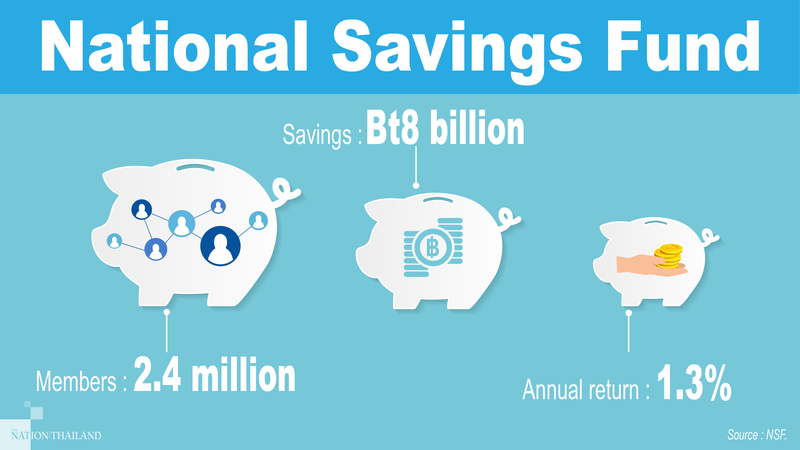
Membership of the National Savings Fund (NSF) has dropped by 500,000 to 2.4 million during the Covid-19 crisis, as people have been unable to maintain their annual contributions, said its secretary-general Jaruluk Ruangsuwan.
.The NSF is designed to take care of workers who are not protected by the Social Security fund.
This year, encouraging workers in the informal sector to join the fund to save for retirement had been extremely difficult, she said.
“On a positive note, about 30 per cent of members increased their contributions out of the targeted 50 per cent, she added.
Combined savings of the 2.4 million current members amount to Bt8 billion. They save a combined Bt100 million per month at an annual rate of 1.3 per cent, compared to the 0.5 per cent on bank savings.
The NSF on Tuesday signed an agreement with the Office of SMEs Promotion (OSMEP) to encourage 79,000 small-business workers not covered by the Social Security fund to join the pension fund.
The first 3,000 new members who contribute the maximum Bt13,200 a year would be handed the chance to win Bt1 million in a lottery, she said.
The NSF’s minimum contribution is Bt50 per year.
For those aged 15-30, the government tops up their contributions by 50 per cent to a maximum Bt600 per year. Those aged over 30-50 receive 80 per cent up to a maximum Bt960, while people aged 50-60 get 100 per cent up to a maximum Bt1,200 a year.
Members of the fund include farmers, taxi drivers, the self-employed, small-shop owners and professionals.
Govt earmarks Bt140bn from 2021 budget for Covid relief
EconSep 09. 2020Budget Bureau director Dechapiwat na Songkhla
By The Nation
The government has earmarked a total of Bt140 billion from the 2021 central budget to combat the impacts of Covid-19, said Budget Bureau director Dechapiwat na Songkhla.
He added that the amount covered both necessary spending and emergency cases.
Of the total, Bt99 billion is allocated for spending under the prime minister’s authority.
The entire Bt140-billion budget allocation will be spent on measures to relieve impacts of the outbreak, in addition to existing stimulus packages funded by the Bt1.1 trillion being borrowed by the government.
He added that the Bt140 billion is considered sufficient to mitigate the impacts of a possible second wave of the outbreak.
By The Washington Post · Abha Bhattarai · BUSINESS
The nation’s bricks-and-mortar retailers were undergoing a reckoning years before the pandemic led to shutdowns and a tanking economy, tipping more than a dozen major retailers into bankruptcy and prompting many others to thin their ranks.
The result: Thousands of liquidation sales, at a time when many Americans are wary of in-store shopping or spending.
Firms that specialize in winding down stores say liquidating now is markedly different from what it was before the pandemic. Companies are offering deeper discounts to win over consumers – with sales starting at 40 percent off instead of the usual 20 percent – as well as other incentives. Even then, results can be spotty: Proceeds from liquidation sales have fallen about 25 percent since the novel coronavirus took hold, according to Jim Schaye, chief executive of retail liquidation firm Eaton Hudson.
“It’s like throwing a party and having nobody come,” he said. “People are just not running out to a J.C. Penney liquidation or a Lord & Taylor liquidation like they would have in the past. Even at 60 percent off, they’re saying: ‘So what? I don’t need it so I’m not going to buy it.'”
The Gap last week announced that it would shut 200 locations, while Ascena Retail Group – the parent company of Ann Taylor, Lane Bryant and Justice – is closing nearly 1,600 stores while in bankruptcy proceedings. Department store chain Lord & Taylor is liquidating all of its stores, as are Pier 1 Imports, Modell’s, Stage Stores and New York & Co. Overall, retailers are expected to close a record 25,000 stores this year, according to Coresight Reserarch.
The typical liquidation sale, which used to last about nine weeks, now takes about 30 percent longer, according to Michael McGrail, chief operating officer of Tiger Group, which is among the firms managing closeout sales for J.C. Penney, New York & Co. and Modell’s. There are some variations, though, based on the type of product being sold: Sporting goods, furniture and housewares tend to sell quickly, though clothing, shoes and jewelry have become more difficult to offload during the pandemic.
“For certain things, the customer does return,” he said. “Do they come back at 100 percent? No. But [the virus] isn’t enough to wipe out consumerism.”
But it has been enough to complicate matters. Millions of Americans remain out of work, and even those with jobs say they’re cutting back on discretionary items. Sales at clothing stores have declined 37 percent from a year ago, while sales of electronics, appliances, furniture and home goods have all dropped by double digits, according to the latest retail sales figures from the Commerce Department.
As a result, liquidation firms say they’ve changed the way deals are structured. Instead of paying retailers for their inventory upfront, as has long been the norm, they have shifted to a fee-based model where the retailer gets a portion of the proceeds after the sale is complete. The pandemic also has forced them to take on new tasks, such as ordering protective equipment for workers, and hiring and training workers to staff stores.
Many workers are hesitant to come back to work temporarily – especially if they’re already furloughed and collecting unemployment benefits – while others are dropping out of the workforce because of health and safety concerns, said Ian Fredericks, executive vice president of the retail group at Hilco Merchant Resources. The company has recruited and trained hundreds of workers to fill in during pandemic liquidations, he said.
“It’s not something we’ve typically done, but we’re doing it more and more now because there just isn’t enough store staff to help customers during the day,” he said. “When one project is over, we can usually send them to another project in the same area.”
Specialty apparel, like men’s suits, has been particularly difficult to sell, even at half price, he said. There have been other challenges, too: “People aren’t necessarily walking around, looking to browse,” Fredericks said. “If they are going to the mall, it’s because they have [a] specific need in mind – and specialty apparel just isn’t it.”
And although Americans are doing more of their shopping online, liquidation sales haven’t quite followed. Many of the retailers shutting down have antiquated websites that can’t handle major sales or buy-online, pick-up-in-store options, McGrail said. Or, if a retailer does have a booming online presence, it often doesn’t want to tarnish its reputation – or a chance at finding a buyer for its e-commerce operations – by offering deep discounts online.
“There is so much uncertainty: You could start a liquidation, and suddenly the mall closes down or there’s another shutdown,” Schaye said. “It’s a constant struggle, so we’re just limping along.”
Employees at a Catherines store in Parkersburg, W.Va., were notified in late July that parent company Ascena had filed for bankruptcy and was shutting down the apparel chain. They immediately began marking down inventory – 40 percent off at first, then as much as 95 percent off. Jeans that originally cost $60 were discounted to $3; pantyhose fell from $17 to 79 cents.
But selling off a store mid-pandemic comes with other considerations: Only five shoppers were allowed in at a time, and employees were required to wipe down registers after each transaction. Fitting rooms were off-limits – which prompted some shoppers to try on tops and pants on the sales floor, according to Lyndsey Fought, 35, who worked part time at the store until it closed in late August.
“To be honest, we just wanted to get it over with,” she said. “We were dealing with the sadness of losing our jobs after having been furloughed 2½ months. And then to be closing down the store? It wasn’t the greatest feeling.”
By Syndication Washington Post, Bloomberg · Alex Longley, Firat Kayakiran · BUSINESS An oil trade that works only when the market is glutted may be about to make a comeback. That’s bad news for producers withholding near-record amounts of crude in a coordinated bid to help prop up prices.
The global Brent crude benchmark is currently trading quite deeply in a bearish pattern known contango, where the most immediate prices are far below those for contracts for supply in later months. The discount has gotten so big that it appears to cover the nominal cost of hiring 1,200-feet long supertankers. In other words: traders can buy cargoes now, stash them on ships, and sell them later at a profit.
Such a development would be viewed with concern by the likes of Saudi Arabia and Russia, the two nations who led the deepest global oil production cuts in history. In recent months, they have been carefully trying to boost supply to bring it slowly back toward normal. The contango implies that the market is so oversupplied that one of the industry’s most expensive forms of storage is becoming a viable way to hoard barrels — on paper at least.
While the oil market has recovered since the depths of the pandemic in April, there has been renewed weakness in recent weeks. With the recovery in global consumption stalling at about 90% of prior year levels and OPEC+ slowly adding supply back to the market, there has been little incentive for refiners to ramp up their consumption of crude, potentially forcing it toward more unconventional storage methods.
To be sure, part of the reason that storage works on paper is because charter rates for tankers have crashed. Several tanker industry officials and shipbrokers said that, in practice, owners are still reluctant to accept multi-month charters at current levels because that locks in low revenue and it’s not ideal to keep the vessels in a single location for long periods of time. They do acknowledge, though, that there have been increased inquiries about storing in recent days.
Nevertheless, the numbers appear to work, according to storage-cost estimates from E.A. Gibson Shipbrokers Ltd. and exchange data compiled by Bloomberg earlier this week.
If floating storage does materialize, it could offer some relief to the tanker owners after rates plunged, according to analysts at Clarksons Securities Ltd. and Pareto Securities AS.
In recent weeks, some tankers that were booked during a super contango earlier this year for storage stopped doing so as those charters expired. The deepening contango may reverse that, or at least encourage some owners to extend existing contracts to store.
“We see some renewed interest in storage work as the contango has widened and spot rates remain low,” said Pareto analysts Eirik Haavaldsen and August Klemp.
Phuket hotels ‘need immediate help to survive upcoming high season’
EconSep 08. 2020Anthony Lark, President of the Phuket Hotels Association that represents 78 hotels in Phuket
By The Nation
Phuket’s hotel industry is reaching breaking point and the government needs to step in and offer serious economic support to help it survive the upcoming high season, industry leaders said.
Despite plans to reopen the island to international travellers under the “Phuket Model”, reality is biting back as hotels are unable to sustain operating viability based on domestic tourism.
According to the Airports of Thailand (AOT), arrivals have dropped 65 per cent year on year in the first seven months of this year.
What is clear is that the 86,000 rooms in Phuket’s registered accommodation establishments cannot realistically break-even or even be cash-flow positive with only domestic demand. This realistically could set the scene for 50,000 job losses in the hotel sector this year if there’s no support forth coming or international visitors are not allowed in.
One of the green shoots is the government’s Alternative Local State Quarantine (ALSQ) programme, for which more than 60 properties have applied. While this scheme is meant to emulate the ASQ programme in Bangkok, it will not help unless the government ensures the return of international travellers. Though this may take months to materialise.
Anthony Lark, president of the 78-property strong Phuket Hotels Association, said: “The math simply doesn’t work with single-digit occupancies being reported. No amount of induced local demand can prevent the continued loss of jobs and rapidly eroding financial crisis for owners and operators. We strongly advocate a safe, pragmatic, and strategic reopening for foreign travellers.”
Data recently released by hospitality consulting group C9 Hotelworks also showed that 69 per cent of hotel development plans in the pipeline have been delayed or put on hold.
As of the end of 2019, there were 1,758 licensed accommodation establishments on the island, while today incoming projects stand at 58 hotels or just a 19 per cent increase in supply with 16,476 additional rooms planned.
“Thailand’s failure to relaunch overseas tourism creates a dangerously perilous scenario for Phuket’s hospitality industry,” said C9 Hotelworks managing director Bill Barnett.
“The domino financial impact is not only on hotels and the expanded tourism sector, but it suffocates the development pipeline. This will negatively trigger the erosion of jobs in construction, real estate, retail and ultimately be manifested in consumer credit defaults. The situation is bad, and likely to get worse, as operating hotels remain incur losses day in and day out.”
While a stark warning was issued last week by the Bank of Thailand (BOT) over the potential disruption to the tourism-dependent country, Phuket faces an even bigger challenge in the upcoming high season.
“Any reopening plan must not only be well planned but has to win the hearts and minds of the Thai people to see any chance of success. While the island may hold the keys to the Kingdom in leading a restoration of tourism, the more critical issue is how hotels can fight for their lives in the current state of limbo,” Barnett said.
“Firstly, greater proactive dialogue between the public and private sector has to be undertaken. We can’t simply say we are now in unknown territory forever. Steps must be taken and a single voice formed,” Lark added.
“Secondly, the central has to look at interim measures to assist hotels with short-term operating bridge loans to weather the storm and retain jobs. Tourism is a human endeavour and without protecting and nurturing our Thai workforce there will be no recovery.”
Thailand’s exports in July this year dropped 11.37 per cent year on year to US$18.82 billion, while imports plunged 26.38 per cent year on year to $15.48 billion, the Thai National Shippers’ Council chairperson Ghanyapad Tantipipatpong said.
Exports in the first seven months of this year dipped 7.72 per cent year on year to $133.16 billion, while imports contracted 14.69 per cent year on year to $119.118 billion.
The council has maintained its export forecast of minus 10 per cent this year on the assumption that the baht’s exchange rate will remain at around Bt31.5 per US dollar.
Krungsri’s subsidiary in Cambodia gets regulatory nod for commercial banking
Sep 08. 2020
By THE NATION
Hattha Kaksekar Limited, a microfinance institution in Cambodia wholly-owned by Krungsri, has been given regulatory approvals to become a commercial bank under the name Hattha Bank Plc.
Krungsri (Bank of Ayudhya Pcl), a member of Mitsubishi UFJ Financial Group (MUFG), said the development marks another key milestone in Krungsri’s journey to pursue regional business expansion and capture growth opportunities in CLMV (Cambodia, Laos, Myanmar, Vietnam) countries by leveraging local expertise and physical presence together with its established business platform and extensive networks.
Krungsri president and chief executive officer Seiichiro Akita said: “We are pleased to announce that, after successfully obtaining all regulatory approvals, Hattha Kaksekar Limited has now become Hattha Bank Plc. With the new status, Hattha Bank is eligible to deliver most excellent financial products and services to better meet diverse demands of clients in Cambodia through its financial innovation and inclusion.”
He said Krungsri will continue to support Hattha Bank through sharing best banking practices, marketing expertise, product development, sales channel enhancement and risk management.
“We believe that, through the synergy of Krungsri’s distinctive financial expertise and Hattha Bank’s local business know-how and experience, Hattha Bank will play an important role in driving the Cambodian economy towards a sustainable growth path,” Akita added.
Hattha Bank Plc (formerly Hattha Kaksekar Ltd) has been providing financial services to people in Cambodia for over 26 years. It became a part of Krungsri Group family after being acquired in 2016.
State-run banks are speeding up the restructuring of debt for clients participating in the debt-moratorium schemes to reduce the chance of rising non-performing loans (NPLs) in their system.
Apirom Sukprasert, president for the Bank for Agriculture and Agricultural Cooperatives, said his bank has restructured debt for some borrowers, most of whom are farmers and small and medium enterprises (SMEs).
Of the total borrowers in the debt-moratorium programme, 260,000 are SMEs in the agricultural sector with a total debt of Bt81 billion. Their debt suspension term was extended from the end of this month to the end of December.
The bank’s NPL is 4.03 per cent of its outstanding loan of Bt1.5 trillion.
Vithai Ratanakorn, president of Government Savings Bank (GSB), said the bank will restructure the debt of clients participating in the debt-moratorium scheme in the last quarter of the year now that the moratorium period has been extended to year end.
He added that some of these clients are still feeling the pinch from the Covid-19 outbreak and may become NPLs early next year. Hence, he said, the bank will call them in to discuss debt restructuring in the fourth quarter.
By Syndication Washington Post, Bloomberg Opinion · Brian Chappatta · BUSINESS Stock market cheerleaders are finally putting the never-ending rally in share prices into terms that bond investors can understand.
More and more, investors and analysts are justifying the records in the S&P 500 Index and the technology-focused Nasdaq 100 in the context of interest rates, which is ordinarily the domain of bond traders. Strategists at Bank of America Corp. attributed about 16% of the outperformance in technology stocks in recent years to falling bond yields; that’s a record high and more than twice the level observed before the 2008 financial crisis. The earnings yields on the S&P 500 and Nasdaq 100, which measure profit relative to share price, might be at the lowest levels since the early 2000s, but they’re still 296 basis points and 184 basis points more than the benchmark 10-year Treasury yield, respectively.
Even trailing 12-month dividend yields look compelling: 1.69% on the S&P 500 and 0.71% on the Nasdaq 100, compared with 0.65% for the 10-year Treasury note. And those rates aren’t skewed by a few companies: About 78% of individual stocks in the S&P 500 have a dividend yield that exceeds the 10-year U.S. yield, an all-time high and compared with an average of 25% in the past two decades, according to Russ Certo at Brean Capital.
All of this is to say: In many ways, it’s still possible to claim that stocks are cheap. But only if you believe the Federal Reserve will keep tight control over the yield curve.
On Aug. 6, the 10-year Treasury yield fell to as low as 0.5%. Three weeks later, the yield touched 0.79% – still low by any historical measure, but suddenly higher than the dividend yield on the Nasdaq 100 by the most since before the coronavirus pandemic took hold in America. The only other time this relationship reversed was in early June, when 10-year Treasury yields were heading toward 1%. After that, stocks swiftly sold off and yields fell back in line.
That precedent was enough to make JPMorgan Chase & Co. strategists nervous. “With the long end of the curve already threatening a confluence of threshold signals for yields to break higher, continued price weakness has the potential to trigger another flow of momentum based selling pressure,” said Peng Cheng, a JPMorgan global quantitative and derivatives strategist. Bloomberg News’s Ven Ram wrote this week that “Treasury Yields Will Become a Headache for Stocks Around 1%.”
This time around, however, U.S. yields tumbled back into their range while the stock-market rally pushed forward unperturbed. What happened?
The Fed tipped its hand.
For evidence, look no further than the move in 10-year Treasurys on Sept. 1, from a yield of 0.73% at 10:30 a.m. in New York to 0.67% by 3 p.m. There was no bad economic news; in fact, Institute for Supply Management data showed U.S. manufacturing expanded in August at the fastest pace since late 2018. It was hardly a risk-off day, either, with the S&P 500 advancing by 0.75% and a Bloomberg Barclays index of high-yield bonds gaining for the eighth consecutive session.
Instead, it all boiled down to the central bank. First, the Fed bought $1.73 billion of 20- to 30-year Treasury bonds in its daily purchase operation, immediately driving down longer-term yields. Then, Fed Governor Lael Brainard discussed the central bank’s new policy statement, following speeches from Chair Jerome Powell and Vice Chair Richard Clarida.
“In coming months, it will be important for monetary policy to pivot from stabilization to accommodation,” Brainard said. “While the Committee did not anticipate the unprecedented challenge of the Covid-19 pandemic when the review was launched, the new statement puts us in a stronger position to support a full and timely recovery.”
Most obviously, this is a nod toward a form of explicit forward guidance that ties future interest-rate increases to actual inflation that exceeds the central bank’s 2% target. But it could also be seen as foreshadowing a more tactical round of quantitative easing, perhaps in the same mold as Operation Twist in 2011. The Fed’s official line on the program at the time, after all, was that it should “put downward pressure on longer-term interest rates and help make broader financial conditions more accommodative.”
One of the last remaining points of intrigue among Fed watchers is how officials would react to rising long-term Treasury yields. In general, I tend to think central bankers would tolerate a modestly steeper yield curve if it was happening for the “right reasons,” like a pickup in inflation or signs of a more robust economic recovery. It would certainly be a lifeline for the banking industry. But, as my Bloomberg Opinion colleague Tim Duy has said, Powell and his colleagues have also been begging Congress for additional fiscal stimulus to support the economy, and rock-bottom borrowing costs make that an easier sell on Capitol Hill. Then again, if low Treasury yields are pushing the stock market to record highs, which in turn dials back lawmakers’ urgency to pass a new round of relief, which harms the economic recovery, then that brings everything back to square one. And around and around it goes.
An alternative way to measure the appeal of equities relative to bonds is looking at how the two markets treat the same company, which incorporates credit risk into the equation. Consider one poster child for an overpriced tech titan: Apple Inc. Even though its share price has more than doubled in the past six months, it doesn’t look wildly overvalued in a fixed-income context. The iPhone maker issued five-year securities last month that pay a 0.55% interest rate. That’s far below its current earnings yield of 2.45%, and somehow even less than its dividend yield of 0.6%.
Now, it’s not quite such a simple calculation. While Apple will pay its bondholders their initial investment upon maturity, its shares offer no such promise. In theory, the company could stumble and leave investors saddled with a steep loss. A bond’s yield is a guaranteed nominal return if the security is held to maturity (defaults notwithstanding). A stock’s earnings yield is just the inverse of the price-to-earnings ratio. Dividends can also rise or fall in a hurry – globally, payouts dropped in the second quarter by the most since 2009.
Regardless, the stock market appears to be all-in on the Fed keeping the long end of the U.S. yield curve in check. This week’s moves “can be chalked up to the market’s faith that the Fed will not hesitate to offer additional accommodation in aggressive fashion,” BMO Capital Markets strategists Ian Lyngen, Jon Hill and Ben Jeffery wrote. “There is limited scope for risk assets to fall in the very near term.”
In other words, it all comes down to yields. And from that vantage point, even after this unprecedented run, stocks still offer better value than bonds. For better or worse, that doesn’t seem likely to change until the Fed says so.
– – –
Chappatta is a Bloomberg Opinion columnist covering debt markets. He previously covered bonds for Bloomberg News. He is also a CFA charterholder.
The Bank of Thailand (BOT) said some 85 per cent of retail debtors struggling in the fallout of Covid-19 have applied for the second-phase of debt relief, while Kasikornbank projects 60 to 70 per cent of debtors will be able to start repaying their debts once the subsidy wraps up.
Ronadol Numnonda, BOT deputy governor, said many businesses have been hit hard by the Covid-19 outbreak, especially tourism-related services such as hotels, airlines and car-rent companies, which are unlikely to rebuild any time soon as the arrival of 40 million tourists is a thing of the past.
He said that there is an oversupply in tourism-related industries, adding that the government and private sector need to find solutions to support and remodel these businesses and restructure their debts.
Financial institutions, namely commercial banks as well as specialised and non-banking financial institutions, have implemented several rescue packages for their debtors.
As of the end of July, up to Bt7.2 trillion has been spent on providing financial relief to 12.52 million borrowers. Of this, Bt4.25 trillion was provided by commercial banks and non-banking entities to ease the burden for 6.12 million borrowers.
Financial relief includes debt moratorium, debt restructuring, interest rate cuts, refinancing and new soft loans.
State-run banks, meanwhile, provided support to 6.41 million borrowers holding debts worth a total of Bt2.94 trillion.
As of July 15, more corporate clients applied for financial relief, up about 0.15 per cent from the previous period, while 0.7 per cent fewer small businesses sought help.
Support worth Bt1.63 trillion was provided to 5.74 million retail debtors, marking a slight drop from applicants in the first phase.
Now that banks and non-banking institutions are also offering financial support in the second phase, 85 per cent of old debtors and 15 per cent of new ones have applied for help.
Most of the retail debtors who received support in the first phase and were able to start servicing their debt again were engaged in hire-purchase schemes, he said.
Surat Leelataviwat, vice executive president at Kasikornbank, said the bank has helped 98,000 corporate clients whose loans are worth Bt600 billion. The second phase of financial support will run until the end of October, and Kasikornbank estimates that 60 to 70 per cent of these borrowers will resume their debt repayment.
However, borrowers in the hotel and tour businesses will continue to need help as the industry has yet to return to normal.
Kasikornbank has provided debt relief to 600,000 retail borrowers whose debt totals Bt190 billion. It expects some 70 per cent of them to be able to resume payments.
Pikul Srimahan, senior vice president at Siam Commercial Bank, said the bank has provided support worth Bt800 billion, or 39 per cent of its total loans. This support includes debt moratorium, debt rescheduling and soft loans with 2 per cent per annum interest rate.
Kitiya Srisanit, chief of Krungsri Bank’s Krungsri Auto Group, said many businesses are gradually recovering from the Covid-19 fallout, adding that the bank has restructured or suspended the debts of 650,000 borrowers.
Meanwhile, 4.2 million consumer loan account holders participated in the first-phase of the debt-relief scheme and as of July 1, 10,000 applied for additional support.
Separately, Krung Thai Bank has provided support to 200,000 clients so far, and believes another 2,500 corporate clients with a combined debt worth Bt150 billion may seek financial relief in the second phase.

 Budget Bureau director Dechapiwat na Songkhla
 File photo
 Oil tank/ File photo
 Anthony Lark, President of the Phuket Hotels Association that represents 78 hotels in Phuket




 Ronadol Numnonda, BOT deputy governor

