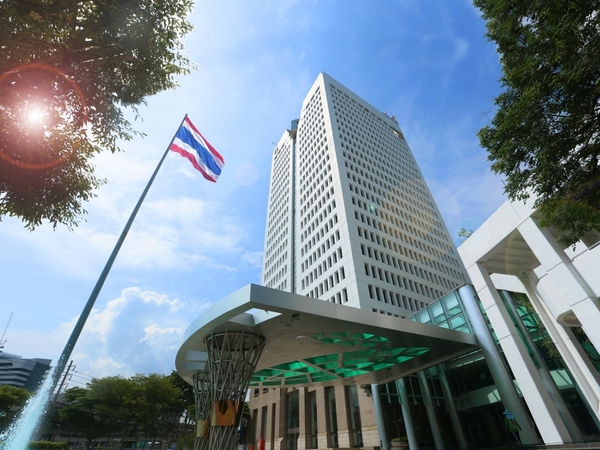
Don Mueang Airport is expected to see 13.6 million passengers this year, falling short of the targeted 15 million, said the airport’s general manager Sumpun Kutranon.
The airport catered to more than 41 million passengers per year before the Covid-19 pandemic.
Passenger numbers at the airport gradually recovered as the lockdown was eased, said Sumpun. The airport currently serves 220 flights and 45, 000 passengers daily.
That compares with 700 flights and 120,000 passengers before the outbreak.
The airport is ready to serve foreign passengers when the government implements the travel bubble policy, he added.
The Cabinet on Tuesday (September 1) approved the Transport Ministry’s proposal for the State Railways of Thailand (SRT) to take a Bt11.5 billion loan for operations in the 2021 fiscal year as well a short-term loan of Bt800 million.
The loans aim to boost SRT’s liquidity, especially since the agency expects to suffer a shortage of cash in the next fiscal year.
The loans will be sought and guaranteed by the Finance Ministry, while SRT will be responsible for the repayment of the principle and interest.
‘Phuket model’, job creation on agenda for Prayut’s economic team today
EconSep 02. 2020Deputy Prime Minister and Energy Minister Supattanapong Punmeechaow
By The Nation
More economic stimulus measures are expected today as ministers and experts in the Covid-19 economic management team discuss a job creation scheme for new graduates and packages to bring in foreign tourists.
Chaired by PM Prayut Chan-o-cha, the meeting will discuss proposals to boost the economy in the rest of the year, Deputy Prime Minister and Energy Minister Supattanapong Punmeechaow said on Tuesday.
Most of new measures would be short-term, he said.
The team will also address the employment situation and discuss a plan to hand financial support for companies that hire new graduates, he said. Previous tourism measures would be reassessed, he added, promising details would be revealed after the meeting.
Government spokesman Anucha Burapachaisri said ministries have submitted their proposals to the team, while PM Prayut wants to strike a balance between economic activities and virus control. The government is worried that workers in neighbouring countries experiencing a surge in new cases may illegally enter Thailand, he added.
Tourism and Sports Minister Pipat Ratchakijprakan said his ministry and the National Economic and Social Development Council will offer a joint proposal on how to bring in more foreign tourists. The Cabinet recently approved a proposal to bring in 200 long-stay tourists from Australia and New Zealand next month to pilot the so-called Phuket model on the southern island. The tourists will be checked for Covid-19 before they depart and again when they arrive in Thailand. If they test negative again after a mandatory 14-day quarantine in their hotel rooms, they will be able to travel in Phuket province. After 21 days in Phuket province, they will be permitted to travel further afield on 90-day visas that can be extended by 180 days.
Authorities will watch how local communities react to the tourists before deciding whether to allow more in, said the minister.
Subsequent groups may be not be required to stay in their rooms but instead be able to walk around hotel areas for four to seven days before travelling outside.
Pipat insisted reopening for foreign tourists was essential for the economy, adding that he failed to understand why medics oppose the move but supported bringing in migrant labourers. He said foreign labourers from neighbouring countries such as Myanmar, where cases have surged, were a bigger worry since they could not be checked if they entered Thailand illegally.
The Stock Exchange of Thailand (SET) should begin to gradually recover this month after securities companies cut their forecasts of listed companies’ profit for this year and next year, according to Asia Plus Securities’ executive vice president Therdsak Thaveeteeratham.
He explained that listed companies’ second-quarter performance was Bt117 billion, down 46 per cent year on year, the lowest in 13 years.
“Therefore, the securities company has cut listed companies’ profit forecast this year from Bt64 to Bt56.65 per share, the lowest in 11 years,” he said.
“We hope this is the last time we cut the forecast because profits are expected to recover by 28 per cent next year on the base profit of Bt76.7 per share, resulting in a rise in the SET Index.”
He expected foreign investors’ cash to flow into the SET despite pressure from domestic politics and imported Covid-19 cases.
“Currently, mass sell-offs of Thai stocks by foreign investors are lower than in previous months, while they only hold 26.13 per cent of Thai shares,” he said.
He forecast the index would move between support and resistance lines of 1,300 points and 1,335 points, respectively.
“We do not expect the index to fall below 1,270 points, because of the SET’s uptick rule, while the domestic political situation will pull down the index by only 4 per cent,” he said.
“But if the index does rise over the current resistance line at 1,335 points, the next resistance is 1,385 points.”
He forecast the SET Index will rise from deposits, which at Bt15.52 trillion are currently higher than the index’s market capitalisation of over Bt14 trillion.
“According to historical statistics, when deposits are higher than capitalisation, cash flows into the market to boost index recovery.”
“In the long term, the index will move to 1,450 points due to the high earning yield gap of 5 per cent, based on the index at 1,320 points. If the interest rate is below 0.5 per cent, the index will move to 1,500 points,” he predicted.
Comparing the Covid-19 crisis to the 2008 global financial crisis, he said the difference between the two is there is still cash in the system this time.
“If investors realise where the low point is, they will invest more and the index will rise sharply,” he added.
The Business Sentiment Index (BSI) rose for a fourth consecutive month in August thanks to improved sentiment in the manufacturing sector.
The BSI rose almost 3 points, from 42.9 in July to 45.7 in August.
However, although the index signalled ongoing recovery, it was still below the threshold, according to the Bank of Thailand (BOT).
Meanwhile the 3-month expected BSI rose again to 50.9, above the 50-threshold for the first time since the Covid-19 crisis began, implying that future business confidence has improved.
The BSI rise in August was mainly due to stronger confidence from manufacturing, especially in the machinery and automotive sectors following recent launches of new car models. The index for the non-manufacturing sector remained relatively stable.
While the hotel and restaurant sector benefited somewhat from the government’s tourism stimulus package, August’s index for the logistics sector fell after a sharp improvement last month.
The 3-month expected BSI rose from 48.6 to above the 50-threshold, reflecting confidence that business conditions are improving. The 3-month index was driven up by growth in both the manufacturing and non-manufacturing sectors and from almost all components, especially production and total order books.
Specifically, indices for the food & beverage and automotive sectors were above the threshold for three consecutive months. Moreover, indices for the electric appliance and electronic sectors significantly rose this month. These implied that
confidence of respondents in the manufacturing sector is recovering relatively well, the BOT said. For the non-manufacturing sector, the index increased in all businesses except for construction, whose index dropped for the second consecutive month because of lower construction volume given fewer property projects launched.
The Stock Exchange of Thailand (SET) Index closed at 1,305.57 today (September 1), down 5.09 points or 0.39 per cent. Total transactions amounted to Bt48.635 billion with an index high of 1,316.68 and a low of 1,301.014.
The index fell into negative territory following news that Finance Minister Predee Daochai had tendered his resignation less than a month after taking the post, citing health problems.
In the morning session, an analyst at Krungsri Securities expected the index to drop to between 1,300 and 1,305 due to lack of positive sentiments to boost investment.
“Also, the index would be under pressure from the slump in the US Dow Jones Index, which fell sharply by 224 points after China implemented new rules on technology exports,” the analyst said.
“This negative sentiment caused [China’s] ByteDance to request approval from [Beijing] before selling its TikTok business to the US, resulting in mass sell-offs in stocks which had aimed to buy the TikTok business, such as Microsoft, Walmart and Oracle.”
The analyst added that foreign investors’ mass sell-off of Thai shares also pressured the index.
The 10 stocks with the highest trade value today were CPF, BAM, KBANK, CPALL, MINT, SCC, PTT, BBL, ICHI and AOT.
As of 4.30pm, the price of oil rose by US$0.45 or 1.06 per cent to $43.06 per barrel, while gold rose by $16.50 or 0.83 per cent, to $1,995.10 per ounce.
Other Asian indices were mixed:
Japan’s Nikkei Index closed at 23,138.07, down 1.69 points or 0.0073 per cent.
China’s Shang Hai SE Composite Index closed at 3,410.61, up 14.93 points or 0.44 per cent, while the Shenzhen SE Component Index closed at 13,849.66, up 91.43 points or 0.66 per cent.
Hong Kong’s Hang Seng Index closed at 25,184.85, up 7.80 points or 0.031 per cent.
South Korea’s KOSPI Index closed at 2,349.55, up 23.38 points or 1.01 per cent.
Taiwan’s TAIEX Index closed at 12,703.28, up 111.83 points or 0.89 per cent.
The threat of a second-wave of Covid-19 infections may delay economic recovery despite latest indicators showing signs of improvement, the central bank said.
Though the economy was better than expected in June and July, it is too early to predict that it will do better than the estimated 8.1 per cent contraction, due of the threat of a second-wave of infections, said Don Nakornthab, senior director of the Bank of Thailand.
There has been a recent spike in new cases in several Asean countries, while Thailand is imposing more restrictions on border crossings.
Tourist arrivals is expected to be lower than the 8 million initially forecast for this year, he said, pointing out that there have been only 6.7 million arrivals this year. Recovery of the tourism sector is expected to be delayed until next year. The central bank believes there will be 16 million tourists next year, though the Tourism and Sports Ministry has only predicted 12 million.
He said the best way to deal with this downturn is for the government and the public to learn how to live with Covid-19. He said Thailand should open to tourists and business activity should resume if there are no more than 20 new cases in the country.
Economic indicators in July showed continued recovery from June, while public and state enterprise spending expanded 50 per cent and 17.2 per cent respectively.
Meanwhile, consumer spending only contracted by 0.1 per cent in July, far better than the 4.5 contraction in June. Exports also did slightly better, dropping 11.9 per cent compared to the 24.6 per cent fall in June.
However, private investment dropped further to 12.8 per cent in July compared to the 10.2 per cent drop in the previous month. Thailand’s manufacturing sector has gone beyond its capacity, especially in terms of machinery and parts.
The labour market, meanwhile, remains fragile and has shown few signs of improvement. So far, 27 per cent of workers who have lost their jobs have put in for unemployment benefits with the social security system.
Don said that though there is a large number of people who are still employed, their income has dropped drastically and measures should be put in place to look after them.
Meanwhile, the country’s economic stability is solid. The country’s current account deficit worth US$247 million in June turned into a $1.8-billion surplus in July thanks to the export of gold. If gold exports are not included, the surplus was $300 million, because capital began flowing back into the Kingdom.
The Thai currency weakened in July but rebounded in August. Headline inflation remained in the negative territory, but at the smaller figure of minus 0.98 per cent in July, which is a good sign as it indicates that the deflation threat has weakened.
He added that the negative inflation rate will be a lower due to rising oil prices and economic recovery.
Insurance brokerage company, TQM Corporation (TQM) has set its sales target at Bt50 billion by 2026, the company’s president Anchalin Pannipa said on Tuesday (September 1).
She said the company’s sale of insurance policies will rise in the next six years thanks to the expansion of marketing channels, the launching of new products as well as mergers and acquisitions of both local and foreign insurance companies.
“The company is currently negotiating investments in two insurance firms and is expected to close the deal by yearend,” she said. “This will help boost the company’s potential, and we expect our revenue and profits to rise once the deal is closed.”
She added that TQM will maintain its sales target for this year at Bt15 billion.
“We expect performance in the second half to be better than the first half as many businesses will improve in the fourth quarter,” she said. “TQM will also launch new products and tie up with other insurance companies to boost revenue and profit.”
She added that TQM will also cooperate with Forth Smart Service to sell insurance products via Boonterm top-up machines.
“There are currently 130,274 Boonterm top-up machines nationwide with more than 21 million customers making over 1.5 million transactions daily,” she added.
“This cooperation will help the company expand its customer base and market channels to other provinces.”
Oil and gas conglomerate PTT has conducted a feasibility study to supply liquefied natural gas (LNG) for industrial use to industrial estates in Yangon, said the company’s senior executive vice president for Gas Business Wuttikorn Stithit.
Yangon, the commercial capital of Myanmar, has more than a dozen industrial estates.
Wuttikorn added that PTT estimates LNG demand in CLMV (Cambodia, Laos, Myanmar and Vietnam) markets as well as the Philippines and southern China at more than 1 million tonnes per year.
Demand for natural gas worldwide has fallen due to the Covid-19 impact, but PTT believes it will recover by mid- or late next year.
The Stock Exchange of Thailand (SET) Index rose by 2.45 points, or 0.19 per cent, to 1,313.11 in the morning session on Tuesday (September 1).
An analyst at Krungsri Securities expected the index to fall between 1,300 and 1,305 due to lack of positive sentiment to boost investment.
“Besides, the index would be under pressure from the slump in the US Dow Jones Index that fell sharply by 224 points after China implemented new rules on technology exports,” the analyst said.
“This negative sentiment caused ByteDance to request approval from their country before selling the TikTok business to the US, resulting in mass sell-offs in stocks which aimed to buy the TikTok business, such as Microsoft, Walmart and Oracle.”
The analyst added that foreign investors’ mass sell-off of Thai shares also pressured the index.
He recommended that investors buy stocks whose third-quarter performance would improve, such as CPF, GFPT, TU, Asian, KCE, Hana, Delta, HMPro, Global, DoHome, Com7, JMT, CHG, BCH, PTG, PlanB, CBG and Tasco.
The SET Index closed at 1,310.66 yesterday (August 31), down 12.65 points or 0.96 per cent. Total transactions amounted to Bt54.005 billion with an index high of 1,333.30 and a low of 1,308.73.


 Deputy Prime Minister and Energy Minister Supattanapong Punmeechaow