The price of gold rose by Bt250 per baht weight in morning trade on Tuesday (September 1), the Gold Traders Association reported.
As of 9.27am, the buying price of a gold bar was Bt29,000 per baht weight and selling price Bt29,100, while gold ornaments were priced at Bt28,470.48 and Bt29,600, respectively.
At close on Monday (August 31), the buying price of a gold bar was Bt28,750 per baht weight and selling price Bt28,850 while gold ornaments were priced at Bt28,227.92 and Bt29,350, respectively.
Ths Chinese Gold and Silver Exchange Society has reported that Hong Kong gold price rose by HK$80, opening at $18,190 (Bt72,808.60) per tael this morning.
Comex (Commodity Exchange) gold price for delivery in December rose by US$3.7, or 0.19 per cent, closing at $1,978.6 (Bt61,379.39) per ounce on Monday.
Gold price closed in positive territory from the weakening dollar and US Federal Reserve’s policy to maintain the interest rate at a low level.
The Eastern Economic Corridor (EEC) Policy Committee is still confident that the investment in the government’s flagship infrastructure project will meet the target of Bt1.7 trillion in 2022, despite the impact of the Covid-19, said Kanit Sangsubhan, EEC Office secretary-general.
Investment in the corridor, which spans Chonburi, Rayong, Chachoengsao provinces, has reached Bt900 billion – half of the targeted total.
However, the applications to invest this year are expected to be low due to the virus crisis fallout before recovering next year as the situation improves.
EEC investment applications for the first half 2020 totalled 225, with combined worth of Bt85.480 billion. Chonburi saw 120 applications worth Bt39 billion, Rayong saw 76 applications worth Bt33.32 billion, and the remainder were for Chachoengsao.
Experts see good value in Bangkok Commercial Asset Management (BAM) shares, as mutual funds buy up the stock on expectations of a second-half recovery for Thailand’s largest manager of distressed assets.
BAM shares closed at Bt23.30, down Bt1.20 or 4.30 per cent on Monday (August 31) after a disappointing second-quarter performance.
Thanatphat Suksrichavalit, an analyst at Maybank Kim Eng Securities (Thailand), said BAM shares dropped after its Q2 performance was lower than market expectations of 80 per cent.
The decline was due mainly to the Covid-19 fallout and changes in financial reporting standards that meant the company was unable to recognise revenue despite cash flowing in.
“In fact, BAM was still able to generate cash flow of about Bt2.7 billion. Although it was 6 per cent down year on year and 14 per cent down quarter on quarter, it was still higher than the 20 per cent drop expected by the market,” said the analyst.
He forecast BAM’s performance would recover to its first-quarter level now that the Legal Execution Department has reopened after the Covid-19 lockdown, allowing the BMA to resume auctioning off its non-performing assets [NPAs].
“We found signs of NPA sales growth after the company held an [assets] auction in June,” he added.
“As the company is not facing cash flow difficulties, we expect it to pay a dividend of Bt1 per share as the market expects.”
Anuwat Srikajornratkul, an analyst at Capital Nomura Securities, said this was an opportunity to gradually buy BAM shares, given that mutual funds are aiming to buy them despite the weak Q2 performance.
“We judge that performance has already bottomed out, but an important risk factor is high expectation in the market as most analysts are waiting for additional information from the company,” he said.
“We have cut its share price forecast from Bt29.50 to Bt27.50 per share as its performance for the rest of this year is expected to be unchanged.”
Tanapat Chatsatien, an analyst at Trinity Securities, said the drop in BAM’s Q2 performance was caused by the temporary closure of the Legal Execution Department.
“The company’s revenue is expected to increase after the Legal Execution Department reopened in June, while the company is offering discounts on its Non-Performing Assets [NPAs] to stimulate sales,” he said.
He added that BAM shares were attractive because the price had dropped sharply but company profit in the rest of this year is expected to recover.
“We have kept the company’s 2021 share price forecast at Bt28.50 per share,” he said.
Nakhon Ratchasima should have electric trams by 2025, said Mass Rapid Transit Authority of Thailand (MRTA) deputy governor Theeraphan Tachasirinugune today, during the second market sounding for the city’s Green Line route.
The study of the system, which features 21 stations, should be ready to be presented to the MRTA board this year before being proposed to Cabinet. Bidding for private companies to jointly invest in the project is expected by the middle of next year.
Construction is scheduled to begin in 2022 before the system launches operations in 2025. Successful bidders will be offered a 30-year concession for operation.
The project will cost Bt7.11 billion, of which Bt2.2 billion is for the civil works, Bt2.2 billion for the tram system, Bt995 million for procurement of 10 trams, and B176 million for hiring a consultant. Yield is estimated at 13.11 per cent with a break-even point in the 11th year.
The winning bidder will gain revenue from ticket fare collection and commercial activities such as leasing advertising space in stations.
The Stock Exchange of Thailand (SET) Index closed at 1,310.66 today (August 31), down 12.65 points or 0.96 per cent. Total transactions amounted to Bt54.005 billion with an index high of 1,333.30 and a low of 1,308.73.
In the morning session, an analyst at Krungsri Securities expected the index to rise to between 1,330 and 1,335 in response to news that US President Donald Trump will sign the US$1.3-trillion Covid-19 relief bill, before falling back.
“Meanwhile, the market gained positive sentiment from the Federal Reserve’s move [last Thursday] to change its approach to inflation to support the US economy,” the analyst said.
The 10 stocks with the highest trade value today were BAM, KBANK, SCC, MINT, PTT, CPALL, CPF, BBL, ADVANC and CRC.
As of 4.30pm, the price of oil rose by US$0.45 or 1.05 per cent to $43.42 per barrel, while gold fell by $6.10 or 0.31 per cent, to $1,968.80 per ounce.
Other Asian indices were mixed:
Japan’s Nikkei Index closed at 23,139.76, up 257.11 points or 1.12 per cent.
China’s Shang Hai SE Composite Index closed at 3,395.68, down 8.13 points or 0.24 per cent, while the Shenzhen SE Component Index closed at 13,758.23, down 93.10 points or 0.67 per cent.
Hong Kong’s Hang Seng Index closed at 25,177.05, down 245.01 points or 0.96 per cent.
South Korea’s KOSPI Index closed at 2,326.17, down 27.63 points or 1.17 per cent.
Taiwan’s TAIEX Index closed at 12,591.45, down 137.40 points or 1.08 per cent.
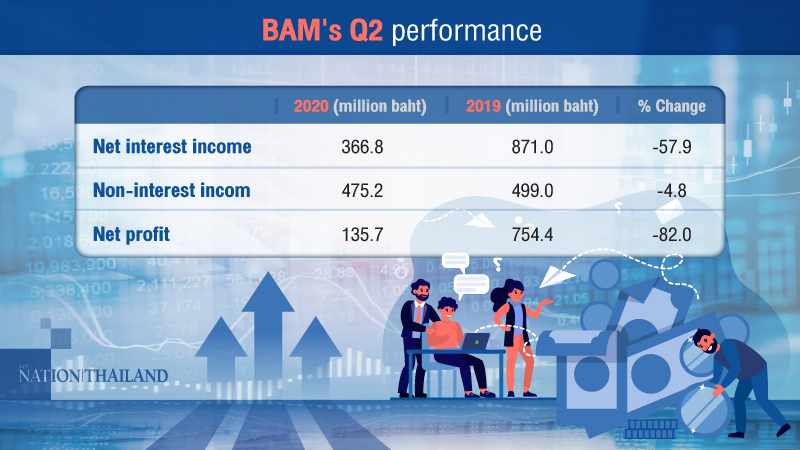
The price of shares in Bangkok Commercial Asset Management (BAM), the country’s biggest manager of distressed assets, fell 6 per cent to Bt23 in today’s morning session (August 31) after it reported a disappointing second-quarter performance.
BAM’s second-quarter profit was Bt136 million, down 82 per cent year on year.
Thanatphat Suksrichavalit, an analyst at Maybank Kim Eng Securities (Thailand), said BAM shares dropped due to a Q2 performance that was lower than market expectations of 80 per cent.
The decline was mainly due to the Covid-19 fallout and changes in financial reporting standards that meant the company was unable to recognise revenue despite cash flowing in.
“In fact, BAM was still able to generate cash flow of about Bt2.7 billion. Although it was 6 per cent down year on year and 14 per cent down quarter on quarter, it was still higher than the 20 per cent drop expected by the market,” said the analyst.
He forecast BAM’s performance would recover to its first-quarter level now that the Legal Execution Department has reopened after the Covid-19 lockdown, allowing the BMA to auction off non-performing asset [NPA]s.
“We found signs of NPA sales growth after the company held an [assets] auction in June,” he added.
“As the company is not facing cash flow difficulties, we expect it to pay a dividend of Bt1 per share as the market expects.”
An analyst at Trinity Securities said BAM revenue from NPLs dropped 28 per cent quarter on quarter because the Legal Execution Department was closed from April to May, causing auctions of collateral assets to be postponed.
“Although profit from selling NPAs increased by 92 per cent quarter on quarter, it could not compensate for the loss in revenue from NPLs,” the analyst said. “The company’s operating cost dropped slightly in line with its revenue, while expected credit loss [ECL] rose slightly from the deduction of NPL income from accrued income.”
The analyst expected the cash flow from NPLs to recover over the remainder of this year, while cash flow from NPAs should be high as the BAM will launch promotions to boost sales.
“BAM has reassessed the value of deferred tax asset [DTA] and found an increase in deferred tax liability (DTL) from the Legal Execution Department’s debtors, causing the company’s remaining DTA to be Bt5 billion,” he added.
An analyst at Yuanta Securities (Thailand) said BAM shares were still interesting because its performance has bottomed out, while its NPL and NPA sales are likely to recover steadily.
“In addition, BAM gained positive sentiment from financial institutions’ bad debt, which is expected to increase in 2021, resulting in a rise in NPLs,” the analyst said.
New partnership sees guests insured on every night spent at an OYO hotel
Aug 31. 2020
By The Nation
OYO, an Indian hospitality chain, signed a strategic partnership with insurance firms Chubb Samaggi and Qoala on Monday (August 31) to provide complimentary insurance coverage to guests who book rooms at any of the 800-plus OYO partner hotels in Thailand.
This is the second time that OYO and Qoala have partnered in Southeast Asia. The first such partnership was signed in Indonesia a few weeks ago.
The insurance coverage – Hotel Protection – is underwritten by Chubb Samaggi, a member of the world’s largest publicly traded property and casualty insurance company, and powered by Qoala, the fast-growing and leading multichannel insurtech in Southeast Asia.
The policy covers hotel guests for personal accidents, emergency hospitalisation, loss of luggage or personal effects and other benefits for every night they spend at an OYO partner hotel.
Krungsri Group has appointed Nayanee Peaugkham as head of Krungsri Consumer Group, effective from Tuesday (September 1).
Nayanee was managing director of Ayudhya Capital Services Co Ltd, where she managed the support functions and operations of Krungsri Consumer Group, including the brands Krungsri Credit Card, Krungsri First Choice, Central The 1 Credit Card, and Tesco Lotus Visa Card, the company said.
Seiichiro Akita, Krungsri president and chief executive officer, said: “Nayanee has
long-standing experience and unparalleled expertise in consumer finance. As managing director of Ayudhya Capital Services Co Ltd, her role in spearheading the operations and support functions of Krungsri Consumer Group including operations, finance and accounting, risk management, internal audit, legal and compliance, HR, corporate communications and AEC business development, has helped propel Krungsri Consumer’s growth in recent years. She has played a vital role in driving Krungsri Consumer’s business to become the leader in credit card and personal loan industry, with over 9 million accounts of customers and the biggest market share.”
“In her new role as Head of Krungsri Consumer Group, Nayanee would definitely take Krungsri Consumer to the next level of success,” he added.
As head of Krungsri Consumer Group, Nayanee will be responsible for overall strategic direction, and management of the credit card and personal loan businesses, as well as embracing innovation for new products and services of Krungsri Consumer Group.
Nayanee graduated with a bachelor’s degree in business administration from Assumption University, and a master’s degree programme in marketing (International Programme) from Thammasat University.
Dentsu Aegis Network tops Thai ad industry ranking for size and quality
Aug 31. 2020
By The Nation
Dentsu Aegis Network (DAN) Thailand has once again been named Thailand’s top media and advertising firm, with a 33 per cent share in the Thai ad industry and a No 1 ranking for quality.
Carat, DAN’s media arm, contributes the strongest to these successes after achieving a growth rate of five times the industry average while also acquiring the highest quality marks.
The assessment was made by RECMA, the leading research company evaluating media agencies worldwide.
R3, another global independent consultancy firm, also named Carat as the highest achiever in its June 2020 New Business League rankings for Thailand.
Parithas Moongprasittichai
Parithas Moongprasittichai, Carat Thailand’s chief executive officer, commented: “The media industry and technology have evolved so quickly. And so have our consumers! To ensure our clients’ enhanced competitiveness, we cannot just keep up with the industry’s offerings. To win, we must defeat standards. The growth we achieved and the positions we earned are simple proofs that our policy produced pleasing results – especially in growing our digital activities by winning new prominent partners such as Minor Food Group, Estee Lauder Companies, SCB Abacus, to name a few.”
Wisarn Sirijantanon, Carat managing director, added: “To maintain our leadership positions and continuously widen the winning gap, it is essential that our people are empowered to deliver at a pace much faster than the industry’s, despite growing economic difficulty. Data-powered, Local Focal, Startup-Minded Ecosystem, Academy Cloud, Talent First – these are some of the strategies we deployed to excel growth.”
Parithas concluded: “Competing as the winner will be tough as people will look at you with an expectation. This year we’ve laid a strong future-proofing foundation, so going forward, we’ll focus more on client servicing and services integration. The future is clear. We’ll continue to create value for our clients through our data-driven, ideas-led, tech-enabled solutions through profound service of specialists.”
About Carat
Carat (Thailand) Co Ltd is an independent media and communications specialist, a member of Dentsu Aegis Network, headquartered in London. Dentsu Aegis Network consists of a group of world-class marketing communications specialists: Creative – Dentsu, Dentsu One, Media communications – Carat, dentsuX, Vizeum, Digital marketing – Columbus, iProspect, Isobar | Out-of-Home – Posterscope.
GSB earmarks Bt15 billion as soft loans for tourism SMEs
Aug 31. 2020
By THE NATION
The Government Savings Bank (GSB) is offering soft loans to small and medium-sized enterprises (SMEs) affected by Covid-19 in the tourism industry, GSB president Withai Ratanakorn said.
“Two loans are now being granted. One is the ‘Loan for Restoration of Thai Tourism’ with a budget of Bt10 billion. Eligible applicants must be operators or supply chain providers in tourism-related businesses who have been affected, either directly or indirectly, by the Covid-19 outbreak,” he said.
“The maximum loan limit is Bt20 million per customer, whereas GSB will provide loans to commercial banks and state-run financial institutions at 0.01 per cent interest annually, while the institutions will grant the loan to customers at 2 per cent interest annually. This campaign is expected to start by mid-September.
“The other one is the ‘Loan for Tourism SMEs’ with a budget of Bt5 billion. Eligible applicants include operators of such businesses as hotels, guest houses, restaurants, spas, traditional massage parlours and tour guides that have been doing business in tourism field for at least two years,” added Withai.
“The loan limit for each customer is Bt500,000 with fixed interest rate at 3.99 per cent annually and five years repayment plan. This loan will offer a one-year grace period and will require a personal guarantor,” he said.
“We hope that the loan programmes totalling Bt15 billion will help operators of tourism-related businesses to get back on their feet from the impact of Covid-19 and continue their businesses in the new normal era,” Withai added.
Interested people can contact GSB’s SME Call Centre at 02-299-8899.


 Kanit Sangsubhan, EEC Office secretary-general


 Nayanee Peaugkham


