The Stock Exchange of Thailand (SET) Index rose by 10.70 points, or 0.79 per cent, to 1,361.20 in morning trade today (July 13).
A stock analyst at Krungsri Securities expected the index to rebound between 1,360 and 1,365 points before falling in response to positive news of an anti-Covid-19 drug even as the number of virus cases continued to increase especially in the United States.
“The market gained positive sentiment from Gilead’s Remdesivir drug, which is said to reduce the death rate of Covid-19 patients by 62 per cent compared to standard treatment,” the analyst pointed out.
However, he said the index would come under pressure from the conflict between the US and China and mass sell-offs in stocks, whose second-quarter performance would drop sharply.
The analyst added that the Opec+ grouping will hold a meeting on Wednesday (July 15) to discuss an agreement to cut crude oil production, which will reach maturity at the end of this month.
He recommended investors buy:
> Food and Electronic stocks that benefit from the weakening baht, such as TU, CPF, GFPT, TFG, KCE, Delta, Hana and SVI.
> Stocks whose second-quarter performance will improve, such as Top, PTTGC, SPRC, BGrim, CKP, Tasco, STA, STGT, SPALI, PRM, PTL and AJ.
> Stocks that benefit from the Covid-19 drug development, such as Mint, Centel, ERW, AOT and AAV.
The Stock Exchange of Thailand (SET) Index dropped 15.31 points, or 1.12 per cent, on Friday, closing at 1,350.50. Transactions totalled Bt64.19 billion with an index high of 1,363.28 and a low of 1,346.72.
The Energy Ministry has said it will present a revised version of the 2018 Power Development Plan to the Cabinet on Tuesday (July 14), which if approved, will allow it to go ahead with calling bids to set up grassroots community power plants.
This project had been postponed from its original schedule by a year.
The revised version of the plan now incorporates the amount of electricity to be generated by these plants totalling 1,933 megawatts from 2020 to 2024. Last December, the National Power Policy Committee had approved the project in the form of very small power plant, with a capacity not exceeding 10MW.
Under the scheme, the government will purchase 700MW between 2020 and 2022 from community based plants.
Despite lower interest rates this year, bank deposits have risen sharply as investors have stayed away from investment in risk assets.
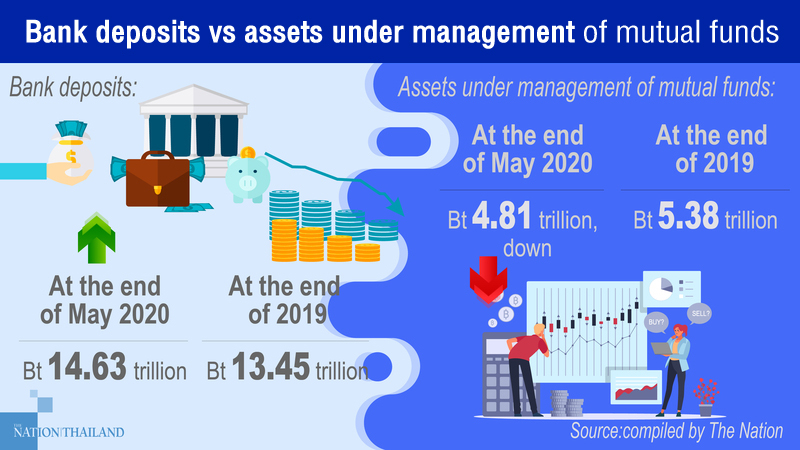
Banks’ deposits as the end of May shot up by 8.76 per cent to Bt 14.63 trillion, an increase of Bt1.18 trillion from the end of last year.
Liquidity has flooded the banking system as investors delay investment in risk assets and put their money into bank accounts instead, Adisorn Sermchaiwong, president and chief executive officer at CIMB Thai, said.
He said CIMB bank’s deposits rose to Bt216 billion at the end of May, up from 199 billion at the end of last year.
“Despite lower interest rates, banks have excess liquidity, as people do not know where to invest. Money is expected to continue flowing into banks but in smaller amounts,” he said.
Some may start to invest in corporate bonds, as the spread of Covid-19 has been contained in Thailand, he added.
Thaweelap Rittapirom, executive vice president at Bangkok Bank (BBL), said investors were cautious about making new investments so they had parked their money in banks. Banks’ deposits are expected to remain high until the end of this year, he said.
BBL had deposits of Bt2.5 trillion at the end of May, up from Bt2.3 trillion at the end of last year.
He said that rising deposits did not increase the cost for banks, as bankers could find ways to manage the increasing liquidity.
Kangana Chockpisansin, head – research at Kasikorn Research Centre, said banks had cut their interest rates in response to the cut in the key policy rate by the Bank of Thailand, which has lowered its policy rate to 0.50 per cent.
She pointed out that deposits in March rose by Bt750 billion, by Bt238 billion in April and by Bt55 billion in May.
Deposits rose 12 per cent year on year in the first half of the year and are projected to rise 9-12 per cent for the whole year, up by Bt1.4 trillion to total Bt14.6 trillion, the largest deposit pool in nine years.
Naris Sathapholdeja, head of TMB Analytics, said the increase in deposits was at the expense of mutual fund management businesses. Assets under management (AUM) of the mutual fund industry dropped by about 10 per cent from the end of last year. AUM at the end of May was worth Bt4.81 trillion, down from Bt5.38 trillion at the end of last year.
In March, AUM of mutual funds decreased by 15.3 per cent as investors were wary of risk assets.
“The flow into bank deposits partly came from investment funds, driving bank deposits up to Bt14.6 trillion in the first five months of the year, up 13.59 per cent year on year, or 8.76 per cent up from the end of last year,” he said.
Among the five largest banks, Krungthai Bank’s deposits rose by 10.75 per cent, Kasikornbank’s by 10.16 per cent, BBL’s by 8.95 per cent, Krungsri’s by 6.27 per cent and Siam Commercial Bank’s by 3.82 per cent year on year in the first five months of this year. Bank deposits have risen two times faster than lending, he added.
Jul 11. 2020Alexander Lacik, chief executive officer of Pandora, at the company’s headquarter offices in Copenhagen, Denmark, on Aug. 19, 2019. MUST CREDIT: Bloomberg photo by Carsten Snejbjerg. Location: Copenhagen, Denmark
By Syndication The Washinton Post, Bloomberg · Andrew Noel
Accustomed to crunch time and performing in a crisis, the world’s supply chain managers are having something of an extended moment in pandemic recovery mode.
Procurement experts were center stage in the rush to secure alternative sources of household essentials, medical gear, raw materials and components to keep factories running when covid-19 first struck. Now chief executive officers are looking to those same managers for more strategic vision and ways to shock-proof supply chains for corporate survival.
From auto makers to food processors, manufacturers that have relied on a strategy of low-cost supplies and minimum inventories are rethinking such an approach given the combination of the pandemic, trade conflicts and harsher natural disasters.
The buzzwords now are flexibility and resilience.
“This whole part of the equation has a higher prominence,” Alexander Lacik, CEO of Danish jeweler Pandora Group with about 7,400 outlets, said in an interview. The chief supply chain officer “is not someone I speak to just once a month,” he said.
When the coronavirus hit, it took some companies three to four weeks to understand the ripple effect on areas like procurement and logistics.
Those firms are now in the rebuilding phase, with one eye on what digital tools and other technology they need to stay on top when the the next crisis comes, according to Kristian Park, a risk advisory partner at Deloitte in London.
“There’s been a 50% increase in people coming forward who have realized they didn’t have the information they needed,” Park said. “As always with these things, it takes one seismic shift to change people’s perception of the risks.”
That’s the sweet spot of a chief supply chain officer, who is typically more comfortable with a broad focus spanning procurement, logistics, strategic alliances and managing costs, Park said.
Recent studies support a move to introduce more flexibility. Companies with a resilient supply network grow faster because they better adapt to shifts in demand, potentially boosting their order rate by as much as 40% and customer satisfaction by up to 30%, according to a study by Bain & Co.
Making its own jewelry in Thailand and owning shops across 100 countries means Pandora’s Chief Supply Officer Jeerasage Puranasamriddhi has greater control. Yet the company still relies on air freight and some 200 suppliers. As the pandemic snowballed, the company’s initial response was to push more inventory to its shop premises in case one of the large centralized warehouse facilities went down, Lacik said.
Lacik is now reviewing his company’s set-up, from procurement of materials to surging online sales. Where possible, having a single source for an input will be avoided and back-up plans put in place. Online sales are up as much as 300% currently, leading the Danish company to rethink its e-commerce strategy, and whether it could manage online sales internally rather than rely on a third party. It may also look at factories outside of Thailand, Lacik said.
Two decades ago less than 10% of companies had a supply chain director, according to Jan Godsell, a professor of operations and supply chain strategy at the University of Warwick. The number now is closer to 50%, with the role of a chief supply chain officer becoming more common in the past five years.
They’re ascending the corporate ladder even more in the post-pandemic world, she said.
“Covid-19 may have been a wake-up call to main boards of the importance of supply chains and hopefully it will accelerate the rise of the chief supply chain officer,” Godsell said.
The median salary for a supply-chain manager was about $78,507 a year for those with a bachelor’s degree and $95,750 with a graduate degree or higher, according to the Association for Supply Chain Management’s 2020 annual survey. The poll generated about 2,500 responses through Jan. 31.
At large global companies, the top positions can pay $300,000 to $400,000.
But even before the health crisis, there were chronic shortages of workers to fill the positions – about one applicant for every six openings, says Abe Eshkenazi, CEO of the Chicago-based association.
As the jobs become a bigger part of a company’s strategic management team, he says more lucrative salaries will follow. “The demand for talent is going to be significant on the backside of this,” Eshkenazi says. “We’re seeing skills and expectations for supply chains increase exponentially.”
All the sudden interest hasn’t gone unnoticed among students facing a brutal job market. Haslam College of Business, part of the University of Tennessee in Knoxville, is among colleges offering supply chain studies that are seeing a flurry of inquiries from students and workers looking for a new career, according to George Drinnon, executive director of undergraduate programs. “This awareness is translating into more attention to the field,” he said.
Another anecdotal sign of the profession’s popularity: 6,000 registered attendees from 109 countries for a July 16-18 virtual conference titled “Preparing for the Recovery After Covid-19” and hosted by Alcott Global, an executive search firm specializing in e-commerce, logistics and supply chain executives.
Speakers include the supply chain bosses from companies including Swedish appliance maker Electrolux, U.S. tool maker Stanley Black & Decker and Beiersdorf, the German maker of Nivea skin-care products. The Singapore-based recruiter sold out of sponsorships for the event in 10 days.
“We are seeing huge interest,” said Radu Palamariu, Alcott’s managing director for Asia-Pacific.
MEA inspects water drainage facilities to avoid mishaps during monsoon
Jul 11. 2020
By THE NATION
The Metropolitan Electricity Authority (MEA) conducted safety inspections of a drainage tunnel under Bang Sue Canal, the authorities said.
On July 9, Samrerng Chiewchukul, MEA deputy governor, together with officials from Bangkok Water Drainage Office inspected the electrical system in the drainage tunnel under Bang Sue Canal located in Dusit district to ensure that equipment is working optimally and safely during the rainy season.
“As the provider of electricity and related services in Bangkok, Nonthaburi and Samut Prakarn areas, MEA is committed to ensuring that all facilities related to public utilities are functioning at 100 per cent capacity, especially during rainy season when flash flood and heavy rains may damage electrical equipment,” he said. “MEA has dispatched staff to monitor 10 water drainage facilities and 492 drainage tunnels in Bangkok and surrounding areas to provide emergency services in case of equipment malfunctions at anytime of the day.”
If you witness damaged electrical equipment or powerlines at these facilities, contact MEA Call Centre 1130 or Facebook: @Metropolitan.Electricity.Authority, Line: @meathailand, Twitter: @mea_news or via the MEA Smart Life mobile application, which is available at http://onelink.to/measmartlife
Bangkok Land launches ‘Cosmo Walk’ in the heart of Muang Thong Thani
Jul 10. 2020
By The Nation
Bangkok Land is going ahead with its Bt400-million project to develop the “Cosmo Walk” in the centre of Muang Thong Thani as it expects that the reopening of the IMPACT Exhibition and Convention Centre will help revive tourism and shopping activities in the area.
Peter Kanjanapas, vice president and managing director of Bangkok Land, said the company has invested more than Bt400 million between June last year and this month to develop the project in a bid to expand retail business in Muang Thong Thani. This project links the three shopping malls, Cosmo Bazaar, BEEHIVE Lifestyle Mall and The Portal with other long-established venues like Outlet Square and Popular Walk.
It also includes the fifth phase expansion of Outlet Square, the biggest sports outlet in Thailand covering more than 15,000 square metres and housing top sports and fashion brands, as well as a Bt140 million 320-metre skywalk connecting IMPACT exhibition halls to ibis Hotel and Cosmo Bazaar.
Meanwhile, it has spent Bt245 million to develop Cosmo Walk, a two-storey commercial building covering 6,800sqm, 4,500sqm of which is up for rent. Cosmo Walk currently houses a 1,300sqm Nike factory store, a Dohome outlet which sells construction materials and home décor products and Malaysian brand Mr DIY, which focuses on lifestyle products.
Cosmo Walk is open daily from 10am to 9pm.
“Cosmo Walk meets the demands of customers from all levels, though its main targets are residents, government employees, office workers, university students and professors as well as guests from Novotel and ibis Hotel. It is also a convenient meeting point as there is a skywalk connecting all buildings,” Peter said.
He added that since the Covid-19 outbreak is more or less under control in Thailand, it is expected that people will travel and shop more in the second half of the year.
Data from the IMPACT Exhibition and Convention Centre also shows that there is an increasing number of reservations for trade shows, seminars, parties, wedding and other events, which should help revive businesses in the area.
The Thai economy stares at an uncertain future because the Covid-19 outbreak is likely to prolong until the first half of 2021, Krungthai Bank (KTB) said.
KTB president Payong Srivanich said during the bank shareholders’ meeting that commercial banks must beware of this factor, as it may cause non-performing loans (NPLs) to increase, adding that commercial banks must set up debt reserves to maintain stability in the long term.
“The bank will evaluate the situation periodically by focusing on preventing risks to maintain stability in the long term and adjust the loan portfolio to cope with risks,” he said. “In 2019, the bank had adjusted the direction by focusing on maintaining loan growth and reducing NPLs.”
He said the bank must set up more debt reserves from the second quarter of this year onwards to prevent risks and uncertainties due to the economic slowdown and coronavirus outbreak. He added that the bank had set up 100 per cent debt reserve to cope with risks from granting loans to Thai Airways International (THAI), which will be added in the second-quarter performance report.
“Risks from granting loans to THAI will cause less impact on the bank because we granted short-term loans to be used as circulating funds,” he said. “We believe that THAI’s rehabilitation plan will be approved by the court, while we will cooperate with creditors and debtors closely to maintain the bank’s benefits.”
He said the bank was waiting for the Bank of Thailand (BOT) to issue guidelines for the second phase of measures to help debtors, adding that the guidelines would help commercial banks to assist debtors in the same way.
“The bank will take care of customers as much as possible, such as postponing the debt payment, restructuring the debt,” he said. “BOT and the Thai Bankers Association will discuss this issue closely.”
He added that the meeting haD approved the allocation of net profits of 2019 for interim dividend payment.
“The bank’s net profit in 2019 was Bt26.325 billion of which Bt4.99 million was dividend for preferred shares, Bt10.523 billion was dividend for common shares, and Bt15.796 was remaining profits to be paid in the next period. Preferred shareholders will receive a dividend of Bt0.9075 per share, while common shareholders will receive a dividend of Bt0.753 per share,” he said. “We do not have to allocate net profits in 2019 as reserve funds because the bank has already allocated it.”
Four major players in the transport system have picked up bid documents for the MRT Orange Line which runs from Bang Khun Non to Min Buri.
Surachet Laophulsuk, deputy governor of the Mass Rapid Transit Authority (MRTA), said four companies have picked up bid documents, which are available from July 10 to 24.
The companies are Bangkok Mass Transit System Public Company Limited, BTS Group Holdings, Sino-Thai Engineering and Construction and Bangkok Expressway and Metro (BEM). The MRTA has opened the bids for private companies to invest in the project and is hopeful that a foreign company will also be interested in the project.
They have until September 23 to submit their tenders, which will be opened by the MRTA on September 30. The route is expected to start operating in the next three years.
Jul 11. 2020A hackathon at Stony Brook University in New York. Before the pandemic arrived employers were increasingly using these competitions to search for talent, at a time when many say they’re skeptical that a college degree alone reflects a candidate’s ability to do a job. MUST CREDIT: Photo by Emma Harris for The Hechinger Report.
By Special To The Washington Post · Jon Marcus · BUSINESS
Among the many frustrations ahead for millions of Americans thrown out of work by the pandemic is one that may surprise them: To get a new job, it’s increasingly likely they will have to take a test.
As the number of candidates balloons while health risks make it hard for hiring managers to meet with them in person, a trend toward “pre-hiring assessments” – already underway before the novel coronavirus swept through the country – is getting a huge push.
With so many applicants, “you need filters,” said Richard Price, a research fellow at the Christensen Institute, which studies innovation. “You’re creating a quasi-audition for jobs.”
The recession and health crisis is speeding momentum for job tests that, before the pandemic, was driven by more than just logistical considerations.
Skeptical that university degrees are the best measure of whether candidates have the skills they need, employers were already looking for ways applicants could prove themselves – including in fields where that was not previously required.
“It’s like try before you buy,” Price said.
Growing equity concerns resulting from the explosion of racial justice protests now are also playing a role in this. They give companies another reason to stop relying principally on academic degrees when hiring, because candidates who are black are less likely than white candidates to have one, according to the U.S. Department of Education, for reasons including cost and access.
“With employers fielding a lot more applicants, how do we help create equitable processes for people at the top of the funnel?” said Stephen Yadzinski, who works on innovations in workforce technology for Jobs for the Future – an advocacy group that makes its own job finalists take on work-related projects as a part of the decision process.
By removing the requirement of a degree, this process holds the promise of opening doors to capable candidates who never got one, he and others said.
“We’ve conflated employability with university degrees. We shouldn’t,” said Jacob Hsu, CEO of Catalyte, which conducts tests designed to find job candidates who have the potential to become software engineers, whether or not they went to college.
If a college degree was the only measure of potential, he said, no one would have ever hired Apple co-founder Steve Jobs, Microsoft co-founder Bill Gates or Facebook co-founder Mark Zuckerberg, who all dropped out.
Employers “are starting to recognize that there are people with the talent they’re looking for that don’t come from Harvard or the other colleges they have historically recruited from,” said Alex Linley, a co-founder and CEO of the testing firm Cappfinity.
Nearly one in four businesses now conduct such assessments, the National Association of Colleges and Employers reports; nearly 40% of hiring executives expect them to become widespread within three years and 70% within five, according to a survey conducted in 2018 by Northeastern University’s Center for the Future of Higher Education and Talent Strategy.
Now, with far more applicants in the pipeline, “I only see pre-hiring assessment gaining momentum,” Price said.
An interview will still come at the end of that process, “but this is a way to cut 10,000 people to 1,000 and then figure out how to sort them,” said Jack Buckley, president and chief scientist at the testing technology start-up Imbellus.
Further driving this trend are advances in technology that make it possible to evaluate how people think and not just what they know, to paraphrase one testing company’s motto. The tests are designed to measure such things as whether applicants can work in teams, communicate and make good decisions.
It’s also a response to falling confidence in university degrees as measures of career preparedness. Only about one out of 10 business leaders in a Gallup poll strongly agreed that college graduates were ready for the workplace. Some employers, including Apple, Google, IBM, Bank of America and EY – formerly Ernst & Young – have dropped college degree requirements for some new hires altogether.
“There has been an inherent promise and almost the inherent contract of, ‘I’m going to go to this Ivy League university and then walk into a job by virtue of the pedigree I have.’ And that is no longer the case,” said Linley, whose tests present job candidates with scenarios they might confront at client companies – including EY, Deloitte, DHL and KPMG – and measure how they respond.
“There’s no trickery. It’s all very straightforward and transparent,” Linley said. “What we’re trying to do is provide a realistic job preview.”
In the past, employers that tested applicants for jobs would do such things as ask them to agree or disagree with a series of pronouncements, Linley said. Most candidates would naturally give what they assumed to be the answers the employer wanted.
Artificial intelligence, gamification and other developing technologies are giving rise instead to what experts call “situational judgment” and “scenario-based” assessment tests. Most require candidates to respond to real-world situations. One, developed for the McKinsey & Company consulting firm by Imbellus, puts them on a simulated coral reef or in a mountain valley where they have to work alone to save the endangered ecosystem.
“It’s not just, ‘Here’s my resume and here’s my degree’ and that’s your marker of talent,” said Caitlin Storhaug, McKinsey’s director of global recruiting communications.
Online forums to help applicants beat tests such as these have inevitably sprung up, along with coaching services to help candidates prepare for them; a human-resources executive at one large tech firm said it hadn’t moved to widespread use of pre-hiring assessments because of the potential that people would cheat. (The creators of these tests respond that AI lets them build in unpredictable twists and turns, and that they monitor response patterns and completion times to fend off cheating.)
The most sophisticated, customized tests are also pricey. “The difference between what we’re doing and the old-school way of hiring a person is cost,” Buckley said.
But it’s cheaper than hiring the wrong person.
Storhaug said though there isn’t yet a critical mass of results to quantify this, the people hired after taking the McKinsey test “do have really good problem-solving skills. There haven’t been mis-hires.” And as the cost begins to fall, Buckley said, “I don’t think [these tests] are going away.”
Employers also were starting to show up at events such as hackathons to watch prospective candidates show their stuff, under pressure and in real time – a practice interrupted by the pandemic but likely to resume when the competitions do.
At a hackathon at Stony Brook University before the coronavirus disruptions, for example, tech firm representatives prowled for talent among the 150 hackers from around the country vying for $5,000 in prizes that would reward their ingenuity and hands-on skills.
“A resume is a two-dimensional view of someone,” Ryan Behan, senior director of engineering at Netsmart Technologies, said as he gestured around the all-purpose room where the busy hackathon was underway. “You come to a place like this, you’re seeing them in their element.”
More than 10,000 participants got job or internship offers last year from companies they encountered at Major League Hacking events, the organization says.
Employers “get that one-on-one time with students and can watch them work through problems,” said Jonathan Gottfried, the official collegiate hackathon league’s co-founder.
Students say they like this route to a career.
“It was a much better way to show off what I can do” than by putting on a suit and sitting through an interview, said Adam An, a senior at the College of William & Mary who got an internship with Capital One through an encounter at a hackathon.
At Stony Brook, tired students sat behind laptops covered with stickers commemorating past hackathons, at tables dripping with colored wires. The daylight outside was kept at bay by shades pulled over the windows.
“This is the absolute best way you can demonstrate your skills, your knowledge and your drive,” said Muntaser Syed, a 36-year-old doctoral student in computer engineering at Florida Institute of Technology. “Staying up for 40 hours to build something shows how driven you are.”
Employers “can even test us here, and we can deliver and really show them what we can do,” said Aishwarya Kanchi Ranganath, 23, a graduate student in biochemical engineering at Rutgers.
And Donald Finlayson, a 21-year-old cybersecurity major at Johnson & Wales University, said a friend who has already graduated got a job at a company that “only asked him about the hackathons,” despite his long list of credentials.
Frank Jacovino, vice president of operations at IPVideo, circulated among the hackers as a judge and said he was keeping one eye open for prospective employees.
“We get lots of students that come in, they give us a resume, and ‘We took this course, we took that course’ ” – they all look the same,” Jacovino said.
“What we’re looking for is for the kids that are really passionate about the technology, going to hackathons or doing their own projects at home,” he said. “They’re the ones that we’re most interested in.”




 Alexander Lacik, chief executive officer of Pandora, at the company’s headquarter offices in Copenhagen, Denmark, on Aug. 19, 2019. MUST CREDIT: Bloomberg photo by Carsten Snejbjerg. Location: Copenhagen, Denmark


 A hackathon at Stony Brook University in New York. Before the pandemic arrived employers were increasingly using these competitions to search for talent, at a time when many say they’re skeptical that a college degree alone reflects a candidate’s ability to do a job. MUST CREDIT: Photo by Emma Harris for The Hechinger Report.

