Details of how restrictions will be relaxed to allow Japanese businesspeople to enter Thailand should be concluded next week, said Transport Minister Saksayam Chidchob.
The move comes after Japanese businesspeople advised the Board of Investment that they want to enter Thailand to run their existing businesses here.
They are currently prevented from doing so because Thailand requires them to first undergo a Covid-19 test in their own country. However, Japan is only testing suspected patients.
Saksayam said that he still wants any future foreign arrivals to strictly follow Thai public health rules.
If the measures planned for Japanese businesspeople are successful, they will become standard protocol for others entering Thailand, he added.
Chula Sukmanop, director-general of the Civil Aviation Authority of Thailand (CAAT), said the restrictions on inbound and outbound flights remain in place.
The value of Thai electronics stocks has risen almost 20 per cent over the last month as European countries promote electric vehicles and the baht weakens, say analysts.
Among the beneficiaries is Delta Electronics (Thailand) (DELTA), whose share price has risen 14.68 per cent to Bt69.50.
Anekpong Putthapiban, assistant director at Asia Plus Securities, said electronic stocks gained positive sentiment from the baht falling to Bt31.2 against the dollar, European countries’ measures to promote use of electric vehicles, and moves around the world to ease disease controls.
“After many countries eased lockdown measures, investors may be thinking that the price of electronic stocks has bottomed out,” he said. “However, we advise people to avoid investing in these stocks because their price has reached maximum value, while these companies’ second-quarter performance is likely to drop.”
Meanwhile, a stock analyst at Capital Nomura Securities noted the price of Delta shares had risen by over 150 per cent from their low point in March this year, adding that the company’s performance is likely to recover faster than its competitors.
“We expect the company’s second-quarter net profit to be about Bt681 million, up 8 per cent quarter on quarter, but down 30 per cent year on year,” the analyst said.
“The company’s sales will increase by 4 per cent thanks to growth in telecommunications infrastructure and the European auto industry’s move to buy materials for electric vehicle manufacturing. Meanwhile, the company’s net profit in the second half of this year would increase in line with seasonal factors.”
The analyst added that Capital Nomura Securities has adjusted Delta’s net profit forecast from 16 per cent to 15 per cent in 2020 and from 12 per cent to 21 per cent in 2021.
“Aside from the recovery in automotive and telecommunication industries, the company also benefited from the weakening baht, so we expect Delta’s gross profit to increase from 20.5 per cent in 2019 to 21.2 per cent in 2020 and 22.4 per cent in 2021,” the analyst added.
The Finance Ministry has asked the Thai Credit Guarantee Corporation (TCG) to guarantee Bt30 billion in SME loans, but will set up a separate Bt50-billion fund to support small and medium-sized businesses hardest hit by Covid-19 and the economic contraction.
Finance Minister Uttama Savanayana said he has assigned the state-owned entity to extend guarantees for SME bank loans worth Bt30 billion.
“The pressing issue for SMEs now is lack of liquidity, and their next problem is how to use funding to upgrade themselves. We agreed to address their immediate problem first,” said Uttama after meeting with bankers and senior officials.
Once the existing fund is used up, then this further financial support may be extended, he added.
TCG president Rak Vorrakitpokatorn said guarantees for loans of Bt15 million-Bt20 million would be extended to eligible SMEs, down from previous programme’s Bt100-million limit. The Bt30-billion guarantee scheme will enable banks to lend up to Bt45 billion, benefitting 40,000 to 50,0000 SMEs, he added.
Meanwhile, Predee Daochai, Thai Bankers’ Association president, said that banks will look at businesses’ ability to repay debts before extending loans. He admitted that bad debt in the banking system was on the rise, but did not know by how much. The important thing was that the banking system was still functioning properly, he added.
Meanwhile, Uttama said the planned Bt50-billion SME support fund would be proposed to Cabinet in the next few weeks.
Thai SMEs have been hit hard by the Covid-19 fallout. The Bank of Thailand has rolled out a Bt500 billion programme of soft loans via commercial banks but only Bt100 billion in loan applications has so far been approved. Bankers wary of bad debts had asked the Finance Ministry to instruct the TCG to guarantee the loans.
By Syndication Washington Post, Bloomberg · Yakob Peterseil · BUSINESS, US-GLOBAL-MARKETS U.S. stocks traded mixed as investors considered whether a rising number of coronavirus cases will curb the global economic recovery. Treasuries jumped, with the five-year yield touching a record low.
Tech shares led declines, a dynamic that’s become increasingly rare as investors favored megacap companies seen as insulated from pandemic lockdowns. Most shares rose on the S&P 500 as the gauge fluctuated between small gains and losses after data showed record deaths in Florida, Texas and California from the virus. Gilead Sciences Inc. advanced after the company said its Remdesivir treatment cut covid-19 mortality risk by 62%. European shares edged higher.
With record deaths across America, as well as fears of a second wave in Asia, the spotlight is back on the spread of the coronavirus as investors head into the weekend. Fiscal and monetary stimulus buoyed markets thus far, but investors are looking for signals on what additional support may be in the works. Federal Reserve Bank of Dallas President Robert Kaplan, speaking on Fox Business, said he sees the need for more fiscal outlays.
“We’re going to see intermittent periods of shutdowns over the next year or so while we’re still grappling with this virus,” Erin Browne, a multi-asset portfolio manager at Pacific Investment Management Co., said on Bloomberg TV. “But I wouldn’t expect we’re likely to see a wholesale shutdown of the U.S. economy like we saw earlier this year.”
Elsewhere, China shares dropped as selling by state-backed funds signaled authorities wanted to slow the pace of gains following the Shanghai Composite’s eight-day winning run.
Oil traded below $40 a barrel in New York. In the U.K., yields on two- and five-year notes hovered near all-time lows amid speculation that the Bank of England may further ease monetary policy.
These are the main moves in markets:
Stocks:
– The S&P 500 Index was little changed as of 10:19 a.m. New York time.
– The Stoxx Europe 600 Index climbed 0.5%.
– The MSCI Asia Pacific Index dipped 1.1%.
– The MSCI Emerging Market Index sank 1.3%.
Currencies:
– The Bloomberg Dollar Spot Index fell 0.2%.
– The euro decreased 0.2% to $1.1309.
– The British pound rose 0.3% to $1.2642.
– The Japanese yen strengthened 0.4% to 106.76 per dollar.
Bonds:
– The yield on 10-year Treasuries fell two basis points to 0.60%.
– Germany’s 10-year yield declined two basis points to -0.48%.
– Britain’s 10-year yield declined two basis points to 0.14%.
Commodities
– West Texas Intermediate crude declined 0.1% to $39.58 a barrel.
Jul 10. 2020Prime Minister Prayut Chan-o-cha on Friday meets with his economic advisers, business leaders and some ministers to discuss extra measures to support small businesses and people adversely affected by the Covid-19 pandemic.
By The Nation
Prime Minister Prayut Chan-o-cha has changed the way he manages the economy by increasing collaboration with his economic advisers and business leaders.
Prayut postponed today’s meeting of the Council of Economic Ministers and instead held a meeting with his advisers, economic ministers and business leaders to discuss remedial and recovery plans after the Covid-19 outbreak.
Deputy Prime Minister Somkid Jatusripitak, who leads the Cabinet economics team, also attended today’s meeting.
Somkid downplayed the postponement of the economic ministers meeting, saying that economic management would run smoothly as he knows both the PM’s advisers and business leaders very well.
“It is better for the PM to have all the information, including from outsiders, before making a decision on economic measures,” said Somkid.
“PM Prayut is interested in how to support small and medium-sized enterprises and we have already talked with the Finance Ministry about measures to support SMEs, which will be submitted for Cabinet approval once the PM agrees,” said Somkid. He added that the Finance Ministry cannot solve many problems on its own and needed cooperation from other ministries run by different parties in the coalition, such as the Agriculture, Commerce and Labour ministries. The PM, as leader of the economic team, was in a good position to secure that cooperation “because coalition government needs to move together”, added Somkid.
Kobsak Pootrakool, secretary of the Council of Economic Ministers and the PM’s deputy secretary-general on political affairs, said the prime minister has changed the way he works under the “new normal” by listening more to his economic advisers. Previously, Prayut was merely updated by senior officials and talked with ministers.
Kobsak said the PM’s economic advisers and business leaders have proposed establishing a centre for economy recovery from the Covid-19 pandemic, similar to the government’s Centre for Covid-19 Situation Administration (CCSA) which has won success in containing the outbreak.
Meanwhile Paiboon Narintarangkul, chairman of the Federation of Thai Capital market Organisations, urged the government to make Thailand the hub for regional finance and capital markets. Others have proposed legal reform in order to make doing business in Thailand much easier.
Other business leaders attending today’s meeting were Kalin Sarasin, secretary-general of the Thai Chamber of Commerce. Suphachai Chearavanont, chairman of the Council of Digital Economy and Society, Ghanyapad Tantipipatpong, chairmen of the Thai National Shippers’ Council, Supant Mongkolsuthree, chairman of the Federation of Thai Industries and Predee Daochai, president of the Thai Bankers’ Association. Prayut’s economic advisers in attendance included Pailin Chuchottaworn, former deputy transport minister, Setthaput Suthiwart-Narueput, a member of the central bank’s Monetary Policy Committee, and Pirapan Salirathavibhaga.
The meeting came a day after the four ministers credited with running Thailand’s economy resigned from the ruling Palang Pracharat Party, though kept their seats in Cabinet. Prayut announced on Thursday he would reshuffle the Cabinet after talks with coalition parties. Prayut’s economic management has failed to impress observers since Thailand’s economy is currently the worst performer among Asean countries.
The Stock Exchange of Thailand (SET) Index dropped 15.31 points or 1.12 per cent closing at 1,350.50 today (July 10). Transactions, meanwhile, totalled at Bt64.196 billion with an index high of 1,363.28 and a low of 1,346.72.
During the morning session, a Krungsri Securities’ stock analyst said he expected the index to fall between 1,355 and 1,360 before rebounding due to uncertainty over the impact Covid-19 is having on economic recovery as the number of new cases is continuing to rise.
“In the US alone, there are more than 61,000 new Covid-19 cases daily, which has forced some states to impose lockdown measures again,” the analyst said.
“Plus, the SET Index is under pressure from the drop in the price of crude oil and the resignation of four Palang Pracharat Party executives.”
However, the analyst reckoned that the index would rebound from speculation in stocks of companies whose second-quarter performance will benefit from the weakening baht.
The top 10 stocks with the highest trade value today were STGT, AOT, CPALL, PTT, KCE, PTL, STA, PTTEP, EA and PRM.
As of 4.45pm, the price of crude oil dropped by US$0.94 or 2.37 per cent to $38.68 per barrel, while the price of gold rose by $9.10 or 0.50 per cent, to $1,812.90 per ounce.
Other indices in Asia were also on the slide:
Japan’s Nikkei Index closed at 22,290.81, down 238.48 points, or 1.06 per cent.
China’s Shanghai SE Composite Index closed at 3,383.32, down 67.27 points, or 1.95 per cent, while Shenzhen SE Component Index closed at 13,671.24, down 83.50 points, or 0.61 per cent.
Hong Kong’s Hang Seng Index closed at 25,727.41, down 482.75 points, or 1.84 per cent.
South Korea’s KOSPI Index closed at 2,150.25, down 17.65 points, or 0.81 per cent.
Taiwan’s TAIEX Index closed at 12,073.68, down 119.01 points, or 0.98 per cent.
Apichet Srivaddhaprabha, assistant chief operating officer at King Power Group, fourth from left, presides over the launch of ‘Million Footballs, Million Power for Thai Youth’, a project in which footballs will be handed out to children in remote areas. The event was held at the Wat Nong Sala School in Nakhon Pathom province recently.
Also present were, from left, Tawatchai Kuammunkun from Fox Hunt football club, actor Jirayu La-Ongmanee, Krobkeaw Panyarachun from King Power, Min Prachubwan, deputy director of the Primary Education Service Nakhon Pathom Area Office 1, Bundit Laoaroon from the Nakhon Pathom Provincial Administrative Organisation and Chantana Phumma, director of the Wat Nong Sala School (Prachanukul).
Luxury mattress maker opens flagship store in new outlet complex
Jul 10. 2020
By The Nation
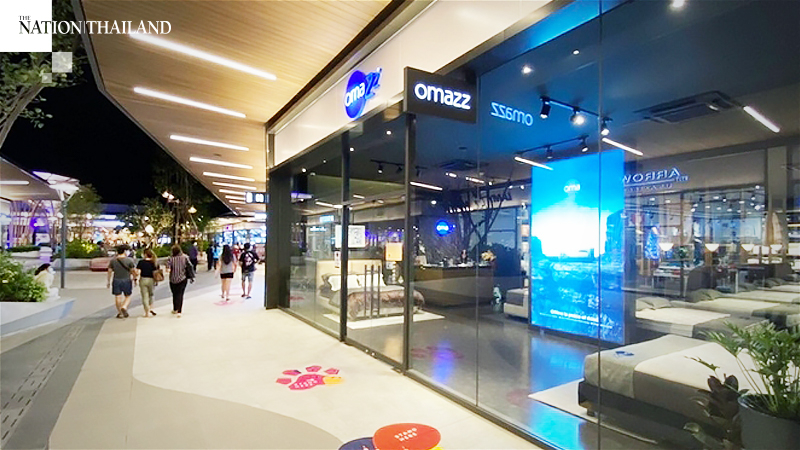
High-end luxury bedding manufacturer Omazz has opened a new flagship store at the Siam Premium Outlets Bangkok complex in Samut Prakan.
The 174-square-metre store, designed following a dark gothic minimalist style, features a full range of mattresses and bedding accessories made from natural materials.
A 60 per cent discount on selected products is also being offered at the new Omazz Gallery Store at Siam Premium Outlets.
CPF subsidiary to offer A+ rated debentures in August
Jul 10. 2020
By THE NATION
CPF (Thailand) (CPFTH), a subsidiary of Charoen Pokphand Foods (CPF), has signed up with the Securities and Exchange Commission (SEC) to offer unsubordinated and unsecured debentures to institutional investors and/or high-net-worth investors.
The offering comprises five series of debentures with tenors of four years and six months, seven years, 10 years, 12 years and 15 years, all of which have been assigned a credit rating of A+ from TRIS Rating.
CPFTH has appointed Krungthai Bank, Kasikornbank, Siam Commercial, Government Savings Bank, CIMBThai Bank, TMB Bank and Phatra Securities as joint lead arrangers for this batch of debentures, which should be offered by August 20.
Paisan Chirakitcharern, chief financial officer for CPF, said CPFTH’s business encompasses integrated operations in Thailand in relation to livestock, comprising swine, broiler and layer chickens as well as duck.
CPFTH’s operation covers three core livestock business lines, namely the production and sale of animal feed; breeding, commercial farming, and primary meat processing; and production of processed semi-cooked, fully-cooked and ready-to-eat meals, including outlets like CP Fresh Mart, Five Stars, Star Coffee and CP Kitchen. It also runs a Korean BBQ restaurant chain called “DakGalbi” and a seafood and international food buffet restaurant chain called “CP Hilai Harbour”.
Thai Otsuka joins hands with Nation Group in donating ‘Medical Food’
Jul 10. 2020
By THE NATION
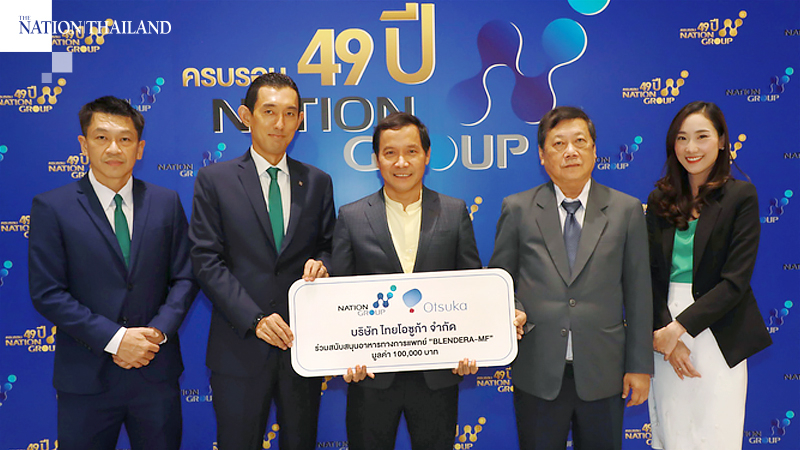
The chairman of Thai Otsuka Pharmaceutical Co Ltd, Thanan Suntayodom (4th from left), along with president Shinsuke Yuasa (2nd from left), director of BIV & CN Business Division Wattanachai Itsarasenarak (1st from left), and finance manager Thanasunun Suntayodom (5th from left) recently donated medical food ‘Blendera-MF” for those at risk of malnutrition to Yuttana Nualjaras, (3rd from left), editor and representative of Nation Group, at Interlink Tower in Bang Na district.

 Transport Minister Saksayam Chidchob

 Finance Minister Uttama Savanayana

 Prime Minister Prayut Chan-o-cha on Friday meets with his economic advisers, business leaders and some ministers to discuss extra measures to support small businesses and people adversely affected by the Covid-19 pandemic.



 A 60 per cent discount on selected products is also being offered at the new Omazz Gallery Store at Siam Premium Outlets.